On rare occasions I’m caught off guard by a new material or tool that has capabilities requiring me to rethink its use, or offers a feature never hosted on the traditional tool. When I moved from cheap scissors to surgical equipment, I needed to relearn how to use scissors that could be damaged by errant use – or might lose a tip if I cut too aggressively towards a hook shank and catch metal .. as well as the soft materials.
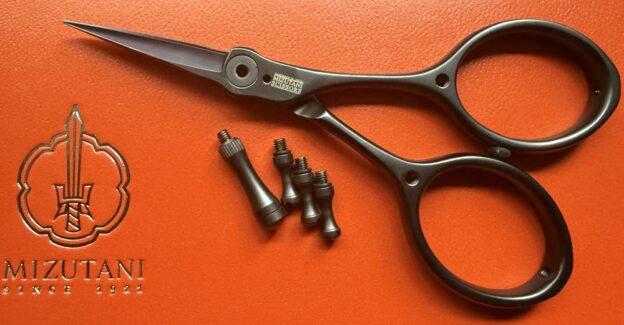
After using Ophthalmology scissors for a couple of decades, i again find myself relearning how to use scissors with the adoption of the Mizutani Kava II scissor. Made in Japan, the Mizutani Company has been making barber shears and scissors for upscale hairdressers for over one hundred years. Their handmade scissors are the hallmark of craftsmanship and can cost over a thousand dollars for the high end models.
Mizutani scissors are known for the steel used in their construction, for their longevity, and ability to hold an edge. “Nano powdered metal,” Stellite (High Cobalt content), Damascus, as well as specialty alloys containing Cobalt, Molybdenum, and Vanadium are used in the different styles of Mizutani scissors. “Nano powdered metal” is a term describing the construction of steel by first reducing it to tiny particles, then using heat and pressure to blend the powder into a steel free of impurities, whose ability to hold an edge is unrivaled.
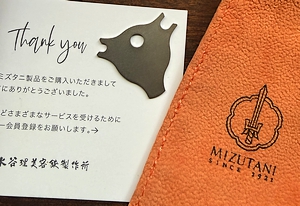
The scissors come in a small box with a Certificate of Authenticity, and the name of the craftsman that made the scissor. Each has the serial number etched on each blade to aid in verifying their authenticity versus one of the many fakes that exist in this high priced market. The fly tying scissor is much smaller than traditional shears, and only cost about $150 each – which is comparable to mid-range surgical grade scissors available to doctors. Each scissor case contains a suede glove to contain the scissor, a small tube of specialized scissor oil, a ratchet device to tighten the unique screw used in the scissor, and several band-aids to use while relearning how to use the scissor properly …
… that’s right, something to prevent your bleeding out – after you do something really stupid …
Mizutani has released their fly tying scissor in Japan, called the “Kava II” scissor, using the same Nano Powdered Metal process as their traditional barber shears. I was recently gifted a set of these scissors and after a couple of uses, I find myself describing them as, ” …other .. worldly.”
Mizutani scissors come with a warranty covering materials and craftmanship for 30 years, and these can be resharpened via a Mizutani certified shop or by mailing them back to Japan. Resharpening the scissor currently costs between $70 and $100 US dollars (via Japan), depending on the prevailing exchange rate. In our current environment these will be subject to changes in both the Yen/Dollar exchange rate – and tariffs .. which the current administration is fond of wielding.
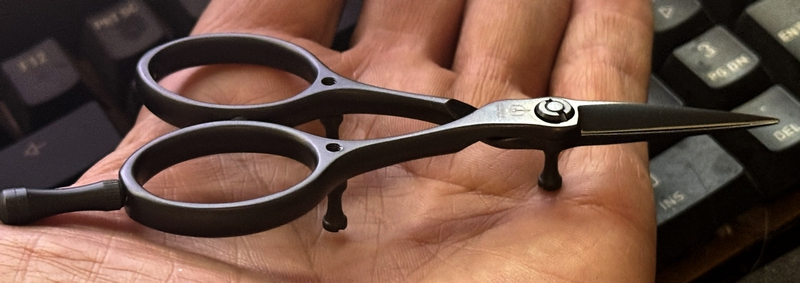
The scissor comes with several screw in tangs that increase the number of fingers participating in the grip (can be added either left or right handed), and serve to lift the scissor off the work surface, so it’s not scraped across your desk each time the scissor is added to your hand. Fly tiers, like myself, always wear through their scissor finish simply due to the volume of times we hunt then grab our scissor off the work surface.
Note that the screw shown above is not a traditional screw for tightening scissors. A small coin shaped ratchet comes with the scissor that allows for tightening or loosening the screw, which controls the tension needed to close the scissor completely. This ratchet turns the screw easily and is a very smooth tension adjustment. I set the ratchet tighter a few notches to test how much it changed the tension, and it was almost unoticeable, so I returned the setting to its original mark.
Scissors have always had a design weakness as the steel used to make the screw is typically harder than the steel making the scissor body. Over time, the effort needed to cut tough materials like wire and feather stems, distorts the screw hole and adds unwanted “slop” into the action of the scissor. As all documentation accompanying the scissor is in Japanese, I am unable to confirm the scissor and screw are identical steel, but the 30 year warranty suggests that’s the case. Surgical steel is typically Stainless (for antiseptic purposes) which is a “soft” steel and the hardened screw can easily deform the screwhole with moderate pressure (and/or considerable use). A good pair of Opthalmology scissors might last be 18 months to two years before the screw hole deforms beyond repair, as fly tying is more abusive to scissors than the minor tendons and flesh of the human eye.
Use and Abuse
As these were recent additions, I have only run several dozen trout flies through the tying process, and can comment on both the new function and dangers these scissors represent. What I cannot speak to is the prohibitions the maker insists upon – and what shortens or lengthens their lifespan, as I am unable to translate Japanese.
What’s completely different about these scissors from other high end scissors, is these are two razor sharp knives joined with a screw, these are NOT scissors. You DO NOT run your finger down the blade like you would with a scissor as they will filet your finger instantly. These are conjoined knives or razor blades, and you need to keep your fingers, your children, and everything else away from the “business end” of these scissors.
The three-pronged stand and the increased height of the scissor makes it much easier to find and grab off the pile of feather dander to begin cutting, and is a welcome option that becomes instinctive quickly. I tried the scissors both with, and without, the “stand” and other than the ease of restoring the scissor to your grip due to the elevation, found the three tangs do not get in the way whatsoever and are quickly forgotten.
If the finger-extension tang is used on the rear of the scissor, it has just enough weight to tilt the scissor off of its three point rest and make it sit upon the work surface point upward …The weight of the scissor borne by the two rear tangs and the rearmost “grip extension” tang. That does not imply you will impale yourself on the point if you aren’t careful, the points on these are not thin and sharp, rather a fine general -purpose tip versus something “needle sharp” and dangerous.
To that end, I would describe these scissors as an outstanding general purpose scissor usable for all fly types and sizes. They are not “delicate” nor do they seem fragile or damage prone.I would feel comfortable taking a large “whack” out of a spun deer hair bug, a heavy saltwater fly, or a smaller trout fly. Their size and design makes the scissor your “go to” option for all tying, rather than some needle pointed scissor that only handles small flies and fine materials.
New Functionality
A scissor this sharp requires you to think outside the “box.” You should not cut towards your fingers, nor cut towards the shank if your view is obscured by a big gob of marabou or a thicket of spun deer hair.
The scissor is so sharp that most of the tactile feel of the cut is gone. You don’t feel the individual hair strands parting when you close the scissor, and the blades are so sharp they part the material like butter. Tying something like a Goddard Caddis and cutting toward your fingers as they hold the bend of the hook, is unwise. It’s likely that your fingertips would offer little resistance to the cut and only the spurt of blood will clue you that you have cut too far … and then the pain will hit.
Flattening the bottom of a Goddard Caddis? Hold the fly in your hackle pliers and keep those sensitive fingertips away from the cut. Trimming a Bass Popper? Large hooks offer more safety, but make sure your fingers are visible and not covered by untrimmed hair …
Razor blades can cut materials simply by applying tension to the item as it touches the blade. This same cut is available from Mizutani’s scissors. Touch the point to the thread, and it’s cut. Pull the floss tight against the scissor edge, and it parts instantly. You can saw the scissor through the material WITHOUT closing the blades, so you have a new type of cutting device that offers a different style of cut than scissors.
Typically most scissor cuts (with precision scissors) are done up and away from the shank. A right-handed tier will typically have the scissor in front of the fly, cutting back toward the tail with scissor points elevated above the shank. This induces a tapered angle to the cut which is thinnest close to the shank and the material widens as the cut procedes down the material towards the tail. By sawing with the blade you can cut from either direction, tail to head or head to tail, which gives a bit different profile on the severed material butt.
If you decide the cut needs to come from a different direction than traditional, just make sure you attach the material with this new directional force in mind. Cut or saw with the scissor edge in the same direction you wrapped the material as pulling or tensioning the item in the opposite direction will loosen it. Tinker with this to understand the options you have.
As with surgery scissors, especially those with Tungsten Carbide inserts, avoid cutting down towards the finished areas of the fly. At least minimize these cuts where possible. The scissor is so sharp that hitting the completed ribbed body, when cutting a material on a future step, could cut through the wire rib, fur, and sever six or eight turns of thread, ensuring your fly comes apart instantly. Cleaning the hook shank of the remnants of a poorly tied effort is possible with a simple sawing motion to remove all the mats off the bare hook.
… and yes, I’m still commiting most of this to memory, but so far … still have all nine digits intact.
How to Purchase Mizutani Scissors
My understanding is the wait time on these scissors can be non-trivial. I have heard mention of “months” of wait for a completed pair. The scissor is available from the Dolly Varden Fly Shop in Hokkaido, Japan. You can add yourself to the notification list and be informed when new stock arrives. Their email address is dolly@dorllyvarden.com, and they offer worldwide shipping.
In Summary:
These are an outstanding general purpose scissor for the professional tier, not for the occasional hobbyist. Their 4.25″ length is traditional for a small pair of scissors, and they currently offer only the single size in four finishes for fly tiers.
The fact that I like this scissor does not mean you will like it, as I have tied both commercially, professionally, and occasionally – and have spent many hours using precision scissors. The Mizutani scissor is a wonderful instrument but will not be appropriate for everyone due to their sharpness and potential to cause injury to the unwary. It would likely make a great gift for someone that ties lots of flies and has been doing so for many years, but this tool is not for the beginning fly tier.