Tag Archives: fly tying scissor

Mizutani KAVA2 Fly Tying Scissor

Review of the Mizutani Kava II Scissor: Razor blades joined by a screw

It’s always pleasant to find new functionality in a time honored tool, and scissors being the life blood of a fly tier, it’s even sweeter to find something that raises the bar on the traditional implement.

When I converted from inexpensive fly tying scissors to surgical scissors, I needed to relearn how to use scissors, as fine tips and tungsten inserts did not play well with brass wire and hook shanks. I needed to learn to care for the scissor and be judicious in its use – or risk destroying them quickly. A cut toward the hook shank was now a dangerous move, risking catching the shank between those fine points, in addition to the unwanted material I was removing.

After using Iris surgical scissors for several decades, I find myself relearning how to use scissors all over again, this time to avoid removing an errant fingertip, or accidentally severing a Carotid artery.

I was recently gifted a set of Mizutani Kava II scissors from Japan. Mizutani scissors are among the premier makers of barber shears and hair cutting scissors for upscale hairdressers, and have been making them for over one hundred years. Their handmade scissors are known for outstanding edges and meticulous craftsmanship and can cost over a thousand dollars for the high end models.

Mizutani scissors use unique steel alloys in their construction, designed for longevity, and ability to hold an edge on the blades. “Nano powdered metal,” Stellite (High Cobalt content), Damascus, as well as specialty alloys containing Cobalt, Molybdenum, and Vanadium are used in the different styles of Mizutani scissors. “Nano powdered metal” is a term describing the construction of steel by first reducing it to tiny particles, then using heat and pressure to blend the powder into a steel free of impurities, whose ability to hold an edge is unrivaled.

My scissors come in a small box with a Certificate of Authenticity, and the name of the craftsman that made the scissor. Each has the serial number etched on the blade to verify their authenticity versus a potential fake that proliferate in this high priced market. The fly tying scissor is much smaller than traditional barber shears, and only cost about $150 each – which is comparable to mid-range surgical grade scissors from a medical supply house. Each scissor case contains a suede glove to contain the scissor, a small tube of specialized scissor oil, a ratchet device to tighten the unique screw used in the scissor, and several band-aids to use while relearning how to use the scissor properly …

… that’s right, something to prevent your bleeding out – after you do something really stupid …

Mizutani has released their 4,25″ fly tying scissor in Japan, called the “Kava II” scissor, using the same Nano Powdered Metal composition as their traditional barber shears. I was recently gifted a set of these scissors and after a couple of uses, I find myself describing them as, ” …other .. worldly.”

Mizutani scissors come with a warranty covering materials and craftmanship for 30 years, and these can be resharpened via a Mizutani certified shop or by mailing them back to Japan. Resharpening the scissor currently costs between $70 and $100 US dollars (via Japan), depending on the prevailing exchange rate. Our current environment will also be subject to changes in both the Yen/Dollar exchange rate – and tariffs .. which the current administration is fond of wielding and/or repealling.
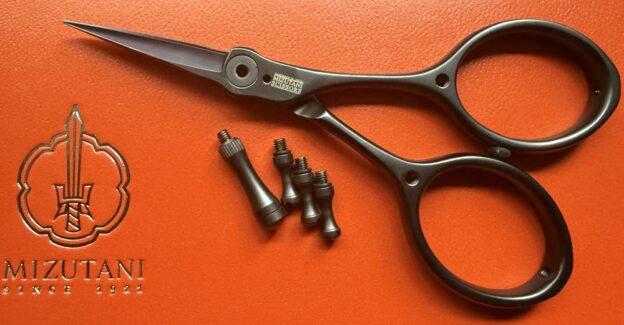
Mizutani KAVA II Fly Tying Scissor (Black Non Glare Finish)

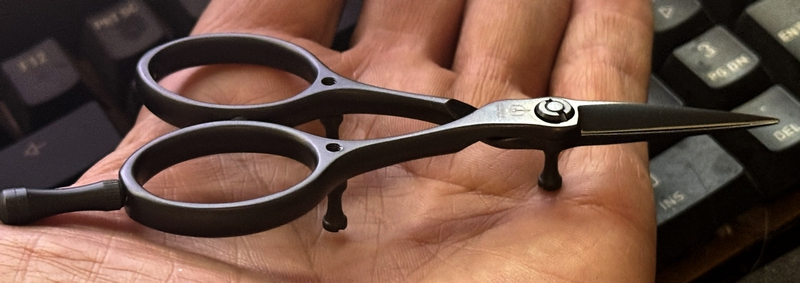
The scissor comes with several screw in tangs that increase the number of fingers participating in the grip (can be added to either left or right handed), and serve as a stand to lift the scissor off the work surface, ensuring it’s not scraped across your desk each time the scissor is added back into your hand. Many fly tier, like myself, tend to put the scissor down when not in use, then hunt for it later when needed. Typically we drag it across to work surface in the process, removing whatever finish the scissor has over time.
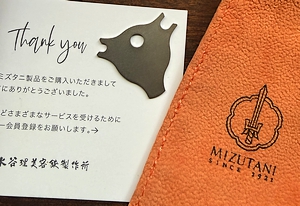
Mizutani Ratchet used to tighten the specialized screw

Note the screw shown in the above illustration is not a traditional screw used for tightening scissors. A small coin shaped ratchet comes with the scissor that allows for tightening or loosening the screw, which controls the tension required to close the scissor completely. This ratcheted adjustment turns easily and is a very smooth tension adjustment. I set the ratchet tighter a few notches to test how much it changed the tension, and it was minute, implying a lot of adjustment is available to the user.

Most scissors have a design weakness due to the steels involved. The steel of the screw is typically harder than the steel used in the scissor body. Over time, the effort needed to cut tough materials like wire and feather stems, distorts the screw hole as the screw moves minutely against the screw hole, and this expansion becomes unwanted “slop” into the action of the scissor. As all documentation accompanying the scissor is in Japanese, I am unable to confirm the scissor and screw are identical steel, but the 30 year warranty suggests that’s the case.

Surgical steel is typically Stainless (for antiseptic purposes) which is a “soft” steel and the hardened screw can easily deform the screwhole with moderate pressure (and/or considerable use). A good pair of iris surgical scissors will last me somewhere between 2 and 3 years, as fly tying is more abusive to scissors than the minor tendons and flesh of the human eye.

Use and Abuse

I have completed several dozen trout flies through the tying process, and can comment on both the new function and dangers these scissors represent. What I cannot speak to is the prohibitions the maker insists upon – and what shortens or lengthens their lifespan, as I am both unable to find the maker’s prohibitions nor able to translate Japanese.

What’s completely different about these scissors from other high end scissors, is these are two razor sharp knives joined with a screw, these are NOT scissors as we know them.

You DO NOT run your finger down the blade as they will filet your finger instantly. These are conjoined knives or razor blades, and you need to keep your fingers, your children, and everything else away from the “business end” of these scissors.

The three-pronged stand and the increased height of the scissor from the bench makes it easier to find on your work area and begin cutting, and is a welcome option that becomes instinctive quickly.

I tried the scissors both with and without the three pronged “stand,” and found the three tangs do not get in the way whatsoever and are quickly forgotten.

If the finger-extension tang is used on the rear of the scissor, it has just enough weight to tilt the scissor off of its three point rest and make it sit upon the work surface point upward …The weight of the scissor borne by the two rear tangs and the rearmost “grip extension” tang. That does not imply you will impale yourself on the point if you aren’t careful, the points on these are not thin and sharp, rather a fine general -purpose tip versus something “needle sharp” and dangerous.

My default configuration is all tangs attached; three on the scissor as the stand, and the larger tang attached in right hand mode to increase the fingers used in the grip.

I would describe these scissors as an outstanding general purpose scissor usable for all fly types and sizes. They are not “delicate” nor do they seem fragile or damage prone.I would feel comfortable taking a large “whack” out of a spun deer hair bug, a heavy saltwater fly, or a smaller trout fly. Their size and design makes the scissor your “go to” option for all tying, rather than some needle pointed scissor that only handles small flies and fine materials.

New Functionality

A scissor this sharp requires you to think outside the “box.” You should not cut towards your fingers, nor cut towards the shank if your view is obscured by a big gob of marabou or a thicket of spun deer hair.

The scissor is so sharp that most of the tactile feel of the cut is gone. You don’t feel the individual hair strands parting when you close the scissor, and the blades are so sharp they part the material effortlessly. Tying something like a Goddard Caddis and cutting toward your fingers as they hold the bend of the hook, is unwise. It’s likely that your fingertips would offer little resistance to the cut and only the spurt of blood will clue you that you have cut too far … and then the pain hits.

Flattening the bottom of a Goddard Caddis? Hold the fly in your hackle pliers and keep those sensitive fingertips away from the cut. Trimming a Bass Popper? Large hooks offer more safety, but make sure your fingers are visible and not covered by untrimmed hair …

Razor blades can cut materials simply by applying tension to the item as it touches the blade. This same cut is available from Mizutani scissors. Touch the point to the thread, and it’s cut. Pull the floss tight against the scissor edge, and it parts instantly. You can saw the scissor through the material WITHOUT closing the blades, so you have a new type of cutting device that offers a different style of cut than scissors.

Typically most scissor cuts (with precision scissors) are done up and away from the shank. Both right-handed or left-handed tiers will have the scissor in front of the fly, cutting back toward the tail with scissor points elevated above the shank. This induces a tapered angle to the cut which is thin closest to the shank and wider as the cut procedes down the material towards the tail. By touching or sawing with the blade you can cut from either direction, tail to head or head to tail, which gives a bit different profile on the severed material butt.

If you decide the cut needs to come from a different direction than traditional, make sure you attach the material with this new directional force in mind. Cut or saw with the scissor edge in the same direction you wrapped the material as pulling or tensioning the item in the opposite direction will loosen it. Tinker with this to understand the options you have.

As with surgery scissors, especially those with Tungsten Carbide inserts, avoid cutting down towards the finished areas of the fly. At least minimize these cuts where possible. The scissor is so sharp that hitting the completed ribbed body, when cutting a material on a future step, could cut through the wire rib, fur, and sever six or eight turns of thread, ensuring your fly comes apart instantly. Cleaning the hook shank of the remnants of a poorly tied effort is possible with a simple sawing motion to remove all the mats off the bare hook.

… and yes, I’m still commiting most of this to my muscle memory, but so far … still have all nine digits intact.

How to Purchase Mizutani Scissors

My understanding is the wait time on these scissors is non-trivial. I have seen multiple references to two to three months waiting for a completed pair, so you need to plan accordingly. The scissor is available in multiple finishes, different steels, and the fingerholes can be ordered in three different sizes, but each special element will require additional delay. The scissor is available from the Dolly Varden Fly Shop in Sapporo, Japan, and from their website you can add yourself to the notification list and be informed when new stock arrives. Their email address is dolly@dorllyvarden.com, and they offer worldwide shipping.

In Summary:

These are an outstanding general purpose scissor for the professional tyer, not for the occasional hobbyist. Their 4.25″ length is traditional for a small pair of scissors, and they currently offer only the single size in four different alloy/finishes for fly tiers.

The fact that I like this scissor does not mean you will like it, as I have tied both commercially, professionally, and occasionally – and have spent many hours (and many dollars) using precision scissors. The Mizutani scissor is a wonderful instrument that will become your workhorse scissor, but is not appropriate for everyone due to their sharpness and potential to cause injury. It would make a great gift for someone that ties lots of flies and has been doing so for many years, but this tool is not for the beginning fly tier.

The Blue Dun fly shop in Japan has additional information on the scissor and the different specialty elements and steels they offer. You need to translate the page to English, as I have for the below technical blowout showing the scissors features.
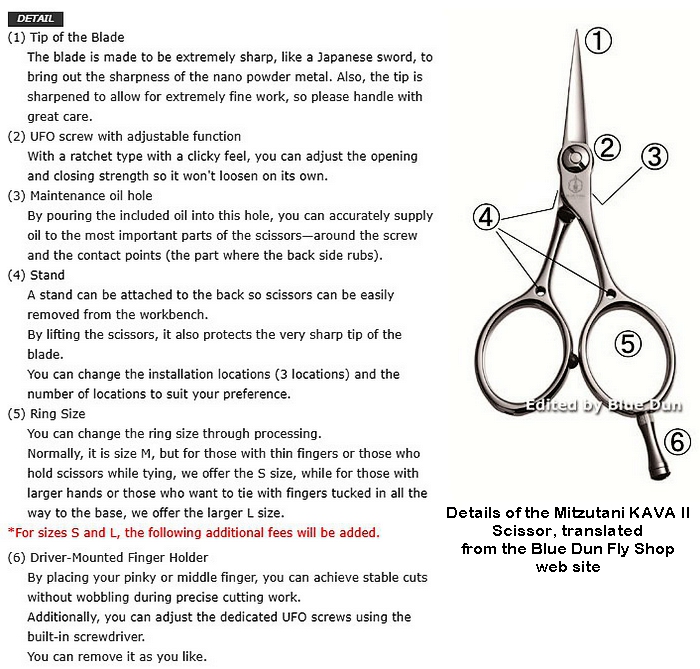
On the above technical blow out, the reference to “Ring size” refers to the ability to order the scissor with three different finger hole sizes. I haven’t found the actual dimensions of each, but the standard finger holes measure (which I assume are Medium), 13/16″ wide by 17/16″ tall, and are perfectly suited for the average hand.

Postscript: He’s Exaggerating, Right?
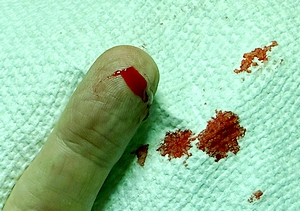
No. Not even a little bit.

This is the result of the 11th fly tied with the scissors, specifically a Bird’s Nest, in size 12. I was ensuring the feather distributed itself around the hook evenly, and used the point to flick the teal fibers apart, and caught the edge of a forefinger with the open points.

The cut was not even felt via the hand holding the scissor, only a slight impediment to the swing of the scissor motion … and then the pain hit …

I followed up with a few emails to the staff at the Dolly Varden fly shop, and they confirmed that these scissors are in short supply. When I asked about the Matte Black finish variants, they mentioned a two month wait for anything special ordered. It didn’t sound like a preorder was possible, rather you simply had to wait for whatever became available via the shop’s existing orders. This is consistent with anything rare and handmade – so you’ll need to monitor their inventory and/or inquire as to when their next shipment will be arriving.

With the current tariff agreements imposed by our administration, the simple “silver” colored scissors (Hot Isotropic Pressure or HIP finish) retails for about $150 (JPY 20,000Y, $180 with shipping and insurance). The Matte Black version is closer to $200 (JPY 36000Y, $230 with shipping and insurance), and the Damascus steel version lists for about $800-$900. (JPY 140,000Y).

Damascus steel gained its notoriety during the Crusades, and most historians suggest the original mineral deposits have long been exhausted. “Damascus” steel today is made by mixing numerous steels together to form the traditional multicolored “topographical map” look that’s present in the blade. In short, Damascus steel is a visual phenomenom, neither superior nor able to hold an edge better than other high carbon steels. Powdered metal and its impurity free composition is considered by many to be the best at holding an edge, and both the Matte Black and Silver (HIP) scissors use Nano Powdered Metal, I am unsure of the Damascus variant as it contains numerous steels …

I think these are worth the wait. Simply because the low end scissor costs the same as surgical quality scissors, but use a much harder steel – backed up by a 30 year warranty. If I burn through a set of Miltex stainless IRIS scissors every couple of years, these suddenly become really cost effective.
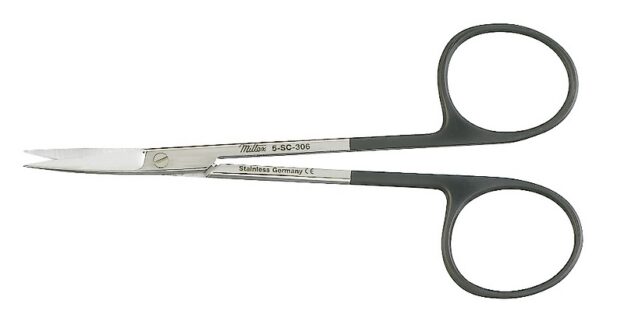
Supercut Iris scissors, serrated blades

Expensive bobbins and other engineering marvels distract your dollars from where they’re really needed

Only two items are used at every step of the fly, and rather than spending precious dollars on tools that are simply more expensive because they can be, spend your money where it really counts, by upgrading your scissors or your vise.

The fly tier’s vise and one or more pairs of quality scissors will always justify their cost simply because they are constantly in use, their quality levels increase dramatically with the dollars spent, and their capabilities increase with the increased outlay, as blades and tips become finer and sharper, or jaws become capable of a wider range of hooks, can rotate, and can attain the same nosebleed price levels as lesser tools, so you don’t feel left out.

Fly tying vises being too expensive to own more than one or two of them, thereby making me blanch at the thought of buying several for review, but scissors are enjoying a renaissance in both price and quality, and a canny fly tier intent on upgrading his tool suite should learn where the good scissors grow, and how to determine what he really needs in light of this vast unexplored continent of expensive cutlery.

Scissors, and the Vastness of Options

All the best scissors grow in the medical and dental professions, and what’s available from fly shops are the cheapest quality scissors, mostly made in India or Pakistan. Both regular and dental surgery have created thousands of different types of specialized scissors that you cannot imagine exist, until you are curious enough to visit an online medical supply house, and dive into all the names, sizes, and shapes.

The myriad of choices, shapes, cutting edges, and materials are likely to be a bit daunting to your untrained eye, but I include enough information to help you limit your focus to a few important qualities and the types of tips, frames, and edges available to make your choice and your dollars go further.

Tips

Tungsten Carbide inserts are obvious to the naked eye. Don't assume cheap scissors are tungsten unless you can see the inserts

For the fly tier the sharp fine tip is the most desirable element in a scissor. Medical scissors can have a tip fine enough to trim a single fiber from the inside of the eye of a hook, but that degree of metalurgy comes with a high price, both in dollars and in the education of the fly tier that spent the $600 necessary to own those scissors.

Medical scissors also come with blunt tips, rounded tips, curved, straight, and one rounded tip and one fine tip, but for most fly tying uses the dual fine tip is preferred. Fly tiers may lust after other types of scissors, once they learn of their existence, like Wire Cutting scissors would be superb for cutting heavy feather stems, wire, and bead chain. Medical supply houses often describe these as “heavy pattern” scissors, or heavier frames designed for increased force, and most come with one serrated and one straight edge designed specifically for cutting stainless steel wire.

Stainless steel wire is the preferred standard in dentistry and medical surgery due to its strength and possesses the highest intrinsic hygiene value, requiring less disinfecting chemicals to provide a sterile surface. Stainless steel wire would destroy most fly tying scissors very quickly, so the extra “beefiness” in frame of a heavy pattern scissor is welcome.

For most tiers the question of which tip will reduce itself to straight or semi-curved. Fly tying scissors are typically straight points, but scissors designed for fine work are often available in both straight and semi-curved. The curvature allows the cutting points and fingers of the user to not block the view of the area being worked on, giving greater visibility for precision cutting. Most tiers learn with straight points, many prefer the semi-curved once introduced to them solely due to the increased visibility garnered at the point of the cut.

Edges

The “Supercut” blade (typically with black handles) are superfine serrated blades. These serrations are much finer than anything available to fly tiers and will positively grab and hold anything ensuring no slippage during the cut. Tiers are familiar with hair or fibers slipping along the blade as it closes and we compensate without realizing it, often trimming two or three times to get a single even cut. Supercut scissors prevent any hair from slipping and you will get straight and even cuts on fibrous materials every time.

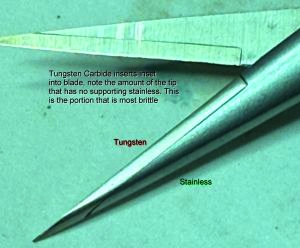
Tungsten Inserts are small insets of Tungsten Carbide imbedded in the leading edge of each blade. Tungsten is among the hardest of steel, so it makes a superior cutting edge. It is also the most brittle of steel, so you can destroy the points simply by dropping them onto a concrete floor. If you are not careful and cut toward the hook shank perhaps catching the tips on the hook shank, you can remove both tips in the blink of an eye, destroying the scissor in the process. Tungsten Carbide scissor usage requires the tier to relearn how to use scissors, and how to protect the points properly.

Most medical scissors are simply stainless steel which is a softer cutting edge and less prone to damage. Many medical scissors have “German Stainless” stamped or stenciled on them, which refers to the type of steel used versus the steel (or scissor) originating in Germany. Metalurgy analysis suggests sulpher and phosphorus are added to traditional stainless to make this variant, it is considered a “soft” steel.

Ceramic bladed scissors are a ceramic coating added to stainless or tungsten inserts to make the edges harder, sharper, and last longer than stainless or tungsten normally would. Ceramic coating also reduces glare on the scissor, and makes it resist corrosion better. Ceramic coated scissors are incredibly expensive, lusted after by every fly tier that handles a pair, and should be considered only if you have a friend whose a surgeon, a rich uncle, or win the lottery. Ceramic OR (operating room) grade scissors typically range between $250 to $600, depending on size and type.

… and yes, the gold coating on their handles is real gold.

What a Hammy Handed Meathead needs to know before buying the Good Stuff

Semicurved tips on operating room scissors. These are the tungsten carbide OR grade

Medical scissors are available in four grades. There’s the disposable scissors from Pakistan and India that are $10 or less, and make up most of the offering from fly tying shops, and are available by the squillions on Ebay at much cheaper prices. A decade ago these were really poor quality, but the sample purchases made recently suggest vast improvement on both fit and tolerances.

As these scissors are less than ten bucks each, you can order a sample pair to check the points and quality of blade construction before ordering more. These are great scissors for equipping a club fly tying class – or used as loaners for same. These scissors mimic the fancy scissors by using gold colored handles, and stencil “German Stainless” on the frame, hoping you’ll think the scissor is made in Germany.

Often these scissors are labelled with the term “TC” for Tungsten Carbide, but none of the samples that I bought had tungsten carbide inserts in the blades (see the below picture), so this is simply a sales tactic hoping to dupe the unwary.

There is the high quality disposable from both US and German vendors, and are usually in the $17 to $25 range. These scissors are typically better than our fly tying scissors, have fine points, are made in the US or Germany, and are typically only made of stainless steel.

The third grade of scissor is the “supercut” and tungsten carbide scissors. These scissors can range from about $75 to $250, and are better than anything offered by fly tying vendors. The above picture (at left) shows the fit of the blades on a pair of semicurved Tungsten IRIS scissors. Note that daylight cannot be seen between the two blades from their tips all the way to the screw fastener. This is the hallmark of the best scissors as they only cut where the upper and lower blades meet. Daylight means little or no cutting ability on that segment of the scissor.

The ultimate grade is the ceramic coated scissor, and is largely out of the tier’s budget. Paying $300 to $600 for a pair of scissors that you are certain to destroy should they be your first set of quality scissors, is for trust fund babies who can afford thousand dollar fly rods, and $200 nippers. I recommend learning to use tungsten carbide scissors first before moving higher on the food chain, and prior to ceramic coated you should have destroyed at least one pair of tungsten scissors learning how to use them properly.

These scissors (tungsten and ceramic) should be approached warily, as the fly tier needs to learn how to use scissors of this quality, given that flesh and ligaments can be soft in the comparison to some of the things you may be cutting with your inexpensive fly tying scissors.

Learning how “soft” steel can be

Stainless is considered a “soft” steel, and using a quality scissor improperly will show you how soft stainless can be.The screw joining the frame and blades is a much harder steel than the stainless of the scissor, so the more pressure applied to the legs of the scissor to make the cut, the more the screw will deform the soft stainless housing that surrounds it. Over time this screw hole deformity becomes “slop” in the meshing of the blades, and the legs of the scissor will show increased play in all directions. Eventually the scissor will be destroyed, or the screw can deform the screwhole to the point where the scissor no longer functions as such.

Test your existing fly tying scissors for damage in the same fashion. Simply grip each fingerhole and move the legs in opposite directions vertically. The distance the legs move away from one another in the vertical plane shows how much deformity or slop is present in the screw hole.

Your first set of really excellent scissors will be your ritual sacrifice, you will destroy them learning what you can and cannot do. Destroying good scissors should take years if you don’t do anything stupid, so be mindful of their use and assume you will destroy them via time-honored trial and error.

Rule 1: Heavy cutting needs to be done with heavy duty scissors . I have a “heavy pattern” scissor with standard stainless blades that I use to cut wires, monofilaments. stems of peacock and other thick flight feathers, and bead chain. These heavier scissors have lasted about 30 years of commercial tying with no obvious damage, due to my choosing the proper tool for this job. I may succumb to a set of inexpensive wire cutting scissors just to try them in a similar role.

Rule 2: Stop cutting toward the hook shank with tungsten carbide scissors, learn to cut “away” from the hook shank instead. Closing the tips on a hook shank will remove those fine points you paid so much for – so learn how to minimize risk. Use Needle Scabbards on your best scissors to protect them when not in use.

Rule 3: Fine pointed medical scissors are designed to cut flesh, skin and soft organ tissue. They are not used to cut heavy tendon and bone. This learning curve is identical to a surgeon-in-training, you have to learn which tool is best suited for what type of cut. Use your heavy scissors to cut leather for mouse tails, brass or stainless wire, or anything else rigid or thick.

Of the thousands of medical scissors, what should I be looking for?

I have linked to numerous different medical supply houses in this article so you can see the hundreds of types of scissors available. There are also plenty of explanations for the basic types of medical scissors and their uses available on the Internet.

A fly tier who is ready to make the leap from fly shop to doctor’s office should focus on these attributes.

IRIS Scissor : Iris scissors have small, fine tips and sharp blades. They were originally designed for ophthalmic procedures but are now used in a wide range of applications like delicate tissue dissection, cutting fine sutures, or removing delicate ocular tissues. Note the medical uses all mention delicate or fine, pay attention. IRIS scissors are best suited for the fine work needed on flies. Stick with this style in your initial foray, and get more emboldened once you’re used to the types and styles.

If you want to look at a new type of scissor, order the seven dollar version of it from a medical supply or EBay. Test the heft, length, blade, and cut, using the inexpensive version. If warranted, you can buy a better grade of the scissor once you’re comfortable with its attributes, capabilities, and shape.

Length: 4.5″. Scissors come in many sizes, for fly tying … stick with the 4.0 – 4.5″ lengths, depending on your hand size. I prefer the 4.5″ length, it’s typically the standard length for most fly tying scissors sold in fly shops as well. (4.5″ is 11.4 centimeters, Germany is on the metric system. and many supply houses list their metric size.)

Large fingerhole. Scissors are available in different fingerhole types, ribbon and standard. Medical scissors are designed for male fingers so all should have large enough fingerholes, but given a choice, opt for more room.

Fly tying scissors all have straight tips, medical scissors offer semicurved, slanted, straight, and scissors whose blades are tilted 45 degrees. Start with straight points and work your way up to the semi-curved once you’re more comfortable. Semi-curved scissors are designed to remove scissor and fingers from the same plane as the cut being made – meaning you have increased visibility of the work area so you have better control over the single hair you’re removing from the eye of the hook. I prefer semi-curved, but I use both styles.

There are many high quality makers of medical scissors and most reside in the US or Germany. I cannot vouch for all, but if you are concerned and wish to make a large dollar purchase, I recommend the Miltex brand, Miltex being a German made scissor. I have also purchased numerous Hu-Friedy scissors, and I can recommend those as well.

I have used Miltex scissors for at least 40 years and have never had a bad pair. I have destroyed a couple pair, but this was the normal process of learning about the scissors and their limitations. That first sacrificial pair paid for itself many times over as I did not repeat the same mistakes with others I have purchased.

… and Lastly.

If you’re contemplating a purchase please recheck the scissors length, and tip type before buying online. You may even want to call them if the photographs are grainy or too small. It is easy to mix a round tip for a fine tip or a blunt scissor, if you’re not playing close attention.

Some states require the purchaser of the medical scissor to be a doctor, and in those states a license or license number must be produced at the time of sale. Don’t buy from the supply houses that are limited by this requirement. All the eBay scissors and 90 percent of the remaining supply houses do not have a license requirement, so simply shop a different state.

As only the largest of cities host stores selling these items, ask your dentist or dental surgeon to look at his tools. Most dentists are boring conversationists, due to all their conversations being one sided, you being hampered by a mouthful of stainless steel and someone else’s fingers, so have him show you some of the scissors he has at his practice, or … tell you about the merits of the different vendors he’s used .. or where he purchases his tools.

… and when the SOB isn’t looking you can pocket a handful of the Good Stuff ….