It was a crash course in paraffin, beeswax, petroleum distillates, herbal additives, and tropical fruit – none of which I’d anticipated with such a mundane bit of research.
I’ve gone through three sports, two industries, and a half dozen hobbies – hoping to find something special, and found that the ignoble Beeswax remains right up there with the tackiest waxes known. I found better, but the toilet ring from the local hardware store is still among the top waxes available.
As described in an earlier post, wax usage is on the decline – limited to those geezers like myself that learned prior to the debut of specialty fly tying threads and pre-waxed nylon. In those days small thread was size “A” – and most of it came from the sewing trade.
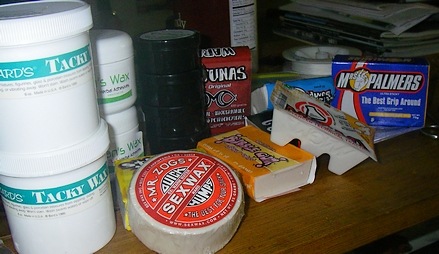
Desirable characteristics include being soft enough to use with materials other than thread, non-staining and colorless so it doesn’t change the material, non-oxidizing – so you can leave the cap off and the material doesn’t harden, and cheap as dirt – so you can indulge in obscene rituals without breaking the bank.
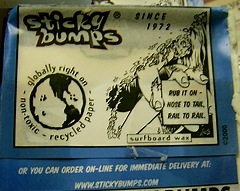
10 different surf board waxes and three different temperatures later, it’s safe to conclude that feet and flies don’t share any similarity. Surf wax is much harder and less tacky than Beeswax and is only a bit softer than candle wax. It has a light “tack” to the touch, is cheap – less than $2 per block, and is available with the best range of scents; Mango, Banana, Bubblegum – but no Nightcrawler or Salmon Egg, which would’ve tilted my research instantly.
While disappointing, it only whetted my appetite, knowing that somebody somewhere had a malleable wax with enough surface sticky to make fly tiers happy.
Casting and the mold making “lost wax” process uses a repair wax that’s soft and somewhat sticky, sold by the pound it fit only the malleable and cheap criteria.
40 Rivers mentioned bow wax, used to lubricate bow strings; it’s soft enough but it’s dual purpose – to adhere bow string filaments into a single strand and to lubricate the pulleys and gears used in modern compound bows. There’s many different kinds and was the sole industry distinguishing between sticky and tacky.
Bow strings (both crossbow and compound bows) are made from a diverse mix of fibers, including many synthetics like Dyneema. Some waxes use a mixture of wax and silicon, others use Beeswax blends designed for older bows. Silicon suggested even more possibilities, being the dominant component of liquid dry fly floatants and many common pastes. A fellow that ties mostly dry flies might want to yield some sticky in lieu of a wax with water resistance and minor floatation qualities.
Bow wax is worthy of additional study.
Magician’s use tacky wax for palming cards and other magic tricks. Like bows and surfboards, dozens of different varieties exist – each touted as stickier than most or stickiest. Small balls of this semi-transparent white wax are concealed in the magician’s palm, allowing him to press the hand against the deck and remove cards.
These waxes are perfect for traditional thread work, quite sticky to the touch and will enable a thread to load considerable fur without assistance. As the wax sticks to everything; human skin, paper, fur, beer cans, etc., and is colorless and odorless – it’s perfect for fly tying.
… I suspect it’s stolen from another industry however, and as additional candidates were delivered the Holy Grail became clearer…
Museum wax.
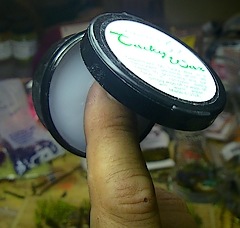 Designed to attach precious artifacts to glass display cases without staining or adding residue. Also called “Miniature Wax” – used by those hobbyists that delight in recreating the battle of Waterloo with lead soldiers, spending months building battle scenes complete with miniature foliage and regiments of soldiers, all of which is secured to the base substrate with small balls of semi-transparent white wax.
A white wax that sticks to absolutely everything …
Department 56 “Tacky Wax” was one of two finalists. Department 56 is known for miniaturized Christmas villages and provides a complete line of miniature building materials for hobbyists. Retail is $2.50 for about 1-1.5 ounces – and can be found on eBay for less than half retail. Like all eBay items it’ll be available at many prices – some more than retail, so wait for your price to appear.
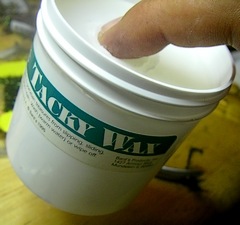 Bard’s Tacky Wax is another museum grade display wax, looks identical to the Department 56 product and is extremely tacky. It’s comparable in price to the Dept 56 product, but is also available in 6 ounce tubs for about $9.50.
The picture at right shows the six ounce container suspended by the grip of the wax on my finger – plenty of tack to suit us fly tying fiends – something Beeswax was unable to reproduce …
Both are perfectly suited for fly tying. Soft and malleable allowing you to press a feather into the surface, works exceptionally well on thread (once removed from the container), and both are odorless and colorless – allowing use on white or light colored materials, and doesn’t oxidize or harden when left with the container open.
Neither are derivatives of Beeswax – as they lack the “greasy” feel at room temperature common to Overton’s and the venerable toilet ring, which are Beeswax based. Handling the wax will add “tacky” to your fingers without any apparent residue – also different than Beeswax – which adds “sticky” and visible residue.
I suspect many of the Magician’s Wax products are actually miniature wax decanted into different containers. Comforting to note that fly tying isn’t the only hobby scrounging elsewhere for materials.
I’ll decant wax from the containers and encase the ball of material in simple saran wrap, exposing half to the elements for brushing on thread, while handling the wrapped side. Simply close the wrapping around the ball when leaving on your bench so it doesn’t pick up trimmed material from the work surface.
Wax is one of those materials never made for fly tying – merely lifted from another industry and decanted into a more suitable container. Brown waxes are traditionally blends of Beeswax and other compounds, white waxes can be paraffin based or an entirely different synthetic compound.
Synthetics offer tackiness without the room temperature greasiness of Beeswax nor the slight discoloring inherent in a darker wax. If you’re dissatisfied with your current fly tying wax you might want to look into either of the above museum waxes as an alternative.
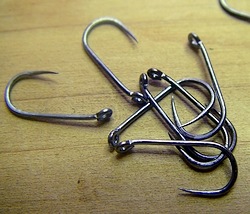 The points are fiendish, much longer and sharper than what I’m used to – and beaked, turned up to hold onto the flesh its just violated.
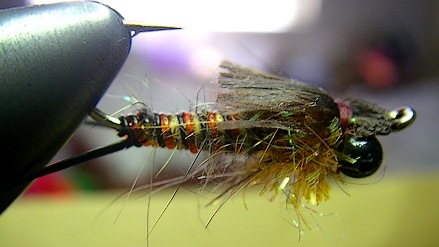
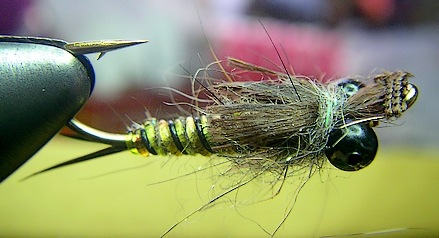
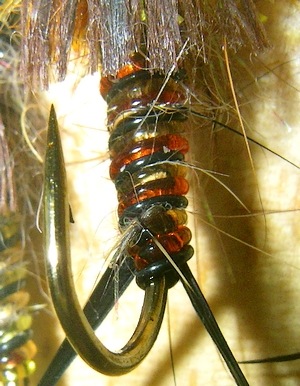 On most patterns I’ll stick a dubbing needle between coils and yank out the underbody. Slick and glassy looks great in a magazine – but I like scruffy and dirty, and have never had much luck on flies that seemed stiff and glossy.
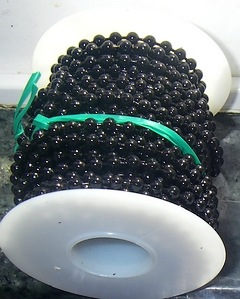 They are – the assortment is broader than what we’ve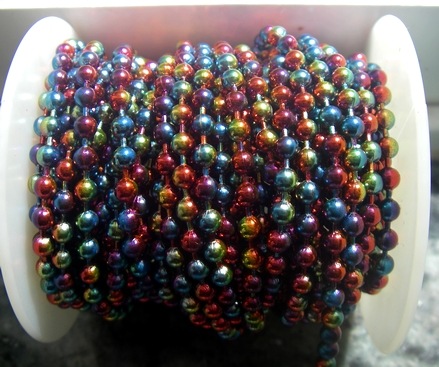

 Called “Cool Spools” – they show the connector colors but only have violet, rainbow (shown above), black, and dark blue to purchase online. It’s a rather poor web presence – but I called and they mentioned the other colors were available – but not all were in stock.
 I figured I was uniquely qualified – knowing the stiff and austere demeanor of the
 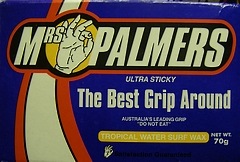 Tropical, Cold, and Lukewarm, describe the melt point of the material so it doesn’t slough off once applied. It also describes whether it’ll be stiff or soft at room temperature and how it’ll wear with you running threads and other materials over its surface.
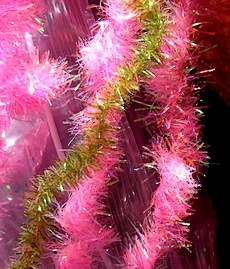 There’s nothing quite like an epic outage of materials on the eve of a trip – where your own shortcomings cause you to lack whatever was required to catch fish…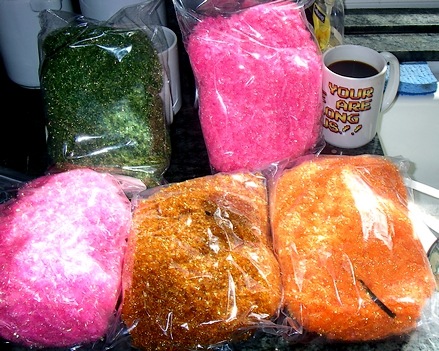
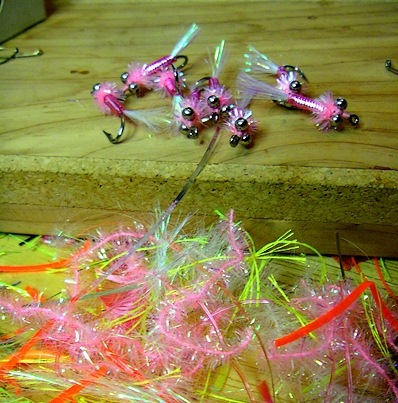
 For some it’s drugs, booze, or gambling, for others it’s the rush of adrenaline. For the chaste, it’s religion, or a triple decker, three cheese, bacon-wrapped grease-meat with a side of stained paper bag.