Category Archives: Fly tying Materials

Where to find them cheaply

Blame Harry not me – I’m just the messenger

A quick leech tie featuring the mylar portion of the yarnI’m reminded of the last minutes of “The Natural” – where Robert Redford glances at his broken bat, turns to the batboy and says, “Pick me out a winner, Bobby.”

Singlebarbed reader Harry has done just that – stumbling onto a superb mohair/mylar yarn blend:

A lady I work with gave me a couple yards of a yarn by Karabella called “gossamer”.  You may have already found this stuff, it ain’t cheap, but it makes a great looking nymph.  Check it out at yarnmarket.com ($24.95 for 222 yards. also found some on ebay at $20.  Haven’t ordered any yet, but they offer some neat color combos.  Sort of like the stuff that Danville thread will make by combining chenille and crystal chenille only with mohair.

I don’t buy the “gave me some” angle, most likely he stapled her knitting hand, and while coworkers applied bandages, rifled her possessions and grabbed it.

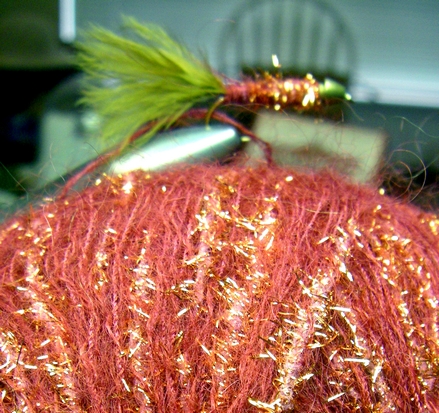
The yarn is alternating segments of mylar chenille (4″) and spun mohair(16″), yielding a combination of flash, yarn, and when pulled apart, great dubbing. The Mylar segment is a bit thicker than the rest of the yarn and makes a natural taper when wound on the shank.

 Karabella Gossamer mohair and mylar blend

Available in 37 colors is a bonus –  I grabbed the Dark Olive/Copper and the Claret/Gold colors as a trial. The mylar component is quite soft, not bristly or stiff like cactus chenille so it’s well behaved when wrapped on a hook.

The plain mohair portion is quite thin and could be wound on #16’s and #18’s, or you could trim those portions out and rip them into dubbing with a coffee grinder.

Next week I’ll have a long winded article on just that – so grab a couple skeins, clear the table – and be prepared for some mess making.

The Oscar for Fly Tying Theatre will be awarded Saturday

Commercial tying is a hellish occupation, once your orders breach the 100 dozen of a single fly single size  – it’s becomes a ghastly test of endurance where perspiration and desperation perch on opposite shoulders, you discover nerves in your backside you never knew existed, and all the careful planning has been frittered away by pals and fishing, it’s crunch time and a #18 Pale Olive is this week and most of next.

shankapotamus Your only real friend is “Fly Tying Theater” – that collection of tapes or DVD’s whose dialog you recite from memory, you know the audio cues for the heroine disrobing, what she displays and for how long, and can list the internal organs forcibly removed by the next violent death.

National Geographic loses luster after 1:00AM, and as eyelids start to droop and you’re gingerly shifting weight from one tender cheek to the other, you want coffee, Sensurround, and the screams of the dying…

You can’t watch it – the TV is there to give the illusion of company in the pre-dawn darkness, glance up and refocus the eyes – then back to threading small stuff onto smaller stuff.

Audio-only is the best of the Best, those actors and subjects whose delivery is so wooden and uninspired you’ve no need to watch:

5) Anything by Steven Seagal. Note the deft use of all black clothing and clasped hands at midsection to disguise his ponderous gut. Ninjitsu can render an entire human invisible – but the gut is still a problem even at the 13th Dan.

4) Anything by Chuck Norris. Like Steven Seagal, Chuck possesses only a single facial expression. He let’s Steven live only because he needs an opponent in his next movie, he’s killed everyone else.

3) Anything with Jean-Claude Van Damme. No, Bruce Lee never sounded like that. Chuck lets him live so he has a love interest in his next movie.

2) Anything with The Duke. You’ve seen them all 17 times, and only his 4″ lifts hurt more than your 14 hour marathon of garage sale chair and hip pointers …

… but the undisputed King of fly tying theater – the show that dwarfs all competition is ..

1) Anything with Mel Kiper. He emerges from under a rock one day each year, hosts the NFL Draft, the most inane non-event on television, and as quickly vanishes from whence he came.

For those that aren’t fishing, Saturday is your chance to make up for winter sloth.

Technorati Tags: , ,

The fly tying equivalent of the One that Got Away?

Fly tying success is akin to fishing success, you’re happy to bore tears out of your fishing buddies, describing the instant of clarity when goat nostril was the perfect tailing fiber for your pre-menopausal emergent mayfly adult.

So long as you’re buying the beer they’ll feign interest…

What’s never described is the 750 refusals you got earlier, how you couldn’t buy a fish with your variant – and the really big SOB they’re congratulating you on was foul hooked in the dorsal with an Adam’s.

Fly tying is the same way.

I keep encouraging you to buy bulk, cut out the middleman, and go offshore … but that really nice out-of-production yarn I found that you wanted – may have been the Lemonade, and while you’re piling onto eBay to score some, I’m sleeping with lemons.

Oopsie, that ain't Olive

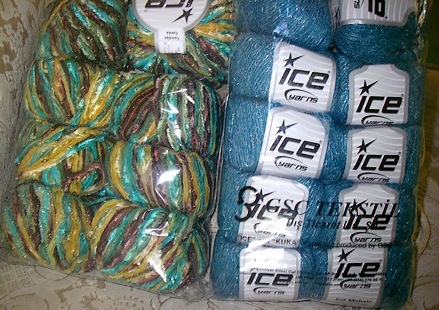
Another “factory direct” shipment from Turkey, minimum order is 10 skeins, and that mildly interesting navy blue mohair wrapped with a thin strand of silver tinsel?

… that’s dark Olive.

Mutt yarns are always a “home run” swing, there’s no bunting or swinging for percentage – it’s either what you wanted or Jimi Hendrix lit it on fire at Fillmore West.

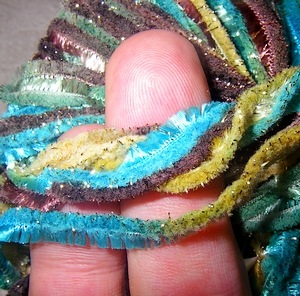
It's a cross between Chenille and a bottle brush

It’s a head scratcher, chenille on one side and a bottle brush on the other?

I may have found the World’s Most Awesome Pipe Cleaner. Dip it in bourbon and watch the tar and dried spit melt from your stem…

I’ll wind it around a couple of hook shanks to check the effect, but I’ll not hold my breath.

The knitting cabal at the nearby church keeps showering me with stale sugar cookies everytime I produce a bag of colorful rejects – in between complaining about their kids I’m sure they’ve seen fit to put me in the good graces of the Man.

I see it as cheap insurance.

The K-2 of fly tying, a solo ascent on dry fly hackle

It was a comment made by Alex at 40 Rivers to Fish that had me pondering fly tying as a whole. Like all artisans you wake one morning and realize you’ve explored most continents – and wonder is this the pinnacle of the craft, and after years of toil – are there no dragons left to slay?

Two or three hundred years of small hooks and smaller feathers doesn’t leave many Everest’s to climb, and with the few surviving manuscripts of “them as came before”, you never know whether it’s really invention or modification you’re working on.

Most real innovation in fly tying has come from new synthetic materials, rather than technique. Simple items we’ve taken for granted hold a great deal more promise than their older counterparts – and poring over countless synthetic fashion yarns has introduced new worlds for me to conquer.

The Granddaddy of all fly tying mountains has been hackle, and most tiers will admit that the big dollars is invested in their collection of genetic chickens, and the unending desire to accumulate more colors and rarer strains to assist in either floating flies or imitating the terrestrial bug.

So long as that continent remains untamed, there’s plenty of uncharted territory for the tinker tyer.

Despite all the synthetics we’ve grown from test tube, and despite the efforts of thousands of fly tiers attempting to find a substitute, only the Haystack/Comparadun series of Caucci-Natasi has yielded an adequate substitute for hackle. Some may argue that the Swisher-Richards No Hackle was viable – but mallard wings don’t stand up to abuse and once tattered, may be eaten as a caddis emerger versus the fully terrestrial mayfly dun.

Cul Du Canard (CDC) has its legion of followers, but most flies are hybrids – a mixture of CDC and chicken hackle – not the truly hackle-free dry that would free us forever of the genetic chicken.

In response to the larger question, I’d suggest there’s a great deal more real estate for the journeyman fly tyer – but it’s rarified turf, a combination of physical properties and technique, where you’ll have to know the first and invent the other.

I’ve attempted Everest many times, and this year I’ve got working prototypes. Chicken farmers are safe, it’ll take a couple more seasons to figure out the tool I need to tie these blazing fast, but the physical qualities are sound, the materials tough as nails, and all I really need are some hungry and desperate fish to make me feel the effort was warranted.

There’s still plenty of refinement needed in both form and execution, and my Brownline activities don’t offer the ability to test dry fly theory – most hatches are Trico or Caenis and I’m reluctant to fish things I can’t see – hackled or otherwise.

I’ve never seen their likeness anywhere – but that doesn’t mean some canny Victorian fly tyer didn’t get tired of his stringy old roosters and use Red Deer in a similar fashion – the only advantage I have is his work was lost to Time.

Flies float because of combination of surface tension and square footage. Meaning, materials heavier than water can float so long as they occupy enough surface to prevent the fly from sinking. Chicken hackle itself is not lighter than water, neither is the hook, tail, or dubbing.

The hackle above the water provides no flotation, neither does the hackle underwater, so it’s the cross section that occupies enough real estate to resist sinking.

Drop a needle into the water point first and it sinks instantly, lay it on the water lengthwise, carefully, and it’ll float.

The answer to our Everest is to find a substitute material that’ll provide the same cross section as chicken – and if it’s durable and cheap, we’ve got something.

Like the Caucci-Natasi Haystack/Comparadun, I’m exploiting deer hair.

The profile is a parachute dry, which after a couple decades of intensive personal use, I fish more frequently than the traditional Catskill dries popularized over the last century.
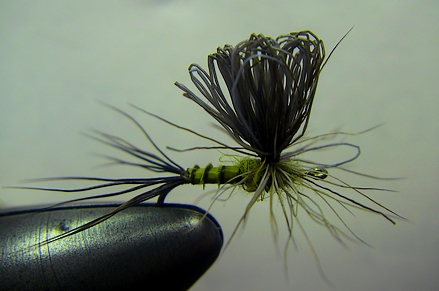
The Brownline NoHack, slow water edition 

This is the lightly dressed variant, a Blue Wing Olive in size 16. Dun gray elk hair is tied in as the wing, then bent 180 degrees and flared around the post. Wing length and “hackle” retain traditional proportions. The whip finish is spun around the wing rather than the hook shank, as the wing is the final component of the fly.

I had an idea that I could cut the wing loops and pull down more hackle if the fly was fished in broken water. If it works you’ll be able to adjust the amount of hackle with your nippers.

That and you could sever the wing to make the spinner, leaving a little nub so you can pick it out from all the other naturals in the surface film.

The heavier hackled variant is tied completely differently and is still in the beta phase. I’m hoping to finish a couple dozen for the season Opener, which’ll give me and SMJ something to giggle over while fishing.
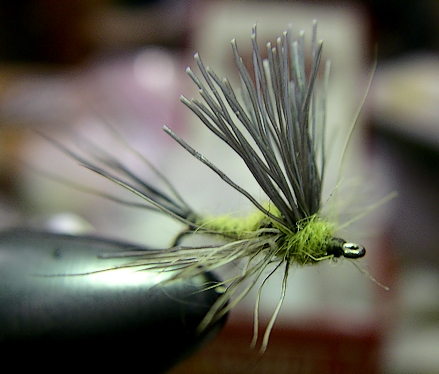
 Brownline NoHack PMD freestone flavor

Above is #16 Pale Morning Dun using the “heavier hackle” construction method. I didn’t put too much more hackle on this version, but this style allows me to reduce the wing mass despite the use of more elk hair. Hackle and wing are a single bunch of elk/deer that’s trimmed to produce the final wing shape.

I guess I’d answer 40 River’s comment with something different; you spend a couple decades painfully mastering the craft, and when you look around and see nothing that stimulates you, it’s time to stimulate others, taking the craft one small step past your comfort zone.

For me, the tinkering component is an endless amount of hideous barriers to overcome; chicken hackle a physical obstacle, and angler perception an emotional barrier, both await some fellow not satisfied with a McGinty – and wonders can he make a better bug’s arse with a popsicle stick.
The fly tying equivalent of two buck chuck is a three buck flyer

While everyone else is hunting a “10” – us unkempt fly tying types are content with a four. We’re not lowering the bar, rather it’s how many dozen flies we bang out before exhaling.

New materials are like that, anything capable of strumming the Creativity gene, leaving an “Edward Scissorhands” cloud of snips, tucks, flying debris, and a wake of forgotten half-filled coffee cups – is worthy.

Friday’s mail included a “three dollar flyer” – a package of unknown yarn whose grainy eBay picture looked promising, but out of focus. I saw sparkle and the potential for a trophy mutt – whose colors and qualities could generate a four or better.

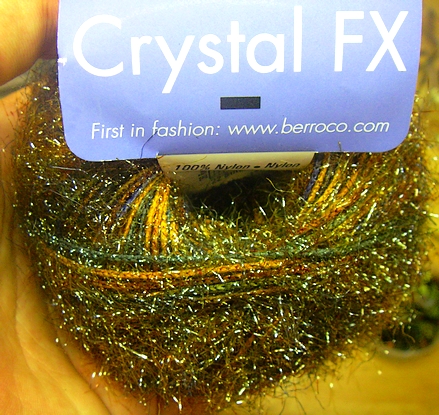
 Berocco Crystal FX "Amber Mix"

Saturday morning I woke with fly tying scissors still in hand and a trail of dander leading to neatly ordered phalanx’s of replacements marching across my desk.

The yarn is called “Crystal FX” from the Berroco Yarn Company of Italy. It ceased production in 2007, so like everything else it’s in limited supply. eBay still has plenty, offering an assortment of colors for $8 per 147 yard skein.

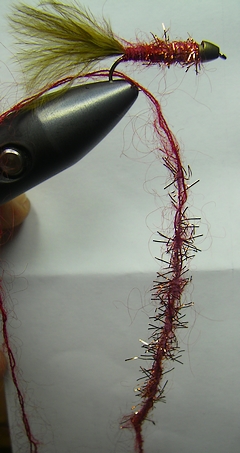
Leech patterns showing color transitions 

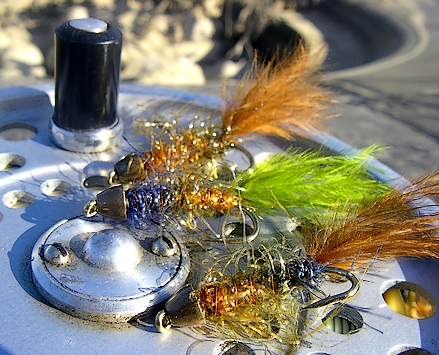
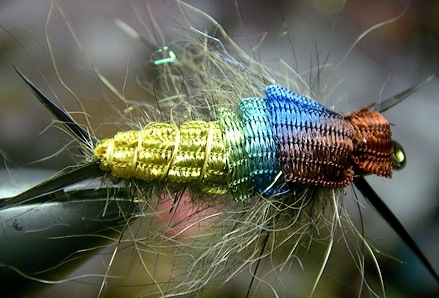
I’d describe it as similar to an Estaz, Fritz, Cactus, or Glimmer chenille – but in a soft and flexible yarn form. Comprised of 100% nylon, it’s a flexible, semi-stretchy braid with mylar strands coming off as a fringe. It’s a trophy “mutt” – with color changes every 3 inches, which allows flies to take on any number of color transitions as the yarn is wrapped forward.

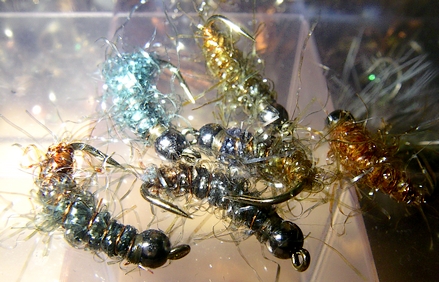
I’d purchased two skeins of “Amber Mix” which is blue, green, olive, gold, rust, and brown repeated along the fiber. It lacks the opalescence of glimmer chenille, but makes a fly that looks like shattered glass, with enough sparkle to blind a camera lens. 

 Czech style caddis with a single wrap

Ribbing the finished body reduces the scruffiness somewhat, allowing you to adjust the fringe effect to whatever length is desired. It’ll produce a “Czech” style caddis with a single wrap, and yield a worm if you plan a color transition at the head.

It’s heat sensitive, so you can melt the top fibers and leave the bottom shaggy, and lends itself to just about everything.

 An AP style mayfly nymph tied with Crystal FX

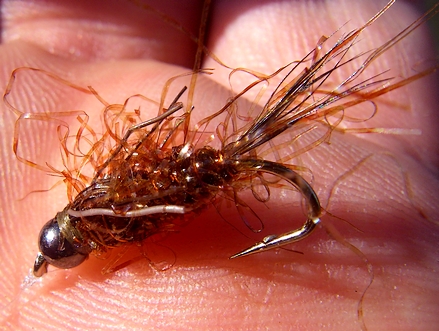
The yarn is thin enough to be useful on flies down to a size #12. The AP style mayfly above is a size 10, and showcases the fiber sizes and width of the mylar straggle.

You can trim the fibers easily with scissors to allow the dull nylon braid to show – I’ve left mine full length to test whether they break with abuse.

I grabbed some hot pink to use for Shad flies and the magenta mutt to use for steelhead. I tested them yesterday for fragility and they’re bulletproof.

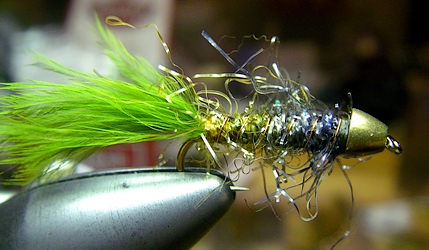
Good color transition for streamers and leeches

This is first class leech material. Most of the patterns I’ve used in the past have some sparkle, some hackle, and fur to complete the forward portion of the fly. This delivers all three plus the added bonus of the color transition – which can be planned at any point on the completed fly.

Roughfisher has a good thing going with his glimmer chenille patterns, this may be a useful addition as the yarn dimensions are different enough to allow use in areas where glimmer chenille becomes unwieldy.

Braided, dammit – not shaken nor stirred

One of the reason you buy copper wire by the pound versus the shop spool is so you can dominate the Spring runoff with forty-leven pounds of non-toxic, gutslammer nymphs.

Dynamite is neither green nor legal, and on occasion something just as sinister is warranted.

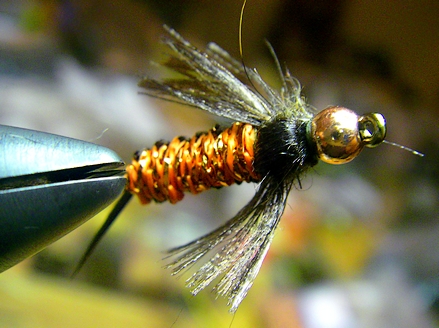
My take on the Copper John, I call it the "Copper Johnson"

It doesn’t look like much but that’s three feet of 34 gauge wire per fly, 20 turns of 1 amp fuse wire and a 4mm bead chaser – just what’s needed when the runoff will be short and violent, just like it was last year.

Actually I’m polishing my braiding skills, I used to be able to bang these out really fast – but declining eyesight has slowed me somewhat.

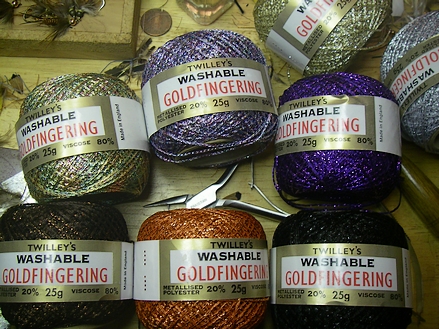
I bought the “Goldfingering” for Shad flies, which should start sometime in the next couple months, it’s a heavy nylon floss wrapped with a complimentary color of mylar. No sooner did I spy it in my “weird stuff to try” bag – when I started braiding more goodies than I’d anticipated.

Goldfingering, add a Walther PPK to your arsenal

The dark brown and orange made a handsome combination. The balance of colors (especially the multicolored flavors) will flavor my shad flies for the season. This is really tough material, the mylar shine is partially muted by the floss, so it’ll lend itself to a variety of questionable inspirations.

The Over and Under seen from the bottom

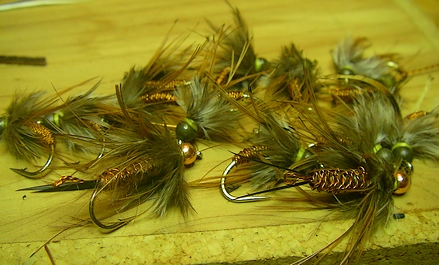
The bottom view of an “Over and Under” variant. Woven Goldfingering body (dark brown and orange) two turns of Gedifra Costa Rica polyamide hackle. Dub a little fur in front, then grab the hackle on the top and bottom and pull forward to make two wingcases – leaving the fibers on the side for legs.

Outside of the tail and a dab of dubbing it’s another all yarn fly; cheap, expendable, and when your orthodontist pal asks for some you can tell him, “Doctor, No” or equally bad movie quip.

Tore it from his daughter’s fingers no less

Reading between the lines suggested somebody was still paying for the crime. Singlebarbed reader RDT sent me a traditional gauntlet, a double-dawg-dare-you note describing his wrenching the yarn from an unsuspecting innocent..

I was finishing up the Golden Mutt post while staring at it and scratching my head. It’s a ribbon yarn in “clownshoe” colors, sturdy and about 1/2″ wide.

Six or seven things leapt to mind, but I had the stonefly materials at hand and whomped together something…

I'd call it a Scarab from the Mummy's Tomb

It’s one continuous strip of ribbon laid over the back and folded three times to make the wingcases – Lord knows it’s a garish looking scarab  monster, just ugly enough for a steelhead to take exception to its presence.

I’ll give it more thought, I just wanted RDT to know he was going to have to dig deeper to get me to blanch.

After 20 years of enforced servitude tying little drab things by the gross for fly shops, this is dessert. It’s in my fly box for the next outing, once the rain lets up we’ll see what carnage ensues.

The yarn is called “Incredible” from Lion Yarn Co., and both the “Autumn Leaves” and “Copper Penny” colors look enticing. Thanks much, RDT – we’ll fiddle with it and see what else we can make.

Some set fashion, some follow, others would be wise to wait

This weekend featured continuous sustained downpour that blew the Little Stinking into the Great Muddy – one 24 hour monsoon turned a sleepy fetid little brook into a chocolate gravel throwing monster – increasing its size tenfold.

I went out and admired the snarling beast, watching Audi’s and Toyota’s tumble past intermingled with goat guts and lawnmowers.

There will be new holding water aplenty – and while the bridge reverberated from log strikes and abandoned farm equipment – I couldn’t resist a couple of fist pumps, all we need is three or four more storms of the same quality, and us Californian’s can start to breath easy.

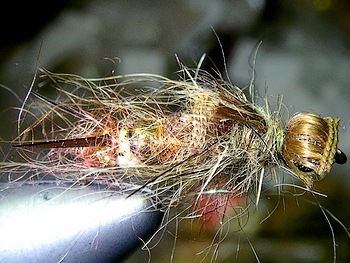
Enforced idleness allowed me to finish the Purple, Olive, Gold, Rainbow, and Red stonefly nymphs that SMJ and I’ll be testing come April. I’ll only share the magnetic versions, but he should fall for it repeatedly and often. I still have four dozen rubberleg versions to finish this weekend and I’ll have an even 10 dozen stoneflies – enough to get into all manner of trouble.

… after that we start working the mid sized caddis.

I’ve located a current source of the Polyamide double eyelash yarn I’ve been using on the streamers, figured to pass it along if anyone’s interested.

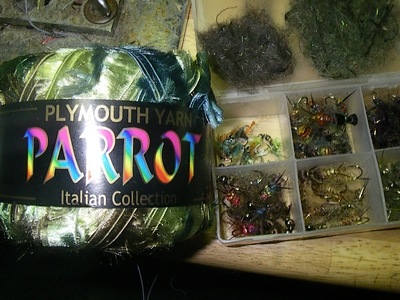
Plymouth Parrot Polyamide double eyelash

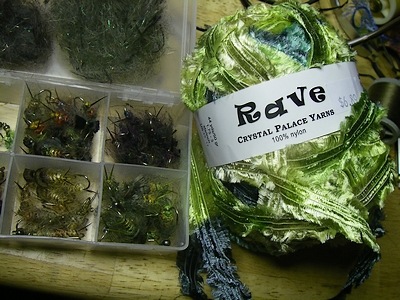
The Plymouth Yarn Company makes “Parrot” – a full sized double eyelash identical to the Gedifra Costa Rica that I’ve been using (and no longer made).  Crystal Palace Yarns makes “Rave” a half size double eyelash that is no more than an inch wide – yielding a polyamide “hackle” about a size #16 (once trimmed from the yarn and prepped).

Crystal Palace Rave

Both are posing next to my collection of bead equipped, full shank leaded, color-imbued, stonefly nymphs. I’ll mention the “Rave” hackled damselflies in the top left corner of the fly box once I’ve stuck something other than my finger..

A dollar says he stops helping himself to the Precious

Revenge served waist deep in cold water I was beginning to think stern looks from anglers were due to the similarities fly fishing has with the workplace. Guys on vacation smile and hold a dripping fish close to their chest, but guys at work thrust it towards the lens to look focused and professional.

Another silly idea proven wrong, but fly fishing and the workplace share one common feature and that’s ants.

Everyone knows the ant(s) where you work, and if you don’t – then you’re the guy that inhales everyone’s donuts and never brings any, the guy that fingers lunches in the communal refrigerator, the guy that knows the location of every candy dish for six floors, and more importantly – when they’re undefended.

You’d better nod vigorously … and while protesting your innocence perhaps you may want to question similar behavior when fishing?

Every fisherman I know can point to the pal who insists he’s required to share flies with, “one tenth of his get” donated to a callous GrabbyMitt with a drooping backcast.

I suggest something like leaving him in the parking lot at dark, or pulling a runner and sticking him with the breakfast tab, and the complainant usually scuffs his toe whilst looking downward, mentioning something like, “… can’t, I married his sister” or ” … I’d like to but Ma would ..”

Revenge is a dish best served in cold water, I may be able to assist.

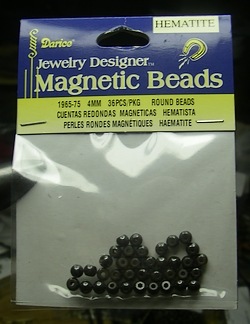
I’ve been fiddling with magnetic hematite beads, hematite being an oxide of Iron – non corrosive and not as heavy as traditional brass or copper beads.

It yields a beadhead fly with a slower sinkrate than traditional fly tying beads – but more importantly, if you toss a handful in your buddies box it’ll cause every loose fly in the compartment to instantly polarize, gluing itself to the closest bead. It’s a dramatic effect on small flies – and while “Grabby” is separating his #16’s from his #24’s – you’ve got ample time to take ownership of the water he was laying claim to …

Toss him a half dozen and make sure they land in all the small fly compartments.

I haven’t had a chance to try the super-conductive Hematite version, mainly because I pick up too much debris on the Little Stinking with the regular flavor, most of the streambed appears to be metallic fragments, and coupled with algae – it’s just plain hard work.