Category Archives: Fly tying Materials

Where to find them cheaply

Part 1 – Singlebarbed teaches the fundamentals of fly beauty, and insists you’re catching fishermen mostly

Fly tying is six weeks thinking of nothing but the fish, tying small stuff to smaller stuff, the shock and awe that all insects don’t suck blood or whine in your ear, the majesty of the first fish caught on your own fly, and the amazing riot of colors and animal parts coveted and purchased …

… and then it’s forty years of attempting to make your flies resemble someone else’s – validation not so much duped fish as successful copy of a book photo, or an appreciative comment from a fellow angler.

You start tying flies for fish – and wind up tying flies for fishermen.

It’s not a conscious decision, but aesthetics and beauty are as insidious in fly tying as they are in life.

The industry has always embraced beginners with great fervor, as they’re the source of a great deal of revenue. They need everything and a canny shop owner loves to host a class as it guarantees commerce. Fly fishing clubs love them as well. It’s a great way to be “hale fellows well met”, attract “lurkers” that don’t show for banquets and Beef au Jus’, and co-sponsor them with local shops happy to provide a small discount for students.

… and six weeks later you’re mounting that gleaming new vise to a table wishing you had someone to ask the hundred-thousand questions that occurred since your final lesson …

Magazines, books, and Youtube provide inspiration but spawn more questions than answers, and despite the fellow at the fly shop claiming “Cree” is nearly as good as Grizzly, your unimpugnable sources are gone and you’re left to figure it out … alone.

Intermediate and Advanced classes are few and far between, as there’s no agreement on what techniques or flies belong to either, there’s little retail traffic, and finding a master-instructor that has all the answers and is sober is more difficult in a club setting.

When offered they’re usually a three-part chain; beginner, intermediate, and advanced – and often filled with recent graduates of the beginner class, who’d be better served if they tied 5 or 6 thousand flies before stepping up the complexity.

If you’ve made it past the beginner class and resolved to master fly tying, knowing full well that further precision is largely vanity as the “well chewed fly” and its effectiveness has debunked taut, tight, and pretty…

… I’ve got nine steps for you to master if you want to catch fishermen.

The “Why” of it all

Refining your tying for the critical gaze of other fishermen will make your flies sturdier. All the painful lessons you’re about to learn are lost on fish, fish are stupid, lack artistic sense, and eat cigarette butts.

If you smoked you’d know this.

“Refinement” is a fancy word for discipline. Holding instincts in check and enduring someone else’s artificial sense of style, proportions, and method.

Beginning tiers lament the movement of materials on completed flies, loose tinsels, flopped over tails, and precarious hackle – and are heavy-handed with thread on all subsequent attempts. Reaching inside that glossy plate to give the author’s fly a twist will yield movement too, but it won’t unravel or fall apart – and yours might.

The difference between 30 years of fly tying and a recent initiate is about 8-9 fish. Even the best flies disintegrate and replacement is required.
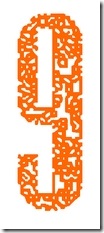
In its day the flat tinsel body humbled most tiers. It’s not used as much presently but the lesson learned holds true for all wound body materials, doubly so if they’re shiny.

Dubbing bodies allows a tyer to add a little more or take a little off, but yarns and chenille don’t share that quality. They’re a constant diameter that shows every lump and foible of the materials underneath, and completely unforgiving.

Mastery of these materials is simple if you get to watch someone else do it. For chenille, downsize it one size and tie it in at the front and double wrap the body.

A double wrapped body of small chenille is the same size as a single wrap of medium, yet you can add taper, wrap it tighter, and tie it off with less thread than the larger size.

Flat tinsel and floss are identical. Wrap from the front of the fly backwards to the tail then wrap back up the body to the start. You’ll have a gleaming body absent gaps in the tinsel or “bubbles” – where overlapped tinsel pops out of the turn next to it leaving a small area of underbody and thread showing.

A large area to work with doesn’t make the task easier. Large trout streamers with their 6X long hook actually magnifies the floss or tinsel’s effect on the overall fly – as it’s much more visible. Working with floss requires you to cover your fingers as the sweat of your grip will immediately remove the shine or stain light colors.
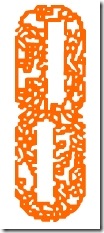
Lead wire on nymphs and larger flies dictate the look of rest of the fly. A poor choice in placement or the inability to address the obvious lumps of where it starts and stops, cannot be corrected.

On trout nymphs the lead wire is the thorax – giving you a pronounced lump that ends the body and defines the wingcase. It should be positioned on the fly exactly where the thorax will occur – and the number of turns used should be the exact width of your planned thorax area.

…that’s right, planned. Flies don’t wind up with proper proportions by accident, and tail, body, thorax, and head are all mapped in your mind before thread touches the hook.

On larger flies lead wire may cover most of the shank, or it may be larger diameter, and no amount of thread or glue will keep it from rotating. Bind it as best you can and use the tail and body materials to plug the gap between shank and the rearmost end of the lead.

The mistake most make is not leaving enough room for the forward transition at the eye of the hook. All your materials will be spiraling off the lead coils and secured on the much thinner hook shank. Dubbing can be used to hide many sins, but wound materials like ribbing and chenille will always have trouble on that transition.

Positioning the thorax too close to the eye of the hook will yield a crowded eye – and worse – if a couple of turns of hackle need to be wound in that area to complete the fly. If the tie off area is still abrupt in definition hackle will flair outward away from the body due to the bulge – rather than close as it’s intended.

Lead placement dictates everything – including the hackle shape.
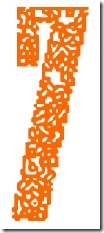
If it’s not dry fly hackle then it’s tied in by the tip and folded, then wound.

… and there’s some very good reasons for that unshakable rule …

Hackle is the most fragile component of any fly, dry or wet. The thin tip gripped by your pliers limits the amount of pressure you can use when hackle is wound around the hook shank. Tying in the tip means the stem gets thicker with every turn and you can apply more force when it’s wound palmer up the body – or used as a collar on nymphs and steelhead flies.

… and at the eye – where it’s tied off, the stem is thickest yet, perhaps enough to withstand being barked on a rock on a low backcast or torn off a tree limb on a misguided forward stroke.

The real value is the effect. Hackle fibers get longer as you move towards the butt of the feather. When winding collars with a folded hackle each turn is longer than the last. Longer fibers obscure the shorter fibers of earlier turns – giving the appearance that all the hackle is a perfect cone of exactly the same length.

It’s beauty were after, remember. Sound science is merely an accidental nicety in our quest to catch fishermen.

“Folding” a hackle is the act of tying it in my the tip and running a right angled object (like your scissors) up the stem to break the fiber’s back and make them slant backwards towards the rear of the fly. This process is shown in all the best fly tying books and is instantly recognizable on the fly itself.

Tying in your hackle by the butts and winding a nymph or steelhead fly’s collar will require you to wrap thread backward onto the hackle to get it to lay down, resulting in a ungainly head that’s got hackle color peeking through – and is prone to damage.

Putting it all together

We started with the least important beautification tips, working our way to the most important. Putting items 9, 8, and 7, together – let’s see how we can use them on a standard #6 Silver Hilton.

Silver Hilton 1: Lead Placement and Downsize
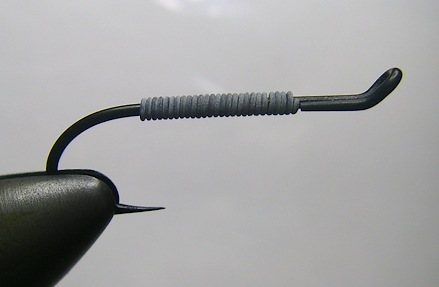
Silver Hilton

Do I use 10 turns of 2 amp lead wire or 20 turns of 1 amp?

Downsize: I opted for the smaller size as I could cover the body completely – guaranteeing the lead is uniform over the entire fly. No lumps or transitions to worry about and I squeezed in 5 extra turns of the smaller wire, making it heavier.

Silver Hilton 2: Gap fill
Silver Hilton 2

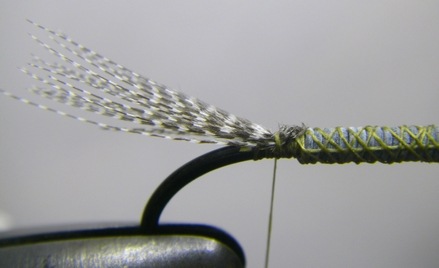
Lead is secured with three runs of 6/0 Olive thread (chosen so you can see it). It’s not going to prevent a vigorous twist between thumb and forefinger – but neither will 50 runs of thread. Thread is always your enemy, use what’s needed and nothing more.

Gap Fill: The teal tail is tied onto the hook shank leaving a transition I’ll address with subsequent materials. The balance of the tail material is trimmed at the rear of the lead, about a 1/4” of tie down/transition remains.

Silver Hilton 3: Gap Fill
Silver Hilton 3

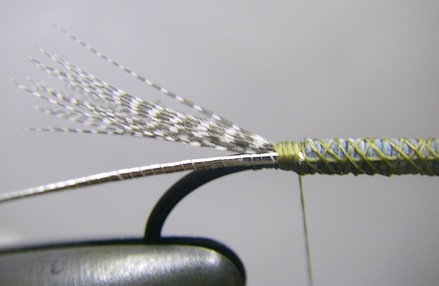
Gap Fill: The oval silver tinsel follows the tail, tied in exactly the same spot and trimmed identically. The “gap” is slowly closing so the transition will be imperceptible on the body material.

Silver Hilton 4: Downsize and Double wrap
Silver Hilton 4

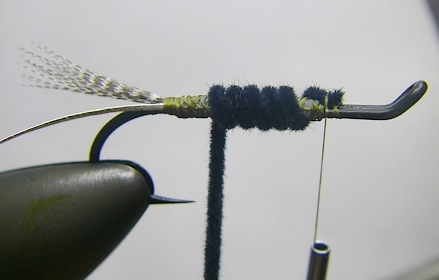
Downsize & Double Wrap: Rather than medium chenille I’m using fine velvet chenille. Regular chenille is just as good but I prefer the finer grained Vernille (velvet chenille) to regular rayon. It’s tied in front so I can make a double pass of the fly body; the first offers bulk, and the second will be drawn tightly over the first to give a smooth gap-free look.

Silver Hilton 5: Double wrap
Silver Hilton 5

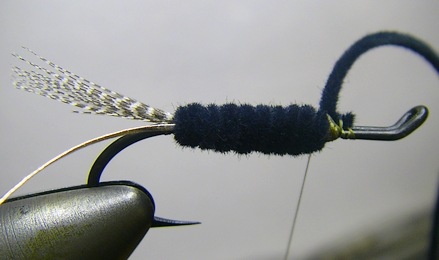
Double Wrap: A nice plush body with a hint of taper, the result of gap fill and the second “finish” wrap of chenille. The second allows me to fill gaps and address contour, resulting in a “fisherman catching” look – and structural integrity.

Silver Hilton 6: Double wrap
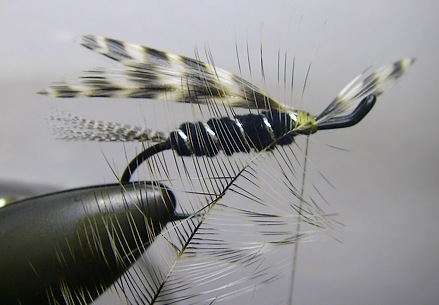
Silver Hilton 6

Because of the fly body being a double wrap of chenille, note how the oval tinsel stays on top of the body versus digging into the material and being lost from view. The extra density of two layers means all subsequent materials will not vanish into the “grain” of the wound chenille.

Likely both fish and fishermen can appreciate that …

Silver Hilton 7: Tied in at the tip and folded
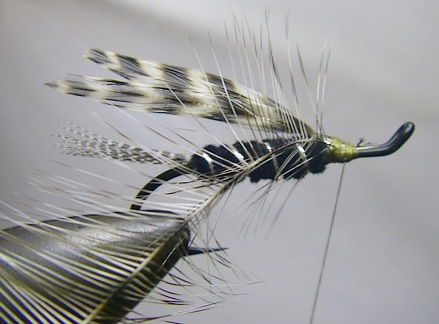
Silver Hilton 7

The hackle has been tied in at the tip and folded. I’ve drawn the right angle of my scissors towards me breaking the spine of each fiber and in so doing they’ll point back toward the tail of the fly naturally.

Silver Hilton 8: Folded hackle
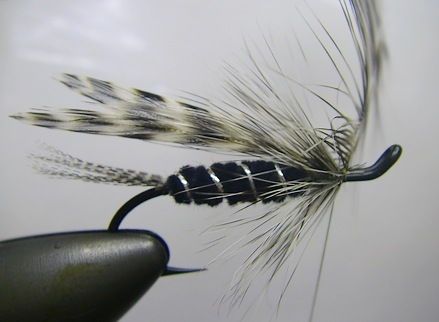
Silver Hilton 8

Folded Hackle: The hackling is complete. Note how the hackle lays back over the fly naturally without being coaxed by 65 wraps of thread. In fact, where’d all that thread go?

Because I can “crank down” on the hackle after the first couple of turns, I’ve laid it exactly where I wanted it – covering the thread tie in area we saw in the previous picture. I’m about to start my whip finish and only two turns of thread are visible.

Silver Hilton 9: The final “fisherman catching Sumbitch”
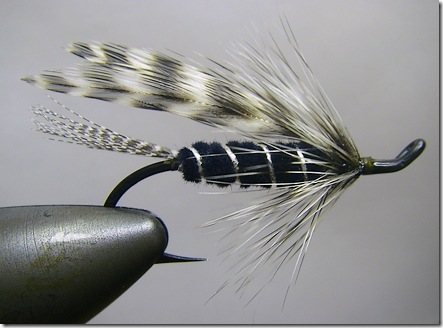
Silver Hilton Final

The completed fly.

Tiny head. No gaps or foibles noticeable – and the eye is clean of cement and feather dander. It is a fisherman catching SOB, and your buddies will compliment you with great sincerity while palming all of them off your bench.

Small things that seem trivial, yet added together can make a huge difference in the way your flies look, last – and how they’re perceived by others. It’s of little consequence when running the fly through a riffle as only fish are a true test of what looks tasty and what doesn’t.

In the meantime, if you’ve just finished your six lessons of beginner class and are feeling your oats, you may want to commit these simple steps to memory.

Next Week: Three more pearls of wisdom as defined by hisself and his questionable wit…

Tags: Silver Hilton, lead wire, tapered fly body, folded hackle, Vernille, velvet chenille, Mustad 36890, teal flank, oval silver tinsel, beginner fly tying class, intermediate fly tying, advanced fly tying, flies that catch fishermen
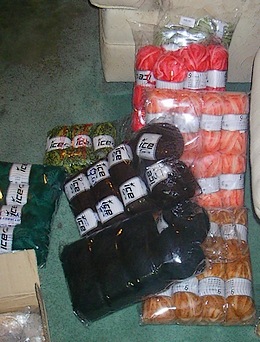
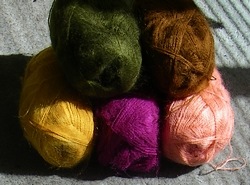
My binges at the Yarn aisle are still intact, just less successful

My yarn fetish hasn’t slowed any I’ve just become demure and sensitive to catcalls from the fellows keeping a manly distance from the yarn aisle and fidgeting under the weight of Madam’s purse. My progress through the store monitored closely by a stern female proprietor who always assumes I’m shoplifting.

Can’t blame her much, she’s never seen a fellow fondle a blend of silk, mohair and polyamide with such sexual tension…

I do my best to set them at ease, shifting the subject quickly to how I plan on dismembering some hand dyed woven masterpiece into lint – and all the fish I’m liable to catch in the doing …

… which is why Grandma presses her phone number into my armload of gaily colored skeins – testosterone is in damned short supply and even a portly scowling fisherman makes for a stirring presentation.

The Yarn reject pile, growing larger by the minute Most of the latest batches have found their way to the reject pile. Lured by color and texture and undone by a hidden weave or indestructible fiber that prevents reduction into fur.
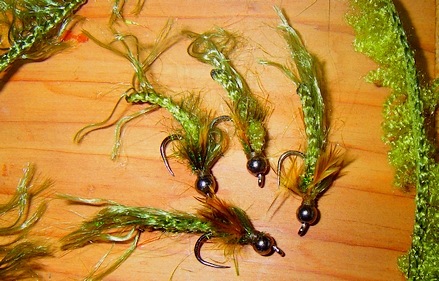
I’m still searching for a heavy fibrous yarn that I can get in 20-30 colors that can be torn apart for large trout flies and Steelhead.

… and at the same time I’m practicing with fiber reactive and disperse dyes – so that once I find it I can turn it into any color missing from the vendor’s base compliment.

Which usually means Olive, as it’s quite a rarity to see anything other than a Kelly Green or perhaps an Ocher.

Swimming_Damsel

I’ve got a lot of testing underway and damn few fish to assist. The above is a swimming-style damselfly made of a polyamide eyelash yarn which also contains a sponge segment that I’m attempting to incorporate.

You saw something similar on the mayfly nymphs I’d done earlier, only this time I’m opting to get more of those soft swimming fibers onto the fly to offer a marabou-style swimming motion.

I’m tying them on Knapek and Skalka hooks, part of a larger test of all the high priced competition wire that is becoming commonplace. I’ve laid in supplies of Knapek, Grip, Skalka, and Dohiku dry and nymph hooks to test quality of manufacture, consistency, fishing capabilities, and wire (soft or brittle) – as part of a larger article on the subject.

… in the meantime I’m proving myself a poster child for the Fish Can’t Read article on obsessive fly mongering.

Tags: Knapek, Skalka, Grip, Dohiku, competition hooks, obsessive feather collecting, polyamide yarn, Fishcantread.com, Olive is no longer fashionable, fly tying

That 70’s cloth none of us admit to wearing? That shortened your life too

Darth Polyester

I figure it was some great sin in a past life – nothing newsworthy or famous, just some callous Lothario that fleeced spinsters of their birthright, some real estate wunderkind that unloaded worthless railroad right-of-way by foreclosing on widows and orphans.

Others have a knack for useful things like plumbing or electrical wiring, own a house full of beaming children and spend most of their time basking in the adoring gaze of their spouse.

Me, I wallow in toxins.

I smile as girlfriend backs out of the garage, giving “thumbs up” while waving the list of “honey-do’s” – and as soon as she’s upwind I’m adding a dab of this to a dollop of that, all of which have skulls and crossbones on the label.

… all of which say, “empty into your sink when finished.”

The sport may be “green” but its components are pure death.

With strong winds in the area and “Momma” elsewhere, it was time to explore polyester and the disperse dyes needed to give it lasting color. Synthetics can be made from thousands of polymers, many of the items we use can be derivatives of nylon, polyester, rayon, or even a component of a natural material like viscose, comprised of plant or wood fiber.

All we see is “shiny” or “sparkly” and rarely delve further than shelling out the money for a nickel bag.

The nice folks that make the raw Soft Crimp Angelina material had sent me the Holy Grail of their “doll hair” fiber, a material data sheet that outlined the temperatures the fiber melts at, the temp the fiber loses its iridescence, and similar data that would allow me to dye their product without torching too many Ben Franklin’s …

Many of you have asked about the material, which is unavailable anywhere except in tiny little packets labeled, “Ice Dub.” I use it in raw form in countless flies and dubbing blends, but have shied away from coloring it because polyester requires caustic chemicals and plenty of heat.

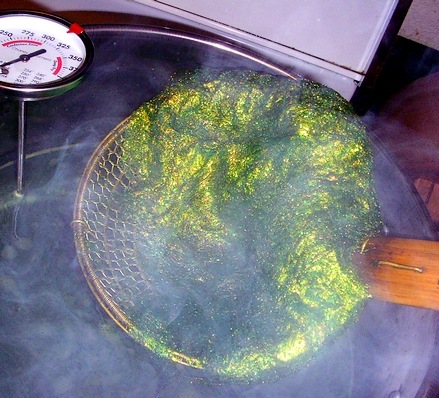
Tasty Peacock Green  … not to mention the fumes, which is the Shit are pervasive and great odiferous. A well ventilated environment is needed so you can get the entire neighborhood lit and as kitchen cabinets, countertops, and flooring may be unknown material (may contain polyester) you can’t afford to drip the stuff on anything other than porcelain or stainless steel.
Skin is no problem. You could dip your head in it and brush your teeth, and after a couple whiffs you’ll want to …

Pro Chemical & Dye has dyes for every type of fiber you’ll encounter. With only 12 colors available for polyester you’ll need to learn the artist’s color wheel and how to construct complex colors from their components.

Example: Olive, a complex color made of equal parts yellow and green, with 1/2 a part of dark grey or black. Add yellow to make it a “warm” olive, and more green to make it a “cold” olive, and add more black to make it a dark olive (either warm or cold). For the below colors I used equal parts Kelly green and Buttercup yellow, and a half part of Cool Black (Pro Chemical & Dye colors). Using Buttercup versus the Bright Yellow means I’ll err on the side of a warm Olive.

As I’ve had experience in dyeing colors and building shades and tints using their components, my goal was to build a color that resembles a Peacock herl or eye. The iridescence was the easy part – it was built right into the Aurora Soft Crimp Angelina, which has motes of bronze, green, and gold.

Peacock is a double complex color as it would be described as green, olive, dark green, bright green, or bronze, depending on the location of the herl and the genetics of the bird itself.

You can’t dye material “peacock” – instead you dye three or four colors around it and blend them to make the final coloration. This is much easier than it sounds as dye baths will alter shades and color depending on the amount of time the material is left soaking.

Three shades, one dye bath

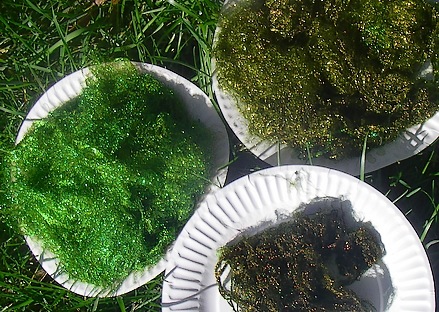
Here is the damp material after 3 minutes (left), 6 minutes (top), and 9 minutes (bottom). One dye bath to color all three shades, only immersion time differs.

Blended Angelina under Morning light

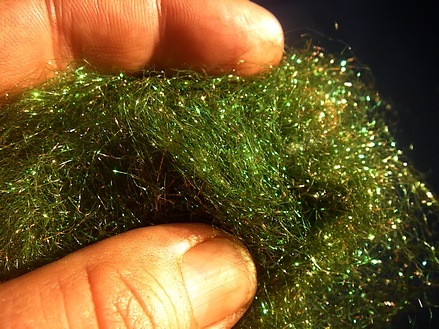
Here’s the final blended color seen under morning light. You can pick out the lighter tints and darkened fibers in the aggregate mass – and I still have the three other shades should I want to alter it further. I used the same formula when blending the result; one part green, one part darker olive, half a part of the darkest shade.

Used on a leech

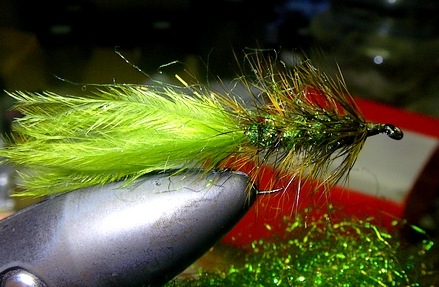
The above shows the mixture used on a traditional leech pattern, note how the florescent light makes the material much more green than the prior photo shot outdoors. Florescent is a “white” light – not blue tinted as is normal sunlight, it always lightens colors by one or more shades.

#14 Zug Bug

I always hated tying Zug Bugs as the peacock has difficulty hiding the bulge of lead wire underneath – plus its fragility. Above is a #14 Zug Bug tied with the blended color, note how the slip of mallard lies flat on the back (as it should). The finer filament coupled with the ability to build the proper taper with dubbing gives much more control over the fly than wound herl, and the durability is increased at the same time.

That's no "dime" bag

I still need a great deal more practice with these new dyes but once I’ve built the formula for colors and immersion times, I’ll be able to reproduce these with reasonable surety. Returning the material to its dry and fluffy state is also quite problematic as I’m still un-matting the fibers by hand.

Knowing my “stay of execution” is limited – I’m hustling the dye pot outside as soon as each color is achieved, there to cool down while fumes exit the house. The ceramic disk attached to the storm drain stares at me accusingly – a large fish with the entreaty, “this empties directly into the river.”

I considered the crime briefly, but opted for the squirrel burrow in the backyard. While the label says it’s safe I’d rather be entertained by a florescent Orange squirrel staggering out of his burrow on unsteady legs.

The kids next door trundle up to investigate and I’m unaware until the little blond angel wrinkles her nose and says, “oOo, what’s that smell?”

They’re peering into the algae colored water with the shiny bits of debris  – and I’m croaking out my best sinister through the rebreather, “ .. in the cauldron boil and bake, eye of newt and toe of frog, wool of bat and tongue of your dog …”

… they screamed appreciatively all the way back to the house. Ma came out to make sure all was well – and fixed me with the obligatory “you are so bad” look as soon as chubby fingers pointed in my direction.

It means visitors next Saturday night requiring a double fistful of Snickers to pay for my sins.

Tags: Peacock, Ice Dub, Soft Crimp Angelina, Pro Chemical & Dye, polyester, disperse dyes, Halloween, little blond angel, toxic chemicals, Leech, Zug Bug, fly tying materials, fly tying

How to torture both cloth and your dog, and not wear the result

Having a eye for the next great fly tying material is one thing, ideas being the easiest part of the larger riddle, it’s the destruction and transformation that is the real test of invention.

I’ve discovered the next great dry fly dubbing; filament size smaller than the finest materials currently available, specific gravity less than 1.0 – so it floats naturally, and wants to stick to thread so badly that static from your fingers is nearly enough to wind it tightly around unwaxed thread…

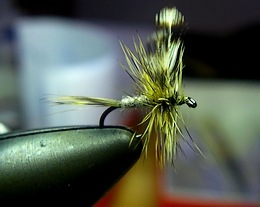
The #16 Light Cahill

I’ve got visions of groupies and dinners at the White House, getting the “hale fellow well met” glad-hand from the current anglers of legend, and never having to pay for drinks again…

… there’s just this teensy little problem I have …

I have to destroy it to make it.

Blenders can’t dent it, acid melts it, and dragging it behind my truck works – but I can’t tie enough to the bumper to create a snowstorm of filaments that I can scoop off the neighbor’s lawn.

I’m doing battle with some Ph.D fabric engineer who saw a great cloth and spent months ensuring it’d never unravel. He didn’t realize some idiot fly tyer would delight in destroying his best work for the sake of dampening it in a trout stream.

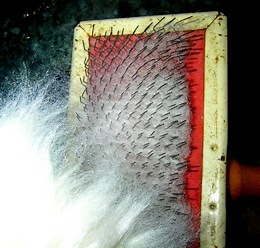
Old Tailwagger The first sign of progress was the judicious use of “Old Tailwagger.” It’s right after blenders in the fly tying book of mass destruction. Blenders excel on yarn, but fabric requires torture to become fibrous, and the Tailwagger is the tool of choice for stressing tightly woven filaments.
The downside being everything four legged is your new best friend. I use a brown paper bag to smuggle it past the family pets – which possess a sixth sense for leashes, brushes, and trips to the refrigerator.

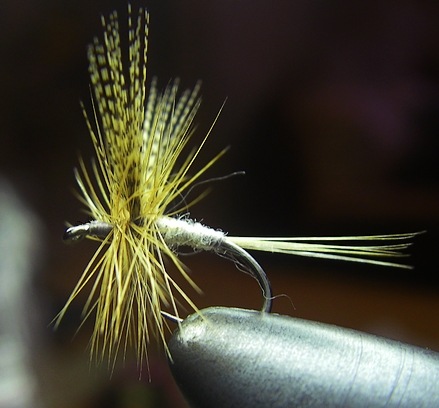
The above picture shows the results of stressing a “panel” of material and rendering it from flat and lifeless – to a veritable sheepdog of fiber.

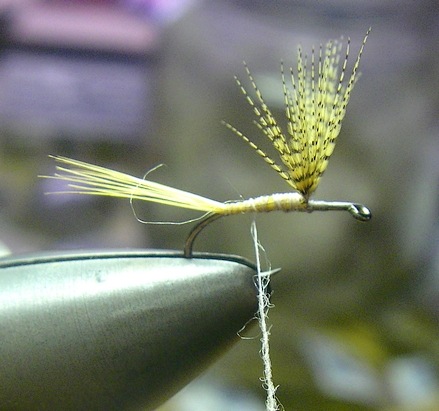
Note the fiber at the tail, about 1/5 the thickness of a single hackle

As I’m still possessed by the Catskill dry (due to Mike Valla’s book) the above shows a single filament of the dubbing contrasted against the tail fibers of a Light Cahill. The filament size is only about 1/8 of the width of a single hackle barbule.

That’s nearly microscopic.

That translates into a tiny dry fly body – and much less water absorption than normal. Wings and bodies have always proven the nemesis of dry flies as they’re the only materials that don’t assist in flotation. Smaller amounts of dubbing assists both classic dry and their scientific cousins in remaining afloat.

No build up

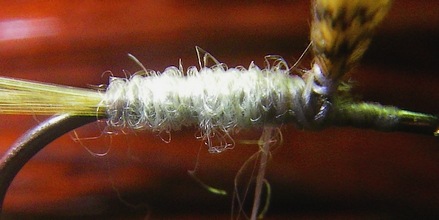
For the aspiring dry fly fiend this solves one of the more troublesome problems. How to dub a tight thin body that’s neither lumpy nor absorbs extra water. The above magnification shows the complete dubbed Light Cahill, albeit poorly, there’s almost no build up of material when compared to the raw thread area behind the wing.

… and why I spent the better part of this weekend transforming the material into something usable.

Hell, I got a bag full of the Goodie

Now all the fun starts. Dyeing the material into the most common 15-20 colors used for dry flies – additional tinkering with blended colors – and I may attempt to mix it with larger-fibered beaver or muskrat just to gauge the effect.

Microscopic fibers don’t blend well using machinery. Only water shaken vigorously can act as the blending agent. Blender blades and agitators just clump the fiber like cotton candy.

It’ll take some time to pick the colors and render mass quantities of material, but Winter is plenty long and this type of project is just what’s needed when football grows dull.

Those of you who fancy the dry fly might want to drop me a note. I’d be happy to send out some samples when I get a couple nice Olives and a medium Gray, as I’ll be looking for some feedback on both the material and colors. Refining a raw product takes a great deal of tinkering, patience, and time.

Tags: dubbing, classic dry flies, Light Cahill, dry fly dubbing, fly tying materials, fly tying

How to extinct the San Juan Worm without half trying

I’ve been holding this one close to the vest for fear of upsetting the Roughfisher, knowing once he catches a glimpse of what’s possible, we’ll be seeing “Darth Earthworm” and the San Juan Worm’s days are numbered.

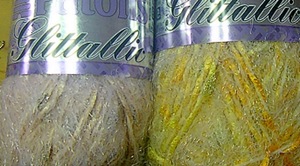
Paton Glittallic yarn

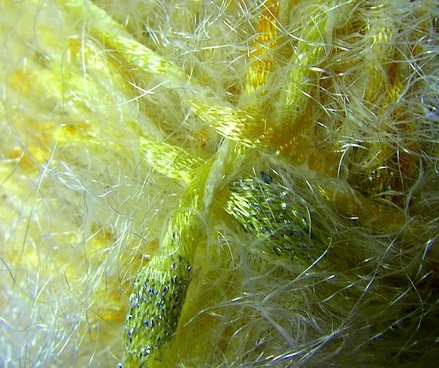
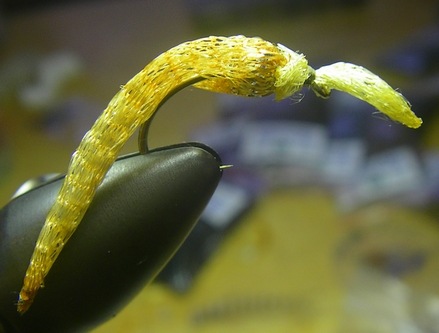
It’s actually two yarns loosely wrapped together. One is best described as a trilobal-polyester that glitters like broken glass, intertwined with a soft synthetic braid that can be used as a flat yarn, or you can stuff things inside it to stretch it into a veined mayfly wing, or seal the ends to make a San Juan Worm-killer.

Pink and Amber

The woven strand looks like a shed reptile skin – and whips around in the water like a snake. I used it for the shellback on the October Caddis earlier, and am converting the old SJW to this – more mobile flavor.

The downside is that not a lot of colors are available, and being polyester, dyeing what’s needed is more work than I care to endure. Special polyester dyes are required as is a chemical fixative and a lot of heat.

SJW Killer

I flamed the end to melt some rigidity into the tube, threaded it over a 4mm gold bead and added the SJW headpiece. Both tubes are sealed with a lighter to complete the fly. The motion is so much more wormlike than the velvet chenille that I’m tempted to eat it.

What’s needed is a good rich Olive, but I’ve only found the material in black, Lilac Lame (pink), Cream Gleam, Blue Flash, and Maroon Shine. It’s about $2 per skein on EBay.

Tags: San Juan Worm, Paton Glittallic, Polyester, Lurex, October Caddis, fly tying material, Roughfisher.com. trilobal yarn,

The Czech Republic lends some sparkle to the mix

In Spring a young man’s thoughts turn to love – and in Fall, us mature types think of love too, how much we’d love it to be cooler…

I’m tired of dusty creeks and the rattle of discarded water bottles blowing in the hot breeze. We’ve endured enough fires, sweltering mornings, and fleeing to the safety of air conditioning before noon.

October usually offers the first real respite from Summer’s heat. After three years of drought and yet another fortnight of blazing days I’m ready for mornings chill and the tinkle of something other than broken glass.

I’m going to will a change in the weather, if only by the flies tied.

Jan Siman's Peacock Dubbing

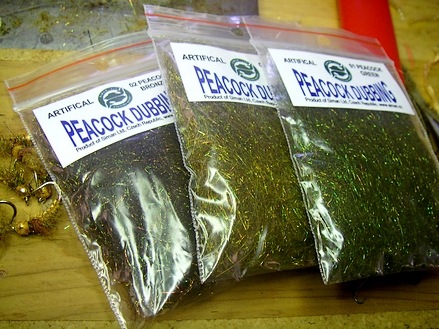
Jan Siman’s Peacock dubbing showed Friday, which had me scratching my chin. It’s a different cut of Angelina fiber that I’ve not seen before – akin to the the soft crimp but with straight fibers rather than crinkled.

The straight fiber offers a much rougher dubbing than traditional soft crimp Angelina fiber, consistent with the dubbing-brush-rough-combed look of most Czech nymphs. I’ll investigate this style with the vendor to see if there isn’t something new in the offing.

Comparatively speaking, the Peacock dubbing package is about a quarter the size of a traditional pack of dubbed fur – and the declining dollar versus the Euro adds to the $4.25 price burden. Beautiful colors useful for much more than Czech nymphs – but I was caught up in a new yarn, a yen for cooler temperatures, and the Fall Big Bug, the October Caddis.

October Caddis, Czech style

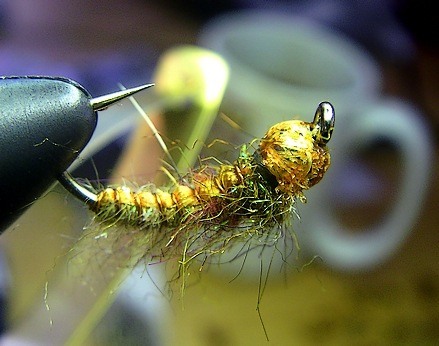
It’s a mixture of new materials; using the lace component of a new trilobal yarn I unearthed, mixed with a gold and brownish-burgundy blended fur and topped with some of the Peacock dubbing.

Tied upside down so the the lace is on top once the fly flips over. The Orange lace extends over the bead and is tied on the opposite side. This gives the gold 4mm bead an orange effect, and dulls the shine quite effectively. You can see the raw gold versus the yarn-draped color in the picture shown below.

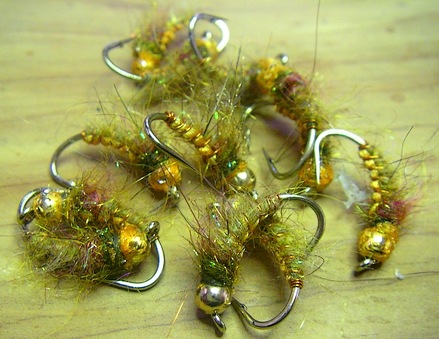
A gaggle of Czech

Comb out the underside a bit to offer a hint of leg, and start praying for colder weather and fish with an appetite.

Tags: Jan Siman’s Peacock dubbing, Angelina soft crimp, Angelina fiber, fly tying materials, October Caddis, Czech nymphs, fly tying

How a tee shirt becomes a dry fly

There’s at least 175 ways to get this outcome accidentally, but only one way to do it intentionally…

Grizzly is one of those “must have” chickens that’s used on absolutely everything. Big feathers used on streamers, small feathers used on dry flies, and everything else used to make hackle tip wings or add mottling to nymph parts.

#16 One Feather Adam's Fly tiers that dye their own feathers are often tempted to toss all the other colors and just dye Grizzly necks Brown, Medium Dun or Ginger. Impressionists like myself love the mixture of colors on the feather – with the light bands somewhat indistinct, and the dark bars offering rigid color that define the fly.
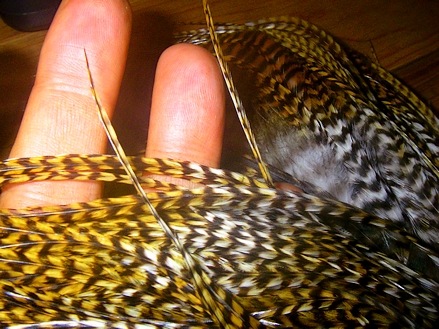
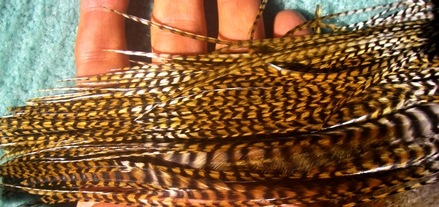
I’d been fiddling with Jacquard Acid Dyes and streamer feathers – using the old “butt ends” of grizzly necks to tinker with yet another dubious idea. Dyeing is the best way to destroy materials and experimenting with new dyes always adds a couple extra foibles guaranteed to disappoint.

I ran out of the chestnut dyed grizzly used for the Calibaetis dry flies I use while lake fishing, and worked up enough nerve to dye a Hoffman Saddle with Jacquard’s version of Olive –  which is actually a nice brown color.

Testing on a chunk of Red Fox confirmed it was a warm chestnut color, and I added a teaspoon of Aztec Gold to warm it further. I vacillate on this fly every season – some years I use natural Grizzly, and when that doesn’t work the next I’m tying the chestnut variant.

A feather with both would be perfect.

Tie-dyed grizzly, an Adam's with one feather

I’ve been playing with a “tie-dye” method for feathers that does something similar. I tightly wrap kite twine to a stick then bind the saddle onto the surface with concentric wraps of twine. Tied tight enough the twine prevents the dye from reaching the feather yielding a “bar” of natural color that can be dropped into a second color of dye (or left natural) to make multicolored hackle.

One look at typical baitfish explains why you’d want a multicolor effect – or the dyed-natural flavor, fish start with a light colored belly and a dark back – with many colors between the two.

More bang for the buck

Us retired commercial fly tiers recognize an Adam’s could be tied with one hackle. Not only would it be cheaper but it would be much faster too. While profit is no longer much of a motivation, like most fly tiers, I still hate using two hackles to tie one dry fly.

Large streamer hackles (some shown above) give a nice color transition from natural to brown. Olive would make another nice color to transition with yellow or similar light color. Toss this into a lighter colored dye bath, like yellow, and the brown would be untouched while the natural sections slurped up that yellow dye.

With this batch I tried a couple other cords all smaller than the kite twine, and all failed to hold the color at bay. I don’t think anything smaller than 30lb mono is capable of mashing the fibers tight enough.

Tags: tie dye, fly tying materials, grizzly hackle, Hoffman saddle hackle, chestnut, Jacquard’s Acid Dyes, Red Fox fur, dyeing fly tying materials

Elk Hair Caddis still don’t tie themselves, something to consider before you call that Malibu halfway house

vulterine guinea fowl I’ve told you many times how fly tiers are a bestial lot lacking moral fiber and entirely untrustworthy when it comes to brightly colored wildlife …

… all wildlife really … they’re hell on the drab stuff too.

A couple of weeks ago Moldy Chum posted about a rare collection of birds pelts lifted from a museum in England – how fly tiers were being “hobby-profiled” and cavity searched as part of the investigation.

At some point all fly tiers work up the nerve to attempt the full dress Atlantic Salmon featherwing as it’s both work of art and testament to the craftsman. Like Everest it’s there – and that’s enough to draw the bold, the feeble minded, and those that thrive under impossible circumstance.

The genre is utterly brutal; starting with feathers and furs that have been banned for 50 years, and ending in a crescendo of references to out of print books, hooks you have to make yourself and a “trail of tears” with no apparent end.

Accumulating the materials is impossible without risking significant jail time. Those that have them are close lipped, those that don’t rely on dyed imitations of a feather they’ve never seen or felt – unsure if it’s even a good imitation.

Those addicted to the craft will endure any agony and pay any price for the original materials.

Many years ago I did my best to scrape together what I could when some of it was still legal. Despite my best attempts at cloak and dagger 90% of what I needed was only available in dimly lit alcoves – sold by smelly old guys wearing trench coats…

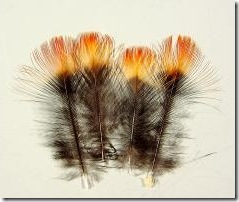
Real Indian Crow Doing a little research recently I stumbled upon Ken Sawada’s storefront where some of these feathers are sold legally. Before you run out and drop $72 for four Indian Crow feathers (which makes two flies) remember it’s not legal to import them into this country – despite their availability in Japan.

The prices are unreal and make fancy fly rods and engraved fly reels pale in comparison. For the fly tiers so afflicted here’s a chance to see what the originals look like. I would save the pictures for reference material.

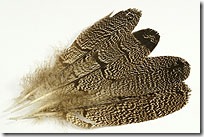
Speckled Bustard                     Speckled Bustard anyone? The shoulders are only $839 for the pair. Cheap.

Keep in mind that Condor substitute – not the real stuff, is $61 per feather.

By now the non-fly tier’s are thinking we need detox or an intervention – 8 weeks mingling with D-list celebrities in some Malibu halfway house. But rather than condemn us to a fiery hell for our avarice and desire to own rare species, remember that Elk Hair Caddis still cannot tie themselves. You still need us.

I’m sure the decline in the US dollar has aggravated prices just a wee bit. The fly rods are cheaper than ours, but the Ken Sawada hooks are $35 for 25 in the trout sizes. Adam’s are $3.93 each.

It’s an interesting browse just the same. A glimpse at feathers you may never see again – and little wonder that fly dressers in the UK (or abroad) might be fencing Blue Chatterer to the tune of a tidy profit.

Tags: Blue Chatterer, Speckled Bustard, Indian Crow, Full Dress Atlantic Salmon flies, stolen museum birds, fly tying, condor, vulturine Guinea fowl, Ken Sawada

How they do that is a mystery

You might say my day started poorly. I’m up extra early attempting to cram in a fast run to Sporting Creek even though it’s supposed to be chore day.

My first mistake was making the coffee using the dubbing grinder – the Obergruppenführer of Romance insisted I be doubly good in her absence and had outlined a long string of chores to accomplish. The commandment was “…and don’t mess or dirty anything!’” – and I’m spewing Angora French Roast out of my nose while hacking up a claret hairball.

I figured “dry grinding” some of the my double-extra complex dubbing could be done while fixing leaky faucets and doing the laundry. A once-over with a wet sponge and the countertop is “guy clean”.

… and if she spots a dust mote shrug shoulder and act innocent.

Now I’ve got French Roast dripping from the kitchen cabinets and using her pasta fork to scrape squirrel off my tongue. At 3AM you simply strain the coffee through a washcloth and keep packing the truck. Tastebuds don’t wake up till 4:00 AM – so the washcloth doesn’t even have to be clean …

5 colors will make many more Fishing was frustrating and fun – but meeting my first female brownliner was a first. I was already in deep yogurt with the Missus, so I didn’t compound the sin by chatting longer than pleasantries.
I manfully tied on an apron when I returned and did my best not to sulk.

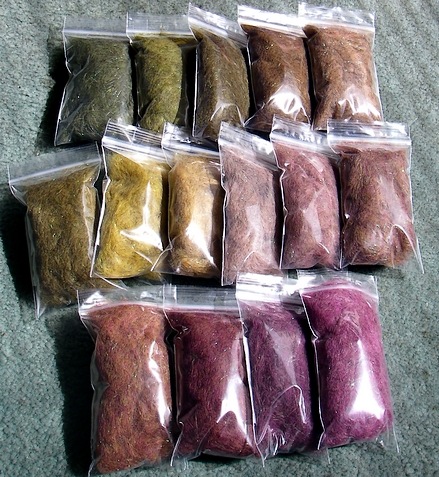
“Dry dyeing” uses the colors of the components to make new colors. I started with 5 colors of an angora-mohair blend, 4 natural furs, and the Soft Crimp Angelina. While diligently mopping the kitchen, mowing, changing light bulbs, and doing all the rest of the honey-do’s, I’d periodically return to the scene of the crime and mash the grind button.

Complex colors - made with up to 10 components each

That’s a grapefruit sized ball of dubbing in each color, enough to tie many thousands of questionables. A little judicious use of the Artist’s Color Wheel allowed me to get a full spectrum of buggy colors with only the five yarn blends as coloring agent.

Most were constructed of equal parts of an adjacent color, some have three, others require four. Can you pick out the color that is all five mixed together? (*answer below)

Just harken back to elementary school watercolors – and what happened when they all ran together.

Complex dubbed Birdsnest

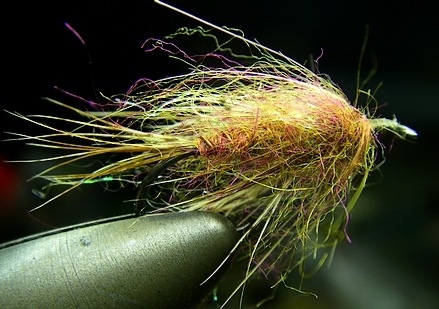
The above Birdsnest is constructed of brown partridge and a complex dubbing. It’s actually brown but photographed under a florescent (white light) lamp which lightens it up considerably. Note how the claret color stands out from the rest of the components.

Which is precisely what I expect on the Missus’s return. One white gloved swipe of the kitchen counter and she’ll mention, “ … note how the exhaled French Roast stands out from the faux walnut of my cabinets.”

How they do that is a mystery…

*Bottom left – the same color as used on the Birdsnest, note the difference of natural daylight versus florescent light in it’s appearance.

Tags: Angora, Mohair, blended dubbing, brownliner, partridge, artist’s color wheel, french roast, fly fishing, fly tying materials, deep yogurt, guy clean

How Yugoslavia put the adrenaline back in fly tying

I suppose some might consider it  “the fun’s back in fly tying” – but while I’m here sucking a forefinger, I don’t see it that way…

The Skalka and Knapek competition barbless hooks arrived yesterday, and with less than 24 hours before my march northward, I had to bang out as many flies as possible to have something to test.

I tested my coagulation rate thoroughly, that and my blood type…

Knapek dry fly and streamer hooks are a “squarish” bend with a wicked kirbed, barbless needle for a point that seeks human flesh with neither guilt nor remorse. Lacking a barb to slow its progress through your palm or forefinger – it’s added a new dimension to fly tying…

… and that’s what I’d expect of a hook that costs nearly $0.30 each – whose attributes might separate you from kissing “Miss Colorado Flyfish” and a five digit payday.

Knapek Streamer Hook

For the first time I found myself commiserating with the prey – as I alternately nursed one fingertip after another. Materials that obscure the hook point yet need to be coaxed backwards on the shank – like hackle or chenille, invariably put those precious highly-trained, coaxing fingers into Harm’s Way. 

The pain starts to register after it’s a quarter inch in – giving you a hint you should stop applying pressure – but the follow-through is still enroute, so the second quarter inch is just a bonus. Once the point encounters the back of your fingernail it slows down some …

I’m thinking that a standard hook set would drive a #14 Humpy clean through the trout’s skull – and with a bend designed to keep the corpse attached – telling the warden, “I didn’t do it” will be a bit of a dance – what with the lifeless parr-marked corpse bobbing nearby.

Tying on these requires the vise to grip the bend of the shank and none of the point, or just the point and none of the bend. With a 10 degree offset, grabbing both point and bend will bend the wire, removing the kirbed portion and possibly weakening the wire.

knapek Dry #14 The points are fiendish, much longer and sharper than what I’m used to – and beaked, turned up to hold onto the flesh its just violated.

They adhere to traditional Redditch sizing – which I like much better than the Tiemco / Mustad standards. Both the Tiemco 100 series and the Mustad 94840 / 3906B are about 1X longer than they should be – and the Knapek are sized true like the older and shorter Partridge, “Captain Hamilton” style.

In short, I’m in love – not the sappy “chick flick” kind, more of the sinister sado-masochistic thing – and with piercing all the rage, I can wait till “Mr BB-Lip” finishes wowing the girls with his fourteen piercings, then I can recount the last thousand I endured …

I’m not so sure the Masai might not induct me as a full blood brother…