Author Archives: KBarton10

At least the supply of farmed Turkeys is assured

Enjoy it while you can Despite two years of closure the count of returning salmon at the Coleman National Fish Hatchery is down 60% compared to last year.

Scott Hamelberg, the hatchery’s manager, said Thursday that only 8,000 Chinook salmon have returned to the Battle Creek hatchery so far this year, down from 14,000 the year before, one of the lowest-ever returns since the hatchery was built to offset the loss of breeding habitat caused by the Shasta and Keswick dams.

In light of 480,000 returnees in 2002, Salmon populations in the Sacramento now cannot even provide enough eggs and milt to fill the incubation trays.

I suppose it’s a relief to Cemex – as they’ll be getting the contract to line the bothersome ditch with cement – smoothing out all the bends so the water can be carried south faster.

I’m reminded of the scene in “Rivers of a Lost Coast” where the fisheries biologist mentions, “it won’t be the fisheries that will change things, it’ll be the need for clean water that’ll arouse the public..”

I think the fisheries lobby has missed the boat. It’s plain there’s not enough anglers to make the demise of a noble river an issue, we need to bring the issue to the masses in a way that’ll deprive someone of something.

… like rationing Fillet O’ Fish sandwiches, or closing a half dozen Hollywood sushi venues.

Some suburban mom outraged that she can’t slow her child’s wail of anguish with a sugar-fish with bun – some minor celebrity pouting over his Tekka Maki being made with canned tuna …

Hell hath no greater fury.

Tags: Coleman National Fish Hatchery, Sacramento River Salmon

Part Last – Singlebarbed teaches the beauty secrets of the Shao-Lin Masters

As we mentioned in Parts 1 & 2, the measure of true fly beauty is held by fish not humans. Unfortunately only averaging  9 days afield your flies are viewed most by people, and suffering their continual criticisms can make a fly tyer resign himself to please both anglers and quarry.

… and in the doing, gain the precision to make his flies sturdier.

We’re down to the final three, each so hideous and daunting as to cause fly tiers to scream, gnash teeth, or give up the craft entirely. Three crucial steps that professional tiers do subconsciously, that plague beginners for decades, are rarely mentioned, and completed so quickly you’ll miss it on a video or live demonstration because you’re drawn to more glamorous materials and technique.

Watching a talented tier can be mesmerizing. A crowd of fellows inching forward looking at some vindictive SOB who’s just palmed a couple ounces of yard-long #16 saddle hackle in Coral Pink. You’re trying to stammer the question, “… Wh … where’d you get that?” – and you miss a half dozen gems of technique while he pretends he’s got a closet full of the material and doesn’t.

Here’s what you missed:

three In prior posts we mentioned the difficulty of keeping materials from moving around the shank – either via thread torque, bulk, or method of attachment.

I’ll ask a simple question;

Which holds the tail of a nymph onto the shank, the six turns of thread you used to tie it on, or the forty turns of thread that come with adding ribbing, body, and all remaining steps?

Light bulb.

Thread management is part art form and part physics. Thread is your enemy and we use it as sparingly as is possible. It’s heavy, lifeless, and is always applied in great quantities where it’s least useful.

A tail isn’t “lashed” onto a hook with tight concentric turns, it doesn’t require taming where all traces of it are buried under thread, it’s anchored with three tight consecutive turns of thread at the tie-in point, and then the thread is spiraled to the next step.

That’s true of wings, wingcases, ribbing, bead chain eyes … and everything else.

The anchor wraps occur at the last portion of shank before the fibers become tail. The butt ends will be bound securely by the thread used to dub the body and attach the ribbing, and we don’t need any additional turns to hold them mid-shank. Any tail movement will occur at the anchor point – not in the middle of the fly.

Understanding the physics behind this practice is the hard part, execution is much easier. “Anchor points” exist where the stress will occur – and the thread wraps and tension used are critical only at that spot – all other wraps position the bobbin for the next step.

Less thread pays off in slim profiles, small heads, and buoyant dry flies – and is as memorable to the critiquing angler as is the curves of a Supermodel.

two

Hand in hand with the notion of “anchor” is the tapered cut. As described above the anchor is needed to hold the material firmly to the shank. Once the three wraps of the anchor are in place, it’s an automatic trigger for the cut.

New tiers are still unfamiliar with everything; small hooks, tiny scissors, unfamiliar materials, and insecure grasp of proportions. They’re thrilled to cut the material at all – and usually after securing it with 46 turns of thread.

Often they’ll “blunt cut” the item, scissors held at right angles to the hook shank so they can square cut the wing or tail butts – leaving a promiscuous gap between material and shank that will have to be addressed by subsequent materials.

Intermediate tiers will have learned the horrors of the lump left by the blunt cut, and will taper their cuts – scissors parallel with the hook shank – cutting downwards at the shank.

… after they’ve secured the item with 26 turns of thread.

A blunt cut can only be used when the material covers the entire body area of the fly.

All that’s needed to attach any part of a fly to the hook shank is three turns of thread.

Bold words, and you’ll note I didn’t say it was attached permanently. If the anchor is the only thread needed to hold the material stationary – and subsequent steps will add more thread to lock down the butts that extend over the body area, than those three anchor turns will hold the material well enough for us to cut the taper – yet will be loose enough so if torque has carried the fibers too far to one side, we can straighten them with finger pressure.

Which is why the Golden Rule applies: Nothing on a fly can be fixed by laying more crap down – because the “three-turn-anchor-tapered-cut” allows us to reposition it before we move to the next step.

We fix as we tie, because we’re learning thread management.

The taper we induce as part of the cut is every bit as important as the anchor and the three-turn trigger cut. For flies that please humans, only two kinds of cut are permitted; the blunt cut when the material covers the entire body area – as in the tail of a dry fly – where it’s trimmed behind the wing, or the tapered cut – which produces the finished body contour.

Using cuts to define body shape is easier than adding the right amount of dubbing to thread to have a thin arse and thicker middle. Beginners and Intermediate tiers haven’t mastered dubbing yet, asking them to be doubly clever in its application will not work.

… and tapered cuts have to be learned anyways – as not all flies have dubbing to make contour. The Quill Gordon is a classic example, it’s body is the stripped quill from a center strand of Peacock eye and the taper of the body is caused by the cuts made on the prior materials.

It’s easiest for a new tier to learn to dub “level” – that’s something he can gauge easily as it’s the same thickness of fur over the length of thread used.

… later, after he finishes digesting the three parts of this post, he’ll be able to master a tapered dub consistently – and will have an additional tool at his disposal.

one

Nothing gives the prospective fly tyer more trouble than dubbing. It’s deceptively simple, a simple twist between thumb and forefinger – nothing devious or hidden, no wrist motion or hidden timing.

It’s “mash crap on thread” – yet the proper technique of this routine task eludes most tiers for decades.

That’s because there is no technique.

It’s no different than loading a paint brush. A tiny thread, whether it’s waxed or no, can only trap a certain amount of fur tightly. Anything more than that will be trapped loosely – and if you add more will degenerate into a lump of sodden crap that resists your saliva, glue, hammy hands, and everything else you throw at it.

Golden Rule of Dubbing: if you can’t see through it, you’ve got too much.

I like to use “mist” to describe the dubbing process to students, as all mists whether water, vapor, or solid, are transparent.

The average #16 dry fly uses so little fur that you could snort it without sneezing … but the gag reflex is horrid.

The inability to apply the correct amount of dubbing, and the myriad of issues it raises, adds a common visual roughness to all your flies – as it’s among the most common tasks performed, and is so very visible.

It will not matter how many videos and demonstrations you’ll watch, the right amount of dubbing is an afterthought to the presenter – he’s mastered dubbing and is busy explaining why you want to fish his Hopper over someone else’s. “Mist” isn’t visible to the camera lens unless it’s within inches of the fly, and much of the action is off screen.

Dubbing can be a very deep subject to us reformed-whore-nutcases, that two percent of fly tiers that go where others fear to tread. We blend fur types and textures, layer colors, give it loft and sparkle, or shape it to replace traditional fly components. But the average tyer still struggles with loading it on the thread, and his Messiah is strict adherence to the Golden Rule of Dubbing above.

Once mastered you’ll realize there are many kinds of dubbing, some are well suited for the task, and others are very poor dubbing choices – but are endured due to the color or sparkle they offer, some quality not found in traditional fur bearers. Baby seal is a great example. A transparent sheath surrounding a white inner core, designed to reflect sunlight away from the animal so it doesn’t burn to death while waiting for that insensitive Canuck to mash its life out with a club.

… sure, you’re all tears now, but that’ll change once someone offers you a nickel bag.

Dubbing that’s suited for dry flies are usually the waterborne mammals, fine filaments and soft to the touch. Nymph dubbing can range from fine to coarse, often contains a goodly component of guard hair, and may contain synthetics to offer sparkle or other qualities.

Just because it’s the right color doesn’t mean it’s the proper tool for the job. Store bought dubbing is simplistic generalist dubbing, not the premier designed-for-dry-flies that us nutcases are fond of …

Putting it all Together:

Let’s put these hideous lessons together in an assault on the traditional Catskill dry, a magnet for criticism whose light coloration shows every lump, knot, and tear stain:

Light Cahill 1: What I see that you don’t
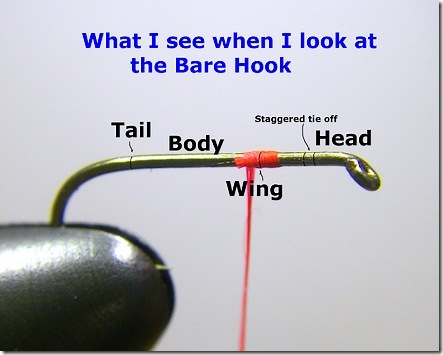
This is what I see, and you probably don't

I can’t help it, I see all the tie-in and tie-off points, where I’m going to put the wings, tie everything off, start the head, where the body ends, the entire fly just by looking at the hook shank.

With this “tie by the numbers” approach coupled with thread management, I know when I’ve strayed over a boundary line – and correct it right then, rather than let the problem slowly compound.

Light Cahill 2: Three turn anchor, trigger for the tapered cut
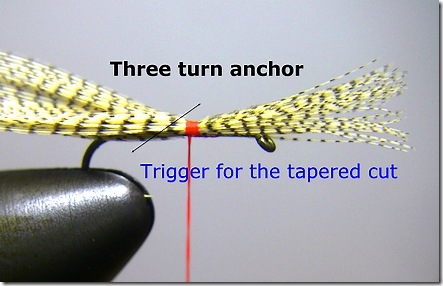
Three Turn Anchor

I’ve attached the Woodduck with three turns of 6/0 Danville. I’ve tied them in about two turns of thread past the mark where I want the wings to stand – this space will be consumed by me folding the material upright, something that most beginner and intermediate tiers forget. Transitioning anything from horizontal to vertical will consume space on the hook shank – and if the heads of your dry flies are perennially crowded, you may be forgetting that critical physics lesson.

Three turns is my trigger for the tapered cut. I’ll come in from the wing side and cut downwards towards the shank. If you have tungsten tipped scissors, it’s the most dangerous cut possible, as tungsten is extremely brittle and you can chip or remove the points if you catch the hook shank in your cut.

Light Cahill 3: Body taper complete
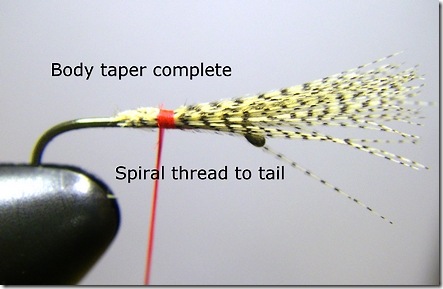
Body Taper compliments of a scissors cut

The tapered cut is complete and my body taper established. The anchor point holds the materials firmly so I’ll spiral the thread to the tail position and mount the tail now.

Note: Us old geezers that used Nymo thread in the 70’s and 80’s recognize that nylon thread can be used in two manners. Spinning the bobbin will essentially turn the filament flat (which is why my thread appears so wide) and will create less bulk than a normal strand of 6/0. Spinning the bobbin again will restore the spun flat fiber to round – best used for the anchor wraps themselves as they can bite into the material.

It’s all part of the art of thread management. Thread is a lot more than it seems…

Light Cahill 4: Tail anchor
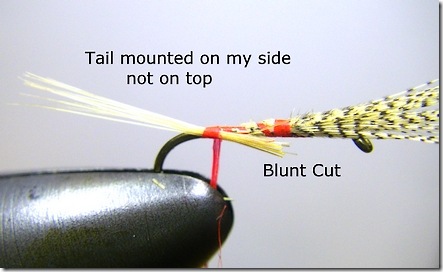
Tail anchored

There’s a lot to see in this picture, as this is where a lot of techniques start to pay off.

The thread has been spiraled from the wing anchor to the tail mount point. The tail has been mounted on my side (thread torque) with a three turn anchor. The tips of the tail have had a blunt cut (scissors at right angles to the hook shank) but are long enough to traverse the entire body of the fly.

A blunt cut can only be used when the material covers the entire body area of the fly.

… so we have adhered to the rule as stated above … and now we’ll begin to see the reward.

Light Cahill 5: Token Blurry Picture
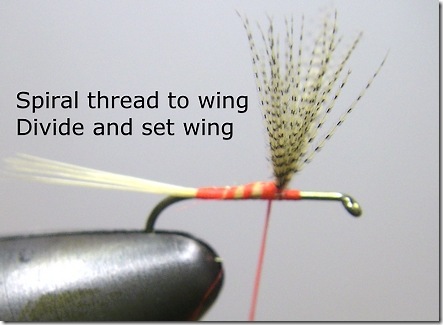
Taper preserved

Because the tail butts are uniform thickness and cover the entire body, the taper induced by our scissor cut has been preserved.

Note the spirals of thread as it was moved from tail mount to the base of the wing. That’s not 56 turns of thread, or even 24 – it’s exactly three. Also notice the tail as compared to the picture above; we’ve only wrapped three turns of thread since the anchor, but note how far towards top-dead-center the thread torque has moved it.

I’ve lifted the wings (consuming some horizontal shank) and divided them, the tie-off and head area remain untouched.

Light Cahill 6: A Mist of dubbing
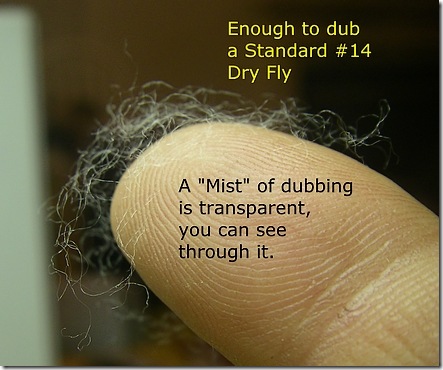
Mist of Dubbing

A mist of dubbing is transparent and even at its thickest point you can see right through it. It will lock onto thread like a fat kid on a candy bar, it will do anything you ask it without complaint, with little coaxing.

Your dry flies will be buoyant and float twice as long as there is so little water absorption, and they’ll dry with a flick or two of the rod. Beauty, with good physical properties to back your play.

Light Cahill 7: A mist on thread
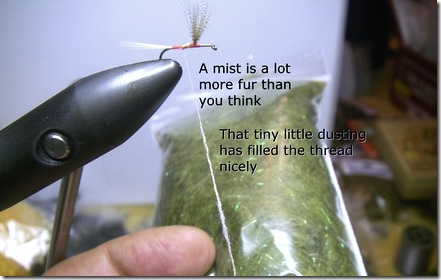
Mist on Thread

That’s the same small dusting you saw on Step 7 above. It doesn’t look so small anymore. I’ve switched to tan thread (which is what I use on the Light Cahill) so the thread color won’t overwhelm the dubbing I’ve added.

Note the tail, it is now top-dead-center … bloody miraculous.

Light Cahill 8: The final dubbed body
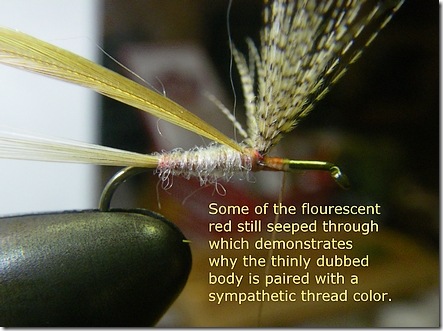
The dubbed body with hackle tied in

A bit of the tail anchor florescence has peaked through – partly because of my reluctance to cover absolutely all of it with tan thread. Thread is always your enemy even when you’re demonstrating what not to do.

The staggered tie off area and head are untouched. I’ll put 1/3 of the hackle behind the wing, 2/3rd’s in front. It’ll be “westernized” – we use a bit more hackle than our eastern brethren due to the brawling nature of our rivers.

Light Cahill 9: Tie off
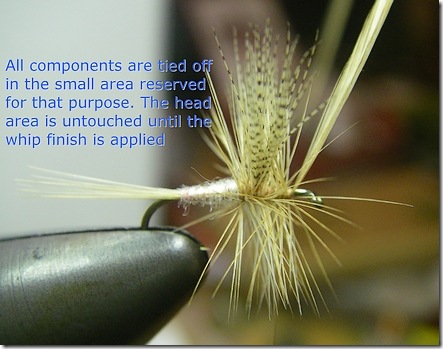
The tie-off area gets thread

The hackle has been applied and the reserved area for tieing off the final materials has been intruded upon. The head, which we planned since the bare hook shank, has its area yet untouched.

Light Cahill 10: The finished “westernized” Light Cahill
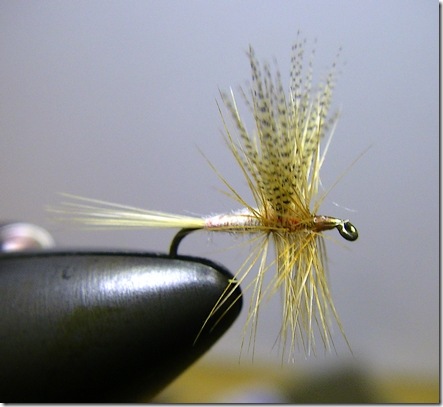
The Finished Light Cahill

The finished Light Cahill using most of the lessons we’ve described in the past three posts. This magnified version shows all my foibles – which I’ll gladly admit to while pretending I didn’t see you add it to your fly box.

I’ll do better on the next hundred dozen, honest.

Tags: Light Cahill, Catskill dry fly, small tapered head, fly tying tips, thread anchor, dubbing, tapered cut, tungsten fly tying scissors, beauty as perceived by anglers, fly box, hackle, vindictive fly tyer

Genetic Dry fly hackle meets the Vegi-Matic

If you’ve ever wondered about the inner workings of the genetic hackle business – how years of careful selection and good genes yields those yard-long saddle hackles and expensive rooster necks – you won’t find any of that here…

Instead, we’ll show you how those lengthy saddles are harvested, and how trained specialists size and select feathers destined for a “100 Pack” – and your tying desk.


It’s clever enough to tenderize the bird while coaxing the hackle gently from the skin, and rivaled only by throwing the bird under a bus.

Tags:chicken plucking, dry fly hackle, Whiting “100 pack”, fly tying materials

Tree trunks and old cars leave a lasting impression on fish

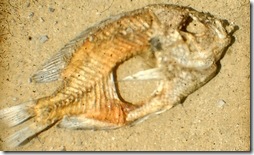
Flattened fish It’s one of those questions that has plagued me for the last couple of years, what happens to fish subjected to the annual torrent of runoff and massive amounts of debris dislodged from upstream.
The small creeks in my area are scoured badly every year, growing to over a thousand times their normal size in just 24 hours. Hundreds of tons of gravel displaced, old cars tumbling through the watershed, and deadfalls dislocated upstream – to wedge themselves into bridge abutments or anything else that’s anchored.

I suspected the result was bad, having seen lots of abrasions and raw areas on the fish each Spring, but never finding any research on the subject you can only assume that it’s tough for us to breath in a sandstorm, and a fish is likely to have similar issues with floods.

We used radiotelemetry to monitor the movements of adult brown trout Salmo trutta in a New Zealand river over 11 months (September 2004 to August 2006) and linked those movements to the changes in flow and water temperature. Individual fish moved up to 41 km during the study. However, most fish moved less than 1 km. All of the trout that showed little movement throughout the summer were living in relatively deep pools that presumably provided cover. The rates of movement declined steadily over the spring–summer period, as flow decreased and water temperature increased. The percentage of fish moving was positively related to the average daily flow during the interval between tracking occasions and negatively related to the average daily water temperature, less than 20% of the tagged fish moving once temperatures were above 19°C. A severe, 50-year flood occurred in March 2005 and was associated with the mortality of 60–70% of the remaining tagged fish, confirming that flood-induced mortality can affect a substantial proportion of an adult brown trout population.

Only a small nugget to confirm my suspicions, flooding is bad – for them and us. The mention of individual Brown Trout moving as much as 41 km is eye opening, as this is observed behavior unrelated to flooding.

The physical conditions also dictate the invertebrate species that can exploit the river. Irregular and unpredictable flows mean that rapidly colonizing, generalist, species that can exploit a range of habitats and food sources will dominate the biological community. Flexible development cycles and mobile juvenile and adult forms allow for rapid re-colonization of areas after floods and low flows.

Which may explain why the “Trico” mayfly is the dominant food source locally. Tiny in size and able to re-establish themselves much quicker than large insects that require larger food.

… and among each group of insects, some are able to spread faster than others, based on food source or breeding behavior. An observant fellow, as we all are, would then be able to determine how long before his favorite bug would be back in quantity – based on what he’d seen in past flush cycles.

Completely unscientific, absolute conjecture – but it gives me something to watch – as I love a good mystery.

It’s both the beauty and peril of the Internet, you’re researching one phenomenon and are completely sidetracked when another presents itself…

Tags: Salmo Trutta, New Zealand, tricorythodes mayfly, impacts of flooding on invertebrates, unscientific method, opinion

Smallmouth Bass DNA could be the savior of Angling

Charles Atlas Science has upset matchmaking theory and suggested the perfect mate for a fisherman is a female Smallmouth Bass.
Sexual selection theory asserts that a female should choose to mate with a male that offers a benefit to her or her offspring. If the benefit is genetic, females should be drawn to indicators that a male might pass good genes to offspring. But in species where males help care for babies, a female might also look for a mate that has the good health and energy to be a good parent.

While human females scorn the pear-shaped lump snoring on the couch,  as they’re unwilling to recognize the value of potential energy – preferring to dissipate our reserves in a single kinetic orgy of lawn mowing, trash removal, and assorted fix-it tasks. The female Smallmouth adores energy storage and is now thought to select mates based on her perception of potential storage, sometimes ignoring the largest male specimens (something human females are unable to do) in favor of lazy, good-for-nothing lay-about males…

Female smallmouth choose a male to mate with, lay eggs in his nest, and then swim away leaving the male to care for the eggs for up to one month. During that time, the fathers don’t forage for food, so they need to depend on stored energy reserves to patrol the nest. Those that run out of stored energy abandon their nests, leaving the eggs to be eaten by predators.

It would make sense then that a female should look for clues that her mate has lots of stored energy.

Big pear shaped angler snoring on the riverbank could be the Smallmouth equivalent of Clint Eastwood and Brad Pitt.

… and while we love fishing for Bass over their spawning beds, it could be a couple weeks earlier we would’ve had better success with their women…

Something to ponder, especially if that gene can be introduced into human DNA – in which case us fishermen are guaranteed an undisturbed nap after that horribly strenuous day of fishing …

Tags: Smallmouth Bass, potential energy, lazy fishermen, lawn mowing, DNA, Clint Eastwood, Brad Pitt

Upstaged by a Frog?

Cameron Mortenson of The Fiberglass Manifesto recently gave away a set of the Precious, for any stalwart willing to tie midges. A worthy contest, liable to bring the worst of a fellow’s character to the fore – what with inhaled fly hooks, gossamer tufts of unmentionables, and everything requiring a microscope to see the craftsmanship.

… and we were upstaged by a frog?

As Cameron also runs the Fishy Kid website, this had better not be the mascot for same – as a “fishy kid” should wail in anguish, refuse to eat, and turn the carpet damp with tears …

No, Poppa … not the Scissors! (sniffle)”

… then again, a live Frog is pretty cool.

Tags: The Fiberglass Manifesto, Fishykid.org, Cameron Mortenson, fly tying scissors, midges

Madison Avenue doesn’t do Turkey or Football

If you’re as uncomfortable with the building storm of Xmas advertisement, cognizant that the undeniable forces of consumerism lack the courtesy of waiting for Thanksgiving, you’re not alone.

The only difference between this year and last is all the stock market pundits poised to declare the recession is here here over based on the retail reports of your spending … I’d guess they’re understandably anxious to be the first to yell the news…

Thanksgiving is the “third best holiday ever” – combining an excuse to overeat with football games whose teams haven’t been in the Superbowl since Plymouth Rock.

… followed closely by the obligatory Midnight Turkey Sandwich Debauch, and going fishing on Friday while “Ma” throws elbows in every discount shopping venue your municipality offers.

Fly Fishing Ornaments

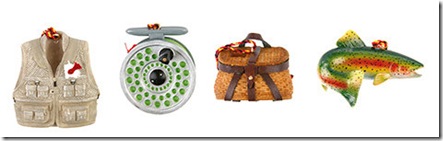
The Fly Fishing Christmas ornament market has exploded – something I discovered quite by accident. I had to pause when I caught sight of the above. A Christmas ornament modeled after my beloved Scientific Angler System fly reels.

I say, “let the torment begin.” You’ve tried thoughtful means to get that new rod or reel and failed miserably. Now it’s time to leverage Egg Nog and raw unmitigated guilt to score that gleaming engineering marvel.

Imagine the mock anguish you deliver when the wagging dog’s tail sends the reel ornament to the floor, shattered. Them whining sounds you make as you cradle the fragments will be clue enough – and since you’ve got a gross of them stashed in the closet, you can repeat this tearful tragedy as oft as needed.

It’s premature and underhanded, but there’s patriotism and bailouts in the mix and the “enemy” shall receive no quarter.

Tags: Christmas ornament, fly fishing ornament, thanksgiving, Christmas, unmitigated consumerism, Scientific Angler System Reel, Plymouth Rock

Fish Can’t Read, Issue #2 Return of the eZine

Fish Can't Read, Issue #2 The second issue of “Fish Can’t Read debuted yesterday, and the boys at Dry Fly Media have really done a bang up job. Lot’s of diverse content, photo essays, and meat … from numerous continents and a variety of gamefish.

… and yes, I added my two cents. This month’s column, “Three Flies Short” is “Paris Hilton is Now, but the Silver Hilton is Forever.” Wherein I accuse the last forty years of fly tiers of obscene crimes too horrible to mention here.

It’s a big, brash issue – filled with commentary and color, art and opinion, and is guaranteed to consume your entire lunch hour – and most of the next.

Quite a few pages, and with all the folks hitting the site – give it a minute to download.

Tags: Fish Can’t Read magazine, fishcantread.com, ezine, three flies short, fly tying, fly fishing, online fly fishing magazines, Dry Fly Media

Part 2 – Singlebarbed teaches the fundamentals of fly beauty

I don’t expect Science will ease a fly tier’s burden anytime soon. Even if they manage to add the vocal gene into a Salmonid and trundle the tank up to the podium … while all us fishermen crane forward waiting to hear what fish really like – it’s liable to eyeball a flybox and croak, “… needs Garlic.”

In the meantime, our best efforts are subject to the opinions and wit of brutish fishing pals – who continue to pillage our fly box despite their being; “too small”, “too yellow”, “too thick”, and “too few.”

Our goal is to weather criticism knowing that only fish determine beauty, and the success of the “well chewed fly” is ample proof. Pursuing visual perfection will teach solid construction technique – ensuring both ratty and perfect flies can be well chewed without falling apart.

six

Absolutely nothing can be corrected later. A tail that’s flopped onto the far side of the shank, the lumpy tie-in point for the body material, that upright and divided mallard wing whose center stem was not clipped, nothing can be corrected on the fly by adding more crap on top.

Nothing.

Perhaps a master fly tier can fix a lumpy body, but he’d never tolerate those lumps on the initial application. Lumps, bumps, cocked, and twisted, are caused by something wrong – or something you failed to do properly.

Elimination of these unsightly blemishes will take decades, as unfamiliar materials and the techniques to tame them are committed to memory.

Learn to back the material off the fly and reapply it. That will mean unwrapping 56 turns of thread (beginner), 30 turns of thread (intermediate), or the six turns (advanced) used to secure it.

A case in point:

The body of the fly and its transitions determines the finished fly’s appearance. In Part 1, Step 8 I made the same claim for lead wire on weighted flies, both are essentially the same thing. Lead is the underbody and whatever covers it has the ability to influence all the critical final steps of construction.

Anglers adore tapered bodies – it reminds them of the  mythical Supermodel lounging on the rock at the next bend – whom doesn’t exist, and they’ll never date…

In Part 1 we described the “gap-fill” process to overcome the rearmost transition which allowed a smooth taper from tail to thorax. We’ve got a similar dilemma on the front of the fly, an unknown number of steps and materials remain, we don’t want to influence their shape, but still need to close the gap between lead-filled thorax and hook shank.

You need a taper in front as well.

Especially critical for flies that have wings laid over the back (wet flies), hackle you want swept back and close to the body (soft hackles) or thorax materials placed on top and only tied in at the front, like Polly Rosborough nymphs or the wingcase of a Zug Bug.

A forward taper can be induced at the front of the fly using the body material itself, or by staggering the tie off points of the remaining steps to make an orderly transition from the thickest portion of the body (thorax) to the bare hook.

A nice front taper will put a finishing hackle or wet fly wing just far enough away from the thickest part of the body so that it doesn’t wedge against it and flair outward or upward.

Figure 1: Tied too close to the body lump

Spread_hackle

If you have too abrupt a transition from body to hackle and wingcase, those final steps will be “flared” outward; wings or hackle are pushed away from the body by the bulge of dubbing at the thorax.

Figure 2: The Double Tapered body

Tapered in front and behind

Put a short taper on the front of the body to allow hackle and other components to lie flush with the body rather than flared outward like a dry fly. When hackle is brushed back against the smaller diameter tapered area, the fibers will rest easy and encase the body in a cone of barbules.

Figure 3: Due to the taper the hackle is closer to the body

Hackle lays close to the body

five

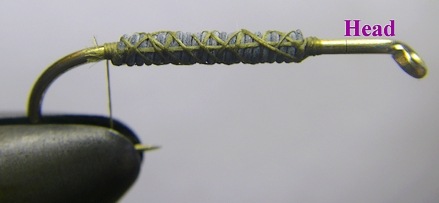
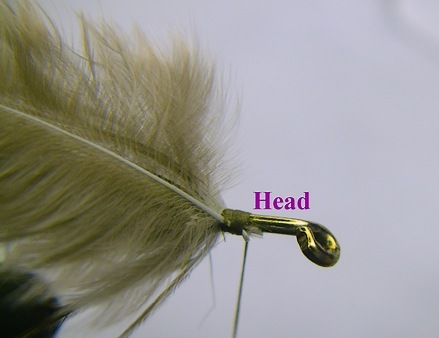
The head of the fly is never shown in schematics. It’s the only part of the fly that defies known physics; it has no mass, no size, consumes no hook shank – defies taming, and persists in trapping our hackle and ensures the hook eye is plugged.

It’s the fly tying equivalent of a pimple on the end of your nose; turgid, menacing, and so very prominent.

It’s a fly tier’s signature, equivalent to a woman’s breasts; the first thing you see despite all efforts not to, and unduly influences perceptions of quality and beauty.

… which is why the divorce rate is so high.

Despite the many thousands of fly types and styles, beauty is consistent; the head should be free of materials, small or tapered, or both.

Tiers will commit the “2/3 body, 1/3 hackle” (or thorax) shank allocation to memory. They’ll spend the precious moments to ensure the tail is mounted correctly, the body is thinly dubbed, wings upright – or cocked at a rakish angle … and then destroy the fly by tying off everything in one brutish move, capturing a third of their hackle as they’re pressed for space, slam six or eight turns of whip finish onto the stubble – then dip the result in lacquer like it was a French fry…

… and the porcine lump of thread that results is deserved.

Small tapered heads require space. While the “2/3 – 1/3” rule is quite valid – your instructor was shy and didn’t mention that he’d allocated 1/8” behind the eye for the head – and it’s “2/3 – 1/3” of what remains

That precious allocation will require you to adjust your lead placement on nymphs, and the location of the wing on dry flies. “Small” guarantees the whip finish to land on bare hook shank and not on materials. There are many types of fly and many adjustments that must be made to the “where” and “how” of the final knot – but every head on every fly must be planned.

Figure 4: Reserving space in advance

Reserved Space - the line of Death

Recognize that Step 6 above, and the forward transition from fly body to whip finish is linked completely with the final small whip finish. Planning the forward transition determines how the naked thread is covered by the final materials ensuring the whip finish lands on shank.

Figure 5: The Sacred space is still inviolate

Reserved Space for Head

The above shows the final step on a modified Gartside Sparrow, winding the front philoplume just prior to the whip finish.  Note that the area reserved for the head remains untouched.

Keeping the mental picture of the head as you apply the finishing materials to the fly, ensures loose fibers and crap are not part of the whip finish, and ensures all the tie-off points are staggered so everything isn’t crammed together in one final orgasm of knot.

The head will be small and delicate, will evade rocks as other parts of the fly will contact it first – and will cause your critical viewing audience to swoon in appreciation.

four

Torque is one of those subjects most of us skipped out on in High School. “Grab-assing” on the back steps was so much more important in the day, and physics combined with the post-lunch digestive period guaranteed slumber.

A right-handed tyer will move materials clockwise around the shank, even if they were tied in and secured earlier.

Many fur and feather fibers are slippery, and as we hold them precariously near the shank attempting to secure them, we’ll move them off of top-dead-center just with the torque of our thread wraps.

Tails are especially vulnerable as we may have to tie in both ribbing and body material on top – and if our thread strays too far back in any subsequent step, we’ll move the tail away from us – perhaps even to the far side of the hook.

Some of this can be corrected by grabbing the offending item and giving it a yank in the opposite direction – which is acceptable after the fly is finished, but if it’s still in the vice the Golden Rule of Step Six –adding more crap can’t fix anything, is gospel.

Flies with lead underbodies are especially vulnerable. Securing lead has always been an issue and subsequent steps may rotate the body or thorax due to the pressures of thread direction and torque. Large flies with heavy wire or oval tinsel rib – or synthetic monofilaments like V-rib allow tiers to get heavy handed on the fly – which can induce movement.

Recognizing this phenomenon allows you to watch for it. Tying in tails and body parts 10°-15° off of top dead center on the near side will allow you to adjust troublesome wingcases and tails, and proof them against subsequent steps.

Later as skills develop you’ll have an easier time of it as you’ll learn to anchor materials differently (see Part 3) which will resist movement and proof you against everything but your own strength.

Note: if your tongue is clenched between your teeth as you apply ribbing, or your sweating profusely afterwards, that’s bad.

Our last post will feature the Big Three, techniques learned only after climbing the mountain barehanded, walking across hot coals, and observing the tying secrets of ancient Shao-Lin masters.

Tags: Gartside Sparrow, torque, lead underbody, V-rib, oval tinsel, fly tying, monofilament, ribbing, Philoplume, whip finish,

Rivers of a Lost Coast released to DVD

You saw it, you loved it, and now you can drive the wimmenfolk batty with the original DVD, or merely the soundtrack – or both.

Rivers of a Lost Coast has been released on DVD, available for $29.95 from the folks at Skinny Fist Productions. It’s just in time to wreak havoc on the entire Thanks-Christmas holiday – and may cause the in-laws to stop fist fighting over who-likes-who-the-mostest.

Rivers of a Lost Coast

Bill Schaadt was a name mentioned with great reverence around the San Francisco scene of my youth. It was respect more than veneration, as his antics caused as much bile as admiration among anglers of the day.

I never knew the man, but like all of us – fished in his footsteps.

I’ve fished the Russian River many times, without success. Although I had a couple of near “hook ups” when I burst through the underbrush and emerged in the middle of a gay nudist beach … who thought my neoprene-encased svelte form was the second coming of John Wayne, hisself.

I apologized profusely, and tried the Gualala after that …

Tags: Rivers of a Lost Coast, Bill Schaadt, Ted Lindner, Russian River Steelhead, Skinny Fist Productions