
Author Archives: KBarton10

The Privatization of Fish will be a by product

Keep your big hammy feet out I’ve been keenly watching water policy over the last couple of years. Much of that ground plowed to find compelling items for posting – yet has me brushing up against water usage and the building water crisis facing every state.

… and it’s going to be every lawyer’s wet dream …

Using EPA estimates, communities will need an estimated $300 billion to $1 trillion over the next 20 years to repair, replace, or upgrade aging drinking water and wastewater facilities; accommodate a growing population; and meet new water quality standards.[5] EPA projects a $650 billion shortfall between current spending levels and money that will be needed over the next 15 years. The Water Infrastructure Network claims spending will need to increase by $23 billion a year for the next 20 years in order to meet the growing water/wastewater treatment needs. Also, in May 2002, the Congressional Budget Office estimated that the cost of drinking water and wastewater infrastructure over the next 20 years would be $492 billion under a low-cost scenario and $820 billion under a high-cost scenario.

Charles Duhigg’s six-part series on drinking water for the New York Times is the latest in a series of exposes on how large farming and industrial interests get to operate with impunity, ignoring The Clean Water Act, as most states are strapped for staff or lack the desire to enforce clean water standards.

Fresh potable water is going to be as expensive as gold, and that puts you and I squarely in the cross-hairs of those same powerful lobbies – and with our puny conservation efforts and tiny organizations, we’re going to suffer considerably more than the rest of the population.

It’s likely we’ll be barred from fishing in public water – as it won’t be public much longer.

The root issue is infrastructure. Cities and states both lack the billions of dollars to address burgeoning populations concentrated in cities. Drinking water isn’t close by – so billions must be spent to ditch, pipe, and canal water from where it “lives” to where it’s needed.

Politicians are reluctant to raise taxes (albeit not at all reluctant to blow the proceeds) and privatization of the water supply is thought as a method to remove local government’s responsibility for pipes and infrastructure onto a for-profit company with deep pockets.

Naturally your rates will climb as the new owner recoups the millions spent on replacing earthen dikes, rotting pipes, Quagga mussel infested pumps, and the brick canals built in the 1800’s that are still supplying critical freshwater to our expanding cities.

You can expect “No Trespassing” as a result. Boaters and anglers are know vectors for invasives that damage the water infrastructure – and felt soles be damned – they’ll bar you from the waterway entirely.

… ditto for duck hunters and ski barges …

Atlanta tried it, now Chicago is thinking about it.

Considering that all of the hallowed Catskill streams of fly fishing fame are sent through mountains and brick-lined tunnels to slake New York City’s thirst, if you’re thinking those geographic barriers will save you – they won’t.

If you’re lucky you live near the coast, making desalinization an option. Eventually someone will figure out how to dispose of the salt, so toxic it rivals nuclear waste, but some canny fellow will figure out a way to cleanse it and sell it to you at the supermarket.

The lawsuits that result from Spanish Land Grants, international treaties with both Canada and Mexico, imminent domain, and all the cities dependent on the same river – yet further downstream, will likely bottle up significant movement for the next couple of decades.

In the meantime about all that’s left is investing in the next conglomerate that will own Southern California’s water supply – hoping that the proceeds will allow you to retire somewhere’s else.

Just one of the reasons why the brown water is so compelling. Little crappy creeks that no one drinks (yet) with inferior-mouthed fish that no one protects (yet) – that may afford you a spot to teach your kids to fly fish.

Tags: Chicago’s water supply, privatizing drinking water, desalination, Spanish land grant, agribusiness lobby, Charles Duhigg, New York Times, No trespassing, brownlining
You’d better hope they’ve got short memories

Little wonder that your typical Brownliner can get a little overbearing and evangelical, our beloved fish are tortured without mercy – just because they can be …

… and while you smack your lips in anticipation of the still beating heart – spleen or other choice viand, what you don’t know is our fish fight to the death rather than face live capture.

If the current science suggests fish eat via “pattern matching” rather than cognitive powers – you’d better hope they’ve got mighty short memories.

Tags: live carp dinner, pattern matching, fight to the death, deep fried carp

Red with Beef, White with Fish, Ripple with a Twinkie

Salmon and Chardonnay It’s the spark that ignited open warfare in my household. Pots and Pans hurled with much force and even greater accuracy – while I backpedal giving the kitchen door a couple of measured three second bursts …
I always figured our relationship would end bloody. She’d discover her favorite dish towels dyed florescent Puce, wadded under the sink out of sight … or the carpet would yield another 3/0 O’Shaughnessy  – buried to the bend in either her hindquarter or big toe.

Fishermen can’t help but strain the boundaries of domesticity with our early morning departures, bleeding gut-stomped prey, or the many sharp accessories we toss around while unpacking.

… toss around and fail to pick up …

We wept during the highly charged, romantic segments of “Rivers of a Lost Coast” – up until they mentioned the Russian River was depopulated compliments of the wine industry. I could feel her stiffen in protest – but took her mind off of “those obscene lies” with chocolate.

… wine being her most favorite thing, more favorite than me …

Then I had the audacity to perpetuate “another heinous liberal myth, like Global Warming” – by posting this piece, and ever since only the fourth kind of sex is available, where you pass each other in the hallway and say “f**k you.”

Unfortunately the Santa Rosa Press Democrat made mention of the phenom, so I’m duty-bound to pass it on.

“We’re here to protect fish as well, but it can’t be done by eliminating the viticulture industry in Mendocino and Sonoma County,” said Devon Jones, executive director of the Mendocino County Farm Bureau.”

To which I’d reply, “Nuts.”

The Napa wineries have spilled over a couple of valleys and into a half dozen watersheds – and all the jug wines are now grown in the Central Valley proper. Many thousands of acres of tomatoes and almonds uprooted to mass produce cheap Chardonnay, Burgundy, and lesser grapes.

I’ve enjoyed wine (jug or otherwise) for many years – but this talk of “absolutes” is starting to become overly burdensome.

… perhaps you’ll have to keep 20,000 acres fallow – to ensure a half dozen sickly Salmon can gasp their way to former haunts – there to expire. Keeping those fish will not extinct the Napa Valley or anything close to it – vintners are objecting at having to share.

“It is really critical that all growers get involved with this,” said Nick Frey, president of the 1,800-member Sonoma County Wine Grape Commission.

This spring “there’s a risk of not everyone having water for frost protection,” Frey said.”

I’ll make you a deal. As some of the founding fathers and “Johnny-come-lately’s” will have to surrender some of the most fertile soil (to ensure salmon survive) …

… we’ll allow you to grow dope in Mendocino.

As you’d have money coming out of your ears – and a lock on the medical marijuana market, you can uproot your restored turn-of-the-century farmhouse – complete with clinking glassware and Marin-gentrified lifestyle – and move North.

As pure sewage can only improve your end product (and may even improve its taste) we’ll let you have an equivalent amount of lukewarm brown water from whatever impoundment is nearby.

… you won’t need to worry about frost, as you’ll harvest all that bud in September …

… and your spendthrift wastrel kids will have the chance to appreciate the richness of your Chardonnay, as they’ll have something to eat with it besides a Twinkie …

Tags: Santa Rosa Press Democrat, Rivers of a Lost Coast, domestic bliss, Napa Valley wineries, Russian River, salmon, medical marijuana, open warfare, think outside the box

109 Seconds to make you an entomological genius, and the toast of the Office XMAS Party

Only 109 seconds to master both human nature and entomology. You’ll master aquatic, terrestrial, learned behavior – and be able to relate to your children as never before.

No need to thank me, it’s what I do …

Warning: Don’t drink coffee while watching, it may come out of your nose.

… and all my taxpayer dollars were spent on, “Just Say No?” For the price paid we could’ve exhumed Walt Disney, brought him back to life, and been in syndication by now.

Tags: Spiders on drugs, YouTube, entomology, Walt Disney, Crack Spider’s bitch

From the mouths of Babes comes Thread Wisdom

With the casting club some four miles distant the round trip on a stingray was reserved for weekends. Weekdays it was the bathtub as trout stream surrogate.

A young lad learning to tie flies has to make due. Each time the UPS truck squealed to a stop out front it disgorged some new material from Dan Bailey’s or Kaufmann’s Streamborne, and I’d start the bathtub going to see why marabou was such a big deal, or determine whether a fly tied of polypropylene could survive the eddy between spigot and drain.

In those days everything was tied with Size A Black Nymo unless I was feeling gaudy and opted for white.

Six feet of monofilament tippet and a handful of experimentals tugged through the water using “hand-twist” retrieve. I learned which materials caused flies to ride sideways, upside down, and how stiff materials assisted by head cement spun the fly uncontrollably …

… but most importantly I learned what not to do, and how to make a shortcoming an asset.

Upper_Sac_Parachute

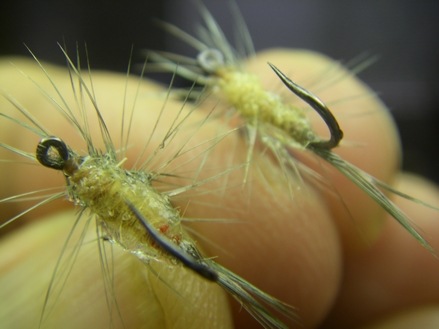
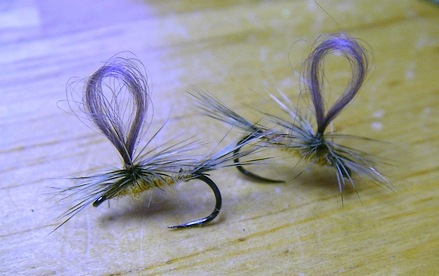
… above are a couple Creamy-Orange Paraduns that I attribute to the Gary Warren – Chuck Stranahan – Hat Creek brain trust. Are the two shown the same?

Wet_Creamy_Orange_Top

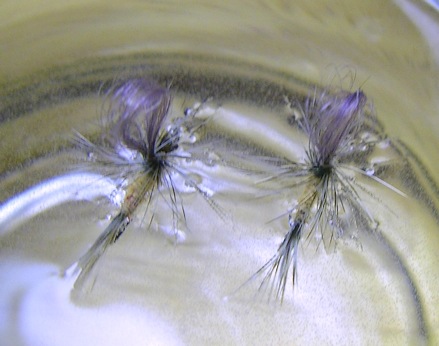
The “Bath Tub” test shows the same two flies riding nicely. The left fly is starting to show it’s true colors …

Upper_Sac_Creamy_bottom

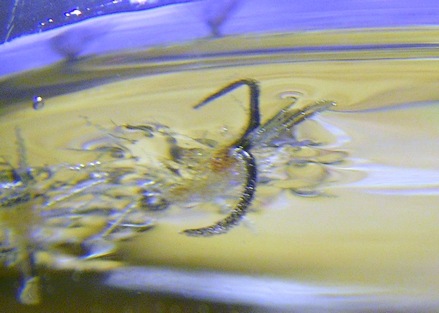
The underwater view of the left fly shows a pronounced orange-red butt section by the tail. It’s revealed to be the Upper Sacramento variant of the Creamy-Orange with a butt of blood red thread underneath the dubbing.

Thread choice isn’t pronounced on the dry version of the fly, but all my “wet testing” of years ago confirmed that Black Nymo overwhelmed every color of dry fly dubbing tested.

Now I knew why Art Flick, Roy Steenrod, and Walt Dette, as well as every other past master of the dry fly used neutral gray thread.

The ensuing month saw me delivering papers frantically, husbanding tips while looking predaciously at the UPS truck and the inevitable squeal that would announce a gleaming 12-pack of gray 3/0 Monocord.

Thread can be many things – a boon as well as a detractor. It acts as a hidden color layer influencing the body color of the fly. In this case, the Upper Sacramento is home to a dusky red-bodied mayfly whose abdomen fades into a creamy orange color up by the wing roots.

Wrapping red thread under a lightly dubbed body gives me precise control over how that color bleeds through the dubbing, and how much it influences the body color of the fly. A light dusting of dubbing will bleed red, a little more dubbing will bleed less (dusky red).

Creamy Orange Damp Underbody

Here’s the same two flies removed from the glass; the left fly shows a pronounced red butt, and the fly on the right has none. Both flies were tied with a neutral tan thread so as not to influence the dubbing color on the remainder of the fly.

Fish never see a dry fly, they only see floating flies that are wet.

Water has a tendency to darken every color one or two shades, and rather than spend all your efforts matching the natural with dry dubbing – doesn’t it make more sense to test the colors wet?

It may well have been the only wisdom learned in the ensuing couple of decades, if you believe my parents …

Tags: dry fly, thread as color, dubbing techniques, upper Sacramento river, Monocord, Nymo thread, butt section, Chuck Stranahan, Gary Warren, Roy Steenrod, Art Flick, Walt Dette, Catskill dry fly, hand twist retrieve, Dan bailey’s, Kaufmann’s Streamborne fly shop

Singlebarbed Reviews the Ultimate Stocking Stuffer: The New Scientific Angling, Trout and Ultraviolet Vision

With our faddish nature I’m always surprised fishermen aren’t more fashion conscious. Our weakness has always revolved around something new as a wholesale fix for all our fishing ailments.

In the Eighties it was Polypropylene – lighter than air and a couple of turns on a hook shank would make a fly float all day. The Nineties were typified by gummy latex and a veritable flotilla of eye catching synthetics.

The last decade was dominated by pearlescent, opalescent, and oily duck’s arse – and the renewed promise that only a couple strands would make a fly unsinkable.

Now it’s the Ultraviolet spectrum and every vendor is hell-bent on squirting chemicals we can’t detect (and of dubious UV qualities) on everything from salmon eggs to dry fly hackle, claiming the “fish killing qualities of the ultraviolet are virtually infinite.”

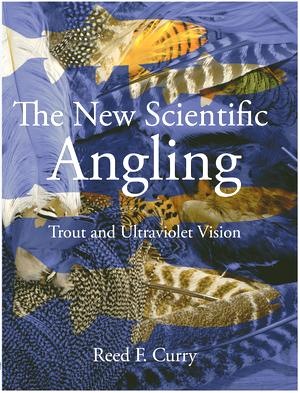
… and in all this frenzy, Reed F. Curry’s book –  “The New Scientific Angling, Trout and Ultraviolet Vision” makes it’s debut.

FrontCover3in

Reed’s task is Herculean. Bring the stuffy lab-coated world of ocular physics out of its chaste mathematical surroundings, remove the obfuscation of scientific jargon, and adapt the material for fishermen, then drop the polished treatise onto the coffee table – there to compete with Playboy, People, and Guns N’ Ammo.

It’s a singular work, and his timing is impeccable.

Those of you familiar with The Contemplative Angler recognize that Reed’s quiet and biting humor is a common thread throughout his work; how he could remain stiff-lipped and scholarly was surely going to be a trial … and I was pleased he failed … miserably.

The book is reminiscent of a High School science text with the salient points highlighted by color in the margins. In this case, Reed spills both wit and angling reality into the colored boxes, a clear demark between the Science and Angler-humorist.

Fly tiers will read it like Playboy. Pictures first and text second – and the concepts of UVA (Ultraviolet absorption), UVR (Ultraviolet refection), and VIS (visible light) are featured in multiple pictures per page – which keeps the scholarly segments easy to absorb and engaging.

There is an enormous amount of real meat for the angler, and the segment of greatest interest to me was the discussion of “pattern matching” that answers that most elemental of all questions, “Why do fish think this is food?”

As the Quill Gordon floats within the trout’s range of vision – and here I am going to avoid the complex issues of Snel’s Circle, reflection and refraction and simply assume that the visual sensory input is very detailed and complete – the trout’s brain receives input of the fly exactly as it appears from below, in the full trout spectrum. VIS and UVR. The trout brain now gathers the elements that are attached to each other – hackle, body, wings, tail – ignoring floating particles of foam nearby, and assumes that it forms the whole unit. Against this gestalt the trout brain uses pattern matching, just as we would. The order of conditions is presumably the same:

  • First, check for danger. Is the object a known threat? “No.”
  • Next , check for food. Is the object a food item? “Yes,” “No,” “Maybe.”

And that is the crux of it. If as anglers we can establish “Maybe,” we have won the first part of the game. “Maybe” can indicate insufficient information which may lead to further investigation through other trout senses – Taste and Touch. In order for the fish to touch and taste, he takes an object in his mouth, hands being in short supply.

The section on “the composite insect” and how it fits into a fish’s pattern recognition “database” is enough to send any fly tyer into a reproductive frenzy.

Schweibert, Flick, and Swisher & Richards all gave us wonderful tomes about mayflies, most with wings intact and inviolate. Reed suggests that the all important “Maybe” that spurs trout to eat – may lie in the thousands of images of mayflies (caddis, etc) stored in memory.

Crippled, in the water and out, half in, struggling, fluttering, landing – double the images to account for the broadside view, quadruple that to take in the fore and aft of all the above, and you quickly get to millions of possible watery lumps that “maybe” food.

Which is why those old archaic flies we know don’t work like the McGinty, the Royal Coachman, and the Trude – all non-scientific flies, get eaten, and often.

“The trout’s pattern for mayfly wings, therefore, must be quite vague, perhaps simply a small extension from the body, light in color and displaying a hint of UVR. A trout that only eats mayflies with perfectly formed wings is missing a lot of food.”

As humans we view insects and their imitations with only the visible spectrum (VIS). Fish can use both visible and UV light to recognize prey, and at depth or during low light conditions where both are active, a mixed image is likely.

“Through UVR in combination with VIS, trout have an opportunity to see fine details of the chitin, the outer surface of an insect’s body and wings. How deep this vision goes depends, of course, on the individual trout, the conditions, and the insect.

… (trimmed by KB)

So, surface texture is significant because, despite what we see with our more limited vision, the trout can detect in the UV that natural flies are not perfectly smooth.”

The book’s photography covers the full gamut of angling gear as well as specific sections dealing with insects, fly tying materials, and the UV signature of colors in general.

Baitfish get some UV love as well. Rather than pile on more UV materials onto a hook shank – knowing which components of smaller fish are most visible in the UV spectrum suggests a thoughtful placement of materials – versus the “more is better” broad paintbrush.

… and while Reed answers more questions than he poses, it’s plain that both vision and perception suggest there is a great deal of unexplored territory left in the classic stalk and seduction of trout – and any other UV equipped gamefish.

This is a wonderful reference work for all anglers, likely to turn some of your notions about fly fishing on their ear. Careful study of the colors and their qualities under UV will assist in fly selection, clothing choice, and fishing qualities like retrieve and how depth may play into fly selection.

… and for the fly tier the color plates alone justify inclusion into your reference library. An essential book if you’re attempting to navigate the vendor offerings and add UV aids in insect imitations.

Me? My next fishing vest will be Bright Yellow … waders painted with a similar retina scorching disjointed color pattern – a not so subtle mix of the Bismarck and Elvis.

Pikeminnow rolling lazily between my feet as I’m completely invisible …

Amazon lists the book at $27.95, with only two copies left. Jump on it.

Full Disclosure: Singlebarbed did trade two (2) pairs of Sixth Finger Scissors to Messr. Curry for the privilege of owning such a superb reference work. Tears were involved … his mostly.

Tags: Reed Curry, The New Scientific Angling Trout and Ultraviolet Vision, Overmywaders.com, The Contemplative Angler, trout vision, ultraviolet spectrum, visible light, baitfish, insects, fly tying materials,

With the aid of a leafy branch you could remove your footprints

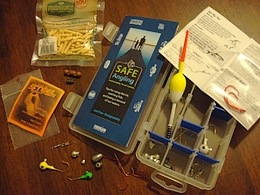
Safe Angling Kit On the heels of safe sex comes “safe angling.” No condoms here as you’re already sheathed in rubber …

It’s toxin-free angling with hook, line, and sinkers all biodegradable or pose a diminished hazard to ducks, geese, fish, small children, and pets. Kits comprised of circle hooks, lead-free sinkers, and protein enriched biodegradable rubber worms.

… which should probably be approved by the local fish and game officer:

FoodSource lures are molded protein, so not only do they catch more fish than plastic lures, they are biodegradable and digestible if a fish eats them. Plus, they are easier to keep than live bait.

… only because “molded protein” sounds like a grey area when fishing “artificial only” water.

Fly fishermen should be able to take the moral high ground, as outside of the Twinkie wrappers and water bottles we spew, most of our tackle already poses little threat.

We lack the studies to determine exactly when a blend of Polyester and nylon decays to the point of exposing a lead wire wrapped hook shank, but outside of the danger of hook ingestion – it sounds fairly sterile.

With the emphasis on rubber soled wading shoes there will be fewer of us – but the increase of shed vests, aluminum fly boxes, sunken shattered rods, and extra spools thrown by drowning fishermen will add some small toxicity, to be sure.

Tags: safe angling, recycledfish.org, lead free jigs, molded protein, biodegradable fishing tackle, fly fishing, rubber soled wading, Twinkie wrapper

Bears do it, but wolves do it better

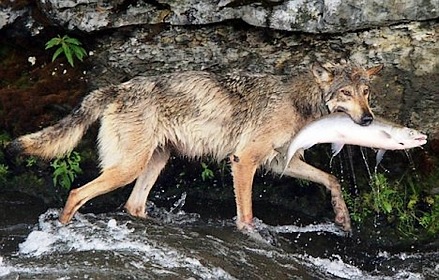
I want to call him Wil E. Coyote – what with tiptoeing around a couple thousand pounds of hungry bear to snatch dinner

Wil E. Wolf

There’s a slim chance you could train a black Labrador to do something similar. It would at least give the worthless flea-bit lump a chance to earn his keep in between bird outings.

Explaining how your “secret fly” was irresistible to migrating fish may cause you a momentary pang of guilt, but that would pass quickly.

… just make sure the Milkbone supply never runs out, he’d sell you out for a stomach rub …

Tags: Wolf catching salmon, black Labrador, Alaskan salmon, single and barbless,

Big on Yarn but even bigger on frugal

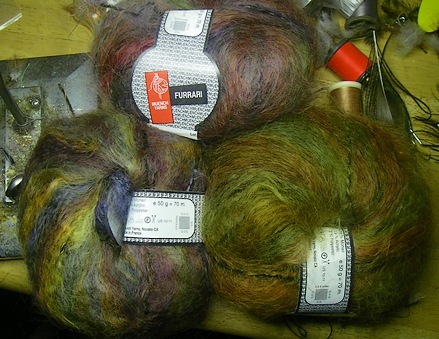
I see one of those “coat of many colors” yarns and I can’t dig the pocketbook out fast enough. The Good News is these mixed-color yarns are all the rage, the Bad News is fashion is capable of turning on its heel quicker than we can respond.

Furrari Mohair

I use a lot of mohair because it’s a cheap and plentiful “filler” for dubbing blends. Lots of sparkle and plenty of spike –  important qualities for big nymphs and steelhead flies, and especially Spey flies – which translate “scruffy” and long fibered into fly movement.

Detail view It’s the Poor Man’s Seal substitute, offering the same loft and spike yet absent the transparency and guilt associated with clubbed orphans.
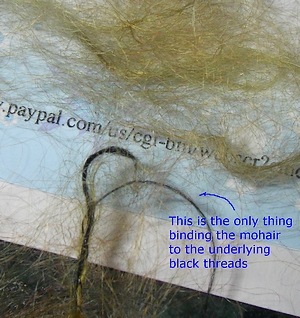
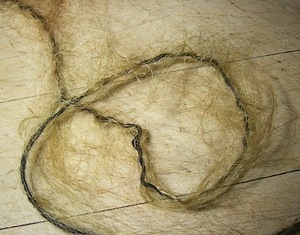
This is Muench “Furrari” (France) and each skein is a blend of a dozen colors. It also boasts an extremely loose weave; two strands of black thread are the core, with a single strand of black spiraled around the mohair to keep it tight to the center threads.

It can be transformed into loose fur by yanking out the black threads and sliding the fibers off the center element. The mohair will collapse into loose fur that can be dubbed or added into something else.

Mohair Thread View The range of colors is the real bargain. Each color is about a foot long before transitioning to the next, plenty to wind a large fly body or yank off as a handful of dubbing.
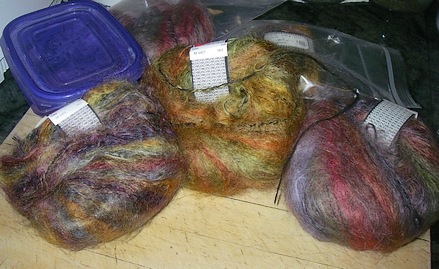

If left intact the black threads offer the ability to wind it as a coarse, spiky yarn – with much of the black obscured by the trailing fibers. It’s perfect for the Jay Fair nymphs or anything else using mohair as a wound yarn.

It retails at nearly eight dollars a skein, but I got it off of eBay for five dollars. There’s quite a selection of colors offered by yarn stores selling their stock on eBay, most have priced it at six bucks per 80 meter skein.

Having a dozen colors in all the right Olives and Browns is a real boon for the frugal. It beats buying those three yard cards (x12) to realize the same color palette.

Colors shown below: Left (Purple, Green, Blue, Yellow) #4401, Center (Olive and Browns) #4407, Right (Grey, Brown, Claret,Green) #4401.

Furrari under incandescent light

The same colors shown under natural light. Makes a big difference.

Tags: Muench Furrari mohair, dubbing blend, filler for dubbing, eBay, J Fair Wiggletail, spey fly, combed fur, mohair, fly tying materials. mohair yarn

Just one economic uptick away from your Fish mobile

Some small segment of the readership gnashed teeth when the news broke of Hummer being sold to a Chinese company. Monstrous vehicles and the taming of wilderness go hand in hand with the fishing ethic ..

Most anglers assume that long hikes from the parking lot leave the hatchery fish and beer guzzlers a distant memory, and the ability to mash the forest flat while reclining in air conditioned splendor is the same thing, only less sweaty.

While the rest of the crowd promotes tents with solar panels, recycled water, butane stoves, and “Top 10” posts of natural occurring toilet paper substitutes – we know you better and won’t waste your time.

… you’re one economic uptick away from that Hummer, a couple thousand dollar fly rods to match, and if the new manufacturer offers the base model with tracks and bogey wheels – you’ll take that over milquetoast mud n’ snow’s any day. 

Dartz Armored with Whale Penis interior

While you’re at it you may want to think past the weekend expedition –and all those pine trees you mashed into the forest duff, how you laughed and made faces while the Warden emptied a couple of clips in your direction, as you rolled over his Jimmy like it was tinfoil …

It’s the Dartz armored. Mongolia was cool – but Camels have fleas and now you’re looking for something more serious…

Unfortunately you’re too late. The Eddie Bauer model had whale penis leather interior, they’ve dropped the lux package – due to the violent protest from Greenpeace and opted for something less painful to whales.

Nickname potential must’ve scared them off, especially with us less fortunate in the crosswalk fearful of the throaty rumble and pale skinned Dot Com wunderkind looking truculent behind tinted glass …

… another “Dick on Dick” comes to mind.

Tags: Dartz, armored SUV, fishing, whale penis leather interior, Fish mobile, far from the beaten path, glampers, carbon sensitive