Author Archives: KBarton10

The toxic spill that cleans itself

It was all in the timing. My latest read is about the spread of that most egregious invasive – how the Rainbow Trout has pillaged most continents (ably assisted by well meaning anglers) – enroute to world domination …

… and up till now it’s been a source of interest, as my California streams provided the brood stock for half the globe.

Then I stumbled on a couple of recent papers where scientists were attempting to answer this century’s question, “when millions of farmed fish escape, where do they go?” (PDF)

My rationale could’ve been Science, but in all honesty it was pure greed. If I knew which creek 100,000 artificially fattened 8 lb salmon were housed, and knowing that a half empty beer can would be struck and often, I’d abandon family and work responsibilities instantly.

While the small sample cited cannot be conclusive, it suggests if you’re a bit timid about crossing “fat” genes with “big” – you might want to grab the brood stock from another continent.

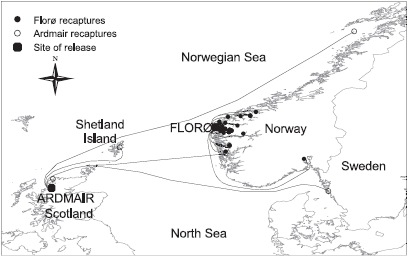
The researchers tagged and experimentally released 678 farmed fish in Scotland and 597 farmed fish in Norway. Only a small percentage of the fish were recovered by fishermen and reported to the researchers (.6% of the Scottish fish and 7% of the Norwegian fish).

However, the Scottish fish that were caught had travelled very far – up to 1600 kilometers from the release site – and all dispersed to the east towards Scandinavia. Meanwhile, the Norwegian farmed salmon released were  mostly recaptured by fishermen in local waters – 27 in freshwater and 15 in sea – within 150 kilometers of the release site.

Released and recapture locales

One especially interesting hypothesis to explain the easterly bias towards Scandinavia in all fish recaptured including those from Scotland, the authors speculate that this may be due to the dominance of Norwegian broodstock in the existing strains of European aquaculture.

It’s akin to the perfect crime. As your aquaculture endeavor is still new – and while you work out the kinks, the anglers a continent away are catching two-headed Salmon in Lemon Yellow and Orange Orange.

Throw some camouflage tarp over your torn nets and shrug shoulder, “it wasn’t me.”

… no doubt some fellow in Langley, Virginia has read the same treatise and is designing a predator drone that’s shaped like a Salmon, so he can deliver a lethal payload to some poor Afghani who pauses for a cold drink.

Tags: predator drone, escaped salmon, aquaculture, rainbow trout, invasive species, Norwegian broodstock, Atlantic salmon, perfect crime

They rattle around in the box when startled

They are easily startled It didn’t work back in the Sixties, when J. Edgar and his G-Men encouraged academics to rename the lowly “Egbert Carp” to “Grass Carp” as it’s known today.

The conservatives figured it would end the Hippy movement, with the participants lulled into toking away on a bowl of fish spleen …

… it didn’t work too well. Mainly because the Egbert was tough to keep lit, and even if you removed the scales it was awful harsh …

Louisiana figures they can handle their Asian Carp issue by promoting the culinary aspects of this mighty gamefish, and rechristening it the “Silverfin.”

Them Southern boys know a thing or two. While the Yankee states fight each other is court – allowing the gleaming hordes of Carp unfettered access to the Great Lakes, Louisiana will be fighting to the last Man with what it does best, deep fry.

Louisiana is known for its food, Parola said. So rather than poisoning the fish to get rid of them like northern states have done, wildlife officials are opting to make them an appetizing meal.

With one of the highest obesity rates in the lower 48, they’ve got a better than average chance of winning, but “Silverfin” is a bit on the flowery side, and doesn’t embody gluttony the way that, “Buffalo Winged Frying Fish” might.

… and with McDonald’s carefully monitoring the trend, if the steam reconstituted, mechanically seperated,  Asian Carp is indistinguishable from the Chicken McNoogie – it’s game over for our shy silver visitor.

Tags: Asian Carp, McDonald’s, Louisiana, deep fry, Silverfin, obesity, J. Edgar Hoover, Grass Carp, don’t Bogart that Carp, Yankee

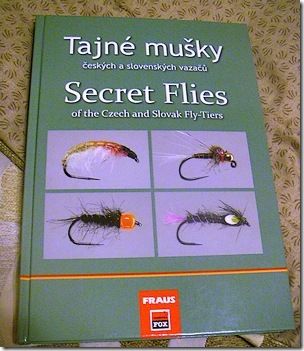
Secret Flies of the Czech and Slovak Fly-Tiers, an encyclopedia of Czech Nymphing patterns

There’s little doubt I prefer the technical references to the feel-good fly fishing memoir, both have their proper place, but when I reach for text I want a question answered, skills increased, or broader knowledge of an unfamiliar yet burgeoning subject.

Secret_flies_ofCzech

Czech nymphing has  fascinated me for a variety of reasons. It’s the “Cinderella” story mostly; small team emerges to dominate traditional fly fishing competition, remains virtually unbeatable in successive years, and the rest of the angling planet alternately “pooh-pooh’s” their meat oriented fishing style, while desperately begging for similar tackle from domestic makers.

Despite their monopoly of the long light rod, the resurgence of the multiple fly rig, coiled Stren indicators, and 24-30 foot leaders, scud hooks, and the preformed lead inlay – what sets the Czech nymph apart from most fly styles is their elegant blend of color and precise imitation.

Quite simply, they have incorporated the finer elements of attractors, yet have retained the shape and styles consistent with our modern realistic imitations.

… and as a reformed whore former commercial fly tier, tying many hundreds of drab dull flies can be onerous. A hint of sparkle or color is just enough to make that chair less hard ….

“Secret Flies of the Czech and Slovak Fly-Tiers” is a pattern encyclopedia featuring twenty one current or former Czech competitors and nearly 350 of their favorite flies.  There is very little preamble and almost no text. Each tier gives a brief explanation of past accomplishments on the World stage, and presents a dozen or more of his favorite flies. Both the patterns and text are in Czech – which is translated into English as a footnote to each pattern.

It’s the largest single compendium of Czech patterns that I’ve seen to date, and provides a glimpse of enough Caddis nymphs, wet flies, and streamers, for you to realize those elements common to all the featured flies.

Like color. Neither Rhycophilia nor Brachycentrus feature a tricolor abdomen highlighted by orange seal, but you’d still welcome a couple dozen in your fly box.

Many countries have a long history of colorful attractor flies, gradually slipping from prominence due to gleaming newer flies and the synthetics they contain. Scientific angling still holds sway, and colors our perception of what’s fishy and what’s not.

… and while we fiddle with knotted legs and precision, some Eastern Bloc kindred spirit adds a dab of maroon seal to his Olive Caddis and eats our competitive lunch …

Czech patterns and fishing style is slowly entering our mainstream arsenal, almost like Spey rods – which we held at arm’s length for a couple hundred years, then claim we invented them …

But the typical Czech nymph tied by American fly tier’s is missing the delicate profile of the european original. As many of the featured flies in the book portray, the authentic flies feature a double-tapered body – lightly tapered body, thick middle, and tapered front. It’s a trifling detail for most, but lends itself to a couple fortnights of inspired tying – especially for those fellows willing to order the book from Europe to learn more …

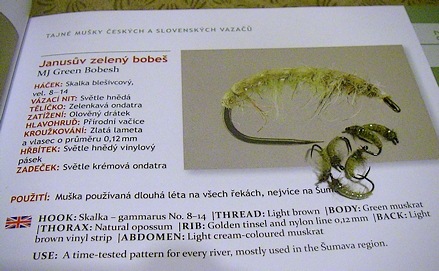
 Milo Janus's Green Bobesh

The above photo shows a representative fly pattern, its translation, and scant narrative. 

While the photographs are detailed and quite excellent, this book is for an accomplished tier – one that can reproduce the pattern from a glimpse of a single photo …

… AND … knows enough of European materials (both hooks and synthetics) to make the appropriate substitution. Unfortunately, Wapsi and Umpqua are only known to the US, and many common synthetics like the vinyl/latex back may have a different vendor and therefore a different vended name for their product.

They’ll be cited in the translation but you may have to do a little leg work to verify your pet flavor of vinyl is appropriate.

Most of the hooks referenced are Skalka, Knapek, and Maruto. You can substitute similar hooks if you’re familiar with those makers and their models. US vendors like the Blue Quill Angler carry both the Skalka and Knapek competition hooks – and they’re not cheap.

All of these materials can be purchased at Czechnymph.com which was the source of the book, as I could not find it available anywhere in the United States.

In short, an advanced fly tying pattern encyclopedia – absent fishing techniques or step by step illustrations, requiring significant knowledge on the part of the reader – and containing about 350 patterns of Czech-Slovak origin.

As I’ve seen few Czech nymphing books contain this many patterns, I’d think it would be considered singular in that respect.

Full Disclosure: I paid 779.3 CZK for the book, with shipping it was about $42 retail. (changes in world currency are daily)

Tags: Czechnymph.com, Milo Janus, Skalka hooks, Knapek hooks, Maruto hooks, Blue Quill Angler, Secret Flies of the Czech and Slovak Fly-Tiers, fly tying pattern reference, Czech nymphing, Caddis

Dip the important stuff but once and you’re proofed against all invasives

Just a few stray electrons, I feel fine

With the promise of but a single day of sunshine between storms and with most of next season’s flies already completed, I had a fast closing window of opportunity, and took it.

Some prefer soaking in pricey venues with mud bathes and mineral springs, instead I uncrated all of my wading finery to launder – in the soothing and heated waters of an atomic forebay. Proofing me of New Zealand Mud Snails, Mussels, Asian Carp spawn and anything else that climbed aboard unnoticed.

It’s the root of my immunity to the lingering pestilence of brown water, how I can tighten knots with my teeth and expose my soft posterior to flesh eating disease, Ecoli, and submerged barbed wire.

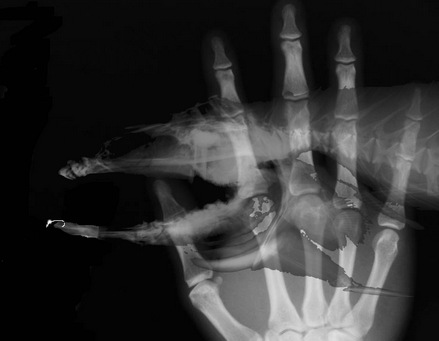
… and now you know. The white blotches in the above photo testimony of the relentlessness of excited electrons that find the smallest recesses in felt soles and laced uppers – leaving enough residual radiation to keep the surfaces sterile for the season.

… ditto for me. I’m content with someone else’s bloodline relieving your darling of his lunch money.

Kelvin lands a nice one

Kelvin and I hopped fence and spent the afternoon lolling in the steaming current. Me testing how many kilorads Marabou can withstand before losing its supple, and Kelvin watching the waterline of his float tube until the seam actually blew.

We managed only a single fish between us, shown above … It started as a Rainbow trout, but like most of the larger fish, loses it’s genetic distinctness after the m-RNA becomes corrupt.

Sun on my cheek, something I haven’t felt in many weeks, and won’t (hopefully) for many more.

Tags: fly fishing, nuclear power plant, rainbow trout, marabou, subatomic particles, mud snails, mussels, invasive species

Dame Berners is safe, but damn little else is

UK scientists have unearthed a startling new trove of prehistoric angling gear, containing evidence that fly fishing may have developed in prehistoric times

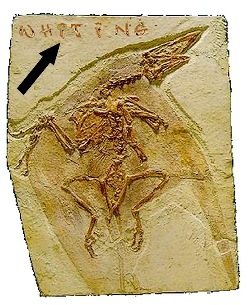
UK and Chinese scientists are suggesting that the Confuciusornis fossil discovered in China, may have been a dinosaur with a Mohawk of ginger colored feathers running down its spine.

… as this is the first evidence of a feathered animal small enough for Man to run around and beat to death, it’s thought the ginger hackles may have been used to craft fishing lures and flies.

As early Man wasn’t able to trod the river with impunity – everything in and out of the water being two or three times his size, possessing foot long teeth, and faster; these early “flies” may have been part of a rod-snare mechanism versus the “park ass on a rock and wait for the rod tip to move” style of angling practiced today.

Wood fragments found in a nearby cave suggest a tapered tree branch with both ends sharpened. This would allow the snare to be cast into the water, the rod stobbed into the mud nearby, with our prehistoric angler zig-zagging frantically – avoiding ravenous meat eaters while his prehistoric angling buddies shouted encouragement from the safety of a nearby cave.

… damn little has changed.

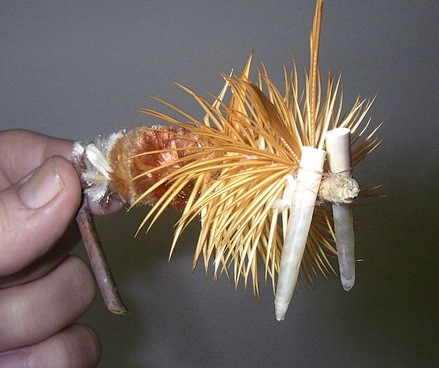
Ginger Cat's Kill

As our lust for science is well documented, I was asked to view the scraps of sinew and fossilized angling debris to assist in shedding light on these rare artifacts…

… and while puzzled by the “saber-toothed” imitation,  scientists reassured me that prehistoric Mayflies ate people with great gusto – and the rendition was anatomically correct.

Fossilized Confuciusornis Cape DNA testing proves the fur used was one of the many predatory cats that roamed the area, perhaps a lucky kill considering the flint spear points and unsophisticated hunting gear consistent with that era.

I called it a “Ginger Cat’s Kill” – due to the indiscriminant use of Confuciusornis hackle – and mentioned that the faint scratches surrounding the fossil had meaning…

Naturally we’ll have to rewrite a few passages involving the Etruscans and Rome … Dame Juliana Berners is safe – but damn little else will be.

Tags:  Confuciusornis, ginger hackled dinosaur, Cat’s Kill dry, fly fishing history, dame juliana berners, fossilized feathers, fishing snare, DNA testing, Whiting farms

The Dyna-King cement reservoir, it’s either that or enduring a bikini wax

It’s unfamiliar ground for a fellow that shops with coupons, but after suffering another glue-based indignity, it was time to plow some dollars into the problem.

Head cement. Thinned to penetrate, odiferous, and requiring equally caustic thinners to remove  from things it wasn’t meant to glue …

… because eventually you’ll get cocky. Coaxing a feather to remain in a certain position, you uncork the cement to lay in a generous dollop, using the tingle of “spider-sense” to replace the stopper.

It’s not so bad when the entire bottle empties into your crotch. It’s mostly room temperature and your careful thinning is rewarded by an even saturation of the pants enroute to a better bond with those sensitive areas below.

No sudden chill or shock to the system, no nerve ending screaming in torture – all that comes later when you’re attempting to separate undergarments from everything nearby …

… all of which are hairy and sensitive.

It’s job induced peril. If you tie this will happen. You will regret it.

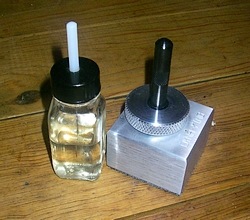
Dynaking Cement After the top two layers of skin return, I’ll be in a better mood – in the meantime I’ll marvel at my gleaming technological cement reservoir (and the hole it left in my pocketbook) – and consider its purchase cheap.

It’s a Dyna-King cement reservoir, and has lifetime written all over it.

Milled from a single block of Aluminum it’s weighty enough to avoid tipping over, holds about half a bottle of cement, and has an “O-ring” seal on the bodkin to prevent leaks or air penetration.

The cost is $39.95, which is steep – but after I bench tested the shape with my hammy hands, I’m positive that I won’t be able to tip the cement jug with a careless or hurried move.

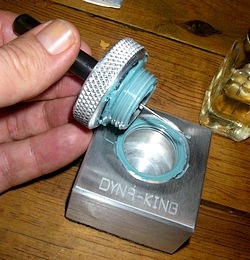
The reservoir ready for filling

The picture at right shows the reservoir ready for filling. Grease has been applied to the thread to prevent cement from penetrating into the threads and sealing the unit.

They suggest periodically replenishing the barrier with petroleum jelly or light grease.

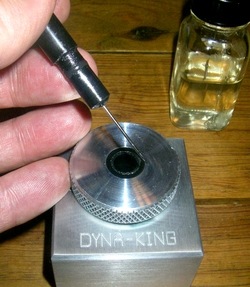
The below picture describes its intended use. The loaded bodkin is pulled from the top assembly and returned for refill or until its next use.

The O-ring provides the tension for removal and replacement and ensures an airtight seal when the bodkin is in place.

Bodkin removed for application of cement

This is one of those niggling long term issues that’s not enough of a problem to warrant an immediate fix, and just enough of a disaster that you curse yourself for not addressing sooner.

I’ve used a variety of hollowed out wooden blocks that were eventually pressed into a multi purpose role. Great for drying flies – but to avoid clippings raining down onto fresh cement, the tendency was to move the block further away.

Guaranteeing you’ll slurp cement on the desk surface as the loaded bodkin traveled between reservoir and fly.

Getting the container too close meant banging it while spiraling a long segment of chenille or hackle – which was just as bad.

The Dyna-King cement reservoir is about 3/8” shorter than the glass bottle flavor, and quite a bit heavier than wood. It may survive close to the vise base without discharging the contents accidentally. The tension on the O-ring is sufficient to hold the bodkin firmly in place when upended, and you can knock over the entire assembly with bodkin in place without a spill.

… which may buy me enough time to regrow some hair, and allow the swelling from the mixture of toluene and pumice to subside a bit.

Full Disclosure:  I paid full retail for the device.

Tags: Dyna-King cement reservoir, toluene, head cement, lacquer, bodkin, fly tying misery, The Fly Shop, fly tying tools

Little Green fish with antennae is too trite

They even come in a boxThe evidence has always been there – but most of us lack the proper venue to espouse sinister conspiracy theories. I’ve been lax on this front for many months, but even the halls of respectable Science are suggesting we may have visitors …

Ask yourself, why is it the Asian Carp turned North when released from that Arkansas bass pond … Wouldn’t a dumb siphon-eater have found it easier to swim with the current towards the Gulf?

… and that laughter you hear when fishing, you’ve shrugged it off as a vagrancy of the wind, some solitary echo off a canyon wall, or some minor reverb in the tinkle of the stream?

Others have heard it, and a brave few have even committed the “laughing brook” to hardcopy, although never giving a plausible explanation why …

Scientist Paul Davies thinks we’re plagued by aliens, and after considerable thought – I’m inclined to agree.

The Asian Carp can now be easily explained, and made the more sinister – they saw the Great Lakes from Space.

Go ahead and laugh, Monkey-Boy, how else could mere Jellyfish sink 10 tons of Japanese trawler?

Anglers have described fish as smart for centuries, yet science claims there is so little intelligence they can’t feel pain – it being tied to higher thought processes that fish lack – like fear, greed, and world domination.

Until now.

Scramble down the bank, inching forward behind the cover of vegetation, and the moment the rod shows your quarry bolts out of sight. Coincidence, or is he under that impenetrable thicket of logjam doing “high fins” with his sentient cousins …

“Dude, you sucked Fatty in again – all the way down the bank, and he tore his external diaphanous envirosuit on the tree branch, and didn’t even notice.”

Summon the Ospreyship for transport upstream, if he starts me off with an emerger, I’m taking his ass Downtown …”

Alien microbes in the water supply, coupled with a nutrient rich bath of female hormones, muscle relaxers, and nitrogenous farm waste – capable of taking over the unwitting host on a whim.

How else to explain Congress, Jerry Springer, or a $9,700 fly reel?

Tags: alien microbes, Japanese trawler sunk by jellyfish, Osprey, Asian Carp, fly fishing humor, laughing brook,

So thick you could walk across their backs

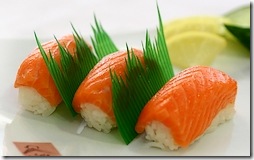
Sake sushi After a two year ban on commercial fishing the result is another large drop in the fall Chinook run. 2008 was the record low for returning fish, and it appears that 2009 will be lower still.

More troubling is what few fish returning are mostly hatchery fish and it appears the wild Chinook of Oregon and California will be the latest addition to the endangered species list.

… which will bring out the celebrities and Hare Krishna’s – who’ll alternate attempts to self immolate …

You can count on a third year of fishing restrictions, that proclomation is only a formality.

I call it “last fish conservation” – where everyone eats everything until there’s only a single desiccated specimen left, then we make hideous noises and point at each other with great animosity.

The really fun part will be how this plays out with the Paramount Farms – Dianne Feinstein review of the “sloppy science” that suggests the Delta is in trouble. It won’t be some unknown baitfish causing the pumps to grind silent …

… now it’ll be Sushi.

The voting public has always grappled with some small inedible member of the food chain causing civic disturbance but once they realize there won’t be any more sake (salmon sushi), all those minor celebs from Malibu and Beverly Hills will be armed with torchs, swords, and iced lattes.

… and the next Governor will watch his predecessor’s Water Pact unravel while the studio execs and Silver Screen nobility make small talk about eating everything in Maine, or Alaska.

We’ll take some serious lumps in the press, it is our karma.

Tags: California Chinook salmon decline, sushi, Paramount Farms, Stuart Resnick, hatchery salmon, sake, shake, Dianne Feinstein, Hare Krishna,

Like a Royal Coachman only with a yellow body …

Some aspiring beginner announces on a forum that he’s invented a new fly, asking for comments on the quality of construction and the style used.

… which brings the Wrath of The Horribly Offended onto his narrow shoulders. The first half dozen comments point out someone else’s fly his resembles, albeit minus the red tail, and then all original thought is ignored as various fanbois attribute the tie to their respective Sensei.

In the meantime the next great fly tier backpedals back into anonymity swearing never to show his work again.

Ours isn’t the only sport where the word “invention” is four letters. Perhaps variation or derivation is more appropriate – but with 200 plus years of fly tying already behind us has anyone really invented anything in the last 50 years?

Of course they have, only we have trouble admitting it.

Discounting the new flies that arrive with each synthetic, most of the natural materials like fur and feathers are well known and documented. We’ve wrapped, clumped, bound, spiraled, tamped, straightened, and parachuted most everything already.

Fly patterns have this enormous gulf of Gray, with rabid partisans perched on every outcropping just waiting to tee off on the unwary. Us well intentioned tiers duck and evade the unguarded phrase containing “new” or “invented” – and are reminded how easy it is to lift the lid off Hell Incarnate.

I figure there are three basic issues within the larger question of “new”, and these revolve around colors, styles, and method.

Changing the tail on a Black Gnat from black to chartreuse will rarely work up much emotion. With only the single change, it’s a variant of the Black Gnat, and should be named similarly. “Bob’s Black Gnat” is appropriate, as is “Yellow-tailed Black Gnat.” The issue is straightforward – do you wish to pay homage to the original, or do you wish fame everlasting?

As with all vanity, it’s an individual thing – and is probably the source of the foment when the issue raises itself in the media. In the most virulent posts – and ensuing comments – affixing your name to an existing variation is unworthy, even if you made the fly better.

… but if you’re already famous it’s okay, as witnessed by the Royal Coachman and its derivative the Royal Wulff.

Variations caused by style are similar. No one raises an eyebrow at a Parachute Adams – unless it’s introduced as Bob’s Killer Bug. Fingers start pointing, flames erupt and in the blink of an eye – the forum thread is in shambles, with the incensed participants labeling each other with even better names …

Fly tying styles have always incorporated the traditional patterns, as they’re already the product of many years of tinkering and refinement.

We don’t like to think in those terms, how the original fly may have been slightly different and bore a different name – but history is written by the victor, and the venerable Adams may have originated as Finkle’s Wilson, until some SOB added grizzly wings …

… and was vilified by anglers when he dared rename it.

Which neatly explains how difficult it is to trace the original recipe on the timeless patterns of yesterday, likely each author took the variant he fished as gospel.

Style can be incurred by materials as well as tying method. Polypropylene made us retie everything, and we gleefully discarded muskrat, fox belly, and beaver bodies … until we learned Poly fur was coarse, unforgiving, and didn’t float much better than our old fur. That didn’t stop us from putting “Poly” in front half the old standby’s, but as the material proved a false prophet the renaming ceased once it became less popular.

Bead head flies are another example of how a functional style begats variation. Somehow the addition of a heavy bead didn’t warrant renaming the Prince nymph, and we merely added “bead head” to distinguish the functional change.

We’ve seen numerous styles in the last 50 years, most have occurred since we mastered the petroleum polymers, like Nylon, Banlon, Antron, and Z-lon – and the countless synthetics that have been adapted from carpet fibers and the upholstery trade.

We’ve replaced chicken fibers with Microfibbets, wings with Polypropylene or Z-lon, swapped fur dubbing for Antron carpet blends, and did away with hackle entirely – or tried to … We’ve endured the Yorkshire Flybody hook, Swedish dry flies, thorax duns, Waterwalkers, No Hackles, and dozens of different surface film flavors that only young eyes can see.

We’re so busy attempting to replace the Catskill dry and standard nymph, that our failure to find a glossy synthetic equivalent may play a part of the angst displayed when policing derivations and variants.

Structural method also spawns flies as new. Advances in hook design or the debut of a lightweight gossamer can spawn new styles of tying the older flies, and inspire much creativity.

Parachute flies are a great example. Most contain the identical ingredients of the traditional fly, and like bead heads we’ve added “parachute” to the name with little fanfare and no resistance.

… and it’s only because the Czech’s have been consistently eating our competitive lunch that we haven’t complained of their adaptation of a scud style (hook and style) into a bonafide Czech Nymph.

… like Kaiser Soze – we’re terrified of angering them.

Fly tiers have always approached invention with trepidation. Our first halting steps were necessity rather than genius, and added a taint not soon forgotten.

A new tier usually takes the glossy plates of books and magazines as his first muse. Consumed with creativity he’ll often overlook materials in the original recipe that he’s missing. With the fly two-thirds complete another four letter word, substitution, rears its ugly head.

Even if a Light Cahill is completed with Green hackle tips for wings he’ll view it as a failed attempt, as it’s not the original pattern. Months later when he’s more comfortable with skills and patterns he makes a minor modification, perhaps to customize it for his watershed or local insects, and we chew his ass for blasphemy.

A strange dichotomy, on the one hand we’re intent on discarding the old, and are incensed by anything new derived of their tradition.
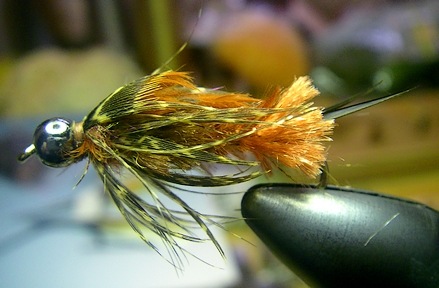
The Royal Coachman Nymph, I invented it The Royal Coachman Nymph, and I invented it

Later in a fly tier’s career it’s all about experimentals and variations of derivatives. After many years fishing you realize that traditional patterns are merely flies that have become popular, not that they’re better than everything else.

But all those test cases and oddballs are kept close to the vest. Metered out to strangers on the creek when you’re lucky enough to have something that’s better than most that afternoon, and the rest given a trial and buried into an overhanging tree limb or sunken log.

… and while the forum dwellers snarl at each other from the safety of their computer, attributing whatever appears as something their favorite author or fishing buddy tied first, half of them don’t tie at all – and the other half don’t tie well … which is most of the reason they’re not offering their flies for commentary.

Is it a new fly worthy of a name, whose pedigree can be traced to its originator? Usually not. Mostly they’re copies of copies whose original dressings were guessed at – contained frequent substitutions, which were fortunate enough to have their name and recipe contained in an early tome on fly fishing.

… and if its description involves naming a classic fly, then it’s a derivation regardless of what you call it.

Tags: fly tying, naming flies, Yorkshire flybody hook, Partridge hook company, Catskill dry, traditional fly patterns, fly fishing forums, Light Cahill, Royal Wulff, parachute flies, bead head, Czech nymphs
Date Error on CA License display

Fish and Game Logo Apparently the newspaper article I cited in an earlier post transposed some dates.

The regulation change for California that eliminates the need to to display your license doesn’t go into effect until March 2010. It’s the Bay-Delta stamp that is no longer required as of January 1, 2010.

… and to the alert reader that spotted the issue, telling the Warden that “Singlebarbed says it’s okay” will likely earn you a fast takedown and a brusque cavity search …

Nor is it a sound defense with an angry Judge.

Just saying is all.

Tags: California fishing license regulation change, Department of Fish & Game, cavity search, Bay Delta stamp