Author Archives: KBarton10

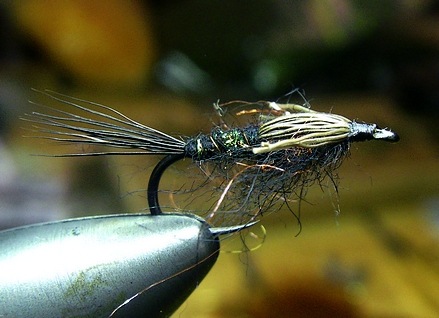
Like a Royal Coachman only with a yellow body …

Some aspiring beginner announces on a forum that he’s invented a new fly, asking for comments on the quality of construction and the style used.

… which brings the Wrath of The Horribly Offended onto his narrow shoulders. The first half dozen comments point out someone else’s fly his resembles, albeit minus the red tail, and then all original thought is ignored as various fanbois attribute the tie to their respective Sensei.

In the meantime the next great fly tier backpedals back into anonymity swearing never to show his work again.

Ours isn’t the only sport where the word “invention” is four letters. Perhaps variation or derivation is more appropriate – but with 200 plus years of fly tying already behind us has anyone really invented anything in the last 50 years?

Of course they have, only we have trouble admitting it.

Discounting the new flies that arrive with each synthetic, most of the natural materials like fur and feathers are well known and documented. We’ve wrapped, clumped, bound, spiraled, tamped, straightened, and parachuted most everything already.

Fly patterns have this enormous gulf of Gray, with rabid partisans perched on every outcropping just waiting to tee off on the unwary. Us well intentioned tiers duck and evade the unguarded phrase containing “new” or “invented” – and are reminded how easy it is to lift the lid off Hell Incarnate.

I figure there are three basic issues within the larger question of “new”, and these revolve around colors, styles, and method.

Changing the tail on a Black Gnat from black to chartreuse will rarely work up much emotion. With only the single change, it’s a variant of the Black Gnat, and should be named similarly. “Bob’s Black Gnat” is appropriate, as is “Yellow-tailed Black Gnat.” The issue is straightforward – do you wish to pay homage to the original, or do you wish fame everlasting?

As with all vanity, it’s an individual thing – and is probably the source of the foment when the issue raises itself in the media. In the most virulent posts – and ensuing comments – affixing your name to an existing variation is unworthy, even if you made the fly better.

… but if you’re already famous it’s okay, as witnessed by the Royal Coachman and its derivative the Royal Wulff.

Variations caused by style are similar. No one raises an eyebrow at a Parachute Adams – unless it’s introduced as Bob’s Killer Bug. Fingers start pointing, flames erupt and in the blink of an eye – the forum thread is in shambles, with the incensed participants labeling each other with even better names …

Fly tying styles have always incorporated the traditional patterns, as they’re already the product of many years of tinkering and refinement.

We don’t like to think in those terms, how the original fly may have been slightly different and bore a different name – but history is written by the victor, and the venerable Adams may have originated as Finkle’s Wilson, until some SOB added grizzly wings …

… and was vilified by anglers when he dared rename it.

Which neatly explains how difficult it is to trace the original recipe on the timeless patterns of yesterday, likely each author took the variant he fished as gospel.

Style can be incurred by materials as well as tying method. Polypropylene made us retie everything, and we gleefully discarded muskrat, fox belly, and beaver bodies … until we learned Poly fur was coarse, unforgiving, and didn’t float much better than our old fur. That didn’t stop us from putting “Poly” in front half the old standby’s, but as the material proved a false prophet the renaming ceased once it became less popular.

Bead head flies are another example of how a functional style begats variation. Somehow the addition of a heavy bead didn’t warrant renaming the Prince nymph, and we merely added “bead head” to distinguish the functional change.

We’ve seen numerous styles in the last 50 years, most have occurred since we mastered the petroleum polymers, like Nylon, Banlon, Antron, and Z-lon – and the countless synthetics that have been adapted from carpet fibers and the upholstery trade.

We’ve replaced chicken fibers with Microfibbets, wings with Polypropylene or Z-lon, swapped fur dubbing for Antron carpet blends, and did away with hackle entirely – or tried to … We’ve endured the Yorkshire Flybody hook, Swedish dry flies, thorax duns, Waterwalkers, No Hackles, and dozens of different surface film flavors that only young eyes can see.

We’re so busy attempting to replace the Catskill dry and standard nymph, that our failure to find a glossy synthetic equivalent may play a part of the angst displayed when policing derivations and variants.

Structural method also spawns flies as new. Advances in hook design or the debut of a lightweight gossamer can spawn new styles of tying the older flies, and inspire much creativity.

Parachute flies are a great example. Most contain the identical ingredients of the traditional fly, and like bead heads we’ve added “parachute” to the name with little fanfare and no resistance.

… and it’s only because the Czech’s have been consistently eating our competitive lunch that we haven’t complained of their adaptation of a scud style (hook and style) into a bonafide Czech Nymph.

… like Kaiser Soze – we’re terrified of angering them.

Fly tiers have always approached invention with trepidation. Our first halting steps were necessity rather than genius, and added a taint not soon forgotten.

A new tier usually takes the glossy plates of books and magazines as his first muse. Consumed with creativity he’ll often overlook materials in the original recipe that he’s missing. With the fly two-thirds complete another four letter word, substitution, rears its ugly head.

Even if a Light Cahill is completed with Green hackle tips for wings he’ll view it as a failed attempt, as it’s not the original pattern. Months later when he’s more comfortable with skills and patterns he makes a minor modification, perhaps to customize it for his watershed or local insects, and we chew his ass for blasphemy.

A strange dichotomy, on the one hand we’re intent on discarding the old, and are incensed by anything new derived of their tradition.
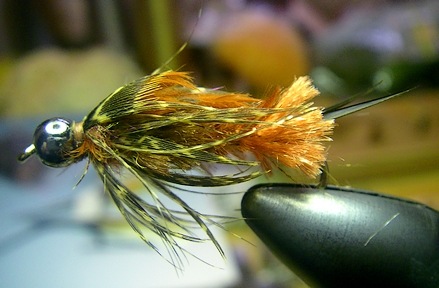
The Royal Coachman Nymph, I invented it The Royal Coachman Nymph, and I invented it

Later in a fly tier’s career it’s all about experimentals and variations of derivatives. After many years fishing you realize that traditional patterns are merely flies that have become popular, not that they’re better than everything else.

But all those test cases and oddballs are kept close to the vest. Metered out to strangers on the creek when you’re lucky enough to have something that’s better than most that afternoon, and the rest given a trial and buried into an overhanging tree limb or sunken log.

… and while the forum dwellers snarl at each other from the safety of their computer, attributing whatever appears as something their favorite author or fishing buddy tied first, half of them don’t tie at all – and the other half don’t tie well … which is most of the reason they’re not offering their flies for commentary.

Is it a new fly worthy of a name, whose pedigree can be traced to its originator? Usually not. Mostly they’re copies of copies whose original dressings were guessed at – contained frequent substitutions, which were fortunate enough to have their name and recipe contained in an early tome on fly fishing.

… and if its description involves naming a classic fly, then it’s a derivation regardless of what you call it.

Tags: fly tying, naming flies, Yorkshire flybody hook, Partridge hook company, Catskill dry, traditional fly patterns, fly fishing forums, Light Cahill, Royal Wulff, parachute flies, bead head, Czech nymphs
Date Error on CA License display

Fish and Game Logo Apparently the newspaper article I cited in an earlier post transposed some dates.
The regulation change for California that eliminates the need to to display your license doesn’t go into effect until March 2010. It’s the Bay-Delta stamp that is no longer required as of January 1, 2010.

… and to the alert reader that spotted the issue, telling the Warden that “Singlebarbed says it’s okay” will likely earn you a fast takedown and a brusque cavity search …

Nor is it a sound defense with an angry Judge.

Just saying is all.

Tags: California fishing license regulation change, Department of Fish & Game, cavity search, Bay Delta stamp

There’s always some fellow that wants to paint outside the lines

Hot Orange isn’t high on the list of trout colors, so it’s only natural you suspect I’m up to something gaudy. Not the case, us Impressionists are freed of the narrow confines of caddis larvae and Giant Stone dry flies and recognize Orange isn’t really Orange if you don’t want it to be …

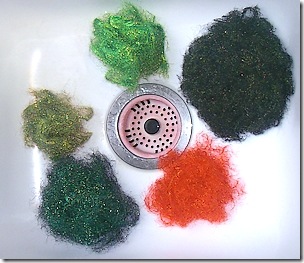
I’m still smarting from the “Polyester Sink Strainer” episode, wherein I subjected the kitchen to hideous odors and obscene colors, just to garner a couple of new halo colors to try.

Being a fan of the “Chaos Theory” of fly coloration, and believing that Mother Nature’s bugs are never a uniform coloration – and there’s always an inherent mottle effect besides the very obvious color difference between belly and back.

Angling books love to describe the “ … mayfly tumbling in the current” representation of nymphing, which I don’t subscribe to either. Throw a cat off the garage roof and he lands on his feet, ditto for dogs and in-laws, so invertebrates likely tumble briefly to regain balance, then swim like hell for safety, or the surface.

Colors can dampen as well as provide highlight or halo effects. My earlier example of adding neutral gray squirrel to yarn blends shows the “dampening” effect of gray, how it can take the bright edge off of the yarn dander and make it an earth tone of the original.

Highlights and halos are often wildly different colors added to dubbing to offer a flash or hint of color to the fly. A bit of boldness on the choice of accent can yield some surprising effects.

Like Hot Orange becoming muted and obvious and all at the same time.

An example of highlights or halo dubbing

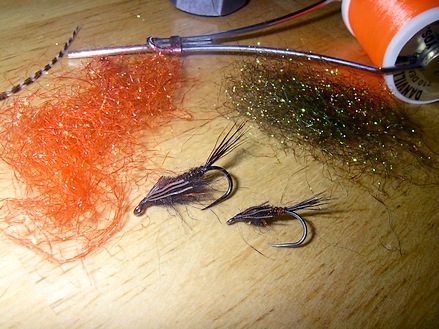
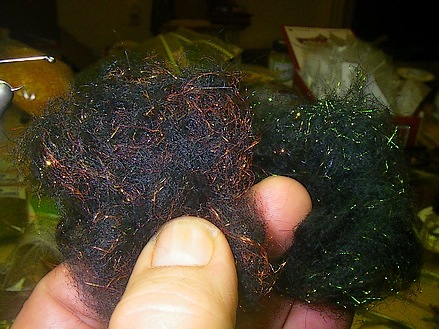
Above are two examples of marrying odd colors together to seem much less so. Black and Hot Orange Angelina, and Black mixed with the Grannom Green. (Original colors shown here)

The bright portion of both has been overwhelmed by the surrounding black, and Hot Orange is now coppery colored, and most of the green has vanished.

My war on monochromatic is well documented. I have a goodly supply of the time-honored traditional colors, but most of the unique flies I use each season are a mixture of effects – but almost always polychromatic.

Which isn’t saying much, as any guide can tell you of the client that scoffs at the flies offered him, loudly proclaiming, “I catch all my fish on an Adams” – and if that’s the only thing the gentlemen uses, it becomes a self fulfilling prophecy.

Real differences in flies can only detected when pals are present. Count the number of outstretched palms, and figure you’re onto something.

Impressionists aren’t limited to flights of fancy, despite our being able to list a hundred great uses for Claret. We can use the scientific method when it suits us  – or succumb to the inner child as we deem fit.

Glance at a natural then immediately glance away. What color was it?

Likely you’ll say brown, or dark, or olive-black – you’ll retain a distinct impression of the predominant color and identify it. Flip the bug on its belly and do the same thing. Now it’s tan, or olive, or another color, Mother Nature always provides a light belly and dark back.

The back color is your base – and make the belly color the halo. It’s quite possible that fish on an intercept may get a glimpse of both – and a foraging fish that’s uprooted the insect from instream vegetation or the bottom will see the tumbling variant – guaranteeing both.

AP Black with Halo colors

Above is the traditional AP Black tied with the mixed black/green on the body, and mixed black/hot orange for the thorax. Those Angelina fibers that are visible are quite muted, but also very obvious.

They look black to me

Moving the perspective a couple inches further away and we’d call both flies … black.

Fish vision and perception are still hotly debated topics, far above our pay grade. What I do recognize is that most artificials are largely stiff compared to the wild gyrations of real insects – and anything I can add that implies motion is as good as the motion itself.

… and Science be Damned, the real fun is in spattering the canvas with Puce, Mauve, and Day Glo yellow, as it upsets conventional bug theory and masks the fact I’ve never been much good at painting within lines …

Tags: Soft Crimp Angelina, AP Black nymph, dubbing highlights, halo dubbing, fish vision, Chaos Theory, Impressionism, evangelical fly tyer

That was some of the best flying I’ve seen yet, right up to the point where you got killed

I didn't do itHer icy gaze punctuated by the bony digit pointed in my direction …
Naturally, I tried the First Law of Backpedalling, innocence.

“ … What?”

I gazed around studiously avoiding That Which She Held, but I guess my look of innocence wasn’t quite up to par – or I’d gone to that well too many times …

I was Flat Busted.

I had counted on her being dazed by the glitzy neon of the Las Vegas strip. A whirlwind of shows, drinking, and pulling handles – and the ensuing hangover would buy me enough time to replace the sink strainer.

Umm, No.

Instead I’m in my kitchen looking “hang dog” while the Gestapo asks me to collaborate.

… and I’ve warned you often enough. Make sure you clean all evidence of dye from the important fixtures and linoleum – so you aren’t pinched in your first attempt.

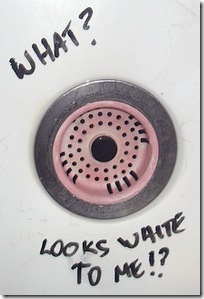
Angelina & Sink discolor Me, thinking I was a Ninja Master was part of my undoing. The rest was the horrifying discovery that sink strainers contain Polyester.
… there’s no label on the damn things, how was I to know?

The Olive and Peacock blends strained fine. The Grannom Green didn’t leave a mark, imagine my surprise when the Scarlet (which looks very Orange) left a calling card.

Our modern everyday sink strainer appears to have about 10% polyester – just enough to revoke my parole, and land me in the crosshairs yet again.

I’ve mentioned the destroyed feathers, hinted at the strain in relationships, insisted that you’d be a Past Master within minutes – and even tried the Manhood angle.

But you fellows were smarter than I was, and while I’m watching the next nine sappy romantic comedies with one star or less, understand that dinner works – but hell hath no fury like a woman wanting popcorn.

… and I’ll be fishing quite a few Angelina equipped flies this year hoping to get the taste out of my mouth.

Tags: dyeing polyester, soft crimp Angelina, grannom green, fly tying materials, peacock, damsel olive, sink strainer, Las Vegas, flat busted

The Karaoke version of Singing in the Rain

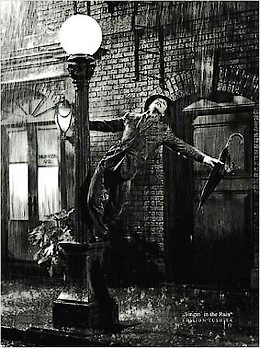
Singing in the rain, urinalysis to follow I make it40 Days and 40 Nights, or at least until Thursday” – and am steadfastly unrepentant because it’s only Day One , figuring if I hold out till about Day 17 there’ll be enough water for both me and them plague tomatoes.

Tamawanis has too much snow, Roughfisher is fleeing his ice-bound pals for Hawaii, and us Californians brace for what could become a fourth year of drought. Even worse, it makes all them other fellows from the frostbitten East want to crowd us further…

…where else are they going to go, Florida?

But the last 24 hours has unleashed a gully washer commensurate with dire need. Horizontal rain in sheets, flooded fields (that are soaking it up greedily), and the South end of the state finally has enough water not to borrow mine …

… in fact they’re wanting to return a goodly portion, gratis.

… and as all those dour faces showed up at work – freshly assaulted by fierce winds, rain, and the death-wish tail-gaiting driver behind them, they were met with the sight of my overly fed form skipping through the hallways with a tune on my lips.

Urinalysis turned up negative – additional proof that non-outdoorsmen are humorless SOB’s.

Singlebarbed’s Official Drought indicator is whether Tom Chandler continues to post. As he’s at the top of the pass, we’ll wait until the snow burden and lack of supplies makes the Wonderdog’s tongue something to eat, and the coughing roar of the Honda generator robs him of creativity.

… today, nothing.

Come Spring they’ll find him face down in the garage – the last match clutched in nerveless fingers. Hand rubbed Spar varnish proving invulnerable to wooden matches – and the snapped remnants of Powell, Phillip’s, and Raine forming an impotent pile of debris amidst a scene from Doctor Zhivago.

Say hello to my little friend, back from the Dead …

Little_Stinking_Flow

What was dry and lifeless is now five feet of roaring filth; tree trunks, rusting cars, and the the unsteady press of a couple hundred tons of upstream gravel headed my way.

From 38 CFS to 7200, washing away the wrongdoings of last season, replenishing the carcasses and goat skeletons at the high water mark – and unearthing my favorite rusting Audi in gunfire black …

Tags: California drought, Little Stinking, Tamanawis, Roughfisher.com, Trout Underground, snapped bamboo rods, Doctor Zhivago, Audi

Where we distill the notion of the Young Angler

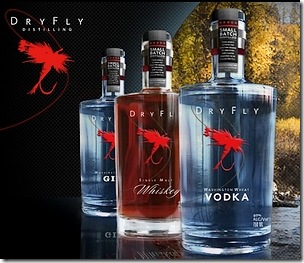
Dry Fly Distilling, for the Youth Meeting You’ve watched them gash bosom and plea with club personnel at every meeting. Each plaintive cry falling on deaf ears – and then some poor SOB that’s not there nominated to be the “Youth Coordinator.”

… a title reasonably vague, implying something to do with finding kids that want to unplug long enough to take up the sport.

It’s the greatest hypocrisy of all. Old guys hate kids, wives, and all familial responsibility, which is why they’re at the club in the first place. “Kids” being equally vague – as the usual measurement of years is often superseded by, “is the inattentive little twit related to me.”

Most of us have seen it, and many more have felt it. Perhaps its time we  use that looseness in definition to our own ends.

I’m on the receiving end of a brief (albeit wheedling) email that insists it’s time to take some local gentlemen fishing again. This fellow being a work in progress, with an attention span of six minutes, reflexes of a Pterodactyl, with the appreciation and refinement of a Visigoth.

Kind of like a kid – only older.

It’s raining and cold outside, and I figure being housebound with spouse and kids has finally drove him over the edge. Only Wild Men intentionally expose themselves to inclement weather – and leaves me wondering whether we should be focusing on adults that haven’t fished – versus kids that would rather not …

I read further and his sudden passion is liquor related. Dry Fly distilling to be exact, which we assume tastes twice as good if you know how to fish – versus merely swilling it as a soulless Kayaker, or dog walker.

But we’re still golden. “Youth Coordinator” now being synonymous with wet bar and the tinkle of ice cubes, and whatever quota of recruits necessary can be shanghaied by them left standing.

… and the problem becomes keeping the regular membership distant. Compared to cramped chairs, congealing Beef Au Jus, and discussing the dining habits of Poodles with Bob’s wife, them youth meetings will be a lively affair.

Tags: fly fishing clubs, youth coordinator, Dry Fly distilling, artisanal liquor, Wild Men of fly fishing, club dinners, fly fishing humor

Print being Dead, and here is where they buried her

Print is far from dead It’s a daunting project that Project Gutenberg & Google has undertaken, scanning all the books in the world and making them available online. It’s not without incident considering they already incurred $124 million in infringed copyrights – but they’re forging ahead undaunted.

With Amazon’s Kindle creating quite the stir over Christmas, and competitors lining up to enter similar products into the mix – it appears we’ll have the opportunity to add to our fishing library virtually.

As my vision is on the wane – I can’t admit to comfort while straining over a dimly backlit screen, but it’s likely to intrude more each decade.

There’s quite a few famous angling tomes already available, and many out of print classics that are unavailable to anyone other than collectors.

George Kelson – The Salmon Fly, how to Dress it and how to Use it (1895)

G.E.M. Skues –  The Way of the Trout with the Fly (1921) and Modern Development of the Dry Fly (1910)

Mary Orvis Marbury – Favorite Trout Flies and their Histories

George M. LaBranche – The Dry Fly and Fast Water (1914)

Frederick M. Halford – Floating Flies and How to Dress Them (1886)

There are many hundreds of titles, some you may have never heard of – and the tags under each allow you to refine your search to specific areas of the online collection. Most of the books are old enough to no longer be copyrighted, and it makes sense that Google would want to avoid all the litigation until it’s determined how the author will receive compensation.

Kelson’s book on the Salmon Fly is still considered the Bible of the married wing, eyeless hook crowd. You can download it for free in PDF form versus paying $500 for an old copy.

I’ve read many of these and am continually fascinated over the convictions of their authors. Adding a certain perspective to read, “the Salmon, being the noblest of all fishes, eat Butterflies …” – then grab a copy of a current magazine and read, “they eat leeches because …”

… and in a hundred years will some fellow be giggling over our assumptions?

Our ignorance of history causes us to slander our own times.  – Gustav Flaubert

Anglers today shrink from the old tomes as being antiquated and out of date – and while the language may be archaic, the lessons are still current.

Download a fistful of PDF’s and fish the turn-of-the-century Catskills, or a Irish freshet for sea run trout – then tuck them away as reference materials or simply a good read.

Tags: Project Gutenberg, Google Internet Book Archive, copyright, George Kelson, G.E.M. Skues, Mary Orvis Marbury, George M. LaBranche, Frederick M. Halford, Amazon Kindle, out of print angling books

and The Pale Morning Dun is the tastiest of all

The Golden Stone, terror of the cobble Most of us anglers are oblivious to what goes on in all those streambed nooks and crannies. We’re content so long as it emerges at dusk and exists in enough numbers to keep fish fat and healthy.

Like the dinosaur – scientists assumed that the biggest were at the top of the food chain and everything smaller ran in fear … until they found a Tyrannosaurus Rex and figured a mid-sized predator with a mean streak may be worse than all those enormous herbivores.

So it is with invertebrates, the Giant Stoneflies of our fast water are benevolent – and the mid-size Golden Stone is the T-Rex of the substrate, driving mayflies to flee in terror as it snacks its way through the elderly and infirm …

… and the Pale Morning Dun is either slow as molasses – or tastier than the rest, as more of them were eaten than any other invertebrate.

Which is oddly consistent with my past haunts. All the rivers famous for PMD hatches like Fall River and Hat Creek were absent significant fast water – and where it existed we’d walk past in favor of a slower stretch downstream.

Naturally I’m using the most rudimentary sampling, the widely recognized “fast water = heavily oxygenated = stoneflies” theory of angling. Which gives us something to ponder. Do we mash stoneflies knowing were saving countless smaller bugs – or do we stay out of the fight?

I’d characterize myself as an indiscriminate masher, as once your wading shoes break the Size 12 or 13 barrier – even the Stoneflies flee screaming.

Interesting to note the document suggests that mayflies can distinguish between the Acroneuria (T-Rex) and Pteronarcys (benevolent Giant Fatty Stonefly), and flee from one yet not from the other.

… and the real question becomes, “ was it the current that caused your feet to slip, or was it a million Infrequens with ropes and pullies – getting you to mash invading stoneflies?”

… the little bastards could well be sentient …

Tags: Ephemerella Infrequens, Acroneuria, Pteronarcys, stonefly, mayfly, cobble warfare, tyrannosaurus rex, dinosaurs, fly fishing humor, Hat Creek, Fall River, wading shoes

50 Years of Science fiction ruined by a single biologist

blacklagoon Those giddy days of Halloween television,  Ma insisted you were too young to watch a pissed humanoid water breather slime its way through the streets preying on the unwary, dragging screaming female teens into the cold bosom of a nearby bay …

… there to perform unimaginable and completely horrific unknown rituals on their taut … flesh …

Pop wasn’t allowed to watch either – and if the pair of you were caught he’d point finger and rat you out.

50 years of perfectly good science fiction ruined because some biologist discovered different …

Apparently fish gills aren’t just for breathing. A dual purpose organ which assists in ion exchange with the surrounding water, allowing fish to regulate their internal chemistry.

“In freshwater fish, like rainbow trout, they tend to lose ions from their blood to the water, because the ion concentration in blood is greater than that of freshwater,” she said.

The team took measurements from the gills of young, developing rainbow trout to find out what functions they were performing.

“When the gills are still immature, a significant portion of ion uptake occurs at the skin. As the fish get older and the gills mature, [this] can gradually shift to… the gills,” said Ms Fu.

“We found that ion uptake shifted from the skin to the gills earlier than oxygen uptake. This led us to propose that the gills are needed for ion regulation earlier than they are needed for oxygen uptake.”

This recent study suggests you may be twice the oaf for jamming them hammy hands into the gill area, as you may be injuring a delicate mechanism designed to suck up sewage, DDT, and twice distilled female hormones.

The good news is that Hollywood can reshoot all them old movies, and feature a really pissed man-eating-mostly-head Rainbow trout with a preference for nubile teen fems …

… and you get to claim innocence (while pointing the finger at Junior) – as you thought it was a Rivers that Cost Most remake …

I say, do the math. A steady influx of chemicals into the watershed and gills as chemical exchange – begats really muscular gills as the toxic burden increases, requiring evolution and expansion of the skull area – resulting in (possibly) larger brains and huge gill assemblies.

That larger head should make big teeth an evolutionary no-brainer, and the result will be a sentient, really pissed, mostly head, rainbow trout – with the ability to harsh your mellow, babe.

… better learn how to cast from a shark cage.

Tags: fish gills, gill evolution, University of British Columbia, Clarice Fu, DDT, rainbow trout, ion exchange, sewage, DDT, science fiction, nubile teens, pissed water breather

The Sixth Finger Roadmap, a Powerpoint presentation filled with dancing frogs

The prototypes for the next generation of Sixth Finger scissors arrived on my doorstep yesterday. I’d asked for them to add a zipper so I could change it each year and obsolete everything you already own …

I figured I could offer it as a fetching facsimile to the Royal Canadian Mounties and the cord that secured their sidearm. Three and a half feet of ballistic nylon – and should you ever lay them down, they’d be available to sit on once you returned to your desk.

It certainly would reinforce the notion to keep them in your hand – the downside would be you’re having to tie standing up for the next three months.

Madison Ave calls it “branding” – affixing the image of a product into your subconscious so you can’t help but think of me when you see it. I call it a life long scar, and you’ll never be able to look at a Band-Aid or tourniquet without cringing …

The vendor has added all of the enhancements I’ve asked for and produced something quite special.

The General Purpose flavor of Sixth Finger Issue: The current flavor of scissor is a light-duty specialty scissor, with small light blades and fine tips. It’s wonderful for trout flies and medium sized flies, yet has issues with thick or bulky. Those same light blades offer a small sharp tip – but can be deflected by a heavy woven four strand yarn, or bulky chenille.

Resolution: The debut of the General Purpose variant, designed to accomodate light,  coarse, and heavy materials. It is equipped with a larger, heavier blade that cannot be deflected. It’s simple physics that cause the issue, and adding mass to the blade prevents it bending out of the way, and lengthening the handle allows more force to be exerted to sever large materials cleanly.

The General Purpose will be longer by an inch, half of which is in the blade area, and the balance in the handle. The spring mechanism has been shortened yet retains a crisp positive action. Even better is the blades – about twice the mass – both thicker and longer, and we didn’t have to give up the fine tips.

As I eat what I sell, I’ve already started testing the materials that proved difficult on the smaller scissors, and have been chuckling with great glee …

But I didn’t do you no favor …

Pure Tungsten at the tip To assist both normal and this new “General Purpose” variant, I’ve also added tungsten inserts on both models, but I didn’t do you any favor by doing so …

Tungsten Carbide is one of the hardest metals known to Man, and in scissors it makes a superior cutting edge – one that will last much longer than conventional surgical stainless.

It’s also the most brittle. One bleary-eyed late night cut where you catch the hook shank up at the scissor tip, and you can take the points clean off.

This is true of $500 surgical scissors as well as inexpensive flavor. The only known solution is to make a blunt point which allows more tungsten into the area, giving the tip greater shear strength. As fine tips are essential on a good set of scissors, blunt is unacceptable.

Having tied with Tungsten inserts and expensive surgical scissors for the last 25 years, I can vouch for the fragility of the tip. Bill Hunter sold me my first pair and mentioned, “you’ll have to relearn your scissor work, or you’ll tear these up.”

I did. But at the cost of the first pair.

The second set lasted 20 years, so the transition is easy enough to make, but only after you’ve destroyed at least one set. In short, you learn to make all cuts away from the shank – never cutting towards the hook.

We’ve also opted for an adjustable screw to aid quick disassembly for sharpening.  Medical scissors attempt to braise or grind the screw to prevent seams that allow bacteria to collect on the scissor surface. This prevents the screw from turning – and tightening the screw is often not possible.

As all scissors eventually need adjustment (except in the medical profession where they’re often discarded) –  I’ve got a slightly different screw assembly on these prototypes to see if I can adjust it in the future.

Summary: For 2010 I’ll be offering three models of the Sixth Finger; a larger General Purpose scissor with Tungsten inserts, the current model of surgical stainless, and a variant of the original scissor also with Tungsten inserts.

Pricing and availability should be around the mid-March timeframe. I’m attempting to bring the price in around the $25 dollar mark for the Tungsten and larger General Purpose flavors.

… and my thanks for the many helpful comments and feedback on these “children” of mine. Many of you have been quite candid about changes you’d like – or features that suited you, and I’ve rolled all that into this second generation of product.

Based on what testing I’ve completed, they’ll go through your jeans and a couple inches of Gluteus before you have time to draw a breath …

Testers: Around March I’ll be sending out 10-12 sets of the new scissors to some of the existing owners as a test group. If you’d like to test one model over another I’ll inquire before I send them.

I’d like to upgrade everyone, but the economics say otherwise.

Full Disclosure: I came up with the bright idea, and use them daily, to the exclusion of all other scissors. But as I’m also the vendor – I am not to be believed.

Tags: Sixth Finger Scissor, Product Roadmap, fly tying scissors, Tungsten Carbide, adjustable screw hole, fine tips, Bill Hunter, RCMP, shameless commerce