What draws me to fishing is the ease with which a simple outing turns into an adventure. I’ve read many articles where the author attempts to describe the attraction of fishing, yet most fall short, not for lack of eloquence, there are just too many compelling aspects to the sport.
I was ready for adventure this weekend, the thought that 50 unexplored miles of the Little Stinking remained led me to forswear the areas I had seen for the unexplored area, north of town.
Cross country was the only route, as the sight of working fish would distract me from the long march upstream. I hunkered down and crunched my way through gravel and low scrub, surfacing up near the “Red Truck” stretch, actually the “Red Something” stretch, as I’d seen the blob of color from downstream but had never seen the object itself.
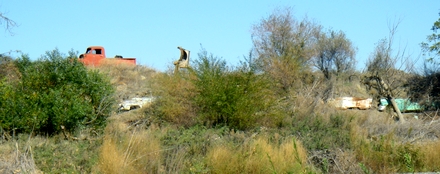
Some enterprising fellow had built a berm of discarded vehicles and covered them with dirt, it was a homespun flood control effort, but the large “No Trespassing” sign near the vehicles discouraged further investigation. A half dozen carcasses of vintage 50’s Detroit were imbedded in the dirt wall, and it appears the Red Truck will be the next sacrificial offering should flood waters appear.
That was the last sign of humanity I was to see all day, but there was much evidence of beaver activity. Most of the trees were neatly girdled, beaver dams broke the flow every couple of hundred yards, and flattened cattails leading to swampy den entrances were dominate on the banks. The population must be extensive and as humans are few, likely they’re unmolested.
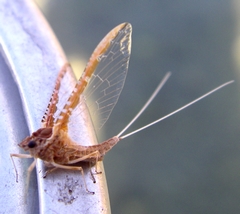 The Little Stinking’s morning spinner fall was in full force, clouds of insects and appreciative fish lying in wait. The creek had become slower and deeper with the change in ecology, and new insects were intermingled with the predominant Trico’s – both Pale Morning Duns and a russet brown Calibaetis added to the blizzard of egg laying mayflies.
I managed to seduce Smallmouth, Largemouth, and Pikeminnow, using #18 and #20 poly spinners. One of the bass I caught appeared to have dirt in his mouth, it proved to be a couple thousand Trico spinners not yet swallowed. I made one pass through the working fish and kept moving, I wanted to see what else the creek offered.
Fall has it’s own special theme, and even Brownliners pause to watch leaves fall, more likely it was an old guy trying to catch his breath, but every creek offers moments of contemplation, even if the creek is in the Central Valley.
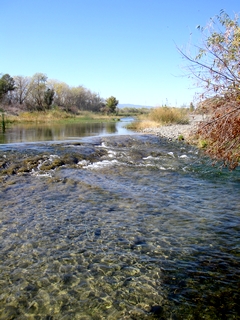 The “Lower Falls of the Upper Stinking”, at least that’s what I dubbed them, the first evidence of any real in-stream substrate. A clay formation channeled by the current, greasy, and quite hard. Now that I’ve found the “greased bowling ball” equivalent I feel much more at home, one careless misstep and I’ll be properly introduced.
The “Lower Falls” was just an appetizer, above me was white water, real rapids, which virtually guarantees I’m going to go ass over teakettle and be consumed by nostril climbing brain mites…
Me and rapids have an understanding; I will find them attractive, I assume big fish live there, and they’ll repay my fascination with a good soaking. I tip-toed around this stretch warily – then thought better of my cowardice and fished up the center of the cataract.
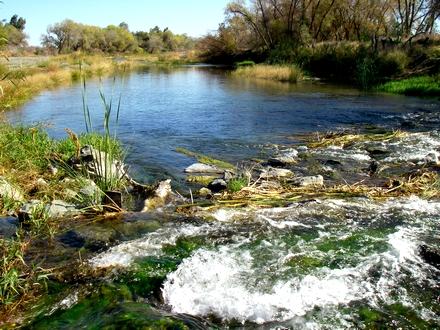
By now I was well past my supply lines, I was guessing maybe 5 miles away from the vehicle by river, and somewhere near 4 miles via overland route. It had taken me 4.5 hours to wander up this far, and the hike back was going to be a lot less fun then this morning’s jaunt.
Above the rapids was another beaver pond, 8 to 10 feet deep, crystal clear, and full of roving smallmouth. I managed to sting a few residents with an array of nymphs and Wooly Buggers, and starting preparing for the long trek out. I noticed I was favoring my finger, after stripping Sharkskin across it all morning it was growing tender – something that I’ll bear in mind.
Deep water and new bugs means bigger fish, while anxious to continue upriver this may be the upstream limit of foot travel. Microsoft Virtual Earth may illuminate some backroad that’s closer, I’m at a 6 hour round trip and the water keeps looking better the further I travel.
Technorati Tags: Little Stinking, “pooty” water, Pikeminnow, flyfishing, Brownlining
Last week’s series of posts were particularly distressing, a lethal combination of looming drought coupled with enough short sightedness to assure us of less fish next year; add the Trout Underground’s access issue for the Upper Sacramento and McCloud River, and both fish and fishermen are being squeezed from all directions.
There’s little question we’re due for some fundamental change, as even my short life has seen consistent degradation of most of the traditional gamefish.
My question is simple, are we still thinking like settlers, possessed by some silly notion that we can pull up stakes and head West?
Fly fishing includes many more species today than it did when I was young; web sites expound on the thrill of common salt water species, warm water coarse fish, and strange venues like Mongolia or downtown Los Angeles. Those exploits largely fail to make the cover of our mainstream media, but those deeds are as worthy and heroic as any fellow paying $10,000 to catch two salmon.
This is what we’ve got, there isn’t anymore unexplored continents, do we adapt our archaic notion of “quality” or do we wait until someone does that for us?
I am often chided for the “Brownline” angle; fishing for nuisance fish in a contaminated creek. I recognize that I am fishing for “cockroaches” – there is little nobility, no posturing, few groupies, and fewer practitioners. It’s fishing, with the same mixture of victory and despair as a fancy fish clothed in an expensive venue.
It’s unfortunate that even with all the stressors allied against trout, salmon, and all the traditional gamefish – and recognizing that future generations may not have the options that we do, we are still content to ignore Darwinism, and those species that will likely dominate the waterways of the future.
Yes, it’s a cockroach – it still got me off the couch, out into the woods, and exercising – it has me pondering variables at the tieing bench, and leaves me alternately elated and frustrated when fishing.
Isn’t that the true measure of a gamefish?
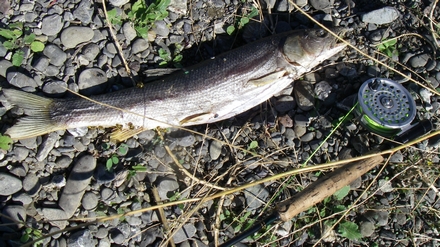
The above picture is a 20″ Pikeminnow thrown onto the bank by a fisherman. Pikeminnow are notorious killers of salmon fry, but this fellow didn’t know that, he was merely disappointed that it was a “sucker” rather than a mercury filled bass.
It’s a cockroach and my guess is he felt that he was making room for more desirable species. It’s likely he’s right, but there are a lot of nets between the desirable fish and the river mouth, and multiple dams preventing their re-entry into my little creek, and if one or two were to actually make it, this fellow would be pleased to kill both of them.
Me, I look on this with a dim view. Both Darwin and the press of Humanity are conspiring to rid us of the desirable fish, why not ascribe a little dignity to what remains?

Ever seen this unappealing fellow? It’s a Hoki, sometimes called a “Whiting” and it should be very familiar to you. It’s a replacement for Pollock, which replaced Atlantic Cod, which replaced Halibut. It’s likely a cockroach for the 4 star restaurant crowd, but a single US company imports 61 million pounds of it a year. Meet the Fillet O’ Fish sandwich, gentlemen.
Fish Filet Patty:
Pollock or Hoki, bleached wheat flour, water, modified corn starch, yellow corn flour, dextrose, salt, yeast, cellulose gum, natural flavoring (vegetable source). Cooked in partially hydrogenated vegetable oils, (may contain partially hydrogenated soybean oil and/or partially hydrogenated corn oil and/or partially hydrogenated canola oil and/or cottonseed oil and/or sunflower oil and/or corn oil). TBHQ and citric acid added to help preserve freshness. Dimethylpolysiloxane added as an anti-foaming agent.
Change is inevitable both in our sport and elsewhere, and I’m thinking perhaps our value system needs to adjust in lockstep with the environment. I’m not interested in validation, I just want to swing my fly in front of the nose of that waterborne insect, and watch him melt my reel.
When my kids trod the “pooty” water, maybe he’ll remember the pictures and exclaim to his pal, “…when my Dad caught these they were huge.”
Technorati Tags: brownlining, hoki, atlantic cod, fillet o’ fish, coarse fish, eat me
 The Partnership for Sustainable Oceans has released a draft plan for Northern California Marine Life Protection Areas (MLPA) for consideration by the California Department of Fish and Game.
You may remember an early post on the Southern California Marine Preserves, this new plan is in response to the next round of legislated sanctuaries, covering Mendocino to San Mateo County.
The mouth of the Russian River is one of the candidates, and as the Russian still has a small steelhead run, you may want to keep an eye on the status of this plan so’s not to run afoul of new restrictions.
The proposal restricts both commercial and sport fishing for Point Arena, Sea Ranch, Salt Point, Russian River, Bodega Head, Point Reyes, Drake’s Bay, Fitzgerald (south of Pacifica), and the South East Farallon’s.
No timetable has been announced for acceptance of the proposal. The plan is available at the www.keepamericafishing.org website, and contains maps of the proposed sites as well as the custom restrictions for each preserve.
Technorati Tags: Partnership for Sustainable Oceans, MLPA, california marine preserve
I can’t help it I’m a sucker for “noodling” videos – perhaps it’s the Brownline connection, but the idea of sticking your hand in a hole and wiggling your fingers as “bait” requires testicles the size of grapefruit, or an IQ less than 15, or both…
It’s fishing in it’s purest form, akin to “the only fair battle between Man and fish is to insert a 4/0 hook in your mouth, connect it to an identical hook in a Bluefin Tuna’s mouth, and drop the both of you in 100 feet of water.”
[youtube]http://www.youtube.com/watch?v=bAgw6d3kLPI[/youtube]
A billion dollar fund to restore fish, but don’t expect any dams to be breached. That’s the gist of the NOAA’s third draft of the plan for the Columbia and Snake watersheds:
The draft plan would provide new equipment to detour fish around deadly dam turbines, manage spills to better match when fish are present, fine-tune hatchery programs, restore salmon habitat in tributaries, and control birds, sea lions and fish that prey on salmon. The extra cost probably would increase power rates.
The operative word is “trend” – as the plan hopes to “trend” the seven runs of salmon above Bonneville dam towards recovery – rather than actually recover them.
Today’s Sacramento Bee also mentions our local decline in returning Salmon, as only 20% of the fish have returned to spawn. Fish biologists are scratching their heads, but are noting the collapse of the krill population may be linked to the lack of fish.
Schwing said the population of krill has mysteriously crashed in the ocean. This zooplankton, which resembles a tiny shrimp, is a key salmon food.
It seems the noble salmon are in the grip of a vice, with pressures in both fresh and salt water conspiring against them.
Technorati Tags: NOAA columbia river plan, krill, salmon, extinction
 Emboldened by our shrinking numbers is my guess, I can’t figure it any other way, our mistake was assuming other people wouldn’t mind our archaic pastime, and that’s proving to be wrong. Me, I can understand, as I giggled at “glamper” jokes, belittled the “Vente Frappachino” and alienated all them swells at Aberchrombie and Fitch…
You guys was polite, well groomed, and conspicuously silent but none of that matters…
In its new “Draft Beach Bye Laws”, the council classifies fishing as a “nuisance” – a description which has infuriated anglers – and seeks to ban the sport from all the beaches in its jurisdiction.
So we’re a nuisance now, some vestige of a bygone era that no longer has a place in the out of doors. I can just see the science teacher explaining the lifecycle of fish to future generations…
…fish eggs are deposited into the grocery store’s freezer, they are fertilized by the male when it’s placed into the Styrofoam container, prior to being sealed in plastic. This styro-Plasticine yolk is gradually consumed by the fry until they mature as a Fillet O’ Fish sandwich…”
I think I’ll urge my kids to cut class.
Technorati Tags: nuisance fishing, dun laoghaire, beach angling
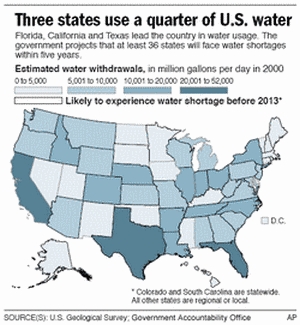 Which side are you on? Native species and habitat restoration is a worthy cause, but will you deem it so when you’re raking the gravel where your lawn used to be?
Singlebarbed readers thrive on fear and pestilence, but this issue is so large it’s likely to have all of us switching allegiances. It’s a “plea bargain” scenario, where all the crooks rebuff the cops until one cracks, then it’s every man for himself.
Will you insist on un-dammed streams and wild trout habitat when your house loses half its value, or will you cave and let them add more dams and reservoirs to preserve the lifestyle you have?
I think you’ll cave, you’re going to fold so fast even you’ll be surprised.
It’s one thing to bemoan the loss of pristine habitat, but when it’s your swimming pool they’re talking about, the Salmon can fend for themselves.
It’s a juggernaut issue, and it’s headed your way.
The government projects that at least 36 states will face water shortages within five years because of a combination of rising temperatures, drought, population growth, urban sprawl, waste and excess.
That’s means you – a 72% chance the state you live in will be adding dams, reservoirs, and a lot of underground pipe, in the next 5 years. If those years are “dry” years, you’ll be doing it sooner.
That’s not the end of it, water rights and the property that owns them will be going parabolic in value, which will cause fishermen additional grief as many small ranches and farms that hold water rights will be gobbled up by corporations that smell massive water profits.
It’ll yield additional fences and “No Trespass” signs, much litigation, and the rise of “Donny Beaver” angling associations. Thirty-Six out of fifty suggests none of us are immune, including Mr. Beaver.
Desalinization is still somewhat in it’s infancy, and will likely have the same issues that nuclear plants have, where do you dump the salt? Many desalinization processes remove salt from seawater, while the water is quickly used the salt has to be disposed of in some manner, and in high concentration its as toxic to the living as nuclear waste.
Desalinization technology will mature and be a boon to states with ready access to the ocean, but with deficit spending still the rage, coastal states will likely use this as a source of revenue, selling excess capacity to inland states that lack access.
That means the price of water goes up. It also means some high dollar beach real estate will be tapped for plant construction, as thousands of plants will be needed per state, a lot of beach will lose its scenic appeal.
Intakes to those plants will be posted with “No Fishing” restrictions, as nothing fouls pumping gear more than nets, crab traps, and fishing line.
The price tag for ensuring a reliable water supply could be staggering. Experts estimate that just upgrading pipes to handle new supplies could cost the nation $300 billion over 30 years.
“Unfortunately, there’s just not going to be any more cheap water,” said Randy Brown, Pompano Beach’s utilities director.
This rabbit-hole just gets deeper and deeper, and even casual research reveals the potential for much disruption for all fishermen, both fresh and salt.
Of specific interest is how the “eminent domain” laws will be wielded by communities short on drinking water. Water rights and real estate close by could easily be pre-empted for the community good. Small truck farms whose only “crime” is proximity to a city, are the likely targets.
Water conservation efforts will mean many more impoundments, canals, and underground pipes. Many will be covered to prevent evaporation, but wastewater reclamation will be considered “low hanging fruit.”
Florida’s environmental chief, Michael Sole, is seeking legislative action to get municipalities to reuse the wastewater.
“As these communities grow, instead of developing new water with new treatment systems, why not better manage the commodity they already have and produce an environmental benefit at the same time?” Sole said.
That’s the silver lining, plenty of Brownline fishing for warm water species. They may object to you wading in drinking water, but nobody will mind when you’re hip deep in crap.
I think we’re hip deep in crap already, and I’m just the fellow that remembered to bring tackle.
Technorati Tags: freshwater supply, desalinization, water conservation, brownlining, wastewater treatment, irrigation
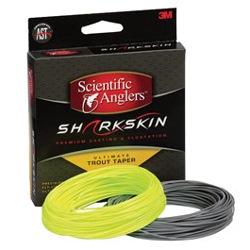 I’ve always viewed fly line purchases as a necessary evil. Choices are limited to color and taper, available from a handful of companies marketing small variances in a similar product.
Advertising distinguishes the vendors more than performance and whether it’s the Volkswagen or the Porsche chosen, performance gain is small compared to price increase.
I was introduced to textured fly lines in 1985, at the time my home stream was Hat Creek, which was an equal mixture of “spring creek” slow water and traditional broken water angling. Most of the guides I fished with used a Chancellor Chalkstream, produced by the English fly line company, Masterline.
Each fellow had his own reasons, some liked the neutral gray color, some claimed the flotation was better, others preferred the genteel taper – all of them could agree that the “pebble” finish offered some small advantages over traditional fly lines.
My preference for textured fly lines led me to test a Scientific Anglers Sharkskin fly line for the last two weeks. It is a “ridged” finish not imbedded spheres like the old Masterline.
The benefits of the ridged surface drew me to this style of line years ago, as it doesn’t retain contact with the guides like a traditional line, rather it skips from ridge to ridge – akin to a fast boat in choppy seas. With less resistance or friction to paying out line, you will see some small distance improvement, more importantly it’s easier to mend or flip slack from the rod tip and keep your fly drag free.
Friction is your enemy when flipping slack to a dry fly drift, if it cannot pull from the rod, then it will pull the fly side of the line, yanking the fly with it.
I tested the Sharkskin with an older Scientific Angler line, a Cortland 444 floating line, and my last Chancellor Chalkstream line, the SA and Cortland lines were unused, and the Masterline had a decade of service on it.
Differences:
1) The Sharkskin line is the most supple of all of the lines tested, it is markedly limp. That’s a positive when stopping your cast high to induce a puddle of slack for a long dry fly drift, as limp means more line falls closer to the fly – it’s able to fit more coils in the same space.
It’s a negative when you have a bundle of running line at your feet, as it will draw knots easier. The stiffer lines will draw the knot less tight due to resistance. I picked up snarls in waste high grass from all the lines tested, at approximately the same frequency.
2) The ridged surface of the line gives it a matte finish, not shiny or wet looking like traditional smooth lines. The SA marketing material mentions, “the complete elimination of fly line ‘flash’…” – my experience testing suggests this is largely true, it was one of the reasons we fished the Chancellor Chalkstream in the technical water of Hat Creek, whether it’s ridges or pebbles the refractive qualities of this line are much diminished.
3) The Sharkskin line is ‘dry’ to the touch even when fishing. It’s not slick or moist like a traditional line, it doesn’t slip through your fingers easily, and isn’t greasy. Like the snake guides your fingers are contacting the high points, the water is in the recesses below – so a sudden hook set will not pull the line out of your fingers – something we’ve all seen occasionally.
4) You get audio feedback to stripping the line, so you can set the proper tempo without looking at anything other than where you want to fling it next. I like this feature as I’m constantly looking elsewhere at fish, bugs, and rises.
Noise Level
A single or double haul sounds like your fingers sliding down the neck of a guitar, and if you’re unaccustomed to this you may be discomforted. For us Masterline junkies – we’ve listened to “fingernails on a chalkboard” for years, this is much less evil.
Rough finish makes a noisy line and if you’ve never used one you may not like it. A double haul sounds as described, a “Wheet, Wheet” sound from the ridges screaming over the snake guides. High pitched, but not overly uncomfortable.
All that noise is abrasion. If you are using cheap snake guides or the “Japanned” black snake guides that were popular, you’ll be tearing them up. Yes, pebbles and ridges will shorten the life of snake guides, but only the cheap ones. Standard chromed snake guides are unaffected as chrome is an extremely hard surface. Older rods, especially vintage bamboo rods – with non chrome guides or whose chrome is sloughing off should not be used with this line.
I built some rods using the sneaky black snakes – figuring I could stealth up to large trout and club them. I replaced them after about five years of Masterline usage, as they had been sawn halfway through. I have to assume likewise for a Sharkskin.
Floatation:
The line floated well but there was little to distinguish it from contemporary fly lines. Coiled running line still sank at your feet and the tip appeared to be above water – even with the 40lb Maxima butt section I use. No, it won’t support a bead headed nymph, but none of the manufacturers can make that claim. It was vastly superior to the old Masterline as they sank no matter what was on the end of the line. It did not appear to ride higher in the water per advertising, it was comperable to the other lines in this regard.
Color
I tested the bright yellow green flavor of Sharkskin (available in a somber gray as well) and had no issues. This morning I was using the color as a strike indicator while fishing for bluegill. The bright yellow color is stark and visible in morning’s half light and the tip of the fly line was all that I needed to see the bass and bluegill inhale the sinking nymph.
I have used all colors of fly line in the past, and am of the opinion that color does not matter. Most fish are looking up and the line will appear black in contrast to the bright orb of the sun.
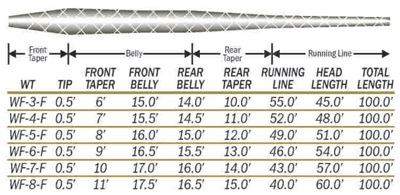
Sharkskin lines are only available in weight forward taper. This is unfortunate because I prefer double taper for my fishing. Most of the issues I had with the line were due to the weight forward component, not the line physical properties or construction.
Lawn testing with the WF-5F suggests it is a double taper until 14 feet of fly line is out of the tip, after that the weight forward taper is noticeable on the cast. Assuming a 10 foot leader, it gives you a 24′ range where it is delicate – this is fine for pocket water dry fly fishing where both distances and drifts are short.
The line is good at distance as well – where the weight forward component truly shines – punching a fly into a breeze or flinging the 60 foot dry fly at some spooky critter. It’s the in-between portion that has that heavy weight forward issue; a 35-45 foot cast where the entire belly is out of the rod tip, you don’t want to shoot anything and badly need a graceful landing. The Sharkskin line was traditional in this respect – heavy and ungraceful – putting the fly into the water too fast and with much more impact than I wanted.
That is a weight forward problem, not related to the Sharkskin at all.
In summary, I like the new line as it offers some distinct advantages over the traditional smooth fly line. Suggested retail is around the $100 dollar mark, with competitive products about 30% cheaper. For the difference in price you’ll get 6-8 feet of additional shoot, the ability to mend and add slack with less effort, and a positive grip on a dry line.
I would recommend that you cast one before buying just to test your attenuation to noise. It’s likely the first thing you’ll notice about the line and you may not care for it. Most fly shops will accommodate your testing a line on one of their rods, just ask.
If this was available in double taper I would be reaching for my piggy bank.
Most fly lines will last a decade or better with even marginal treatment. It always sounds more expensive than it works out to be, and considering the last of the Masterlines are now $135, this is cheap. I’m down to my last Chalkstream, so I’ll likely pick up a couple to cover me for the next twenty years.
Technorati Tags: Sharkskin, Scientific Angler, fly line, Masterline, Chancellor Chalkstream
 It’s only been 200 years but it worked the last time. Inflation or Recession is immaterial but when the price of beer is scheduled for a 10% increase, with the likelihood of mass shortages AND the flavor will be akin to strained gym socks…
It’s time for armed insurrection.
The timing is perfect, this close to Halloween no one will notice a couple hundred Indians in full warpaint armed with can openers. The national media will be all over it – with the proper notification – and we can lay waste to a couple of Budweiser trucks accompanied by the cheers of the populace.
“Beer Ships” don’t exist, but with a subtle modification of venue, mayhap we can hijack a ferry, pull a couple of doughnuts in the Sound, and be back by lunch.
Personally I think American beer tastes like gym socks already, but as we are seeking the moral high ground, we can’t admit it publicly.
Technorati Tags: beer shortage, armed insurrection, beer ship