This describes the bulk of my outings, a random find on the Internet so I’m not sure which cartoon artist to give credit.

Back shortly.
This describes the bulk of my outings, a random find on the Internet so I’m not sure which cartoon artist to give credit.

Back shortly.
Tomorrow I’ll vacate the brown water in preference of a heady “blueline” trout experience. The timing is right as the Trout Underground has abandoned its readership traditional stomping grounds to pursue high-dollar, high cholesterol, exotic locales – complete with liveried butlers, cooks, and guides-in-waiting.
That gives me an opportunity to assist all them unloved Northern California fish by laying waste to the National Park Service’s crown jewel, Manzanita Lake.

Back when I was living in the area, all the fellows lounging on the fly shop’s porch would pile into a truck and fish Fall River in the morning, throw a sandwich in the car and hit Manzanita at noon, fish through the hatch, then be back on Hat Creek in time for the evening. It was the Trifecta of Dry Fly fishing, with the Preakness, the Belmont, and the Kentucky Derby, all in one daylong orgy of silicone and chicken feathers.
Both Hat Creek and Fall River have dwindled significantly from their heyday, but Manzanita Lake has held up remarkably well. Credit goes to the National Park Service, which has had a zero-kill limit on the lake for over a decade. It’s a small lake and patrolled aggressively, and with campgrounds so close – the seasonal aides are quite busy redirecting the unwary to Reflection Lake across the way.
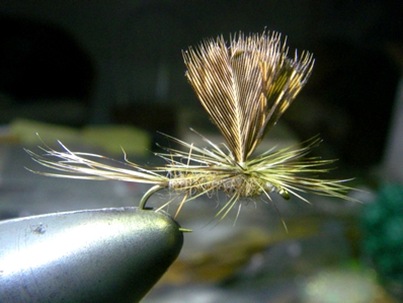
The countless hours spent there formed the basis for all of my lake fishing theory, and can be summed into a single sentence, “They eat the Wing.”
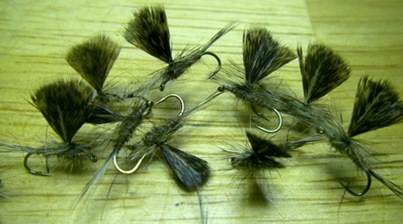
I always oversize the wings on the dries I use in lakes by a full hook size, I can see them better – and I assume the fish can too. All of us regulars had a “double secret” experimental, and despite fishing over the same natural, none of them resembled each other.

We could agree on profile, and if the fly didn’t land correctly it was immediately lifted off the water and recast.
It makes perfect sense, lakes always have a light chop due to the ever present breeze, and like a ship – the masts appear first on the horizon, why wouldn’t a prowling fish key itself to wing and silhouette – likely it’s the first visual cue it sees in the natural.
Making sense and catching fish are not always hand in hand, which is why my compatriots are stocking up on J. Fair’s Wiggle Nymph – rather than take my advice. Conviction is a good thing, but it can lead to force feeding the wrong fly to the right fish.
I’ll be the talkative fellow in the float tube with an excuse for everything.
I’d like to call it wisdom, but that small voice from the Eternal Child Within suggests it ain’t smarts, it’s unwelcome gentrification.

Prior to age 30 a weekend fishing trip was a buddy calling Friday night with a twenty burning a hole in his pockets, a pack of bologna, and a blanket. As long as you had the cash to match his tank of gas, the details fell into place when the creek came into view.
As daylight turned to darkness, the absence of proper planning meant, “You didn’t bring a flashlight? Guess we’re sleeping here.” Meals were spur of the moment, “I got some bread, some moist toilettes, and … SWEET, Tic Tac’s …”
Years later, my coworkers and I are headed up to Manzanita Lake for the weekend, and the water cooler conversation sounds like the antithesis of all we held sacred…
“You aren’t bringing a tent? You ain’t sleeping with me!”
Nope, as compelling as your narrow arse is in the moonlight, I thought I’d just toss in a tarp and a bag and call it good.
“There better be showers at the campground. You think they have showers there?”
You’re going to be arse deep in water all day, you think bathing will be that much of an issue, and if so – what about simply going swimming, like Jim Bridger…
OK, so it’ll be steaks Friday night, but what about Saturday night?
We could fight over the bones the bears leave us, or we could break camp and return a day and half early, just before we starve to death.
What do you guys put on your steaks?
Teeth mostly, sometimes fingers.
I’m trying my level best to steer the conversation to the important stuff; ensuring everyone is bringing a rod, someone is packing a float tube pump, which fly shop we’re stopping at so everyone has flies, how old is your tippet, knotted versus knotless, and will “NumbNuts” remember to bring his wading boots this time.
They’re having none of it, good sports, but somewhere between 20 and 50 we lost or gained something. Creature comforts asserted themselves, and invulnerability or spontaneity were lost when old bones touched cold ground, with wood smoke no longer the after shave of choice.
Well, what about Breakfast?
That’s the meal you and Martha Stewart slept through, I call it lunch, which will be the first time my feet touch dry land since dawn broke.
It’s both surprising and predictable, a statistical glimpse of the evolution of fishing and outdoor tradition – after a couple of decades of Ronald McDonald, over protective parents, and absent the sterile blessing of Saranwrap.

Pennsylvania Fish and Boat commission released a trout angling survey last week that has an uncommon tilt; of those surveyed only 3% confessed they fished to eat the result.
82% fished bait, 59% lures, and 40% were fly fishermen, the majority preferred bait (53%), but they also preferred to release the fish (88%) at least half the time.
That seems abnormally high – and may include small fish thrown back in favor of larger quarry, which may qualify as “half the time.”
Pennsylvania being a couple thousand miles away, California’s interpretation of this time honored practice suggests; 97% of us are neighbors of the 3% that keep fish, so we can expect freezer burned “gifts” at any moment.
I’m relying on a lot of older hooks to compensate for what’s not available, and that’s never a recipe for long term success. What’s needed is a commercially available “extra stout” hook or a “2X short shank” that combines a nice gape and heavy wire.

I keep looking for something other than the traditional vendors and their limited offerings – as it appears hook makers have undergone both a consolidation and retrenchment on what used to be offered.
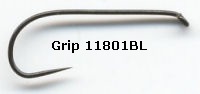
Last week I stumbled on the Dohiku hook, and through that had a chance to chat with Kevin Compton of Scientific Fly. He’s introducing Grip Hooks, of South African origin at an upcoming Denver Trade Show, and he mentioned the Knapek Hook as another vendor that had aspirations in this space.
A cursory look at their offerings suggests we may see some changes in the mainstream market, as many of these hooks are being adopted by competition anglers – something the US has always been reluctant to acknowledge.
The success of the Czech nymphing style and their dominance of the professional angling circuit in Europe has rods, lines, flies, and hooks under scrutiny. Longer rods are an asset as there is little casting – and with 25 foot monofilament leaders – it’s a cross between “high sticking” and spin fishing.
Barbless hooks have always been available in only one or two styles; a model perfect bend dry fly hook, and standard nymph. Absent are all of the XL (extra long), XS (extra short), different bend styles, or anything else that makes tinkering fun.
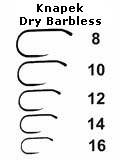
That’s all about to change, as most of the vendor’s mentioned above are delivering quite a few styles and variations of barbless hooks for competition purposes – and if any of these features are credible, you can expect them to spill over into the mainstream shortly.
Features that separate these hooks from the current fare:
Rotary vise users will be a tad upset, as kirbed hooks will no longer provide effortless rotation of the vise head, they’ll rotate out-of-plane, but that can be mitigated.
The decline in the US dollar affects pricing on all imported goods, it appears the target retail price of each vendor is around $5 per 25 hooks. A resurgent dollar would likely lower these costs significantly.
Scientific Fly offers what I’m seeking but they’re not yet available for purchase, a 2XS (extra stout) wired nymph hook, yielding the wire of a #10 on a traditional #14.
I might be the only fellow planning on hooking a 15 lb fish on #14, but my meager skills can stand all the buttressing they can get. No sense tempting fate further using wire that straightens on anything bigger than an enraged Twinkie.
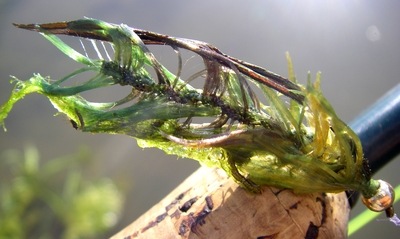
I cracked open the padded envelope and immediately flashed on the scene from Top Gun, “Negative Ghostrider, not one pair, TWO pair ..” Seems in my haste to secure the Bernat Boa yarn in “Mallard”, I overlooked a trifling detail about 2 skeins for $5.
Now I’m looking at 351 yards of imitation pond scum hoping fish eat this stuff … If they don’t I’ll just do what fly tiers always do when they have a lifetime supply, strip naked and roll in it.

I stopped off at the Little Stinking and flung it with trepidation, it didn’t absorb too much water to be unruly on a 5 weight, the brass bead sank it fast enough, and the effect when wet was perfection.
Something ate it on the first cast, but I was too busy chewing fingernails to react.
The creek is only a shadow of itself, and from the bridge only a single fish was visible, what little water present was coming from the horse barn and that restricted visibility to less than 6 inches.
The above flavor is tied on a Tiemco 3769, #8 hook – equipped with a 4mm brass bead. Beads 4mm or larger can be purchased much cheaper from a beading supplier than a fly shop, just make sure the hole is 1.5mm or larger to use on flies.
I’ll need a different venue to test the fly further, so I’ll head upstream after returning from this week’s foray into clean water.
You know Rio or Scientific Anglers will rise to the bait, they’ve made a fly line for almost every conceivable gamefish, rod action, and water density, and this latest trend folds neatly into the light tackle phenomenon.

AFTMA will spew coffee out of it’s collective nose when manufacturers insist on either decimals or scientific notation to cover the line sizes smaller than #1, but as carbon nanotubes are mainstream science we can expect the rod companies to introduce something shortly .. after they’ve figured out that “sticky ferrule” issue.
Can the 0.0002 weight be that far away – and will they be enough to subdue an enraged Goldfish? Forget “double taper” think “double helix” …
The Wall Street Journal posted, “The Top 10 Products that Transformed an American Pastime” a survey of the American Sportfishing Association on their view of the top 10 products that changed fishing forever.
I couldn’t decide whether the fly fishing equivalent would be, “The Top 10 Products that I’ve tucked away never to Use” or “The Top 10 wallet-lightening items that I should have reconsidered.”
I’ll go with the straight face for once, and let you remind me of the seventeen other items I completely forgot about.
The Top 10 Products that Changed the Face of Fly Fishing forever?
I tried to restrain the fly tier bias, removing the Matarelli Bobbin in favor of generalist gear, and opting for genetic hackle over synthetics. It’s a daunting and distinguished list, and I’m sure I missed some really important items.
“Kids” or “a job” are disallowed, that only changed your fly fishing world forever ..
I’ve always thought the reason anglers treat aquatic insects with respect is the knowledge the winged version can’t suck blood – therefore trodding streambed was indiscriminate, without thought to repercussions.
Of all the aquatic bugs the giant stoneflies occupied that “reserved tier” among bugs; they’re easy to identify, only a little more agile than a rock when flying, and land with similar grace.
Wad a pound of anything on a fish hook and it’s a legitimate imitation, just the kind of starter fly for a novice tier – and no matter how well crafted the fish are usually receptive.
Me, I like watching one of those big brutes crawl down someone’s shirt collar midstream – and applaud the “break dancing” that follows – if the bug don’t getcha the creek surely will..
For those driven to be overly serious about their bugs, Illiesia is an online publication devoted to stonefly research and populations. It’s strictly scientific literature, but before you scream “Skwala” you may want to look again with a microscope.
Me, I’m screaming ” SWELTSA YUROK “, a new stonefly discovered this year on the Trinity and Klamath Rivers here in California. Since no one else has a pattern, I’m going to be rubbing shoulders with Izaak Walton shortly..
Hush, I’ll put in a good word for you guys ..
I’ve had ample time to get over them really monstrous fish kicking sand on my sandwich yesterday. I made a hasty pitstop at Joann’s Fabric’s and scored the necessary boa material – leaving the place in complete disarray…
All the old lady’s were having “hot flashes” when they found out the pear shaped male striding down the millinery aisle knew the difference between chenille and mohair, and when the aging starlet at the register asked, “Did you find everything you was sent for?” I leaned in close with my best “MacDaddy” squint, and said, “…sent for? Hell, ma’am I’m killing fish with this stuff..”
That set them hearts aflutter, and I beat a hasty retreat before I got called on the swagger..
I have to try this stuff out – and as I set the first hook in the vise, I’ve suddenly got cold feet. The San Juan Worm’s were for Minnesota, the good sister’s hydrilla fly was for Arkansas, and what I failed to consider was the influence of nouveau cuisine on them California fish.

Some modification was in order, and I set the boa yarn down reluctantly and start doodling on a napkin. A second cup of coffee vanquished my inhibitions and creativity came to the fore. The San Juan Worm was quickly adapted to California taste buds.
It would be so much simpler to live somewhere’s else…