Author Archives: KBarton10

There’s a fine line between desperation and inspiration

Help from Sister Carol Anne Corley Had to work straight through the weekend again, but I did get a chance to sneak out before dark last night to observe the “Carp Conundrum” and see if I could puzzle out a solution.

The issue isn’t their willingness to feed, it’s a combination of murky water coupled with what and how they eat.

I spent an hour on the bridge just watching and noted the two styles of fish available; a pod of fish facing the bank and eating what appears to be grass roots and weeds along the edge, and there’s the occasional solo fish that has a mud plume behind him – it’s slowly headed upriver in a traditional bonefish pose. Nose down into the bottom and tail just under the surface making an almost imperceptible disturbance.

I can’t get a fly into the bank fish, they’re facing the wrong way and there’s no water between them and their forage. The “bonefish” feeders are more skittish than trout and their mud plume can’t be seen when you’re down at the waters edge.

They’re creatures of habit, and once spooked they’ll return within 15 minutes, as long as you’re motionless. Makes for one hell of a difficult stalk – and I haven’t even got to the presentation part yet.

As I can’t get a fly into eyeball range of the grouped fish, looks like I’ll need to design something that’s heavy enough to ride along the bottom, carries the hook point up, and looks like whatever it is they’re feeding on.

Someone once asked, “If it costs so much more to tie flies, how come you do it?” Simple, if I could get a fly that looks like a severed stalk of hydrilla, with dull olive bead chain eyes, I’d buy snot out of them.

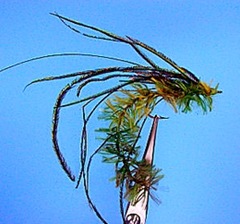
The Roughfisher blog has been kicking butt and naming names, and I’m thinking of trying his latest creations modified for my oddball presentation needs. He steered me to the above fly tied by Sister Carol Anne Corley that looks exactly like what I need – after I throw some copper bead chain eyes on it.

Bead chain will turn a hook over instantly so it’ll ride point up, copper is the dullest color commercially available, and if it fails to produce I’ll dip them in green “tool grip” – a fast drying latex rubber that’s used to dip tool handles. That’ll take the shine off the beads and hopefully I’ll have my Gutbusting BottomRoller Hydrilla Carp Killer.

Naturally I’ll forget all the help I got from the Good Sister and Jean Paul – claiming it “came to me in a vision…”

… which is the other reason you blow all that cash to learn fly tying, so you can appear humble and gracious when you take credit for someone else’s hard work … same as middle management, only with hackle pliers.

UPDATE: The Bernat Boa yarn used by the above fly is no longer made in the “Mallard” color. I found two skeins of it on eBay – at $5.00 each, and the vendor has a couple more at last look.

Couch Potato float tube

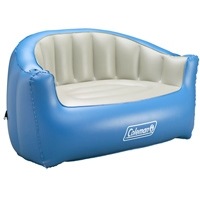
Couch Float tube, that's living I’ve been struggling with the need to update my aging float tube, now I’m glad I waited.

The eighties version surrounded the angler in a donut of inflation – with little fear of slipping out of the beast accidentally. The latest tubes offer the open front – which aids an awkward entrance and exit ritual, but takes a little getting used to for us water averse types.

Leave it to Coleman to come up with what’s really needed, complete with “integrated cup holder”, it has all the safety features necessary to make me feel … drowsy…

All that’s needed is an inflatable remote and we can forget about that lawn entirely.

If they were out of season, I’d call it "bacon" too

The Montana It’s too damn convenient a tale not to have some kind of unsavory involved. No one busts a rod without pointing fingers and wailing horribly, and the deadpan delivery aroused my suspicions:

Adding to the Extreme Fishing Situation (imagine a rock soundtrack playing under this report) was the oddly pleasant high-modulus “crack” generated when a high-end graphite rod simply snapped in half when my big, burly, sinewy, extremely manly arms attempted a hookset into a big, big brown trout.

…then there’s the ever present food reference – with the implication that downing a brace of “bacon” dogs was positively drenched in testosterone.

“[Name Redacted]” was the final straw, some shadowy figure conveniently unavailable to corroborate any of the stories posted to date, culminating in the “18 hour gap” between the last known escapade and a furtive arrival in California…

I could swear there’s a naked woman in the reflection of that trout’s eye – either that or it’s a partially dressed slaw dog. I think we’re owed an explanation ..or two…

Dohiku Barbless Hooks – Black Nickel

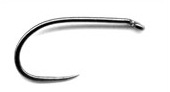
Dohiku barbless fly hooks I saw these on a Slovakian fly shop’s web site, black nickel finish barbless hooks that look mighty interesting. Czech nymphing being all the latest rage, it always pays to see what everyone else is using just to keep abreast of change.

A slight upturn to the point and a hint of a Sproat bend makes these singular among the mainstream vendors, almost all of which are using Model Perfect bends – and have at most one or two styles of barbless hooks available.

Dohiku Barbless While the US dollar has suffered considerably overseas, and is nearing uncharted lows against most currencies, it’s something to keep in mind if you have unique needs and the conventional stuff just doesn’t apply.

I like the wide gape and narrow angle of the down eye, these remind me of old Partridge hooks of years past – and look strong enough to handle large fish in the small sizes. I would mention Carp, but they ignore my best efforts regularly.

I requested a price list in US dollars and Euro’s, anyone had a chance to play with these yet?

UPDATE: At the current exchange rate these are $5.28 per 25 hooks (3.32 Euro’s per 25) There are no import or export taxes associated with the purchase.


That about covers the fly-by’s ..

cafire14 With 109 degree temperatures outside and the smoke reducing  visibility to about two miles, it’s a wonder that anyone has a desire to go out-of-doors.

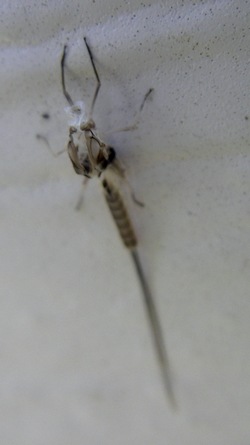
I sure don’t, and now the Mayflies hatching in my driveway want inside to lay eggs – can’t say I blame them with everything outside all the same color.

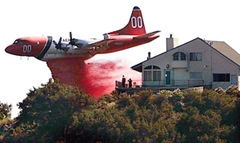
I have always been fascinated by airtanker’s doing what they do best, and Tanker 00 used to be stationed next to me when I lived in Redding, California, some years ago. This is a USFS contractor buzzing some high rent real estate in Santa Barbara, part of a 17 photo series hosted by the Boston Globe on our California fires.

Makes for some serious wallpaper for your desktop.

My Garage Door attracts the Slow Learners

The difference between my garage and the Pooty water might not be muchIt just goes to show you how ungrateful Mayflies can be..

I always invite them to the party, the fact they rarely show is likely a source of amusement – but mighty damn important to me. Then I turn my back, and they cover my garage door with moot evidence of their scorn, no courtesy knock at the door, no chance for me to attend.

The empty beer cans I can handle, but the fact that they leave their clothes lying around makes me grit my teeth, am I some sexual miscreant that I have to clean up their debauchery?

I bet that pavement was a shock, while idly pleasuring themselves in mid air them females ignored the “wave off” and found concrete an unwelcome companion to egg laying.

I’m sure the Mayfly males were appropriately sensitive, “Get up, let’s do it again – this time higher.”

It’s one of many perils when air, water, and land are all roughly the same color palate – there’s no telling what you’ll find with your morning paper…

Compared to the air quality, the water is clean

Murky water, dirty air, and fish that give me the finger We’ve returned to the “fun” part of summer, temperatures breached 103 today, add the smoke burden and it’s about as enjoyable as you can imagine; profuse sweat, extra humidity, and air you can eat with a steak knife.

Perfect opportunity to go fishing, if heatstroke and Mercury doesn’t get us than Cancer surely will. Harsh conditions are always a prelude to the best fishing, and the Little Stinking always welcomes those with diminished IQ and a high threshold for pain.

That new hole in the right boot was welcome, at least for the first 15 seconds, the spreading coolness on my foot quickly became a pants leg full of murk. Carp were in evidence and contentedly mowing grass roots along the bank, which is the way it always starts … them visible, you optimistic, then they crush your spirit by ignoring everything you throw.

I was tempted and there were a couple really big rocks close to hand.

Tight to the bank and facing the wrong direction makes it doubly difficult to see my stuff wiggling in midcurrent, but like most fishermen anything that outwits us consistently is assumed to be smarter than us.

“Aquatic Cows” is more like it, and I scrambled out of the murky water into murkier air and called it a day.

The creek is still only a quarter its normal size and is making the fish spread themselves thinly, what few pockets of deeper water remain hold fish – and everything betwixt that and the next is devoid of life. The combination of heat and poor air has me keeping the adventures short until further notice.

The Red Sun in the evening is pretty – but only from the artificial safety of an air conditioned smokefree living room.

Ignore the Bouquet, it’s all part of the natural order of things

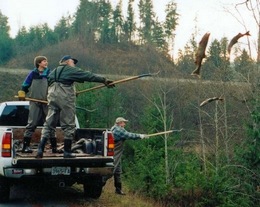
Migration by truck I don’t think the government would be terribly appreciative but we may want to reintroduce the “Viking funeral” for hardcore anglers, what better way to display your devotion than,  “I want to be nutrients for invertebrates.”

A lot of research has been focused at the effect of pacific salmon carcasses in West Coast fisheries, specifically the benefit performed by many thousands of tons of decaying fish distributed throughout the waterway and its banks.

Researchers have traced salmon nutrients to many
different types of organisms, from freshwater invertebrates
and fish to birds and bears and even to streamside
vegetation. These organisms take up the nutrients
by feeding directly on salmon eggs and spawnedout
carcasses, incorporated dissolved nutrients (e.g.,
algae and fungi), or feeding on other organisms that
have taken up salmon nutrients. Streams that are fertilized
by salmon nutrients are hypothesized to be more
productive than streams that receive relatively few or
no salmon.

Salmon apparently have great impact to the insect populations of their host streams, and not all of them are beneficial. Construction of spawning “redds” are destructive to to the host insects – and the density of the spawn can radically diminish insect populations in the prime gravel areas.

After two years of benthic sampling for insect production
and analysis, preliminary results show that the stream bed disturbance caused by salmon spawning activities severely impacts the insect community, reducing density and perhaps even diversity
.

This affect is reversed by the decomposition of spawned salmon, and the benefits of carcasses and their debris lasts about 6 months. Researchers are able to see the effects of Carbon, Nitrogen, and Phosphorus, released by the decaying salmon, as their isotopes originated in salt water making them different than resident minerals. Streams vary in mineral richness, and some streams can get a mineral boost in excess of 30% of their historical totals.

Bilby et al. (1996) also monitored growth rates of juvenile
fish, finding that age-0-plus coho salmon exhibited a doubling in growth rate after adults spawned in the stream. In a nearby stream without spawning salmon, age-0-plus steelhead showed no change in growth rate during the winter. High growth rates can increase the overwinter survival rate, and larger smolt size has been related to increased marine survival (Bilton et al. 1982; Ward and Slaney 1988). Piorkowski (1995) qlso found that direct consumption of salmon biomass was the main avenue of nutrient uptake for salmon fry, grayling (Thymallus spp.), and rainbow trout (0. mykiss) in southcentral.Alaskan
streams.

The value of a carcass is obtained only if it isn’t flushed out of the ecosystem due to high water. Streamside debris plays a role in capturing and retaining carcasses long enough for them to be consumed by insects and terrestrial animals.

The bad news is the value to the watershed rises if more bodies are available to decay, as almost all of the Pacific salmon runs are a fraction of their historic size, this makes the host rivers less fertile than before. The implication may be that less returning fish means  the rivers are able to support less insects and juveniles.

The same applies for salmon eggs and released milt. About 30% of the eggs released actually spawn, the other 70% become additional forage for anything able to ingest them.

What isn’t mentioned and might be inferred is the effect of dams on the fertility of a host river. Blocking any migration would remove the beneficial effect of carcasses and suggests the river is immediately less fertile and unable to support historic populations of insects and resident fish.

The short answer is there’s no such thing as a bad way to dispose of fish parts. Tossed onto the bank they’re forage for all manner of terrestrial wildlife and plants, and flung into the creek they’re chow for mayflies, caddis, and everything else, including next season’s fry.

Add it to your list of snappy comebacks should some bird watcher grief you over your “natural” disposal methods – as long as you don’t hit them with it – it’s all good.
Ordering a Pizza might be a better way to get fed

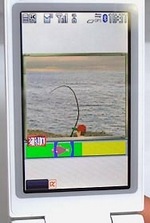
Fishing with a cell phoneSkipping the fishing to go straight to the catching part sounds potentially cheaper, but the virtual odds sound much too realistic to be a cost savings.

I don’t think you’ll want to leave your cell phone lying around; $10 for three casts approximates the cost of fly fishing, but the idea that your kid could pizzle away your entire paycheck, worse yet, could win two or three hundred pounds of fish should cause you to blanch.

The game — called “Ippon Zuri” (which means “pole-and-line fishing”) — was created by FIT, a Fukuoka-based system development company who teamed up with a local seafood wholesaler. Game play is simple: players use the phone keys to cast bait to promising-looking fish in the game’s virtual waters, which include sea bream, crab, and other seasonal fish. When a fish takes the bait, the player is sent to a slot machine screen where, if luck prevails and 3 numbers line up appropriately, the virtual fish is hooked and reeled in. A message is then relayed to the wholesaler, who picks up the real-world equivalent from the local seafood market and delivers it, whole and raw, to the player’s doorstep.

Hardened anglers will balk at the slot machine segment, decrying that fishing could ever compare with any game of chance. I’m not so sure that fading light and tiny naturals isn’t exactly that – chancy at best to pick the correct fly and even less of seeing it to set the hook.

They tried the live action version on those Internet deer hunting sites, I’m guessing the webcam flavor can’t be far behind.

Coiled Stren Indicators

Boiled and Frozen Stren strike indicator Fish and Fly has posted the recipe for the “coiled strike indicator” in their follow-on to “Fishing the Frontier.” Singlebarbed reader, “Z Fisher” was correct in his description of the process; boiled Stren, wrapped around a Cutip, then frozen to make the coils permanent.

Anything that requires fiddling with cooking pots and slopping things onto the kitchen floor has to work in our book – that way the resulting bruises are worth it.