Category Archives: Fly tying Materials

Where to find them cheaply

Nothing makes the fur fly like using the wife’s coffee grinder

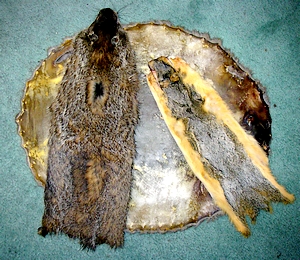
The Essentials, a round of Beaver, Woodchuck, and Red Fox SquirrelUs impressionists are a tough crowd, you’ll regret us painting your house because of all the spots we miss – but we’ll march you across the street and insist the color looks fine.

We’ve got more theories and hare-brained ideas than the average fly tyer, most won’t hold water so we wander around the fly shop sighing heavily, and then go home and make it ourselves.

Materials vendors don’t cater to guys that tinker, and that single-shade pack of rabbit would work well on a small dry fly, but we’re cooking up something with lead and multiple X’s of hook shank. Two bucks worth of bunny bottom just don’t cut it, and while the Australian Opossum was close to the right color, we could’ve snorted that microdot of hair and not sneezed.

For us, 2 x 2″ is an appetizer, and at those prices an expensive one.

I was taught that a good dubbing is crafted like a fine cigar; comprised of filler, binder, and wrapper, special effects can be added after the dubbing is complete, but the basic recipe is identical to a good smoke.

There’s an art form to winding up with what you intended to make; almost everything you construct will have some usefulness – but the thinking and planning are relatively easy – execution takes a little practice.

You’ve got only three obstacles, texture, color, and target application. I started with a couple colors of wool yarn, tossing in a hint of this and a dab of that – then when I’d stumbled onto something good – found I could never make it again.

Jotting down some recipe notes is required – some units of measure would be nice too. Square inches of hide comes to mind, as in, “I clipped four square inches of coyote, added four square inches of green mink, and dipped the result in my coffee – accidentally.”

That’s enough to get close.

With my blends I’ve learned to target a hook size with the completed product. The precise mix of filler, wrapper, binder and special effects changes depending on whether you’re crafting dry fly dubbing, a general nymph blend, or something for making giant stonefly nymphs. My General use blends target a #12 hook, dry fly blends I’ll target a #16, and for big stuff, I’ll want a long shank #4.

The above rule isn’t hard and fast, it’s my personal preference – this allows general purpose blends to work with dry flies as well as nymphs.

Once comfortable with mixing and colors, use Coffin Creek Furs to score the skins you need. Always opt for the damaged ones as they’re the cheapest and you’ll be shaving it anyways.

Be forewarned that real hides from a furrier can be a really good deal. Beaver is sold as “rounds” – the skin is stretched to a circle, a 20″ round that’s damaged may only be $10.00. That’s an “extra large Pizza” worth of Beaver – and will make you reticent to pay $2.50 for the little dust motes sold by the fly shop…

Filler: The filler is comprised of inexpensive coarser hair – it may contain guard hair, but is usually typified by “curly” fur fiber. These bends and kinks will be preserved in the final product and will add air and mass to the blended furs so it resists matting.

Example: Australian Opossum, Mohair, Wool,

Binder: The binder is usually a semi-aquatic mammal. Their fur has the smallest filament size and is quite dense, it assists them to remain warm despite constant exposure to cold water. The binder will coat the filler and wrapper and assist your fingers when you want that mess on your thread. Binder is your friend and can tame the most unruly fur.

Example: Beaver, Mink, Muskrat, Otter, (if nothing else is available, rabbit)
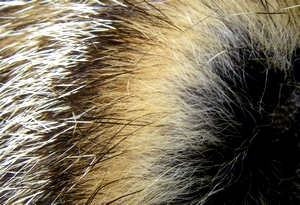
Woodchuck body, the blond tips and tan band will take dye really wellWrapper: Wrapper is present on blends for larger flies and can be omitted for building fine dry fly dubbing. Wrapper is usually an animal that has pronounced guard hairs – often with a light band that can absorb dye. It provides “spike” to the blend and breaks up the uniformity of the other two furs.

Just as important, because we choose it for the guard hair, we’re introducing six or seven new shades to the blend. If you’re going to dye the result those shades will break up the even color and add light and dark splotches within the mix.

Example: Hare’s Mask, Red Fox Squirrel body, Woodchuck body

Special Effects: Special effects describe any enhancements added like glitter, shine, or contrasting color. Materials chosen impart an affect to the entire mix like spectrum or sparkle.

My use of sparkle increased with proximity to Brownline prey. The waters are often milky with effluent during peak farming periods – and coupled with Winter drainage I have to help fish see my offering.

That’s translated well to trout fishing, as I’ve found the pedigreed blue water fish like a hint of sparkle in their food too. Usually the special effect component is less than 10% of the final blend.

Example: Baby Seal, Soft Crimp Angelina (Ice Dub), and Spectral

Spectral is the color combination of the primary and secondary colors of the color wheel; scarlet, yellow, cyan, orange, purple, green.

Use a coffee grinder (maybe $15) to blend colors and fur, most of the fur you’ll be using is less than an inch in length and won’t bind the grinder motor. Lacking a grinder, use a empty quart jam jar half filled with water – shaken vigorously it’ll mix hair in seconds.

If your fur source is fresh killed or road kill, toss in some shampoo to remove guts, blood, and tire marks. Repeat with clean water to rinse. Large batches are best mixed with a big container or a garbage bag.

Smaller hooks need more binder (the really fine fur), general use blends are roughly an equal mix, and the large hooks require more filler and wrapper. The completed mix shouldn’t require the tyer to load the thread more than twice to finish the fly body, and if you find yourself adding more than a couple applications of fur – your blend is best suited for a smaller hook.

The indispensable materials are Beaver and Red Fox Squirrel body, both are dirt cheap and plentiful. You’ll get additional use if your source has the Squirrel body in tanned flavor – as it makes the stunning fur strip leeches – the bands of color makes the rabbit versions look limp in comparison.

Adapt, evolve, and overcome – free yourself of what’s on the retailer’s shelf and make what you really need, just remember to clean the kitchen spotless – or it’s your hide we’ll be admiring.
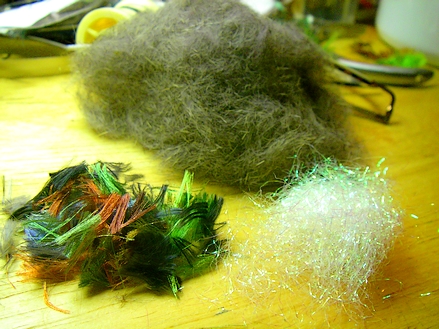
A pile of polyamide scrap, some Angelina fiber and the base blend, ready for special effects

Above is a general purpose blend of Australian Opossum, Red Fox squirrel body, and dark gray beaver. In it’s present form it’s useful for both dry flies and nymphs. I’ll add chopped polyamide “clownshoes” colors – leftover from the streamers I tied for a spectral color effect, and add about 5% sparkle to the blend using Soft Crimp Angelina, in the opalescent “Aurora Borealis” color.

The Polyamide fibers are tiny – half the width of a beaver fiber, so the spectral affect will not be pronounced, it’ll still look like a gray blend until I dub the flies where a close examination should make colors  show more plainly.
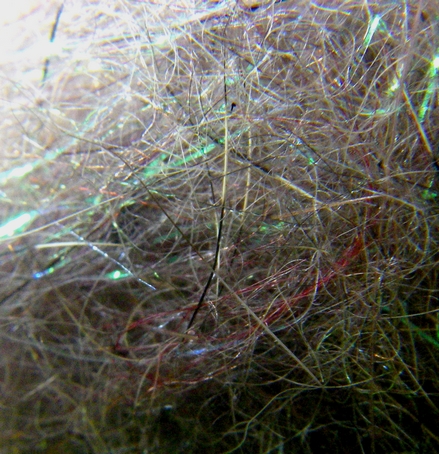
Closeup of the newly blended dubbing complete with special effects

A close up of the finished blend; three natural furs, polyamide, and Soft Crimp Angelina. The polyamide fibers offer a very subtle color effect.
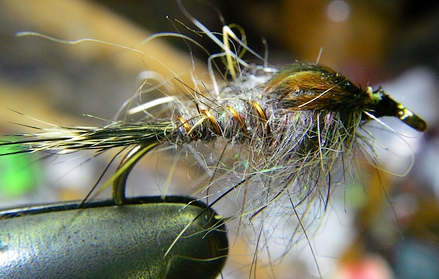
A #12 Copper Hare's Ear tied with the fresh batch of dubbing

… and a #12 Copper Ribbed Hare’s Ear tied with the mixture. I touched the thorax up with Velcro to add some additional scruffiness.

Total preparation time for the fur blend was five minutes, resulting in about ½ ounce of this color. That’s a ball as big around as your clenched fist – and should tie a couple hundred dozen trout flies.
It whispers to me, telling me to do bad things

I stopped fighting it long ago. You’re standing there holding your gal’s purse while she’s swearing in the changing room attempting to make the size she wore in High School make it over the convex of midlife …

Guys have it so easy, “I need a bigger pants size … must be I’m hung better.” Whatever the inner voice whispers, it’s lying to them and dissembling to us.

Good trade.

I get the same voice whispering at me when I’m fondling some gawd-awful material last worn by the Bee-Gee’s, and even then it was questionable.

Roughfisher calls it “Clownshoes” – and I do my best to defend an “artistic challenge” – figuring that was the reaction all them other fly tiers had – and how my pending discovery of an unknown fish weakness for Pink Lame’ is about to change fly fishing forever.

That same voice claims Van Gogh sold nothing early in his career ..

A break in the weather afforded an opportunity to stomp gravel, and I was quick to take advantage – in spite of a month of zero luck. By now the lower river had consumed the piles of goat guts, allowing me to use the bridge access without fainting.

I stuffed the latest 10 “Clownshoe” candidates in an upper pocket and figured I had enough time to roundtrip four miles before them big gray thunderheads drew close.

 The latest clownshoe candidates with skein of yarn in background

I had a couple new yarns from Turkey – and the little voice yammered overtime – I took one look at the rainbow color and polyamide braided mayfly nymphs leapt out of the vice. The above samples are size 14.

Polyamide (a form of nylon) has a sheen that becomes translucent in water. The double eyelash streamers had shown me just how remarkable it looks – so I figured a smaller gauge would lend itself to mayflies and damsel nymphs.

Four miles later I was still wondering – the lower river was lifeless.

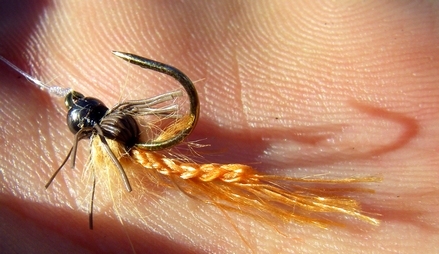
The Rusty Orange clownshoe, figure it darkens and is transluscent 

The physics trials went really well, but the fish are nowhere to be found. Tied on the small scud hooks with a 2mm gunmetal bead, the fly flops over nicely and rides hook point up – a requirement for Brownline fishing.

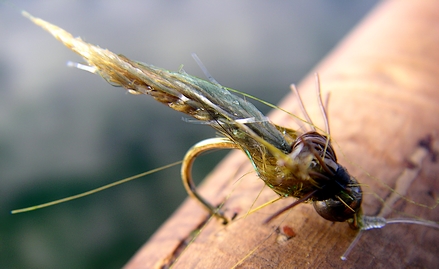
The damp Olive Clownshoe, the material shows its opaque and transparent areas 

The translucent effect is still present, the braided area is opaque and the filaments turn ghost-like when wet. It’s a promising look that we’ll try later, when the fish have decided to eat again.

One ball of yarn and all the colors in the rainbow makes a daunting artistic challenge.

The disco yarn even looked good – but this will have to wait until the next steelhead trip – or Spring, when the good citizens of the Little Stinking abandon all semblance of refinement and eat broken glass …

 The Bee Gee's probably wore this before being stoned by the crowd

It’s another Turkish export, 65% Polyamide and 35% Mylar – and it’s bright enough to make you cringe, just what’s needed to make a big Steelhead hear the little voice that tells him, “Shazam!..”

Just be glad Ma didn’t gift you this sweater for Christmas …

I was thinking durable – how I might singe the end with a lighter just to make sure it didn’t unravel, when a big Sacramento Sucker came upstream at me with “Durable” written on his back..

 He's awful lucky, Osprey's don't normally get just one fistfull

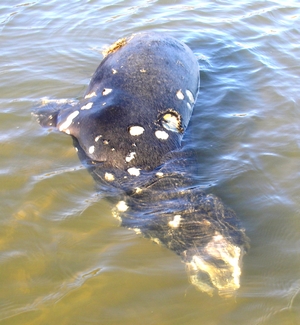
Despite his appearance he was mighty lucky, Osprey don’t usually lose their grip. In his case, his weight tore the talons out taking with it a walnut sized chunk of his back. This fish is about 24″ long – he’ll live.

Add durable to a long list of stellar qualities

A beginner tears hell out of everything – it’s his nature; the unfeeling, uneducated, flailing of amateurish casting is the best way to determine whether a material warrants more study or whether its got both durability and looks.

…that and you can see whether the dyes cause wounds to fester, as only the novice can imbed a really big hook where it’s least desired.

I had an awful lot of casualties this week; fanciful flies with intricate parts, simple flies with new replacing old materials, and simple patterns that merely allowed something to flop around in mid-air.

The winner was the Polyamide double eyelash yarn, it’s completely bulletproof and possessed of qualities unlike any other synthetic I’ve seen in recent years.

 Opaque when dry

The bad news is that every source I’ve identified has ceased production, and while finding multiple sources of manufacture, I assume its the “look” of the finished garment that’s no longer in fashion.

 Translucent when wet

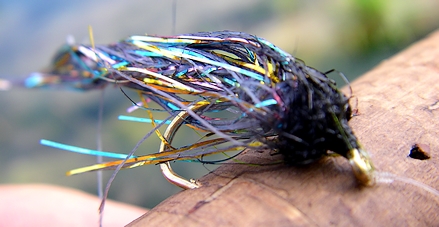
The dry version of the fly looks nice, but the soaked material has a marabou-jelly quality that simply defies description. The dry version is opaque, the wet version is translucent, and the damp fly resembles jelly.

Add to the mix the crystalline sheen of seal fur, and a fiber size about half the width of a human hair – where the slightest movement in water current or line causes the head to pulse and tails to flop wildly – and you’ve really got something special.

 Gelatinous when damp

I managed to get four skeins of the Gedifra “Costa Rica” flavor, and have seen similar yarn marketed under the Feza “Karbele” label. Six skeins of the autumn colors are available on eBay but that’s all I’ve seen in recent memory.

There’s a special hell for fly tiers … we finally get a couple synthetics to slow our killing of real critters, only to find the man-made stuff is closer to extinction than the beasts we’re saving…

Mustad to discontinue the classic standard fly hooks

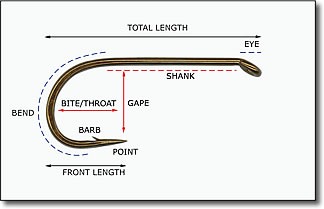
Hook Anatomy Mustad is discontinuing their line of classic fly tying hooks in favor of their Signature Series.

That means the classic 94840 (std. dry fly) , 94845 (Barbless Dry), 94833 (3x fine dry), 3906B (std. nymph 1X long), 9671 (2x long), 9672 (3X long), 79580 (4x Long), 3665A (6X long), 3399A (std wet) – are out of production as of January 1st, 2009.

Cabela’s web site seems to corroborate the news as they’re listing multiple standard Mustad hooks as, “Sold out Sorry, Cannot back order.”

J. Stockard’s catalog references the same issue:

Below are our best deals on some Mustad Standard hooks that are discontinued. Most of these hook styles are being replaced by equivalent hooks with chemically sharpened points in the Signature series.

Many tiers prefer the Tiemco, Gamakatsu, and Daiichi wire and  switched from the Norwegian iron many moons ago. Mustad is replacing the hooks with their “Signature series”, they’re twice the price of their standard hooks and compete directly with the Japanese product lines.

There’s no mention of the change on the Mustad web site.

Those of you still wedded to one or more of the above styles should perk up and inquire of your dealer, you may want to lay in a stash of them while they’re still available.

Then again, there’s always the “Bernie Madoff” option, slurp as many as you can and double your money on us old guys on ebay …

Thanks, Bernie..

Wax on Wax off

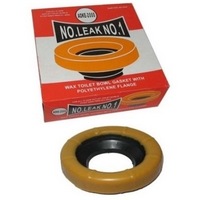
Non-drying, tacky toilet wax I’ve always assumed it fell from favor based on the unyielding goo Danville dips its spools into, their idea of waxed thread doesn’t share any of the properties that made wax a staple on every fly tying bench.
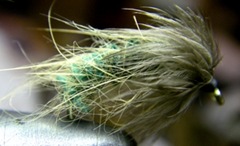
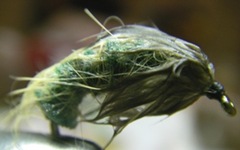
Both smaller thread and fly tying specific threads assisted in removing wax as a mainstay, but it’s still has capabilities that pre-waxed nylon and head cements have never been able to reproduce.

I still use quite a bit of it, mainly to stymie the smiling fellow in the plumbing department when he sees me pawing over the toilet gaskets. A two dollar gasket is the better part of a decade of non drying, tacky wax designed to stay supple with even my ponderous bulk on the throne.

dubbed_chenille

I use it to tame the unruly and coat materials that take a lot of abuse, where even a flexible vinyl cement will flake off … and on occasion, I’ll stretch the boundaries of materials – sometimes the results are useful, sometimes not.

The fly at left is flat forest green chenille that’s been dubbed_chenille_wet stroked with wax, then amber rabbit dubbed onto the chenille, which is spun, trapping the fibers. It’s a simple caddis imitation that once dampened offers a good looking scruffy pupa – akin to what Gary Lafontaine was after …

Naturally I like mine better, but I’ll let you be the judge.

Technorati Tags: , ,

War on Six Dollar Items – Head Cement

Lacquer and thinner There’s thousands of glues, lacquers, shellacs, and cements, but no such thing as “head cement,”  that’s a term we invented to describe grabbing a gallon jug of something used in the woodworking industry, decanting into a tiny little jar and selling it for 97 times what the jug costs.
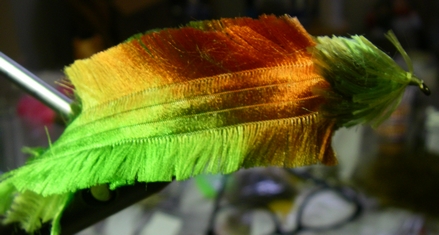
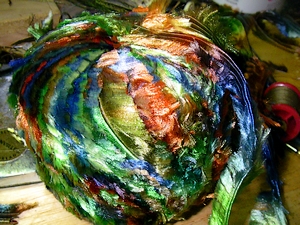
Fly tying cements are one of two types; the vinyl cement family, and the lacquer-shellac family. A good rule of thumb is high gloss = lacquer, and dull = vinyl cement.

Vinyl cement is available in many viscosities – and most of those sold in fly shops are thinned to a water consistency for maximum penetration. Lacquer is usually thicker and is almost always sold with thinner, allowing you to customize the mix to your liking.

Lacquer gets thicker as it gets older and is subjected to oxygen, vinyl cement mostly evaporates with exposure to air – without changing viscosity. Most tiers have both in their desk; vinyl cement is flexible and works well with feathers, lacquer dries shinier, harder and is brittle.

Both have great qualities, reinforcing a feather to make a wingcase would be vinyl cement; it doesn’t add shine, is more flexible than lacquer, and the first couple of fish won’t destroy feathers as it retains some of the original flex despite the coating. Exposed thread would be best served with lacquer as it dries harder and often the shine is desirable, like the larger exposed heads of steelhead or salmon flies.

Last year I wrote where to find cheap vinyl cement but I never touched on the glossy lacquers and what to look for…

I prefer the nitrocellulose lacquers once used in the automobile industry (which has since shifted to water based lacquer). These are the thin lacquers used with spray guns and are now used for finishing musical instruments.

Violins and guitars derive much of their sound from the resonance of the body, and a hard glossy lacquer is preferred to enhance its musical qualities (I assume a flexible sealer would dampen sound).

I buy the Lawrence-McFadden lacquers by the quart ($18.00), along with a quart of thinner ($10.65) and either use it as a 50/50 mixture for general fly tying – occasionally using it un-thinned for the “large head” flies, where gloss is part of the overall presentation.

Nitrocellulose lacquers produce a very hard yet flexible, durable finish that can be polished to a high sheen. Drawbacks of these lacquers include the hazardous nature of the solvent, which is flammable, volatile and toxic.

Decanting and resealing the larger containers has always led to quarts of wasted wood finishing products lining your garage, and how each time you’d opened one it had turned into a dried hardened mass.

Instead of pouring into a smaller container, save a couple of straws from your favorite fast food vendor – those big round ones that induce an aneurism because the milk-shake-substance hasn’t thawed yet.

Cut one of those about two inches above the height of your quart jug. When you need to refill your bench bottle – just press it down into the lacquer and when it hits bottom put your finger over the end. Hold your small bottle over the lacquer jug and transfer the straw – about three trips with the straw and you’ve filled a head cement bottle half way, repeat with the thinner, and stir. Toss the straw when you’re done.

No mess, no drips, and the large cans reseal tightly so you get to use all the goody.

I’m not sure how many years two quarts of head cement represents – but to a casual tyer it’s measured in decades. Store-bought head cement is at least $5 per bottle – double that if you buy thinner, so it’s a considerable savings over their product – whose bottles often leak or evaporates the product anyhow.

Not yet a fly, not even rational thought. Blame Nyquil.

I’ve been calling it the “Fishing Jones” yarn – ever since I saw his Peacock Bass picture. I’m not sure what eats little Peacock Bass, but yank six inches of this stuff through the water and you’re sure to find out.


Mornings are cold and wet and with me honking snot already, wisdom has kept me indoors. I’ve got a couple of “alpha prototypes” to test this weekend; they’re not flies yet – merely strips of the material lashed onto a hook to test the physical qualities; does it shred apart, does it flap around wildly, does it resemble anything other than a Nyquil induced nightmare … the usual tests.

It’s an Italian double-eyelash yarn that is iridescent, all the colors of the rainbow are present and they glimmer like the center of a Peacock eye. 100% Polyamide – so it’s soft as a baby’s arse, and melts when exposed to flame.


What makes it difficult is the 4-strand stitch up the center. It’s unnecessary as a structural component, yet something I’ll have to work around.

The maker is Gedifra, “Costa Rica” is the yarn name. It appears to have ceased production in 2004, but can be had on eBay or some of the traditional yarn outlets.

I have to assume the best fishing yarns make the poorest fashion. Never much of a “clothes horse” myself, it certainly brings into focus the question of sense of style. I find something I like only to learn it fell out of favor four or five years ago.

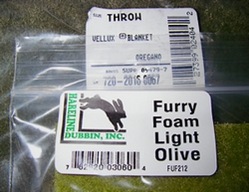
Furry Foam by any other name is a blanket

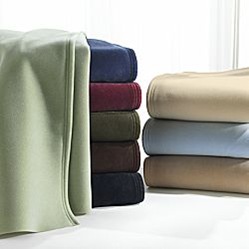
JC Penny's Vellux blanket with 9 colors available I was tracking some quarry for the Roughfisher, and as the supply is ample figured I’d share with everyone else, as many of you tie flies with baby blankets …

You call it Furry Foam, and are content to pay $1.25 for a 6″ X 6″ square, I call it a Vellux Throw, and pay $15.00 for 36 square feet. At retail that’s a 600% profit for the middlemen – who score them wholesale I’m sure.

J.C. Penny’s offers nine colors in stock, available as a throw wrap ($15), and Twin through King sized sheets ($19 – $34).

Hareline sells it in the fly shop, but why buy it from them Big stonefly nymphs and Darth Clam come to mind, likely it’s something you’ll want to split with a buddy, or share with your fly tying class – 36 square feet is a lot of flies.

One of the few investments for a toddler they won’t outgrow – once they get too big you can launder it and chop it into manageable pieces, you may even have it longer than the bronzed baby shoe.

Just cut around anything that looks like “urpy-chuck.”

You could at least throw me a towel when you’re done, the War on Six Dollar items heats up, or I do

I made the mistake of restocking some rubber leg material at my last visit to the local establishment, and was driven into another paroxysm of swearing.

There among all the pre-packaged “jobbed” materials was the Spirit River “Tarantula legs” – minus the color I was looking for, naturally. I did find one old pack down at the floor that someone had missed – just enough to get me through the weekend.

My mistake was glancing at the price while admiring my find.

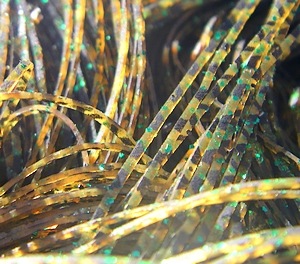
Detail view of the (olive) Pumpkin metal flake

Don’t waste your money – times is hard enough without being used savagely, $2.50 for about 24 strands of colored leg material is unconscionable – that’s a dime per fly.

Spirit River buys the damn stuff from someone akin to the Living Rubber Company, and you’ll find all the colors and sizes they offer – plus extra colors not available at your fly shop – and the price is 1/11th what the shop charges.

Do the markup math yourself – a “25 skirt pack” is about $6.00 from Living Rubber, and each of the “skirts” equals a Spirit River pack of rubberlegs, about 24 strands. I don’t mind so much if an enterprising fellow doubles or triples his money, but 11 times is enough to make me wince – only because he’s making 11 times the retail price of the rubber, he’s making double that if he buys it wholesale.

The standard skirt material from Living Rubber is what Spirit River describes as their “medium” size, and it’s rectangular rather than round. If memory serves, the Spirit River “fish scale” rubber is also rectangular. Living Rubber sells the round rubber in 15 foot lengths for $8.00 – these are simple one-color bands of ~50 strands each. They don’t yet sell the printed pattern round fibers on their web site.

I haven’t contacted the company for the availability of round imprinted rubber, but if they’re selling it wholesale to jobbers, they’ll certainly sell it to you.

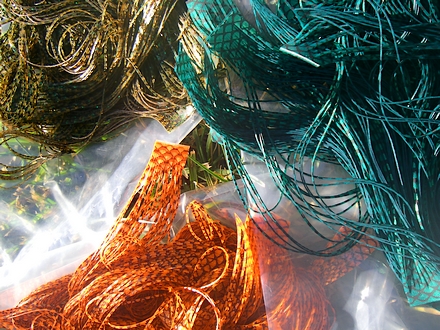
Shown in the photographs are “25 skirt packs” of “Green Pumpkin” (the olive and black metal flake) and dark green/black and the orange/black varieties.

Take advantage of the vendor for a change, see how it feels – it’s another sawbuck saved for your next big purchase …

Stalking the elusive Ultra Chenille, it’s Vernille in the Wild

I figure it’s a cross between Euell Gibbons and Basil Rathbone, a mixture of natural curiosity and dogged determinism; a personal quest, my ongoing War Against Six Dollar Items, where I delight in finding products “in the wild” – unfettered by middlemen, fly shops, and their obligatory markup..

I’ve been chasing down Ultra Chenille (Vernille, Velvet Chenille, Suede chenille) for almost a year. I thought I had it when I discovered a manufacturer in Turkey,  instead it was an interesting crop of fibers and yarns, all cheap as dirt and as yet undiscovered.

The good stuff, and it's cheap as dirt

Ultra chenille is a great material, tough as nails, low buildup, and has a variety of uses from traditional chenille flies to the nouveau dressings unique to the product.

At $2 for 9 feet, it’s also pricey.

I’d toss the old rayon stuff if the price was low enough to replace it – mainly because ultra chenille wears better and doesn’t come apart in your fingers if spun in the wrong direction. The fibers being so much shorter – it doesn’t mat or bleed, especially after the flies have been fished.

Tie is the blue strand, fly shop stuff is the flesh colored strand This fiber is made by a manufacturer called “Silk City Fibers” located back East, and is marketed under the “Tie” name, to distinguish it from the myriad of other yarns they make. It’s neither suede, rayon, or cotton, rather a synthetic nylon called “Polyamide.”

Acid dyes will dye nylon just fine – allowing the possibility of scoring a 2000 yard cone of white and making whatever color you fancy.

Chenille and yarn follow a number of sizing conventions and the “YPP” convention is commonplace. “YPP” is Yards Per Pound, and the higher the number the smaller the diameter of the material.

“Tie” is a 3800 YPP fiber which is about 15% smaller than the size sold in the fly shop. Also good, because we can use it on smaller hooks without making the fly too bulky – and it’s likely available in a variety of sizes – something else that’s missing from the fly shop selection.

100 yards in a neat little bundle for only five bucks A cone of ultra chenille is $90 from a reseller – and while only a commercial tyer will get excited – searching on eBay yields a vendor with 14 of the 16 colors available from the factory.

50g skeins for $5 is a steal, and she has plenty.

The top picture is her color selection, and contacting the vendor directly will score you enough of “the good stuff” to make it worth your while.

The smaller size is especially useful, as it’s diameter is small enough to make trout flies – expanding your use beyond  traditional steelhead flies and streamers.

The War Against Six Dollars Items continues, with you folks the beneficiary.