There is a place in every burgeoning entrepreneur’s repertoire for daytime soaps or Judge Judy … Some hideous repetitive task looms, and as you eyeball the points, run your hand over the assembly for burrs, loosen or tighten screws, and whack a chunk of whatever is close by, the Good Judge is sending some sobbing teenager into the steely grasp of the bailiff …
Such has been my fate of late. The gloom of my living room and the toil of quality control leavened with the glow of the boob tube. It’s something learned from commercial fly tying; find a show that’s uninteresting – and focus on the task at hand, glancing up only for the obligatory flash of breast-meat or the dismemberment scene.
… and I even oiled the damned things, because I knew you never would.
I received the first shipment of tungsten-imbued Sixth Finger scissors this week. After paying off all the owe-sies, vendors, and blood relatives, it appears I’ll have nearly 50 sets available of the 4.5” (original size) model. The “General Purpose” large size will be arriving next – as I’ve just approved the final design and finger hole placement.
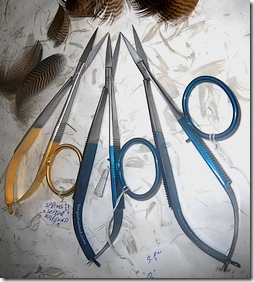
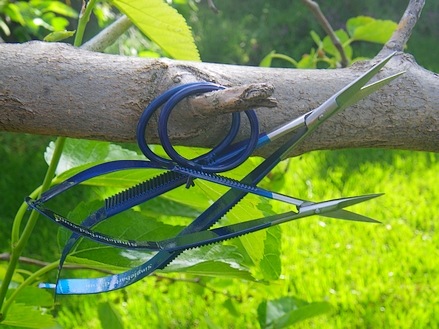
The last six months were spent testing three different fingerhole placements, and the hard part was choosing between the last two (shown with blue handles) – but the right-most won, allowing the 5.5” General Purpose to extend beyond the hand the same distance as the smaller 4.5” Original design.
This allows you to switch back and forth between the two styles without changing your grip or suddenly poking out an eye because you forgot which set you were holding.
The longer heavier blade comprises nearly half of the extra length, and we’ve shortened the spring without affecting the effort needed to press the blades closed. The adjustable screw allows for complete scissor disassembly for sharpening, or just give it a quarter turn every couple of years if they loosen with use (and abuse).
Care and Feeding of your New play toy
I’ve witnessed many hideous crimes committed on or with scissors – and only occasionally was it some other oaf – most were of mine own invention.
The 4.5” scissor is a “light duty” precision scissor. Adding faster colors, adjustable screws and tungsten inserts makes it a extremely sharp, light duty scissor.
… it doesn’t make it invulnerable to your hammy handed enthusiasms, nor should it be used to chew concrete.
The sweet spot for this design is the countless tiny snips and trims associated with preparing feathers, positioning, and the finishing of the final product. It will cleave moose hair off the hide, it’ll whack copper wire into pieces, and accomplish most of the fly tying tasks you’ll ask of it.
Do you think the new scissors would work well for tying glo-bugs? I’m looking for a super sharp, heavy duty blade that will last a while tying egg patterns. I’ll try the sample you sent and let you know.
… and my response:
The 4.5" is still a light scissor. While the tungsten allows it to plow through heavier materials, I’d use the 5.5" scissor instead. The larger size has a beefier blade as well as the tungsten – and glo-bugs are heavy work. I’d use the heavier blade only because it’s less about "can it do it" – than it is about "can it do a million of them."
Proper tool for the proper job rules – that heavier blade should allow you to chop a fistful of yarn a million times – the lighter scissor might be able to do it – maybe even well – but the pressures on the screw hole will chew the scissors up … the blades will loosen … and you’re left reaching for a new set.
The answer was in the question, “ super-sharp, heavy duty blade.”
Depending on what we were raised on as fly tiers warps our judgment completely. Surgeons have a thousand different kinds of scissor – each suited for specific tasks, yet us fly tiers insist that one pair of scissors be capable of mowing the lawn, mixing drinks, and walking the dog …
Just because you can cut the stem off a turkey quill with a pair of scissors doesn’t mean you can do it a million times without damage.
If you focus your usage in the sweet spot for any scissor, they will last a lifetime.
/end Momma’s lecture
The Avaricious Greed Part
My goal was to keep the price of both styles of scissor below thirty dollars. I was only partially successful …
The 4.5” Tungsten will retail for $28 a pair, and the 5.5” Tungsten will be $29 each. This is consistent with the market maker, Dr. Slick – whose 4.5” tungsten standard scissor is also $28.
But wait, there’s more …
My strident bellow about the inequities of the vendor community require me to trod rarified soil, anything less flirts with hypocrisy. While the gesture will be ignored by the larger community, my ethics require some small allegiance is owed those whose twenty dollars I’ve already pocketed.
Contrary to Harvard Business School and their tutelage, I see the customer as friend and compatriot, not competition.
Therefore, owners of the existing scissor can pick either flavor of the new scissor for $22.
Postage for a single set of scissors is $1.56 – and the padded envelope is $0.42 each, I’ll eat the bubble pack, tape, and the 20 minute wait at the Post Office.
Last time I paid the postage and you got the scissors for $20, this time you’ll pay for the shipping … and get the scissors for $20. This discount will be honored by me only – so asking your local merchant will result in a blank stare.
I’ll keep the offer open until redemptions roughly equal the amount of original scissors sold.
I’ll be working this weekend to update the Google shopping interface (the purchase image in the center column of this blog) to reflect the models and the discount, and dreaming up a surefire way to query you on your older purchase thereby qualifying you for the same.
I’ll mention this option again when the 5.5” models arrive, so if you’re interested in an upgrade decide which flavor you prefer. A rain check will be available if I run out of stock, so there’s little need to rush blindly into a new purchase.
Just my way of saying … thanks.
… and if you simply must be the first on your block, just drop me an email to reserve a set, as this shipment is small and sales look to be brisk.
Full Disclosure: I am the principal vendor for the Sixth Finger scissor and will benefit from any sale of this incredibly awesome scissor. All superlatives used to describe the male enhancing qualities and mind boggling function should be taken with a grain of salt.
Tags: Sixth Finger scissor, tungsten carbide insert, scissor upgrade option, light duty scissor, precision scissor, Google shopping, daytime soaps, Judge Judy, thanks for your patronage
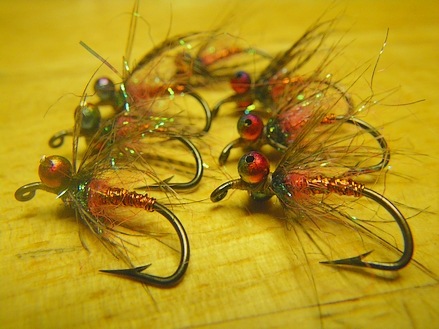
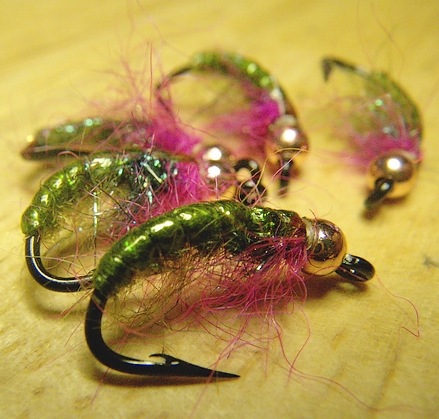
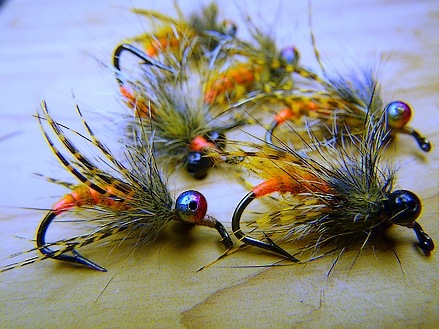
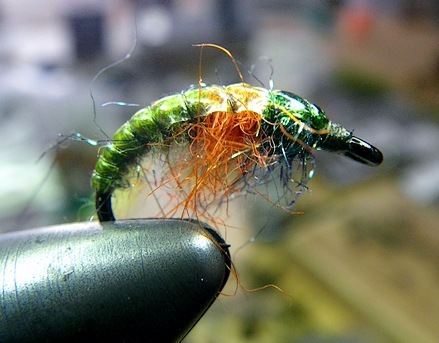
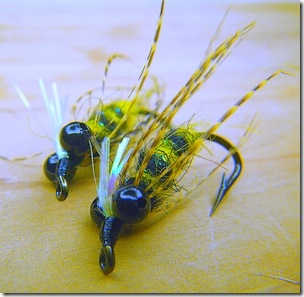 The Underwear River Caddis marries the soft hackle and fur collar to traditional shad orange, it’s an homage to classic shad colors with a bit of trout food chaser.
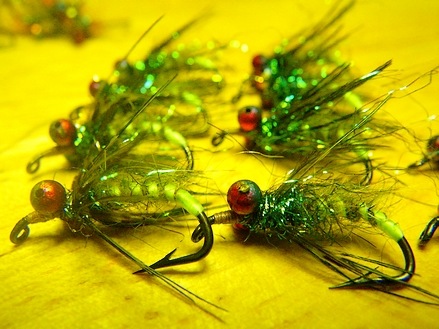
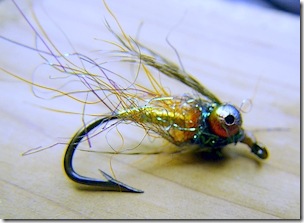 … and for the minnow crowd we assumed a bit of shiny mixed with a lean silhouette would cover all the possible fry that might stumble into a pod of ravenous herring.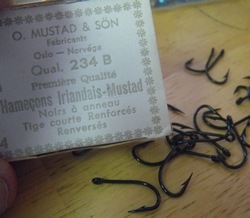
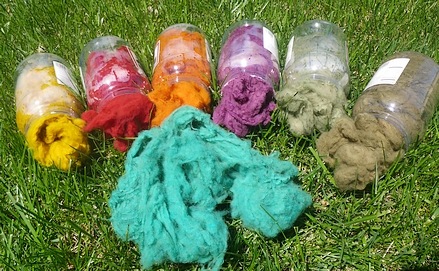
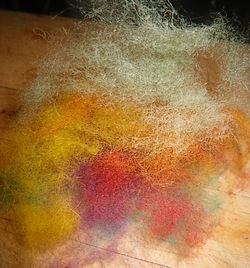 The simplest way to build a good spectral effect is build the “Chaos” color and simply add it to your base fur in the desired quantity.
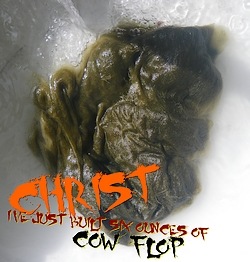
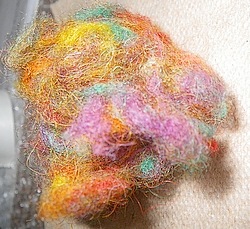 At right is the knotted mass that came out of the blender. It mixed the colors slightly, but the bulk of the mixture is still clumped color and undesirable.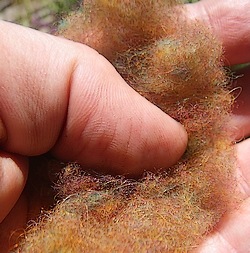
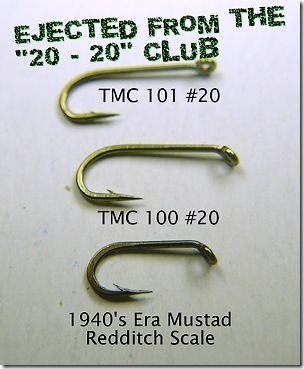 I’m a self confessed collector of hooks and a complete snob. Not that they have to be gilt plated or come from some distant clime, I just need them to be as versatile as screwdrivers and socket wrenches, lots of sizes and similar shapes, but there should be one perfectly suited for the task.
 Our old favorites, the 94840 (R50-94840 – Dry) and 3906B (S82-3906B – Nymph, Wet) were actually extra long shanked – and used to say as much on the label. Now with the economy packaging and terse descriptions – the 94840 is listed as “standard length” and most tiers are unaware that their #18’s and #16’s share a nearly identical shank length.
 Hook makers from Japan have upset Mustad’s domination of the fly hook market, but in doing so they copied the Mustad hooks and preserved the Mustad measurements of gape and shank length, and propagated the differences to Tiemco, Daiichi, Dai-Riki, and all the rest.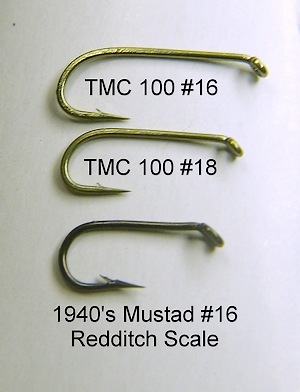
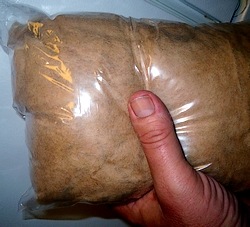
 As my starting dye is not a bright green (like Kelly Green), rather it’s a Forest Green, there’ll be no need to add any black, so the final mix will be 75% Forest Green and 25% Golden Yellow (using RIT colors).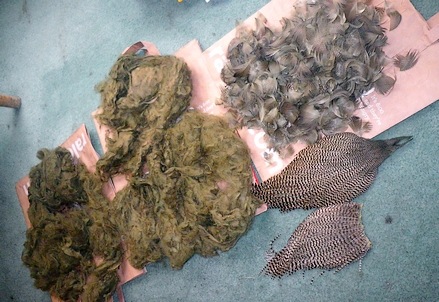
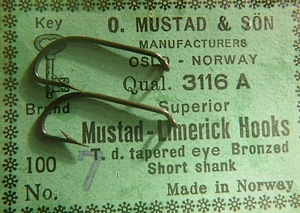 As today is the much dreaded “Tax Day” I thought I’d interrupt that lethal mix of sulk and stress with a return to the 1950’s – more importantly, a return to 50’s pricing…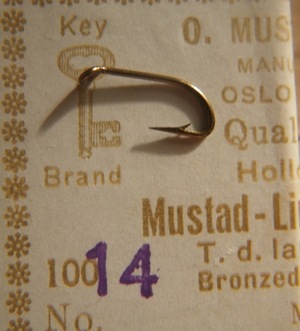
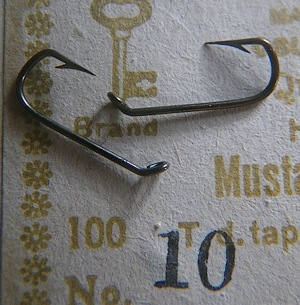 Take a close look at the 3116A, 36712, and 3667 styles, as these are superb hooks.