Author Archives: KBarton10

Susan’s Purse Making Caddis, ten toes on the fender

Us Anglers have always been linked with conservation issues. Often we’re the whistle blowers that link some abusive practice with its effects on riparian habitat.

Invasive species and our part in spreading them was a stiff jolt. We’ve had the luxury of being the “Good Guys” for so many years – finding out we are the cause of some malady is a bit uncomfortable.

Giving up felt soled waders may be martyrdom to some, but as the pristine environments shrink, what else are you willing to part with?

Oh yes, it’s coming to that.

Those that made the pilgrimage to Hat Creek when reopened after its makeover by CalTrout have fond memories of large fish, Green Drakes, and the Powerhouse #2 riffle lined with enormous October caddis cases.

They are all gone now and have been for many years.

We did that. All those thunderous feet chasing large fish managed to squash the October Caddis out of the areas accessible to wading anglers. Siltation from the upstream powerhouse and the occasional canal break were responsible for the demise of the Carbon Bridge Drake hatch – but all our feet in the riffle above certainly added to the silt burden downstream – we just never measured the effect.

… and like most “trophy” water – our passion for bigger fish and wild trout has always put a dent in populations – despite our intentions otherwise. Hook the same fish 34 times a year and eventually he gets his gut squeezed, hits a log when dropped, or no longer has enough integrity in his lower jaw to eat mayflies …

We mean well – we’re not bad people, it’s just a numbers game. Thousands of anglers fishing continuously over a small space alters the landscape just like grazing cattle.

… and cleated rubber soles – they will make it easier to destroy the banks – as the same entree and exit points are used by thousands of anglers season after season.

The next couple of decades are liable to make us give up a lot more than felt soles, we may even be banned from certain watersheds – or no longer permitted to wade at all.

Invasive species come to mind, but I’m thinking of the Endangered Species Act and shock of finding some of the best water denied to the Gore-Tex hordes.

This year two species of underwater insect made the Federal Endangered Species list; the meltwater lednian stonefly (Glacier Park), and Susan’s purse-making caddisfly (central Colorado: Trout Creek Spring and High Park Fen) and may result in federal protection for what small areas still contain them.

This has always been a hot issue among private land owners who are suddenly denied use of their property to protect a salamander or lily – and with our big feet stirring up sediment and squashing insects underfoot, we may have to ante-up as well.

It’s certainly an unwelcome thought, yet fascinating to contemplate.

… and while you glance down at them big feet knowing you’re innocent of all wrongdoing – how your gazelle-like dance through the fast water couldn’t possibly be doing harm. Think again. Many thousands of insect lovers you never knew existed will be gearing up to confront you in the parking lot…

… you’ll have one foot poised over the water when you feel the Taser darts bite through your vest.

Tags: meltwater lednian stonefly, susan’s purse making caddis, insect lovers, taser, hat creek, wild trout, big wading feet, CalTrout, Trophy trout, global warming, Endangered Species Act, cleated wading shoes

Wherein we apply the boots to her watery midsection

I’m on unfamiliar turf, unsure whether to be melancholy, maudlin, or go with chest thumping bravado. Guys are always conflicted that way as we aren’t allowed to “tear up” when Old Yeller gets lead out behind the barn, nor are we supposed to get melancholy when we see our home water laying there with bones exposed and buzzards her only companion.
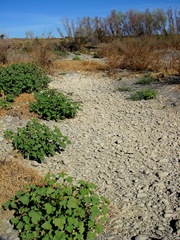
Dry as a bone

On May 9th my beloved Little Stinking had the stopper pulled and ran bone dry. A couple months ago I wandered the lower stretch and saw the only water remaining was four large beaver ponds. This morning I had the nerve to go up to the big fish stretch to see what remained – as the gauge read that water had been restored.

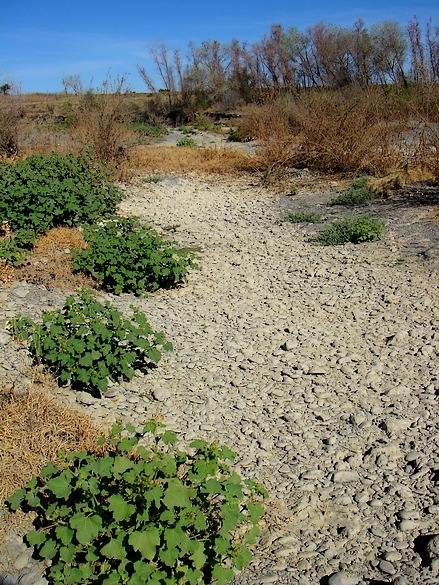
The creek was dead, completely dewatered and dry as a bone.

As it was early still and heat wasn’t an issue I elected to hold a wake. I’d wander down through the normal jaunt and see how deep each hole was and collect a few lost flies.

I must have made quite the spectacle as even the ATV crowd gave me a wide berth. I’m fully geared with hip boots, vest, and rod – and crunching through dry creek bed like I was expecting to fish sometime soon.

My already dubious reputation was lowered a couple of notches, I suppose I’m the “Wild Man of Crap Creek”, “tetched” in the head by too much sun. Mothers no longer wave back – they gather their kids close as I pass …
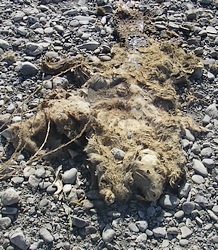
Wally, where's the Beaver? Dead and desiccated beaver were scattered near their burrows. While agile underwater they’re clumsy prey on dry land, easy pickings for coyotes or someone’s Rottweiler.

The pelts were too far gone for my road kill honed reflexes, and I left them for the buzzards.

Even the deep stretches were dry, at best with a bit of dampened mud at the bottom. No fish carcasses were evident but they would’ve been picked clean and skeletal.

It’s a complete wipe. Bugs dead, fish dead, and the wildlife in the area foraging for water as best they can. I found a couple muddy traces that had an inch of water remaining, and the volume of animal tracks nearby were moot testimony to the deer, coyotes, and birds having to make do.

It was science at this point. What happens when fish detect lowering water and the temperature rises to unacceptable? Do they slide downstream until blocked – there to die, or can they sense the calamity and migrate before the inter-pool riffles dry and block passage?

At the end of my downstream leg and after tromping nearly two miles I found the last pool of water remaining. A family of four mink (might have been otter) were swimming in four feet of of clear water in a pond I could nearly cast across.
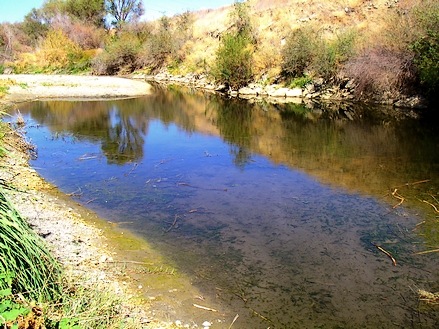
The last oasis

In the past this had been the home of all the really large smallmouth, with the far bank a deep slot nearly ten feet deep. Now it was a large swimming pool of half that depth.

I’d never seen mink on the creek – even in her final moments the Old Gal was still full of surprises. I sat on the gravel bar above and watched them swim around a bit. The water was full of fish, everything that could swim downstream had done so – now marooned by shrinking water and likely will be eaten by the four mink in residence.

Not much a fellow could do other than remember the big fish landed or lost on the same stretch.

… but Singlebarbed ethics require me to add my boot heels to the watery bitch’s midsection and I strung the rod for one last go. We’d make this an “Irish” wake and dispel melancholy with a few fingers of adrenaline.

The Little Stinking had one last surprise in store – surrendering my first Black Crappie. It was a bit bittersweet, but I’ve now landed every fish on the “Lethal Mercury – Do Not Eat” sign posted on every bridge crossing.

…most would consider it a dubious honor, but I was thrilled.
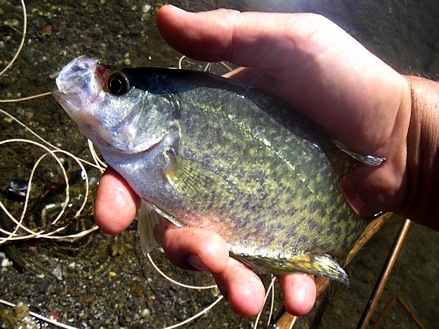
The Black Crappie

Say hello to my little friends, they’ve entertained both you and I these last couple of years …

The Sacramento Pikeminnow – the lateral line moves upward as it approaches the gill plate, about the only distinguishing feature separating it from the equally common, Sacramento Sucker.
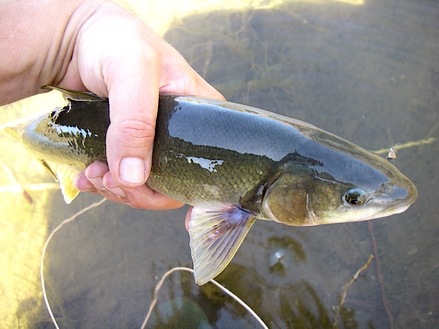
Sacramento Pikeminnow

The Hardhead – nearly indistinguishable from the Pikeminnow except in the larger sizes, where it’s entire belly becomes an orange-yellow. (whereas the pikeminnow remains white)
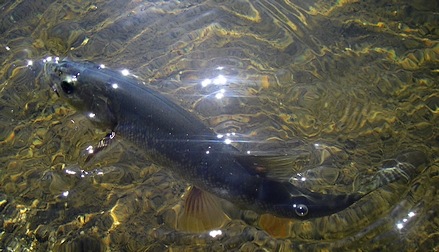
Sacramento Sucker

I landed fifty fish in about an hour; bluegill, sunfish, pikeminnow, suckers, smallmouth bass, and crappie. Each displayed its unique characteristics that I’ve memorized over time. Pikeminnow adore the large fly stripped fast (as do the suckers), and Bass love to inhale flies as they sink.

It was a great way to part company with an old friend – and while Winter’s rain will replenish the water it will take longer to refurbish the food sources and fish.

If the creek had invasives, they’ll be dead too.

I’d like to be really angry about the demise of this fishery, but it’s merely a symptom of a larger problem. Drought to be sure – as California has been suffering for the last three years, but the more painful thought is the realization that water is bought and sold for profit rather than metered for efficiency or environmental concerns.

Recently outfitted with a water meter, it’s plain that even the rural communities will be paying for water by the gallon, while the big agricultural interests resell their water back to cities for enormous profit.

Yesterday, the Hanford Sentinel broke the news that Sandridge Partners, a Westside “family farm”, was planning on selling 14,000 acre-feet of Sacramento San Joaquin Delta water a year to the Mojave Water Agency, San Bernardino County, for a mind boggling 5,500 dollars an acre-foot.
Who wants to be a millionaire? This deal will yield 77 million dollars to, wait for it, multimillionaires. Sandridge Partners is owned by the Vidovich family of Silicon Valley, who already amassed a considerable fortune turning Silicon Valley orchards into housing tracts. More recently, according to the Environmental Working Group, as detailed in an article in the San Francisco Chronicle, Sandridge Partners were the biggest 2008 recipients in the entire nation for federal subsidies for thirsty cotton, wheat, and peanuts for their farms in three San Joaquin Valley counties. Think of them as Kern County’s Welfare Kings.

(via The Trout Underground)

Equip your house with solar panels and you can resell energy back to the grid, so why aren’t you credited with money for the water you conserve?

Drinking water is fast becoming the world’s most precious commodity. While many have giggled at the crappy brown mess I fish in – they aren’t laughing when I name the communities that are drinking it – and my cigar butts.

When water reaches four bucks a gallon some type of reform will resurface the issue of salmon versus watery tomatoes – and which we want to eat for ten cents a pound more …

Until then be content that despite the iron grip of a third consecutive year of drought, California tomatoes shrugged it off with alacrity:

It’s shaping up to be a record year for California’s processing tomato contracted production with a forecast of 13.5 million tons, 13 percent above the previous record year of 1990.

Planted and harvest acres are forecast at 308,000 and 307,000, respectively, according to statistics from the U.S. Department of Agriculture. Acreage drifted from areas where there wasn’t adequate water supplies, with acreage up significantly in Kern and San Joaquin counties.

Fresno still leads the state with the most 2009 contracted production with 102,000 acres. San Joaquin County is second with 44,000 acres and Yolo County rounds out the top-3 with 34,000 acres.

… and then they sue the state because we cut back water to save a few hundred salmon.
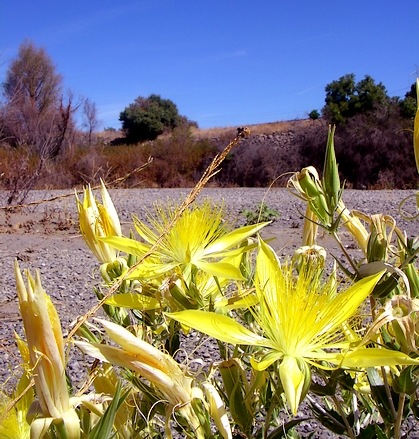
Dry creekbed and a few posies are all that's left

Something stinks, and it’s not the corpse of my creek. She smells of hot rock and a few posies … all that remains.

Tags: California tomatoes, little stinking, pikeminnow, sucker, crappie, bluegill, wake, smallmouth bass, California drought, water politics, potable water, drinking water

Is the Noose tightening on Abel Automatics Inc?

The Madoff finish AbelWe’ve mentioned in past posts that Abel Automatics Inc., maker of the Abel reel, has their destiny intertwined with the Bernard Madoff scandal.

Abel Holdings LLC owns Abel Automatics – and both Andrew and Mark Madoff are principals for Abel Holdings, with Andrew Madoff listed as the CEO of Abel Automatics Inc.

Loans made to both sons by the elder Madoff are being contested by the court appointed trustee, Irving Picard, and are likely to be considered Ponzi funds eligible for seizure.

Mark Madoff owes his parents $22 million, and Andrew Madoff owes $9.5 million, according to the filing.

CBS News is reporting that civil suits will be filed against both sons to recover the money.

One source says Picard will seek in excess of $50 million – including at least $30 million in loans to the sons. He is not accusing them of wrongdoing; instead his goal is to recapture money diverted from Bernie Madoff’s massive Ponzi scheme.

A judgment against the Madoff sons will require liquidation of assets to repay the victims of the elder Madoff’s avarice. Which assets are unknown – as is the son’s ability to absorb such a loss.

Outside of the spectacle of rich people and their money, our interest is in the fate of the reel company, Abel Automatics Inc – and whether the Madoff assets will be seized by the government, or whether the sons will be allowed an orderly liquidation and repayment of the original loans.

In one case, Abel Reels will be sold to someone else and in the other – the US government owns the banks, the doctors, and is now making some tasty reels – proof of the decline and fall of free market capitalism…

… actually, in either case the company is likely to be sold.

I just wanted to make the Hardy-Grey’s corporation sweat bullets …

Tags: Andrew Madoff, Mark Madoff, Bernie Madoff, Abel Automatics Inc., Abel Holdings LLC, Irving Picard, Ponzi scheme, Hardy reels

Mountain Trout, you drove all morning to fish like crazy and opted for the drive thru

Trout Economix Nothing like a research paper to wave angrily in front of  county planners while they debate paving your favorite trout stream…
Southwick Associates has released another paper on the effect of mountain trout anglers on North Carolina’s rural pocketbook. Compiled from last year’s statistics, it’s the first research I’ve seen on who we are and what we do when we get there.

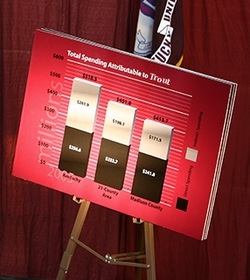
The typical resident mountain trout angler spends approximately $65 per day on trip expenditures when mountain trout fishing in North Carolina; nonresidents average $158 on trip expenditures. Annually, the typical resident mountain trout angler spends a little over $500 on mountain trout fishing equipment in North Carolina.

In 2008 North Carolina-bound anglers spent $500 annually; suggesting no new rod, last year’s waders, and the economy weighing on their consciousness. In fly fishing terms that’s 12 dozen flies, a few extra leaders or terminal tackle, and a sandwich or two.

The typical resident mountain trout angler fishes for mountain trout about 10 days in North Carolina in a year; the typical nonresident fishes for about 5 days for mountain trout in North Carolina. Anglers fished an estimated 625,147 days in Hatchery Supported Waters, 374,611 days in Delayed Harvest Waters, and 422,671 days in Wild Trout Waters. Most trips taken by mountain trout anglers last only 1 day.

“Delayed Harvest” is a stocked fishery with catch & release during the Spring, and kill during Summer.

Wild Trout Waters paints a compelling economic picture as it draws nearly 2/3rd’s what the hatchery fishery can boast. Great factoids to use when the county commission balks over the local tributary and a pending “wild trout” designation.

A one day trip suggests additional economic influence. Desperate to get bit they drive all morning, fish like demons, and drive back satiated – avoiding the additional expense of lodging and a possible outfitter.

… and 92% of those basking in the Wild Water are males. Statistically you’ll have to draw straws in the parking lot, with the small straws forced to drink the water, as that’s the only feminine in your collective future.

Tags: North Carolina mountain trout anglers, trout fishing, delayed harvest, Southwick Associates, angling statistics, Wild trout, economic effects of wild trout, fly fishing, hormone water

Elk Hair Caddis still don’t tie themselves, something to consider before you call that Malibu halfway house

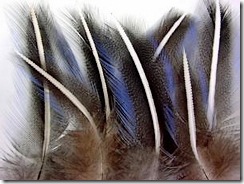
vulterine guinea fowl I’ve told you many times how fly tiers are a bestial lot lacking moral fiber and entirely untrustworthy when it comes to brightly colored wildlife …

… all wildlife really … they’re hell on the drab stuff too.

A couple of weeks ago Moldy Chum posted about a rare collection of birds pelts lifted from a museum in England – how fly tiers were being “hobby-profiled” and cavity searched as part of the investigation.

At some point all fly tiers work up the nerve to attempt the full dress Atlantic Salmon featherwing as it’s both work of art and testament to the craftsman. Like Everest it’s there – and that’s enough to draw the bold, the feeble minded, and those that thrive under impossible circumstance.

The genre is utterly brutal; starting with feathers and furs that have been banned for 50 years, and ending in a crescendo of references to out of print books, hooks you have to make yourself and a “trail of tears” with no apparent end.

Accumulating the materials is impossible without risking significant jail time. Those that have them are close lipped, those that don’t rely on dyed imitations of a feather they’ve never seen or felt – unsure if it’s even a good imitation.

Those addicted to the craft will endure any agony and pay any price for the original materials.

Many years ago I did my best to scrape together what I could when some of it was still legal. Despite my best attempts at cloak and dagger 90% of what I needed was only available in dimly lit alcoves – sold by smelly old guys wearing trench coats…

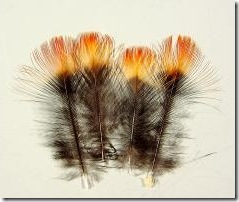
Real Indian Crow Doing a little research recently I stumbled upon Ken Sawada’s storefront where some of these feathers are sold legally. Before you run out and drop $72 for four Indian Crow feathers (which makes two flies) remember it’s not legal to import them into this country – despite their availability in Japan.

The prices are unreal and make fancy fly rods and engraved fly reels pale in comparison. For the fly tiers so afflicted here’s a chance to see what the originals look like. I would save the pictures for reference material.

Speckled Bustard                     Speckled Bustard anyone? The shoulders are only $839 for the pair. Cheap.

Keep in mind that Condor substitute – not the real stuff, is $61 per feather.

By now the non-fly tier’s are thinking we need detox or an intervention – 8 weeks mingling with D-list celebrities in some Malibu halfway house. But rather than condemn us to a fiery hell for our avarice and desire to own rare species, remember that Elk Hair Caddis still cannot tie themselves. You still need us.

I’m sure the decline in the US dollar has aggravated prices just a wee bit. The fly rods are cheaper than ours, but the Ken Sawada hooks are $35 for 25 in the trout sizes. Adam’s are $3.93 each.

It’s an interesting browse just the same. A glimpse at feathers you may never see again – and little wonder that fly dressers in the UK (or abroad) might be fencing Blue Chatterer to the tune of a tidy profit.

Tags: Blue Chatterer, Speckled Bustard, Indian Crow, Full Dress Atlantic Salmon flies, stolen museum birds, fly tying, condor, vulturine Guinea fowl, Ken Sawada

Now I understand why everyone south of Maine drinks Dr Pepper

estrogen_in_the_water Goodwill has tugged on your heartstrings long enough, and this Christmas I’m turning a deaf ear to the Salvation Army’s brass bell, as we’ve got members of the Angling Brotherhood who are in worse shape.

It’s the perfect storm; upside down on the mortgage so they can’t move out of the area and victimized horribly by selfishly ill people intent on making all their local fish hermorphadites and cross dressers.

We’ve reported on the early findings with great regularity; how wastewater treatment plants are unable to keep pace with the hormone burden, and how the steroids, aspirins, and mood stimulators, are pouring into our precious creeks and canals in increasing amounts.

West Virginia is the most medicated state in the continental US, followed closely by Alabama, South Carolina, Tennessee, Arkansas, Louisiana, Kentucky and Missouri.

“The growth in prescription drug use,” says Barlow, is driven in part by “chronic diseases that are largely preventable and are linked to lifestyle and physical activity.”

OK, call it a shared responsibility – West Virginia and most of the South eat irresponsibly and don’t fish more than a couple car lengths from the parking lot, but emasculating their quarry may be partly to blame.   

And their health problems don’t end there. Twelve percent of the population has diabetes, nearly 4% more than the average rate. Worse yet, almost 70% of West Virginians are obese or overweight, more than one-quarter smoke and 30% report having poor mental health, according to the Centers for Disease Control and Prevention.

Ignoring the above’s health concious bias, it means 70% of  West Virginian’s are ardent anglers – and the other 30% are guides – whose only quarry is semi-female fish with morbidly low blood pressure. It guarantees declining licensing revenue, the shuttering of their hatcheries and a crisis that should make us all donate.

With all the abandoned exercise equipment rusting in my watershed I’m thinking West Virginia wouldn’t mind a few of my invasives if it meant restoring masculinity to their gamefish.

All we need is a little compassion – and some donated gym gear.

Tags: estrogen, wastewater treatment, West Virginia, angling brotherhood, fishing, Goodwill, obesity, cross dressing

How they do that is a mystery

You might say my day started poorly. I’m up extra early attempting to cram in a fast run to Sporting Creek even though it’s supposed to be chore day.

My first mistake was making the coffee using the dubbing grinder – the Obergruppenführer of Romance insisted I be doubly good in her absence and had outlined a long string of chores to accomplish. The commandment was “…and don’t mess or dirty anything!’” – and I’m spewing Angora French Roast out of my nose while hacking up a claret hairball.

I figured “dry grinding” some of the my double-extra complex dubbing could be done while fixing leaky faucets and doing the laundry. A once-over with a wet sponge and the countertop is “guy clean”.

… and if she spots a dust mote shrug shoulder and act innocent.

Now I’ve got French Roast dripping from the kitchen cabinets and using her pasta fork to scrape squirrel off my tongue. At 3AM you simply strain the coffee through a washcloth and keep packing the truck. Tastebuds don’t wake up till 4:00 AM – so the washcloth doesn’t even have to be clean …

5 colors will make many more Fishing was frustrating and fun – but meeting my first female brownliner was a first. I was already in deep yogurt with the Missus, so I didn’t compound the sin by chatting longer than pleasantries.
I manfully tied on an apron when I returned and did my best not to sulk.

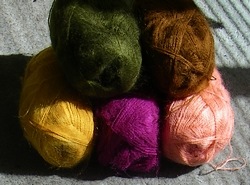
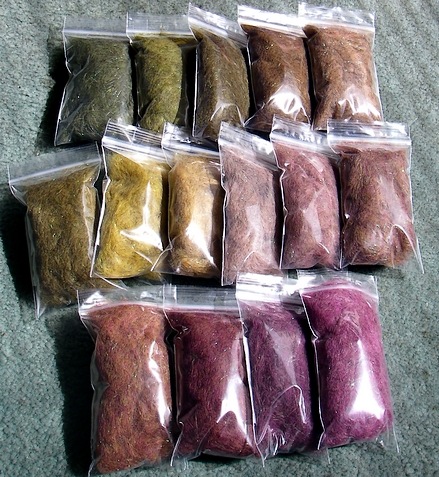
“Dry dyeing” uses the colors of the components to make new colors. I started with 5 colors of an angora-mohair blend, 4 natural furs, and the Soft Crimp Angelina. While diligently mopping the kitchen, mowing, changing light bulbs, and doing all the rest of the honey-do’s, I’d periodically return to the scene of the crime and mash the grind button.

Complex colors - made with up to 10 components each

That’s a grapefruit sized ball of dubbing in each color, enough to tie many thousands of questionables. A little judicious use of the Artist’s Color Wheel allowed me to get a full spectrum of buggy colors with only the five yarn blends as coloring agent.

Most were constructed of equal parts of an adjacent color, some have three, others require four. Can you pick out the color that is all five mixed together? (*answer below)

Just harken back to elementary school watercolors – and what happened when they all ran together.

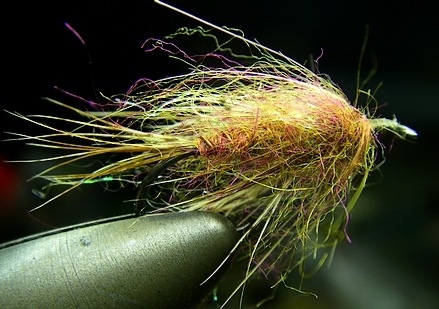
Complex dubbed Birdsnest

The above Birdsnest is constructed of brown partridge and a complex dubbing. It’s actually brown but photographed under a florescent (white light) lamp which lightens it up considerably. Note how the claret color stands out from the rest of the components.

Which is precisely what I expect on the Missus’s return. One white gloved swipe of the kitchen counter and she’ll mention, “ … note how the exhaled French Roast stands out from the faux walnut of my cabinets.”

How they do that is a mystery…

*Bottom left – the same color as used on the Birdsnest, note the difference of natural daylight versus florescent light in it’s appearance.

Tags: Angora, Mohair, blended dubbing, brownliner, partridge, artist’s color wheel, french roast, fly fishing, fly tying materials, deep yogurt, guy clean

The Pebble Mine is a drop in the bucket to what’s coming

Chuitna Coal Mine With all the attention and outcry focused on the proposed Pebble Mine, what’s sliding under the radar is the Great Alaskan Coal Rush.

With the far East clamoring for coal to fuel the Chinese infrastructure build out, and with Alaska containing one half of the coal reserves of the United States, and the shortest distance to market, we can expect to see a lot of pristine plowed under.

The proposed Chuitna mine and numerous other in-the-works coal projects would launch what some are calling the “Alaska coal rush.” Such an explosion of coal production would bring to the so-called Great Land an extraction industry that has devastated vast portions of the Lower 48. The effects would be many and far-reaching: from clearing out wilderness and infringing on the outback lifestyles of many residents to an acceleration of the epic disintegration of ancient glaciers brought on by warming climates. At stake are not only Alaska’s land and waters but also its allure as the country’s last true frontier.

Much of the proposed activity will be centered around the Cook Inlet near Anchorage. With the Chuitna Mine actually plowing through the riverbed – and the promise that the river will be restored via a man made facsimile after all the goodie is extracted.

The scientists who completed the analyses concluded that PacRim’s plan to strip-mine for coal directly through 11 miles of salmon-bearing streams would significantly damage local wetlands and headwater streams in an area 45 miles west of Anchorage. Restoration of the fragile and valuable wetlands and streams that feed the salmon-rich Chuit River would be virtually impossible, they determined.

More of the now-famous “It’s only one river” ecological standard – which has got us to the teetering point of Pacific Salmon extinction. “Texas investors” and Sarah Palin, “Drill, Drill, Drill” and be damned to you.

In all, eight separate projects are in various stages of review.

Half the coal reserves of the US and 100% of the Salmon reserves – and a lot of folks standing around shrugging their shoulders wondering, “how could this have happened?”

Tags: Alaska Coal Rush, Sierra Club, Chuitna Mine, Sarah Palin, China stockpiling commodities, PacRim coal, pacific salmon extinction, drill drill drill, Cook Inlet, Pebble Mine

I might’ve called 60 minutes back but they were awful rude

I was idling at the curb picking up a buddy and couldn’t help overhear two youngsters squabbling on the sidewalk. One of them had professed the desire to tattoo his forearm – and the other was rejecting the idea as “totally lame.”

While not an official statement on the death of “sleeves” and the “tramp stamp”, it was a reminder that each generation perceives the prior as archaic and retarded.

Ever sensitive to the economy and the “bubble-bust” phenomenon, it means all those tattoo artists will be looking for work in the next decade.

A piece on fishing news caught my eye, how hatcheries are searching for better ways to tag fish – how the “fin clip” is overly time consuming allowing only 25,000 fish to be tagged per technician per day.

… which was quickly followed by another piece on “Benson” the famed UK carp that was discovered dead – and how the entire populace was either in mourning or demanding an autopsy.

I figured Benson and Michael Jackson might have the same physician; what with the King of Pop scheduled for a series of London concerts and the Baron of Boilies finning nearby..

…  60 Minutes didn’t see it that way and promptly hung up.

Add all the esoteric together and I’m thinking we can clothe the out of work tattoo artists in lab coats, seat them in a long line at the hatchery and mark all the fish needed in half the time.

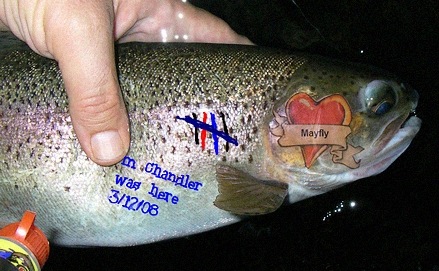
… and Benson wasn’t a celebrity until he was huge and recognizable. Most fly fishermen would admit that one rainbow trout looks much like another – and a bit of individualistic flair on markings would allow us to recognize fish as individuals, which would please snot out of the folks at PETA…

… briefly, until they caught us laughing at the big dummy with the “Mom” tattoo – and how he ate anything thrown at him.

The new Hatchery fish

Scar tissue and torn mandibles are so last year. We could carry felt markers to count coup on the fish we caught – and make a big story out of the “untouched-never-been-caught-sumbitch” whose cherry we popped with our Zug Bug.

It’s all upside; people are back to work, hatcheries are humming efficiently, and we’ve got fishing celebrities whose stories we’ll tell in hushed voices around campfires…

Tags: Benson, Zug Bug, celebrity fish, unemployed tattoo artists, fashion statement, Rainbow Trout, Michael Jackson, 60 Minutes, PETA, tramp stamp

Rare three tailed stone fly discovered in Manhattan sewer

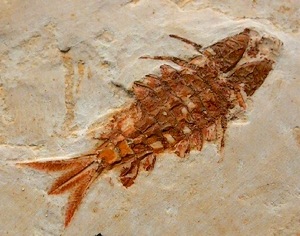
Fossil Mayfly? Scientists claim the below fossil to be that of a rare mayfly.

I think they spent a couple hundred grand of their parent’s hard earned cash on beer drinking and frat parties  – more, if they have a Ph.D.

Mayfly, my ass – anyone above the age of six knows that’s a stone fly.

Science. We serve it up so you can hate it all over again.

Tags: fossil insect, mayfly, stonefly, entomology