Author Archives: KBarton10

A Triploid World Record Rainbow is so last week

Get some today I’m in that tiny minority of fishermen that see the Big Picture and won’t lose any sleep over whether a trout fed on deep fried Snicker bars is a true world record or not.

I attribute my pragmatic view to the slow death of the quality water – and the inexorable spread of taint. Too many humans in too small an area begats a slow corruption of water, soil, and air.

You recognize the issue all too well and while you’d rather it wasn’t on our doorstep, you’ve witnessed a lot of your former haunts become a shell of what once was…

Humans have to eat and water is precious. If you’re of the school that only a pure strain rainbow is deserved “World Record” status, then it’s likely you still leave cake and milk on the hearth for Old Saint Nick.

Considering that steaks will probably come from an amorphous blob of cattle-like substance – grown in vitro so we can reduce bovine-sourced Methane, and fish will suffer some similar fate; a scaly mass – fed brightly colored proteins via a latticework of tubes, surrounded by white-coated freshman wondering which gene to add next. Science doesn’t care for your silly little pastime – they’re worried about the important stuff ..

.. like feeding all of us snobs for the next couple of decades.

The beauty of science is all the permutations we’ll see before that sodden mass is ready for filleting, and some of them will be unsuitable table fare, they’ll be adding a bit of this to a dab of that and something’s bound to escape.

If it doesn’t eat all of us or befoul what little planet is left, it might prove to be a robust gamefish – despite having to wear a shark suit when you fish for it, as wading in anything less means you’re bait (fishing).

In the meantime, lighten up a little. What we know is going the way of the Model A Ford, and what we don’t know may make you scratch your chin …

… like the Superfish I’m always giggling about. It might be here … now.

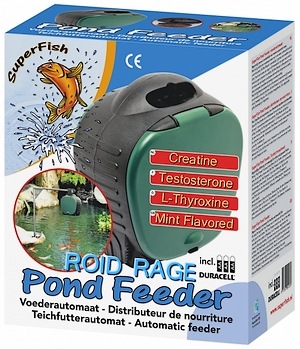
“The duo has been feeding rainbow trout a diet of 5 percent Creatine, the naturally occurring amino acid (contrary to some, Creatine isn’t a steroid or a growth hormone, Hayward says) that former Major League Baseball slugger Mark McGuire said he used as he chased baseball’s single-season home-run record in 1998.

The results show that some of the rainbows are responding to the Creatine diet like humans who regularly take the popular yet controversial body building supplement and follow a consistent weightlifting program.

They’re getting stronger ..”

Stuff some fatty triploid with Creatine and we’ll need Double Taper 9 weights for dry flies … and if 5% is good, 75% would be sublime.

Your kid will be munching on a fish burger, that’s still wriggling despite being deep fried, wondering how you endured those “quaint” natural fish – while he’s knotting on another Titanium treble-equipped parachute.

But that has not prevented the researchers from leaping to an economic conclusion. ”Fishermen probably would pay a premium for a chance of catching fish that fought longer and harder,” one of them said.

… and Mr. Trout Snob, your lofty ethics will fall by the wayside when a membership to Brawny Creek opens. You’ll be so busy reaching for your checkbook to notice you’ve drooled on your cravat.

45 pound Rainbow the new World’s Record? That is so last week

Tags: Creatine fed rainbow trout, performance enhancing drugs, Mark McGwire, super trout, steroid trout, good old days, world record rainbow trout, triploid, fish burger

How a tee shirt becomes a dry fly

There’s at least 175 ways to get this outcome accidentally, but only one way to do it intentionally…

Grizzly is one of those “must have” chickens that’s used on absolutely everything. Big feathers used on streamers, small feathers used on dry flies, and everything else used to make hackle tip wings or add mottling to nymph parts.

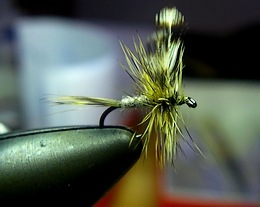
#16 One Feather Adam's Fly tiers that dye their own feathers are often tempted to toss all the other colors and just dye Grizzly necks Brown, Medium Dun or Ginger. Impressionists like myself love the mixture of colors on the feather – with the light bands somewhat indistinct, and the dark bars offering rigid color that define the fly.

I’d been fiddling with Jacquard Acid Dyes and streamer feathers – using the old “butt ends” of grizzly necks to tinker with yet another dubious idea. Dyeing is the best way to destroy materials and experimenting with new dyes always adds a couple extra foibles guaranteed to disappoint.

I ran out of the chestnut dyed grizzly used for the Calibaetis dry flies I use while lake fishing, and worked up enough nerve to dye a Hoffman Saddle with Jacquard’s version of Olive –  which is actually a nice brown color.

Testing on a chunk of Red Fox confirmed it was a warm chestnut color, and I added a teaspoon of Aztec Gold to warm it further. I vacillate on this fly every season – some years I use natural Grizzly, and when that doesn’t work the next I’m tying the chestnut variant.

A feather with both would be perfect.

Tie-dyed grizzly, an Adam's with one feather

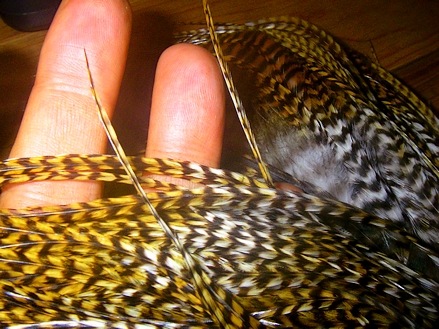
I’ve been playing with a “tie-dye” method for feathers that does something similar. I tightly wrap kite twine to a stick then bind the saddle onto the surface with concentric wraps of twine. Tied tight enough the twine prevents the dye from reaching the feather yielding a “bar” of natural color that can be dropped into a second color of dye (or left natural) to make multicolored hackle.

One look at typical baitfish explains why you’d want a multicolor effect – or the dyed-natural flavor, fish start with a light colored belly and a dark back – with many colors between the two.

More bang for the buck

Us retired commercial fly tiers recognize an Adam’s could be tied with one hackle. Not only would it be cheaper but it would be much faster too. While profit is no longer much of a motivation, like most fly tiers, I still hate using two hackles to tie one dry fly.

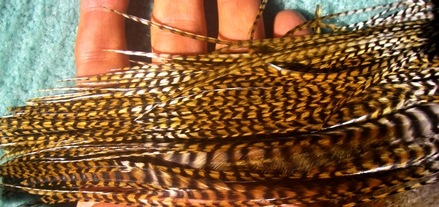
Large streamer hackles (some shown above) give a nice color transition from natural to brown. Olive would make another nice color to transition with yellow or similar light color. Toss this into a lighter colored dye bath, like yellow, and the brown would be untouched while the natural sections slurped up that yellow dye.

With this batch I tried a couple other cords all smaller than the kite twine, and all failed to hold the color at bay. I don’t think anything smaller than 30lb mono is capable of mashing the fibers tight enough.

Tags: tie dye, fly tying materials, grizzly hackle, Hoffman saddle hackle, chestnut, Jacquard’s Acid Dyes, Red Fox fur, dyeing fly tying materials

They don’t reproduce as well because of the time spent in front of the mirror

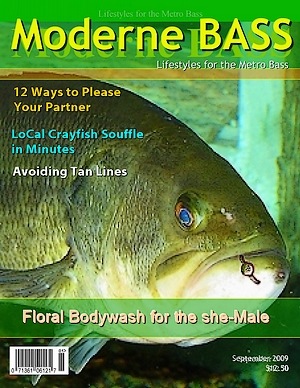
Moderne Bass The US Geological Survey released a study this week suggesting bass are especially prone to gender-bending and are doing so with great gusto.

… makes me wonder whether the professional BASS circuit will be stood on its collective ear when metrosexual bass cease feeding on crankbaits as the ensuing chase makes them all sweaty …

In the Mississippi River, near Lake City Minnesota, 73 percent of the smallmouth bass had characteristics of both sexes.

“Gender bending” humans exhibit traits ranging from undetectable to flagrant, and while diet appears largely unaffected – presentation and table manners most certainly are..

Will that mean the days of the vicious slashing take of an aggressive largemouth are over? Replaced with a “window shopping” study of our flies and a possible demure inhalation?

The Southeast, especially the Pee Dee River Basin in North and South Carolina, had the highest rates of feminization. In Bucksport, S.C., 10 of 11 largemouth bass examined were intersex. In parts of the Mississippi River in Minnesota and the Yampa River in Colorado, 70 percent of the smallmouth bass had female signs.

Any fellow witnessing two gals fighting knows that feminization of fish should improve the ensuing tussle. With the predominance of hair-pulling we’ll have to change flies more often, but the increase in ferocity should make that a wash.

While diet may be unaffected, successful imitation may require emphasis on matching the color of the nest, proper accessorizing of flies, and inclusion of trademark labels; Dolce & Gabanna, DKNY, and their ilk.

The rubber-worm manufacturers will have to retool if mauve becomes the new Purple.

Tags:feminization of fish, she-male, estrogen, largemouth bass, gender bending fish, wastewater pollution, fly fishing humor, DKNY,

Tastes like a McNugget but can’t swim

A few genes missing won't hurt much I keep harping on the need for a genetic superfish and unfortunately science seems hellbent on granting my wish.

Scientists have been working on reducing painful conditions in farmed livestock so they can be wadded into kennels closer together, fed rocks instead of real food, and beheaded without undue hormonal surge – all for the perfectly humane burger…

No, the condemned won’t get a last meal – they’ll merely have certain genes removed so they are no longer uncomfortable when packed in tightly and sleep standing up.

Now that 50% of the fish consumed are farmed scientists can focus on a disease resistant strain that doesn’t mind getting crapped on by the fish above, hit in the head by shovelfuls of pellets, and excretes daisies rather than starving the ocean floor with normal waste.

With the DNA rewired from stem to stern we’ll get some bottle-nosed, lumpy thing that takes to polluted water like we take to Ma’s freshbaked cookies. It’ll gargle feminine hormones, spawn in sewage and still taste like a Chicken McNugget.

As the farmed fish industry will be footing the bill, it’ll hunt in packs so it can defend its cage from seals, possess an armored carapace so Osprey just bounce off, and can burrow in the bank and thrive on earthworms during dry spells.

We’ll be scared to fish for the damn thing for fear we might catch one.

Science is an amazing discipline and while most of the above is near term, you’ve still got a little time …

… they’ll have to teach the invasive-superbeing-sumbitch to swim.

Tags: genetic super fish, gene removal, pain threshold, pain tolerance, Chicken McNugget, DNA, farmed fish,

“Less is More” holds for both writing and hot weather wading

Now that the prototype has dried out I can claim that it runs in the family. Idiocy mostly, but occasionally us Singlebarbed menfolk come out of the kitchen clutching some napkin-based idea that’s been done seventeen times before yet lacks military epaulets or bondage belt buckles popularized by the late King of Pop.

My steady whining about “too damn hot” is only drowned out by Igneous Rock’s louder lament of the same issue. He has to transition from San Francisco’s steady 65° to my summertime 105° within a 45 minute drive. Despite my living here for the last decade, the combination of humidity near the water and the forced march through the Scorching Sands of Death – has the both of us looking for something better.

… cooler, actually.

I pried the “concept” vest out of his hands as soon as I laid eyes on it. I claimed “eminent domain” as the waters nearby were all mine, he countered with “blood-rite-of-Firstborn”, but I rattled a boxful of experimental flies he hadn’t seen and won temporary custody.

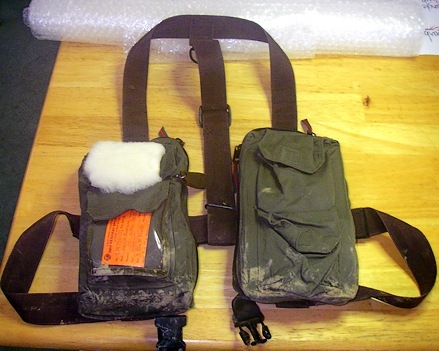
The Hot Weather vest

This is merely a concept to test construction and fabrics, but the lack of fabric sets it apart from traditional fare and diminishes the heat burden significantly. Especially the back – where the large rear pocket on a vest means a double layer of fabric – complimented by the hydration pack to make a third layer of stifling warmth.

A lot of our fishing is single-purpose. All that’s needed is a couple boxes of flies, a couple spools of tippet, and a set of nippers. Shad comes to mind – hot temperatures, wading up to your navel and only one box of flies needed. Ditto for Carp and most Bass fishing.

The complexity of fishing technology is not always in our best interest. Many products are spat out like computer software, where vendors try to find some whiz-bang gadget that sets the 2010 model apart from the 2009 version, hoping you buy both. I own one and am quite pleased with it, yet have no need for half the pockets and during shad season the bottom four inches are underwater.

All the super-secret components of the next prototype are absent so older brother doesn’t mind revealing what may become a hot-weather-shorty vest. I figure I can trade flies for a neck-level cell phone pocket – I’m always on a short tether during fire season and carry one on my local trips. It’ll double as an iPod harness for the younger crowd, many of whom prefer to drown out the tinkle of the brook with the sounds of molten metal.

… and no, the lower pocket “camouflage” pattern is entirely my doing – compliments of a tunneling muskrat and opaque water. It’ll cost me some flies when Older Bro sees his “Mona Lisa” defaced, but we’ve determined it drains quickly enough – under duress.

If I could turn it into a set of “Miami Vice” shoulder holsters it’d set the Florida flats afire …

Tinkering with these products are usually a fusion of what you do for a living with what you do for a hobby. It’s that “outside the box” thinking that births the revolutionary idea versus the evolutionary. If only a couple of the ideas planned for this harness work out  – the boys at SIMM’s are going to kick themselves …

Tags: shorty wading vest, Igneous Rock, iPod, hydration pack, hot weather vest, muskrat, SIMM’s

Lunch Hour fodder: The debut of the FishCantRead eZine

Fish Can't Read eZine I’m an unapologetic supporter of the eZine format. Hard copy is good, but eventually they are dog-eared, foodstained, crumpled, and left in the bathroom – where some non-fisherperson seizes them for a quick journey to the trash can.

I like them because the online marketplace features content and authors that don’t fit the traditional mold. With minimal startup costs editors of fly fishing eZines are less afraid to risk uncommon topics and engage unknown authors – giving us rabid angling types a chance to do something other than flip the pages.

“Fishing the [Insert Famous River Here] River” or “ Indicators for Monstrous [Insert Trophy Salmonid Name Here] have had a couple of decades – and I don’t mind seeing what the new guy is using or the water he calls home.

I’ll credit the younger crowd for the new attitude, the quickness to adopt the new medium and much of the “in your face” bravado. Occasionally it may rub us the wrong way but us older crowd need a good shaking to keep us invigorated

This is Fly and Catch come to mind – and while you may not care for every article, author, or posture – they’re bringing technology and a new viewpoint to some of our hoary old traditions – and that’s refreshing change.

Our mainstream media has inbred to the point of predictability – and with many newspapers and magazines struggling in the current economic climate, we’re quite close to realizing a largely paperless subscription model.

Today marks the debut issue of “Fish Can’t Read” the latest fly fishing eZine. and I’ll donate a lunch hour and sandwich to peruse the virgin issue despite it being not work related…

… and when the Web Gendarmes call me on the phone to rattle their manacles in my ear, I’ll respond in characteristic flavor, “… glad you boys pointed that out – stop by the cafeteria on your way up as I could use more Mustard.”

Let’s give the New Kid a warm welcome … because something about him is so very familiar …

Tags: Fishcantread.com, Fish Cant Read magazine, This is Fly, Catch, ezine, online fly fishing magazine

Singlebarbed debuts the “Sixth Finger” Scissor – Can fly tying be improved by a fellow with mud between his toes?

My childhood was interspersed with some family member saying, “Hmm” and disappearing into the basement to craft the “John Wayne Super-Sport Rubberband Gun” – allowing me to cut a swath through the opposition forces which were armed with antiquated single shot muzzleloaders.

… as Hisself was the local paperboy with access to millions of rounds of ammunition, life was good for a few short weeks until the partisans discovered rocks …

The lesson is the same, the better mousetrap exists in countless garages and only the occasional product is pursued from napkin illustration to vendor countertop. Those that make the journey can always be improved upon to accommodate new functionality the original design didn’t anticipate.

I had my “Ah-ha” moment last year while doing a little research on surgical scissors. I stumbled across a design that looked promising, bought a couple of sets to try, and liked the result but also recognized it had shortcomings.

Without a foundry and metallurgical skills, I managed to mock up a pair using wire – and that was close enough to be a proof of concept. I had something and the idea was good enough to pursue.

The Sixth Finger from Singlebarbed

The Singlebarbed “Sixth Finger”, designed to remain in the hand for the duration of the tying session. One over-sized finger hole allows the scissor to be worn like a wedding ring – at the base of the finger and keeps the points away from your work and them precious eyeballs.
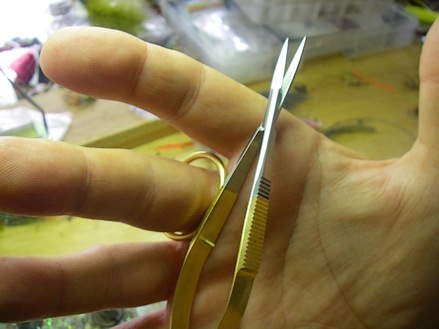
Wear them like a ring

If you watch fly tiers they fall into two groups; those that keep the scissors in their hand at all times, and those that set them down. Bulky finger holes make it more difficult to close your hand around the scissor – and can slightly restrict the use of the fingers during material preparation.
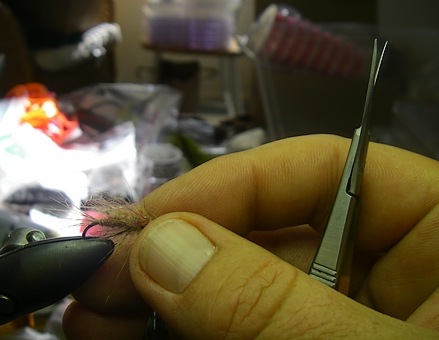
Points out of the way - and away from your eyes

Absent that extra wad of metal, the hand can close naturally around the scissor and give the fingers a full range of motion during material staging and placement.
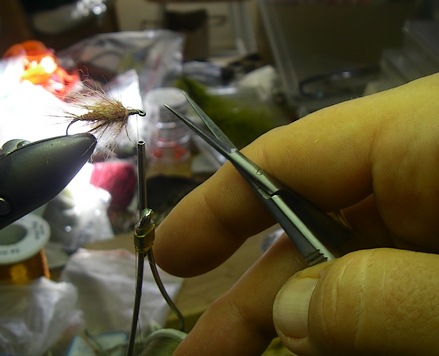
Thumb makes the cut

Simply open your hand to make a cut, using the thumb to press on the spring-loaded handle.

These are light scissors with fine points and a finger hole designed for big hammy hands, not the smaller style common to other scissors and the embroidery trade. 4.5” inches long and made of surgical stainless steel with faux gold handles. These will work with either left or right hands.

Angling products are normally colored by Madison Avenue’s blessed action words; “revolutionary”, “extreme modulus”, “laser engraved”, “sublime action”, and “rocket-taper” … Singlebarbed would rather skip the heavy platitudes – rather we’ll let the testimony of our peers divulge just how tasty these scissors perform:

The plastic container said “tear at notch to vent” and I placed the spaghetti and meatballs in the in the microwave and pushed the start button. I was leaning against the sink and watching the table rumble around when I heard the “cla-clunk” of the mailbox lid. I opened the front door and reached into the box and found your package and returned to my lean on the sink while cutting away the clear tape. As I lifted the top of the box I was startled by a large pop and looked up to see that the top had blown off the ready-to-eat-meal and now my lunch was sticking to the ceiling of the microwave.

Luckily for me, I was holding a box full of “quilted packaging material” to assist in red sauce removal. I can’t thank you enough.
 
Oh, and the knuckle-scissors are neat too.

Even the packing material is multi-purpose – as we’ve spared no expense.

The scissors are available via Google Checkout on this site, simply click on the advertisment to initiate the purchase.
 How to Use the Sixth Finger

Most will find it completely intuitive as the scissor shape and gravity dictates most of the motion.

Three basic positions are used to “holster” or cut with the points. Depending on the size of your fingers most will find the holster position somewhere behind the knuckle and the base of the finger.
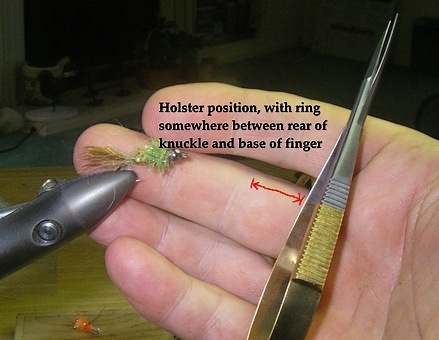
Scissor in holstered position

Absent that big metal second finger hole – your hand can flex naturally while positioning materials in preparation for them to be secured to the hook shank. So long as the hand is tilted upward the scissors remain out of the way.
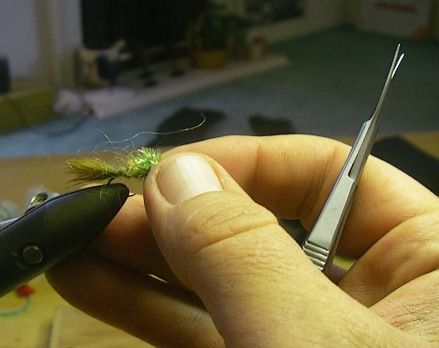
Full range of motion for the fingers containing the scissor

Once the materials are secured with thread just tilt the hand downward and the scissors will fall into the “cut” position. The overly large finger hole allows the scissor more motion on the finger than traditional tying tools – and accommodates larger hands – so chafing is at a minimum.
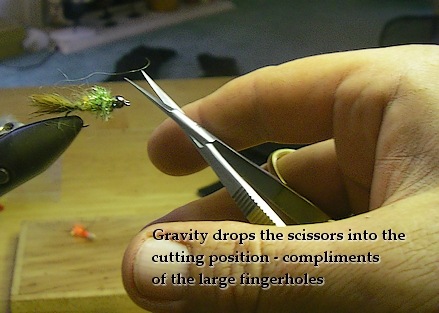
Gravity assists in reaching the cutting position

All that remains is to press your thumb against the spring loaded scissor and the cut is made. Tilt the hand and the “Sixth Finger” falls back into the holstered position.
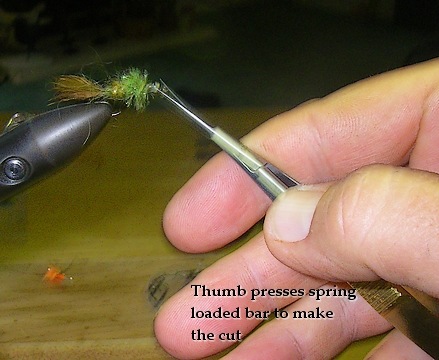
Thumb presses spring loaded bar to make the cut

Having tied flies for thirty years and used a wide range of scissors – from four dollar specials to surgeon’s scissors, I’m personally quite thrilled at the result. Having the scissors at the ready cut an additional 30 seconds off of my tying time – compared to regular scissors – and if you’re not used to holding the scissors in your hand you should save at least a minute or two versus hunting for them in the debris at the vise base.

These are fine point – light duty; no cutting of bead chain or prying open tuna cans, heavy work is best left to larger shear-style scissors. These will cover the bulk of your cutting and should provide great service. They will not tire your hand or chafe the ring finger.

From innocent angler to state and local taxes, lawyers, patent discovery, and all the ills I’ve preached against. Not something a fellow does willingly. I suppose it’s moot testament to the rigors of paper napkins and the “better mousetrap.”

I’m counting on you seeing the difference at first use.

Dealer inquiries are welcome.

Tags: Singlebarbed scissor, sixth finger fly tying scissors, surgical stainless, fine point scissors, shameless commerce, fly tying tools, EBAY

Hoki, the other White Meat

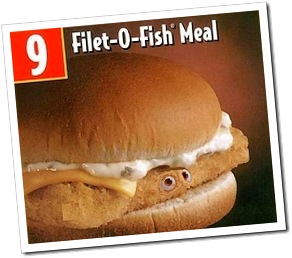
Filet of fish like substance Two years ago I introduced you to the Fillet O’ Fish sandwich – the Hoki, or Whipfish. The New York Times is reporting that this model sustainable fishery has suddenly become unsustainable compliments of McDonald’s, Long John Silver, and modern fast food.

This is one of those rare moments where anglers can take the Moral High ground – as everyone knows despite our lust to catch fish, most of us would rather have a hamburger.

My theory is you can bread and deep fry a car tire and it’ll make a suitable replacement given the volume of Tartar-saucelike-substance added. As the Hoki lives a half mile down with a lifespan of nearly 100 years – the next great whitemeat has to be Jellyfish..

… no worries, they’ll give it a catchy name.

Tags: McDonald’s Filet O’ Fish sandwich, Hoki, Whipfish, Moral High Ground, Long John Silver

Mel Krieger Dinner and Tribute

Mel Krieger Tribute Event

Thursday, September 24, 2009

MarketBar – One Ferry Building, San Francisco

6:00pm Reception, 7:30pm Dinner

Ticket Price: $150 per person or $2,000 for a table of (8)

Mel Krieger (1928-2008)

Mel Krieger is considered to be one of the top fly fishing and fly casting instructors of the twentieth century. Mel and Fanny Krieger moved to San Francisco in 1964 and soon became fixtures in the fly fishing community. Mel was a champion caster who turned to books, videos, workshops, and clinics to teach his simple techniques around the world. Mel taught thousands of pupils the art of casting, including casting champion Steve Rajeff. He was also played an important role with the Fly Fishing Federation when that organization’s Certified Casting Instructor Program was created in 1992.

Krieger has received many awards from the fly fishing community. In 1994 he was inducted into the Northern California Fly Fishing Federation Hall of Fly Fishing Fame, received the Federation’s The Order of the Lapis Lazuli award in 2006, and was presented with the American Museum of Fly Fishing’s Heritage Award in 2003.

MarketBar

The MarketBar is located at One Ferry Building in San Francisco. The MarketBar boasts a seasonal Mediterranean menu using fresh, local ingredients found in the surrounding marketplaces. For the evening’s event the MarketBar will be serving a brassiere-style dinner accompanied by wines donated by the E. & J. Gallo Winery of Healdsburg, California. Owners Doug Biederbeck and Joseph Graham are generously donating a portion of the dinner’s service to the American Museum of Fly Fishing.

For more information about the Museum and the tribute dinner honoring Mel Krieger, please contact Kim Murphy at 802-362-3300 or kmurphy@amff.com. Keep checking our website at www.amff.com for an auction preview and proxy bids.

Laundry day on Sporting Creek

Seeing a muskrat sends shivers down my spine.  It’s “freshwater Taliban” whose yen for burrows and tunneling are the source of hyperextended knees, unstable footing, and cursing fishermen.

Laundry Day on Sporting Creek I’d seen a couple last week and made every effort to move slow near the waters edge – and even slower in the water, but the little bastards got me…

I’m easing into position all sneaky like – can’t see my feet due to an oil slick and brown water, and then the bottom fell out.

Ten inches of water turned into five feet of coffee colored, cigar destroying, lukewarm  goo – compliments of a Muskrat tunnel whose roof collapsed, sending me down the muddy slope into the deep end.

On the one hand it was a welcome dip on a mighty hot day – but on the other – calling it water was being generous.

The path less trodden means you skinny out of your clothing without fear. A suitable rock to park your laundry for ten minutes and let the 103° temperatures work their magic. The eye-scorching whiteness of all that exposed flab likely fried some muskrat retina – so we’re even.

I’d been thinking it was time to get out of the sun anyways – but as I was testing out a new rod and a “hot weather” vest-prototype, I had lingered a bit longer.

Echo Classic 9' #7, 4 piece

The above Echo Classic is what that Redington RS4 should have been. I’m becoming a huge fan of Tim Rajeff’s Echo rods – and it’s not surprising, both of us spent our youth learning from them mean old guys at the Golden Gate Angling and Casting Club.

… we share the same school of Kung fu ..

As I was “squelching” my way back to the car I located the Largemouth Bass nursery, and took out my remaining ire on stuff smaller’n me.

Sporting Creek Largemouth

These little guys were responsible for baitfish spraying out of the water like leaping frogs. I had hoped it was something bigger chasing them – my best was about five inches long.

Tags: Largemouth Bass, Muskrat, Echo Classic 790, Echo Rod Company, Redington RS4, Taliban