Author Archives: KBarton10

Angling for a little Swine Flu

You can rest easy knowing ALL the important freshwater gamefish will not be contracting Swine Flu.

Having endured mandatory training due to employment with a “first responder” organization,  it’s certain that while humanity may expire in a paroxysm of Phlegm; “Porkulosis”, “Bacon Lung”, or “Pigluenza” will leave freshwater fish untouched.

Yum Yum

The details of fisheries science are a mystery to me, but while listening to the health professionals insist we wash our hands hourly, and how the communal pink donut box is “… a virtual Petrie dish of exotic toxins” – I couldn’t help wonder whether us fishermen were especially at risk.

Really big fish are oft-called “Pigs” or “Porkers” and us fly fishermen lack the good sense to avoid a forcible fish exhale or sputum when the big SOB is gripped too tightly. Waders only protect us from the chest down and we could be unwittingly made “pollination vectors” as legions of big fish wheeze their way to the surface bent on payback.

Not to worry.

I considered prostrating my morals by cornering the market on 100% impermeable facemasks, getting them silk screened with Light Cahill’s and Royal Coachmen, but the thought of making freaking goddamn millions at the expense of the Brotherhood was distasteful …

In a study published September 28th ahead of print in the peer-reviewed journal Environmental Health Perspectives, researchers measured oseltamivir carboxylate (OC), the active metabolite of the popular anti-influenza drug Tamiflu (oseltamivir phosphate), in samples of sewage discharge and river water

… so if the long lines for the H1N1 become burdensome you could wait a week and gargle river water. Dosages vary based on population size, so bring at least two straws. The “prime lie” will be at the outflow nozzle and bathing in it might provide additional surface resistance.

“An antiviral drug has never been widely used before, so we need to determine what might happen. During a flu pandemic, millions of people will all take Tamiflu at the same time. Over just 8 or 9 weeks, massive amounts of the drug will be expelled in sewage and find its way into the rivers. It could have huge effects on the fish and other wildlife.”

… maybe it’ll restore all that lost testosterone?

Tags: H1N1, swine flu, the other white flu, tamiflu, sewage treatment, fly fishing humor, Light Cahill, Royal Coachman, oseltamivir carboxylate
How to extinct the San Juan Worm without half trying

I’ve been holding this one close to the vest for fear of upsetting the Roughfisher, knowing once he catches a glimpse of what’s possible, we’ll be seeing “Darth Earthworm” and the San Juan Worm’s days are numbered.

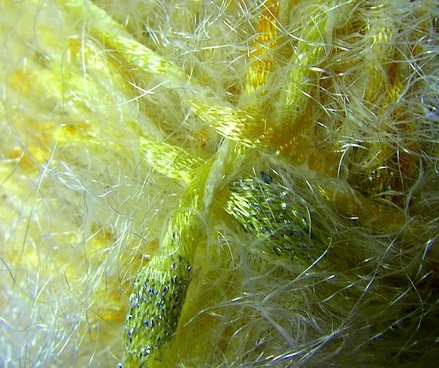
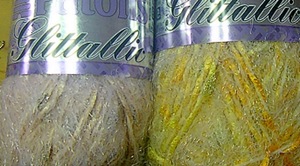
Paton Glittallic yarn

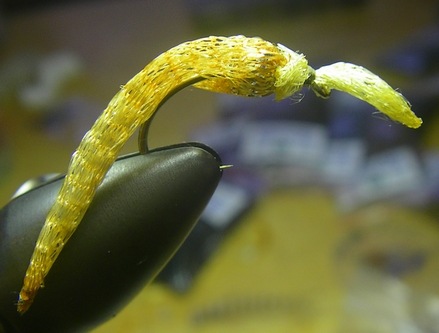
It’s actually two yarns loosely wrapped together. One is best described as a trilobal-polyester that glitters like broken glass, intertwined with a soft synthetic braid that can be used as a flat yarn, or you can stuff things inside it to stretch it into a veined mayfly wing, or seal the ends to make a San Juan Worm-killer.

Pink and Amber

The woven strand looks like a shed reptile skin – and whips around in the water like a snake. I used it for the shellback on the October Caddis earlier, and am converting the old SJW to this – more mobile flavor.

The downside is that not a lot of colors are available, and being polyester, dyeing what’s needed is more work than I care to endure. Special polyester dyes are required as is a chemical fixative and a lot of heat.

SJW Killer

I flamed the end to melt some rigidity into the tube, threaded it over a 4mm gold bead and added the SJW headpiece. Both tubes are sealed with a lighter to complete the fly. The motion is so much more wormlike than the velvet chenille that I’m tempted to eat it.

What’s needed is a good rich Olive, but I’ve only found the material in black, Lilac Lame (pink), Cream Gleam, Blue Flash, and Maroon Shine. It’s about $2 per skein on EBay.

Tags: San Juan Worm, Paton Glittallic, Polyester, Lurex, October Caddis, fly tying material, Roughfisher.com. trilobal yarn,

Another Singlebarbed Science post, mainly because absolutely no one else has the patience

Me, I wallow in bad news Me, I can’t help it. Fly fishing is like the stock market and every channel has some nicely powdered fellow telling you what to buy. Most ignore the larger picture in favor of the populist message; get in now, you’re missing it.
Fishing has the same urgency for me, as I’m forced to eat a great deal of bad news and mold it into glib commentary. Which is why I’m fascinated by stream science (in all its many forms) and insist on posting these tasty little nuggets – despite your collective yawn.

It’s mostly about fresh potable water, something that our piddly little sport requires in great abundance and in the pristine variant. With the increasing density of humans and the decline in freshwater quality, most of the streams we hold dear – will be squarely in the crosshairs of plenty of important people, numerous multinational corporations, and all of them will have bigger war chests and more political clout than every conservation group added together.

… but that battle is still decades distant.

Right now, it’s about 20% of the dragonflies and damselflies disappearing in the Mediterranean, due to the scarcity of fresh water.

Dragonflies are generally known for being good indicators of water quality. Major threats for 67 percent of these Mediterranean species are habitat degradation and pollution. The Spotted Darter (Sympetrum depressiusculum), which used to be common in the Mediterranean, is now listed as Vulnerable and is declining due to the intensification of agricultural practices in rice fields.

Pollution and rice fields, sounds mighty familiar.

I tromp through the same chemical brew here in California, fishing for panting trash fish covered in Copepods, knowing that some kindred spirit in Italy is cursing his politicians as violently as I am. His damselflies will go the way of my salmon, one day they’re here and the next … the supermarket freezer has pallid stacks of frozen “color added” …

Then it’ll just be us guys spinning yarns about what used to be in that toxic rivulet the neighbor kid emptied his motor oil into.

… but Science ain’t all bad. I’m forced to wallow through an aggregation of dead, diseased, and dying – to find the occasional scientific nugget to cheer us all.

It may be safe to put them big feet back in the creek, as the sand and sediment stirred by your sliding through the fast water allows the creek to hold its shape.

Sand and siltation has always carried the evil label, as it’s known to cover spawning gravel and terraform a cobble bottom to its liking. UC Berkeley researchers suggest it also plays an important role in cutting off meanders allowing rivers to avoid fragmenting into many smaller rivulets.

The significance of vegetation for slowing erosion and reinforcing banks has been known for a long time, but this is the first time it has been scientifically demonstrated as a critical component in meandering. Sand is an ingredient generally avoided in stream restoration as it is known to disrupt salmon spawning. However, Braudrick and his colleagues have shown that it is indispensable for helping to build point bars and to block off cut-off channels and chutes–tributaries that might start and detract from the flow and health of the stream.

Animal trails and depressions in the landscape can be scoured deeper with Winter’s flows, providing the opportunity for channel formation which splits the river and diminishes flows along both branches. A combination of bank side growth and instream sand forms a “self sealing” repair kit preventing channelization of the riverbed.

Science. I got your reality show right here, babe.

Tags: channelization, meander, UC Berkeley, siltation, sand, bankside vegetation, dragonflies, damselflies, rice, tomatoes, pollution

Plight of the Living Dead – George Romero’s ode to Brownliners

The scorn of the fly fishing elite we could shrug off, but brownliners as role model for the latest Zombie flick is applying the boots to our prone form.

It wasn’t the steady persecution nor threat of harm, our numbers were thinned steadily by enraged spouses wielding bars of Ivory Snow. A fellow can only take so many “hose-downs” on his front lawn with neighbors a-titter before he holds his manhood cheap …

It’s proven fact that Mankind cannot survive a Zombie invasion, but us fishermen have always assumed we’d be aligned with the screaming survivors – as Hollywood insists most will be comely high school babes who deserve better than being the entree …

I figured I’d go out like the grizzled old “reptile” that blazes trail for the escapees compliments of a D-9 Caterpillar and a fully loaded fuel truck. He always gets it in the end, but this wise old fellow sacrifices everything knowing that holding a conversation with them gals is worse than living death …

Tags: George Romero, Night of the Living Dead, Zombie menace, Brownliners, zombie fishing, Youtube, teenage girls, shudder

The Czech Republic lends some sparkle to the mix

In Spring a young man’s thoughts turn to love – and in Fall, us mature types think of love too, how much we’d love it to be cooler…

I’m tired of dusty creeks and the rattle of discarded water bottles blowing in the hot breeze. We’ve endured enough fires, sweltering mornings, and fleeing to the safety of air conditioning before noon.

October usually offers the first real respite from Summer’s heat. After three years of drought and yet another fortnight of blazing days I’m ready for mornings chill and the tinkle of something other than broken glass.

I’m going to will a change in the weather, if only by the flies tied.

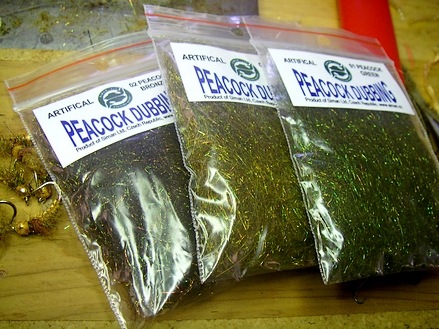
Jan Siman's Peacock Dubbing

Jan Siman’s Peacock dubbing showed Friday, which had me scratching my chin. It’s a different cut of Angelina fiber that I’ve not seen before – akin to the the soft crimp but with straight fibers rather than crinkled.

The straight fiber offers a much rougher dubbing than traditional soft crimp Angelina fiber, consistent with the dubbing-brush-rough-combed look of most Czech nymphs. I’ll investigate this style with the vendor to see if there isn’t something new in the offing.

Comparatively speaking, the Peacock dubbing package is about a quarter the size of a traditional pack of dubbed fur – and the declining dollar versus the Euro adds to the $4.25 price burden. Beautiful colors useful for much more than Czech nymphs – but I was caught up in a new yarn, a yen for cooler temperatures, and the Fall Big Bug, the October Caddis.

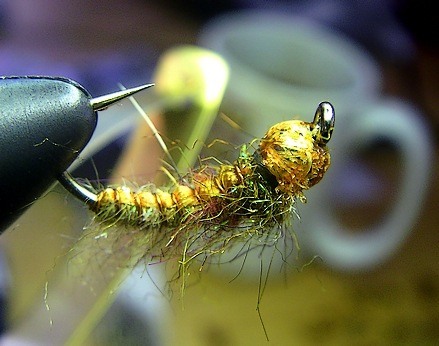
October Caddis, Czech style

It’s a mixture of new materials; using the lace component of a new trilobal yarn I unearthed, mixed with a gold and brownish-burgundy blended fur and topped with some of the Peacock dubbing.

Tied upside down so the the lace is on top once the fly flips over. The Orange lace extends over the bead and is tied on the opposite side. This gives the gold 4mm bead an orange effect, and dulls the shine quite effectively. You can see the raw gold versus the yarn-draped color in the picture shown below.

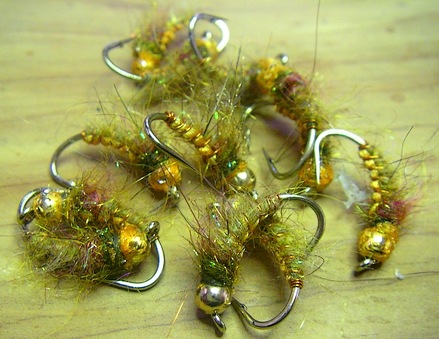
A gaggle of Czech

Comb out the underside a bit to offer a hint of leg, and start praying for colder weather and fish with an appetite.

Tags: Jan Siman’s Peacock dubbing, Angelina soft crimp, Angelina fiber, fly tying materials, October Caddis, Czech nymphs, fly tying

Denied!

It’s one of those moments where you look at your buddy and wonder what hideous crime was committed in a past life that you’re deserved this fate …

Nice fish to the boat only …


… and when the day’s events are totaled, who’s telling the neighbor the fate of his borrowed landing net, and is this totaled in your “caught” fish or no?

Tags: Sea lion, salmon, mooching, epic denial

Will the Wooldom conquer our fear of Winter Steelhead?

I get envious when I see a grinning angler holding a yard or more of dripping chrome. I realize he’s still under the influence of all that adrenaline – which makes the grin appear natural…

It isn’t. The poor SOB spent half a day in frozen slush with icy rain trickling down his forearm with each backstroke, his buddies are huddled next to the fire on the sandbar wishing he’d quit so they can get indoors and count their fingers …

The last time I caught a steelhead I had neoprene and It's just a thoughteveryone else didn’t. As they shuffled out of the water to the fire I’d move closer to the best lie. For my suffering I was rewarded with a bonafide hookup and landed a 10 lb buck.
I couldn’t feel my feet as I turned toward the bank and shuffled towards dry land, ignoring all them fellows headed the opposite direction suddenly aware that fish existed in that god forsaken freezer.

On dry land it was worse. I numb-foot it behind a bush and fumble for my better half … to find it had the good sense to hide inside the body cavity…

Gave me a good scare.

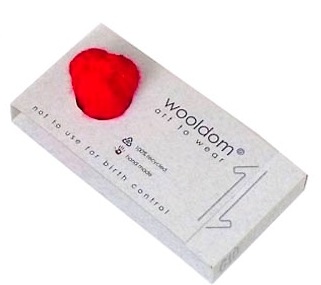
I realized Steelhead fishermen were a breed apart, and talk soft when among them. I figure to repay the favor, fellows – you may want to try a Wooldom.

Tags: steelhead, icy river, frozen testes, wooldom,

Fishouflage, so your kid can wear it to his Prom

Talk about a “bait and switch” – I was all geared up to insist we all buy it so that our corpse was indistinguishable from the bottom, guaranteeing our watery resting place was undisturbed.

Or, the astounding scientific evidence that we’d be invisible to fish were we to slip it over waders…

Instead, I’ve stumbled on an angling fashion plate – only the hardcore professional angler “wears their passion on our sleeve.”

As I shamefacedly gazed down at my sleeve, it appears my passion is Hamburger … with mustard …

“The angling community never had a universally acceptable image, and now we do.”

Anglers have a universally robust image; hard drinking, womanizing timewasters, ignoring societal taboos and overgrown lawns with equal vigor. Our sermons are delivered from the couch, our whereabouts largely unknown, and our conquests legion.

We’ve had poets, ball players, singers, writers and a half dozen Presidents as our spokespeople. While we’re searching for the next great Angling Contemporary to rally behind and crystallize our issues, running around in foul smelling camouflage will just make us an Al Qaeda splinter cell.

Fishouflage, umm – I’ll wait.

Tags: fishouflage, angling fashion, wear passion on our sleeve, timewaster, Al Qaeda, societal taboo, fly fishing humor

A Triploid World Record Rainbow is so last week

Get some today I’m in that tiny minority of fishermen that see the Big Picture and won’t lose any sleep over whether a trout fed on deep fried Snicker bars is a true world record or not.
I attribute my pragmatic view to the slow death of the quality water – and the inexorable spread of taint. Too many humans in too small an area begats a slow corruption of water, soil, and air.

You recognize the issue all too well and while you’d rather it wasn’t on our doorstep, you’ve witnessed a lot of your former haunts become a shell of what once was…

Humans have to eat and water is precious. If you’re of the school that only a pure strain rainbow is deserved “World Record” status, then it’s likely you still leave cake and milk on the hearth for Old Saint Nick.

Considering that steaks will probably come from an amorphous blob of cattle-like substance – grown in vitro so we can reduce bovine-sourced Methane, and fish will suffer some similar fate; a scaly mass – fed brightly colored proteins via a latticework of tubes, surrounded by white-coated freshman wondering which gene to add next. Science doesn’t care for your silly little pastime – they’re worried about the important stuff ..

.. like feeding all of us snobs for the next couple of decades.

The beauty of science is all the permutations we’ll see before that sodden mass is ready for filleting, and some of them will be unsuitable table fare, they’ll be adding a bit of this to a dab of that and something’s bound to escape.

If it doesn’t eat all of us or befoul what little planet is left, it might prove to be a robust gamefish – despite having to wear a shark suit when you fish for it, as wading in anything less means you’re bait (fishing).

In the meantime, lighten up a little. What we know is going the way of the Model A Ford, and what we don’t know may make you scratch your chin …

… like the Superfish I’m always giggling about. It might be here … now.

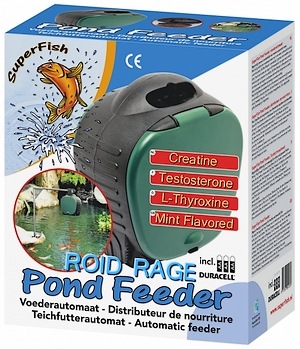
“The duo has been feeding rainbow trout a diet of 5 percent Creatine, the naturally occurring amino acid (contrary to some, Creatine isn’t a steroid or a growth hormone, Hayward says) that former Major League Baseball slugger Mark McGuire said he used as he chased baseball’s single-season home-run record in 1998.

The results show that some of the rainbows are responding to the Creatine diet like humans who regularly take the popular yet controversial body building supplement and follow a consistent weightlifting program.

They’re getting stronger ..”

Stuff some fatty triploid with Creatine and we’ll need Double Taper 9 weights for dry flies … and if 5% is good, 75% would be sublime.

Your kid will be munching on a fish burger, that’s still wriggling despite being deep fried, wondering how you endured those “quaint” natural fish – while he’s knotting on another Titanium treble-equipped parachute.

But that has not prevented the researchers from leaping to an economic conclusion. ”Fishermen probably would pay a premium for a chance of catching fish that fought longer and harder,” one of them said.

… and Mr. Trout Snob, your lofty ethics will fall by the wayside when a membership to Brawny Creek opens. You’ll be so busy reaching for your checkbook to notice you’ve drooled on your cravat.

45 pound Rainbow the new World’s Record? That is so last week

Tags: Creatine fed rainbow trout, performance enhancing drugs, Mark McGwire, super trout, steroid trout, good old days, world record rainbow trout, triploid, fish burger

How a tee shirt becomes a dry fly

There’s at least 175 ways to get this outcome accidentally, but only one way to do it intentionally…

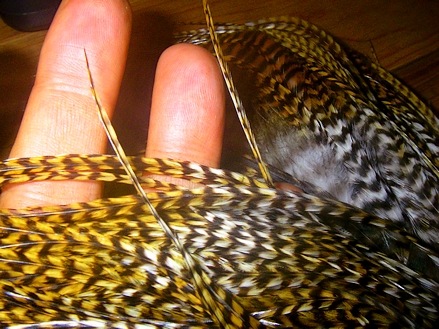
Grizzly is one of those “must have” chickens that’s used on absolutely everything. Big feathers used on streamers, small feathers used on dry flies, and everything else used to make hackle tip wings or add mottling to nymph parts.

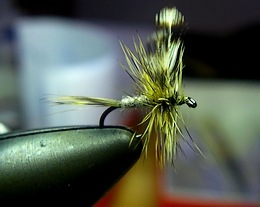
#16 One Feather Adam's Fly tiers that dye their own feathers are often tempted to toss all the other colors and just dye Grizzly necks Brown, Medium Dun or Ginger. Impressionists like myself love the mixture of colors on the feather – with the light bands somewhat indistinct, and the dark bars offering rigid color that define the fly.
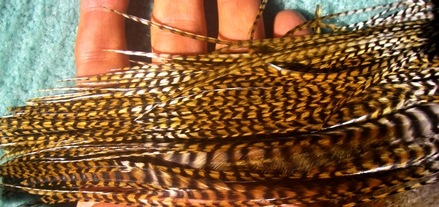
I’d been fiddling with Jacquard Acid Dyes and streamer feathers – using the old “butt ends” of grizzly necks to tinker with yet another dubious idea. Dyeing is the best way to destroy materials and experimenting with new dyes always adds a couple extra foibles guaranteed to disappoint.

I ran out of the chestnut dyed grizzly used for the Calibaetis dry flies I use while lake fishing, and worked up enough nerve to dye a Hoffman Saddle with Jacquard’s version of Olive –  which is actually a nice brown color.

Testing on a chunk of Red Fox confirmed it was a warm chestnut color, and I added a teaspoon of Aztec Gold to warm it further. I vacillate on this fly every season – some years I use natural Grizzly, and when that doesn’t work the next I’m tying the chestnut variant.

A feather with both would be perfect.

Tie-dyed grizzly, an Adam's with one feather

I’ve been playing with a “tie-dye” method for feathers that does something similar. I tightly wrap kite twine to a stick then bind the saddle onto the surface with concentric wraps of twine. Tied tight enough the twine prevents the dye from reaching the feather yielding a “bar” of natural color that can be dropped into a second color of dye (or left natural) to make multicolored hackle.

One look at typical baitfish explains why you’d want a multicolor effect – or the dyed-natural flavor, fish start with a light colored belly and a dark back – with many colors between the two.

More bang for the buck

Us retired commercial fly tiers recognize an Adam’s could be tied with one hackle. Not only would it be cheaper but it would be much faster too. While profit is no longer much of a motivation, like most fly tiers, I still hate using two hackles to tie one dry fly.

Large streamer hackles (some shown above) give a nice color transition from natural to brown. Olive would make another nice color to transition with yellow or similar light color. Toss this into a lighter colored dye bath, like yellow, and the brown would be untouched while the natural sections slurped up that yellow dye.

With this batch I tried a couple other cords all smaller than the kite twine, and all failed to hold the color at bay. I don’t think anything smaller than 30lb mono is capable of mashing the fibers tight enough.

Tags: tie dye, fly tying materials, grizzly hackle, Hoffman saddle hackle, chestnut, Jacquard’s Acid Dyes, Red Fox fur, dyeing fly tying materials