Author Archives: KBarton10

We’ve covered our usual haunts and the larder is empty

neat_gravel You can’t fault them as it’s worked well for the environmentally conscious types.

Stop the creek with a well placed cork, extinct everything but ATV hellions and gravity donations from the housing dispossessed – and when no one’s looking – slap up new signs to keep out the dog walkers and environmentalists.

Are they worried someone will destroy the perfection of their mounded symmetry?

The latest batch of signs that surround a couple billion pounds of spawning gravel excavated out of the surroundings of my newly dampened – dirty little creek.

… soon to be part of your driveway or that subdivision up the road that’s dampening the resale value of your home – due to jinglemail and foreclosure.

It’s one of many changes I logged while tromping through the underbrush this weekend, part of the yearly Spring ritual which maps the newly deepened, the undercut, and the shallow.

… and the living, although there’s not much of that left.

Saturday yielded two turtles lounging in the shallows, away from the sterile scour of the main stem – proof that some of the larger life had made it through the de-watering and subsequent flood.

Root Ball upgrade, air conditioning

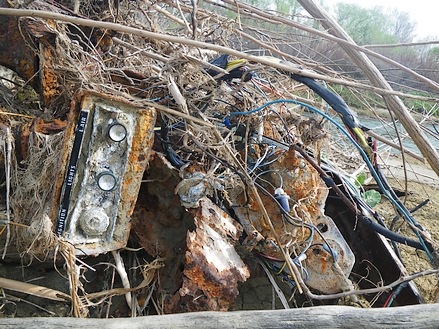
Old cars being a lifeform of a sort, and most are disgorging their contents independently of the chassis. This old Chevy moved a couple dozen feet closer to the Sacramento, complements of the root ball it has created.

I managed to sting one bass up at the Siphon hole, and the departing ripples suggested at least a pair of carp remained from the school that inhabited the area last year, so some small brood stock remains.

There are no minnows in the shallows, nor fry of any type.

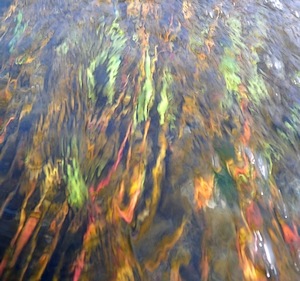
goodweed Benthic drift suggests the smallest insects repopulate first, and the larger organisms follow. This may be why the watershed is dominated by Trico’s – who have yet to stage an appearance.

All algae and weeds are limited to the secondary channels which are typically dry by June. New growth is readily apparent and I stomped through the dense sections to assist Mother Nature in releasing plenty of algae and sprouted growth to repopulate the sterile sections downstream.

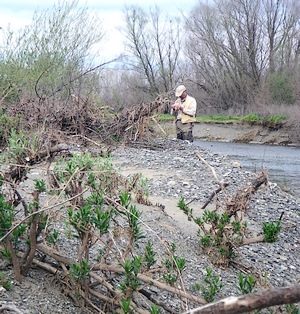
Sunday it was the upper stretch of the river, which had been completely dry last year.  The creek is running about four times normal, so crossing the main channel required trepidation and tree limbs morphed into wading staff.Sheared cleanly and starting to sprout

No sign of fish or weeds apparent, drastic bank removal complements of the earlier flood, and the bottom cobble covered with a thin layer of brown algae.

Much of the willow growth has been sheared cleanly, evidence of the flood’s ferocity.

What’s left is being eaten by those beaver that survived, and the ample tracks in the drying mud suggested numerous survivors.

After covering nearly five miles of creek in two days and finding visual evidence of fish in only a single spot, things look grim. It’s not unexpected, and the increased flow likely hides additional detail, but it will be some time before anything more than casting practice is offered.

Tags: rebirth of the Little Stinking, turtle, largemouth bass, grass carp, fly fishing, brownlining

Silverfin causes international incident

gefiltefish Eight or nine states, Congress, and now two governments are pissed off over our handling of the Asian carp explosion. Nine containers of frozen Asian carp threaten to undermine Israel’s domestic carp industry, and idle dockside while the two governments wrestle over tariffs.

The dispute centers on a 120 percent import duty imposed by Israel on nine containers of Asian carp fillets that were being shipped from an Illinois fishery to a processing plant that makes gefilte fish.

via IsraeliNationalNews.com

As the Internet is very much present in Israel, and YouTube shows us shot gunning the SOB’s in midair, the fact that we’re charging anything other than postage is usury.

… that and a dense pattern of steel #8’s probably isn’t Kosher.

I can’t blame the fish farmers at all, knowing there’s a half dozen states that’ll rush to gill nets and depth charges if they could find a valid export partner that’ll take the carcasses.

Tags: Asian carp, gefilte fish, frozen fillet, Israeli tariff, shot gunning fish

Millions of pebble gathering minions slaving on your behalf

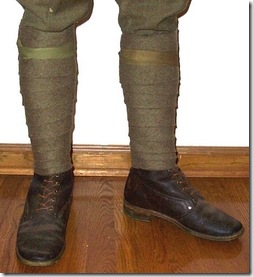
Brachycentrus boots with taped legging Fishermen have always put catching far above creature comforts as it makes the story twice worthy of the retelling.

Breathable waders will be jettisoned in favor of the new “mummified” look – a return to leggings and the garb of yesteryear.

Why? Because you’ll have the scent of a million smashed caddis tucked in the glove box – and at the first hint of dampness, you’ll skip gleefully back to the car to swathe yourself in “Sedge” tape, which you’ve been buying at Costco by the gross.

“I picture it as sort of a wet Band-Aid, maybe used internally in surgery, like using a piece of tape to close an incision as opposed to sutures,” said Stewart, an associate professor of bioengineering, in a news statement. “Gluing things together underwater is not easy. Have you ever tried to put a Band-Aid on in the shower? This insect has been doing this for 150 million to 200 million years.”

via the Salt Lake Tribune

Our pal the Caddis has been spinning a hot commodity all these years, and is liable to put a dent in sales of duct tape.

Plumbers will have to hew through Gordian knots of Sedge tape enroute to leaking faucets and cracked toilets, as decades of plumbing “honey-do’s” were neutralized by petulant husbands and their ever expanding application of Brachycentrus.

…and it may solve the invasive issue completely. We can jettison those slippery rubber soles in favor of “Spider-man” brogues; able to walk straight up a damp boulder or waterfall – and anything living that hitches a ride can’t get off, so “clean, dry, inspect” becomes “inspect, laugh, use putty knife.”

Tags: brachycentrus, caddis silk, underwater adhesive, wading boots, puttees, Gordian knot, spider man, breathable waders

Nobody wants to fish with the Greatest of All Time

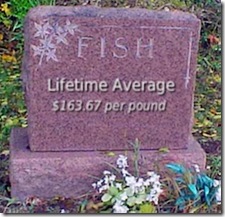
Carved on your headstone I struggled with batting averages largely because I’d hoped everyone would forget mine. Being the KPL (Kid Picked Last) carries a blacker mark than Mister Irrelevant as it amounts to a youthful version of  shunning …

Pro Bass anglers have statistics too. They endure CAV (catch average value), MAV (money average value), and LAV (limit average value) – and I’m sure they’re held to task by their cigar chomping manager and his check writing sponsors.

Like all statistics they’re argued hotly depending on whose interpretation fits your local heroes best – with “best” and “greatest”  the hottest topic of all.

Fly fishermen have statistics as well, only they’re largely unknown to the owner – but widely used by their friends. None of us are interested in fishing with the Greatest of All Time, as we know we’ll have to listen to a lecture over dinner – mostly Latin, and involving the Kama Sutra …

Our statistics are bandied about in our absence, when Bob at the casting club mentions you’ve invited him to fish somewheres. Communal pals then chime in with the important errata; “he’s got a positive FAV, middling to neutral SAD, a dismal BWO, bigtime SFG, and his FiF is off the goddamn chart, be sure to bring a camera

FAV – Fly Average Value. The number of flies you carry divided by the number of flies in your buddies fly box, positive values mean you’re his new best friend.

SAD – Snores After Dark (see BWO) The average decibel of your glottis divided by the decibel value of an FA-18 in full afterburner. A positive value is bad, consider a second room.

SFG – Springs for the Gas, Used in conjunction with THC (Takes his car) and 4WD, invariably springs for the gas, never invokes CNOTE (all I got is hundreds).

BWO – Breaks Wind Often. Self explanatory, consider a second room, or an upwind sleeping bag lie.

FiF – Falls in Frequently. This guy is a laugh riot – possibly a timid wader, takes it in stride, doesn’t wuss when wet.

Most anglers are unaware of their lifetime averages – a combination of too frequent fabrication, and decades of tromping through taint.

Our spouses keeps a different kind of records, also cumulative over a career and largely demeaning. But as they’re outed to sympathizing same-sex pals, only during periods of abandonment, while watching romance movies, both you and your fishing buddies will find them largely useless … until she has them carved on your headstone.

Tags: batting averages, cost per pound, angling statistics, fly fishing scores, fly fishing humor, fly fishing buddies, lifetime averages, Mister Irrelevant

One day the grocery lady will fix you with that steely gaze

Shopping The comment echoed as if it were yesterday. My buddy and I frozen in appreciation of the measured stride of some long-legged vision negotiating the corner crosswalk. We’re doing our best not to stare, yet as the thoroughbred approaches we realize she’s still in high school…

… which didn’t slow us down much, but we knew once she found out we were the same age as “Dad” – her drawn out “..Eeew..” would be the Hiroshima and Nagasaki of Male Ego, and we’d crawl away broken men.

I mentioned to my pal, who was older, “I’m thirty-something and feel like I just got out of High School.” He replied, “So do I, but old is when the lady behind the checkout counter calls you ‘Sir’.”

As it took an impossibly long time to get old, I figured it would be six or seven decades before I’d even flirt with the issue.

He was spot on. She’s got her hand out for your cash while the “MacDaddy” pose crumbles, the held breath exhales sharply – and you realize she’d dismissed you while you pawed carrots in the produce aisle.

(Cut to present day)

Out of a dusty drawer came “Old One-Seventy-Nine” – a Dyna-King Professional (Serial #179) purchased the first year the vice was available. I’d never grown overly comfortable with the big slotted jaw and realized I’d better get around to purchasing a set of midge jaws before they vanished forever.

Naturally, the old jaws wouldn’t come out, so I appealed to Dyna-King for assistance.

Shannon replied: “ the back end of the jaws have possibly been ‘smashed up’ over time from the cam handle, causing them to be snug through the body. If you still are unable to pull them out you can certainly send the vise in and we can take care of it for you.”

Having plenty of experience busting fine engineering with medieval German-esque hand tools, I opted for the safer course of action.

Shannon,

Enclosed you’ll find the stem and jaws of my Dyna-King Professional, Serial # 179. I’ve secured the replacement midge jaws to the vise via rubberband …

The reply came back quickly, “Damn that’s old.”

Cue the sharp exhale of breath, and the inaudible mumble of protest when the bagger offers to push my shopping cart  to the vehicle for me. I’ll just dodder along in her wake …

Tags: Dyna-King Professional, midge jaw replacement, old guy, misspent youth, gene pool, MacDaddy

The Fusion fly: Where we expose our ample hindquarters to scorn and levity

The Author in a moment of repose I’m minding my own business and Reed Curry plants an idea in my head that’s been gnawing at me for months:

“What elements of a natural fly are absolutely essential for the trout brain to use…”

… to recognize food.

Better yet, what elements of a natural (or successful imitation) are essential when it’s moving at eight or ten miles an hour, in concert with millions of oxygen bubbles, scraps of moss and twigs, and the sediment your buddy upstream added?

Does a fish eating stonefly nymphs take your nymph because of its size, or because it’s both big and black? Does the grab you just missed on your Pheasant Tail mean the nymph represents the predominant hatching insect – or was it merely the closest, and the fish was bored of the olive ones ….

Hence the quandary, the simplest of all questions – and there’s no single authority to ask for a definitive answer.

Anglers never look a gift horse in the mouth, we’re free with what little fact we’ve established. Some fellow sees us playing a fish and inquires what they’re eating, and the fact that we’ve caught four on a #14 Pale Morning Dun cannot be denied. If our new found pal knots one on and scratches a fish or two, it’s unanimous, the fish are eating PMD’s …

… but are they?

Caddis are dancing under the overhanging brush, there’s something in the water column headed for the surface, and just above us could be slack water with a spinner fall.

It could be that the PMD’s are emerging upstream and only getting to the surface in the fifty yards we’re camped in – perhaps that caddis has a similar body color, and your mayfly imitation is the next best thing to Nature, accidental like …

… or maybe the outflow from the slack water is bunching the spinners into small rafts of wings and tails and the fish are keyed to anything that looks semi-edible and floats.

… but we’ll never know, as we’re intent on sliding that PMD under that big tree limb where the dimples appear larger.

I love posing the impossible question, and hate being the recipient. Friend Reed has dropped an imponderable in my lap and I can’t tease it loose.

Compounding the problem is my binocular vision, and while I can’t see as a fish can, I’ve got a couple hundred years of succesful flies to inspect for those common fish appealing attributes.

If you bounce some mayfly nymphs off your desk the impression you get may be a hint of color, perhaps a lumpy front and a thin rear. Throwing some caddis nymphs yields less singularity, tubelike and a flash of color. Stonefly nymphs give you BIG, and dark – and well defined legs, but only if the pattern is biot based or contains rubberlegs.

Dry flies are like caddis, very little detail other than “stuff in front” and a hint of color, sometimes hackle – sometimes it’s the body.

We’ve always been enamored of the static view of flies, and matching the frozen natural, something a fish never sees. Instead, fish have to cull food items from the moving litany of leaves, bubbles, and debris that accompany them, and if they’re not right 90% of the time they starve to death.

Looking at the patterns and construction we’ve used to imitate the Big Three food groups, reveals many common elements that reduce the singularities to a manageable number. Mayfly nymphs use the traditional construction of tail, body, and folded wingcase, and then eight or nine million different things for legs.

Caddis stages mostly look wormlike and almost always have a light body and a dark head – unless it’s a cased pattern.

Stonefly nymphs are big, also dark.

Therein is the crux – those few necessary features that distinguish one bug family from another. An enormous leap of faith is required, but we’ve already done that; that fish eat selectively, whether they feed on the most numerous bug, or the insect that requires the fewest calories to capture.

I started off conventional enough, but the experimental flies looked just like the stuff we’ve been using for decades, which shouldn’t be terribly surprising – as I was imitating imitations.

Then the Czech Nymph book threw me for a tailspin, as I’d overlooked the entire attractor paradigm. I started integrating attractor elements with physical design and came out with stunning bugs – that looked like all the other stunning bugs I’d seen …

… and while I patiently waited for the flood waters to subside, towing first one fly then another through stained puddles on the creek bank – I glanced down at the fly box and the Angels sang …

… a medley actually, featuring Eminem and Jay-Z compliments of the boom box rattling the parking lot.

First Law of Fusion : The best elements of flies can be contained on a single fly – and the result serves as multiple insects, rather than a single imitation.

We’ve trod that ground before, employing countless flies that imitate nothing yet resemble everything. Most of the better nondescript flies like the Bird’s Nest, Burlap, Casual Dress, and Adams, all fit this mold.

Second Law of Fusion : Combine two bugs on the same hook.

That … is truly different.
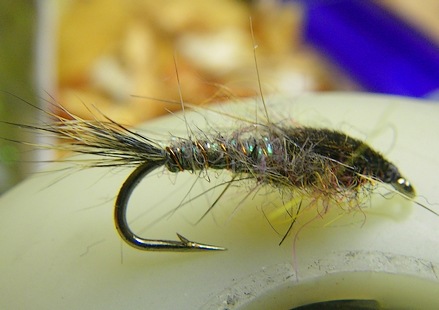
Fused Hare's Ear

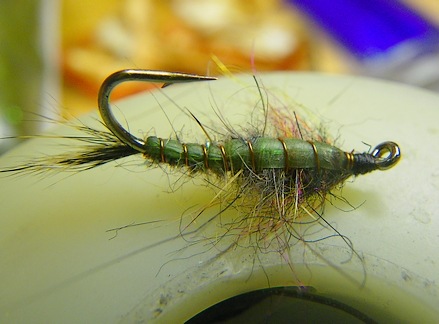
Above is a minor variation of the traditional Hare’s Ear, I’ve added some attractor elements; a little flash blended into the body dubbing, and a hint of Claret and Yellow to the front of the thorax…
Fused Hare's Ear, bottom view

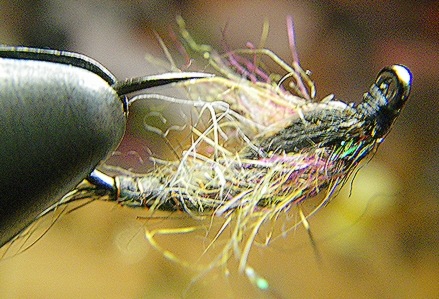
Here’s a glimpse of the same fly only a bottom view. We’ve fused the traditional Czech nymph attributes – the caddis “worm” shellback, with the traditional “mayfly” design of the Hare’s Ear. The hint of claret and yellow is revealed to be the traditional multi-color Czech element, part attractor, part tradition.
Czech Nymph bottom view

Here is a smaller size Czech nymph (tied on a traditional Knapek Scud hook), and the underside is revealed to be the venerable Hare’s Ear.

The idea is sound enough – with the complimentary flies needing a shared body color – although the shellback of the Czech-style eliminates even that restriction.

Tugging flies through puddles demonstrated that anything tied on scud wire, competition or otherwise, rides upside down. Allowing me a blank canvas to build the mayfly on top.

… and for the rest, it’s a homework assignment. There’s infinite possible ways to combine two insect groups on a single fly. Giant stoneflies are troublesome as their size restricts fusion to either Crane fly larvae or baitfish on the underside.

Which of you stalwarts is willing to risk public castigation to offer a better fused mousetrap?

Damn you Reed Curry, you’re the stealthy hand that forced inspiration past the normal cranial pathways and into the realm of outright mirth, as if they’re not giggling yet they certainly will be when I debut the Loch Ness dry fly series.

Tags: fusion flies, Knapek scud hooks, crane fly larvae, Hare’s Ear nymph, Reed Curry, The New Scientific Angling, Eminem, Jay-Z, inspirational fly tying, shellback,

Both of us were out of shape and ill prepared for company

It was many things, slippery mud, icy water, and blustering breeze, with the occasional dog walker giving me a wide berth. They were as uncomfortable as I was, me out of shape and unkempt – wearing too much olive drab to suit them – and me hoping they wouldn’t ask what luck I’d had, as luck wasn’t in the cards.

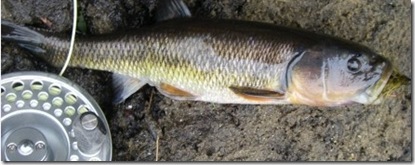
Greenwing Teal for the collection I had cork in my hand, the creek was a river – and hip boots weren’t enough to get me to the other bank.

Unsettled flood gravel gives no purchase when fording, and the water’s pressure merely drives you and the pile of gravel downriver without regard to how the cleats bite or the frantic tap-tap-tap of a wading staff.

I was content. A winter worth of couch pupation had birthed the awkward predator – the young lion, clumsy and unsure of footing and every disturbance an excuse for the stalk and pounce, yielding only dry leaves and dandelions, adventure of a sort as the den and safety only a few feet distant.

The river hosts a single green frog.

The insects are largely absent, many perished during the drought and those remaining were hunkered down for Spring. Cracks in the clay banks yielded small scuds and water fleas and little else.

The beaver dams are gone, but they served their purpose. Alder shoots driven flat by flood are starting to emerge from the matted grasses and sticks cast onto the bank by receding water – prime forage for beaver and the multitude of muddy tracks and gnawed ends suggested a few survivors.

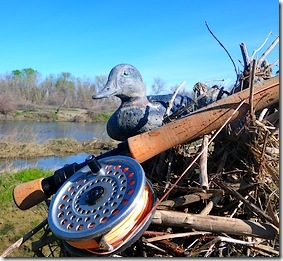
I added a single green wing teal to my collection – the outdoor’s equivalent of dumpster diving, as everything manmade eventually becomes entangled in a root ball. This year was mighty slim as the scour was thorough and even the ever-present water bottles were gone.

I was content to throw experimentals at imaginary steelhead lies – or dangling them in the current to see their posture. Scouting via long line – as the far bank was inaccessible to foot traffic.

With the first week of dry weather scheduled, I expect flows will begin to dwindle and allow me a little elevation and ability to see whether any fish remain. Until then my fishing is reduced to out of practice, out of shape, and out of luck – old friends in our annual Spring purgatory.

Tags: Little Stinking, spring flood, green wing teal, spring purgatory, fishless fishing

Eat The Fly , a balanced and nutritious tour of the important finned food groups

Alex Cerveniak of 40 Rivers to Freedom and the Hatch’s Blog network is creating yet another endeavor documenting all possible fish foods and the flies to represent them.

Entitled, “Eat the Fly” it’s an ambitious undertaking that will contain the common food items and insects available to fish, offset by some of the fly patterns used to represent them.

It’s a hellish undertaking to be sure, but the rest of us have the easy part – admiring the photographs and remarking, “so that’s what a Black Nosed Dace looks like…”

He’s got species, phases, links to additional resources, flies that represent the food depicted, and where possible, seasons and emergence dates, coupled with locale information.

Horny-Head-Chub

Horny Headed Chub, Alex Cerveniak Photo

It’ll take some time before he’s scratched the surface – but there’s a great deal of work (and effort) already available, and he could use an assist on compiling all that information, you may want to drop him a note if you’ve got some compelling photographs of known food items.

Tags: Eatthefly.com, Alex Cerveniak, Hatch’s Blog Network, angling resource, baitfish, aquatic insects

It would’ve taken the angling world by storm

RRyouexpectVisions of me and Rachel Ray, the soft tinkle of fine crystal and a dusty carafe of aged spirits – small-talking our way through the commercial break …

The book signings, the adoring fans, followed by the reality show and ample syndication stream.

Instead I’m spiraling back to earth as another blogger has unveiled the “Ultimate Brownliner Cookbook”, without so much as a mention of the proper rinse cycle for Mercury abatement, or a simple descriptive on rendering toxic algae bloom less so.

While I can’t say “E.V.O.O” with a straight face, our dishwasher repertoire includes liberal applications of “TCG” lozenges to rid our prey of that cloying muddy taste.

Tags: dishwasher cuisine, fish recipes, brownliner sterile, Rachel Ray, EVOO

The dawn of the Boutique fish

With all the genes being sprayed at the tasty fish we should’ve known eventually we might get something other than a soft docile lump, content with pellet feed and milling aimlessly within its concrete lined habitat.

All the gnashing of teeth and mention of asterisks will be done away with … and by them that protested the most. Mother Nature’s version of the Brown, Rainbow, or Brookie won’t be able to compete – and we’ll be writing congressmen insisting our stream should be the next stocked.

Ten years of research has conceived the genetically super strain of Rainbow Trout, complete with six pack abdominals, broad shoulders, and  capable of peeling 400 yards of backing in a single run, adores mayflies, and can chew through dams and fallen logs.

According to Bradley, the number of muscle fibers in mammals is limited after birth, but in fish, muscle fiber numbers increase throughout their lifespan. Since inhibition of myostatin increases the numbers of muscle fibers, it had been a mystery as to whether inhibiting myostatin would cause an increase in muscle growth in fish.

-via University of Rhode Island

The problem is us. Once ova are commercially available and the barest of research is complete, some land owner will insist on adding “Bonehead Rainbow” to the upper reaches of his property – or some big city charismatic with visions of dollar signs will lease some drainage ditch and start selling memberships.

What fisherman could resist? Plentiful and enormous, able to leap tall buildings with a single bound, and a known weakness for Peacock herl.

Twice the musculature as the normal fish and a viable breeding population that’ll shoulder the hatchery fish aside while racing up the Mississippi to eat all them scaredy-cat Asian Carp, then clean the beaches of small children, wino’s, and miniature poodles …

… while we clap and shout encouragement.

It’s in our nature. We’re practitioners of a classic blood sport, callous to pain and disfigurement, willing to complain loudly when something tastes bad or smells poorly, but in this we cannot be trusted.

Didymo looks like Goat puke, but if we could smoke it – or it had some form of innate beauty, I doubt we’d wrinkle a brow over its invasive qualities. Big muscular salmonids are what we’ve dreamed about for the last couple hundred years – and we’ll be complaining with great fervor should someone take exception to their spread.

License sales will soar, tackle will be obsolesced overnight, vendors will be ecstatic, and the rarified experiences of the pricey remote lodges will be available to the newly frugal.

Trophy lakes with named fish will lead the way, IGFA officials will be in a tizzy – and the former purists will find themselves alone with a dusty rack of salmon eggs, while the rest of us troll T-bones and wonder which of our neighbors is worthy of a ripped, muscle-bound fish whose delicate flavor is reminiscent of Tang mixed with stale bread.

Having posted on this subject two years ago, the only surprise is they’re here already.

Tags: genetically superior trout, superstrain, IGFA, Peacock herl, Bonehead Rainbow, Donny Beaver, goat puke, salmonids, genetic engineering, rainbow trout