Author Archives: KBarton10

The fly fishing magazines continue to increase, our lunch hour is made whole again

upstream Add Upstream to a crowded field of e-zines making their debut in 2010.

I liken the ezine conundrum to the current political spectrum, where Republicans and Democrats try to distance each other from the opposition, the administration, and their own party.

As each new magazine throws down their own unique brand, free of tired articles about indicator fishing, and espousing the “journey”, the “experience”, or “we’re not your Dad’s hobby” – I find the distinction losing a bit of allure.

It’s fly fishing that brought you to the dance, and I’d always assumed you should leave with those that brought you …

Numerous straw polls and statistics suggest the influx of new blood has been on a steady wane – and us current practitioners are growing older, wiser, and accumulating skills. We’re no longer the fresh faced novitiates who are struggling with wind knots and trying to makes sense of it all, and our impatience with the “same old articles” may stem from fluency with the technique – and having read six or eight already.

The existing print media takes considerable heat from nearly everyone, much of it well deserved, but I wonder whether they are the root of our  dissatisfaction, or merely we’ve changed and are impatiently waiting for the literature to catch up.

Like you I read them all, yet have trouble verbalizing what I’d like to see – what prose or topic would make one magazine head and shoulders above the others and engage me completely.

The picture-based magazines ooze stunning photography and make me yearn to take better pictures, the “Red Bull” magazines make me wish I could chug an energy drink without making faces, and the “journey” magazines get me all maudlin then jar me with an ad for the technical clothing needed to fish bacon rind.

As fishing is such an individualistic exercise, what’s lacking is liable to be quite different from one reader to the next, but I’m still not seeing what I think I’m looking for …

I may be yearning for lost youth, where the mention of puce baboon bottom would send me in a frantic search to secure some, or that new knot that would fix all my monofilament ills, or new creek packed with giant voracious fish that I’d ignored enroute to some place further.

Older and wiser I recognize that fellow in the fog and half light would be the same fellow cursing me for low holing his pool, and the photographs are appreciated but skimmed quickly. The “Red Bull” crowd gives me the impression they discard their empties on the beach – while disappearing in a cloud of sand and hamburger wrappers. They’re skimmed and put to rest as quickly. The “journey” and “feelgood” attempts all feel good, until the advertising intrudes – and part of my journey includes a “tactical” shooting head and the “experience” of paying off a high priced venue or higher priced rod.

We want to feel your experience through your unique professional approach. If you’ve got a garden variety fly fishing story – we are not interested.

I suppose that once the graphite rod crossed the thousand dollar barrier, we were forced out of our hobby to join other pastimes whose professionalism includes the tools to ply our craft, and also the uniform – the accoutrements of social station.

Like golf being synonymous with double knits and headless hats … er … visors.

I welcome each new entrant into my reading itinerary, there’s plenty of lunch hours and ample time to digest each attentively, but I’m still unsatisfied, struggling with what’s missing and it may be nothing at all.

Cigars, food, dancing, Patagonia, what’s not to like?

Upstream magazine, fly fishing e-zine, fly fishing literature, garden variety fly fishing story, social station, fly fishing

The California Delta just another victim of conspicuous consumption

Father Serra and the Missions of Ca Another in a long list of reports on Delta water use, the state’s best and brightest suggest that 75% of the rain and snowmelt of the Sacramento and San Joaquin watersheds must flow through the Delta and into San Francisco Bay to maintain ecological equilibrium.

True to form the report was met with great skepticism by water users;

Big water agencies that rely on the pumps criticized the report in news releases as imbalanced and “purely theoretical.”

In human terms it means we’re already using twice what the report allows, and the tensions between folks holding rights to the water are bound to escalate.

Meeting all of those requirements would require San Joaquin farms, Southern California and portions of the East Bay and South Bay that rely on pumps in the southern Delta to cut their Delta water use by one-third in addition to recent cutbacks required to meet endangered species rules.

For other water users upstream, including utilities serving Oakland and San Francisco, the effect could be even worse — up to 70 percent, because the goal to increase river flows would make more water available in the Delta for pumps to export.

But those figures do not take into account water rights laws that say agencies with older rights — including some in the Bay Area — should not have to give up water for newer users, and that agencies closer to water sources also should not have to give up water to those relying on Delta pumps.

– via the San Jose Mercury News

As the report is non-binding it remains just another data point on what plagues all the western states. Limited water, too many people, rampant construction, and the conversion of desert to irrigable land.

Us fishermen and conservationists might start the teapot boiling, but we’ll be on the sidelines during most of the ensuing legal orgy – as cities sue other cities, farmer pitted against farmer, and decades of legal haranguing ties any real change to the courts.

… and it wouldn’t surprise me to see documents dating back to Father Serra and Sir Francis Drake waved about with great furor …

California delta, water wars, Sir Francis Drake, Father Serra, Spanish land grant, water rights, Sacramento River, San Joaquin River, San Francisco Bay

Wherein we celebrate that which lacks spots, and lacks the aloofness that comes with wearing same

Who couldn't use more tail The only thing in short supply this year has been success. It’s part and parcel of a “too” year; where everything is too cold, too high, too soon, and then suddenly it’s too late.

Shad came and went, and while there was no lack of trying, my entire season was a single hooked fish.

Till now, trout fishing has been every bit as fickle, and with the daytime temps at triple digits, it’s hovering on too high, soon to be too late.

… while the tomatoes are still green and irrigation rampant, there’s plenty of flow in the brown water, which is recovering slowly from last year’s dewatering.

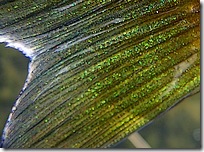
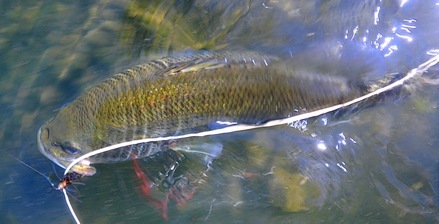
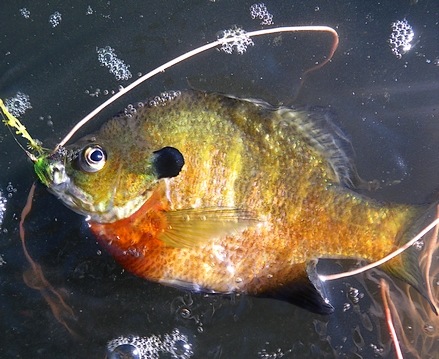
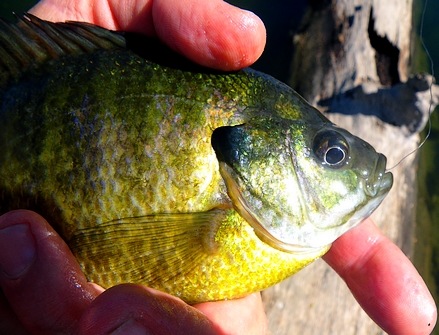
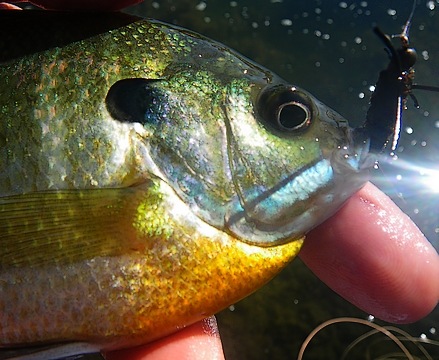
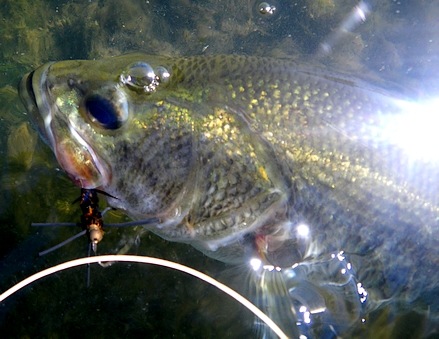
And as we’ve been subjected to thousands of pictures of fins and spots on a trout’s arse – a worthy yet relatively drab foe, it may be time to give some of their scrappy cousins a little choir music, and equal respect.

Every fish a thing of beauty   

bass2

Fishing being the second oldest profession, it shares some small similarities with the first; the bright bawdy-house colors, obvious contusions and willingness to share themselves with strangers, a welcome respite from the aloof and chaste I’ve been chasing the last six months.

With fish being as sparse as they are this year they’re all worth celebrating, all photogenic, trophies in their own unique way. A healing balm to an angler whose gone without for too long.

Tags: rough fish, fly fishing, brownlining, trout, bass, bluegill, American shad

Eastern Brook trout victimized by sloth and indolence

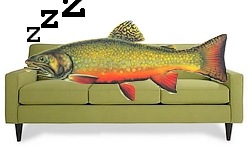
CouchTuber While the ignoble Brook Trout has enjoyed recent popularity due to its coronation as the Official Char of the Trout Underground, the question remains which Char is that exactly?

Brook trout are exhibiting two distinct sets of behaviors, and scientists are attempting to determine whether it’s in the early stages of divergence – splitting into two distinct albeit related species, one aggressive and actively foraging, the other content with a shady bank – and whatever drifts by.

It turns out that the telencephalon, the part of the brain linked to movement and spatial abilities, was relatively larger in the fish that went foraging away from shore, where they would have to recognize underwater landmarks to navigate and avoid becoming prey themselves.

But this raises other questions. Were the fish reacting to their environments differently, and developing separate behaviours in consequence?

A study now being completed by another of McLaughlin’s former students, points in that direction.

The brook charr that hugged the bank have higher levels of the hormone cortisol, which is associated with stress, so perhaps worry keeps them home.

via the Toronto Star

Given the Trout Underground’s penchant for snoring hounds (whose telencephalon lacks folds or fissures) – and fatter slaw-smothered dogs, there can be little doubt the early nod for Official Char should be the couch potato worry-wart (Salvenus Stressor tuberosum) variant.

Leaving us lean and predatory coarse fishermen to adopt the “Big Brain on Brad” Salvenus – as the Official Snack of Them as Lives in Sewage.

… where that big brain can be an advantage – however short lived.

We captured 42 of 74 individuals in 1991 and 42 of 69 individuals in 1992. Each captured fish was killed immediately with a blow to the head, its fork length measured to the nearest millimeter, and the carcass placed in a labelled plastic tube and put on wet ice.

Oops, maybe not. A 57% capture rate in the first year followed by 61% in the subsequent season suggests a drop in IQ –  more smart fish were thumped than slumbering homebodies.

… and for them as fish for them regular, remember it may take two or three drifts before them Eastern tubers even think of stirring off that couch.

Eastern Brook trout, Salvenus fontinalis, char, trout underground, evolution of trout, trout fishing, fly fishing, telencephalon

The Birds and Bees pale in comparison

Imitation dog biscuit That’s when you turn to your son and have a serious heart to heart conversation – probably the hardest you’ll ever have, knowing the horrid truth …

“Kid, you’ve seen the best fishing has to offer, it’s all downhill from here.”

… minutes after the father and son team set up their rods by the banks of the reservoir, they began reeling in their massive catch, which fishing experts have described as one of the largest carp hauls in history.

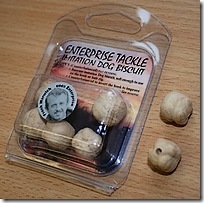
Mr Lee credited the success on a combination of good weather and the imitation dog biscuits the two used as bait.

via the Northhampton Chronicle

Which is the truly wonderful part of the story, akin to the freckled kid with bent sapling and enormous dripping trout. The high dollar tackle crowd clandestinely keeps count while gashing themselves in torment …

800 pounds later:

Mr Lee said: “By the end of it, Louis was getting a bit bored really.

Which explains why I can’t hook more than the occasional fish, I’m imitating a real dog biscuit.

Buoyant imitation Dog biscuit, soft enough to use on the hook or hair rig. Our imitation Dog biscuits have been developed to overcome some of the problems associated with other similar products currently available. The inclusion of a counterweight into one side, ensures that the hook always remains on top, out of view of any ware fish. It also ensures that the imitation biscuit sits low in the water, just like a real biscuit that has become waterlogged.

… all I need to do is add a set of bead chain eyes for a counterweight, and lose the deer hair that made mine look like a freshly discarded dry treat.

Tags: imitation dog biscuit, carp fishing, scientific angling, fishing

Wherein we propose a modification of the 3rd rule of outdoor storytelling

It’s the Third Rule of the sporting fraternity, in the retelling of any feat of sporting prowess, add two inches (or a half pound) in case your audience has heard this yarn already …

Adherence to the 3rd Rule ensures your friends and neighbors never tire of your oratory – you never repeat yourself either forgetfully or pedantically, and you must go fishing a lot.

I was in mid sentence, and that 6” black bass was now 14” – weighed about thirty six pounds, when a tremendous crash echoed above, a pale lightning bolt descended from the Heavens striking the 8” tree limb above me – and as I scattered for cover, impacted my truck in precisely the spot I’d vacated …

owned

  … suggesting that even the 3rd Rule of the Sporting Fraternity has limits, and as He had heard the story enough times, was sending me a quick warning shot to restore the straight and narrow.

Me, I figure I’ll need to add six inches (and two pounds) to each retelling, so He doesn’t recognize the story as one already heard.

Full Disclosure: That Bass, was all of six inches, honest.

… and that branch was 16” if it was an inch – a veritable tree trunk even ..

Tags: The Man, warning shot, outdoor storytelling, fish stories, complete falsehood, born again

The solution to an age old angling problem

WatchedAllNight The guys were all at a fish camp. No one wanted to room with Bob, because he snored so badly. They decided it wasn’t fair to make one of them stay with him the whole time, so they voted to take turns.

The first guy slept with Bob and comes to breakfast the next morning with his hair a mess and his eyes all bloodshot. 

They said, “Man, what happened to you?”

He said, “Bob snored so loudly, I just sat up and watched him all night.”

The next night it was a different guy’s turn. In the morning, same thing -hair standing up, eyes all bloodshot.

They said, “Man, what happened to you? You look awful!”

He said, ‘Man, that Bob shakes the roof with his snoring. I watched him all night.”

The third night was Fred’s turn. Fred was a tanned, older cowboy; a man’s man. The next morning he came to breakfast bright-eyed and bushy-tailed.

“Good morning!” he said.

They couldn’t believe it. They said, “Man, what happened?”

He said, “Well, we got ready for bed. I went and tucked Bob into bed, patted him on the butt, and kissed him good night. Bob sat up and watched me all night.

Tags: Outdoors humor, fishing

It’s not Swisher and Richards, it’s Darwinism

alexandra Next time some old codger tells you, “they was thick as flies, big ones, not that little crap what’s in there now” … rather than nodding respectfully you can just backhand the old gasbag …

… and while he’s recovering his dentures you can retort, “Yea, but they were dumber then, and you ate all the idjits or toed them into the brush, and now we’ve got nothing but small fish with twice the IQ!”

Until now, scientists knew that birds – like great tits, zebra finches and European blackbirds – could be picky about new types of food, but hadn’t seen it in other animals.

The new findings suggest that fussiness could be universal among all predators.

After countless decades of weeding fish based on bright stuff, shiny stuff, and now drab stuff – is the selective fish something of our own creation?

As size and aggression determine feeding lie, are the largest fish grabbing one of their smaller brethren – hurling him out of the rock’s protection with the commandment, “try them orange ones and tell me if they hurt …”

Which neatly corroborates why we hook the smaller fish first – and why they rush from the safety of the shade to slay themselves on a Parmachene Belle.

Us fly tiers are constantly adding a bit of this to a dab of that – to outwit the most finicky tastebuds, and when we finally strike paydirt and catch everything within six hundred yards, the moment we bring our pals and promise wholesale slaughter – or return the following weekend expecting similar, the fly doesn’t work.

By then every fish has heard that them wiggly pink things are a free root canal.

The team dyed the sticklebacks’ favourite prey – a tiny plankton-like crustacean called Daphnia – with either green or brown food colouring. Once each fish had got used to either green or brown Daphnia, the researchers introduced the different coloured Daphnia to the fish.

The researchers found that when they encountered the new colour, the fish responded in two ways. They either ate it, which eventually drove the new colour extinct; or they avoided it, which ultimately let this new colour dominate the population.

via Planet Earth Online

Which suggests that Ernie Schwiebert got the entire thing ass backwards, and all those same colored bugs emerging at dusk are the bugs that taste like spinach …

We should be matching what we don’t see …

One hundred years ago everyone was fishing attractors, and while Grandpa played fast and loose with the fish population he was killing everything with a taste for red, orange, jungle cock, or tinsel.

Your Dad saw the tail end of the Attractor Turkey Shoot and killed whatever Granddad missed – until the 1950’s when big colorful wet flies went extinct as all the fish were trained to avoid them.

Ernie Schweibert was man enough to try some drab concoction out of dog hair and owl feathers, knocked snot out of the fish, and became the New Messiah …

… now, all we’re doing is ensuring whatever Pop missed gets kilt, so your kids can catch less, lose interest, until some new Holy Man emerges.

Neo. The One.

All we need to sleep soundly is a bit of research on how long fish retain these multi-generational messages, or whether they carve petroglyphs in the cobble near the bottom.

Sure it’s scary, but not half as scary as reading Matching The Hatch backwards and finding out the double haul is dead.

Tags: Parmachene Belle, attractor flies, Ernest Schweibert, Matching the Hatch, dumb fish, sins of our fathers, fly fishing, fly fishing humor

Fly fishing responsible for Global Warming

As if we needed another reason not to drink the water You drive a Prius (or it drives you), you only use fur from renewable animals that aren’t clubbed to death, you release all your fish, police your candy bar wrappers, and field strip your cigarette butts so only the wind knows of your passing …

You wear rubber soles and sterile gear for fear of leaving anything behind, and crap a couple of miles from any trace of moisture – using handfuls of leaves or Poison Oak rather than man-made anything.

Yet all that toil and effort is for naught, because you’re still responsible for global warming.

Cow farts and pollution are the primary and secondary offenders, but as we slowly relinquish our grip on fossil fuels and feed bovines something other than their ground up cousin – and then only the parts we’re scared of –  fly fishermen will become poster children for selfishness and environmental genocide, as well as propagating all those noxious gases burrowing through the ozone layer …

Spin and bait fishermen have lived up to their end, and likely as not are armed with spoiled produce to heave in our direction. All those years of “purest form of fishing – nose in the air – snootiness” will come back as half eaten or half rotten fastballs.

Not because we’re creating the gases, although this post and most parking lot recitals add measurably to global warming, it’s because we venerate the Unclean Thing, never to grace our hook with That Which Lacks Legs

Studies of soil-dwelling earthworms had showed that the creepy crawlies emitted nitrous oxide because of the nitrogen-converting microbes they gobbled up into their guts with every mouthful of soil.

Peter Stief, of the Max Planck Institute for Marine Microbiology in Germany, and his colleagues noticed that no one had ever looked for similar nitrous oxide emission in aquatic animals, so that’s where they turned their attention.

“We were looking for an analogy in the aquatic system,” Stief said.

The researchers found that in a variety of aquatic environments, animals that dug in the dirt for their food did indeed emit nitrous oxide, thanks to the bacteria in the soil they ate, which “survive surprisingly well in the gut environment,” Stief told LiveScience.

via Fox News / Live Science

It’s bad enough that the aquatic worm views a Whirling Disease microbe like a T-Bone, and adds insult to injury by becoming a host and farting uncontrollably …

Nitrogen rich fertilizers seeping into the watershed from evil ranchers and farmers – causing hideous, sustained mayfly and caddis flatulence – and all the Hex nymphs eaten despite their deep burrow as truly selective trout can spot the bubbles forty yards distant …

Scratch a third of the mayfly genus’s and anything else that burrows.

Tags: Nitrous Oxide, Ozone, Global Worming, Worm farts, mayfly flatulence, fly fishermen, fossil fuels, hexagenia limbata

“More function” versus “Less filling” would convince me to lighten my wallet

It’s my contention that the only thing spurring innovation is the much reviled competition scene, every other rod maker is fiddling with weight and thinking they’re being creative as all hell.

The idea is certainly clever, a fifth piece, lacking guides, that transforms a nine footer into a Czech nymph rod; but they might want to keep going and include a detachable handle and a three foot extension that makes a full blown spey or switch rod.

fifth_section

Why not more than a single use for a fly rod? It would go a long way to lessen the clutter in the garage, lower the divorce rate, and make rods multi-seasonal, and we could get a deftly accented quiver to carry all those spare sections.

No guides means we can snap them in or take them out at any time. If we’re striding the bank looking for trout and spy a pod of feeding carp, we snap in the stiff section, cut the leader back to 0X, and alter our timing.

Or the line makers could extend the multi-tip concept beyond the spey crowd, and we could snap in a weight forward segment that boosts the five to a six, even a seven …

Walton Powell (and others) have always insisted that rods can handle three different weights with little more than a timing change, suggesting them wily Czech’s were listening.

… and while the mainstream rods go for “less filling” over “taste’s great” they’re just marking time until Graphene can be rolled on a mandrel. The wait won’t be long as they’re already testing TV screens made with a four atom thick variant.

A material one atom thick that’s stronger than steel, almost transparent, and you dare not set the rod down in a strong wind … We’ll jettison the extra scabbard notion and take a segment out of our wading staff to extend the rod.