Author Archives: KBarton10

Fly fishing and fly tying have always been costly, but can an employee discount replace a misspent youth

I’m the fellow that leaped off the couch signaling a “wave off” … frantically gesticulating while your diatribe continues unabated …

“Yea, it’s great I showed the shop some of my flies and they want me to tie for them it’s great I get a big discount on all my stuff 40% off on rods and waders and tippet and books and my wife can’t say sheeet!”

“Yea, but …”

“…and the thing that is really cool is I’m tying these twenty dozen wooly worms and they’re fast as hell and I’m making all kinds of money and it’s going to be great ‘cause the IRS don’t know sheeet!”

“Yea, BUT…”

“ …don’t harsh my buzz ‘cause I’m a machine cranking these bad boys out they wanted five dozen peacock and five dozen brown and five dozen purple and five dozen grey so I’m unleashing some serious bucks and you’re trying to rain on my parade ‘cause they didn’t ask you and you can’t tie sheeet!”

“Yea, that was just the first order Meatloaf, new talent always gets training wheel flies to draw them in, and now your new boss is contemplating which miniscule hell he’s going to unleash on your second order.

In fact, I got a dollar that says he wants #16 and #18 Henryville Specials, with the little spray of lemon wood duck between the quill wings, better yet I’ll go lobster dinner if I’m wrong.”

A week later I get the pitiful-yet-defiant voice on the other end of the phone, “I finished that order for wooly worms.”

“Yea, and ….”

I picked out the Sage rod I’m getting …”

“ … and …”

“ … and the prick wants me to tie 100 dozen Quill Wing Royal Coachmen in size 18 and another hunert dozen in 20.”

“ … and which Sizzler was you taking me to?”

My first order was from a family friend, fifty cents apiece for two dozen #14 Adams. I was about 15 at the time and that was all the money in the known world.

Ditto for the second, third, and fourth orders. Brindle Bugs in size 6 & 8 – only they had to look exactly like the specimen provided; thirty years mashed in a fly box, dampened and dried countless times, bleached by sunlight, then handed over with complete reverence.

Even at that tender age I knew he meant it.

It was bad enough the solution involved lining garbage cans until Poppa offered to drive me to Mecca. That was Creative Sports Enterprises, Andre Puyans, and the giant crate of fifty cent India capes, the only establishment that offered hope of finding a Rhode Island Red that had been pawed over and bleached by incandescent to mimic Rhode kill.

… and the hooks were no longer made, so the hangers-on at the cash register tried to get rid of me with the standard fare, then endured my critical regard  for the Mustad’s he offered before I lit him up, “limerick bend small barb, 2X long, bronzed, tapered and looped down eye, steelhead hook … these are model perfect bend and forged, what else you got?

… even Puyans raised an eyebrow at my steely tone.

I pocketed eighteen whole dollars at the cost of nine. Two weeks of arduous labor to complete three dozen, and the proceeds were a princely sum … for the Sudan or Somalia.

I eked out a small subsidence wage pimping tiny dry flies to school children, until the American Casting Association needed 60 dozen tournament dry flies with trimmed hackle.

Months later, Ma was still sweeping the dander from yellow saddle hackle out of the living room … and I was approaching the dollar-an-hour barrier, which like the speed of sound was something mysterious, theoretical, and largely mythical.

Now that I was big enough to peer over the counter,  as I pawed through smuggled Chinese capes at the local shop, mentioned that I “had vice, will travel” … and the portly gentleman manning the register figured he could run me off by demanding to see my letters of marque.

Samples. Lots of them.

… and while he pawed through Caddis and mayflies in assorted shapes, sizes and colors, confessed to an immediate need for Umpqua Specials, size 8, “bring ‘em until I say stop.”

Steelhead stuff was easy money, and as the Umpqua Special was a standard pattern and didn’t require yellow saddle, I was a budding entrepreneur.

Gray thread? Who told you to use Gray thread for the head on an Umpqua Special?”

I was caught unawares, and while the guilty party was likely Trey Combs or AJ McClane, assisted by a grainy photograph, I realized us commercial fly tiers were not chosen for our artistic tendencies nor innate sense of fashion, commercial flies were “acne” – black heads on everything.

…until he ordered Light Cahill’s, where I heard similar, “Black Thread? Who told you …”

The Devil was always detail. Never leave the establishment without a sample, failing that, never guess, never embellish, and absent a hard sample, lock in the thread color beforehand.

I was an animal.

I started the day brushing teeth and memorizing fly patterns, and while the other kids were at lunch, rifled their desk for the brass tubes from ballpoint pens, drained the ink and made barrels for tube flies. Homework assignments were works of art, their content marginal, but the margins festooned with Trichoptera, mating Odonata and dancing mayfly nymphs for the late assignments.

My pals talked carburetors and valve timings, and I responded with metatarsals and pronotum, both parties nodding sagely at the other’s comments – entirely ignorant of their meaning, but multiple syllables being smarter than singles, whatever he’d said was surely profound.

They discovered posi-traction and I learned their interior was navy blue chenille, and how vinyl fuel line in small diameters makes a great  sleeve for a salvaged ballpoint enroute to salmon greatness.

I was “Neo,” The One. The kid that answered strange phone calls from desperate anglers, from Captains of Industry, where black limo’s swooped to the curb and neatly folded brown baggies were exchanged for wads of cash, stock options, or smuggled exotics from far continents.

“Hello?”

Can you tie a fly called a Green Highlander, and could you have three dozen 4/0’s done by Thursday?”

“Sure, you want that in traditional full dress, or low water, tube-style, hairwing, reduced, original Kelson, the Scottish or Irish variant, spey style, Dee style, on a Waddington shank, or tied on a Salmon double?”

“Shit, I don’t know, they just told me to bring those!”

“I’ll need a Dun & Bradstreet, your last two years of Income Tax returns, and the name of the river you’re going to fish – or you can smuggle an ounce of baby seal back through customs and I’ll waive the fee for the Lady Amherst and Silver Monkey hair.”

“D-d-de-Deal!”

Smuggling was part and parcel of the enterprise, as a trip to Tasmania meant you could afford the surcharge for “real” Tasmanian Devil fur, Newt eyelash, or whatever indigenous species the locals raped for their flies. Upon your return or via anonymous post you sent the plainly wrapped endangered species to a pre-arranged safe house.

Mine. Mostly.

The basement dumpster of the US Customs Office yielded a current copy of the regulations and prohibitions, and offshore vendors were thrilled to label the forbidden package, “Commercial synthetic samples, not for resale.”

Despite all those federal agencies and sniffing canines, there was only one guy at the airport that knew what sawdust in the fiber meant, only one guy that could recognize a Grey Jungle Fowl – and while the dogs pawed through the luggage from Bogota, intent on valises stuffed with white powder, Golden Bird of Paradise just looked like a drab chicken by comparison.

There weren’t any pastel tee shirts or cigar boats in my future, no gold chains – and while my pals had discarded crankshafts and blowers for girls, I was battling moths.

Safely in college, yet broke due to reinvestment of all proceeds, I memorized war movies and naked celebrities. A decade of breathing Naptha and licking arsenic off your fingers meant the daylight hours were spent in class sleeping, and the evenings were tying flies for cash.

Stuff started hurting, first your backside from all those late night cram sessions involving unsteady chairs and great gouts of deer hair, whose hook points were invisible to mashing fingers until you exerted enough for a clean through-and through. The drone of the war movie in the background while you focused on upright and divided, until the soundtrack cued you that the platoon was going to get raked by gunfire, or the point man dismembered …

Ditto for celebrity skin, craning forward to ensure the post on the parachute was just tall enough, only to glance up for the obligatory disrobing scene, followed by three turns of Ginger and a whip finish.

The fly received that – Ginger got what broadcast TV allowed, then faded to commercial.

By then I was “Little Dry Fly” – a rare find for a shop, as the less talented were assigned duties and the Indian names corresponding; the “Zug Bug Guy” or “Balding Hare’s Ear.” None of us were referred to by name or with any real human courtesy – we were commercial fly tiers with clever sounding Indian names, distinguished by our always being late with the order, always short, and when un-chaperoned – always elbow deep in your Metz necks.

We were calloused, hardcore, and harder to find when the order was due …

… the only thing harder than us was getting paid, as every proprietor had visions of retiring to a fly shop and little knowledge of how to run one.

Like hired guns, we’d occasionally cross paths – often when reaching for the same tuft of marabou or grizzly neck – standing hipshot in the thread aisle talking war stories, “… he ordered 400 dozen #16’s? Dude, that’s depressing, count backwards or something so it seems like you got more done …”

Flies didn’t exist singly any longer. Your fingers had a will of their own, and only dozens counted. A bright idea for an experimental, and you’d glance down and there’d be a dozen finished.

New thread?
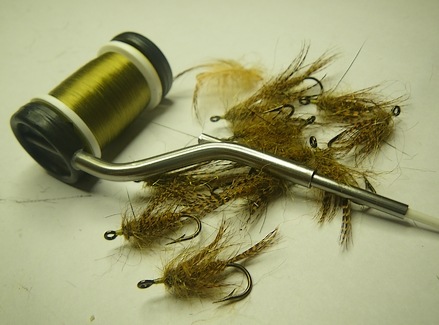
You blink and there's a dozen

… another dozen. New dubbing color?

and another dozen

A bronze olive accident in the dye pot and … you guessed it.
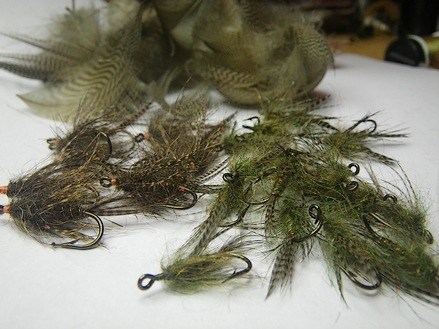
 everything results in a dozen

You’re at the height of your craft, mind whirling with combinations and permutations and fingers follow without conscious thought, everything looks fishy, all of them edible, only your fly box is full.

… so is the second one you carry, and the reject box you pretend to leave out for your kin to pillage, and the steelhead box, and the coffee can next to the varnish spill.

… double for the big box you bought for dubbing, and your sock drawer.

… and all those tungsten and copper beads, lead wire and cone heads – are not so much selection as death warrant, and the inevitable header cataclysmic – akin to a Polaris class sub in full alarm dive.

If you’re lucky you’ll leave an oil slick and floating debris, so the widow can toss a wreath at the spot while inviting your pals to paw through all your accumulated Precious.

One day you look back on all that misspent youth and misplaced ardor and wonder – did you ever take possession of that discounted Sage rod, or does the sumbitch still owe you …

Test. Sage rod, commercial fly tying, dubbing, steelhead, bead head, cone head, thick head, fly tying humor, fly tying blog, fly fishing, Green Highlander, baby seal, U. S. Department of Fish and Wildlife, captains of industry
Sure doesn’t sound like guts and entrails

Yea, we're really going to mourn this Sure it’s morbid, but knowing all of the scientific hijinks involved haven’t you wondered what they were going to call it?
… a leading producer of functional, sustainable Tilapia biomass …

With the Food & Drug zealots insisting it has to respire to be called “fish” – and the animal welfare crowd insisting it has to have a heartbeat to be an animal – and hence possess a soul, and with consumers adamant that it has to be boneless to be real food,  Madison Avenue has to come up with some catchy new phrase to describe the contents of  fish-like substance.

On the surface, it’s brilliant.

Note how weak it sounds when added to, “ %$#@*, that noxious bath of chemicals you’ve leaked into the water has nearly destroyed the Tilapia Biomass!”

Widows and orphans don’t exist with “biomass” – as it sounds too much like, “eww, hope I don’t get any on me ..” Now we can stomp life out of whichever species tastes best, without mourners or anyone protesting.

Love it.

Test: tilapia biomass, widows and orphans, real food, madison ave,

Some medicine comes with fins

Ankle deep in a big water year August colds lack the trappings of their wintertime cousins, luring a fellow out of bed prematurely so he can wheeze and wilt under summer’s heat.
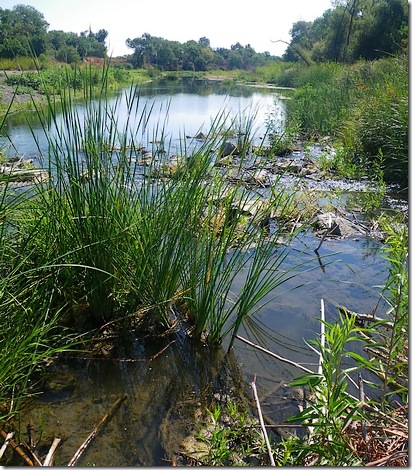
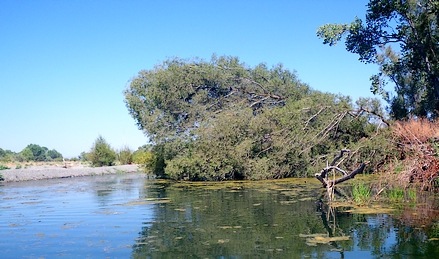
Two weeks without wheels and I was desperate enough to risk the mile and a half to the body shop to claim my chariot. Nearly expiring in the process, another 24 hours alternating shots of Nyquil and orange juice emboldened me to attempt the local watershed, knowing it was still recovering from last year’s dewatering, and probably felt as healthy as I did.

The healing properties of brown water are well documented, whatever remained of the cold bug gobbled up by legions of voracious Ecoli, and like Popeye making me stronger with continued exposure …

… and invulnerable should I slip and take a header.

Given the continued high water the last thing expected was to see the bones of the Old Girl exposed.

 Little Stinking Aug 2010

The flow is only a third of the old normal, which is consistent with the acres of green tomatoes still in the field. The draw on the creek has extended into August as the harvest has been delayed by the wet weather of Spring.

There’s ample fry evident in the “frog water” – mostly Pikeminnow, but I did find largemouth spawn in the deeper water, and fingerlings up to 3” in size.

Most of my beloved creek was ankle deep however.

At least one pair of beaver survived the Purge, moot evidence of why their reintroduction into the UK is a hotly debated topic. Terraforming being part of their nature, and while both fish and fishermen are appreciative of new cover, the land owner is often less so.

This hole will get a new name

I rested on the bank watched for signs of fish life, but all the commotion was the result of fingerlings growing fat on tiny Trico spinners.

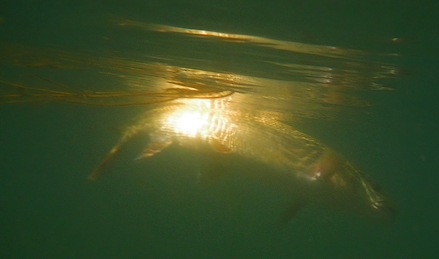
At the Siphon Pool, I managed to wake something of the brood stock, lean and sinewy – a Fedayeen who’d survived on a handful of dried dates all winter to plant a Stinger in the path of a Soviet Hind, or so he thought. A holdover from past seasons that had escaped suffocation, the both of us surprised and winded by the violence of the ensuing tussle.

It might be a tarpon, or a Rainbow

Perhaps through the miracle of a rare shot, you can glimpse them as I do, noble in their own right, burnished by early morning light and worth every droplet of sweat necessary.

Puts a lightness in a Man’s step, sorely needed when faced with the slow regeneration of a dead creek, and a couple miles of burning streambed cobble between him and his beloved Nyquil tit.

Test: Sacramento Pikeminnow, fly fishing for coarse fish, brownlining, Nyquil, largemouth bass, august cold

Introducing the Salmon Pout: Why fly fishing for Carp is the new Purism

In our Bold New World department comes a Salmon angler’s dream, an Atlantic salmon that eats year round, reproduces like a New Zealand Mud Snail and grows twice as fast as real salmon.

The only problem is the damn thing has to be taught how to swim.

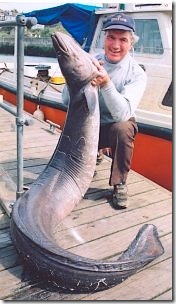
Ocean Pout or Conger Eel

You grab a gene from a Pacific Salmon, add a couple more from the Ocean Pout (or Conger Eel, at left) mash the syringe into an Atlantic Salmon egg, and watch the magic happen…

Once you cull the progeny for misshapen ogres and hunchbacks – and fillet what’s left, you’ve doubled your seafood production and the consumer is none the wiser.

As the FDA faces unthinkable hurdles trying to regulate these test-tube fish, producers exploit loopholes in food laws with great glee.

But AquaBounty says FDA cannot legally obligate the fish producer to label the product as anything other than Atlantic salmon. Anything else is voluntary.

via AOL News

On one hand I’m not so sure anglers will lose out in the mix. At some point a couple of extra genes may produce a scrappy opponent that will provide great sport when planted illegally in a backyard pond, or even the kitchen sink.

As most fishermen rarely eat their catch, we won’t care too much when some lab coat wads a big needle up Mother Nature’s finest, we can no longer afford the outpouring of cash for a weekend-long pilgrimage to the Pristine, or the gear necessary.

AquaBounty says it has launched a “blue revolution,” which brings together biological sciences and molecular technology “to enable an aquaculture industry capable of large-scale, efficient and environmentally sustainable production of high quality seafood. Genetically altered trout and tilapia are the next to be offered up to the nation’s fishmongers.

Once trout hits the aquaculture cross-hairs we’ll see some plaintive bleat from our conservation organizations and the IGFA, but they’ll be steamrollered into quiescence because of the larger issue, world hunger.

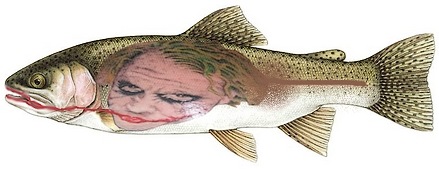
If we know we’re headed down this path, the next Theodore Gordon may be the fellow that grows a boutique fish purely for the sporting crowd. Throw a little bluegill genes into some Bluefin tuna, and squeeze the result into something colorful, yielding the Gangsta Trout.

Able to swim at a reel screaming 40MPH, can sheer a seven weight in a single jump, and feeds on Asian Carp, Zebra Mussels, and small children.

Lipstick on a Pig Trout

In light of what is about to occur, I see the Carp crowd having the last laugh, “sure, the water is tepid and the fish have Roman noses, but at least they don’t share any genetics with a Snickers Bar…”

Genetic salmon, Ocean Pout, Conger Eel, Heath Ledger, gangsta trout, asian carp, IGFA, bold new world, aquaculture, fish genetics, carp, fly fishing

Rod making legend lays off entire workforce

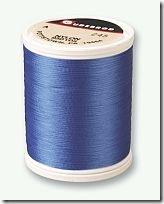
gudebrod NCP thread The Gudebrod thread company appears to be another casualty of recent economic upheaval, with banks unwilling to lend and small businesses caught without capital.

Gudebrod has been synonymous with silk and rod winding threads for decades, yet has been forced to lay off its entire workforce.

W.E. “Nat” LeGrande Jr., company president, said he is hopeful the layoffs, which occurred Friday, will be temporary. He said about 60 to 65 union and non-union workers have been temporarily laid off from the 274 Shoemaker Road facility while the financially troubled, family-owned company seeks new capital.

via The Mercury

The company has been struggling since the loss of the Glide dental floss contract in 2007, which represented 63% of their net business, proving yet again how little angling dollars contribute to a company’s bottom line.

Us hoarders have learned to snatch up whatever stocks remain, as too often published reports of “temporary” setbacks are found to be permanent closures.

It’s likely someone will fill the gap, but if you’re an aficionado of their products I would lay in a goodly supply of the colors used most. They can use the bucks, and you’d be covered for the foreseeable future.

Gudebrod makes a wide variety of silk, nylon, and Kevlar threads for both rods and flytying. Their “NCP” (no color preservative) thread was quite the rage in the day as it remained opaque with no loss of color when a rod finish was applied.

Thread making must be a hellish business as we’ve lost both Danville’s Monocord and (perhaps) the entire Gudebrod line in the same year.

Gudebrod thread, rod wrapping thread, Danville Monocord, NCP thread,

A River of Champagne Runs Through It

Yellowstone guides are so affectionate Paris Hilton has anglers backpedaling in a tizzy with her recent confession that she adores fishing ..
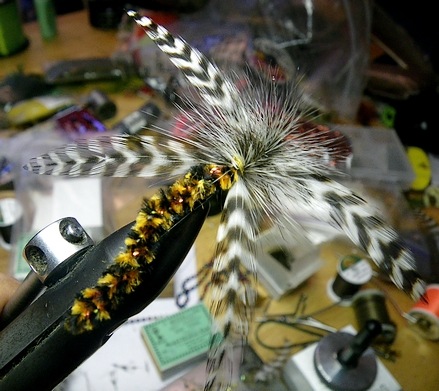
… and I like to go fishing and I like to go look at frogs. I’m really random like that.

via HollywoodNews.com

Leave it to a socialite and outsider to boil the essence of the outdoor experience down into human terms, and with  understated elegance.

It’s plain angling writers have been on an unproductive tangent describing the heroics and hardship of accumulating angling wisdom, and eloquence was lost in the fog of war …

… we like frogs too, and random, but only when it pertains to our showing for work.

When queried of her upcoming reality show with Lindsay Lohan; where Paris and Lindsay portray fly fishing guides in Yellowstone, Montana, there was no comment.

Pre-production is rumored to have started with working title, “A River of Champagne Runs Through It” – but we’ve been unable to confirm or deny any detail.

Paris Hilton, fishing, I’m random like that, fly fishing guides, Yellowstone, fly fishing humor, complete fabrication

We’ve always known our wet flies and nymphs were sexy, it was them dry fly fashionistas that never believed us

I can remember listening intently while it was explained that attractor flies have relied on the color red, as it was the color of blood and should excite any predator.

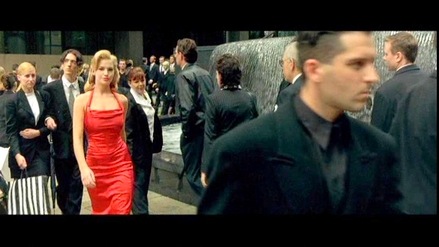
The Woman in Red

The real truth has been revealed that anything in red is twice as seductive as other colors, and while fly fishing’s founding fathers insisted it was blood, they were really playing fast and loose with a fish’s emotions.

Simply wearing the color red or being bordered by the rosy hue makes a man more attractive and sexually desirable to women, according to a series of studies by researchers at the University of Rochester and other institutions. And women are unaware of this arousing effect.

Naturally the American Museum of Fly Fishing blames all them Victorian eurotrash for another in a long string of sports scandals, all the while convinced Theodore Gordon was both chaste and pure of heart. Anyone actually reading Gordo’s book on dry flies knows he was a cocksman, as every third etching has some fulsome yet anonymous babe draped on the bank.

For the collector it means any fly fishing book authored in the last century is liable to be fuel for a puritanical purge that should drive their value into orbit.

Along with this learned association between red and status, the authors point to the biological roots of human behavior. In non-human primates, like mandrills and gelada baboons, red is an indicator of male dominance and is expressed most intensely in alpha males. Females of these species mate more often with alpha males, who in turn provide protection and resources.

“When women see red it triggers something deep and probably biologically engrained,” explains Elliot. “We say in our culture that men act like animals in the sexual realm. It looks like women may be acting like animals as well in the same sort of way.”

– via Science Daily

… and it’s obvious there’s a few loose ends, as most women seeing red are possessed by something deep and primitive, but it’s usually thrown crockery and a couple of snapped fly rods that results.

The volume of fly fishing magazines whose cover is adorned by stern looking Marlboro-men wearing red shirts and dirty ball caps? About 87%, which translates into nearly 46% of the sales destined for beauty parlors and woman that aren’t angry yet …

females attracted to red, the lady in red, fly fishing, attractor flies, Theodore Gordon, cocksman, fly fishing humor, the color of blood

I had similar endless questions, and disregard for wise council, only the fly fishing instruction was less perverse

I’m fixing him with my best grizzled guide Mac Daddy look, hoping I resemble in betwixt pure menacing and and just plain ornery mean, while I snarl, “… and you think you’re ready for dry flies, eh?”

“Sure, as you ain’t got a truck, I can drive us up to the woods and we can try some stream fishing – with cold water and trout …”

“ … and backlashes, and swift water, and gossamer tippets, wary trout, invasive species, a predawn McDonald’s colon plug, a side of rarified casting, quiet water that you can’t splash in, nine phases of the mayfly lifecycle, tactical clothing, fly floatant and application of same, gusty winds, perilous sharp edged rocks, mosquitoes, rubber soles, wading staffs, long leaders, and you ain’t even mastered the Roll cast yet?”

“Yea, that.”

“You want to leave hungry and desperate fish in a private game preserve, within walking distance of your house, cold refreshment, and a nap – in favor of hot, sweaty, public, and hard?”

“Well, yea …”

Ignoring reason and wise council is a critical part of fly fishing – almost as crucial as ignoring weather forecasts and hygiene … yet before we head for the Pristine and all the perils that await you, you’ll need to abandon fancy and embrace science ..

The Royal Coachman of the slack water

We’ve done big and gaudy, small and wiggly, and bright and ponderous, now we’ll learn to match the hatch, where we fish a reasonable facsimile of what the fish really eat. I call it “WidderMaker” and if you can avoid burying it in an arse cheek and bleeding to death, we’ll consider your apprenticeship complete.

“This floats right? I mean, this is a dry fly?”

“Which leader should I use, the 7.5’ or the 9 footer?”

“Do I put floatant on it?”

Lucky Dragon

“Hey, this is kind of fun.”

“That’s the biggest bass I’ve caught here.”

“… and the biggest bluegill too, I can’t believe they eat this.”

“I like this, it’s visual.”

Widdermaker gutslams another

I don’t think the bug lasted more than seven seconds without something attempting to eat it, evidenced by the bluegill snacking on my Widdermaker in the picture below … making it the Thrill that comes Once in a Lifetime

They won't even leave it alone long enough to snap the picture

“For over a thousand years Roman conquerors returning from the wars enjoyed the honor of triumph, a tumultuous parade. In the procession came trumpeters, musicians and strange animals from conquered territories, together with carts laden with treasure and captured armaments. The conquerors rode in a triumphal chariot, the dazed prisoners walking in chains before him. Sometimes his children robed in white stood with him in the chariot or rode the trace horses. A slave stood behind the conqueror holding a golden crown and whispering in his ear a warning: that all glory is fleeting.”
Gen. George C. Patton

If I only knew then what I know now – the spiral downward would have less gut wrenching.

I suppose most of our experiences were similar, something magical and foreign mixed with a dab of science, and suddenly luck has much less influence than first thought. I had the same disregard for wisdom, the same endless questions, only Pop was much less perverse in his instruction.

Dry fly, George C. Patton, Dragonfly, mayfly lifecycle, scientific angling, fly fishing lessons, warm water fishery, trout, grizzled guide

Tents and pocket lint worse than wading boots

It’s bad enough that we’re forced to endure the obligatory cavity search when boarding the plane – thereby removing all the explosives, brass knuckles, shanks, and belt fed weapons common to fishermen, but our arrival may soon be far worse.

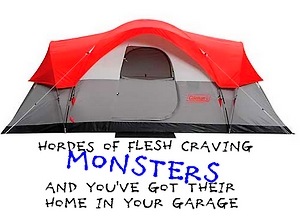
The Nasty live here I stumbled across a New Zealand document outlining their strategy in combating the invasive threat – which includes foreign plants, insects and all the stuff we know about …

The volume of invasives carried unknowingly is enormous – but of particular interest is the items now being routinely confiscated from arriving tourists. Naturally there are the obvious targets like fruit and foodstuffs, but tents are in the high risk group and confiscated immediately.

Shoes have to be declared, and inspected – and may be cleaned on the premises by airport staff, or confiscated, some 80000 pairs were removed from passengers last year.

In 2006-2007, 116,700 seizures were made from 2% (103,000) of arriving air passengers and crew. Contaminated used equipment (e.g. footwear and tents) was the most commonly seized risk good (34%), followed by fruit fly host material (23%) and meat products (10%).

Pathogenic fungus spores, plant seeds, and all manner of biologics are found in debris trapped in the soles of standard footwear.

A study on footwear in Honolulu International Airport recovered 65 species of fungi from 17 shoes (Baker 1966). Pockets of clothing also have been shown to carry potential risk material including dried and fresh foliage, seeds and feathers (Chirnside et al. 2006). Used tents may not only harbour plant and animal debris but also live insects (Gadgil and Flint 1983).
Because tents are potentially going to be used in national parks or other indigenous forest areas, tents were categorised as ‘a major risk’, and carefully screened by
MAFBNZ border staff.

Researchers examined 157 pairs of soiled footwear carried in luggage and found that while the amount of soil and leaf litter adhering to the sole was relatively small, with a median
(range) weight of 1.0 g (0.01-55), this contamination supported a range of bacteria, fungi, seeds and nematodes (McNeill et al., unpublished data). Seeds were present on over 50% of footwear examined, and 73% of all seeds recovered were found to be viable. Nematodes, which are microscopic worms that include a large number of plant parasitic species, were present in 63% of the samples collected.

… and yes, anglers were caught transporting the nasty too.

… used fishing waders and socks have been implicated in the arrival of the invasive freshwater algae didymo (Didymosphenia geminate) from North America to New Zealand.

Assuming a goodly percentage of vacationers wore comfortable footwear due to the walking and gawking necessary to take in the sights, we can assume a significant percentage were rubber soled (soon to be banned on international flights) so we can expect to be replacing all those wading boots again …

Just kidding.

It neatly demonstrates how thin your margin for error is … and if you thought you wouldn’t have to quarantine your rubber soled wading boots, wouldn’t have to freeze them, or wouldn’t have to scrub them with disinfectants and dry them completely … you’re dead wrong.

… and while you’re at it dry those waders and socks too.

Didymo, New Zealand, Ministry of Agriculture and Forestry Biosecurity, nematodes, confiscation of tents, invasive species, anglers

All those lectures delivered by stern biologists go unheeded after it earns a nickname

and while the tabloids make great fun over the adventure, the biologists grind their teeth in frustration.

How to get the invasive message across to a public that flushes pet alligators down the toilet, tosses piranha into the Old Swimming Hole once they outgrow the Goldfish budget, or toss that Boa Constrictor into the brushy area where everyone walks their dog – as it would be cruel to dispatch the oversized SOB now that it strangled the neighbor’s cat.

… then again, it makes an awesome, albeit controversial addition to some fellow’s life list. A story that’ll fetch free beer for months on the retelling.

I can’t help it if your finger freezes on the third tap of flakes feeding your child’s pet – that lumpy orange behemoth in the video would make any fellow question his forthcoming liability.

… as for flies, I’d think an emergent Cheetos would be just the ticket.

Monster goldfish, invasive species, fish flakes, Cheetos, goldfish flies, frustrated biologists, fishing for goldfish