Author Archives: KBarton10

Can fresh water flows alone explain the decline in anglers

Too much placid upbringingTwenty years of data is pretty compelling evidence that  streams are akin to the mortgage crisis, we fiddle and tinker with obstructions and flows attempting to guarantee everyone living on their banks isn’t washed away in a flood, when Darwinism may be the better course for landowner and watershed.

In studying 3000 watersheds in the US, and thousands of jetties, abutments, dams, rip-rapped banks, and countless ways we’ve invented to make flows more moderate, we’ve managed to change nearly 90% of the major watercourses in the US.

Hooray for us as terra-forming locusts …

The down-side is that in taming the flow of any river, we’ve also begun to modify both the invertebrates and fish that live there. Naturally, all those modern palaces we erect near the bank must be preserved like tombs of the Great Pharaohs, and in so doing we erect countless structures to avert floods, erosion, and normal channel movement. All this secondary construction is successful in turning the wild current into something less so, which genetically selects for fish and invertebrates that survive best in slow current and lakes.

In short, you erected that fabulous log palace because you adored the big brown trout out front, but because you put a house where it doesn’t belong, your kids (if they don’t strike your name from all pillars and monuments) will be fishing over large Bluegill.

So let it be written, so let it be done.

… and because I’ve got a yen for both science and the absurd, perhaps we might extrapolate this latest theory as a larger metaphor for civilization as a whole.

With thousands of niggling little constructs that parents and society use to keep us in line, ensuring our environment is absent those savage peaks and valleys, have they really been quietly selecting for fat, diabetic, and urbane as the traits for the modern enlightened Man, ensuring there’s fewer of us sporting-aggressor types so’s we’ll never get within a zipcode of the Big Red Button and the Bomb?

Yes. Wow.

Us fellows that delight in the out-of-doors having outlived our usefulness. Hunter-gatherer skills shed for the ability to double park, more drawers in the bathroom for his makeup, and cooking is correctly guessing the number of seconds to wave a frozen unmentionable so all four corners of the box are warm.

Now you can empty the bucket into the sewer proudly, knowing you’ve stunted less fish

Dyeing materials organically The fun part is you can make every bit as much mess, and your sudden interest in walnut shells won’t be attributable to your fly tying obsession.

She’ll think you’re being “extra good” because of the pending holidays, and your sudden desire to crack all those walnuts are merely foreplay for the fruitcake.

By my count there’s at least 30 colors hidden in your cupboard and the plants that make up your backyard, and if you can make a gallon of tea without wearing it – you’re on your way to handling all your color needs in a toxin free, mostly organic environment.

… which will not get you out of the doghouse should you steal her pots or dribble their contents on her linoleum, but as you don’t need heat and can dump the contents at your curb, you shouldn’t find yourself in the kitchen at all.

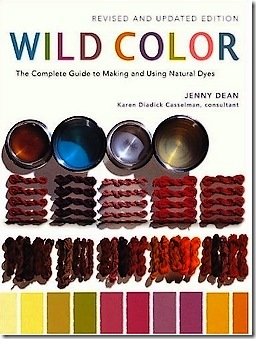
The book is called “Wild Color” and is a cleverly done manual on dyeing fibers (both organic and inorganic) with natural materials; leaves, stems, seeds, flowers, and crushed fiber from household items and decorative plants.

This book was a very quick read, and informative. This is not some dogged treatise on proper Ph and dye bath temperatures as much as it is a first book on the subject, striking a nice light balance of material directly on topic, and some of the history of garments and their coloration, some of the odd sources of colors, and how geography played a defining role in both common and exotic coloration.

Organic dyes are a combination of stain (brute force color) and “teas” enhanced with the proper mordant. Mordants are fixatives, dilute solutions of copper, aluminum, and iron, that assist the natural color to affix itself to animal fiber or cloth.

Mordants are made simply by adding white vinegar and water in equal measure and throwing a couple copper plumbing fixtures into the liquid for a week. Ditto for iron solutions or aluminum. This gives you the hobbyist, the ability to make all the items you need from their source, and not having to pay for anything other than the plant or food.

… better yet, flush with this new “green-ness” you can wait until your neighbor’s asleep and then pillage his Eucalyptus.

Half the book is devoted to the plants that provide the color, and the range of colors each plant is capable of given the mordant used. Dandelions used with copper mordant yields a medium olive, but with an acidic mordant may yield yellow.

It should be no surprise that anything you scuffed on a pant’s leg in your youth has potential as a colorizing agent. All that’s needed is for you to be a bit more surgical in your application.

Organic dyes are not capable of dyeing everything. The intensity of the bath may actually stain some materials that cannot be dyed, but considering our ancestors made use of animal hides and leathers, as well as woven fabrics like cotton and wool – all of which were successfully dyed in many colors, it’s safe to assume you should be able to get both pastel shades and many combinations that will result in much darker colors.

Given that dead and dried plants are desired to brew colors, I would think a visit to a nursery might yield a lot of free exotic plants that have dried past their prime, or simply died while on the vendor’s premise. This book will give you the names to ask for and a nice picture of the plant while living – everything needed to assist your collecting.

I’ve dabbled in natural dyes for some time, but only those whose materials are common to my locale (or to the neighbors backyard). All those neat piles of plant debris at the curb have yielded quite a few finds that I’ve used to make earthy tones of brown and olive, and it can be a lot of fun to devote a gallon jug in the garage to steeping a mixture of bat’s wing, and eyelash of newt …

… knowing the poor SOB next to me has none of them big stoneflies that smell like licorice …

An engaging read, especially the introduction outlining the earliest sources of purples, why they were so hard to find, and why the Celt’s of the British Isles were so fond of blue. Guaranteed to make you never look at an onion skin in quite the same way again.
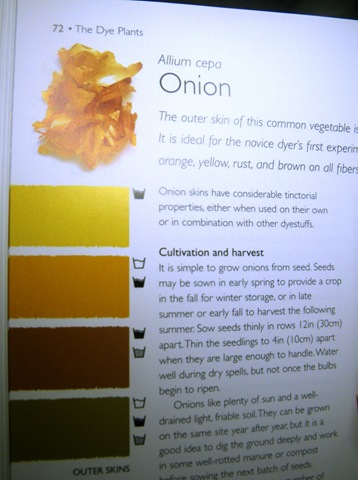
Onion_Skin

The above shows how the plant pages are organized. The material has a brief discussion outlining which parts of the plant contain the coloring agent, and whether they are best used dried or fresh. For each of the materials the bars of reference colors (at left) describe what you will get when used with the different types of mordants (alkaline, acid, aluminum, copper, or iron).

As with any colorizing agent some experimentation is necessary. Some of these colors are susceptible to fading in direct sunlight, as they lack all the chemical finery of traditional aniline dyes, and are often much less concentrated than a couple of heaping teaspoons of a powderized dye.

Earth tones aren’t so bad as regards fading, but anything solid colored, and especially red, should have a chunk nailed to a fence post for a week or two to see if the finished product is stable.

Cost of this tome is $15.35 from Amazon.com, and it may yield something useful to those that wish to avoid caustic chemicals and toxins.

Full Disclosure: I bought this book from Amazon.com for the above price
Mine lips shall not touch the Unclean Thing

Goddamn Tobacco Habit It’s the end of week eight and the monitor no longer looks edible …

After two months of fiery temper, fits of questionable writing (which is really my norm), and short pieces that leave you scratching your head about what I really meant, I figure a confessional is in order …

(sob) (sniffle) … I ain’t had a goddamn cigar in all that time …

… which plays Billy Hell with my prose, attention span, and sense of humor.

The Telly is rife with ads featuring smiling ex-tobacco junkies living blissful lives with adoring children and a trophy wife. I gaze about me at the bags of dead animals and sinkfull of stained dye pots, and it all looks so compelling and easy …

Slap a patch on your shoulder and be restored to your old self, instantly.

They don’t mention the parts where the kids and spouse flee for their lives amid a hail of gunfire – opting for Grandma’s house until they hear the tell-tale snap of a empty cylinder, how nothing in the icebox is safe – or that you’d chip a tooth on frozen sherbet as it was the only tobacco surrogate within reach when gripped by a late night oral frenzy.

Nor do they mention the Dentist taking the blood pressure cuff off you exclaiming, “No need to fix that cavity, you’re already dead.”

As the noxious weed is many things to many people, it appears that like Poppa – it plays a key role in crystalizing thought. Part of that delicate balance of hormones and endorphins that was critical to humor, turned a droll line of prose into something more, and stimulated the brain cells to find something worth sharing from nothing.

Week eight. Somewhere about the New Year I’ll be restored to my old self.

The Royal Foie Gras with Cheese, the official burger of Theodore Gordon

supreme_fois_gras Now that the World’s collective microscope is off our convexness we can get back to eating all that grease-imbued unhealthy.
No more sermons from “green” zealots admonishing us how unhealthy our kids have become, and no high pitched, pallid scientist illuminating the damage done to the Ozone layer by herds of  Big Mac’s as they graze  peacefully.

Instead we can point fingers at French fast food, which has debuted the Foie Gras Burger, containing acres of duck fat and types of cholesterol that vaporizes arteries on contact, with science gasping for the words to aadequately describe the peril.

As diseased goose liver shares a bit of “snooty” culinary reputation in addition to being a Widowmaker,  the fly fishing community will greet the dripping SOB with open arms, and declare it the Official Burger of Theodore Gordon.

It’s obvious them Eurotrash weren’t content with the “Royal with Cheese” and felt it necessary to one-up us on the societal diabetes scale by adding even more lard.

… and they’re welcome to it. It’ll be percussive Darwinism as us newly svelte American tourists will be side-stepping the disenfranchised Islamic fundamentalists as they rush the cafe entrance with a vest full of nitrates, wherein the slow and fat will eat the blast.

Hamburgers being synonymous with American culture, and with copious references to their care and usage in exported media, we can only hope that  “look at the big ass on Brunhilda”, doesn’t get attributed to Pulp Fiction.

Naturally the Trout Underground will recant their hasty decision to go with a mere chili dog and Cole slaw as their mascot, and it’ll be the subject of much tension on the Drake boards as to proper condiments appropriate for this gelatinous monstrosity.

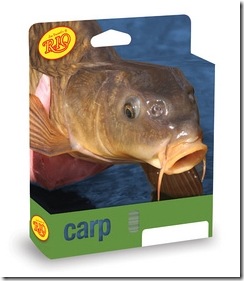
Why you should stock up on Carp lines this Christmas

The Yellowstone Carp line, new for 2035 Dire news on climate change suggests that Western US and particularly the Yellowstone basin are already in the grip of a warming trend, and warming  quicker than the rest of the continental US.
The demise of the whitebark pine trees is the most noticeable result of climate change. Warming temperatures have allowed the mountain pine beetle to thrive in previously inhospitable, high-elevation whitebark forests turning the mountains in every direction brown. Aerial surveys have established that whitebark pine die-offs are approaching a staggering 85 percent. A recent study concludes that climate-induced beetle kill will render the pine species functionally dead in the Greater Yellowstone Ecosystem within the next seven to 10 years.

-via the Bozeman Daily Chronicle

As the Whitebark Pine offers precious cover to delay snow melt, it suggests that Spring runoff will be quicker and potentially much more violent, and summer flows smaller and warmer than those of the past.

Studies indicate that within the next 50 years the Yellowstone River between Livingston and Laurel-one of the world’s great trout streams-will likely become a warm-water fishery.

So B.A.S.S. can add both Lake Tahoe and the Yellowstone River to their ever-increasing list of exotic venues.

The National Park Service has released a 36 page response to the impacts of climate change to the national inventory of parklands. As you might expect it is a roadmap to handle the effects and adaptations anticipated, as they cannot stop the process by any means. As part of the issue is carbon sequestration on park lands, I’d imagine that it’ll require vendors and visitors to adjust to a lower carbon footprint (possibly affecting their ability to enter the park, or the means by which they’ll be allowed access), and the end to livestock grazing – as it’s a known source of gases.

(… rivaled only by fly fishing blogs and their authors … )

Fish hatcheries impacted by state budget shortfalls, less fish the result

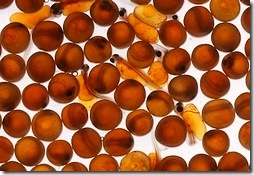
There may be less of these in our future It appears that budget shortfalls and emphasis on belt tightening may have exposed the soft white underbelly of the “put and take” fishery. With both federal and state budgets being carved of fat, and desperate to avoid too deep cuts to the remaining muscle, a combination of license hikes and the systematic redirection of conservation funds may result in a lot less fish for your local creeks.
That’s because when Science fails it often does so catastrophically. The role of a hatchery in this modern era has changed from fishery restoration to fish production, the ability to augment what Mother Nature provides with a steady stream of catchable fish at a rate greater than or equal to their being consumed.

Which was the flaw in their thinking.

Outlined in an article on the New York angling scene, with the state deficit looming at around a billion dollars, and after a license hike of 53% last year, the state hatchery system is faced with not enough money to complete their mission, despite their plight being one of the reasons for the license increase the prior year.

For the first time since 1976, no eggs were taken from the Adirondack strain of lake trout in Raquette Lake, which means there will be 115,000 fewer lake trout for stocking in 37 waterways, Kemper said. Staffing shortages and budget cutbacks have reduced the egg take for landlocked salmon at the Adirondack hatchery by 50 percent, which will mean 700,000 fewer salmon stocked to New York waters, he said.

– via the Wall Street Journal

As hunting and fishing organizations assumed the new revenue was earmarked for agencies charged with the conservation mission, imagine their surprise to find the government may have other plans …

… which will lead to more law suits and additional expenditures, while the remaining holdovers from last season are attrited slowly under the ever-increasing hail of PMD’s with a Pheasant tail dropper.

It’s been that way in California for years, and if your state hasn’t yet it surely will.

Anglers have endured any number of cost increases with only minor grumbling. With incomes stifled by a sluggish economy and with less government being a rallying cry of the next dozen elections, will we begin to see initiatives on the ballot requiring dollars raised from license increases and special stamps, be spent in a manner consistent with their purpose?

… as this new austerity trickles its way throughout Main Street and finally settles into your kid’s consciousness that he’s not going to peer at Life via the lambent glow of an X-Box, it’ll make the both of you read the fine print of the new trout stamp legislation and wonder whether the State that’s proposing to tap you for “spare change” isn’t really going to put it up their nose – versus buy a trout’s dinner like they claim.

A vest like that has to be named “Lucille”

I told him, “ …when I debuted the Sixth Finger I spared no expense … fly fishing being no different than most male dominated sports, with fellows claiming they’re reading when they’re hoping for a picture of sweat-soaked flesh with a come hither gleam. Sex sells, so I hired Gertrude “The Grip” Mapplethorpe, whose hands can raise a fellow’s blood pressure, who’s graced nearly every Cabela’s catalog ever printed, whose fingers launched scissor sales beyond my wildest expectations.”

My brother feigned interest.

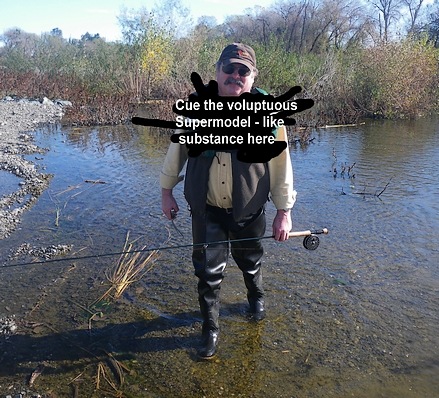
“The problem you’re facing is fishing vests have always been marketed like dirty underwear; shelf folds visible and on some uncomfortably-stiff sales intern whose sweaty hands lack grime or callous. What’s really needed is some tanned and ripe number stretching seams into the realm of convex, like “Lucille” in Cool Hand Luke – so’s we don’t notice the guy wearing the damn thing mounted his reel backwards.”


I’m not getting the head shake that suggests agreement, so I continue,
“I mean we’re two old fat guys and the only way we’re going to get near some sub-30 buxom is if we pay them right?”

My brother is intent on watching his fly drift off the far bank, and appears moved yet unconvinced, mostly because my fit of marketing genius is on his dime …

“So, we can drape them ladies over most of the brownline with the emphasis on taut, sweaty, and extreme – and with all those features and new stuff no one’s seen, it’ll be provocative and doubly extreme.

Meanwhile we can take turns on the camera, making our lechery legitimate, and if anyone sees us we can say they’re our girlfriends – which will make them incredulous and keep prying eyes off your fantabulous vests and preserve their secret until you’re ready.”

Igneous Rock does voluptuous

(Naturally it would be twicet as awesome if we didn’t have to pay them to be our girlfriends, but we can convince them we’re famous, and most would think it a privilege.)

“ .. so whaddya think?”

My brother slowly reels in his line and affixes the fly in its dangling keeper and comments to no one in particular, “ … I passed a fourth kidney stone the other day … “

Which in my bloodline is a “No” – and I’m duty bound to make one last attempt…

The Brownline Diva

“You’re opting for the staid and jaded low-budget-fly-fishing-Diva option, where I’m supposed to wade circles around your corpulent frame snapping pictures, while you hope the convex of your waistline conveys the more traditional ‘I’m well fed, so this gear must be good’ image, which relies entirely on a sympathetic fifty-plus, aging-not-so-graceful, fly fishing audience to make your designs successful?”

“ … and may explain why the fish ain’t eating at all. That portrait is enough for an involuntary regurge, dooming ‘Cyber Monday’ and all its nouveau retail goldmine to Hell and Perdition …”

“I charge double if you want them in focus …”

They’ve got to fill all those hotel rooms with somebody

Big changes destined for the Lake Tahoe basin has California legislators scrambling for dollars to fund the Lake Tahoe Restoration Act of 2010, which will no doubt end up as “California Pork” inside some other piece of legislation…

Responding to a recent study produced by UC Davis, which suggests 50% less snow for the Sierras, an earlier thaw, massive flooding of the Truckee River, which will eventually run dry by the end of the century, and phosphorous precipitation and removal of dissolved oxygen, will transform the area and surrounding watersheds into something much less picturesque.

… with the inevitable fight over the remnants of the Truckee, as it’s one of the primary sources of fresh water for Reno, Pyramid Lake, and some of the farm communities within Nevada.

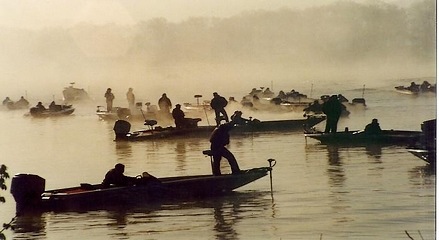
Add to that mixture the “degree per decade warming trend” and Tahoe might find new life as one of many trophy largemouth lakes and a regular host to B.A.S.S  tournaments.

BASS Tournament 

There’s plenty of hotel rooms, and them bright lights of Reno will still beckon to the unwary.

Dyeing and Bleaching Natural Fly Tying Materials

It's not Best's Best Being the only book of its kind might tip the scales somewhat, but I was hoping for a bit more.

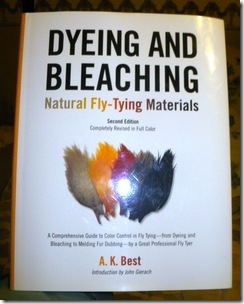
I purchased a copy of A. K. Best’s, “Dyeing and Bleaching Natural Fly-Tying Materials” and spent last week intent on learning some of the differences in style and cautionary information the author has for prospective colorists.

There wasn’t a great deal of information for those having already trod that path. He is generous in the degreasing, he wears gloves, has been banished from his kitchen, and is overly fond of things he can buy at a supermarket.

… and he mentions a “dyeing room” while I’m dealing with Ma’s Kitchen – suggesting Mr. Best may be fastidious in preparation and clean up, and I may be the Oscar to his Felix.

Of interest to me was the use of coffee urns, stainless steel food containers, and hot plates as a heat source. I assumed he’d slurped something onto the Missus’s linoleum and he’d been banished from the kitchen much earlier in his dyeing career, and these implements were forced on him as was the garage.

Hot plates are something I don’t use much, only because of all the apartment fires they caused in my youth. Considering their built-in thermostat it would give more precision to a heat source than raw flame and a thermometer. You’ll just have to remember to turn them off to be safe.

Small batches of material would dye nicely in a 12 cup coffee urn, as it would preserve both dye and keep the dye liquid small and manageable. Nor would it hurt to have a few extra nearby should the real coffee urn take a tumble and shatter. Glass cleans so much nicer than metal or porcelain lined containers – and is impervious to salt as well.

As a first book on dyeing the text may offer good service. Its focus is almost entirely using RIT dyes, and while mentioning Veniard (acid) dyes, there’s not a lot of discussion on frailties or virtues of one over the other. RIT being as close as the local store and therefore gets the nod.

Which is a disservice to the pupil, as RIT and Tintex have their moments, but the acid dyes possess superior color to their salt-fixed brethren, and so long as you don’t shirk from mail order are every bit as available.

There is some brief discussion of the virtue of the artist’s color wheel, a chapter with a dozen RIT-based formulas for common fly tying colors, another on stripping chicken and peacock quills using bleach in a destructive manner, but discussion was largely superficial, with not a lot of material on the all-important why’s of the colorization process.

I would have expected some thoughts on color from his fishing experiences, perhaps a dab on color as compared to trout vision, or a mention of how colors perform with water depth. Instead the last couple of chapters were devoted to biots and fur blending, and offered only brief commentary, about as long as a magazine article.

I thought biots were an odd choice for a dyeing book as there’s nothing terrible special in dyeing them compared to any flight feather, and a much larger text is necessary to address fur dubbing. Five pages wasn’t much of a treatment given the permutations and use of color possible with furs and mixing different fibers.

The chapter devoted to color removal was my favorite. It’s one of those odd tasks we don’t get to practice very often, as most of our material preparation involves adding color versus removing it. Learning that bleach behaves differently on clothes versus raw fibers, is one of those painful lessons learned once and never forgotten.

I suppose when your kid shows up at the door and reveals the blue lightning bolt down his scalp – it’s nice to know what options you have in the matter.

In summary, I find the book useful but odd. Two or three topics that don’t belong well with the overall topic, which should have been omitted to make room for resources a budding alchemist could leverage to perfect his craft, or a bit more on the science of color, or perhaps more recipes and photos of color samples.

Most of the work relies on references to RIT and Tintex colors which were common when the first edition was published in 1993. As most dye companies add and subtract colors routinely, and what’s left of the Tintex company is in Australia – some of the colors referenced may no longer be available.

It’s a “good” starter book and nothing more. As it’s the only thing available on the topic written for fly tiers, it may warrant a second look.

Full Disclosure: I purchased the book used from Amazon.com. The price for a second edition hardcover was $17.00 in excellent condition.

Fresh out of X’s, so we’ll let the fly mark the spot

Last night’s thunderstorm had scrubbed the Little Stinking as clean as I’d ever seen it. I woke Sunday expecting to see more of the same, but all the weather was at a distance and I had a large chunk of blue sky to make a mad dash for the creek. Enough time to get muddy and perhaps lock horns with that big smallmouth.

Fishing on the heels of a weather system is never very productive, but since every living thing had been dodging lightning bolts last night, I was hoping I could get something hungry to stir.

Not a chance.

… even the small fish weren’t interested.

Little Stinking Fall color

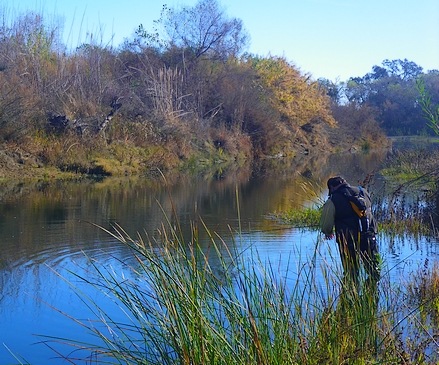
… and with the people still abed, and all the candy wrappers, water bottles and toilet paper washed away, the cattails gave a glimpse of brown water majesty – the Valley version of Fall colors.

The RootBall

Hisself lives on the right side of that downstream root ball.  With the beaver dam raising this run about two feet in depth, it’s nearly eight feet deep. I managed to swim the fly through the area effectively, but nothing was eating.

Once the rain starts in earnest his protective cover will be a distant memory – and with it will go the beaver dam providing the safety of the extra depth. I’m sure he’ll stay within the area, but there’s no telling whether some big mass will wash down this winter and either change the character of the flow, or mash life out my quarry.

Little_Stinking_Christmas With a stiffening breeze and a mass of dark clouds bearing down on me I opted for the safety of the car.

I snuck over and dragged the fly through the deep end just to let the fish know I meant business, then forgot my surrounding during one overly ambitious cast and got a jump on the holidays and tree decoration.

Which gives me ten left, and moot testimony why some of my good ideas are tied in quantity, versus carrying one or two.