I’ve always fought shy of naming fish, mostly because it can mark the angler as a bully, some small indication that camping on known water might be preferred to something new or unknown.
That’s not the same thing as a pool within feet of some cabin, where the fish are known so well simply due to proximity. Driving a couple of hours to catch “Charles” or “Bob” however, is a bit disquieting …
… and why are they always masculine names?
It must go back to our playground days, where you kicked Bob’s ass when he reached for your cupcake, or owned Charlie in four square or kick ball. The retelling sounds pretty good, only Bob is about half your size and Charlie was the kid with braces, who was nearly 60 pounds when soaking wet.
Naming a big fish, especially one that’s been hooked and lost is another matter, as both honor and Jihad may be involved …
While pounding gravel last weekend, I noticed a big root ball near the bank, and taking a breather, I got out some oddball experimentals to test their sink rate in the deep pool made by that mass of tree trunk.
There were a couple of six inch largemouth bass that were mildly interested, and while jigging the fly in front of them hoping for a strike, a big piece of tree trunk detached itself and came over to investigate …
It was the Great White Whale hisself, Moby Dick, the biggest smallmouth Bass I’d ever seen on the creek, and while he sat there inspecting what I was twitching, I attempted to remain immobile so I could eyeball the beast without spooking him.
Looking at the size of the fish and his surroundings, I realized that like Ahab, this was going to be a story of lost flies, fruitless courtship, and obsession, and could end badly for both of us.
“Towards thee I roll, thou all-destroying but unconquering whale; to the last I grapple with thee; from hell’s heart I stab at thee; for hate’s sake I spit my last breath at thee. Sink all coffins and all hearses to one common pool! and since neither can be mine, let me then tow to pieces, while still chasing thee, though tied to thee, thou damned whale! Thus, I give up the spear!”
– Moby Dick, Herman Melville
While working this weekend on chores and raiding the local crop of Pomegranates, Walnuts, and Persimmons, I’m thinking about that big bass and what it’s going to take to seduce him.
… or her, a fish that big might even have a zip code. In either case we’ll name it properly once hooked – which by all indications won’t be soon.
A deep root ball with the limbs facing upstream, nearly guaranteeing the fly will snag, an eight foot pool of water with him at the bottom, requiring a cast that’ll have to sink quickly and avoid all the smaller fish on its way to the base of the tree, and the poor angle I have on his position; water too deep to wade, opposite bank impenetrable, and I’ll have to cast the line where the fly lands on my side of the root ball, and the belly will have to land midcurrent.
The physics suggests that root ball will soon become a Christmas tree of my best efforts, with weighted and gaudy visible on every branch.
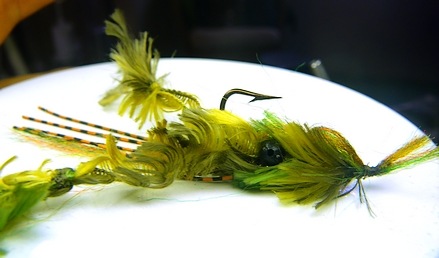
Knowing this fish has been sent to haunt me, and we may have even met a couple seasons ago with the Little Stinking Olive doing the introductions, I’ll start with what has worked and update it in light of the fish’s size and surroundings.
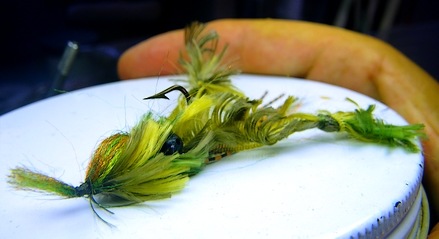
While the original pattern is a known killer, it needs additional weight, a bigger size, and a larger hook. Originally a Crayfish design, I added some frog-like features so it’ll serve double purpose. The above is a weighted #2 hook tied to ride upside down.
With weather in his favor I won’t get too many opportunities before the winter floods, which will likely remove his precious barricade and deposit it many miles downstream. His Whale-ness I’m not worried about, a fish this size is a survivor.
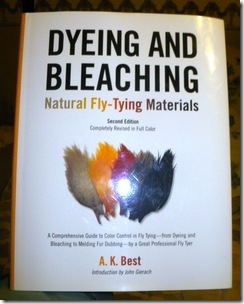 Being the only book of its kind might tip the scales somewhat, but I was hoping for a bit more.
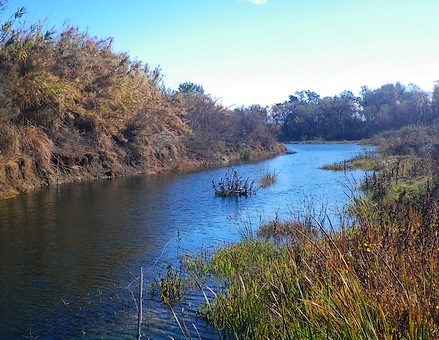
 With a stiffening breeze and a mass of dark clouds bearing down on me I opted for the safety of the car.
 Now that researchers in Australia have discovered that hatchery trout can be raised in the ocean – with a growth rate three times faster than freshwater, we can all rejoice …
 Deep down I’ve always postulated the source of fly fishing’s elitism stems from the lack of goo on our fingers.
 Just when we think we’ve got a handle on this entomology thing, we’re jarred awake with the realization that our grasp of terrestrial and aquatic science is miniscule compared to what we don’t know.