Author Archives: KBarton10

Add durable to a long list of stellar qualities

A beginner tears hell out of everything – it’s his nature; the unfeeling, uneducated, flailing of amateurish casting is the best way to determine whether a material warrants more study or whether its got both durability and looks.

…that and you can see whether the dyes cause wounds to fester, as only the novice can imbed a really big hook where it’s least desired.

I had an awful lot of casualties this week; fanciful flies with intricate parts, simple flies with new replacing old materials, and simple patterns that merely allowed something to flop around in mid-air.

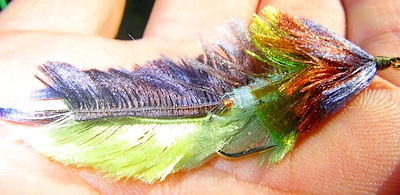
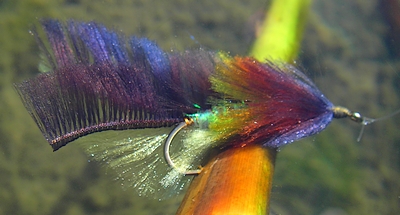
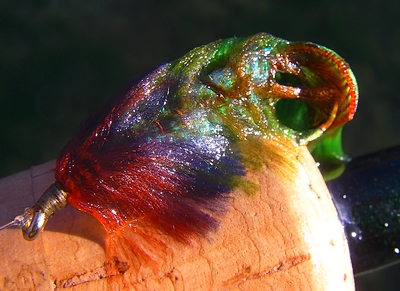
The winner was the Polyamide double eyelash yarn, it’s completely bulletproof and possessed of qualities unlike any other synthetic I’ve seen in recent years.

 Opaque when dry

The bad news is that every source I’ve identified has ceased production, and while finding multiple sources of manufacture, I assume its the “look” of the finished garment that’s no longer in fashion.

 Translucent when wet

The dry version of the fly looks nice, but the soaked material has a marabou-jelly quality that simply defies description. The dry version is opaque, the wet version is translucent, and the damp fly resembles jelly.

Add to the mix the crystalline sheen of seal fur, and a fiber size about half the width of a human hair – where the slightest movement in water current or line causes the head to pulse and tails to flop wildly – and you’ve really got something special.

 Gelatinous when damp

I managed to get four skeins of the Gedifra “Costa Rica” flavor, and have seen similar yarn marketed under the Feza “Karbele” label. Six skeins of the autumn colors are available on eBay but that’s all I’ve seen in recent memory.

There’s a special hell for fly tiers … we finally get a couple synthetics to slow our killing of real critters, only to find the man-made stuff is closer to extinction than the beasts we’re saving…

Part 2: Spey Kung Fu: There’s two kinds of experts, them as can cast – and them as can’t

More danger to myself than to the fish After a week of practice I’m the second kind of expert; I have a theory or opinion on absolutely everything, I’m quick to point out the trifling defects in everyone else’s casting, in both tackle and form, but don’t ask me to show you, ’cause I still can’t cast for beans..

I got some assistance from the fellows at the Washington Fly Fishing forum whose site is blessed with a low “signal to noise” ratio. Lots of talented folks that fling these lines in anger, and readily share what they know with a clueless prospect.

I’d found a couple resources that listed grain weights and had deduced I needed a RIO Windcutter or Airflo Delta Spey, these are mid-belly lines markedly different than the Skagit head I already owned. The Echo website suggested the Airflo and the WFFer’s suggested The Red Shed, a small Idaho fly shop, whose proprietor, Poppy – was strong in the ways of the Force

They weren’t kidding, some fellow answers the phone and as I stutter a greeting he says, “You seek Airflo, for your rod, the #7/8.”

Now that I’m armed with the proper line, I’m captive to the weather – which is alternating between icy fog and rain. The gleaming unsoiled rod is parked by the back door and in between squalls I’m in the backyard committing a multitude of casting sins.

The pop-crack-whizz flushes every cat and squirrel hidden in the underbrush, the fleeing felines get everyone’s dogs barking, and I’ve got Grandma looking over the fence sternly – assuming I’m harassing “Pootsie-Poo” her pampered and fat Persian.

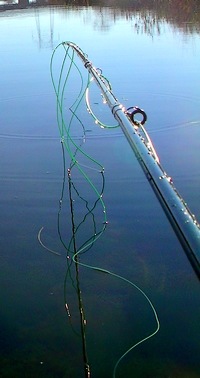
Part of the noise is my use of a  “grass leader“; a knotted leader with barrel knots about every 3-4 inches and the tag ends left untrimmed. The friction of knots and tags in the grass offers additional resistance and assists in loading the rod akin to ripping the line off the water.

Despite my daily sessions I’m not able to get anything resembling what’s desired – my loop is open like a roll cast, and a completed stroke dies horribly in mid-air; no power or direction and I’m left scratching my head.

Saturday breaks with “bluebird” weather and I’m on the creek as soon as the sun is high enough to light my path. I figure an hour of practice and with my newfound “l33t” skills I’ll be rolling in fish. I figured the floating tip would be the easiest to fish with … and destroy.

Multi-tip spey lines include a floating, intermediate, 6″ per second, and 8″ per second sinking heads. They’re 15′ feet segments looped onto the line belly (both are equipped with welded loops) using a loop-loop connection which is unnoticed when casting. This is one of the areas of confusion for us beginners, some Spey lines are incomplete unless a tip is added – and are underweight because a tip is expected. The converse is also true, some lines are just tips – with no belly and it’s mighty important to understand the difference.

I’m focusing on two casts, the Snap-T and the Snake Roll, figuring I’d have them committed to memory quickly via numbing repetition rather than divide my time between a dozen different maneuvers.

There’s a wide pool a couple hundred yards below the duck blind, (far enough away from the watchful eyes of anyone inside), and I figure if a wounded mallard floats by I can grab a couple fistfuls of flank with none the wiser. Striking my best heroic pose I launch my first cast – watching it soar across the frothy water and land an astounding 20 feet distant.

That’s no mean feat with 54′ of belly, 15′ of floating tip, and attached 9 ‘ leader.

As an experienced one hand caster I know how to control the cast stroke to do my bidding, I thought I could translate the timing to the two hand rod and get some semblance of the correct cast.

I was dead wrong.

Water tension replaces the wait on the traditional rearward false cast, and the amount of time the line is on the water determines how much you’ve got to rip off the surface on the forward stroke.

Terms like “kiss and go” have meaning now, a peck on the cheek is what’s needed – and I keep swapping tongues..

The Snake roll was easier to learn and I was able to get distance even with an unguided and hideous open loop. The Snap T was a disaster – but I was able to get the snap portion operational. I think I managed about 40 feet with 70′ out of the guides.

The water is the backcast, therefore casting is entirely foreign – it’s neither intuitive or easy to understand the rod physics or the water load component.

My biggest problem is too much strength. Watching the videos on YouTube you see the rod cradled by the upper hand, and I’m “white knuckling” the cork with all the finesse of a baseball bat.

My hour passes and then some – and because I insisted on realism, I’m out a dozen flies. All of them cracked off by my baseball version of the Snap T. None entering my torso unbidden – so I’m succeeding at building the necessary self preservation skills.

I managed a little fishing, but the fish had all expired in laughter – I couldn’t see their carcasses as I’d put a nice “head” on the creek akin to bruising a good lager. 

I’ve confirmed what Spey is useful for and what it’s not. It’s a “big water” fling and swing style ill-suited for my little creek. Retrieving flies close means you have to shake all the line out of the tip before the next cast, and while the casts can be used in close quarters with traditional lines – it’s not a style requiring you to suddenly replace all your tackle in a mad rush to be first.

The extra handle below the reel does have issue with bulging front loaded vests. It’s used in lever-action mode, drawing it into your brisket with each cast.  Once I learn the proper cast – this may not be much of an issue, but I thumped my fly boxes routinely – something unnoticed in my backyard proving ground.

I’m going to transfer the line to my one-hander. This will eliminate the unknowns of the long rod and let me experiment with the timing and casts with known equipment. It’ll also aid in fishing, because I can fish through the run using traditional casts, then beat the water to death afterwards.

After wind milling a 13′ rod through 30 minutes of Snake Roll, I was feeling the exertion. It’s a great workout – it’s not supposed to be, but I’m grasping at any positives.

The last train from Gun Hill, the Little Stinking MilitiaThe wind started to pick up a bit, and I’m hearing the staccato reports of gunfire upstream – not duck hunters, someone’s unloading seven round clips of Eastern Bloc high powered stuff – which can go some distance.

I’m up and out of the streambed quickly so’s I can be seen, and stumble into the last convoy out of Sadr City. Four motorcycles, 2 ATV’s, 2 trucks, and a dozen pimple-faced hardcore types looking stern and scanning for FSW’s ..

FSW’s are more dangerous than IED’s and common to California watersheds .. it’s easier to yell “FSW” to alert your buddy to “Fleeing Startled Wildlife” – otherwise you’d fail to empty the entire clip into its carcass.

I gave them a wave and headed out of Baghdad, hoping to clear the watershed before the gunships rolled in…

More suffering to follow.
Mustad to discontinue the classic standard fly hooks

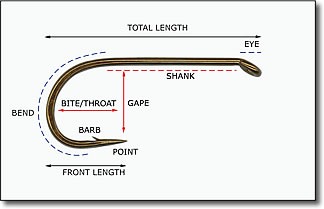
Hook Anatomy Mustad is discontinuing their line of classic fly tying hooks in favor of their Signature Series.

That means the classic 94840 (std. dry fly) , 94845 (Barbless Dry), 94833 (3x fine dry), 3906B (std. nymph 1X long), 9671 (2x long), 9672 (3X long), 79580 (4x Long), 3665A (6X long), 3399A (std wet) – are out of production as of January 1st, 2009.

Cabela’s web site seems to corroborate the news as they’re listing multiple standard Mustad hooks as, “Sold out Sorry, Cannot back order.”

J. Stockard’s catalog references the same issue:

Below are our best deals on some Mustad Standard hooks that are discontinued. Most of these hook styles are being replaced by equivalent hooks with chemically sharpened points in the Signature series.

Many tiers prefer the Tiemco, Gamakatsu, and Daiichi wire and  switched from the Norwegian iron many moons ago. Mustad is replacing the hooks with their “Signature series”, they’re twice the price of their standard hooks and compete directly with the Japanese product lines.

There’s no mention of the change on the Mustad web site.

Those of you still wedded to one or more of the above styles should perk up and inquire of your dealer, you may want to lay in a stash of them while they’re still available.

Then again, there’s always the “Bernie Madoff” option, slurp as many as you can and double your money on us old guys on ebay …

Thanks, Bernie..

Free Willy IV – Willy starves to death and becomes odiferous mass on Southern California beach

willy The Sacramento Bee reports the National Marine Fisheries Service has compiled a draft “biological opinion” that may compel the California Department of Water Resources and U.S. Bureau of Reclamation to change reservoir operations, improve river habitat and divert less water from the Sacramento-San Joaquin Delta.

The 2004 version had a similar finding and was altered by the Bush administration to show fish would not be imperiled by existing operations, and were sued successfully by environmental groups.

The judge insisted that Interior department officials had violated the Endangered Species act by modifying the report.

Fishery biologists assert that the current system, whose emphasis is on water for people, does not provide enough cold water for spawning habitat in the Sacramento river. Climate change and increased population will magnify the effect.

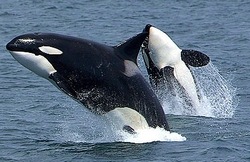
It’s so bad that Killer whale’s are being added to the list of impacted species, due to the absence of Pacific salmon.

The report is scheduled for public release, March 2nd – with North-South fireworks to commence shortly thereafter.

It just doesn’t pay to be beloved of humans

Nobility ain't what it once was I’ve often heard the lament associated with the decline of the world’s rain forest, how the loss of countless unknown species of flora and fauna may be of enormous impact  – as some rare tree frog or rain forest lily may hold the cure for cancer.

It’s very possible, but even proof of the poor critter’s existence wouldn’t slow those bulldozers more than seven minutes.

It just doesn’t pay to be a plant or animal that humans hold in high regard, as it assures you a spot on the menu.

Salmon, widely considered the most noble of all fishes, is about to have a harder time of it now that Sea Run Holdings Inc. (funded by the Department of Defense) is about to go to clinical trials on their plasma drug.

Freeport-based Sea Run has been developing two major product platforms. One of them is Sea Stat CNS, a salmon fibrin product the company claims can minimize the damage caused by spinal cord and traumatic brain injury. The other is Sea Stat HS, which helps clot blood and can potentially seal torn or wounded tissue.

It appears a blood clotting agent can be made via draining salmon of theirs – which naturally deprives the fish of any future options.

They’re using farmed salmon, which is both a relief and a question mark. Farming fish is still in its infancy and shoveling Orange Dye #3 at a pool full of triploids may have ramifications in the finished product.

They might have to back off the shade a bit, that way when you’re wheeled out of the hospital – folks don’t mistake you for a traffic cone.

Glampers and the 201K, reborn as Crampers

Leave it to some canny fellow from California to come up with a solution for the entire housing crisis using just “budget dust” from the TARP funds.

On the road again

This ushers in the age of “Jingle Mail“, sending the keys of your massively leveraged home to the mortgage company – along with some carefully chosen prose describing what they can do with it.

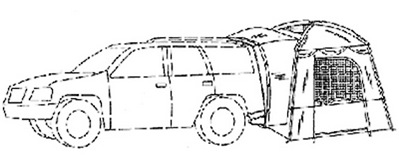
The Big Three automakers specialize in large, roomy SUV’s with indoor television and all the comforts of home. Your credit rating remains intact while the letter’s enroute, score a couple and make for the open highway.

Become an economic patriot…

“Glamping” died with Bernie Madoff, welcome to “Cramping” and the airy lifestyle of the modern American nomad.

The schools in Idaho and Montana are pretty good …

It’s best from a boat, but a big rock would be a close second

iMu iPoD speaker, any flat surface transformed into an ImpalaI figure stream etiquette rightfully belongs to the Country and Western crowd, only because the million lines of anguished prose generated each season could be crooned into a double-platinum album for somebody, there’s more suffering, unrequited love, and boorish behavior than romance and breakup ever had…
It’s the only subject capable of turning fly fishermen into women, whose forums and magazines are replete with sobbing tales about, “I was low holed and wasn’t even kissed”, “he pretended I wasn’t even there” or “I called him a sumbitch and he never called back.”

Brownliners don’t have this problem because we expect the worst from our fellow man;  while other anglers are still a rarity, people aren’t  and etiquette is when the interloper relieves himself downstream of us, rather than above.

We’re “angling primitives” – quick to anger and react with handguns, clubbing weapons, or simple hand to hand, we don’t moan or leave in frustration, we just calculate how many rocks it’ll take to keep the corpse on the bottom..

One of our most productive tools for minor infractions is the iMu Vibrating speaker for the iPod:

The iMu vibrating speaker will transform any flat, hard surface into a top notch audio speaker.

Any hard surface is transformed into a vibration transmission device that’ll rival the sound of a chopped and lowered 1965 Impala.

Don’t get mad, get even.

Perch yourself on a rock shelf or large boulder that extends into the water, savor the selection of the appropriate Snoop Dog MP3, and crank the bass – watch aggressively feeding trout vanish, the waterline rise two inches, and the mannerless intruder leave in a huff.

[youtube width=”400″ height=”335″]http://www.youtube.com/watch?v=Gz3Cc7wlfkI[/youtube]

Prolonged exposure will deafen smaller fish – which isn’t as bad as would seem, when they get bigger you can wade close without scaring many.

I’ve used Wagner’s “Flight of the Valkyrie’s” on my pram for some time, we call it “announcing our presence with authority…”

Dangerous When Wet, where you can witness the madness

Monday’s rain wasn’t welcome, I’d covered for the folks at work during the holidays and elected to take some time off after they returned to work with sugar-orgy hangovers.

It’s a carefully planned strategy on my part, the combination of Christmas and New Year’s means everyone over-spends, over-drank, and over-ate, and the crowd filing through the door on Monday has resolved themselves to a life of chastity.

Not the chipper and upbeat crowd I choose to associate with ..

I was hoping the weather would hold but it didn’t – so I fiddled with flies and naps, not necessarily in that order. I’d been mulling an idea for a “Skunk-tail Caddis” type fly, destroying it’s two-material elegance with something more involved.

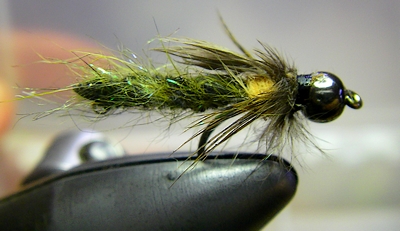
 The furry butted something-or-other

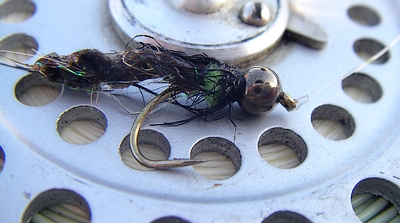
It’s more of my “furry chenille” work – an olive case  for use on the Little Stinking, a 4mm bead to make sure it’s rolling in the gravel, with a touch of “worm” color and dubbed ringneck pheasant to offer a hint of motion near the head.

I took it out this morning, and flung it at some fish. The water was plenty cold and higher than my last adventure – I figured they’d be lethargic and reluctant to chase anything, so I just let this roll down with the current to their waiting maw.

I stuck a half dozen fish in the first half hour using a dead drift, then tried it with a retrieve which yielded nothing.

 A similar variant when wet

It’s a neat little design, and completely bulletproof. I’ve got some additional tinkering to do with colors and materials, building a variety of colors for some of the trout streams up north.

Mayflies always get top billing with patterns representing every miniscule stage in their development, it’s a nice change to fiddle with something outside the norm.

In the past I’ve just tossed the fly onto the page with little explanation, I thought some additional fly tying coverage was warranted, so I’ve created simple step-by-step tying illustrations on a companion site to assist you in reproducing the fly.

I’ll put some of the patterns mentioned here on that site in case someone actually wants to reproduce them.

I’ll take Taxes for two hundred, Bob

Arnold_Troutstamp Politicians love to make distinctions that don’t exist in dictionaries. It’s part of the benefits of such a lofty post, caretaker of the public trust.

Miriam Webster doesn’t see it that way.

Main Entry:
user fee
Function:
noun
Date:
1967

: an excise tax often in the form of a license or supplemental charge levied to fund a public service —called also user’s fee

Main Entry:
tax
Function:
noun
Usage:
often attributive
Date:
14th century

1 a: a charge usually of money imposed by authority on persons or property for public purposes b: a sum levied on members of an organization to defray expenses2: a heavy demand

During times of economic hardship fees can never be taxes, as increasing taxes play havoc with economic recovery, and increasing fees just means those that used to enjoy something – pay more for enjoying it.

With the collapse of the financial system states and business’s are struggling to find new sources of revenue to bolster massive shortfalls in traditional taxes. Bond markets remain in upheaval, and many states are prevented from using the traditional tools to secure operating revenue.

That’s where you come in.

Your house isn’t worth pizzle, your investments have been cut in half, you’re squirreling money away rather than spend it, in short – you’re not holding up your end of the economy.

You’re not patriotic.

We can expect most of the 50 state legislatures to start getting creative with the fee versus tax distinction, and those groups with little representation (anglers) will pay much more for “normal” stuff.

New York state is soliciting opinion on their new 2009 Salmon – Trout stamp, ten bucks on top of the normal license fee. Salmon anglers are likely a minority – toss “trout” on the label and you’ve got everybody having to pony up.

We’re not suggesting that wardens and natural resources aren’t deserved of protection, nor are we suggesting that state’s raise and plant trout for free.  We’re suggesting these dollars will be siphoned off into the General Fund, and spent on something wildly different than their original intent.