 After a week of practice I’m the second kind of expert; I have a theory or opinion on absolutely everything, I’m quick to point out the trifling defects in everyone else’s casting, in both tackle and form, but don’t ask me to show you, ’cause I still can’t cast for beans..
I got some assistance from the fellows at the Washington Fly Fishing forum whose site is blessed with a low “signal to noise” ratio. Lots of talented folks that fling these lines in anger, and readily share what they know with a clueless prospect.
I’d found a couple resources that listed grain weights and had deduced I needed a RIO Windcutter or Airflo Delta Spey, these are mid-belly lines markedly different than the Skagit head I already owned. The Echo website suggested the Airflo and the WFFer’s suggested The Red Shed, a small Idaho fly shop, whose proprietor, Poppy – was strong in the ways of the Force…
They weren’t kidding, some fellow answers the phone and as I stutter a greeting he says, “You seek Airflo, for your rod, the #7/8.”
Now that I’m armed with the proper line, I’m captive to the weather – which is alternating between icy fog and rain. The gleaming unsoiled rod is parked by the back door and in between squalls I’m in the backyard committing a multitude of casting sins.
The pop-crack-whizz flushes every cat and squirrel hidden in the underbrush, the fleeing felines get everyone’s dogs barking, and I’ve got Grandma looking over the fence sternly – assuming I’m harassing “Pootsie-Poo” her pampered and fat Persian.
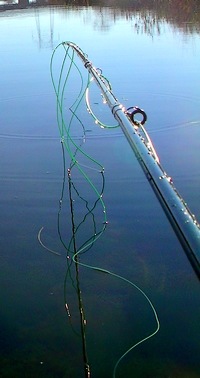
Part of the noise is my use of a “grass leader“; a knotted leader with barrel knots about every 3-4 inches and the tag ends left untrimmed. The friction of knots and tags in the grass offers additional resistance and assists in loading the rod akin to ripping the line off the water.
Despite my daily sessions I’m not able to get anything resembling what’s desired – my loop is open like a roll cast, and a completed stroke dies horribly in mid-air; no power or direction and I’m left scratching my head.
Saturday breaks with “bluebird” weather and I’m on the creek as soon as the sun is high enough to light my path. I figure an hour of practice and with my newfound “l33t” skills I’ll be rolling in fish. I figured the floating tip would be the easiest to fish with … and destroy.
Multi-tip spey lines include a floating, intermediate, 6″ per second, and 8″ per second sinking heads. They’re 15′ feet segments looped onto the line belly (both are equipped with welded loops) using a loop-loop connection which is unnoticed when casting. This is one of the areas of confusion for us beginners, some Spey lines are incomplete unless a tip is added – and are underweight because a tip is expected. The converse is also true, some lines are just tips – with no belly and it’s mighty important to understand the difference.
I’m focusing on two casts, the Snap-T and the Snake Roll, figuring I’d have them committed to memory quickly via numbing repetition rather than divide my time between a dozen different maneuvers.
There’s a wide pool a couple hundred yards below the duck blind, (far enough away from the watchful eyes of anyone inside), and I figure if a wounded mallard floats by I can grab a couple fistfuls of flank with none the wiser. Striking my best heroic pose I launch my first cast – watching it soar across the frothy water and land an astounding 20 feet distant.
That’s no mean feat with 54′ of belly, 15′ of floating tip, and attached 9 ‘ leader.
As an experienced one hand caster I know how to control the cast stroke to do my bidding, I thought I could translate the timing to the two hand rod and get some semblance of the correct cast.
I was dead wrong.
Water tension replaces the wait on the traditional rearward false cast, and the amount of time the line is on the water determines how much you’ve got to rip off the surface on the forward stroke.
Terms like “kiss and go” have meaning now, a peck on the cheek is what’s needed – and I keep swapping tongues..
The Snake roll was easier to learn and I was able to get distance even with an unguided and hideous open loop. The Snap T was a disaster – but I was able to get the snap portion operational. I think I managed about 40 feet with 70′ out of the guides.
The water is the backcast, therefore casting is entirely foreign – it’s neither intuitive or easy to understand the rod physics or the water load component.
My biggest problem is too much strength. Watching the videos on YouTube you see the rod cradled by the upper hand, and I’m “white knuckling” the cork with all the finesse of a baseball bat.
My hour passes and then some – and because I insisted on realism, I’m out a dozen flies. All of them cracked off by my baseball version of the Snap T. None entering my torso unbidden – so I’m succeeding at building the necessary self preservation skills.
I managed a little fishing, but the fish had all expired in laughter – I couldn’t see their carcasses as I’d put a nice “head” on the creek akin to bruising a good lager.
I’ve confirmed what Spey is useful for and what it’s not. It’s a “big water” fling and swing style ill-suited for my little creek. Retrieving flies close means you have to shake all the line out of the tip before the next cast, and while the casts can be used in close quarters with traditional lines – it’s not a style requiring you to suddenly replace all your tackle in a mad rush to be first.
The extra handle below the reel does have issue with bulging front loaded vests. It’s used in lever-action mode, drawing it into your brisket with each cast. Once I learn the proper cast – this may not be much of an issue, but I thumped my fly boxes routinely – something unnoticed in my backyard proving ground.
I’m going to transfer the line to my one-hander. This will eliminate the unknowns of the long rod and let me experiment with the timing and casts with known equipment. It’ll also aid in fishing, because I can fish through the run using traditional casts, then beat the water to death afterwards.
After wind milling a 13′ rod through 30 minutes of Snake Roll, I was feeling the exertion. It’s a great workout – it’s not supposed to be, but I’m grasping at any positives.
 The wind started to pick up a bit, and I’m hearing the staccato reports of gunfire upstream – not duck hunters, someone’s unloading seven round clips of Eastern Bloc high powered stuff – which can go some distance.
I’m up and out of the streambed quickly so’s I can be seen, and stumble into the last convoy out of Sadr City. Four motorcycles, 2 ATV’s, 2 trucks, and a dozen pimple-faced hardcore types looking stern and scanning for FSW’s ..
FSW’s are more dangerous than IED’s and common to California watersheds .. it’s easier to yell “FSW” to alert your buddy to “Fleeing Startled Wildlife” – otherwise you’d fail to empty the entire clip into its carcass.
I gave them a wave and headed out of Baghdad, hoping to clear the watershed before the gunships rolled in…
More suffering to follow.
 I’ve often heard the lament associated with the decline of the world’s rain forest, how the loss of countless unknown species of flora and fauna may be of enormous impact – as some rare tree frog or rain forest lily may hold the cure for cancer.
 I figure stream etiquette rightfully belongs to the Country and Western crowd, only because the million lines of anguished prose generated each season could be crooned into a double-platinum album for somebody, there’s more suffering, unrequited love, and boorish behavior than romance and breakup ever had…
 Politicians love to make distinctions that don’t exist in dictionaries. It’s part of the benefits of such a lofty post, caretaker of the public trust.
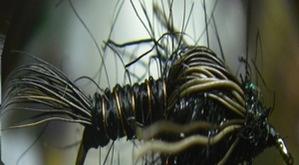 Fish vision is not binocular, they must integrate two separate images of the same scene when looking to the front. There is a gap of missing information between the two images – as fish have eyes mounted on their sides and cannot see what’s in front of their nose.
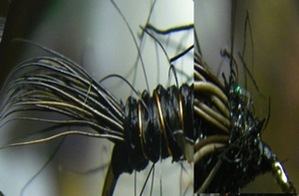 Fish eyes have evolved over many millions of years in a pristine environment, now the Man has “muddied the waters” vision is limited by turbidity, and fish diets are changing –
  It’s the latest trend among those in power – circumventing the normal political process with urgency replacing the painstaking scientific work, and when called to task for the crime, blame the other fellow for not thinking for you.