Author Archives: KBarton10

Retail woes continue unabated

layoff Our economic woes continue to devastate the sporting fraternity, with the “big box” stores taking it on the chin.

Orvis laid off an additional 30 employees from its Roanoke, Virginia operations, Eddie Bauer severed 198 employees as part of a 61 million dollar restructuring, and even Bass Pro has let go of 50 associates.

Calling the fourth-quarter retail environment “brutal,” Eddie Bauer also announced recently that it will reduce the size of its board from 10 to seven members and freeze salaries.

Frugality is “in”, and as I mentioned earlier, we’re just seeing the tip of the iceberg. Orvis’s Virginia operations were the source of many of its “tent sales”, which may affect the volume of tackle on eBay as well.

An economic “perfect storm” – record drought in the West, coupled with economic turmoil suggests trips will be fewer and earlier in the season, with the balance of the year handicapped due to low, warm water. The shops buttressed by guide revenue will not be immune.

That which will never be spoken in polite company

USDA inspected For fly fishermen it’s the number we’ve always feared. We think about it with every trip but it’s strictly a “don’t ask, don’t tell” topic in the parking area.

Spouse and family members have brought it up multiple times, we shrug and pretend we didn’t hear, often followed by some weak retort on what they’ve spent recently.

Not one for politeness, I’ll just stomp on your hobby and tell you.

Six dollars and thirty four cents per pound.

… and that makes your average 12″ mountain bred trout worth nearly $3.16 each.

Figure a $1.50 per fly, you’re at break even if it takes two to catch one.

I’m wincing too, given the cavalier way I treat my bugs. They’re quick to tie and just as quick to adorn a tree branch, yet somehow I figured my investment was being squandered a little less quickly.

… and here I am poking fun at hedge fund managers for pissing away our collective earnings – when they may have done us a favor by taking it all at once.

Figuring a typical weekend afield is; $40 worth of gas, $50 lodging, $40 in food, and $50 worth of tippet and flies, you’ll need to catch and eat 28.4 pounds of trout to break even.

Look at the bright side, a brownliner has to eat nearly 300 pounds of carp in the same period. Yummy.

Is the garage the only possible venue for wildlife art?

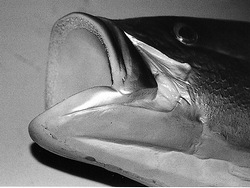
The dreaded dead fish trophy Art and the sporting fraternity have an uneasy relationship, usually predicated on a spur of the moment artistic bent, followed closely by the threat of divorce.

There’s nothing sporting-neutrals fear more than a spouse bursting through the door, scanning the living quarters for an appropriate shrine, then nailing some gawd-awful dead thing to a living room wall.

Degas, Gogan, and Van Gogh knew there was no money in immortalizing his Lordship’s catch, so they cashed in on the portrait craze, occasionally painting some fellow bait fishing in the Somme, Seine, or Rhone, but that was pro bono work.

There’s a couple exceptions to the rule; duck decoys come to mind, but only because they depict something living, while the Big Game crowd and fishermen drag bloated carcasses into the living room insisting the lifeless stare of dead animals enhances Puce divans and ancestral china.

A pastoral scene featuring an angler casting flies can pass muster – but it’s unsatisfying as it lacks testimony to our personal skills, which is why the stuff we like hangs in the garage.

I’m thinking there’s a chilling message in all this. It’s unfortunate, but the living critters we’ve spent half a lifetime chasing are prettier alive – which is why the Bible insists Jesu Christo was a fisherman, but lacks a “grip and grin” sketch, no marble saints holding largemouth bass, and little proof other than he could walk on water – a skill only a fishermen would prize.

The DaVinci Code was a work of pure fiction, but is it too much of a stretch that the oppression we face in possessing sporting art might have some secret society at it’s heart?

… and in some dusty vault under the Sistine Chapel, a forgotten trophy might adorn a small alcove – proving John the Baptist was a fly fisherman – and the baptism ritual was developed because both the Tigris and Euphrates were a sumbitch to wade in sandals?

Thin. Really thin.

The whole religion thing has me wading a slippery slope, but after seeing the mosaic unearthed by Buster Wants To Fish might some canny fellow have retouched other relics under the direction of a shadowy splinter society?

Add the good nun, Dame Juliana Berners to the legend of the Holy Grayling – and I’m hearing black sedans in my driv

Nothing makes the fur fly like using the wife’s coffee grinder

The Essentials, a round of Beaver, Woodchuck, and Red Fox SquirrelUs impressionists are a tough crowd, you’ll regret us painting your house because of all the spots we miss – but we’ll march you across the street and insist the color looks fine.

We’ve got more theories and hare-brained ideas than the average fly tyer, most won’t hold water so we wander around the fly shop sighing heavily, and then go home and make it ourselves.

Materials vendors don’t cater to guys that tinker, and that single-shade pack of rabbit would work well on a small dry fly, but we’re cooking up something with lead and multiple X’s of hook shank. Two bucks worth of bunny bottom just don’t cut it, and while the Australian Opossum was close to the right color, we could’ve snorted that microdot of hair and not sneezed.

For us, 2 x 2″ is an appetizer, and at those prices an expensive one.

I was taught that a good dubbing is crafted like a fine cigar; comprised of filler, binder, and wrapper, special effects can be added after the dubbing is complete, but the basic recipe is identical to a good smoke.

There’s an art form to winding up with what you intended to make; almost everything you construct will have some usefulness – but the thinking and planning are relatively easy – execution takes a little practice.

You’ve got only three obstacles, texture, color, and target application. I started with a couple colors of wool yarn, tossing in a hint of this and a dab of that – then when I’d stumbled onto something good – found I could never make it again.

Jotting down some recipe notes is required – some units of measure would be nice too. Square inches of hide comes to mind, as in, “I clipped four square inches of coyote, added four square inches of green mink, and dipped the result in my coffee – accidentally.”

That’s enough to get close.

With my blends I’ve learned to target a hook size with the completed product. The precise mix of filler, wrapper, binder and special effects changes depending on whether you’re crafting dry fly dubbing, a general nymph blend, or something for making giant stonefly nymphs. My General use blends target a #12 hook, dry fly blends I’ll target a #16, and for big stuff, I’ll want a long shank #4.

The above rule isn’t hard and fast, it’s my personal preference – this allows general purpose blends to work with dry flies as well as nymphs.

Once comfortable with mixing and colors, use Coffin Creek Furs to score the skins you need. Always opt for the damaged ones as they’re the cheapest and you’ll be shaving it anyways.

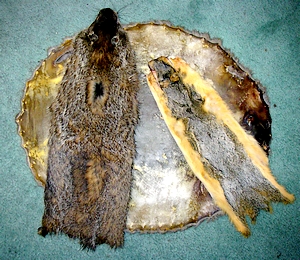
Be forewarned that real hides from a furrier can be a really good deal. Beaver is sold as “rounds” – the skin is stretched to a circle, a 20″ round that’s damaged may only be $10.00. That’s an “extra large Pizza” worth of Beaver – and will make you reticent to pay $2.50 for the little dust motes sold by the fly shop…

Filler: The filler is comprised of inexpensive coarser hair – it may contain guard hair, but is usually typified by “curly” fur fiber. These bends and kinks will be preserved in the final product and will add air and mass to the blended furs so it resists matting.

Example: Australian Opossum, Mohair, Wool,

Binder: The binder is usually a semi-aquatic mammal. Their fur has the smallest filament size and is quite dense, it assists them to remain warm despite constant exposure to cold water. The binder will coat the filler and wrapper and assist your fingers when you want that mess on your thread. Binder is your friend and can tame the most unruly fur.

Example: Beaver, Mink, Muskrat, Otter, (if nothing else is available, rabbit)
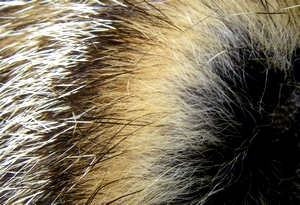
Woodchuck body, the blond tips and tan band will take dye really wellWrapper: Wrapper is present on blends for larger flies and can be omitted for building fine dry fly dubbing. Wrapper is usually an animal that has pronounced guard hairs – often with a light band that can absorb dye. It provides “spike” to the blend and breaks up the uniformity of the other two furs.

Just as important, because we choose it for the guard hair, we’re introducing six or seven new shades to the blend. If you’re going to dye the result those shades will break up the even color and add light and dark splotches within the mix.

Example: Hare’s Mask, Red Fox Squirrel body, Woodchuck body

Special Effects: Special effects describe any enhancements added like glitter, shine, or contrasting color. Materials chosen impart an affect to the entire mix like spectrum or sparkle.

My use of sparkle increased with proximity to Brownline prey. The waters are often milky with effluent during peak farming periods – and coupled with Winter drainage I have to help fish see my offering.

That’s translated well to trout fishing, as I’ve found the pedigreed blue water fish like a hint of sparkle in their food too. Usually the special effect component is less than 10% of the final blend.

Example: Baby Seal, Soft Crimp Angelina (Ice Dub), and Spectral

Spectral is the color combination of the primary and secondary colors of the color wheel; scarlet, yellow, cyan, orange, purple, green.

Use a coffee grinder (maybe $15) to blend colors and fur, most of the fur you’ll be using is less than an inch in length and won’t bind the grinder motor. Lacking a grinder, use a empty quart jam jar half filled with water – shaken vigorously it’ll mix hair in seconds.

If your fur source is fresh killed or road kill, toss in some shampoo to remove guts, blood, and tire marks. Repeat with clean water to rinse. Large batches are best mixed with a big container or a garbage bag.

Smaller hooks need more binder (the really fine fur), general use blends are roughly an equal mix, and the large hooks require more filler and wrapper. The completed mix shouldn’t require the tyer to load the thread more than twice to finish the fly body, and if you find yourself adding more than a couple applications of fur – your blend is best suited for a smaller hook.

The indispensable materials are Beaver and Red Fox Squirrel body, both are dirt cheap and plentiful. You’ll get additional use if your source has the Squirrel body in tanned flavor – as it makes the stunning fur strip leeches – the bands of color makes the rabbit versions look limp in comparison.

Adapt, evolve, and overcome – free yourself of what’s on the retailer’s shelf and make what you really need, just remember to clean the kitchen spotless – or it’s your hide we’ll be admiring.
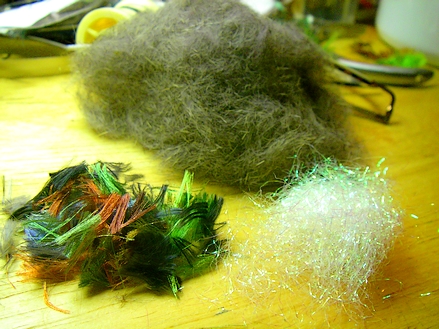
A pile of polyamide scrap, some Angelina fiber and the base blend, ready for special effects

Above is a general purpose blend of Australian Opossum, Red Fox squirrel body, and dark gray beaver. In it’s present form it’s useful for both dry flies and nymphs. I’ll add chopped polyamide “clownshoes” colors – leftover from the streamers I tied for a spectral color effect, and add about 5% sparkle to the blend using Soft Crimp Angelina, in the opalescent “Aurora Borealis” color.

The Polyamide fibers are tiny – half the width of a beaver fiber, so the spectral affect will not be pronounced, it’ll still look like a gray blend until I dub the flies where a close examination should make colors  show more plainly.
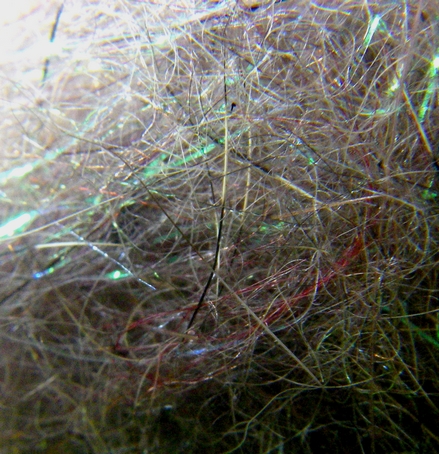
Closeup of the newly blended dubbing complete with special effects

A close up of the finished blend; three natural furs, polyamide, and Soft Crimp Angelina. The polyamide fibers offer a very subtle color effect.
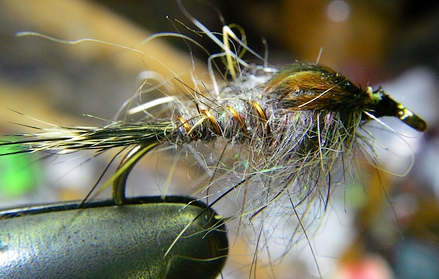
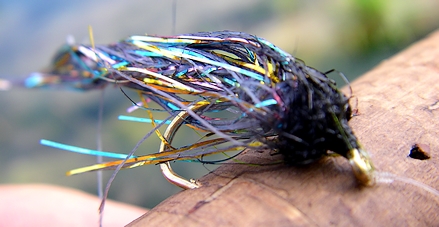
A #12 Copper Hare's Ear tied with the fresh batch of dubbing

… and a #12 Copper Ribbed Hare’s Ear tied with the mixture. I touched the thorax up with Velcro to add some additional scruffiness.

Total preparation time for the fur blend was five minutes, resulting in about ½ ounce of this color. That’s a ball as big around as your clenched fist – and should tie a couple hundred dozen trout flies.

Mix Blue and Brown and it still winds up Muddy

Oh, Dear! The Sacramento Bee reports that to maintain my Brownline status, I’ll have to move.

Tom Chandler over at the Trout Underground and Roughfisher are likely to accuse me of “selling out” – backed by numerous posts on how they didn’t like me anyways. Once they find out my beloved Little Stinking is being bandied about in the legislature to achieve “Wild and Scenic” river status, it’ll sort my pals from the camp followers …

It shows the steep decline in California waterways … we’re going to consecrate mud puddles next.

I can personally vouch for the wild and scenic thing; short of a bawdy house – it’s all floated by me, ricocheted off a nearby rock, or colored the air with decay, and I doubt I’ll be truly surprised by anything other than a tour guide pointing me out as the Old Man of the Sea-wage.

I did effluent before effluent was cool … and the stuff you’re wading in? Tame compared to what I used to walk through, why I remember back in .. ought 7, when …”

Maybe if I practice enough the nature crowd will toss me quarters, or slivers of sardine.

The unbreakable bond with my readership can withstand any hardship, now that they know I’ve been unknowingly victimized.

Perhaps after I donate my vast collection of graphite rods as freebie contest prizes, a few stalwarts might remain – I’ll need assistance on my conversion to bamboo rods and dry fly only, upstream presentation.

Actually, nothing’s changed. The headwaters of the Little Stinking have been nominated as has many hundreds of thousands of acres adjoining. There are already two wilderness areas designated along its path, and it appears a great deal of real estate upstream of me is included.

There may be a small silver lining, but the agribusiness of the lower river is sure to fight restrictions tooth and nail, perhaps they’ll no longer be allowed to direct their raw effluent into the drainage – or maybe they’ll let a little water through during the summer to simulate a permanent flow.

Then again – it may get new restrictions that prevent me from fishing it. Upstream counties close the Little Stinking along with normal trout season, only the effluent rich county I live in allows year round angling.

… and Tom, Slaw Dogs are a crime against humanity, not a suitable mascot for a “muddy” blog.

Hardy and Grey’s reintroduces the glass – carbon composite

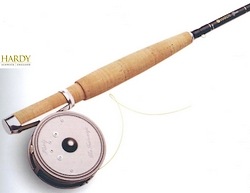
Hardy glass fly rods Not to be outdone by the Retro Movement, the venerable Hardy and Grey’s dips its toe in the fiberglass market along with Sage.
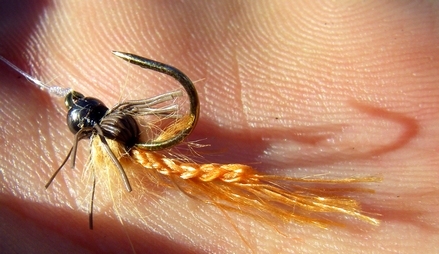
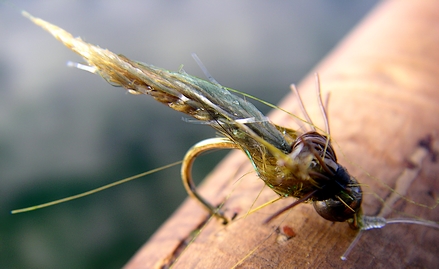
Four rod models are available; Aln, 5′ for #2, Brook, 6′ for #3, Stream, 7′ for #3, Test, 7’6″ for #4, and Trout Fisher, 8′ for #5, retailing for $300 to $400 each.

These are composite rods using a mixture of 90% glass and 10% carbon fiber, akin to the many hybrids of the 1980’s, when carbon was first introduced.

The companies website and it’s international sites are down for renovation so very little technical detail is available.

I smell a push into American markets, solidified by their opening of a 14,000 foot distribution center and retail outlet in Lancaster, PA., last month, and creation of the wholly owned subsidiary, Hardy North America – suggests a larger strategy to come.

If they can weather the economics, they’ve certainly got the brand.

It whispers to me, telling me to do bad things

I stopped fighting it long ago. You’re standing there holding your gal’s purse while she’s swearing in the changing room attempting to make the size she wore in High School make it over the convex of midlife …

Guys have it so easy, “I need a bigger pants size … must be I’m hung better.” Whatever the inner voice whispers, it’s lying to them and dissembling to us.

Good trade.

I get the same voice whispering at me when I’m fondling some gawd-awful material last worn by the Bee-Gee’s, and even then it was questionable.

Roughfisher calls it “Clownshoes” – and I do my best to defend an “artistic challenge” – figuring that was the reaction all them other fly tiers had – and how my pending discovery of an unknown fish weakness for Pink Lame’ is about to change fly fishing forever.

That same voice claims Van Gogh sold nothing early in his career ..

A break in the weather afforded an opportunity to stomp gravel, and I was quick to take advantage – in spite of a month of zero luck. By now the lower river had consumed the piles of goat guts, allowing me to use the bridge access without fainting.

I stuffed the latest 10 “Clownshoe” candidates in an upper pocket and figured I had enough time to roundtrip four miles before them big gray thunderheads drew close.

 The latest clownshoe candidates with skein of yarn in background

I had a couple new yarns from Turkey – and the little voice yammered overtime – I took one look at the rainbow color and polyamide braided mayfly nymphs leapt out of the vice. The above samples are size 14.

Polyamide (a form of nylon) has a sheen that becomes translucent in water. The double eyelash streamers had shown me just how remarkable it looks – so I figured a smaller gauge would lend itself to mayflies and damsel nymphs.

Four miles later I was still wondering – the lower river was lifeless.

The Rusty Orange clownshoe, figure it darkens and is transluscent 

The physics trials went really well, but the fish are nowhere to be found. Tied on the small scud hooks with a 2mm gunmetal bead, the fly flops over nicely and rides hook point up – a requirement for Brownline fishing.

The damp Olive Clownshoe, the material shows its opaque and transparent areas 

The translucent effect is still present, the braided area is opaque and the filaments turn ghost-like when wet. It’s a promising look that we’ll try later, when the fish have decided to eat again.

One ball of yarn and all the colors in the rainbow makes a daunting artistic challenge.

The disco yarn even looked good – but this will have to wait until the next steelhead trip – or Spring, when the good citizens of the Little Stinking abandon all semblance of refinement and eat broken glass …

 The Bee Gee's probably wore this before being stoned by the crowd

It’s another Turkish export, 65% Polyamide and 35% Mylar – and it’s bright enough to make you cringe, just what’s needed to make a big Steelhead hear the little voice that tells him, “Shazam!..”

Just be glad Ma didn’t gift you this sweater for Christmas …

I was thinking durable – how I might singe the end with a lighter just to make sure it didn’t unravel, when a big Sacramento Sucker came upstream at me with “Durable” written on his back..

 He's awful lucky, Osprey's don't normally get just one fistfull

Despite his appearance he was mighty lucky, Osprey don’t usually lose their grip. In his case, his weight tore the talons out taking with it a walnut sized chunk of his back. This fish is about 24″ long – he’ll live.

Things that make you go, huh?

The Moffitt fly fishing system The “system” word always scares hell out of me. I’ve always assumed it’s the rugged individualist that gets squeamish at the thought of tailoring his fishing to someone else’s system; it doesn’t mean it’s bad – we just know our opportunity for freestyle points evaporates.
Circle hooks have really made an impact in saltwater – and most of the big game market has converted to their use. Moffitt Angling has adapted Circle hooks to their hookless fly fishing system.

My reaction is like everyone else, “Huh? Eww…” But that’s based on years of conventional fly fishing – and like they say, only a baby likes change…

Hookless soft cored flies attached to a leader via looped connection, with the leader tipped with a Circle hook. Fish eats fly, angler sets hook, and hook makes contact with outer jaw only.

The theory is sound.

The hideous flaw is angler ego, now that bug and hook are separate they can be differing sizes, and ego will dictate the #24 Trico will be used in the retelling , even though the Circle hook was a #14.

Despite the ease of release and the claim that fish no longer need to handled – they’ve forgotten the need to immortalize the event, so the fish is yanked out of the water and manhandled for the lens…

The Science appears sound, it’s us that may need changing.

It’s always interesting to see something that doesn’t fit the traditional mold, you may want to visit and watch their video on how it all works.

The white dinner jacket is optional

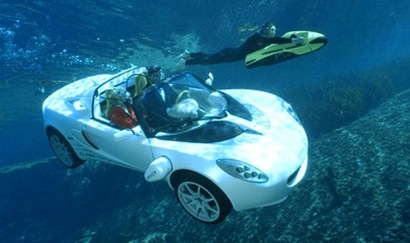
Waders have always served well in the water and can be bestial on long treks from the parking lot. Rather than take a chance on the viability of the Big Three automakers, perhaps you can convince the spouse to kill two birds with a single stone

It's greener than green

Three onboard electric motors coupled with zero emissions and biodegradable lubricants yields a 13mph underwater speed; fast enough to get into the holding water before the competition realizes their foot’s missing.

Not many of us can pull off the white dinner jacket, “Olive, Pale Olive” line of Hollywood legend, but herding steelhead would be fun for a change – and if you live near the coast, DUI’s may be a thing of the past. One good wrench of the wheel and the arresting officer is calling an ambulance – while you weave your way through the yacht traffic..

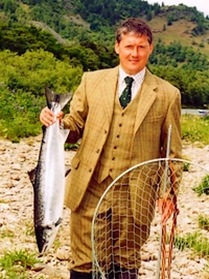
Tweed might itch, so we’ll let you wear Polyester

A Professional - you can assume the tie is a clue Professional has its moments, but if “Unwashed Bob,” who catches more fish than any human alive, is unbooked, wouldn’t he be equivalent to a smiling courteous staff?

“Professional” is as common as fish on ads for fly fishing outfitters, lodges, casting schools, waders, and accessories. Vendor coffers spew oodles of dollars to show beaming clients, pristine cabins, heroic guides, and crisp linen. Owners insist that their clean cut “professionals” are of different cloth than the hard drinking, eye patch wearing, womanizing brutes that made your last trip an adventure.

Is professional really so, and do we need it?

The foundation of fly fishing lore is some crusty local whose homespun wit and flies makes enormous fish do bad things. His secret is the unique color of the flea bit hound snoring on his porch, who might resent being awakened but doesn’t mind you yanking a handful of dubbing – unless it’s from a sensitive area. 

Miriam Webster defines a professional as, “participating for gain or livelihood in an activity or field of endeavor often engaged in by amateurs.”

That covers the full gamut – from part time guides to full time drunks.

Guides would be the first to complain, as full time guides are superior to part timers, and local full timers are seated next to the Holy Ghost hisself.

Using the same criteria, the little Sri Lankan gal tying Hare’s Ear’s for a dime a day – why isn’t she awash in certificates? She’s a professional, she lacks the free time to become the complete fly tier as we know them, but after tying 47,266 #14’s, I’d include her in any sweeping usage of the term.

Apparently there’s more than one kind of professional, and confusion lies in the small advertisement space, wherein the proprietor doesn’t have the print real estate to explain which kind of professional he’s employing.

If I’m engaging a bush pilot for the last leg to the lodge, I’d prefer the Professional professional, the fellow with a silk scarf that flew P-39’s with Claire Chennault, not the regular kind. If I’m fishing in bear country, serenaded by the roar of Grizzlies, I want the fat and slow professional, the fellow that wheezes after a single flight of stairs. If I’m learning to cast, certification is an aging yellow paper, I’d prefer the medical professional, as we’d both save money on the insurance.

Accommodations are professional, I want an empty ashtray, clean linen, and the professional steak; most steaks were actually cows, so they can’t be professional, I’m willing to take my chances with the stem cell variant.

… and for all else, I want them hard drinking homespun fellows from down the street. They ogled my daughter, swear at me for mistakes, and serve bologna for lunch – but the pictures I show the office won’t have any of that – just a lot of slab sided, dripping fish with me “making heroic” in the background.

Real professionals wear ties. They dress up to fish, invented the fly you’re using, and can add 60 feet to your cast just by uncrating the crystal dinnerware.