Author Archives: KBarton10

Is there two kinds of cheap

Defiant until SquashedLike you I received my latest fishing catalog and saw carbon rods had finally surpassed the thousand dollar price point. My thoughts on this topic are well documented,  but I couldn’t help wondering – has the price of graphite made bamboo rods a bargain?

Prices listed in the H.L. Leonard and Orvis catalogs of the 1980’s were more pronounced, a graphite rod was in the vicinity of $165, and their bamboo counterpart somewhere between $800 to $1000 each.

Today the graphite is $1000, and the handmade bamboo is somewhere between $2000 and $3000 per rod. Comparatively that’s a decline in the difference between the two of nearly 50% in 28 years.

The raw material used to make carbon fiber is called the precursor. About 90% of the carbon fibers produced are made from polyacrylonitrile. The remaining 10% are made from rayon or petroleum pitch.

During the same period bulk pricing of Polyacrylonitrile fiber has decreased from roughly $6 per pound (1984), to about $0.30 per pound (2005). Once used solely by the military, carbon fiber precursor is now part of everything from cars and cement to roof tiles and outerwear.

Tonkin cane has always been the preferred bamboo source, and while prices spiked in the late 60’s and early 70’s (because we were napalming it with great gusto), relationships in the region have since normalized. Tonkin cane was about $10.00 per bale in the middle 70’s, and today a bale, 20 culms, is nearly $400. (Cheaper if you travel to China and purchase your own.)

Figuring the balance of parts used on graphite and bamboo rods are similar; Portuguese cork, carbide guides, stainless snakes and tip, etc., we can assume the material costs of making a bamboo rod has risen considerably while carbon fiber has declined during the same period.

As carbon is tied to petroleum costs, it fluctuates with energy prices, but as carbon fiber and precursor is used by hundreds of industries and world production is in excess of 500,000 metric tonnes, mass production has lowered the cost dramatically.

So, why have graphite rods prices increased so dramatically?

I can’t answer that, and rod companies won’t.

Some  rod company executive is likely spitting venom at his screen – claiming I’m one in a long line of simplistic rubes that couldn’t possibly understand the economics of rod construction.

Largely true, but only the TARP bailout has less transparency than rod companies and their cost structures.

I think it’s time to buy Bamboo. I haven’t heard of any breakthroughs in mass production that would account for the decline in bamboo rod pricing, it’s plain that these rare craftsmen charge less per hour today than they did 28 years ago – and should rethink that.

$6500 per handcrafted and handrubbed specimen would restore parity, until then $2000 per rod is a bargain.

All Hail the coming of his Flaccid Porcine Awesomeness

Suck her down, Bro Terms like “girth”, “chunky” and “football”, sprayed at large fish by those lucky enough to have hooked an uncommon specimen. The rest of us nod, recognizing the use of reserved fishing superlatives.

So what are we going to call the exceptional blended farm-raised-wild strain of salmon?

Tom Gill of Dalhousie University told The Chronicle-Herald newspaper in Halifax said producers complaining to him about the texture of their farmed fish can blame themselves for adding fish oil to the salmon feed to increase their weight.

Some ponderous lard body rolls on your fly, giving you a brief and lethargic dead-weight squeal to your drag, then points itself at your feet and gasps in long sobbing wheezes, while drooling all over your shoe.

“So you can fatten the fish up and make them heavy in a hurry by feeding them a high-fat diet, but it gives you a really sloppy sort of soft texture,” he said. “If you’re feeding them a high-fat diet, it’s like feeding an individual on a diet of peanuts and potato chips only — of course they get flabby and soft, and that’s what happens to the fish.”

I’m thinking that this has to turn the angling world upside down. Noble Salmon reduced to crack-whore status, spurned by legions of former aficionado’s, and loved only by the Malibu physician administering celebrity facials

A “fatbody” isn’t getting up for the morning bite, it’ll be napping by midday, and will skip dusk in favor of the all night drive thru – where it won’t have to display it’s sickly, pale flesh to the gaze of bystanders.

In the latest incident, at the end of last week, 30,000 maturing 2.5kg (5.5lb) fish escaped from their cage in West Loch Roag, off the coast of Lewis, after a seal attack.

The escape, which was detected four days ago, comes at a time when wild salmon are approaching the rivers to spawn, meaning that there could be intermingling and genetic dilution of the wild fish. These are extremely fit creatures, swimming thousands of miles across oceans, then battling their way upstream.

If they spawn with the flabby, cage-reared fish, it is claimed that the offspring can be genetically weak and the wild salmon population, which is recovering after some very bad years, could be threatened.

The Association of Salmon Fishery Boards and the Rivers and Fisheries Trusts of Scotland are now preparing a formal complaint to the European Commission.

In the states, we’ve always asserted that “wild fish” were superior in every respect to their hatchery counterparts, but will that remain true? Hatchery fish have to make the same journey as a wild fish, imparting some common sense and muscle tone, with the addition of a flabby panting farm fish in the watershed – will we have a new respect for its pen reared migratory cousin?

… and will we invent new terms of endearment and prowess? “Half Pounders” refer to returning small steelhead, will we call the smaller farm fish a “quarter pounder with fleas?”

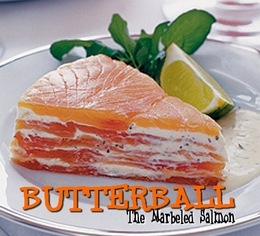
Will the “honor roll” of distinguished names; King, Chinook, Pink, Dog, Chum, and Silver, be augmented with the Butterball and Acne variants?

“I prefer the Butterball, less stretch marks on the fillet, and the timer pops out when it’s done.” 

Go ahead and giggle, a couple seasons from now that could be you talking.

Police identify thief in fancy carp burglary

The Thief is unrepentant Police in Suffolk, England have closed the books on a £10,000 theft of rare carp. Over the course of a few weeks 23 exotic Koi were stolen from a backyard pond.

Among the highly-prized fish which vanished from a home in Carlton Colville were three ghost koi carp worth £500 each, a three foot long orange fantail koi carp and a gold koi carp.

Police in Lowestoft feared that a professional thief had stolen them to order and issued this appeal: “Did you see anything suspicious in the area or have you been offered any similar fish since?”

No mention is made of stakeout, infrared sniper scopes, or surveillance, but the thief was observed lounging in a neighboring field, a well fed Great Blue Heron…

“Thankfully on this occasion an arrest wasn’t necessary.”

Here in the States, I’m sure the distraught owner would have insisted on a civil suit and a firing squad.

A dollar says he stops helping himself to the Precious

Revenge served waist deep in cold water I was beginning to think stern looks from anglers were due to the similarities fly fishing has with the workplace. Guys on vacation smile and hold a dripping fish close to their chest, but guys at work thrust it towards the lens to look focused and professional.

Another silly idea proven wrong, but fly fishing and the workplace share one common feature and that’s ants.

Everyone knows the ant(s) where you work, and if you don’t – then you’re the guy that inhales everyone’s donuts and never brings any, the guy that fingers lunches in the communal refrigerator, the guy that knows the location of every candy dish for six floors, and more importantly – when they’re undefended.

You’d better nod vigorously … and while protesting your innocence perhaps you may want to question similar behavior when fishing?

Every fisherman I know can point to the pal who insists he’s required to share flies with, “one tenth of his get” donated to a callous GrabbyMitt with a drooping backcast.

I suggest something like leaving him in the parking lot at dark, or pulling a runner and sticking him with the breakfast tab, and the complainant usually scuffs his toe whilst looking downward, mentioning something like, “… can’t, I married his sister” or ” … I’d like to but Ma would ..”

Revenge is a dish best served in cold water, I may be able to assist.

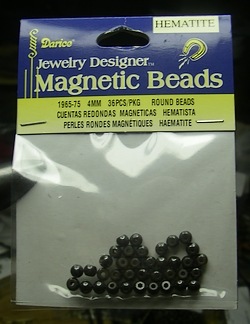
I’ve been fiddling with magnetic hematite beads, hematite being an oxide of Iron – non corrosive and not as heavy as traditional brass or copper beads.

It yields a beadhead fly with a slower sinkrate than traditional fly tying beads – but more importantly, if you toss a handful in your buddies box it’ll cause every loose fly in the compartment to instantly polarize, gluing itself to the closest bead. It’s a dramatic effect on small flies – and while “Grabby” is separating his #16’s from his #24’s – you’ve got ample time to take ownership of the water he was laying claim to …

Toss him a half dozen and make sure they land in all the small fly compartments.

I haven’t had a chance to try the super-conductive Hematite version, mainly because I pick up too much debris on the Little Stinking with the regular flavor, most of the streambed appears to be metallic fragments, and coupled with algae – it’s just plain hard work.

Is the next truly indispensable material a Mutt

Somewhere some poor fellow is crouched over his vice cursing a blue streak, all he needs is a Halloween Orange or black spey hackle and the fly in his head becomes reality. It’s the classic frustrated artist, on the verge of greatness and the drawer yields nothing but earth tones of wool or polypropylene – none of which possess the qualities he so desperately needs.
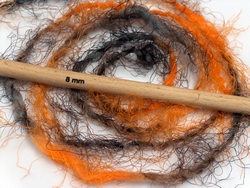
Some fellow is looking for this now

So is it the fear of entering a store full of women that’s his undoing? One of his pals is likely to see him talking to the counter help discussing the relative merits of flag versus eyelash?

… and why is it that fly shops insist on stocking a token contingent of lifeless wool in muted earth tones? There’s plenty of natural fur in the same colors further down the aisle, the wool doesn’t sell worth beans, has poor tying properties, and is so common that even we know three yards for a buck is a waste.

It’s what we don’t know about that could be really useful, usually we stumble upon it while standing at the end of the aisle, her purse in hand, giving the “I’m with Madam” look to quizzical bystanders.

Guys have always prided themselves by calculated shopping, and cannot abide the poking, prodding, browsing, got-to-touch-it method that gals practice.

Sorry, Sweetness. If you want the “good stuff” you’re going to have to earn it.

Yarns have three basic fly tying properties; the wrap, rend, and the comb:

Wrap: the most obvious, what you wind up with if you wrap it around the hook shank.

Rend: what it becomes when you cut it into 1″ pieces and tear it apart in a coffee mill.

Comb: How spiky it is when wrapped around a hook shank then combed with Velcro.

Size, shape, and texture are described by the yarn itself, often using reserved words familiar to knitters and the millinery crowd, like: Boucle, Chenille, Mohair, Flag, Ribbon, Eyelash, and countless others.
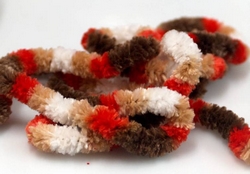
Anyone tying a caterpillar?

What’s apparent is many of these odd styles offer some streamlining of the fly tying process. They’re not just body materials any longer, many provide hackle, wingcase, or other detail at the same time.

The variegated Orange eyelash yarn above can tie a spey fly with better movement than heron hackle. Yarn fibers are “loosely coupled” rather than affixed to a rigid and brittle stem – and while the rest of the fly tying world seeks the next emu saddle or dyed pheasant heron replacement – you can enjoy 80 yards of uniform sized spey hackle for about ninety eight cents.

It’s tough being so narrowly focused on endangered wildlife  especially when your wife solves your problem in the millinery aisle.
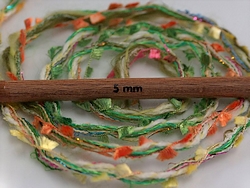
Flag Yarn

Perhaps it’s why the lament about “nothing new” is oft heard, we killed and pelted anything bigger than a fingernail, and the physical restrictions of bird feathers and natural fur have been well defined in the last couple hundred years.

What we’ve got that they didn’t have is synthetics – and they’re just as varied and colorful as exotic birds, something I’ve been dabbling in while my compatriots focus on perfumed emu bottom.

There’s hundreds of thousands of yarns currently available, and many more hundreds of thousands of colors and textures made in the last couple of years. So many that you cannot possibly see them all.
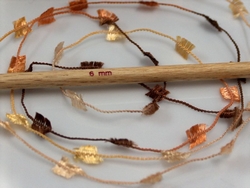
Butterfly yarn

Fashion dictates what’s made and in what colors, and with the short lifespan of garments, you may only stumble on a handful before they’re no longer made.

Yarndex.com is an attempt to catalog every yarn ever made – and is an indispensable resource for finding both manufacturer and what colors were made in which year.

Like automobiles many manufacturers only release certain colors in certain years. Finding that “perfect” olive color might be a couple years too late – with only eBay as a potential source. Yarndex displays a dated color card for each year of manufacture – and also will tell you whether it’s currently in production.
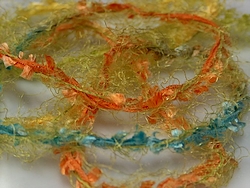
Bowtie Yarn

I’ve intentionally narrowed my project to cover qualities that Mother Nature’s materials often lack, movement and vibrant colors. Birds and beasts possess many colors on an single skin, but most are hues of a single color like Brown, Gray, or Tan. Those that don’t are illegal to import, possess, and are worth many dollars per feather…

Steelhead, Salmon, Shad, Bass, and most saltwater flies are quite colorful, sometimes a range of colors is better suited than a range of hues, and the synthetic qualities of some yarns lend themselves to better uses than natural materials.
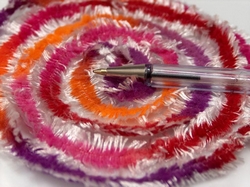
Didyma, this give you any ideas?

I am a self professed fiend of “mutt” yarns, they look like junkyard dogs with splotches of color and odd shapes that when wrapped, shredded, or combed, yield something terribly special.

Even trout flies, that bastion of somber and muted earth tones, is no longer safe. While the rest of the crowd fiddles with the traditional droll materials, us “colorful” types get to fiddle with imbedded tinsel, mylar, strung beads, and lumpy yarns – causing the snobs to blow tea out of their collective noses …

… ’cause in the millinery aisle, that’s how we roll …

I’m still working my way through my last shipment from Turkey (via Yarn Paradise’s eBay store) and I’ve got additional piles of promising shapes and colors readied for a couple of months of “fiddling.”
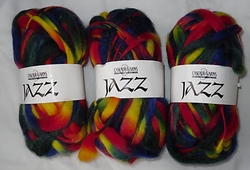
That talks loudly enough to be something specialWe touched on fur blends and how they’re constructed, with yarns I’ll use “sympathetic” fur blends. Small flies can benefit from yarns as well as large – but small fly construction doesn’t lend itself to a big hammy handed yarn wrap, many components are better suited for  rending yarn, as it minimizes bulk and requires less thread to tie it off.

I’ll take a base of natural fur in a neutral color (typically gray) and mix in enough of the chopped and milled yarn to make it a shade of the yarn color. “Binder” is best suited as the natural component because many yarns when shredded are coarse – the binder tames them into an easily dubbed blend.

Mutt yarns require intestinal fortitude because they violate all the principles and tenets you’ve learned. No two flies look the same – so the security blanket of “I just caught six on the same fly” is removed. Even though you’ve tied six dozen, the fear that “they liked the one with more yellow” is very real.

Fish are stupid, and you’re the Scourge of the Fabric Outlet, stride with confidence…

A well matched mutt yarn can save a tyer both time and effort, but finding the perfect yarn remains the most difficult task. Most craft superstores carry less than 1% of what’s available, eBay lists 12,000 different entries for “yarn”  – but still isn’t more than 5% of what’s been made in the last couple of years.
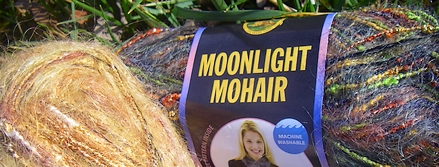
The Mutt King, Moonlight Mohair

The ultimate Mutt is “Moonlight Mohair”, two separate yarns wound as a single strand, together offering a stunning mixture of tinsel, thread core, and a limitless source of mohair dubbing.  

The above left is my Golden Stone nymph color, and the one on the right is a leech-steelhead candidate. The golden color offers a half dozen shades of golden brown, gold, tan, and dark brown – wrapped over a black thread core, and complimented by another strand of gold tinsel-infused brown, gold, and dark brown wound over a white cotton core. Both strands wrapped together is the best golden stonefly nymph color I’ve ever seen.

A golden stone isn’t really “golden” – so much as it’s mottled in a very pronounced fashion. A mixture of dark bug with light yellowish highlights on wingcases, legs, and each ring of its abdomen. It cannot be matched by any single color – which is true of most underwater insects.

I got lucky, this was thrust under my nose while I toe tapped impatiently waiting for my gal – who was feeling her way through the millinery aisle and spotted something uncommon.

I felt the same thing … uncommonly lucky … about the gal. The yarn was superb too …
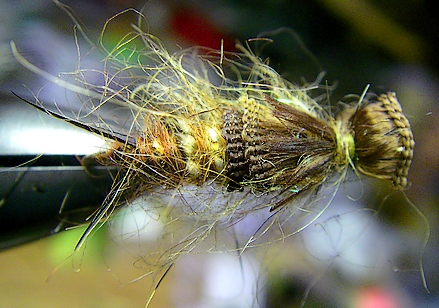
The Golden Mutt

Only the tail on the above “Golden Mutt” isn’t yarn. Wingcases and hood over the bead are Bernat Boa Eyelash yarn – I like its pronounced stitching as a wingcase effect.

The Moonlight Mohair body shows the multiple brown and gold colors with bits of gold tinsel and white cotton core. The black thread that binds the mix is quite pronounced and will show at interval.

The above picture shows the “comb” of the yarn – once the body is wrapped, I comb the mixture to pull loose the mohair fibers and give the fly its shaggy appearance. Under the wingcase is a sympathetic blend of yarn fragments and gray beaver as binder – it’s indistinguishable from the rest of the fly. Mohair is a wonderful spiky dubbing unto itself, the beaver merely makes the unruly into well behaved.
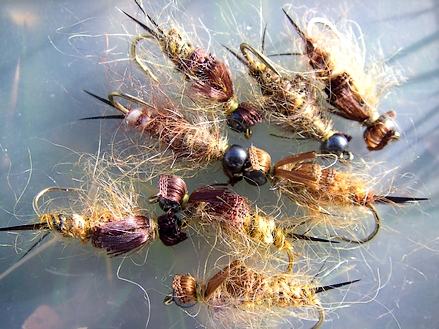
All yarn except for the tails

Us millinery store aficionados are in touch with the inner female, we’ve learned to poke and prod our way through the yarn aisle with aplomb.  Unshaven, unruly, yesterday’s shirt hanging out – it’s unfortunate that a little beaver can’t do the same for us.

The gaggle of Golden Mutt’s above show that no two flies are identical, the sign of the true mutt. Note the visible black thread in the body and the color of the blended fur under the wingcases.

Moonlight Mohair is available in the craft store for $9 per skein. I prefer to buy it on ebay, where the price is about 1/3 retail. The above golden stone color is called “Safari” – the color next to it is “Rain Forest.”

… and the next time I hear some fellow pronouncing “their ain’t been anything new in fly tying in the last forty years,” I’ll know I’m dealing with someone who can’t think outside the feather dander.

Synthetics are new – and if we added up all the fly tiers in the entire world, we’ve collectively seen about 10% of what’s available.

See you in the sequin section, Sweetpea …

Add "age defying" to a long list of superlatives

The Anadromous Greatest HitsI could be a celebrity doctor without half trying. No credentials needed just some whispered word-of-mouth from one besotted celebrity to another and my phone is ringing off the hook.

Howard Hughes spoiled it for everyone else, we figured he was wiping his arse with Ben Franklin’s and only later found he didn’t  bother to do that. Now I’ve got to endure Madonna proclaiming Salmon is “age defying” and the more you eat the younger you look?

These poor fish just cannot catch a break…

Normally, I’d snort and turn the page – except I know better; some pristine watershed will be snapped up to ensure some celebrities deteriorating looks are preserved for all time.

“Madonna has embarked on a January salmon ‘retox’ regime to “knock 12 years off her appearance”.

The 50-year-old singer is so determined to make herself look younger she has enlisted the help of health experts who have devised a new programme for her packed with the oily fish.

A source said: “The new ‘retox’ means she has got a more cardio-intensive gym regime and a diet overhaul. She will also be eating a lot more salmon as it’s got age-defying properties. Her aim is to knock 12 years off her appearance.”

If you want to take 12 years off your life, just drink a water glass full of the crap I fish in – it’s cheaper than salmonids and available year round.

My apologies for even commenting on the story, but as it was paired with the Chilean “Salmon Anemia” crisis, I couldn’t help wondering how much  pink dye she can ingest before extremities start to glow.

Fishing gets a makeover

I’m assuming the desire to rename fishing to “sea kitten hunting” makes for better mental imagery; enormous weapons toted by laughing killers intent on bloodshed is much more menacing and dangerous than a fellow armed with rod, lawn chair, and cooler.

I think “harvesting” vegetables is a trifle mild myself, and “decapitation” or “maiming” conveys a better picture. Grinning swarthy field hands lopping off arms and legs, ignoring the screams of immobile creatures bent on photosynthesis.

We’ve got killers, they’ve got killers. We club baby seal’s and they kill adolescent asparagus, I figured we were well matched – only our killers are licensed …

The banned PETA Superbowl ad that was never telecast … at least we don’t torture our food or the folks watching … More importantly, we don’t SCREW our prey, we leave that to real deviants further down the food chain.

A Yellow Brick Road would be a close second

Good, just police your butts enroute to the store Fishermen have always had a love-hate relationship with roads, largely because their presence ensures high traffic, making  the fast water home to drunken teenagers throwing rocks, and attracting refuse – beer cans and food containers discarded callously by persons unknown enroute to someplace better.

Firemen hate them as someone always builds a fire or flings a cigarette, ecologists despise them as wilderness has been tamed forever, and all of us are deafened by the hordes of ATV hellions that find these capillaries as quickly as they’re constructed.

As darkness falls, we’re often glad to see some even footing – especially after slogging against fast cold water all day, and a tailgate is a welcome surface to prepare a midday meal – but if you’re willing to walk a mile for a Camel, are you willing to walk two for a better hatch?

We’ve seen the pictures many times, tons of Hexagenia mayflies ovipositing in a Chevron station due to light pollution – a lethal combination of attraction to white light and mistaking the asphalt for water.

Recent studies suggest dark surfaces can polarize light better than water and can override the natural environment in favor of mass egg laying on dry land.

Polarized light pollution (PLP) caused by artificial planar surfaces has clear and deleterious impacts on the ability of
animals to judge safe and suitable habitats and oviposition
sites. In particular, PLP presents severe problems for
organisms associated with water bodies. Orientation to
horizontally polarized light sources is the primary guidance
mechanism used by at least 300 species of dragonflies,
mayflies, caddisflies, tabanid flies, diving beetles,
water bugs, and other aquatic insects. This is used to
search for suitable water bodies to act as feeding/breeding,
habitat, and oviposition sites (Schwind 1991; Horváth
and Kriska 2008).
Because of their strong horizontal
polarization signature, artificial polarizing surfaces (eg
asphalt, gravestones, cars, plastic sheeting, pools of oil,
glass windows) are commonly mistaken for bodies of
water (Horváth and Zeil 1996; Kriska et al. 1998, 2006a,
2007, 2008a; Horváth et al. 2007, 2008).
Because the p of
light reflected by these surfaces is often higher than that
of light reflected by water, artificial polarizers can be even
more attractive to positively polarotactic (ie lured to horizontally polarized light) aquatic insects than a water
body (Horváth and Zeil 1996; Horváth et al. 1998; Kriska
et al. 1998).
They appear as exaggerated water surfaces,
and act as supernormal optical stimuli.

Thinking of buying a car? I’d consider a light colored model – especially if you’re planning on parking it near where you’re fishing, every bug that mistakes your hood for water is one less you can fish over.

As rural areas succumb to development, light pollution and polarization is becoming a larger issue – especially with insects that use dusk or full dark to oviposit.

No research describes the percentages of affected insects, but as a layman, can’t we draw the conclusion that those stretches of the river without buildings, cars, or roads have more bugs?

… this might be the scientific proof of our conventional axiom, “the farther we get away from the parking lot, the better the fishing..”

Those of you contemplating construction of your fishing “dream retreat” take note – cover your driveway with white quartz, and make sure the Jacuzzi cover is light canvas.

Brownliners have exploited this scientific “wrinkle” for years, we’re often asked why we’re trailing 400 yards of black VisQueen behind us – mostly we smile and keep walking, figuring you’ll assume the Port-a-Potty lacks toilet paper…

Too much information to entrust to a four legged former pal whose loyalties shift with the sound of crinkled cellophane

He'd rat you out for a treat It might be the perfect campsite companion, she cuts off your air supply wrapping the GPS waterproof cell phone around your neck, and can reel you in when dinner’s ready.

The PetsCELL™ is the first voice enabled waterproof GPS cell phone optimized for animals. It will be available for commercial distribution early in 2008 and consumer distribution in mid 2008.

The possibilities are limitless, but the original concept leaves me puzzled.

Combining industry leading GPS technology with the ability of 2-way communication.

What are you supposed to do when you hear, “Grrr, arf Arf, ARF” on your end? Small dogs are known conversationalists, but your big lumpy Labrador or Golden Retriever is suddenly able to tell you where them quail went?

I don’t get it.

I figure most dogs could master text messaging in seconds, but there’s no mention of voice or data plans, what they cost, or whether you can screen 900 numbers from “Meathead’s” call list, and if he chews it are you responsible for the charges when he accidentally calls the Pentagon?

A two way waterproof cell phone with voice activation might be pretty snazzy for anglers, but only if it can filter the white noise of rapids and won’t embarrass you with a simulcast to either spouse or fishing pals.

This cell phone costs quite a bit more than the iPhone 3G, however, at $400 plus a monthly service fee.

Fish and Game would love you to wear them, it’s likely a shared data source hosted by somebody. They’ll dial into the Upper Sacramento and figure which bank they need to visit and how often.

… and is he still “man’s best friend” when your pals downlink the record of where you fished, how long, and that brief stop at … Safeway?

Nothing like a passive transponder to reveal all the secrets of your favorite creek, and the source of that enormous salmon fillet. You’ve got more to worry about than simply removing the price tag…