Author Archives: KBarton10

Part 1 of 2: Is the fly line industry running out of superlatives?

Scientific Anglers UltraI just can’t seem to leave well enough alone. Dogged determinism has me squinting at the screen digesting numbers and errata when I should be mowing lawn or squinting at a small fly going in harm’s way.

Like the evolution of medicine, fly line manufacturers are no longer content with a general practitioner, they’ve pushed us down the specialization path with glee – leaving us to ponder whether Mango is better than Avocado, slick is superior to textured, and whether a line called Salmon is needed for Salmon, or just another gimmick to add to the already horrendous weight of our vest.

Much is made of all the differences, with anglers professing allegiance to one camp or another, or merely shivering in the middle; unsure and undecided whether the voices of vendors and vendor-backed media are taking them down the primrose path.

Our angling publications aren’t much help, authors vie to give manufacturers the least offense, hoping the flow of freebies continue unabated. Product reviews always contain superlatives, the marketing materials contain even more  – and  end prematurely with little more than, “it’s cool, definitely slick despite the ridged and  bubbled finish and the Puce polka dots allow you to maintain contact despite blending with bankside shrubbery.

Vendors are in constant competition, and pricing depends on mass production, each manufacturer wants as few pots of bubbling plastic polymer as possible. Cortland and Scientific anglers prefer PVC, Airflo likes Polyurethane, and everyone touts their mixture as the “one true God.”

But with the plethora of specialty lines and the maker’s desire to ensure you own all of them, they’ve trapped themselves. The AFTMA standard requires the line adhere to a given grain weight in its first 30 feet. Like NASCAR, everyone has a similar rule set – and there’s only so much you can do to a fly line taper. Shorten, lengthen, make “stairsteps” of increasing or decreasing line size, but when you’re done it’d better weigh within a fixed range just like your competitor.

We’ll assume everything they say about coatings, compounds, and textures is true, allowing us to get past the nouns and acronyms, past the religious fervor of Sharkskin, SYLK, and softeners, and focus on the product’s taper. We may not be able to discern the difference between hydrophobic and hydroponic, but we’re expert in soft butts,  big bellies, and a long tip when cast.

That “feel” comes from the taper – and whether it’s a sinking line imbued with Tungsten dust or a floating line with microbubbles, we’ve flung them with great passion for years; we know what we like, and might be able to answer, “are all these specialty lines really necessary?”

Remember, “as few pots of bubbling plastic as necessary” – and regardless of the spittle and vitriol, it’s likely all these lines use the same basic formula of plasticizers and polymers.

Method

I chose a AFTMA WF7 F/I/S to show the taper of each vendor fly line. These numbers are taken from the vendors website and/or discrete PDF’s constructed by the vendor which contain their line specifications.

We’ve ignored sink tips intentionally as their taper is compounded by the sinking portion.

Length = Total length of the fly line (feet)

Running Line = Length of the level running line portion (feet)

Rear Taper = The length of the rear taper of the head (feet)

Belly = The length of the fly line belly (feet)

Front Taper = Length of the front taper (feet)

Tip = the length of the level tip (feet)

If the line has a compound taper in the belly portion that taper is denoted by its overall length, and the steps of the taper in parenthesis. 35(Front20Rear15) is 35 foot overall belly length, the front 20′ is different from the rear 15′.

Lastly, I took every WF7 the vendor sold and compared their respective tapers in a chart, allowing you to see real differences in the line taper without being swayed by box art and advertising.

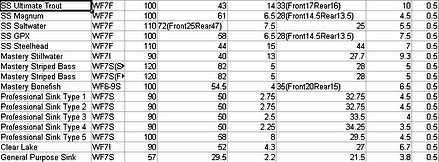
Scientific Anglers

Scientific Anglers fly linesScientific Anglers fly lines

I’d describe Scientific Anglers as the most prolific of the fly line kingdom. It’s apparent that almost every discrete line they manufacture has some small difference. These differences are not drastic and begs the question, “can the average angler detect the taper, and will it make much difference in his casting?”

Example: Take the Lefty Kreh Signature and the SA Professional floating line.  The differences between the two are a 2.4 feet longer rear taper on the Kreh line, and the Professional floater is the converse of the above, a 2.4 foot longer head taken from the rear taper. Both are the same price at Cabela’s.

All other line specifications are identical, suggesting the Kreh and Professional are largely the same. Manufacturers would claim the Kreh gives the softer presentation due to its longer tip – you’ll note in the marketing material below taken from the 3M and Cabela’s websites – no mention is made for the longer tip – it’s not considered an asset.

The marketing at Cabela’s is very different, differentiating the two, and there’s no mention that the Professional series contains the Lefty Kreh Signature line, as demonstrated by the Scientific Anglers website. That’s not an indictment so much as demonstrates the pains by which advertising attempts to make them all quite different.

Lefty Kreh:

It’s specially engineered by Scientific Anglers to possess optimal density for high-flotation applications. Both supple and easy to use, this line has a versatile midlength head that makes it suitable for a wide range of fishing situations. Special 3M lubricants increase the slickness of the Signature Series, resulting in superior casting performance.

Professional:

Scientific Angler’s new Professional Series Floating Line has optimal density for high flotation, and is supple for ease of use. With a braided multifilament core, internal lubricants to increase slickness and enhance shootability, and integrated UV inhibitors, this line is ideal for a wide range of conditions.

The Scientific Anglers website is terse in its prose, listing an abbreviated preamble and bullet points to describe each line’s attributes.

Lefty Kreh Signature

Applications:

  • Excellent general-purpose line
  • Easy to cast and high floating
  • Optimal line density for high floatation
  • Supple and easy to use in most conditions

WF taper characteristics:

  • Versatile mid-length head designed with input from the master himself – Lefty Kreh

Core:

  • Braided multifilament nylon

Coating:

  • 3M PVC formulated with special internal lubricants to increase slickness and enhance shootability
  • Integrated UV inhibitors for increased durability

Professional Series Floating

Applications:

  • Excellent general-purpose line for all weather
  • Optimal line density for high floatation
  • Supple for ease of use in all conditions

WF Taper Characteristics:

  • Group-tailored heads for general use

Core:

  • Braided multifilament nylon

Coating:

  • 3M PVC formulated with special internal lubricants to increase slickness and enhance shootability
  • Integrated UV inhibitors for increased durability

We find both have the UV Inhibitors, both have the same superlatives in describing function and use, the only difference being that the Lefty Kreh line is “designed by the Master himself” and “easy to use.”

I’d suggest that the lines are identical (except for the 2.4 foot reallocation) and that a casual angler isn’t looking at two different lines – but is in fact looking at pretty much the same line.

So why would a vendor go to the trouble of building a feature into the line that was singular when compared to other tapers, yet make no mention of it?  It’s likely they’ve used the superlative already in a half dozen other lines, and it’s important to distinguish each line as an asset to the angler’s overall quiver.

So you feel you need them all.

Note that the SA Mastery Stillwater has the 2nd longest front taper of any fly line they make, but it’s length isn’t mentioned in the marketing material. Ditto for the Supra Floater, it’s the third longest forward taper SA makes – yet no mention of that attribute on their website.

The Mastery Bonefish and Sharkskin Ultimate Trout Taper both advocate their long tips to provide graceful presentation, and there’s no sense confusing you as to how many “long tip” fly lines you really need, is there?

Both the Mastery series and Sharkskin lines are more expensive than the Professional and Supra series – why not save the best superlatives for your high end lines? That’s good marketing.

Scanning the chart of the Scientific Angler lines above, many more similarities announce themselves, like the Saltwater Specialty, and the Specialty Bonefish line – a mere two foot difference in taper location akin to the Lefty / Professional.

There are many pronounced differences in the tapers as well, what the angler needs to ask themselves is outside of the marketing hype of slickness, texture, color, plasticizers, and coatings – is there much difference between my choices for a Carp line – and would the Bonefish taper be just as good?

Most anglers won’t be able to discern the difference between 2 foot of taper shoved forward, and as we’re ignoring all else other than their functional spec, it appears much of the cornucopia of fly lines tapers are not as distinct as we’ve been led to believe.

Airflo
Airflo_Lines

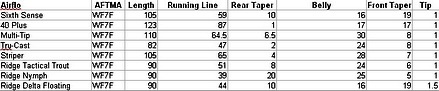
Airflo fly linesAirflo has a much smaller stable of fly lines than Scientific Angler, and like SA they’re showing the same advertising tendencies.  Both Airflo and Cortland include a full foot of level taper at the tip, unlike RIO and SA which opted for 6″.

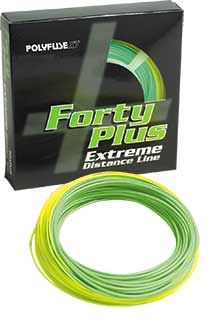
The Delta, Sixth Sense, and 40 Plus all have long front tapers to ease the splash of presentation, and the balance of the Airflo suite are roughly similar with the weight shifted forward or backward by less than 5 feet.

Despite the differences between the two basic groupings of Airflo lines, only the Delta advertising mentions the long tip. The Sixth Sense and 40 Plus make no reference to the tip at all.

(The 1.5′ tip on the Ridge Delta Floating appears to be a website typo)

We should be asking ourselves when the manufacturer touts his “extra long belly” as an aid to long casts, long as compared to what?  There’s no such thing as a normal belly, tip, or rear taper, ensuring every possible change to the line can be touted as a benefit.

With the debut of the Singlebarbed line and it’s Zero-Taper tip, the sumbitch lands like a gutshot mallard – offering the angler the advantage of visual feedback on the location of his fly. Available in Raspberry Red, Lemon Yellow, and Orange Orange..”

Whether it really makes a difference in your casting, you’ll have to try one and find out. 

I fear there’s plenty of lip gloss in fly line advertising, largely to differentiate similar products – giving us anglers the illusion we need multiple lines.

Wednesday, Part 2 of the series, “Are they Rogues or Demons, and why didn’t they tell me snipping 3 ” off the tip of a RIO Striped Bass line yields a RIO Clouser and $9 savings?
105 in the shade might be an appropriate proving ground

The pace is glacial but someone’s keeping their ear to the catcalls from the brown water…

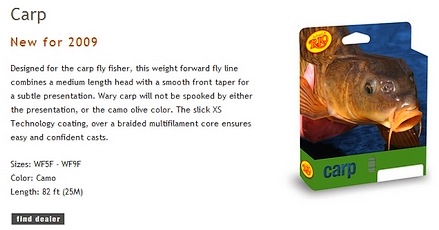
RIO's new Carp Taper

Summer is truly inhospitable and the combination of blazing daytime temperatures and chemicals in the water have bleached the SA Sharkskin and Cortland lines I’ve used in past seasons. It’s only a little bit less harsh on me – with my thin membrane of waders all that separates me from the chemical brew.

Technorati Tags: , ,

You have to read between the lines sometimes

“Furlough Friday” had me on the prowl on the west side of the valley, I’d had the foresight to grab Sweetpea, got her grain-fed and rubbed down and while she gathered her possibles, I’d snuck a rod, vest, and waders into the cab while she wasn’t looking.

It’s the old “winery” gambit, “I think there’s a winery on this road somewhere’s..” – and it worked like a charm. Her howl of indignation at the sight of the rod was much too late, it’s telltale rattle as we squealed onto the Interstate had blown my cover.

Monstrous carp, rainbow trout, bass, and blue water was in the offing – and while the firm set of her chin slowly melted away, compliments of wild flowers and orchards in full blossom, she grudgingly allowed the trip might have merit.

Comes with instructions, rod assembly required 

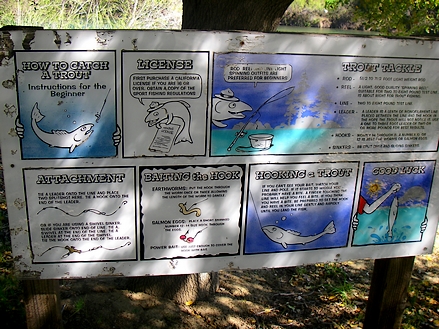
Winds were gusting heavily and the day use area was being repaired, so I parked in the campground instead. The friendly instructions at lakeside gave me pause,  as the last panel seemed out of place. The arm holding the dead fish somehow didn’t jibe with “Good Luck.”

Locals recognize this as the salutation warning you of the gastronomic consequence of dining on your prey, out-of-towners are oblivious to the mercury laden watershed and must pay the ultimate price.

… hence the “Good Luck” – and explains why the campground bathrooms have big signs limiting “parking” to 30 minutes …

Technorati Tags: , ,

The missing link discovered and the Olive branch extended

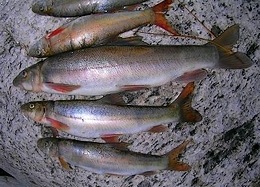
Throw that man an olive branch It’s unification of a sort, something that’s sure to unite the “X-stream” crowd with Blue and Brown water anglers. The Chinese call it a “Snow Trout“, it looks and acts like a Rainbow, only it’s a member of the Cyprinid family which contains both Carp and my beloved Pikeminnow.
I can hear the collective groan from here – both camps pause momentarily in battering each other hoping I won’t suggest a group hug.

Not a %$#@ chance.

The locale is exotic, Mongolia will be left to cruise ships and the camp followers that live in their wake; it’s called a trout – so when the dry fly types hold up their catch in an accusatory manner and insist otherwise – the local guides can smile widely and hide behind the language barrier, and the Pearl River is considered one of the world’s most polluted waterways, which will make the Brownlining aficionados plant flag.

All the enterprising expedition outfitter has to do is keep the respective zealots far apart, add some local myth about ravenous feeding habits and missing schoolchildren, ply both camps with alcohol and watch the cash registers act like slot machines.

Zhujiang Brewery, one of the three largest domestic breweries in China, is located on the Pearl River Delta within the city of Guangzhou.

Paradise.

“Pearl River” conjures some fanciful imagery in the mind of the fiscally prudent spouse; trade winds, grass skirts, and perfumed beaches – all you have to do is nod vigorously on the “perfumed” part, keep a straight face, and you’re there …

If we are most of the known killers, why must they die

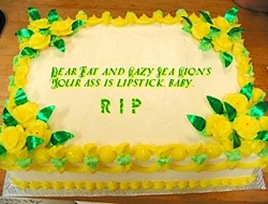
How dare they do what comes natural? The cake exists until the last slice vanishes, then we finger the culprit and demand satisfaction – despite our distended belly and inability to eat anything more. It begs the question, how does not inhaling the last slice exonerate us of eating the rest of the cake?

Somehow our sense of proportion is out of whack, which isn’t surprising, the banks did similar by leveraging assets 30 times – and only claimed foul when everything fell apart.

Now we’re going to kill Sea Lion’s that had the audacity to eat salmon on the Columbia River – after farking the salmon completely with  over-harvest, pollution, and encroachment of watershed. We’ve bulldozed the spawning gravel for the foundation for our McMansion, cut the bank timber to build yet another strip mall, and now we’re incensed that something else on the planet has the chutzpah to want some too?

It’s comforting that we’re so distraught over the salmon’s plight that we’re willing to kill crap out of anything looking to harm one, but as Sea Lion’s aren’t killing for glee or leaving the unwanted carcasses on the bank – and if they outnumber the salmon and that’s not fair, whose fault is that really?

California isn’t the only state with it’s head up it’s collective arse.

We know that sea lions are not to blame for the demise of Columbia salmon. The fish runs collapsed because of dams, overfishing and habitat destruction. Even today, these are more significant causes of salmon mortality than sea lions. But we also know that the Northwest has no choice now but to address every killer of wild salmon.

As we remain “most of the killers”, I’d like to see the list of homes we’ll raze, timber acres to be restored, dams eliminated, and strip malls bulldozed for spawning gravel, because that might give the silvery SOB’s a fighting chance.

Seals, Otter, Osprey, and the American Fish Eagle dine on Salmon – I’m sure we’ll be properly outraged at each affront and insist on blowing a gaping hole in a Liberty Pigeon’s plumbing …

My Brook Trout has a first name

Somebody has to put them on a couch Canadian scientists have noted at least two personality types in studies of newly hatched Brook trout, loosely described in lay terms as “Jocks” and “Couch Potato’s.” This shouldn’t surprise any of us – as we’ve been dealing with the human variants since infancy.
“Jocks” feed actively in the water column, and “Tubers” feed in a sedentary manner near the bottom. Interpretation would suggest that the agile fish seek the food, and the more sluggish variant wait for the food to come to them.

It’s likely scientists don’t always have time to follow each other’s research, and coupled with another study that suggests angling selectively targets aggressive fish (Jocks), with the introverts handling much of the reproduction, Brook trout are doomed.

Leaving the species to fat and shy couch potato’s doesn’t bode well for long term survival.

Humans have the wrestled with similar issues; the agile are shipped overseas to be shot at, leaving the sluggish and shy introverts to play video games.  Eventually both groups have to get jobs, which enhances their reproductive viability.

This research explains why the Eastern Brook Trout is the Official Char of the Trout Underground,  throwing those slow bamboo tapers is akin to chumming  for the Couch Potato Brookie, who adore bamboo almost as much as Twinkies.

Braided, dammit – not shaken nor stirred

One of the reason you buy copper wire by the pound versus the shop spool is so you can dominate the Spring runoff with forty-leven pounds of non-toxic, gutslammer nymphs.

Dynamite is neither green nor legal, and on occasion something just as sinister is warranted.

My take on the Copper John, I call it the "Copper Johnson"

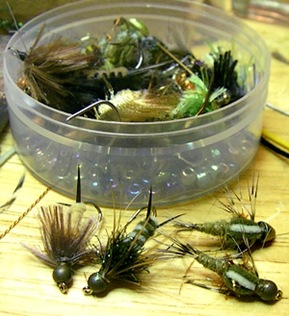
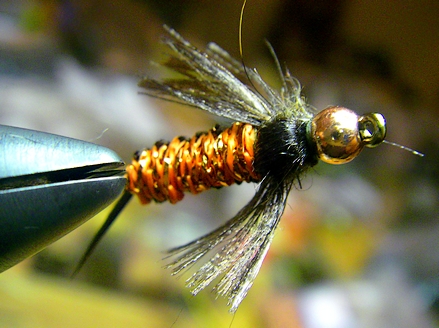
It doesn’t look like much but that’s three feet of 34 gauge wire per fly, 20 turns of 1 amp fuse wire and a 4mm bead chaser – just what’s needed when the runoff will be short and violent, just like it was last year.

Actually I’m polishing my braiding skills, I used to be able to bang these out really fast – but declining eyesight has slowed me somewhat.

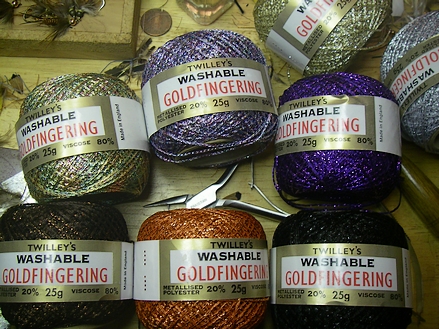
I bought the “Goldfingering” for Shad flies, which should start sometime in the next couple months, it’s a heavy nylon floss wrapped with a complimentary color of mylar. No sooner did I spy it in my “weird stuff to try” bag – when I started braiding more goodies than I’d anticipated.

Goldfingering, add a Walther PPK to your arsenal

The dark brown and orange made a handsome combination. The balance of colors (especially the multicolored flavors) will flavor my shad flies for the season. This is really tough material, the mylar shine is partially muted by the floss, so it’ll lend itself to a variety of questionable inspirations.

The Over and Under seen from the bottom

The bottom view of an “Over and Under” variant. Woven Goldfingering body (dark brown and orange) two turns of Gedifra Costa Rica polyamide hackle. Dub a little fur in front, then grab the hackle on the top and bottom and pull forward to make two wingcases – leaving the fibers on the side for legs.

Outside of the tail and a dab of dubbing it’s another all yarn fly; cheap, expendable, and when your orthodontist pal asks for some you can tell him, “Doctor, No” or equally bad movie quip.

Can clarity exist in Brown water

I’ve always been comfortable with the Bull in the China shop approach, it’s a mixture of distaste for societal norms, tolerance for physical pain, and diminished IQ.

 and now, a word from our watershed

Ardor is useful for the young, but is often confused as evangelical when you’re older. “Religion” tends to breed cliques and the us-versus-them mentality, useful when you’re the underdog, but has little place in fly fishing.

We’ve got enough fractious behavior, backbiting, and cliques to rival any public middle school.

The recent article on “Brownlining” appearing in the Wall Street Journal, bred commentary that reminded me of the issue. While I cannot speak for all devotees, I’ll suggest this is largely perception, and will expand on the topic below.

…but I do think the author missed an opportunity to expand on the gentleman’s comment that brownlining is a “sanctioning” of nature’s destruction. At first I thought that these men were doing something novel in making the best of their environment, but then I realized, yes, they’re giving up in the fight to preserve nature spots.

Not so. Take an ardent fisherman whose got to work for a living, who – like you – has half a weekend afternoon to get in some “decompress” time, draw a circle around his house of an hour or less – and that’s what he’ll fish.

The fact that he represents a small voting minority comprised of like minded individuals means he’ll be fishing soiled water. Most of us live in urban areas whose voters deemed water quality and riparian habitat less important than green lawns and cheap rutabagas.

… which lie lonesome and congealing on children’s plates.

We’re still the only fellow keeping an eye on the drainage, the only guy packing out discarded water bottles, or alerting the authorities to the car or corpse in the streambed. We haven’t given up on the environment, we’re merely fishing the Now rather than gash our bosom over “how it ought to be.” At each opportunity we vote our belief, donate time or money to organizations that avow the same principles, but our lobby is weak, our collective voice a murmur, and our numbers diminish with every passing year.

Pristine blue water can turn into brown water by adding industry and people – and once brown, stays that way. As new watershed can’t be created and what’s left is either fenced or in slow decline, our children won’t understand this color distinction as they’ll be drinking it.

I enjoyed this article, but I think it gives the false impression that fishing in these marginal waters is relatively new. Other than the name “brown lining”, it is certainly not new.

So true. The earliest civilizations are synonymous with great waterways; the Thames, Nile, Tigris, Ganges, Yalu, Yangtze, etc., all spawned civilizations whose waterways boosted the flow of goods with other countries and municipalities. Untreated sewage and wastewater were intermingled with fishing nets and bathers, and the only new wrinkle is leisure time, a modern invention, and the concept of fishing as sport rather than subsistence.

Interesting story, but I’d still rather catch a 10-15 inch trout in clear water than a 10-15 pound bottom feeder in a toxic cesspool. Call it elitism if you like, but these guys will be happy I’m not into it.

I’m not so sure. Firstly, “toxicity” is a shifting target largely dependent on the government for “recommended daily dosages.” When we discover that  (2R)-2-[(4-Ethyl-2,3-dioxopiperazinyl)carbonylamino]-2-phenylacetic acid makes your children unable to reproduce, some fellow in Washington exclaims, “oOpsie” – and then a decade later – adds it to the long list of things to monitor in your drinking water.

… and secondly, a 10-15 pound bottom feeder has physics on his side. Whether lethargic or acrobatic it’s still twice the size of your tippet and glued to the bottom. It’s something to do while waiting for your daughter at band practice, and it’s something that keeps your reflexes sharp and your form true, so the first day of your vacation isn’t wasted as you relearn how to cast …

Clear water is toxic too – brown only gives you an extra visual cue.

…These are quite possibly the hardest fish to catch in fresh water on fly rods…they have some of the most advanced senses of smell of any animal and are easily spooked by even the most gentle casts.

Precisely what we’ve discovered, a one pound trout on a four pound tippet is a test of the trout, a fourteen pound fish on six pound tippet is a test of the angler. Isn’t that what we’re really looking for?

I bet these men would still jump at the chance to go fishing in pristine nature settings.

Also true, but nature is many hours distant and requires a weekend to be truly efficient. A two income household in a declining job market with an onerous mortgage, a 201K, and a kid needing orthodontia … Nature might have to take a backseat to food on the table.

To me the brown water is something close by that I can fish daily without endangering the family unit. No different from the practice range for golfers, who despite the decline in the economy, still have 51 weekends of desire, and a 16 weekend budget.

Beats crap out of painting the living room or remaining cloistered on the couch.

It’s certain some will prefer a secret society and claim to rival Theodore Gordon, but I want no part in it. I just want to make fish suffer.

Given the circumstances, Brown water with it’s miles of river and the solitude of Nature, with working fish and no human competition, contrasted with tales of overcrowding and traffic, rising costs and the diminishing returns of blue water, might make it the last frontier.

It doesn’t make its practitioners anything special unless the wind shifts.

That’ll be a WMD, weapon of Mosquito Destruction

We’ve assumed we needed to preserve the outdoors for future generations, but we may have been hasty. These are urban sophisticates raised on Xbox and Halo, and angry bears and bolt action rifles may be too tame to sustain their interest for more than seven minutes.

Thanks to science, I’m not even sure I want to go fishing anymore – now that I’m “heeled” with my handheld mosquito laser.

I can remember the first time I saw the cold blue light of the BugZapper, how I howled in glee with every burst of sparks, and the smoky spiral of another victim. It was awful tempting not to drop trousers and moon the bloodsucking squadrons destined for my tender posterior.

Gleeful cries of “you want summa this?” and “come get some” were mingled with the steady “bzzzt”, “bzzzt” of six legged executions. When the power went off – we ran inside and hid, shivering.

Now, we’ve got options:

In experiments, the system could target mosquitoes with a flashlight, and then uses a zoom lens to feed the data to the computer, which fires at the insect. Each time the laser strikes a mosquito, the computer makes a gunshot sound. When the mosquito is hit, it bursts into flame and falls to the ground, and a thin plume of smoke rises.

Call me the Two Gun Kid. I may even return to guiding so’s I can protect wagon trains of tenderfeet from marauding wildlife, “… the Kid’s hammy hands were a blur in the noonday sun, twin Colts roared to life …”

[youtube]http://www.youtube.com/watch?v=wSIWpFPkYrk[/youtube]

What kid would even consider fishing under the circumstances?

For us cagey older types immersed in the Catch and Release doctrine, will we succumb to setting our phasers to Stun, then winging Mayflies and Caddis to create our own hatch?

Nothing like struggling insects on the surface to trigger feeding trout. What dad would have the backbone not to employ Junior as his wingman?

Technorati Tags: , , , ,

Will the new frugality reduce the hatchery bonuses paid to anglers?

Angling FatCats supping at the Public Trough? I like the sound of it regardless of motivation, a “put-grow-and-take” fishery versus the standard watery extrusion of 10″ fish through the gauntlet of floating Cheez-it scented Powerbait.

I’ve been many kinds of fisherman throughout my career, but the portrait of the “ovulating” hatchery truck being stalked by a cadre of militant anglers – has always been offputting.

It’s the Charge of the Bucket Brigade reenacted with great violence and no quarter; a stream of pellet-fattened silver splattered from the bridge, accompanied by the snarl of offroad tires, hoots and catcalls mixed with unruly sportsmen jostling for position, and the cheese scented screams of “federales” wrested from their new home.

Planting them at the fingerling stage would end the carnage, allowing them to populate something other than the pool they’re thrust in, and might even engender hatchery fish with “stream smarts.”

With state budgets in upheaval, and wildlife agencies among the first to suffer cutbacks – it might prove to be the economical alternative.

“A put-grow-and-take program is cheaper,” Young said. “It gets fish out of the hatchery system earlier — at six months instead of 18 months — and they look better and have more of a wild-fish behavior. It only takes a year for a fingerling to reach catchable size.”

High mortality rates are an issue with fingerlings, but the mortality rate of planted fish of catchable size may rival that of fingerlings in small waterways.

The costs of hatchery fish cited by the article are fairly astounding. If I were buying them off the restaurant menu, I’d be thinking I was in rarified company ..

The agency has scrapped a program it began five years ago in which it purchased hatchery trout from Tellico Fish Farm in North Carolina to make up for the 2001 closing of Pennsylvania’s Big Spring hatchery. Tellico had charged the state an average of $1.15 per fish (last year it was $1.27) — significantly less than the $2.14 it costs to raise a trout at a Fish and Boat Commission facility. When this year’s Tellico bid came in at $3.38 per trout, the commission drew the line.

Assuming three fish to the pound, that’s a $10 meal. I’d be staring down my nose only long enough to find a wedge of lemon.