Author Archives: KBarton10

It’s the Ocean what done it, and perhaps it’s time we paved that too

Ascent of Something, Kinda

I was gazing fondly at the salmon report for 2009, wherein the Pacific Fisheries Management Council claims, “… the ocean’s are what done it!” There’s a passing reference to the continued decline of freshwater assets throughout California, and how the entire salmon run has the biodiversity of Velveeta cheese – wild fish essentially extinct and what we’re mourning is the inbred product of four hatcheries.

That’s a heady accomplishment, extincting the entire run of one of the largest freshwater river complexes in the world – within a couple of lifetimes.

Naturally the scientists were as surprised as we were, they’d misplaced a decimal point in the mathematical model they were using to predict returnees, which has since been fixed, so we’re all good again.

Alaska is going to harvest more than last year as their mathematicians have sharper pencils than their California counterparts. It begs the question, if the “scientists” most often used by the government are math professors, versus biologists, are we using video games to manage migratory fisheries?

Most of the games I’ve played eventually froze up – and after the reboot you’d lost the last three weeks of play. I guess that’s what happened with our fish, only we lost the last 100,000 years of natural selection.

Despite all the concerned anglers and organizations that represent them, we’re losing almost every battle and the war as well. Fencing off the creek is a short term fix, when the states need the water they’ll annex it, so that’s no solution. Buy the headwaters of whatever you want, imminent domain will leave you the ranch, but your water rights will revert to the state as soon as they’re needed.

Do we take the $40 we’d spend on our CalTrout membership and buy some fish instead? Taking the bag containing the fry of our choosing under the cover of night, and plant the little SOB’s ourselves?

Any mainstream advocacy group would be appalled at the thought, Fish and Game would string you up by your thumbs, and Trout Unlimited would disavow all knowledge.

Fundamentalism is all the rage of late, and despite eight years of “Gee Dubyah” explaining why we should fear it, perhaps its time to be the “little agile fellow” that survives on a crust of bread and a cup of water, thwarting spy satellites, cellular surveillance, and drone aircraft to plant another couple hundred feeder goldfish in some toxic and lonesome trickle.

We’ll suffer any indignity in order to kill a fish, but we’re content to leave the fight to others to restore some.

License money siphoned off the conservation agencies to copper a  burgeoning state deficit, small organizations making smaller progress – undone by hordes of fishermen on hajj to the newly pristine – grinding invertebrates underfoot in their rush to catch the few remaining big wild fish.

It’s one hell of a pickle we’re in – and while there’s no end to the fingerpointing as to who done it, the question that remains unanswered is, “what’s the endgame?”

Is leaving something behind enough, or is leaving what was there more desirable?

Future generations aren’t likely to consider us more than narrow-visioned butchers – more intent on leaving our mark on the sport than leaving any survivors.  The sport and its icons could be just another unkempt footnote in a book whose subject is long forgotten – along with the quaint pastime it gentrifies.

We know where the problem is – even if the forces arrayed against us point elsewhere, and is the forty dollars sent to some well meaning entity enough to assuage our personal guilt, or is an unpopular and protracted insurgency our only salvation?

Largemouth Bass are $2 each for the 2-4″ size, and my $40 donation is 20 fish delivered to a watershed that could sorely use assistance.

My confidence in all the staid conservation methodology is eroding. There’s plenty of well intentioned fellows arguing for the cause in every governmental venue, but the effect appears marginal – we lack the votes to carry the issue past a hearing.

I’m less excited about attempting to reclaim a wilderness experience, than properly managing taint – the eventual fate of our epic watersheds.

My fetid little creek is forty miles of perfect spawning gravel, all of which is the exact size required by steelhead and salmon, yet they’re denied access due to the priorities of waxy and pallid tomatoes. As each of these tributaries were turned into overly warm, toxic rivulets – we lost the native strain and its contribution to the larger yearly run.

We gleefully took 40,000 fish from the millions – because they were as plentiful as Buffalo, and celery wasn’t – and as agrarian interests marched up the valley; impounding, altering, channeling and blocking, we lost another 40000 fish with each stream so corrupted.

Now we’re left with four sterile concrete raceways from which we extrude the last vestiges of what was once a staggering flow of Salmon.

Goddamn ocean. Poppa always taught me to never turn my back on it and I’m beginning to understand why.

The Systematic approach to Rejection

Monotheism simply lacks enough deities to curse and I’m contemplating a switch to Norse or Greek “Old Timey” polytheism.

Cursing is just one of many conversion advantages; you can junk the Solunar tables and paw through Crow guts to see tomorrow’s fishing forecast, there’s meaning to a bird flying past with a worm in its beak or taking a newspaper in the brisket from a kid hurtling past on a 10 speed.

They’re signs

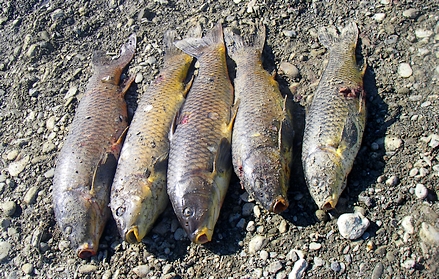
KreamedKorn, the bane of the Carp GenusWith so few practitioners and this being the heyday of Political Correctness, everyone will be back pedaling desperately not to give affront – and every sign points to your going fishing,  because you’re the fellow interpreting them.

My conversion occurred Sunday, I’d busted out to settle scores with a school of monstrous Carp I’d spotted last week. I had a fly box stuffed with sizes, weights, and colors, and having pitted wits with the wily “Golden Salmon” before – I’d resolved to use a systematic approach to rejection, akin to asking all the pretty girls to the Prom knowing the outcome is preordained.

Assuming 100 fish in the school, 5 swings with each candidate should yield enough curled lips and involuntary shudders to move to the next prototype or concoction.

I slunk away from the car while the Paintball Irregulars eyed my ample posterior. I’d left pride and elitism at home, as I’d stuffed a pocket full of patented “KreamKornKillers”, outlawed in 17 states and the bane of all Cyprinids.

Looks like a Chevy, the Ford's are stacked higher on the slope 

I hustled past the Pikeminnow, ignored the massive Trico spinner fall, was oblivious to partially clad supermodel’s that orbit the homeless encampment, and stomped my way past the Bank of Detroit to the magic Carp pool.

Deserted like normal, and a cloud of egg laying Trico’s drenching the far bank with an appreciative horde of small Bass munching undisturbed on the slow, infirm, and spent.

The school of Carp was still there, milling in a slow circle. No eating, no laggards, just a continuous stream of large fish like pedestrians disgorging from a subway escalator.

I tried: Small, Medium, large. Small, medium, and large, beaded. Small, medium, and large – weighted and no bead. I tried red, yellow, green, olive, moss, black, navy, grannom green, puce, paisley, gingham, and elderberry. Next was variegated black and yellow, tinsel equipped, turned up eye, turned down nose, sproat, kirbed, thick, thin, and maudlin. I asked the fat girls, the girls with cleft palates, the freshmen with disfiguring skin growths and their little sister, negatory – no dance.

I tried upstream presentations, downstream drifts, jerked, fried, and drifted. I bottom rolled, bunny-hopped, and pantomimed. Nada.

I’d offended no God – nor was I paying for misspent youth, or hellish and sinister past life – this is Carp fishing as I know it, obscenely difficult – and counter to everything I’ve read in print.

I discovered the advantages of Polytheism as I worked around the bend to the center of the pool, and saw the corpses and burned out wagon train…

 The bow is greater than the rod, it's still mighty wasteful

… and here I’d brought a rod and reel to a gunfight. A broadhead arrow makes a hell of an exit wound, and this “angler” had started lining them up by size until he got tired of touching them, then left them where they lay.

His Kung Fu was better’n mine.

The roar of the ATV from across the creek had me looking in that direction, and while the rider was still 65 yards away the Carp moved in response to his presence, coming enmasse to my side of the creek. A bit touchy still from the Bow orgy of yesterday.

I figure this is a sign. Fish milling in a circle is “response to predator” and means there’ll be no fish caught under any circumstances.

I finished my conversion to polytheism in a vocal manner, resolved little other than the “CoachSoccer “was more adept an angler than myself. Although I read better than he does;  Grass Carp is zero-kill in this watershed … I’d add “zero catch” but that’s just the sour grapes talking.

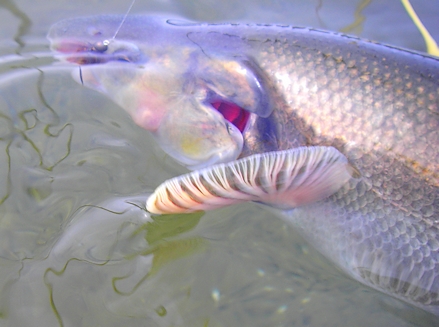
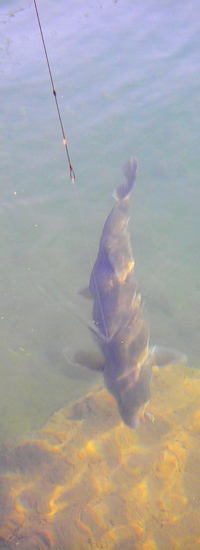
“Notch” improved my spirits a bit, he’s a Sacramento Sucker that came out of the water and tail walked through the finicky carp, it’s part of the beauty of coarse fish – many have the attributes of their noble cousins, yet so few fish for them they’re never recorded.

Neatly notched and healing nicely 

Early Spring displays the war wounds, tossed against unyielding object is my guess, an unlikely location for an Osprey’s talons or other predator, his gill plate neatly notched and healing.

Tossing a #20 Trico spinner with a Skagit head and a 4X tippet is perverse humor, but steady feeding Bass added much needed salve to the wound.

The fly lands south of the line tip and you have to drag about 30 feet of the running line to get the fly out ahead of the rest  – I managed to hook a couple fish, but they tossed the tiny fly after a brief tussle.

Kinda like the way them “gals” treated me, minus the tussle.

The fly tying equivalent of two buck chuck is a three buck flyer

While everyone else is hunting a “10” – us unkempt fly tying types are content with a four. We’re not lowering the bar, rather it’s how many dozen flies we bang out before exhaling.

New materials are like that, anything capable of strumming the Creativity gene, leaving an “Edward Scissorhands” cloud of snips, tucks, flying debris, and a wake of forgotten half-filled coffee cups – is worthy.

Friday’s mail included a “three dollar flyer” – a package of unknown yarn whose grainy eBay picture looked promising, but out of focus. I saw sparkle and the potential for a trophy mutt – whose colors and qualities could generate a four or better.

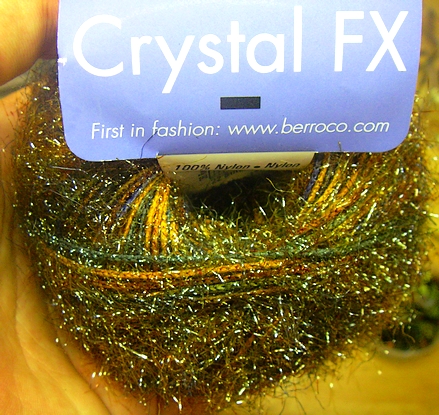
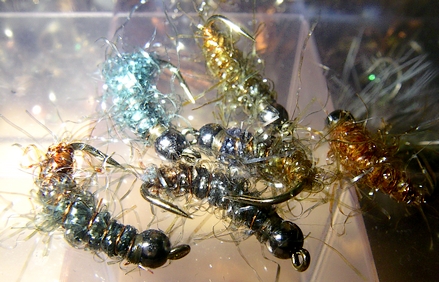
 Berocco Crystal FX "Amber Mix"

Saturday morning I woke with fly tying scissors still in hand and a trail of dander leading to neatly ordered phalanx’s of replacements marching across my desk.

The yarn is called “Crystal FX” from the Berroco Yarn Company of Italy. It ceased production in 2007, so like everything else it’s in limited supply. eBay still has plenty, offering an assortment of colors for $8 per 147 yard skein.

Leech patterns showing color transitions 

I’d describe it as similar to an Estaz, Fritz, Cactus, or Glimmer chenille – but in a soft and flexible yarn form. Comprised of 100% nylon, it’s a flexible, semi-stretchy braid with mylar strands coming off as a fringe. It’s a trophy “mutt” – with color changes every 3 inches, which allows flies to take on any number of color transitions as the yarn is wrapped forward.

I’d purchased two skeins of “Amber Mix” which is blue, green, olive, gold, rust, and brown repeated along the fiber. It lacks the opalescence of glimmer chenille, but makes a fly that looks like shattered glass, with enough sparkle to blind a camera lens. 

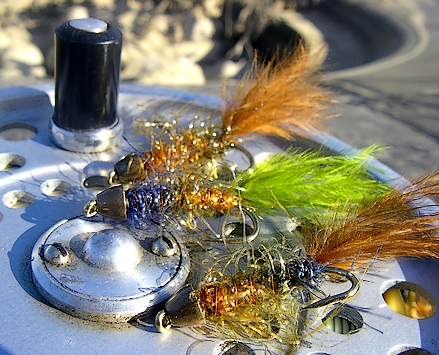
 Czech style caddis with a single wrap

Ribbing the finished body reduces the scruffiness somewhat, allowing you to adjust the fringe effect to whatever length is desired. It’ll produce a “Czech” style caddis with a single wrap, and yield a worm if you plan a color transition at the head.

It’s heat sensitive, so you can melt the top fibers and leave the bottom shaggy, and lends itself to just about everything.

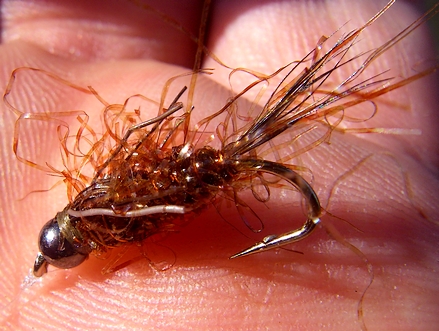
 An AP style mayfly nymph tied with Crystal FX

The yarn is thin enough to be useful on flies down to a size #12. The AP style mayfly above is a size 10, and showcases the fiber sizes and width of the mylar straggle.

You can trim the fibers easily with scissors to allow the dull nylon braid to show – I’ve left mine full length to test whether they break with abuse.

I grabbed some hot pink to use for Shad flies and the magenta mutt to use for steelhead. I tested them yesterday for fragility and they’re bulletproof.

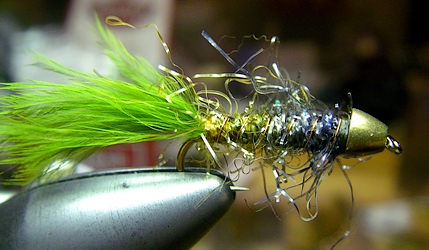
Good color transition for streamers and leeches

This is first class leech material. Most of the patterns I’ve used in the past have some sparkle, some hackle, and fur to complete the forward portion of the fly. This delivers all three plus the added bonus of the color transition – which can be planned at any point on the completed fly.

Roughfisher has a good thing going with his glimmer chenille patterns, this may be a useful addition as the yarn dimensions are different enough to allow use in areas where glimmer chenille becomes unwieldy.

It’s a commercial fly tier’s dream

The Dubbing Divan I had the same problem with watercolors as a kid, sooner or later the entire sodden mass was a muddy brown from intermingled color.

Dubbing dispensers have rattled around my tying area with similar issue – the top layer becomes a blend of everything I’ve tied in the last couple of weeks. Dander and feather duff mixed with the original color, whose self-sealing lid no longer keeps adjacent colors at bay.

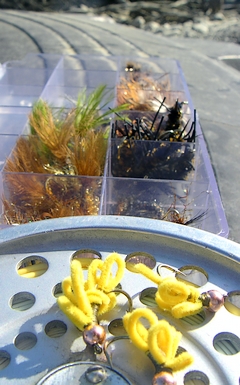
The idea of a “dubbing divan” is appealing. A couple of shades purring contentedly close to hand, allowing the tyer to wrench a handful whenever it’s needed.

No drifting dustbunnies to aggravate family allergies, no mess other than an occasional coughed-up furball, and your source is mobile allowing you to change colors at a whim.

Them or us and Cabela’s picks Them?

PinkGun I’m not sure all those “helpful” spouses would’ve been so eager to dump their gal at the “ladies only adventure day camp” if they’d known Cabela’s was arming them.

Gals and guns is no issue, but my girlfriend armed with “non lethal” weaponry would crimp my angling forever. The luxury of a shotgun, assault rifle, or large bore handgun means she’ll pause for just a split second, consider the consequences, then empty the entire magazine in my direction.

That’s enough time to put a school bus between me and the Never Ending Banana Clip, just enough to hug the floorboards as the windshield is sawn in half, and when she pauses to reload – I’m disappearing around the corner on two wheels and free to fish once again.

Pink handled hoglegs have an air of permanence, it’s not as if you’re assembling gear and call up the hallway. “Dearest? have you seen my .357? Never mind, I’ll just use yours …”

Sounds suspiciously like the sporting manufacturers have given up on us penny pinching males, and have cast their lot with the Missus.

At the camp, women will participate in introductory courses on casting fishing lines, using Tasers, handling shotguns and other topics. During lunch, a hunting and outdoor apparel fashion show is planned.

In theory, the workshops hook women on a new hobby, potentially creating a Cabela’s customer for life.

One longing glance at your vest and you’ll endure 50000 volts of raw energy crackle through an arse cheek – and as your vision dims and the world turns black, you’ll hear the throaty reminder, “No, you promised to do the lawn, remember?”

It’d be Woody Allen and the “Orgasmatron” all over again, with her pumping the Taser button while society crumbles around you…

We’ll all be stuffing a National Geographic down our pants hoping the darts are diffused by the Aborigine article – just like the butt whippings we took as kids.

Is a world record Pikeminnow akin to the most Acne from a single candy bar?

When the wind's right you can hear the laughterThe roar of the motor preceded the scream of wind and shower of leaves, I broke left but evasion was useless, I’d received the Blessing of the Brownline – fertilizer dispensed via propwash – a gift from a leering ex-Warthog pilot, wrestling with his post-conflict internal demons.

The Blessing is why I retain a glossy full head of hair, it’s been fertilized, parted, and mowed regularly.

The really vile chemicals come later, as does my “full camo” ensemble, I dart from bush to brush and everyone assumes I’m just a bit zealous stalking fish. They miss the frightened glances skyward until the howl of Herr Rittmeister’s brightly colored monoplane dispenses an oily blast of fish-based fertilizer-substance.

A Stinger would be really useful, but I’m outgunned. I part the forest with my best oaths, and hope to Christ there’s nobody walking their dog within earshot – as they’d be a pillar of salt.

The creek bottom is barren of vegetation leaving me a porcine, slow moving target, we’re sure to see explosive growth in the next couple of weeks compliments of the Yellow Baron.

The Chunk Monster I rinsed the exposed flesh in creek water – swapping certain death for  disfigurement and continued my northward trek to survey what the runoff had brought me. All the really disgusting stuff is bobbing in San Francisco Bay by now – leaving a pristine creek full of snapped timber, root balls, and flattened vegetation.

Flattened and fertilized vegetation.

At the limit of the upstream section there’s a new beach compliments of a fresh deposit of gravel, and the rest of the creek was scoured much deeper. Lots of new holding water, plenty of deep slots cut along banks, and I’m left thinking the current version is superior to last year’s shallow flavor.

I saw my first fish on mile three, which is normal for Spring. Aided by dam release and winter floods the creek can grow to a thousand times its normal size, which purges everything that can’t hide, isn’t nailed down, or attached to a bridge.

A couple dozen large Pikeminnow and the occasional smallmouth were browsing in deep water – and without any vegetation available to hold insects, and with the catastrophic upheaval of the runoff, I guessed  these might be hungry and desperate fish.

I had a fistful of the “Ellis Island” reject flies I needed to expend and plopped an Olive unknown into the water above them. With a 4mm bead and 25 turns of fuse wire there was a corresponding mushroom cloud and crater in the river bottom – and most of the fish scattered.

I gave it a quick tug to free the fly and all hell broke loose, some silver flash comes out of the water and does its best Salmonid imitation, screams off downstream and returns to sulk.

I’m long past caring what it is – and from it’s profile it appears to be a trophy Pikeminnow – but thick and fat like a bass, not skinny and cylindrical like usual.

It’s laying in the slack water at the bank, and I realize it’s the new IGFA world record for Sacramento Pikeminnow. The old version was merely 6.25 pounds – and “Mr. Chunk Monster”, the genetically blessed fatty was likely to tip them scales closer to seven.

 See that little pink spot, right next to the dent from the vibram sole, it's bleeding profusely

After I kicked it seven or eight times I noticed it was bleeding profusely from the gills, and now I’m torn … do I rush into Raley’s Meats with a dripping cockroach and insist on fame everlasting, or release it and live in obscurity forever?

… and what kind of fame does an IGFA accredited World Record Pikeminnow really bring? Kissing babies and cutting ribbons, Paris Hilton on one arm, little mean-spirited rat dog clutched uncomfortably to my bosom, or is it really infamy, the kid with the largest unsightly blemish caused by ingestion of a single candy bar?

Fearing the outcry of concerned Singlebarbed readers, and knowing how my one small ray of sunlight would be morphed into a hideous crime, the prospect of dampening some Louisville Maple on the prone and defenseless genetic-super-specimen, froze me into immobility.

It regarded me with baleful yellow eyes, suggesting my ashes will trickle off that pristine Sierra mountainside, I’ll wind up a mayfly – and we’d take up this issue again … meanwhile I’m dribbling hollow points into my service revolver wondering whether they’ll show on the cover shot, whether they’ll just go through one side and rattle around a little – and can Fly Fisherman airbrush ’em out like Playboy?

If I’d had a garlic field close I might have been emboldened, but Chunk Monster is breathing atmosphere just fine and looks like he’s finished resting and is about to chase me back to the car.

I eased the hook out and watched him disappear into the murk.

It ain’t the Hoh River, but if I’d yelled loud enough a couple would’ve showed …

Part 2 of 2 : Is the fly line industry running out of superlatives?

RIO NymphIn the last installment we looked at the Scientific Angler and Airflo brands and pointed to similarities of taper and how advertising didn’t always correspond to the line’s attributes. Without a standard we suggested every change to a fly line could be spun into a benefit, and how advertising artfully avoids using the same superlatives to describe features and capability.

Admittedly our research is simplistic; discarding color, texture, slickness, and softness, and most of the hype to focus on taper alone. Taper is responsible for the feel of a line in flight, and that’s something each of us is expert in, it’s something we’ve practiced for years.

We’re hoping that all the Excedrin Migraine we swallowed building the charts will be useful going forward. Knowing your manufacturer and his tendencies can assist in making an informed purchase.

Of the “Big Four” manufacturers only RIO and Cortland remain. We’ve cataloged their tapers and noted some examples of their practices below:

RIO

 RIO Fly lines

RIO doesn’t reinvent the wheel as much as SA and Airflo, it takes proven and popular tapers adds new boxes and artwork and labels them as new lines – often species specific, or topology related. 

The RIO Carp is identical to their Mainstream Floater, the Mainstream Saltwater has an identical taper to their Mainstream Bass/Pike/Panfish, and if you snip 3″ off the tip of a RIO Striped Bass, it’s a RIO Clouser – only about $10 cheaper.

The RIO Lake and RIO Classic share an identical taper, but the Lake is an intermediate sink fly line, which is a marked difference.

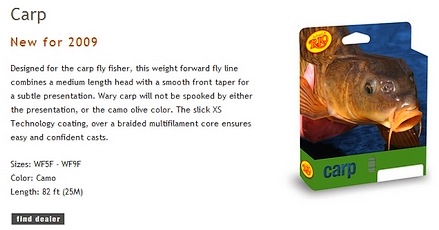
The RIO website has the following for the CARP line:

Designed for the carp fly fisher, this weight forward fly line combines a medium length head with a smooth front taper for a subtle presentation. Wary carp will not be spooked by either the presentation, or the camo olive color. The slick XS Technology coating, over a braided multifilament core ensures easy and confident casts.

… and for it’s twin, the Mainstream Floater:

Designed to optimize rod performance at normal casting ranges with shorter heads, tapers and running lines that empower novice casters to make the cast. MainStream lines undergo the same rigorous production processes and quality control standards as all RIO products. The MainStream floating lines have a supple self-lubricating coating that remains memory-free in cold water.

The advertisements are different, no mention of “smooth front taper” on the MainStream, and they didn’t claim Carp fishermen are novice casters, which was a selling point of the MainStream. “Memory free in cold water?” – is that better or worse than XS Technology?

The RIO CARP retails for $69.95 and the Mainstream floater for $39.95, which is a significant hit despite the XS technology. Is the same taper worth the extra dollars?

You be the judge.

If we look at forward tapers, as we  did with SA and Airflo, RIO has 7 lines with forward tapers in excess of 7 feet. If the practice we’ve seen with SA and Airflo holds true we would expect the Selective Trout II to tout its long tip as that’s the “money” superlative to use; fine tip = soft presentation = selective trout.

The Indicator:

MainStream® Indicator Fly Line • NEW for 2009 With a short front taper and a front loaded head, this line is designed for casting big indicators and heavier flies, and does so with ease. The line is built on a supple braided multifilament core and has a self-lubricating coating that remains memory-free in cold water.

Huh? Short Front Taper? A delicate tip would be worse at turning over large flies as it lacks the mass of a heavier line. The front 7′ of the belly of the line is what they’re trying to suggest as the weight forward, it’ll have to transition its energy into the decreasing diameter of the 8′ forward taper otherwise it’s a mess when it lands.

The RIO Grand:

The RIO Grand is one half size heavier and features more weight distributed towards the front of the line to easily load fast action fly rods. AgentX Technology gives the RIO Grand maximum floatation and the XS Technology produces a wonderfully slick finish for easy distance. The line remains supple in coldwater conditions and is ultra smooth for maximum casting distance. The Super Floatation Tip™ has a welded loop for changing leaders. Tests prove that when you land a fish, the loop slides through the rod guides more easily than the customary nail knot.

No mention of the longer front taper, but has “Agent X” as a wildcard to feel safer about the purchase. “One half size heavier” means the line is AFTMA #7.5, and it’s likely a thicker diameter throughout the taper. We’ll have to take their word on it because a long front taper doesn’t concentrate the weight towards the front of the line, that’s an attribute of a short front taper.

The Selective Trout II:

One of the softest, memory-free fly lines made. A unique manufacturing process enables this line to have a relaxed off-the-reel feel yet the harder outer coating ensures the highest casting performance and durability. The Selective Trout II line is for discerning anglers and technical fishing situations where the long, fine front taper provide the softest of presentations. This line is the best for bamboo and traditional action trout rods. RIO has slightly increased the diameter behind the front taper of the double taper for easy turnover of long leaders. The AgentX coating makes these high floating lines incredibly easy to lift quietly off the water, while the XS Technology results in a very smooth and slick finish.

Predictable isn’t it? Here’s our mention of the benefits of a long front taper and how it assists a gentle presentation. Note how “soft” is immediately diffused by “hard outer coating” and durability is no longer in question. 

There’s little question that the marketing is genius – and fascinating how each line contains attributes that are selectively ignored or pronounced ensuring each line is marketed to a unique niche. This style is constant among all line manufacturers – and is required to ensure we’re lining up for more spools and the lines to go on them.

Real genius is touting a long front taper as good, and not having to  explain why a short front taper isn’t bad.

In my mind RIO takes it past the line of good taste however. I give high marks to its authors, their prose is deft, subtle, and you can’t argue with any of it. Claiming the delicate tip will assist in turning over large flies and a longer front taper is “more weight forward,” isn’t consistent with physics. The belly of the line is not part of the forward taper, and RIO blurs that distinction.

SA and Cortland were both effusive and elusive about their products, but they didn’t require a 4th dimension or a rift in the space-time continuum to validate their assertions.

CORTLAND

 Cortland Fly Lines

Cortland 444 LineCortland appears to have made a concious decision to simplify everything but the box art. It’s as if their strategy is, “We’ll make a taper that we like and use it on everything, if you like the feel of how a Cortland casts, then you’ll like all our lines.”

I can’t argue with the logic as it’s sound. It could also be indicative of a company attempting to keep pace with others and ill prepared for the specialization wave. It’s a reasonable explanation but it’s entirely conjecture on my part.

Cortland makes many lines but very few distinct tapers. Like Airflo they like a full foot of level line at the tip, and prefer 90′ and 105′ lines, and are betting on one of two things; either their coatings and textures are so much better than everyone else, or you won’t look at the above chart and realize they only make 2-3 different lines.

The chart speaks volumes, and suggests you’d be best served looking at price. Despite the box art, the line hasn’t had its taper tuned to match the advertised quarry or conditions, and with so little variance in taper the real difference is what you pay.

The SYLK and Classic Clear Creek have an uncommon amount of level tip and should be noted as such, let’s take a look at the marketing:

444 Classic Sylk is the first modern line designed specifically for fine bamboo and rods. The “Sylk” replicates the fine diameter, long taper, supple feel and subtle color of natural silk, but in a modern, easy to care for fly line. But, the “Sylk” isn’t just for bamboo! If you are one of the many anglers who have rediscovered the delights of fiberglass fly rods, this line is for you! It even works well on graphite for the finest presentations under the most demanding low water conditions. Can you say “midges?” 

… and the Classic Clear Creek:

Whether you’re on the legendary creeks of Paradise Valley, the Chalk Streams of Hampshire, or in the Limestone country of Pennsylvania, spring creeks (and tail waters!) present special challenges. The extra long, supple tip of the Clear Creek helps put the body of the line further from the target, resulting in a softer, more precise delivery of the fly. The mute olive color blends into both bank-side and aquatic vegetation. And our cold-water formulation remains coil free in any condition. 444 Clear Creek, the choice of spring creek experts!

No mention of the 400% longer tip on the SYLK (as compared to SA or RIO), which is being marketed to the bamboo crowd, that “extra long supple tip” is reserved for their technical offering, the Clear Creek.

Artfully chosen verbiage ensures no two lines appear the same in print, regardless of their physical properties.

Summary:

Fly line manufacturers are playing a game of words with us consumers. That’s not terribly surprising, but inclusion and omission requires us to do our homework before assuming anything about a fly line.

It doesn’t appear that a Bonefish line is required to catch a Bonefish, and you may have known that instinctively – but the new fly fisherman who’s looking to fly shop staff and magazines to make decisions doesn’t.

Advertising copy used by fly line makers are slicker than their line coatings. Features they tout on the box are shared by other lines in their product suite, many of their tapers are similar, and there’s no standard to judge words like; longer, shorter, and slicker.

A desirable feature is touted by the maker, its opposite is present on another line – where it too is an asset, and all we’re supposed to acknowledge is “it’s all Good.”

Fly lines are limited in their physical properties by the AFTMA standard. Weight (taper) is either pushed forward on the line or pulled rearward, with predictable consequences. Skagit lines and shooting heads are “all the weight stuffed forward” – and there’s no parallel for everything pushed to the rear other than … kite string.

Our research for these articles is inherently flawed. We’ve ignored all qualities of fly lines other than their taper, but taper is the entire feel of a line in flight and quite possibly the most important portion of any cast. Manufacturers toss us buzzwords; “Agent X”, “hydrophobic”, and “repeating geometric micro patterns” and like fish we swallow the bait whole.

Not all technical breakthroughs are worthy, and it’s up to us to determine what really works, what we really like, and to reward those firms that consistently produce superior quality in addition to superior ad copy.

Note: As an added bonus you can use the charts above to quickly determine who is repackaging another vendor’s lines. While the colors may change, the tapers should remain the same.

Me and Ellis Island is tromping stream gravel

Statue of Liberty box, containing the halt, lame, and weak of heart Every fly tyer has a “Statue of Liberty” fly box on his desk, it’s featured prominently close to his vice. It contains all his huddled masses, his wretched refuse of accidentals, flies missing legs, tails, poor color choices, or merely tempest tossed and a great idea that didn’t live up to it’s full promise.

After being held hostage by four days of howling winds, dawn broke airless and golden. I stuffed the “Ellis Island” specials into the vest and left – completely ignoring all responsibility.

I’ve got a new creek to discover – it’s actually the old creek that’s been scoured clean by this Winter’s floods. I’ll have new structures, new pools, and hopefully a few fish – although I’m not expecting to catch much other than brisk exercise.

Part 1 of 2: Is the fly line industry running out of superlatives?

Scientific Anglers UltraI just can’t seem to leave well enough alone. Dogged determinism has me squinting at the screen digesting numbers and errata when I should be mowing lawn or squinting at a small fly going in harm’s way.

Like the evolution of medicine, fly line manufacturers are no longer content with a general practitioner, they’ve pushed us down the specialization path with glee – leaving us to ponder whether Mango is better than Avocado, slick is superior to textured, and whether a line called Salmon is needed for Salmon, or just another gimmick to add to the already horrendous weight of our vest.

Much is made of all the differences, with anglers professing allegiance to one camp or another, or merely shivering in the middle; unsure and undecided whether the voices of vendors and vendor-backed media are taking them down the primrose path.

Our angling publications aren’t much help, authors vie to give manufacturers the least offense, hoping the flow of freebies continue unabated. Product reviews always contain superlatives, the marketing materials contain even more  – and  end prematurely with little more than, “it’s cool, definitely slick despite the ridged and  bubbled finish and the Puce polka dots allow you to maintain contact despite blending with bankside shrubbery.

Vendors are in constant competition, and pricing depends on mass production, each manufacturer wants as few pots of bubbling plastic polymer as possible. Cortland and Scientific anglers prefer PVC, Airflo likes Polyurethane, and everyone touts their mixture as the “one true God.”

But with the plethora of specialty lines and the maker’s desire to ensure you own all of them, they’ve trapped themselves. The AFTMA standard requires the line adhere to a given grain weight in its first 30 feet. Like NASCAR, everyone has a similar rule set – and there’s only so much you can do to a fly line taper. Shorten, lengthen, make “stairsteps” of increasing or decreasing line size, but when you’re done it’d better weigh within a fixed range just like your competitor.

We’ll assume everything they say about coatings, compounds, and textures is true, allowing us to get past the nouns and acronyms, past the religious fervor of Sharkskin, SYLK, and softeners, and focus on the product’s taper. We may not be able to discern the difference between hydrophobic and hydroponic, but we’re expert in soft butts,  big bellies, and a long tip when cast.

That “feel” comes from the taper – and whether it’s a sinking line imbued with Tungsten dust or a floating line with microbubbles, we’ve flung them with great passion for years; we know what we like, and might be able to answer, “are all these specialty lines really necessary?”

Remember, “as few pots of bubbling plastic as necessary” – and regardless of the spittle and vitriol, it’s likely all these lines use the same basic formula of plasticizers and polymers.

Method

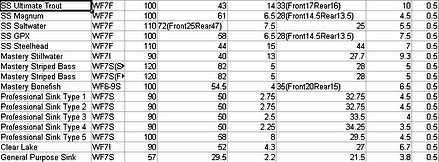
I chose a AFTMA WF7 F/I/S to show the taper of each vendor fly line. These numbers are taken from the vendors website and/or discrete PDF’s constructed by the vendor which contain their line specifications.

We’ve ignored sink tips intentionally as their taper is compounded by the sinking portion.

Length = Total length of the fly line (feet)

Running Line = Length of the level running line portion (feet)

Rear Taper = The length of the rear taper of the head (feet)

Belly = The length of the fly line belly (feet)

Front Taper = Length of the front taper (feet)

Tip = the length of the level tip (feet)

If the line has a compound taper in the belly portion that taper is denoted by its overall length, and the steps of the taper in parenthesis. 35(Front20Rear15) is 35 foot overall belly length, the front 20′ is different from the rear 15′.

Lastly, I took every WF7 the vendor sold and compared their respective tapers in a chart, allowing you to see real differences in the line taper without being swayed by box art and advertising.

Scientific Anglers

Scientific Anglers fly linesScientific Anglers fly lines

I’d describe Scientific Anglers as the most prolific of the fly line kingdom. It’s apparent that almost every discrete line they manufacture has some small difference. These differences are not drastic and begs the question, “can the average angler detect the taper, and will it make much difference in his casting?”

Example: Take the Lefty Kreh Signature and the SA Professional floating line.  The differences between the two are a 2.4 feet longer rear taper on the Kreh line, and the Professional floater is the converse of the above, a 2.4 foot longer head taken from the rear taper. Both are the same price at Cabela’s.

All other line specifications are identical, suggesting the Kreh and Professional are largely the same. Manufacturers would claim the Kreh gives the softer presentation due to its longer tip – you’ll note in the marketing material below taken from the 3M and Cabela’s websites – no mention is made for the longer tip – it’s not considered an asset.

The marketing at Cabela’s is very different, differentiating the two, and there’s no mention that the Professional series contains the Lefty Kreh Signature line, as demonstrated by the Scientific Anglers website. That’s not an indictment so much as demonstrates the pains by which advertising attempts to make them all quite different.

Lefty Kreh:

It’s specially engineered by Scientific Anglers to possess optimal density for high-flotation applications. Both supple and easy to use, this line has a versatile midlength head that makes it suitable for a wide range of fishing situations. Special 3M lubricants increase the slickness of the Signature Series, resulting in superior casting performance.

Professional:

Scientific Angler’s new Professional Series Floating Line has optimal density for high flotation, and is supple for ease of use. With a braided multifilament core, internal lubricants to increase slickness and enhance shootability, and integrated UV inhibitors, this line is ideal for a wide range of conditions.

The Scientific Anglers website is terse in its prose, listing an abbreviated preamble and bullet points to describe each line’s attributes.

Lefty Kreh Signature

Applications:

  • Excellent general-purpose line
  • Easy to cast and high floating
  • Optimal line density for high floatation
  • Supple and easy to use in most conditions

WF taper characteristics:

  • Versatile mid-length head designed with input from the master himself – Lefty Kreh

Core:

  • Braided multifilament nylon

Coating:

  • 3M PVC formulated with special internal lubricants to increase slickness and enhance shootability
  • Integrated UV inhibitors for increased durability

Professional Series Floating

Applications:

  • Excellent general-purpose line for all weather
  • Optimal line density for high floatation
  • Supple for ease of use in all conditions

WF Taper Characteristics:

  • Group-tailored heads for general use

Core:

  • Braided multifilament nylon

Coating:

  • 3M PVC formulated with special internal lubricants to increase slickness and enhance shootability
  • Integrated UV inhibitors for increased durability

We find both have the UV Inhibitors, both have the same superlatives in describing function and use, the only difference being that the Lefty Kreh line is “designed by the Master himself” and “easy to use.”

I’d suggest that the lines are identical (except for the 2.4 foot reallocation) and that a casual angler isn’t looking at two different lines – but is in fact looking at pretty much the same line.

So why would a vendor go to the trouble of building a feature into the line that was singular when compared to other tapers, yet make no mention of it?  It’s likely they’ve used the superlative already in a half dozen other lines, and it’s important to distinguish each line as an asset to the angler’s overall quiver.

So you feel you need them all.

Note that the SA Mastery Stillwater has the 2nd longest front taper of any fly line they make, but it’s length isn’t mentioned in the marketing material. Ditto for the Supra Floater, it’s the third longest forward taper SA makes – yet no mention of that attribute on their website.

The Mastery Bonefish and Sharkskin Ultimate Trout Taper both advocate their long tips to provide graceful presentation, and there’s no sense confusing you as to how many “long tip” fly lines you really need, is there?

Both the Mastery series and Sharkskin lines are more expensive than the Professional and Supra series – why not save the best superlatives for your high end lines? That’s good marketing.

Scanning the chart of the Scientific Angler lines above, many more similarities announce themselves, like the Saltwater Specialty, and the Specialty Bonefish line – a mere two foot difference in taper location akin to the Lefty / Professional.

There are many pronounced differences in the tapers as well, what the angler needs to ask themselves is outside of the marketing hype of slickness, texture, color, plasticizers, and coatings – is there much difference between my choices for a Carp line – and would the Bonefish taper be just as good?

Most anglers won’t be able to discern the difference between 2 foot of taper shoved forward, and as we’re ignoring all else other than their functional spec, it appears much of the cornucopia of fly lines tapers are not as distinct as we’ve been led to believe.

Airflo
Airflo_Lines

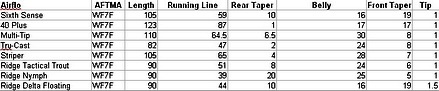
Airflo fly linesAirflo has a much smaller stable of fly lines than Scientific Angler, and like SA they’re showing the same advertising tendencies.  Both Airflo and Cortland include a full foot of level taper at the tip, unlike RIO and SA which opted for 6″.

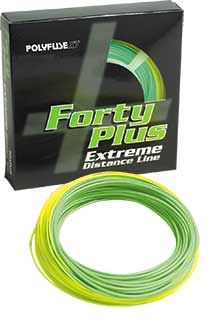
The Delta, Sixth Sense, and 40 Plus all have long front tapers to ease the splash of presentation, and the balance of the Airflo suite are roughly similar with the weight shifted forward or backward by less than 5 feet.

Despite the differences between the two basic groupings of Airflo lines, only the Delta advertising mentions the long tip. The Sixth Sense and 40 Plus make no reference to the tip at all.

(The 1.5′ tip on the Ridge Delta Floating appears to be a website typo)

We should be asking ourselves when the manufacturer touts his “extra long belly” as an aid to long casts, long as compared to what?  There’s no such thing as a normal belly, tip, or rear taper, ensuring every possible change to the line can be touted as a benefit.

With the debut of the Singlebarbed line and it’s Zero-Taper tip, the sumbitch lands like a gutshot mallard – offering the angler the advantage of visual feedback on the location of his fly. Available in Raspberry Red, Lemon Yellow, and Orange Orange..”

Whether it really makes a difference in your casting, you’ll have to try one and find out. 

I fear there’s plenty of lip gloss in fly line advertising, largely to differentiate similar products – giving us anglers the illusion we need multiple lines.

Wednesday, Part 2 of the series, “Are they Rogues or Demons, and why didn’t they tell me snipping 3 ” off the tip of a RIO Striped Bass line yields a RIO Clouser and $9 savings?
105 in the shade might be an appropriate proving ground

The pace is glacial but someone’s keeping their ear to the catcalls from the brown water…

RIO's new Carp Taper

Summer is truly inhospitable and the combination of blazing daytime temperatures and chemicals in the water have bleached the SA Sharkskin and Cortland lines I’ve used in past seasons. It’s only a little bit less harsh on me – with my thin membrane of waders all that separates me from the chemical brew.

Technorati Tags: , ,