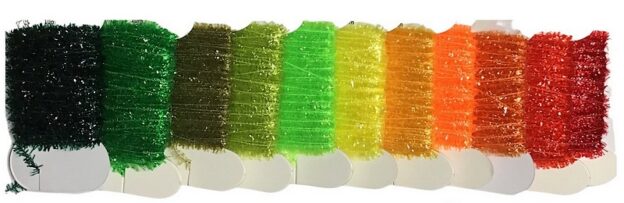
I made the mistake of trying to track down “cactus” or “ice” chenille, and rather than emerging victorious I am scratching my head over the outcome. This type of chenille is commonplace in the needlepoint industry where it’s sold as “edging”, something to border a needlepoint applique or fanciful throw pillow.
It’s a search engine nightmare, and tracking down the different types resold to us fly tiers is a real headache. You can find it under “eyelash” yarn, iridescent chenille, “scrubby” yarn, iridescent chenille thread, as well as using the familiar, “cactus” or “ice” chenille. Numerous vendors exist, many of which are in Europe, and use a different nomenclature for these products than we do. Mylar is called Lurex in Europe, so the search string changes depending on which continent you’re on. In addition there are many colloquial names like, “Cactus” chenille, “Ice” chenille, “Iridescent” Chenille, “tinsel” chenille, “Glass” Chenille, “Mylar” chenille, “Estaz”, and Lurex Chenille, Lurex Garland, among others. It’s made with a variety of materials, some with soft plastic like Estaz, or Kreinik’s “Micro Ice Chenille”, and some flavors feature a much coarser plastic, which we tend to call “Cactus” chenille.
What seemed like a simple item to track down quickly devolved into a multi continent , multi product mess, not the least of which was that fly tying shops sold it for less than needlepoint shops, which added additional mystery, besides being a first …
As I was looking to stock up on what I’ve known as “Micro Ice Chenille“, which is among the smaller versions of the product, I decided to leave all the other products for another day – or another fellow braver than I am …
“Micro Ice Chenille” is a trade name of Kreinik Threads, which is owned by another company called “Rainbow Gallery.” Searching for this product yields a few colors available from a dozen or so needlepoint shops, none of which have a comprehensive selection of colors. Likewise for the fly shops, as it seemed the selection was as sparse as the needlepoint shops. This is typically a bad sign in the yarn business, as it often precedes the vendor going out of business, or the discontinuation of the product itself.
I attempted to track down the status and found a couple old references to discontinued colors, but it appears the company is still making the product, although in less colors, and more importantly, they no longer make the “Fern Green” that is a staple of my warm water damsels and some of my better bass flies.
I’ll live … but only because I bought the last few spools remaining.
Kreinik’s base colors are available on their website, and many fly shops echoed this list, so it was obvious they were stocking the Kreinik product line, as the colors matched. Many shops had additional colors, so more vendors exist, but trade names and manufacturer information is scarce given the repackaging happening in both fly and needlepoint shops.
The best replacement I found was the result of using the search string, “Iridescent Chenille Thread” and while the size and texture was a match, they sold two different styles under the same name. One style of yarn is wrapped on a card (this is the identical version to Kreinik), and the other version was wrapped on itself, no card, and featured a thicker core thread holding everything together. Both worked well, but the tie off of the non carded yarn was bulkier due to the heavier core threads.
I ordered a couple of colors in both styles and they looked good, same soft mylar texture with several dozen new colors – including vibrant florescents, and available as a 10 meter skein, which is double the quantity of the Kreinik product, and about half the price ($2.39 vs $4.30), a great combination. The carded colors have the same thread core as the Kreinik Micro Ice and behave identically on both application and tie off.
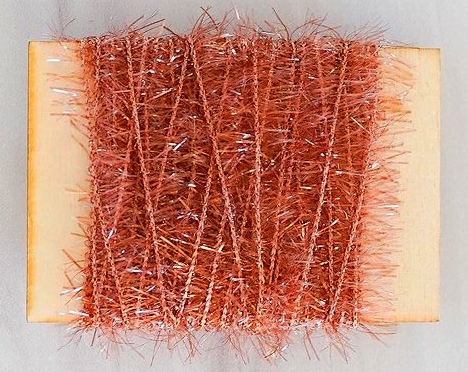
The above picture shows the heavier thread core used in many vendors variants of these yarns, and you need to be concerned if you’re tying small flies as the heavier core will make a bulky tie off point.
The point of all of this is two fold, there is more than one name for cactus chenille, and once you find some you’ll find many more kinds and types of this yarn available. You need to choose your labels wisely, be mindful of the continent you’re on, and you probably need two or three different vendors to get a semblance of a color selection. Kreinek doesnt’ appear to be adding colors, so it may not be a credible source much longer (my instinct, not fact) .
Most tiers are using the subdued “trout” colors as that’s what’s sold by our fly shops. Mallard, Peacock, and Emerald Green, are the only greens available (Kreinik) , and myself and others would like some Olives, more Browns, and perhaps some Golden Stone type colors. Sprinkle in a few bright colors for Steelhead and everyone’s happy. The Kreinek catalog is sadly lacking all of that, which is a bad sign, so start looking for an additional vendor soon, and you may want to stock up on the colors you use most frequently.
Korry’s Little Shop in the UK has the best color selection but most of the colors we’re looking for are also out of stock. Remember to purchase the carded colors to ensure the same thread core, perhaps buying a skein of the non carded (thicker) core to eyeball before buying more.
I spoke with the proprietor of Korry’s Little Shop and she echoed the same issues I am having. Colors last for only a short time before disappearing, the landscape is ever-changing with most of the product lacking anything in the way of trade names, as it originates in China. Chinese cones are made into small cards for the millinery industry and the manufacturer or common name is neither translated nor transferred to the carded product.
Which puts us flytiers, in a bit of a quandary. I have confirmed the colors on a Chinese website, suggesting they are the supplier, but few if any of the colors are making it to our shores.
I’d like to find a cone of Olive, but it appears that’s not in the cards … and while that was a pitiful attempt at humor, it seems we’ll be dealing with the lack of cactus / ice / glass chenille colors for the foreseeable future.
ICE yarns sells a flavor called Metallic Glitz, but the colors available are fine for steelhead, not so much for trout fishing. ICE (vendor name) yarns is one of the larger players in this space, so this illustrates the paucity of our color selection. No one is making “nature” colors – most vendors are making “Christmasy tinsel/garland” colors instead.
“Icicle Tinsel Trim” used in a search string revealed the extent of the Xmas phenonmena, this vendor features the thicker thread core and the colors more appropriate for the holidays.
Kreinik sells 50m cones for about $50 dollars, but the lack of colors means that kind of outlay is really questionable. A cone of Olive would be great for my tying, but your flies will differ, so the value of the larger quantity hinges on your planned use. Finding a backup supplier with additional colors in the Olive, Brown, Golden Stone, range would be a nice hole card to have, given the colors cannot be depended on to last more than three or four years …
For those about to begin their own search, note that all these yarns are called “Eyelash” yarns by the yarn industry. As you wander through vendors supplies this is the category of yarn to use to get close to what you’re looking for – a filamentous yarn with short fibers emenating from a central core. Add the material type, Lurex or Mylar to string and you’ll start hitting options that resemble what you want. Now you simply need to wade through the options until you find a match.