Teetering on the brink always brings out the best in us

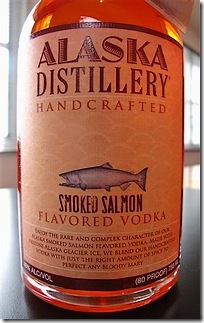
Smoked Salmon Vodka Known  galaxy-wide for our sympathetic stewardship, us Homo Sapiens having the accidental good fortune of eating everything above us on the food chain,  so what do we do with an inferior species teetering on the brink?

… do we pause and reflect, right innumerable wrongs, or merely gash ourselves over our lack of foresight in the indiscriminate use of pavement?

Never.

We find even more novel ways to eat the few remaining survivors, or grind up the heretofore inedible beaks, feet, gristle, and unmentionables – to make even tastier things that require us to kill even more …

Coarse fish point and laugh when they see that silvery salmon smolt wandering around befuddled – still woozy from the long bumpy truck drive, and sick from the toilet flush down the long corrugated pipe into fresh water.

“Dude, the ocean is that way, you’ll know because the water tastes like crap and there’s twice as many tampons … but I wouldn’t worry too much because you’ve got to get past that bigarsed concrete wall with the screen that sucks you into the whirling death machinery.

If you make it you’ll want to hug the far side near Antioch, otherwise you’ll get sucked to LA along with all them trash-talking Stripers, who’ll probably pimp you out to them largemouth in Lake Cachuma or Castaic – and you’ll be spending your best years selling crack on some dimly lit weed bed … if they don’t eat you outright.

… or you could take the red pill – that salmon egg over there, and wind up mashed and forgotten in a Styrofoam cooler with empty beer cans and leftover Cheetos … Sure, it’s cannibalism of a sort, but at least you won’t get the Screaming Blue Shitz from all that Ag chemical in the valley.”

Naturally, a few of us decry that wanton exploitation of such a precious resource, but only after we’ve caught our fill and want to preclude others from matching our war stories …
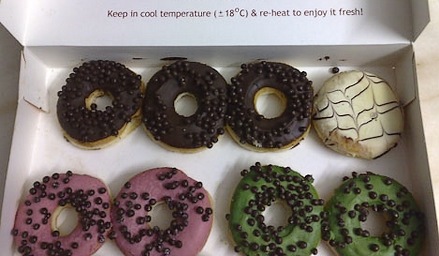
Mmm, looks like deer berries

… so we can make another couple of million paving some marsh so’s we can sell salmon donuts, that use parts even the vodka crowd blanch at  …

Pampered and fed at the hatchery – head filled with nonsense about superior and noble, and some greasy-fat Pikeminnow fills them in on their destiny … you’d think we’d have the courage to do that.

Tags: salmon, smoked salmon vodka, salmon donuts, they were so thick you could walk across their backs, stewardship
I gotta Trout with your name on it Osama

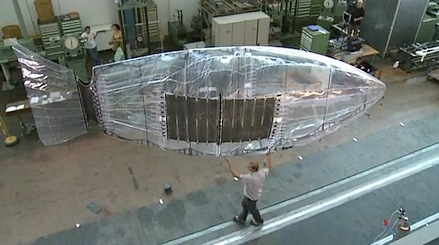
The recently leaked footage of the next generation of Predator Drones has the fishing world in an uproar. Gone are the propeller driven noisy mosquitoes of yesteryear, in their place comes the sneaky-quiet atmosphere fish … the Rainbird Trout…

TroutNator airship

… meanwhile the Defense Department is a mass of denials, claiming the video of the device (found on a Northrup-Grumman engineer’s iPhone) is a hilarious fake.

Airships or Blimps have been used by the military for the last 100 years, and were it to have offensive capabilities we would have chosen something scary like an Alligator Gar … that and it would’ve cost twice as much.”

Email recovered from the phone suggest it’s a joint NATO research effort with elements of both design and fabrication provided by the German firm, Focke Wulf, and the UK’s Bristol Beaufighter consortium.

“It’s a classic stealthy and aerodynamic design that can root out an enemy in either rocks or dense growth, capable of a violent take (sic) of a single insurgent, or feed wantonly in a target dense environment.

We called it the Rainbird because of the sound it makes from the 20mm depleted uranium Gatling we put on the prototype. Hey, there’s a bad guy, chuck-chuck-chuck-chuck …

Additional email suggests the working name for the project is the “Trout-N-Ator”, and mentions a larger tank-busting variant – code named “Eastern Bloc-ee.”

There are obviously fishermen involved. Somewhere.

The Bug died screaming, make sure you imitate that

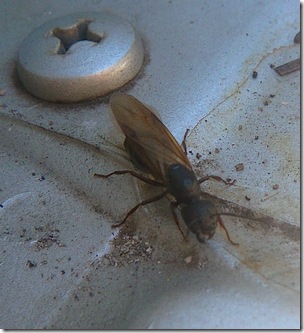
carpenter_ant If fly tying wasn’t such a mood based hobby your flies would be twice as good. A big order of tiny, upthrust, and gossamer locks the poor tyer into a mayfly mindset and when a big black ant is up next – being a “slab” of protein completely out of place on water, the result is tiny, gossamer, and neat …

… which has no parallel when imitating a drowning Chuck Roast.

Knowing my coworkers will be demanding ants by lunch hour, and armed with a half dozen photos from yesterday – whose details are still fresh, I eyeballed a couple of the larger catalogs and noticed every ant was an upright aquatic insect … none were tied as a dead bug, and fewer yet were tied screaming in terror.

The Gods had smiled ever so briefly, and while it may be five or six seasons before I need them again, I learned my lesson.

First of all terrestrial insects don’t ride the surface upright like mayflies. Most of them are dead, the rest are struggling to free a big terrestrial wing from the water’s surface and will expire on their back or curled on their side, and there’s nothing neat and orderly about it.

Wings aren’t gossamer as they’d get in the way. They’re stubby thick affairs that once dampened lose most of their aerodynamic qualities, trapping the insect in whatever position was first contact.

Fish (bless them) are entirely unsophisticated when the equivalent of a Virginia Ham is struggling on the surface, and it’s likely that color and size is all that’s needed.

… and something that allows you to see that flush-in-the-film imitation so you’ll know when to strike.

Not pretty, nor is it meant to be

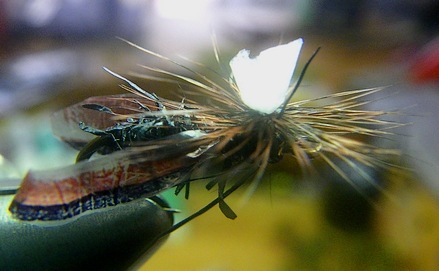
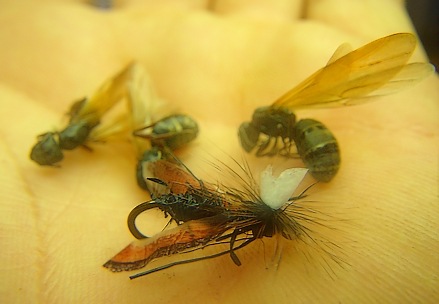
I dubbed the traditional ant profile using black deer hair, which left fibers poking in every direction looking like big black legs. I slapped some brown and black permanent marker on the lettuce bag from the trash, posted some closed cell foam upright and wound a brown-dyed grizzly hackle around it to add a bit more brownish tint to the overall fly.

Those wings will flop onto the surface and stick as the saran is so light it won’t hold its tied-in shape.

Curled and dead

Contrast the dead ants with the live picture at the top. Orderly and shipshape versus cold and curled – wings splayed. This was the look of the wet insect we fished over Sunday.

Surely, if a large Adams was all it took to fool the fish we’re splitting hairs, yet if you’re taking the trouble to imitate something lose the live bug bias and get disjoint and nasty.

Coifed and combed is for that sweet smelling fellow with the droopy backcast, and was never meant for the bait …

I call it four grabs and a welcome asterisk

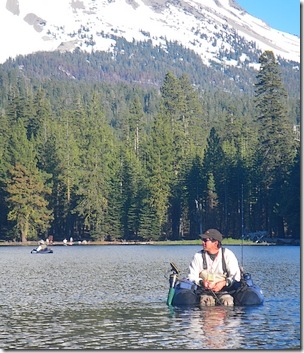
It's his lake, the rest of us are backdrop

I lack the Warden-aint-looking-Velveeta “rod holder”, the depth meter, but more importantly I’m missing that gracious and relaxed look that comes with consistent success.

I was too busy sulking to notice. Fishing is five grabs – and if you’re lucky enough to hook most of them it’s a good day; sunburn hurts less, dinner tastes better, and the mosquitoes bother some other unfortunate.

Me. Mostly.

I flopped around trying secret and double-secret, figuring with each new color I’d unlock the lake and its secrets, but it was for naught. The weather was friendly, yet the fishing remained deathly.

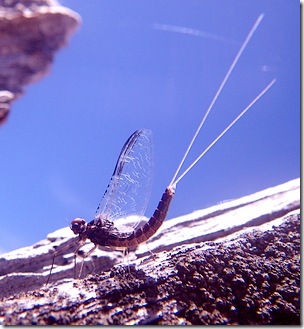
calibaetis spinner

Not a Factor.

My Savior

Why you keep a #10 Adams in a box of #16’s

After the sixth or seventh honey bee floated by I was rethinking the McGinty – and why hadn’t I been smart enough to have a half dozen at the ready…

Everywhere was “Pizza” water. Toppings included every terrestrial not supposed to be there, a smattering of everything that belonged, throw in some midges just to confound everyone and a rise was something to dread, not its normal welcome quickening.

Two fish over was the fellow that likes mayfly, and I’d just cast at the fish that prefers Ladybug…

… and that welcome breeze, the one that adds enough cooling to your burnt forearms so’s you won’t notice – suddenly delivers enough protein to wake up everything downwind plus sending the sunbathers screaming.

It’s the reason you have that one bedraggled #10 Adams in your box of sixteen’s – where you pray you used lots of black thread, because having tried everything earlier, you know you’re lacking ants of any shape or color.

A deft use of the nippers – a bit of artistic license, and sent on its way with a prayer. The first fish shakes it loose in midair, and with only four grabs left …

Why you have a #10 Adams

… that satisfying feeling of a solid hookup. Large meat heading for the weeds and suddenly 5X is too thin, gossamer even.

Everything looks better

Suddenly everything looks better. The girls are prettier, the sky bluer, dinner is strictly gourmet, and there’s still some fish working. No one’s noticed – none have crept closer, and after those two Canada Geese trail past my fly …

NO. He did not just eat that

(The honker is making a wry face, beak and tongue suddenly active)

… and the line is moving smartly from the slack position to nearly taught.

Canada Geese love big dries

Time freezes.

The little Devil on my left shoulder says, “ Dude, figure she’s nearly eight or nine pounds, that bitch can peel line …”

The lesser Devil on my right says, “True, but you’ve got about 60 small children and parents on the beach to your left, that Honker is going to scream bloody murder, likely go airborne – and while you’re flying that kite with your click-pawl pointing its ugly finger right at you, the entire National Park Service is going beat you to death in a really public way.”

… so I feed slack as fast as I can, the Goose is still mouthing frantically and I’m praying the last of my five grabs is a clean miss.

Ptui … and the fly drops safely into the water.

Left shoulder Devil isn’t done yet, “Dude, that counts. It’s aquatic, it lives here – it’s natural, and it was a clean take.”

Right side responds quickly enough, “ An asterisk at best, what’s important is that as the National Park Service has recently converted from wheel guns to the Model 92 – featuring 15 in the clip and one in the pipe – they’ve stopped counting until the slide locks at empty.”

We all agreed that was a good point.

Return victorious or return on thy shield

Dig through the rubble before finding the good stuff I’m the second wave of shock troops intent on despoiling the Pristine. The first wave hit the piney woods absent important supplies like aged booze and microwave pizza.
I got one short call full of the hissing and popping of atmospheric interference – suggesting that I’d better get up there.

“Why? Is fishing awesome?”

“No, * KRRRRR FSSST *  they’re repairing the road and * KRRRR * I’m stuck in traffic.”

Sounds more like a “misery loves company” story – but as I’ve got all the really obscene civilized luxuries in my truck, I’m obligated to go.

Not to mention I’m carrying all the really deadly flies, at least those worth borrowing long term. This year is no different – the crowd will make do with whatever remains from the fistfuls commandeered during last season, assuming resupply is imminent.

Passing provisions and gear between float tubes is always a bit dicey – like two ships matching bearing and speed and hope that your counterpart has a firm grip on the goods.

The communal fly box is chock full of Big 5 wet flies, he’ll have to dig through rubble before he gets to the Mother Load of proven killers. Figure a good stiff afternoon breeze and he’ll be eight or nine feet distant before he realizes he’s been duped.

… or I’ve been, once he lands something of size on a #8 Scarlet Ibis.

Tags: Big 5 flies, gone fishing, microwave pizza, obscene luxuries, fly fishing for trout

The Greatest Invention yet to come may be here now

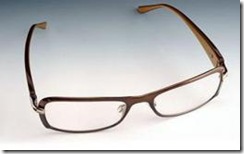
electronicsp Top 10 lists be damned, the greatest advancement to fly fishing ever invented is about to debut – and us old mean bastards can take our rightful place in the riffle undeterred by all the energy drink antics around us …
… assuming we still have good balance, naturally …

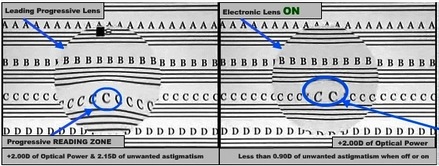
According to PixelOptics the patented electronic lenses provide dynamic and intelligent optics by using a combination of “chemistry, electricity, and other components” to correct for visual problems such as presbyopia, or loss of near focus common in people over 40. The lens has a section with an electro-active liquid crystal layer within it, and the index of refraction of this layer can be changed by a small electrical current passing through it, with the focal length varying with the current applied. Motion detection of the glasses is achieved by motion sensors similar to those used in the iPhone.

In automatic mode the electro-active layer is turned on and the focus changes automatically and almost instantly as the wearer tilts his or her head (to read a book or newspaper for example) and looks through the transparent electronic layer. In manual on mode the lenses behave like normal progressive lenses with the electronic layer frozen in the on position for close distances with the eyes looking down, but objects straight ahead in the distance can still be seen clearly. In manual off mode there is no current in the electronic layer, and so the lenses act like a low power progressive lens, which has little distortion and is good for everyday activities such as playing sports, walking, and so on.

Presbyopia, a fearsome word … you’re going to get it in your mid-40’s and it’s a game changer.

Having enjoyed perfect vision all my life I was not prepared for the impacts to my fishing (and fly tying) when my vision started to change. Small flies and fine tippets were useless without magnification, and if your glasses landed in the creek the trip was over.

Worse was the last 30 minutes before dark – the Sacred Time, when dumb fish get dumber and the big fish finally ease out from the protective cover of their log – and all I could do was hope the fly I’d tied on earlier would continue to work.

Now, like you, I fumble with reading glasses knotted around my neck – or trying to get sunglasses with a reading prescription that cost many hundreds of dollars, only to watch them tinkle apart on the side of the boat – or sink gracefully out of sight …

Low distortion electronic lense

… it ain’t fair. Just when all those skills come together, Father Time pulls the rug out …

The electronic glasses give a wider field of view with much less distortion than traditional bifocal lenses or progressive addition lenses. They also give optimal vision for far and near distances, and in between.

The down side is that batteries are sold separately. The manufacturer recommends they be charged nightly, and claims a single charge is good for 3 to 5 days, just enough for a long weekend.

A thousand dollar bamboo rod or similar priced glasses? I wouldn’t even blink … but I’m going to look awful silly with a big Styrofoam float attached to my specs.

Tags: Presbyopia, small flies, prescription sunglasses, bamboo rod, electronic lens, fly tying, old farts unleashed

It’s the wing they’ll eat – all them other parts are inconsequential

The last piece of my stillwater arsenal has to be the dry flies. All are custom patterns I keep tinkering with as shortcomings and frailties become pronounced. The Calibaetis mayfly doesn’t help much as it’s seems to be a different color on every lake it inhabits.

I like to position myself on the side of the lake the wind blows towards – as the emergent adults are content to ride the breeze for great distances – instead of popping off the water immediately like a stream borne insect. The breeze will deliver all that food right to me and in the right bay or shallows the fishing can be spectacular.

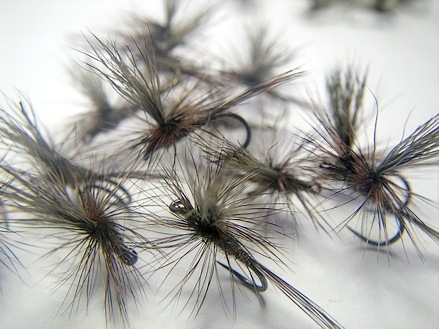
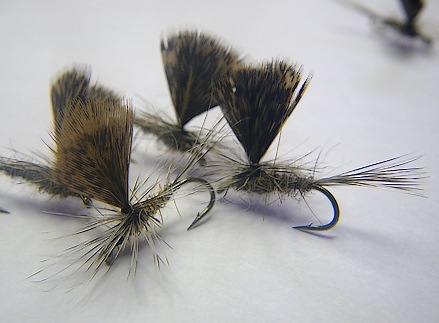
For most lake mayflies I’ll toss the classic proportions and make special flies tailored for an extended float. A traditional size 16 will get the wing and hackle of a 15 (sometimes even larger if the lake is known gusty) – as the tall wing is what fish see when cruising for prey.

… and it allows me to pick my fly out from the pack, allowing me the courtesy of setting the hook when it’s eaten – rather than yanking when it’s the natural next to mine … On breezy lakes, the tall wing allows me to maintain visual contact despite the fly dipping into a wave trough – increasing my chances of seeing the strike.

I cast about two thirds less than the average fellow, as once positioned on the windward side I’ll usually find the fish cruising at my feet. As that ever-present breeze blows my “sailboat” back towards me I’ll slowly take up the slack and recast only when the fly is within a rod’s length.

It’s flirting with bait fishing, but that extra breadth of hackle and light dressing allows a greased fly to float forever.

I’ve settled on both brown and a grey bodied flies for the same hatch. One will have a distinct brownish appearance, the other will be tied mostly gray – and as the emergence is midday – there’s ample light to discern color. I’ve given up theorizing or second guessing and just make sure I have a couple dozen of each.

Hair Wing Brown Calibaetis

The nymph is the easiest part; somewhere between a Pheasant Tail, a Gold Ribbed Hare’s Ear, and a Zug Bug is the proper flavor, and like the dry fly it varies a bit each year.

Hen Saddle tip Calibaetis

I like the speckled hen saddle wings as they present the perfect opaque silhouette, and when riding among naturals are nearly indistinguishable. Note the oversized wing and hackle mentioned earlier. Once damp those wings can overpower a traditional hackle and flop the fly on its side. The broad footprint of the oversized hackle stabilizes the fly and ensures it’ll ride upright with wings prominent.

All these unknown experimental made-it-yourself flies comes with a hideous burden, after the fellow next to you inquires and you tell him to “try an Adams” – you’re obliged to hand over a double-fistful, it’s the law.

Tags: Adams, stillwater dry flies, oversized wing, speckled hen saddle, Calibaetis mayfly, parachute flies, hairwing, dyed elk, grizzly hackle, fly tying

When silhouette is no longer enough

It was a bit of an imposition, watching the steady upward march of a horde of damselfly nymphs – and realizing I’d never considered my camouflaged legs part of any textbook underwater migration. Science held me in it’s grip until the first slimy little sucker made it past the neckline of my shirt and insisted on molting somewhere near my navel.

… and they swim like true fish, not awkward or ungainly like other aquatic insects. That elongated body with the three-bladed gill tail is put to good use. And it makes perfect sense that a stillwater insect that swims as gracefully as a minnow would have his gills where the tail should be – as the swimming motion would allow those appendages to slurp all the oxygen needed – even more when flight was necessary.

I liken them to Stoneflies of the Lake, larger than most of the Caddis and Mayflies, yet slender and elongated – giving a fly tyer the opportunity to practice his craft with larger hooks and plenty of shank – versus the minutiae that comprises the balance of a fish’s diet.

I don’t favor the traditional “wooden” long-shank mayfly imitation, as a small tuft of marabou just cannot substitute for the graceful swimming motion so characteristic to this species.

Wiggle Damsel

Instead I’ll opt for the tail and body as a single unit, coupled with a short shank hook to provide just enough room for lead wire and a wingcase. Three or four strands of medium olive with a like amount of brown over the top gives me a couple of colors that are proven tasty.

Most of the damsel nymphs I’ve fished over are dark Olive – but occasionally I’ll find them in brown. I take my cue from the lake bottom and its weeds – as the naturals are tailored to match. Putting both colors in the wing allows you to remove one later by simply tearing the fibers off – a modification you can do on the water.

Motion is the key, especially when faced with the color dampening effects of deep water, where warm starts to dull and the fish measured in pounds cluster.

Tags: Damselfly nymphs, fly fishing in stillwater, lake flies, fly fishing for trout, marabou, baitfish, graceful swimmer, sink tip, short shank hook

Nothing like a inflated backrest to bring happiness to a deflated angler

I’ve flung them, swung them, and twitched them back. I’ve labored over exotic materials, rare colors, and exacting detail – and for all that labor I’ve got squat.

Now I’ve abandoned any pretense of tradition – any thoughts of skill or science, instead I’ll fin myself around the Pristine on a soft inflatable recliner and tow flies into the waiting maw of Them as Would be Fed.

… and if that don’t work, there’s always the California nouveau cuisine luncheon – featuring the caviar Velveeta sand. I’ll let the wind blow me out of visual range and add an obligatory marshmallow indicator.

Friday I’ll be headed North to try some of my favorite lake venues. Streams are shot, rivers are worse, and I’m tired of fishless fishing trips. Maybe a month of dry weather will restore some of the local water to a semblance of their former selves.

I’ve got the traditional lake fare covered. The Calibaetis mayflies – dry and wet, and the generalist flies that resemble most of the other fare. Float tubes and breeze means you’re going to hook as many fish with the fly being towed as being cast – and those searching patterns are lake fishing staples.

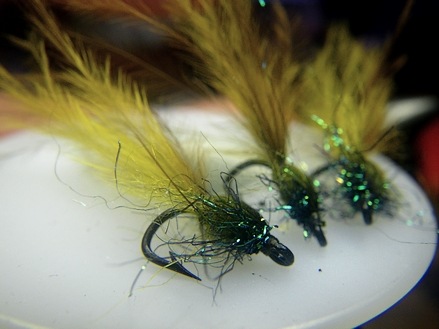
Modeled on the J.Fair Wiggle nymph, a proven lake pattern of long standing, featuring a wisp of marabou for a tail and some sparkle chenille with a hackle rib, it’s the fly of choice for twitching over weeds, or simply finning from one side of the impoundment to the other.

Olive Wiggle Tail

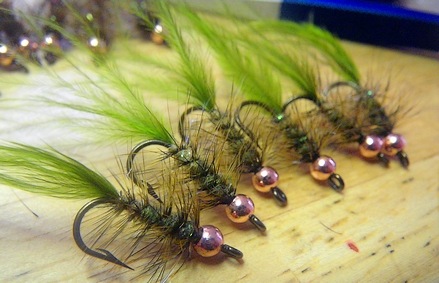
These are dressed very lightly compared to a traditional Wooly Bugger or Leech, using just 5-6 strands of marabou and a pencil thin body. I’ve always assumed it was a combination of damselfly and small baitfish – in between asking pals if they could spare another handful.

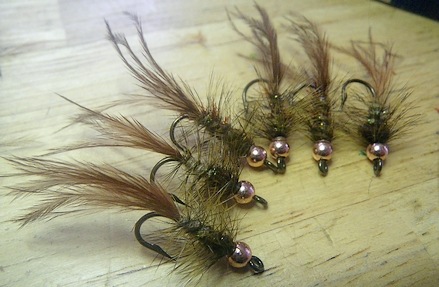
Brown Wiggle Tail

I tie them in Olive, Black, Peacock, Brown, and the tail is left intentionally long – so you’ll get the occasional short strike. Shortening the tails makes them less effective, so endure.

I use the bead version so I can merely lengthen the leader and fish them with a floating line. In between the morning, midday, evening, mayfly activity I’ll use the lull following to tow these over weedbeds.

The darker colors are perfect for deeper water and sinktip fishing. A slow retrieve to seduce those reticent fish that are busy digesting an early insect snack and don’t expect to see a steak this close to home.

Tags: J Fair Wiggle Nymph, fly fishing stillwater, Wooly Bugger, leech, Calibaetis, lake fishing, trout

Something unique to the watershed

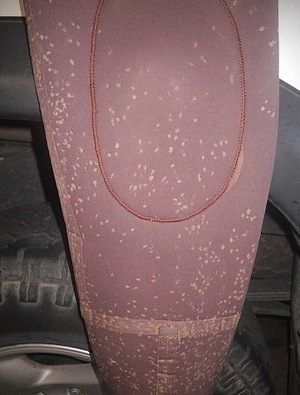
Below is a longstanding mystery unique to the American River. The more you fish the more you collect, and while it’s not a known invasive, its a clear demonstration of what you’re carrying to the next watershed.

American_River_Goober

The only insect hatching this morning was a #20 mayfly, considerable numbers and small enough to inhale. I’ve had this “goober” buildup occur almost every trip – regardless of whether there was insect activity or not.

Anything touching the water gets these small shiny mucous stains, vest, shirt sleeves, anything.

Anyone seen anything like it?

Tags: Unknown insect phenomenon, American River, goober