Certainly the IPO may make you some coin, but the value of Alibaba.com will be the money you save

The financial wunderkind of Wall Street are already lining up in anticipation of the IPO of Alibaba.com, a Chinese B2C web company that makes Amazon.com look like a neighborhood market.

… and it may seem odd to be talking high finance and initial public offerings on a fly fishing blog, but Alibaba and I are old friends, and has been the source of much of my fishing tackle, and all for pennies on the dollar.

Whether you plan on investing in the company is immaterial, what’s important is to understand how you can leverage their business model as a simple customer.

Computers were once thought to make offices paperless, electronic transactions replacing whiteout, staples, typewriters, and most interoffice correspondence. That promise has never been been realized  yet the migration from paper to electronic media continues. Each step forward results in some unforeseen Target debacle that makes us all leery of anything more complex than a #2 pencil ..

The internet held similar promise diminishing the “bricks and mortar” retail presence in lieu of countless web clicks, and while its impact on physical stores has been substantial, companies with significant retail presence have augmented their square footage with websites, and leverage both mediums.

What the Internet did successfully is destroy the notion of “B2C”, business to customer relationships, as the worldwide draw of a web presence made many millions of micro-transactions hugely profitable.

Pre-Internet a company would require a minimum order of 5000 bicycles to establish an account, and only other businesses could absorb that volume, private citizens could not.

The internet has undone the notion that other businesses are necessary to broker consumer sales and manufacturers are now free to cut the middleman out of transactions to enhance profits. Alibaba is an aggregator of manufacturers within a searchable interface that allows consumers to find manufacturers willing to sell direct to them, instead of only to other businesses. Consumers benefit from wholesale pricing, manufacturers get more profit per transaction, and the jobber is reduced to making the small dollars that bulk discounts can grant – rather than making profit at the expense of both manufacturer and consumer.

As manufacturing has largely been shipped overseas, China and the Orient are now the manufacturing engine for the entire world, and Alibaba breadth of product is ample demonstration that “Made in America” has been replaced by Hong Kong, Sialkot, or Hanoi.

Many of the rods, float tubes, waders, fish hooks, and fly tying materials, that we paw through at your local shop stem from the Orient, which is why Alibaba.com is such a compelling shopping experience.

I’m not a fly shop, how can I benefit from wholesale?

As you can buy float tubes, motorcycles, or saddle hackle from Alibaba, all you need is the desire to buy a bit more than a bubble pack of something, or perhaps you wish to broker a purchase with a group of like minded fellows from your casting club.

Let’s take simple brass beads for fly tying as an example. Launch your browser at the http://alibaba.com address, and enter the search term,”fly tying beads” on the search bar at the top of their website.

alibaba.beads

Here is an example of the first vendor returned by that search, the Qingdao Leichi Industrial And Trade Co., Ltd., of Shandon, China. They sell every fly fishing item known, from fish hooks to IM6 fly rods and reels. From our perspective the most important feature is the Minimum Order required by the company, and for Tungsten or Brass socketed fly tying beads, that is 500.

In a fly shop a 25 pack of socketed brass beads is somewhere between $3 and $4. This manufacturer’s price varies weekly based on the international spot price of copper, brass, or tungsten, so a quote request (delivered typically as an Excel spreadsheet attached to an email) will only be accurate for a limited time.

The last time I purchased copper beads from this vendor they were about $4 per thousand, which is what a jobber like Spirit River pays. Most jobbers will allow the shop to double its money on the retail price, so it will sell a 25 pack to the store for $1.50 – $2.00. The jobber makes about $80 on its $4 purchase, netting them a profit of about 2000%.

… which is why both consumers and manufacturers want to reduce the middleman’s share.

Was I a fly shop owner Alibaba would be my only catalog, as I no longer need the jobber or his wares. The limitations of fly fishing’s niche customer base suddenly mitigated by my ability to get product directly from the manufacturer, thereby increasing my profits substantially.

… which has been the promise of micro-transactions and the Internet, now realized.

Because many thousands of small transactions are the same as a few large transactions, all manufacturers are moving to this B2B / B2C platform, and why Alibaba is such a hot topic among the retail brokerage houses.

Sending Money overseas, avoid Banks

Conducting business overseas has also been simplified by the Internet. There are three basic options available; your local bank, an ePayment vendor like PayPal, or Western Union.

Doing business with an entity like Qingdao Leichi Industrial And Trade Co., Ltd, will require you to exchange US dollars for Renminbi or Yuan. As the currency exchange rates also vary daily, prices quotes are usually good for a fixed amount of time. Banks like Wells Fargo or Bank of America should be avoided, as they are still stuck in archaic bank to bank exchanges and typically levy a $45 charge for brokering the transaction and money swap. Paypal (if the vendor accepts it, and many do) has a sub-$10 fee, as does Western Union, which can transfer money to Pakistan or Hong Kong faster (usually overnight) than banks (about a week), and for about a quarter of what banks charge ($10).

A Western Union account can be tied to a credit card making repeat shopping easy. You will need to call your credit card company on large transactions, and certain countries are on “watch” lists – due to fraud or hostile governments, you may need to pre-authorize the transaction to the destination country in order for it to complete its journey.

contactInitiating contact is done via email with the vendor. Each company has a contact name to request price quotes and all will contact you in English.

For small items like fly tying beads or fish hooks I typically ask if I can get samples, or can I pay the shipping to receive samples.

I don’t pretend to be anything I’m not, and typically will explain what my anticipated transaction will be if satisfied with the samples. You don’t need to be a company to do business here, so tell them up front you’re looking for a buy of about 10,000 beads, 2500 each of 3mm, 4mm, and 5mm, and perhaps a couple thousand more in Tungsten.

The Perils of the Orient

Each of the vendors on Alibaba are interested in sales, not fraud, and each of them have a satisfaction and longevity rating, allowing new customers a bit of insight into their past dealings.

It’s never a sure thing, but ask yourself how many of the thousands of affiliate shops on Amazon are intent on fraud. Good ratings drive sales, and sales is the reason they are offering their services, so it’s reasonable to assume a modicum of professionalism.

Copyright laws have little bearing in China and imitation goods are rampant, so you need to be cautious about “Made in China” versus a wader that appears to be a famous US manufacturer at a fraction of the cost. Sometimes it really is the same wader, sometimes it is merely an imitation of that wader, made of very poor quality materials and leaks like a sieve.

Note the availability of the “Battenkill” reel for $35. Whether this is the same reel rebranded by Orvis, we’ll never know. Request a sample, and if it’s a good reel, order a dozen more for your casting club and use them on rods loaned to the public during free casting classes. Fly lines and rods are available for a fraction of store prices, why not equip your club with an inexpensive and serviceable set of tackle for casting practice.

A great deal of the rods and high dollar equipment we use (float tubes, reels, etc.) are made by these same manufacturers and re-labeled by American companies, so you’ll need to do extra diligence before dropping the large dollars. Ask if a vendor in the states carries the item already, perhaps you can view or inquire of that middleman for additional information. Caveat Emptor, baby.

Take this standard one man rowable boat. In the US it may go for $600 –$1600 each. This vendor lists it as $300, minimum quantity only one needed. Postage will boost its price much more, so always inquire of the shipping fees. Typically DHL is used for normal packages, and freighter is likely used for the bulky pallet sized items. Nothing of size shipped from mainland China to the US will be cheap.

Alibaba.com is also one of the best sites to bulk purchase fly tying materials. Most of the iridescent and opalescent synthetics in use today are also manufactured in the Orient, so getting a few skeins of something that sells by the yard will save you considerable money.

It’s worth a couple evenings simply browsing all the categories and viewing prices. Our colloquial terms for items may not hold in their listings, and “float tube” might be “floating boat”, but you’ll find plenty once you drill down to the proper keywords.

The only real downside is you can’t park it by the John for uninterrupted browsing, like the old Herter’s catalog ..

Part 3: I got your frog right here (next to this big foam cup of Earthworms)

Anyone that’s fished for any length of time can channel unflinching optimism, but “too good to be true” is a bubble burst upon us many times. On the outside we’re cocksure and tough, on the inside all that optimism is tempered with reality.

… and now, moments away from losing my first fly in Bass Paradise, having listened to the story of its birth and resurrection, that same inner demon is tugging at my sleeve suggesting, “ … it’s hot out, maybe you should have been here last week.”

Schooled by adversity, I’m not used to flinching in the face of awesomeness.

And it was plenty hot already. As a guest I didn’t set departure and arrival times, and midday temps were scheduled for triple digits, so I eschewed the float tube for the breathable waist-highs (review coming later), and marched out on the first earthen finger …

Bass and Bluegill were visible all around me, and starkness of my pear shaped frame sky-lined against blue sky sent everything living into a panic of flight. Big wakes peeled away into the tules or buried themselves into the neighboring weedy growth, and all I could do was note my “dried tule” camouflage might be hell on geese, but wasn’t fooling fish at all.

With visions of sugarplums dancing in my frontal lobe, I added one of my Massive Protein flies onto the leader. Assuming the fish were measured in yards and therefore only flies representing stray dogs or unattended children would be worthwhile.

Nothing.

I removed the Massive Black Hole of Tungsten off of the leader and opted for the more sedate Eye Searing Crayfish of Rubber-legged Death and flung that at them …

Nothing.

I’m conscious of the retired bass pro snickering to himself as he ties another willow sapling onto a bamboo stake. “ I’ve got to get these up high so the deer don’t eat them,” he says, “You probably want to throw a frog at them.”

He opens the back of his vehicle and on top of the pile of muddy boots, shovels, picks, and rusty chainsaw, are about nine pre-strung spinning rods each rigged with 30lb braid and a variety of baits. Freeing one of them he shows me what “frog” means.

I nod sagely, and produce my Letters of Marque, a fly box stuffed with spun deer hair poppers in a dizzying array of colors. I grab the biggest untrimmed Yellow and Olive, rubber-legged monstrosity and heave that at the fish.

Gurgle … Burble … Bloop. Nothing.

By this time my buddy is in his float tube in mid pond and finning around expectantly, and having similar luck.

The top water bait fails to motivate the fish, so I return to the Crayfish pattern. I’m cinching up the knot when I see a big shadow detach itself form the Tule clump next to me and sidle into a weed channel nearby. I figured Mister Fatty was lying in wait, and flipped the Crayfish out past him and gave it a tug …

Fatty430

Apparently “Fatty” had the same weakness for hot orange and rubbery as did his cousins up at Lake Berryessa.

I spent the morning touring the lake and trying each of the areas defined by the earthen piers, but fishing was very slow, and I was thinking the drought had upended the feeding timetable a bit, and earlier would have been more appropriate.

As I made a full circle and stopped to compare notes with the proprietor, he offered up a rod and a big Styrofoam cup of earthworms. He motions to me, “let’s go catch some of these big Bluegill” he remarks, “I had a nine year old girl out here yesterday with her folks, and she caught fifty-seven without having to move.”

I grabbed the proffered rod and cowboy’d up. My host was unfamiliar with fly tackle and its efficacy and was doing his best to ensure I had a good time. I dropped that weightless earthworm in amongst the tules and quickly pulled a half dozen panfish out of their den. I handed the rod back and reached for the fly rod and downsized the bait to a trout sized bug and then proceeded to lay waste to the surroundings.

I cracked open the fly box and showed him our variants on panfish delicacies, and how each could be applied with great accuracy – so long as you donated a double-fistful to overhanging branches.

“Them brightly colored ones are a nice accent to your poppies, aren’t they?” I was a little reluctant to tug on his tules for fear of wrenching up all those painstakingly planted stalks. Apparently they are sunk in one pound coffee cans, and spread from that source into a traditional gaggle of plants.

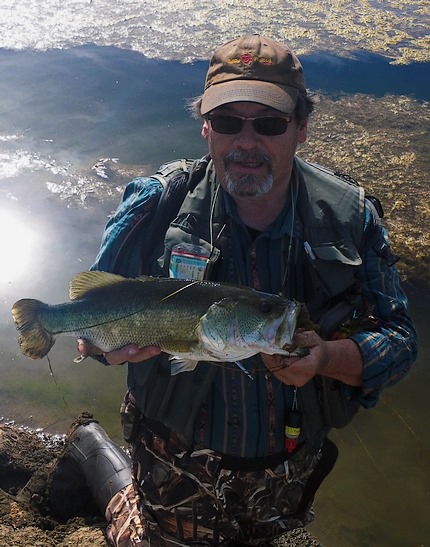
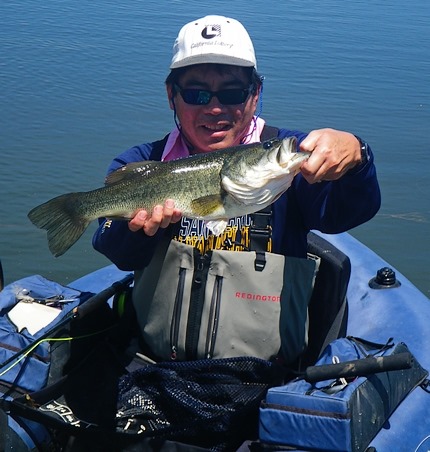
I did have the luxury of catching a few while I had a willing cameraman, and as it’s not often my countenance graces these pages, so this one’s for Ma …

Hisself430

Note the emphasis on grooming and cutting edge angling fashion.

Wading this pond was out of the question. Earthworks lack the integrity of natural substrate, and stepping off the path area meant sinking into mud. The kind of cloying greasy mass that requires you to hold onto your waders for fear of climbing out of them.

By afternoon the temperature was getting to be an issue, and a welcome breeze started blowing that caused everything to get stupid for about two hours.

Screams from the center of the lake suggested my fishing buddy was doing passably well …

KelvinBass430

These being some of the largest bass he’d ever caught. Note the skinny abdomen on this slug, it’s a post-spawn bass that likely will weigh considerably more once filled out again.

Most of the fish we caught were recent spawners, given April and May is their traditional spawn time for this part of the foothills, which we confirmed with our host.

Big bluegill dominated most of the afternoon. Once the breeze put a riffle on the water the fish were much more aggressive. Most of these were about the size of your hand, which is prime size for putting a strain into a seven weight.

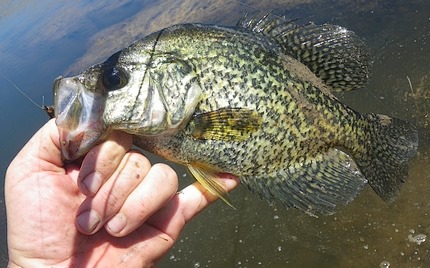
I did manage to catch one rarity. One of the breed stock of Black Crappy ate my Olive Leech, and while the fish is not rare in California, the builder mentioned he’d only planted a few breeders to see if they’d take root, and they had not been overly successful to date.

BlackCrappie430

I have always adored these fish – given their swarming numbers and aggression. They are fine table fare and likely will do quite well in all that overly warm, newly empty trout water.

I’d describe the outing as nothing short of fabulous. If we’d gotten there a couple of weeks earlier the weeds would have been a bit less pervasive, and the daytime temperatures more friendly, the bass fatter and more susceptible to being caught due to nesting behavior.

Any water managed for excellence is likely to draw an eager and appreciative crowd. It’s therefore heartening to know that despite inevitable changes to our environment and our quarry, from fragile salmonids to warm water cockroach, we’ll be undaunted … as opinionated and gear oriented as ever.

Part 2: A couple of backhoes and some dampness, right?

Arnold Palmer made a handsome living designing golf courses, and were you lucky enough to get drawn for Powerball and decided not to take the kids out of school, opting instead for a moderate lifestyle replete with small wineries or something private on the lot behind the house, exactly what would it contain?

Considering a large farm complex already owns backhoes and Caterpillars and those skilled in their use, any lull in tomato growth would give you the opportunity to reposition those assets for your dream pond.

A couple thousand gallons of diesel later, and you’ve scraped a big hole in the ground, but it’s dawning on you that’s the easy part …

Above_Pond

Now you’ve got to decide how deep it is, how much will evaporate in a single season, do you want to fish it from shore, do you plant trees, do you want to wade it or use a float tube, and what kind of fish can it support – and how many?

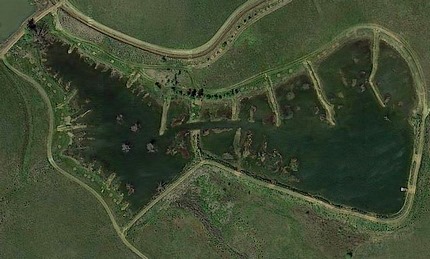
I took the opportunity to interview the fellow responsible, as he was a friendly cuss and proud of his work. This was his third such project, about 1.5 miles in circumference and nearly 12 feet deep at the deepest edge.

No naturally occurring water sources, not large enough to require concrete or reinforcement, just a simple earthen dam as recipient for all the dirt carved out from behind, and a simple spillway system allowing any runoff to meander through a short natural area prior to finding the tomato canal below.

Well water fed the organic tomatoes next door, and a simple ditch dug between the closest well and the pond ensured the area could be refilled as needed (for the price of additional diesel).

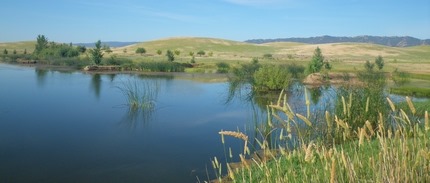
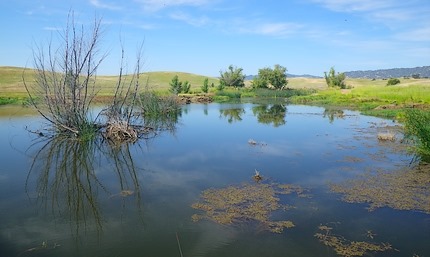
With a hole in the ground and a water source you’ve got a muddy liability that in no way resembles a premier fishery, so you’ve got to add weeds, tules, trees, brush, shade, sunken timber, underwater topography, broken branches, brush piles, duck weed, milfoil, algae, grass, and everything else Mother Nature provides naturally.

… and note we’re nowhere near adding fish yet …

pond1

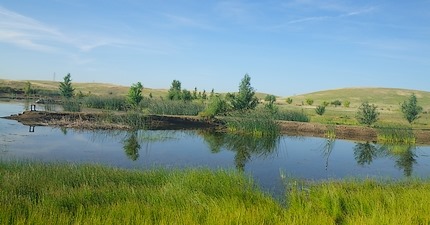
Everything in these pictures, every spec of growth, planted by design to provide the eventual final shade pattern for the water. Every grass bed, every tule clump, every willow seedling, and every tree bordering the periphery, hand selected for the shade it’ll provide and the stabilization it brings to the machined earthworks.

pond2

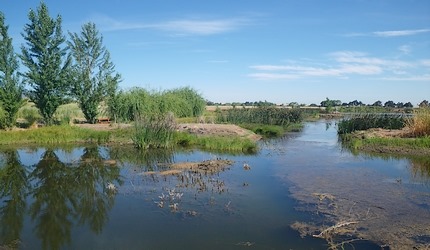
… every finger pier constructed with its wooden chair and steps leading to the water’s edge. All of them carefully staked off at the high water mark to ensure each pier at constant height to the waterline, and every plant placed in the area chosen to stabilize the dirt walking area so wind erosion wouldn’t erode the topsoil off each bulwark.

The owner is in his eighties and losing mobility, so the design incorporates the ability to seat yourself in productive water with minimal effort. Wooden steps and hand rails allow access to the water’s edge, and seating is provided at each cleared fishing area.

pond3

The dead timber is all staked to the bottom to hold it in place, and branches are sawed halfway through then broken to provide branch snarls in the water. Broken but not severed so they hold their position until years of decay eventually dissolves them.

pond4

After a year or two of hard work on the banks and shade, covering the bottom in life-giving weed is child’s play. Weeds provide the dissolved oxygen in the absence of running water, yet controlling them is not so simple, given that water level, temperature, and ambient sunlight change their growth patterns seasonally.

During summer as evaporation lowers the lake and water temperatures rise, algae and weeds blossom, and quickly cover the impoundment unless treated chemically.

The proceeds of our paid trip were to assist in defraying the costs of another application of weed killer. Dispensed manually, the chemical operates only in the areas its applied, allowing you to sculpt and channelize weed beds.

Bass love to lurk and ambush, and providing the cover to predate is part of a healthy fish ecosystem.

pondpoppy

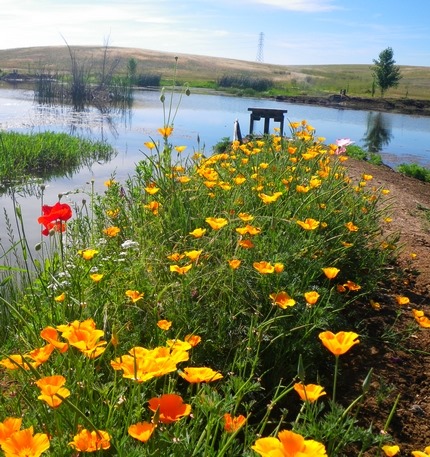
Wildflowers follow each earthen finger out to its seating area. The flowers anchor the topsoil to the structure as it’s prone to erosion. Each earthwork has a mixture of tules, saplings, and flowers to provide wind cover, initial anchor of soil, and then the long term benefits of reinforcing tree roots, and the wind protection offered by its canopy, and shade.

Now that banks offer cover and shade is available, and a mix of weeds line the bottom, you can introduce bugs and forage fish. Mosquito fish to control the mosquito larva and provide forage for anything larger, then Bluegill to eat those – each introduction needing permits and the blessing of Fish & Game. If you have a creek feeding it you have one set of problems, and if you have a wetlands it’s another set of triplicate. If your thing empties into someone else’s thing, it grows even worse.

… and then finally, when all of that stuff is living and thriving, when you learn the delicate dance between water, its temperature, its life-giving carpet, dissolved oxygen, shade, and tasty fish and bugs to eat, you can introduce the Quarry.

Tomorrow – Part III The part you’re salivating over, the fishing

Part 1: Trophy Water Gentility, all the fart bars, sardines, and fly rods you can stuff into a Tacoma

When I’d first heard of it, I wondered whether it was a preview of what the future holds.

Our scientists grow ever insistent that in the coming decades Global Warming will reduce salmonids to 50% of their current range, and in that overly warm future, anything “at-risk” now will be lethal to our cold water bluebloods.

… and while we’re enamored of trophy trout and spare no expense to introduce them in even marginal conditions, at some point will the environment force us to shift from inbred salmonids to a Trophy “Cockroach” fishery, and might we ever hold them in similar regard?

I was fortunate to get a glimpse of the future this weekend. A local rumor of a city planner, turned bass pro, former tomato farmer, whose passion it is to create trophy bass ponds for private land owners.

Access being limited to a couple of local schools and their charity auction, which is about as exclusive as any rarified millionaire’s retreat. One of the fellows from work had stumbled upon the trip last year, and with my urging managed to snap up both of the trips offered this year, and I whined and moaned until he tired of my protruding lower lip and agreed to split the adventure.

boysuit… then, after weeks of enduring his vile torments, “ … my wife wants me to take the kids, instead …’, he relented. I would supply the flies, tie all his knots, and if the landowner questioned my schoolboy’s outfit (and matching bowtie) I would claim to be his son.

… the half wit version, naturally.

Proving that any fisherman worthy of the name would endure any indignity, or humiliation, for a crack at the Holy Water.

Honoring my part of the bargain was simple, only Bass Pro’s and fly fishermen lack a common language. When asked what the fish were biting on, the response was “frogs.”

Live ones? Top water deer hair flavor? Green, Yellow … what?

I was to find that my “dad” was a half wit as well, and “frogs” was to be the only intel to be had.

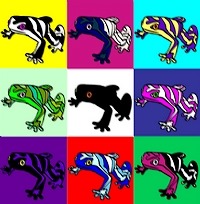
Wharhol.frogDutifully I spent the next week piling mounds of olive and yellow deer hair around the vise, possessed by every bit of top water fancy imaginable. I did normal, fanciful, exacting, and literal. I did frogs by Salvador Dali, Andy Warhol, Monet, and Jackson Pollock.

When I tired of imitation I would mumble like Bubba of Forest Gump fame, “ … frog leg, frog sandwich, frog soufflé, frog sushi, frog eye salad, caramelized frog …”

With fly boxes bulging with rubber legs and trimmed Olive deer hair, and house freshly cleaned of hair via rented leaf blower, I was beginning to feel that “well heeled” feeling, the invulnerability that comes with knowing that even if I stumbled and fell in head first, I would float to the surface in an oil slick of silicon and yellow dye.

Trophy water and private enclaves are typically a genteel sport, and despite the warm water quarry this would be no different.

The luxury of stuffing a vehicle full of every imaginable fishing necessity is foreign to us hardscrabble public water types. Wicker picnic baskets and exotic livery just get in the way of the bloodshed, yet I found myself delighting in adding every possible amenity; a float tube, chest waders, hip waders, and waist breathables. A car within a stone’s throw of the water meant four rods, four reels, a couple of room temperature hydration packs, apples, oranges, sardines, and fart bars, everything necessary to survive hostile environments, ravenous meat eating trophy bass, and with the sketchiest of intel …

Part II Tomorrow, We use worms …

Fossil Record shows Didymo Geminata is native rather than invasive

stickey_RubberYou’d think Science, knowing our history of continental land bridges and pre-historic migrants overwhelming natives, would have consensus on how many thousands of years it takes something to dominate its surroundings to become the new “native” – but you’d be wrong …

The latest science involving Didymo rethinks the “invasive” label, as examination of the fossil record of lakes and streams afflicted by the diatom are finding the Didymo has been resident on five of seven continents for many thousands of years.

The Delaware River shows Didymo having been present for tens of thousands of years, rather than recently introduced by fishermen. Dissolved Phosphorus can dip below its normal threshold via numerous temporal phenomena, and with that change in water chemistry, triggers the visual “blooms” that gives the infestation its characteristic unappealing blanket. As quickly as water chemistry is restored, the blooms vanish, explaining one of the great mysteries of Didymo infestation.

Moreover, fossil and historical records place D. geminata on all continents except Africa, Antarctica, and Australia; records place D. geminata in Asia (China, India, Japan, Mongolia, Russia), Europe (Denmark, Finland, France, Germany, Ireland, Italy, Norway, Poland, Portugal, United Kingdom, Sweden), and North America (Canada and the United States), and historical records dating back to the 1960s place D. geminata in South America (Chile; Blanco and Ector 2009, Whitton et al. 2009). The recent blooms of D. geminata are found on each of these continents, where fossil or historical records have been documented, which indicates that attributing all blooms to recent introductions or to range expansion is incorrect.

… and as the last article mentioned, our collective angst in approaching our respective legislatures was a tad premature …

In fact, citing the threat of human-induced translocations of D. geminata or other unwanted organisms, seven US states (Alaska, Maryland, Missouri, Nebraska, Rhode Island, South Dakota, and Vermont), Chile, and New Zealand have passed legislation banning the use of felt soled waders and boots in inland waters (e.g., the 1993 New Zealand Biosecurity Act, Chile’s law no. 20.254, Vermont 2013 Act no. 130 [H.488]). Although such restrictions may reduce introductions of other deleterious aquatic microorganisms, the connection to the spread of Didymo. geminata within its native range seems dubious.

What’s even more interesting is the final definitive science will employ DNA sequencing of the respective colonies to see which continents have unique strains, and which continents may have sourced strains carried by everything from humans to migrating waterfowl.

The assertion that the recent blooms are caused by inad- vertent introductions of D. geminata cells by humans comes from frequent reports of blooms in areas that are used for recreation or monitoring by various agencies (Bothwell et al. 2009). Although Kilroy and Unwin (2011) reported a correlation between the ease of river access and D. geminata blooms in New Zealand, this has not been found in North American studies. In fact, systematic observations at both rivers with frequent human activities and remote rivers not heavily used for recreation or monitoring reveal no association between human activities at a river and blooms in Glacier National Park, in Montana (Schweiger et al. 2011).
Moreover, pathways for introducing D. geminata cells have existed for decades (e.g., felt-soled shoes; the transport of fish, their eggs, and water from areas where D. geminata is determined to be native on the basis of fossil records), making inadvertent introductions by humans difficult to explain, given the recent worldwide synchrony of blooms.

Really good article for the lay person given the science is common sense and easy to follow. I recommend you read it and draw your own conclusions.

As I adore a good conspiracy theory, I find it equally interesting that our fishing media and conservation organizations have published nothing on how scientists are reconsidering earlier theories as more concrete observations accumulate.

I’m sure those that insisted we act responsibly, by first purchasing new wading shoes, donated most generously …

I wasn’t the only turkey in the parking lot, just the most photogenic

american_turkey300Once fully immersed I remembered how I’d sworn to replace my neoprene waders last season.

The tiny holes I’d been unable to track down being the causal agent. That irritating hole right in the billfold area that ensured your wallet and its contents were soaked, the right foot seam that had decayed to instability and was now dampening my sock, and the mid calf fabric leak that ensured everything between wallet and sock was similarly cooled.

Those being “character” leaks, bearable yet adding just enough suffering as to be retold at the campfire each evening, and ensures the patched and weathered exterior of now-porous waders continues to grant “parking lot cred”, that which separates the seasoned angler from the novice …

… yet, it was the Unforgivable Leak that had sprung last season that had sealed this pair’s fate … that mid groin hole that soaks the crotch and extends down the left leg, ensuring you are unfit for public exhibition.

Having skipped the Trout Opener in favor of working, and this being the first wader-clad scout of the year, I was prepared to work the kinks out of my gear, my cast, and my physique, but had forgotten the all-important Vow of Newness from the prior season.

Muscle memory neatly draped the running line over the fingers of the left hand, the shooting head sang out of the guides with only two roll casts and a single back cast, and what little rust that accumulated from seven months of enforced Shad idleness was quickly dispelled. I was feeling the kind of optimism that only a new fish and a new season can bring – unseemingly effervescent yet rooted to Earth by the spreading chill in my pants leg.

My optimism rewarded by the sudden tightening of the line on the swing, and the rod dipped abruptly and reel started its siren’s wail I figured this might be one of those rare nexuses of good fortune I’d alluded to with my earlier karma of bruised ribs and torn waders.

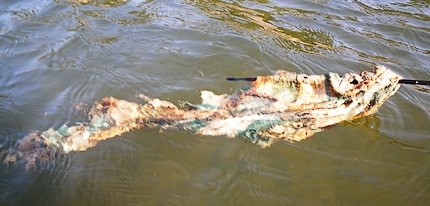
The unyielding mass suggested otherwise, however. Rather than dozens of voracious Shad skewered on a single hook – it was the beginning of my “American River Around the World”, wherein the aspiring angler attempts to catch one of each of the sodden clothing categories; Shirt, Pants, Hat, Swim trunks, or Other (unidentifiable).

American_Shirt430

This trophy was a 39 inch length of Other, possibly of the picnic tablecloth genus. It fought well, yet was not overly acrobatic. I added hat and tee shirt shortly thereafter, but of Shad there were none.

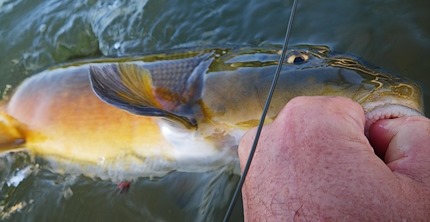
… but Iron Crosses grew everywhere … and as the next swing tightened it snagged something heavy by the arse, and as the reel started giving line it’s telltale screech drew a gaggle of morning dog walkers to the bank to witness my struggle with one of the American River’s Golden Salmon.

American_Sucker430

“Golden Salmon” being the brown water label for Sacramento Sucker, and this fellow was about seven or eight pounds and most welcome. It was considerably more festive than the earlier struggle with the Tablecloth, and granted enormous “street cred” with the crowd behind.

They couldn’t see the shad fly buried in the fish’s arse that lent it “wings” (the reddish object in the belly shown above).

Naturally, I did my best to explain to the crowd of well wishers that it was both toothy and venomous, and how I’d saved the neighborhood – or at least its pets and small children …

But the best was yet to come …

Now that I’m a cause celebre’ I’m accompanied back to the parking lot by a vigorous crowd, and was stunned that my sedate little parking area had mushroomed into the headquarters for a “family 5K run.”

… which means I have to disrobe in front of a cast of thousands, and my newfound compatriots are suddenly arm’s distant as it appears I’ve peed myself …

I was acrobatic in my flight from the area … much to the giggles of the kiddies.

Cut, Slash, and Riposte

I’ve assumed anything I can learn about fish serves me in good stead, and anything known on their feeding habits or behavior will assist me in seducing them to take my fly.

I’ll confess that I’ve wondered just what the “bill” of a billfish is used for – given I‘ve never seen some dolphin or unwary scuba diver skewered prominently on their beak.

Scientists suggest that the bill of a billfish is actually used as a sword, by first inserting the bill into a cluster of tightly packed baitfish, then slashing through the school to wound and disable.

Billfish uses bill to cripple baitfish via slashing motion of head

The above Youtube video shows the action of insertion and then the subsequent slash, and the trailing bits of scale and baitfish that result.

At least I’ll know what to expect when I deploy my “Alabama Rig” in blue water.

Where we fiddle with worms and body armor

With the lawnmower disabled all thoughts of chores and responsibility were discarded in a hurry, and with only a scant few weeks remaining before silvery plankton eaters invade my waterways, I was intent on finishing up my spring project, rerolling the classic Texas worm rig into a fly.

Lake Berryessa being so close – and fish being visible and numerous makes for a good test bed. Clear water allows me to see the motion of the each faux rubber candidate, and visible fish allowed me to think victory as they approached – and defeat once they paused shy of eating the dang thing.

For “Dokter Frankenstein” only mass acceptance would be a surefire sign of a good design, as few tools in a bass angler’s arsenal are as consistent as a big purple jellyroll served with a side of egg sinker …

The wind was blowing a good clip on Saturday, and I’d planned on heavy flies and breeze, opting for a 10.5’ #7 Orvis I had purchased on eBAY some years back. It was a monstrous stiff rod, better suited for an #8, but was just what was needed to keep unwieldy flies from burying themselves in my hindquarters.

I opted for a Type VI sinking shooting head, as my plan was to fish the small coves that occur with regularity along the bank. As a right-handed caster I had to walk left to keep rod and line out over the water, and the cove indent allows me to cast to the other side and “walk” my “worm” down the far bank before stripping it back to me across the belly of the cove.

In these conditions you don’t have to cast far, as most of the fish are within 20 foot of the bank, getting the fly down to them fast enough is the real issue, and a real problem.

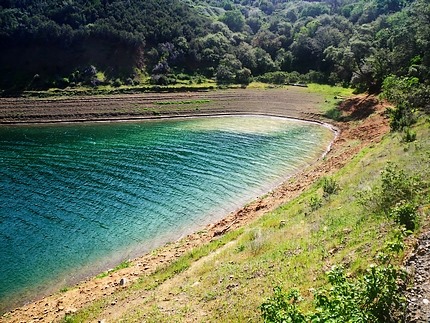
430bay2

The above picture showing a deep cove that allowed me to fish most of both sides, versus (below) a shallow cove that I could fish in a single pass down the bank.

430bay1

Mud plumes caused by wind and boat wakes keep me a bit less visible than normal, allowing me to splash around as much as needed when the bank is obstructed.

I was reminded of last week’s rib mash when I discovered the silver dollar sized hole I’d torn in the left boot when I slammed into the hillside. It was the shore-facing leg, and bothersome, but not as critical as the right boot which is planted deepest.

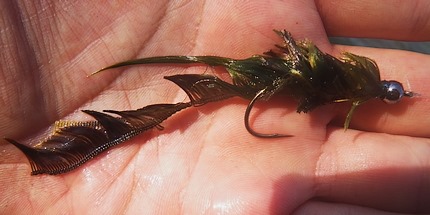
Olive_Rubber_Yarn430

Mix 15 turns of 3 amp fuse wire and 5.5mm bead to the front of a #2 wide gaped popper hook, and you’ve got the aerodynamic equivalent of the Spruce Goose, minus a few engines, and no ability to control its flight shy of the full head out of the guides to coerce the lumbering SOB away from an arse cheek.

Every puff of breeze brought an involuntary full-body clench, anticipation of impact shoved knees together, hat down to protect eyes and face, and cork grip white-knuckled knowing one of your limbs was likely in jeopardy.

I remember thinking to stuff my jacket in the rear pocket of the vest figuring it would staunch any bleeding. Arms were left defenseless as I’d be able to pry the hook out by sight, a back wound would have me operating by feel therefore needed additional protection.

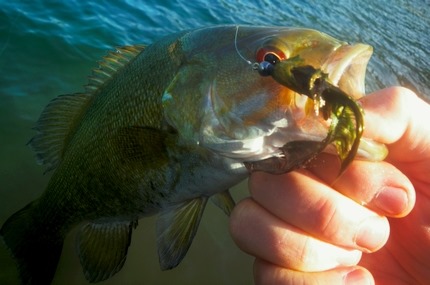
While much refinement remains, the liveliness of the fly is without equal. But getting it to the water remains a bit problematic. The fish gave it a great reception, and I managed to catch both large and smallmouth on the fly in its debut.

Smallmouth430

Five inches of tough polyester ribbon yarn make the tail portion indistinguishable to the action of a rubber worm. I just need to lighten the fly to make it more comfortable to cast. As it is now the last 20 feet of the retrieve the fly is ticking off the rocks as you draw it to you, so it is making bottom early and prone to snags.

Smallmouth430_Cray

The crayfish was a welcome change up for those coves with shallow water. The bright colors make it quite effective in the mornings, and a bit less so at midday. I used both in the morning, and stuck with the muted tones of my Olive “worm” for the bright sun of midday.

The lake is starting to show a few aggressive fish, but the main body of the lake remains docile. All the folks I talked to on the bank mentioned  the visible fish ignoring lures of any type, a condition the locals insist are characteristic of “pre-spawners.”

We’ll continue to refine this beast over the next couple of weeks prior to Shad showing, on the surface the pattern holds some promise.

Decline in angling because fish doesn’t “taste like Chicken?”

Pigeon_ChickenWhile fly clubs focus recruitment to replace their declining ranks, and the Membership Chair attempts to lure any demographic other than aging Boomers, their issues may mirror an overall decline in anglers as a byproduct of the US population becoming “fish averse” and “chicken centric.”

Declining sales of seafood reflect a population leery of fish on numerous levels, including; elevated mercury, the pen-raised versus wild caught controversy, increased prices, and unfamiliarity with preparation.

problems include the confusion and mixed messages surrounding claims that certain types of seafood are high in mercury, fears stirred up by organizations opposed to growing genetically modified salmon, a lack of awareness of which types of fish are healthy, and a failure of the industry and supermarkets to better promote fish. MSN Money

Couple those issues with the information (or disinformation) prevalent with environmental issues, the perceived rape of third world coastal fisheries by developed nations and their fleets of factory ships, and the uninitiated may feel the entire fishing experience off-putting.

Fisherman have always hated the taste of fish so we’re not helping things either…

Seafood company officials aspire to emulate the chicken industry, where consumption has boomed to nearly 82 pounds in 2012 from 34 pounds in 1965. If the industry can ease consumer fears and develop more convenient products, John Connelly, president of industry trade group National Fisheries Institute, said at the Boston show that there’s "nothing to preclude us from having the kind of exponential growth the poultry industry had." MSN Money

While I adore an optimist, Mister Connelly’s note above suggests there are “exponential fisheries left unexploited” that he can use to supply all those new converts with chow. I would assume seafood harvests are now in decline as all known fisheries are under harvest.

Any thoughts of explosive growth in seafood consumption should likely be accompanied with a couple of new oceans, and a continent or two.

Harry Potter’s wand would be hexagonal or quadrate

magicI called it “selective accreditation,” as it is frequently employed by parents to point out despite paying for your college education, next to their life-long accumulation of wisdom – you are still an infant.

Fishing, thankfully, is loaded with similar magics and credentials of convenience.

While fishing at Lake Berryessa, before my ill fated rib mash, I found myself pondering how fishing, science, and magic shared an uneasy relationship, how credentials are granted and just as quickly taken away, and like the movies, a contemporary angler must suspend disbelief to ply his craft with a straight face …

… and as I scuttled around the edges of the lake watching for fish and snagged lures, I encountered the familiar five ounce tuna cans – all of which met their fate at the hands of a knife wielding sadist.

Tuna being an easy chum agent, given its ready availability and oily nature. When stabbed repeatedly with a knife and thrown into the lake will dribble its oily goodness and purportedly draw fish to the area.

At least that’s the scientific reasoning. The movie-magic-disbelief relied on gelatinous ground, as if scent of the oily Tuna is the draw, and tuna being a blue water fish found only in the ocean, and this being fresh water, how is anyone sure it’s attractive to freshwater fish?

An average trip to a supermarket can produce a half dozen edible items that smell to us like rotting something-or-other, gym socks, or much worse. Considering neither chum nor quarry has crossed paths with one another, who’s to say we didn’t accidentally pick the Limburger of oily scents?

… and if five ounces of chum is able to draw fish, what about the gallon of fuel leaking out of your bilge, the cigarette butt you flung idly into your wake, or the ounce and a half of room temperature beer you poured into the water prior to cracking something colder?

Toss in all the asphalt-fossil-fuel scent that washes into the lake when the roadway above is rained on – the oils from transmissions and crankcases, the little bits of humanity jettisoned out of car windows that with each downpour edge closer to the lake, and scent … suddenly gets really muddy.

Five ounces being enough to draw fish closer, but how does that compare with a couple hundred pounds of brake dust, powdered radial tire, and a thousand other manmade scents entering the lake via the rivulet behind you?

I’d like to buy into the science, but I think even the science depends on magic.

I’ve never seen a saltwater fisherman filch a big knot of Powerbait onto a 3/0 stainless and fling the combination into a school of stripers, nor have I seen the pier fishing crowd use salmon eggs for perch, so why isn’t the converse true? …

… and if the pier fisherman chuckles, insisting “ … that’s silly, perch ain’t ever seen a salmon egg …” can’t we make the same case for a landlocked pen-raised trout?

Historians agree that science and magic play a role in the maturation of society, which is why both are found in every society on every continent, however remote. Science is the ability to explain natural phenomena, and magic (often called religion) explains all else.

For anglers, science is boring and egg headed – which is why we skipped Biology in High School, and why should the pendulum swing too far towards the explainable, we flock to the indefinable. We know our sport is steeped in magic, and we know it to be the true source of fishing’s awesomeness.

Anglers use the term “luck” to describe that which cannot be explained, for us “luck” and magic are the same.

Magic is why we believe fiberglass is better than cane, as the science can’t give us a convincing rationale. Why graphite is better than glass, boron is better than both, and if it’s ribbed with titanium, or the blank has unsanded scrim, or is light, heavy, long, or short, has raised the performance bar yet again …

Unfortunately even with rods that cast themselves we fail to let the rod practice during the off season and tie the same wind knots regardless of the boons of technology.

Science follows along obligingly and reminds us that Boron is a metal filament (and what idiot would wave that in a lightning storm), and we skip  those pages in the Fly Shop catalog to find the next unfounded rumor – GMO modified cane that excretes carbon filaments as a byproduct of photosynthesis.

Eco-friendly awesome, until we realize Monsanto holds the patent …

Fishing stores have pandered equally to science and wizardry. They delight in selling us snake oil in as many flavors as colors, and do so with the same rhetoric used by drug dealers; merely providing a service to a clientele that would buy from someone else if not them. While many items will prove unfounded and silly a few years from now, retail’s role is simple pimpage, and as sales and “hotness” are proportional, science provides them empty spots on shelves to stock some new eye-scorching magical goodness.

Science suggests that were you able to devote adequate resources to research and were able to explain all phenomena each angler would be successful on every outing. Anglers know should science gain an ascendancy over magic and we were consistently successful we’d despise the sport, as our successes were now ordinary and no longer a testament to suffering and Manhood.

“Matching the Hatch” gains a brief upper hand for a couple of decades, until mottled and natural becomes ordinary, and the pendulum swings back to married snippets of swan and Indian Crow, and iridescent opalescent, and the colorful magics take over.

Thankfully.

And when the latest periodical insists I dump everything for its Ultra-Violet imbued equivalent, and I confirm that scientists have yet to decide whether my quarry has rods or cones, semi-receptors, or is blind as a bat, my thoughts turn to eBAY and how I’ll slurp your castoffs as if by magic.

Ensuring that despite Sirens attempting to lure me to one camp or the other, I trod the path of the balance and avarice, ensuring my hoard of laughables are buried under a stack of recent purchases and no longer visible.