Category Archives: Fly tying Materials

Where to find them cheaply

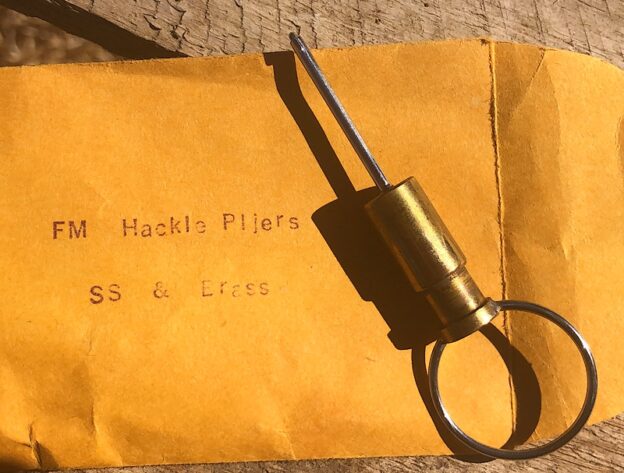
Matarelli Hackle Pliers, Stainless and Brass prototype

Frank Matarelli, Godfather of the Better Mousetrap

Frank Matarelli was a towering, unsmiling fellow, partial to checkered hunting jackets. His physical stature and opinions brooked little disagreement, as he reduced the complex to simple, making current events, politics, and Grizzly hackle, all manageable in a single breath.

He lived out in the Avenues of San Francisco, on Irving Street, neighbor to his close friend Cal Bird. Both were prolific tiers, but Frank was the more secretive of the two, as only family and Cal were allowed to see his garage work area, housing his machinery and tool production. Cal described Frank’s tool building process as a wide leather belt, or harness, that allowed him to bend wire and steel via body weight. “Frank threw his body all over to bend wire to make whip finishers.”

Frank and I were both members of the Golden Gate Angling and Casting Club, and as I taught their fly tying classes for many years, we crossed paths frequently. While Cal fished closer to home, Frank took yearly vacations to Montana, and eventually purchased a vacation home there, close to his favorite fishing.

Frank was a machinist for the San Francisco Chronicle newpaper when I knew him, so his skills with metalurgy were acquired over a lifetime of machine shop work. I’m unsure what he was responsible for at the newspaper, but with all the heavy machinery on the premises, it’s likely both repair and fabrication were involved. He was a meticulous craftsman, as evidenced by the quality of his tools, and was always eager to invent the better mousetrap. He was a vocal critic of his competitors, but criticism was warranted given how poorly their tools performed, in the comparison, and how cheaply most were made.

One glimpse at Frank’s fingers and you understood why his whip finisher was so important to him. He had a job-related ridge of callous on the edge of both forefingers that prevented him from performing whip finishes with his hands. He often absent mindedly trimmed away this callous with nail clippers while talking with you, but the resulting uneven surface would sever thread instantly. His whip finisher kept the thread at a safe distance from his digits and ensured a successful knot.

Despite an imposing presence and his stark opinions, Frank was a grand fellow worthy of regard. He enjoyed watching other tiers weave their magic, and took pride in his ability to increase their skill via the quality of his tools. He always carried extra sets in his pocket at shows and many were his highly prized “presentation” tools, made with stainless steel instead of brass, that you couldn’t purchase retail, you could only get from Frank as a gift.

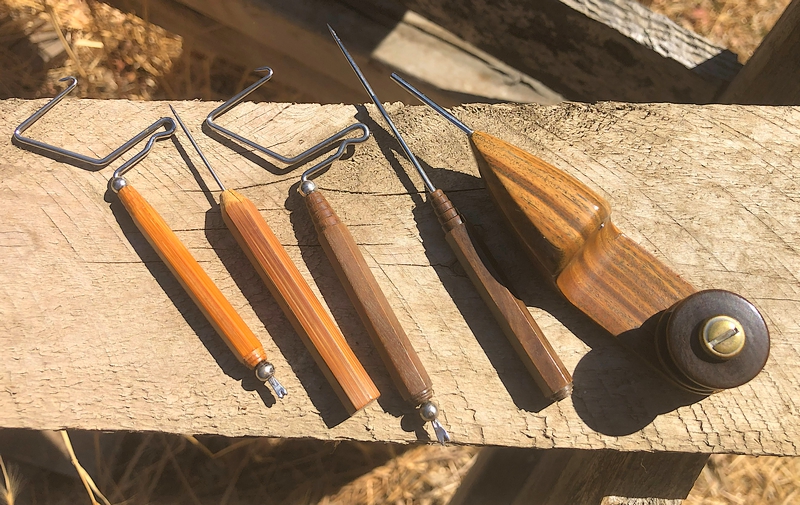
Matarelli Presentation tools
Matarelli Presentation tools in Walnut and Bamboo

… and he gave away plenty of them. Frank would watch any tier closely and was keen to reward talent with a set of his tools. Just as keen would he lambast you for using someone else’s tool if you had a set of his already in possession. Both rewarding talent and his removing “inferior” products would always be done in good taste, with humor, as Frank was a real gentleman despite his gruff exterior.

Frank had multiple prototypes of tools made from a variety of materials. He made bobbins from both metal and wood, used brass, copper, and stainless elements in his tools, and even made hackle pliers, which he never marketed, but you could receive as a presentation gift. He made a lot more tools than most realize, given his wooden versions, his midge, regular, and long tube, bobbins, his presentation whip finishers, in regular and extended reach configurations, and the normal whip finishing tool. In addition to these, Frank made both a midge and regular size bobbin threader, and multiple bodkins, which also were only available as a presentation tool

When Cal Bird introduced his pair of dubbing tools, he mentioned to me that Frank was producing them for him in his garage. Cal was a caligrapher by trade, and produced all the instruction sheets and package labels for his tools, but Frank did all the wire work and shaping for Cal.

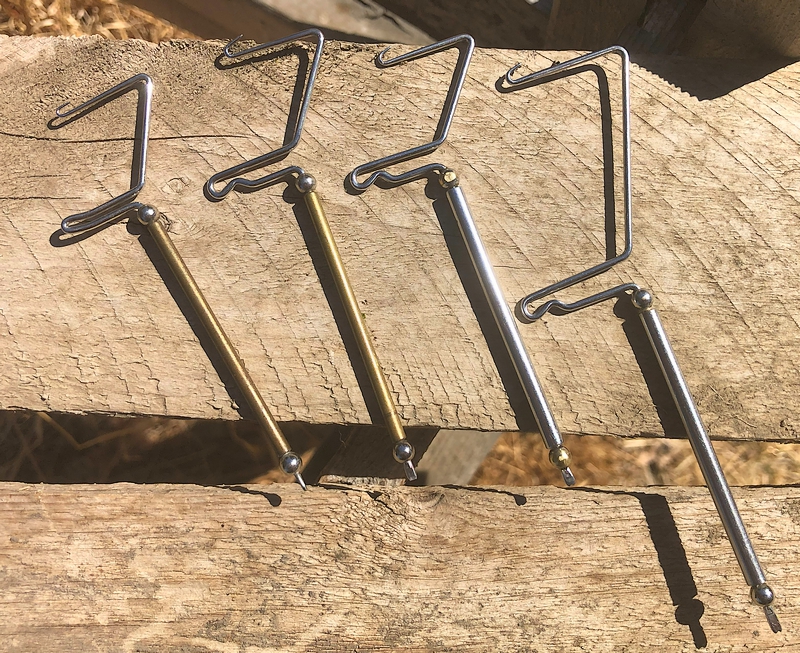
Matarelli Whip finishers. Both regular and Presentation
:Matarelli whip finishers. Early prototype, normal, presentation, and presentation extended reach

My proximity to Frank’s watchful eye meant I was a frequent beneficiary of prototypes and oddities, as well as admonishments when he found me fiddling with some new vendor’s offering. While I loved tinkering with new tools, I learned to pocket them if Frank’s shadow darkened the doorway. Frank knew I was a commercial fly tier as well as a casual hobbyist, and I was gifted numerous prototypes with which to fiddle. Frank knew that commercial tiers have different insights into products; how they wear on fingers, how easily they’re gripped, and how they are slid off the work surface versus held in hand. Quite a few club members were pressed into service to refine things as were numerous tiers in Montana, where he spent his summers.

I recently espied quite a few mentions of Matarelli tools on Internet forums, many inquiring as to their value as they are no longer made. Like most tiers, I’d not thought of “value” regarding tools, as efficiency of use will trump monetary value in every case. Recently I’ve thought I might explore some of the pricier bobbins to see if there is a fit replacement to the Matarelli long tube, and whether several decades, several flops of engineering alloys, and a couple additional sawbucks have increased the capabilities of Frank’s design, instead of merely their cost.

I have added some photographs of all of the Matarelli tools and prototypes in my possession, which will allow the WayBack Machine to catalog them for future generations. It’s important that those of us with first hand knowledge of these “OG” angling legends recount what they know so that future generations of anglers can learn as we did.

Matarelli Hackle Pliers with hook extended
Matarelli Hackle Pliers

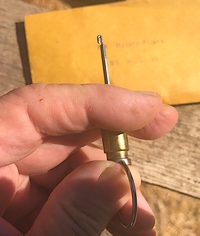
On the featured photo at the top of the article are the Matarelli Hackle Pliers, they were spring loaded where upward pressure of your thumb would extend a small stainless hook outwards to grip the hackle and lodge it against the barrel of the plier when tension is released,

All flavors of the presentation whip finisher; standard, extended reach, and wood handled, had a small “V” notch cut in the end of the tool to sever thread. The non-wood presentation model feature a silver, stainless steel barrel (handle) versus the brass of the traditional retail tool. This thread cutting capability makes them highly prized by those fortunate enough to own a pair, as the tool is already in hand when the finishing knot is applied, and the thread can be cut without reaching onto the work surface for another tool or scissors.

The walnut bobbin is for the “midge” size sewing machine thread spools. This is because all the old school tiers purchased thread in cones instead of spools, and decanted the thread onto sewing machine spools via a power drill held in a vise. Threads used for fly tying were much larger than today, and traditional sized spools were shallow and held much less thread than the thin, deep, metal spools for sewing machine use.

I’m sure Frank would be pleased to read many of the comments on the “value” topic of Matarelli tools, and how despite their increase in worth, not a single tier mentioned his willingness to part with his Matarelli tools at any price.

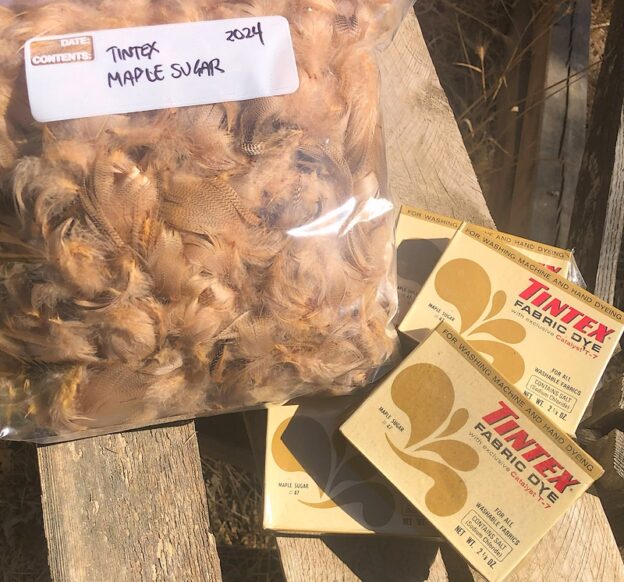
Maple Sugar Tintex, Cal Bird's dyed teal for the Bird's Nest

Maple Sugar Tintex and dogged perseverance

The sight of a box of Maple Sugar Tintex isn’t likely to raise your blood pressure nor cause your heart to flutter, but my recent encounter was cause for an unsightly display of my version of Snoopy’s Happy dance …

Maple Sugar is a color that is no longer made by the Canadian dye maker, Tintex, and is the original color for the dyed Teal Flank that Cal Bird used for the Bird’s Nest. Maple Sugar Tintex, is also an outstanding source of imitation Wood Duck when dyeing Mallard flank as its replacement. Tintex stopped making the color nearly forty years ago without giving us fly tiers a chance to lay in a goodly supply.

After several decades of fruitless searching, garage sales, and similar venues, I’d not been able to turn up some old stock from any source.

Tintex and RIT were both consumer oriented dyes, fixed with salt, that were intended for home use, on curtains, garments, and hosiery. From the 1940’s onward, both RIT and Tintex were available on every store shelf, in every variety store, and nearly all the “Mom and Pop” neighborhood stores. Old school fly tiers, who dyed their own colors to suit local insects requiring custom colors, used both as the “go to” agent for creating materials not readily available.

Both RIT and Tintex have their fixative agent, salt, mixed into the dye powder to make the dye process foolproof. Protein dyes, more commonly used with feathers and fly tying materials, use acid as the fixative, and it is NOT premixed into the dye. Jacquard and similar companies require you to add acid, typically a 5% Acetic (White Vinegar) or 10 % Muriatic (swimming pool acid), into the dye bath to make the color permanent.

Tintex dyes are still made in Canada but many colors have changed and they are no longer in most American stores. RIT won the domestic battle, but even they are only present in a third of their former locations.

Pure stubborn mixed with an elephantine memory allowed me to stumble onto a stash of old Tintex dyes, and it was akin to Harrison Ford glimpsing the Arc of the Covenant … there, gleaming in their aging plasticine wrappers,were five boxes of Maple Sugar, which would be enough to equip a regiment of anglers with teal feathers.

Both RIT and Tintex prepacked boxes dye about a pound of material. More if you will settle for a lighter shade of the color, less if you need it darker. Five boxes means I can dye about two and half kilos of teal flank, which is enough Teal flank to depopulate the Pacific Flyway …

Fishermen are a superstitous lot, with as many metaphysical hangups and superstitions as baseball players and gamblers. NOT owning any teal flank dyed in the original color will NOT make your flies less fearsome, but as success in fly fishing is always due to the angler’s confidence in his fly, your ersatz offering might interest minnows and frogs, while mine …

… … well, I might be going home with the Prom Queen … as it’s my lucky day ..

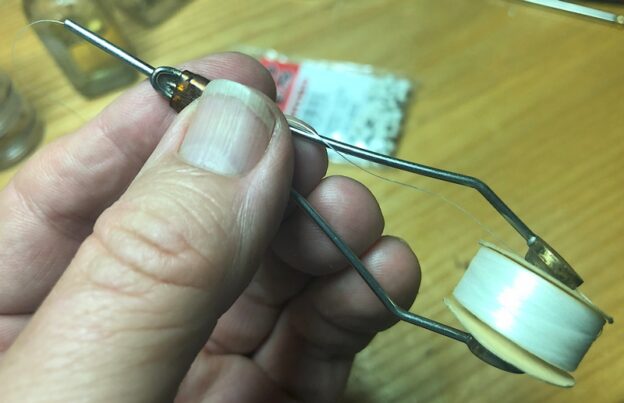
Matarelli midge bobbin with sewing machine spool

Just a follow up on the below NYMO post

Just finished tying a few dozen Clouser Minnows using the smaller sewing machine spools and a Matarelli Midge bobbin designed for the smaller spool size.

So I don’t confuse the reader I’ll need to change the nomenclature a bit. The spools for sewing machines are called “bobbins” and we call the apparatus that holds the spool a “bobbin,” which can lead to confusion on the part of the reader. I will call the sewing machine bobbins “spools” – as in sewing machine spool, to distinguish the fly tying tool from the container holding the beading thread.

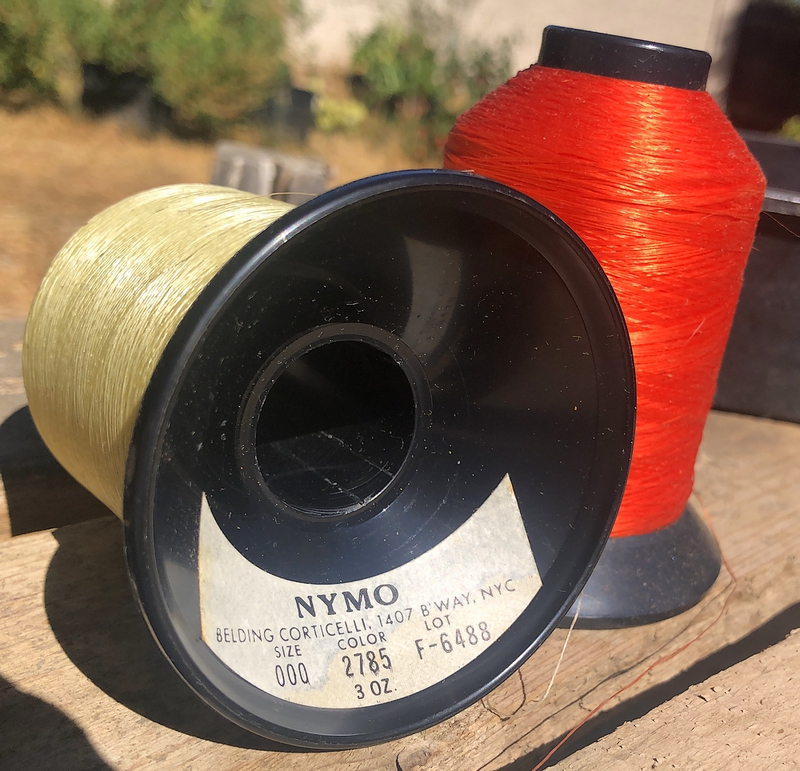
Unlike sewing machine spools, which are made of steel, the NYMO beading thread is packaged on plastic spindels, with paper sides rather than metal. While the paper thread spools work, my hammy hands and their grip on the fly tying bobbin dislodged the spool from the midge bobbin frequently. I had to change my grip a bit to make these work, and once aware of the issue I was able to make them work reasonably well.

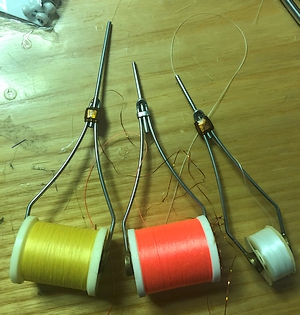
Long Tube, Normal, and Midge bobbins made by Frank Matarelli. This shows the dimensions of the three

Unfortunately, additional definition is needed for what I am describing as a “midge bobbin.” Frank Matarelli made his midge bobbin expressly for the sewing machine spool size – and NOT for our traditional thread spools. Matarelli tools are no longer made, and today “midge” bobbins are typically smaller, lighter bobbins made for tying small flies using the conventional thread spool sizes.

Us old timers that still have a few midge bobbins remember how cone-based thread used to be a reality, and moving fly tying thread from one form to spools was not such an imposition. Naturally, this should “color” your view as to whether this smaller spool form of NYMO is worthwhile for your tying.

It’s likely that winding a rubber band onto the legs of traditional bobbin would close the legs enough for a sewing machine spool to work better. The extra tension afforded by the rubber band might make your current bobbin an option.

Heavy tension on the bobbin while tying can work the thread into the crevass between paper spool side and the packed thread itself. I didn’t get any tangles, but I did get a few turns of uneven tension as a result. When working with big saltwater flies this isn’t much of an issue, but could be if the thread sizes and flies tied were smaller.

In summary, there was a wee bit more bother using the paper spools due to the tier’s palm pushing the paper spool out of the grip of the bobbin’s legs. A grip adjustment was necessary so that I didn’t continually knock the spool from the grip of the bobbin legs. As this thread is 2/0 or larger, you will be tying flies commensurate with the thread size and force will likely cause issues. Be so advised.

Us old tiers cried bitterly on the news of its demise

NYMO was the first unwoven nylon sewing thread that revolutionized fly tying

NYMO, by the Belding Cortecelli Company, was the first nylon sewing thread that relegated all the buttonhole twists, silks, and cotton threads of yesteryear to the scrap heap. As a young tier, I marveled at its strength and how it could be spun via a bobbin into both a round small thread, and unspun to generate a flat thread that added little bulk. We gleefully spun the bobbin to produce the round variant that would knife through deer hair, and attached feathers and hackle tip wings via the flat, “no bulk”, flavor. It was revolutionary to the fly tying realm and changed our perspective of threads and their capabilities forever.

… and then came the news they were taking it away

As this predates the Internet and online shopping, a large city might have access to a fly shop, whose stock was quickly cleaned out, and the rest of us were left ransacking sewing stores, millinery outlets, and wandering around any premises that sold fabric, hoping to find a thread section.

While the thread was magical in the fly tying circles, it sucked horribly as a sewing thread. The “Use warm Iron” admonishment on every spool, meant just that … as using a hot iron would melt nylon and the garment fell apart. This didn’t sit well with the sewing community, nor the dry cleaners, so the Belding Cortescelli Company removed the thread from the mainstay outlets.

I remember spying a few spools of size “A” White at one of the International Anglers Expositions, and as I pointed a shaking finger at the treasure and fumbled for my billfold, was grilled by the proprietor as to how, ” …had I never used it before, I shouldn’t … as it was being pulled off the market.”

I was successful in laying in a small stock of Size A, in black and white, then resigned myself to the notion that on their consumption it was back to the crappy threads of yore.

Fortunately, Monocord emerged shortly after NYMO disappeared, and I, as well as my fellow fly tiers, learned that tying tiny dry flies with “000” (3/0,three-ought) was infinitely superior than the thicker, Size “A” NYMO we had squirreled away. NYMO had been available in 3/0 as well, but when the run started on its dwindling stocks, only “A” was available for hoarding.

What brought back all those distant memories was my recent discovery that NYMO has been reintroduced by Belding Cortiscelli, and is marketed as a “beading thread.” Beading thread is a heavy, coarse thread designed for constructing beaded bracelets and other bead jewelry. Most commonly used by jewelry makers in Size “D”, for strength, the venerable NYMO is available in few fly tying sizes as well. The smallest I’ve found is “00” (2/0, or two-ought), which isn’t likely to unseat our existing threads like Danville’s 6/0 Flymaster, 8/0 Ultra, or UNI threads, but it could prove economical for tying larger flies like steelhead, bass, and saltwater flies.

NYMO Thread
A cone of NYMO tying thread

In addition, the packaging of NYMO offers both “Cones” and spools designed for sewing machines, which fit the Matarelli Midge bobbin, something our current spools do not. As thread hasn’t been available in cones to us fly tiers since the late seventies, most tiers will not find the 3 ounce and 6 ounce (or 1lb) cones attractive. In the olden days, we would decant thread off a cone by placing a spool on a power drill and loading the thread from the cone onto the empty spool akin to adding backing to a fly reel. The six ounce cones cost somewhere between $22 and $55, depending on the source, and hold about 5000 yards of thread, nearly 50 – 100yd spools. The sewing machine spools are 145 yard spools (size 2/0) and range anywhere from about a dollar, to about $4.50 per spool. It pays to refine your search to get the best pricing, and you need to frequent beading and craft stores, not fly shops. Etsy and Ebay are your friends as well.

NYMO on sewing machine bobbins

I was able to secure quite a few individual spools for about $1 per spool. I grabbed some black, white, and blue, in the 2/0 size, as I am making a lot of salt water flies for a donation project I am working on. I routinely find these on Ebay, sold in various colors and sizes, in odd lots sold by private individuals. It appears they use thread colors for a specific project, then move onto other jewelry using other thread colors. Remnants of their past project are then sold on Ebay or Etsy at a reduced price.

Given the wide variety in pricing for the thread, I would only purchase it on sale or on the cone. If you opt for the cone, save empty plastic bobbins first to give you something to offload onto, as the cone is unusable until you transfer the thread to spools useful for your traditional (or midge) bobbin. Store all threads out of direct sunlight, as that is nylon’s nemisis. I am using size “A” NYMO that is nearly fifty years old, and due to dark storage, it has retained its strength without decay.

Many new colors are available that were not present in the past, so we can thank the jewelry and craft folks for insisting on all the muaves, puces, and goldenrods, we enjoy today. As a cautionary note, do not assume you are getting the 2/0 size unless it is plainly marked (or advertised) as such. The most common sizes used for beading appears to be “D”, which is considerably larger than anything we use today.

It’s nice to have a few alternatives to the fly tying brands, given how inexpensive threads are to manufacture.

Phentex Yarn

Fly tying materials in the Wild : Polypropylene Yarn

It turns out I have quite a bit of time on my hands, given my providing care for an aging parent. While that certainly puts a dent in my fishing itinerary, it hasn’t slowed me down on the fly tying front … not even a little.

Like many other fly tiers, the last person I tie for is myself. For whatever reason, I ensure all my pals have plenty, and my fly box is filled with drab experimentals or gayly colored attractors, too gaudy for even the unconventional angler.

I have been restocking a lot of materials with the plan of tying for my own boxes, and find myself alternately thrilled – when I find that missing box of Puce Guinea fowl I misplaced, and gasping … when I see the current price of what it would take to replace it.

In many cases I had the foresight to lay in a goodly supply of common items, like hooks and tinsels, but after years of tying flies, I have made inroads into that supply and need to get more, or contemporary patterns require colors I lack and failed to set aside. As I discover the current trade names, sources, and locales for these materials, I’ll be adding them here for your consumption.

To wit, today we just confirmed that our old friend “Polypropylene” now goes by a different moniker. While the old name is common in fly shops and fishing venues, most of the garment industry has attempted to move away from unwholesome synthetics in favor of more comforting names and trademarks. Fly tiers have long known of the reluctance of the fashionable types to wearing REAL furs, and how it has cut into our supply of animal parts and furrier scraps. The same is true of trade names … and the movement away from names that sound like they cause cancer, to names that sound more wholesome, natural, and socially acceptable.

Polypropylene is now called “Olefin” and those tiny three yard cards of Poly yarn that sell for three dollars each, can be purchased under the Olefin name for a fraction of the cost of retail.

Skeins of Olefin yarn will look slightly different than the fly tying flavor, but only because the yarn you purchase might be a knitting yarn, a spun four ply, versus the unspun two ply seen in the fly tying variant. Combing the yarn out and unspinning the weave yields the same material and the same coarseness of fiber. Color selection is greatly increased due to the non angling uses, and for some that may be an additional benefit. Most poly yarn is used to wing spinners or dries, and typically used in the white and light gray flavors.

It’s not surprising that most of the Olefin yarn consumed in the US originates under Chinese manufacture. As there are so many uses for the Olefin yarn, everything from heavy ropes to gossamer garments, you need to select a form that is conducive to your fly tying.

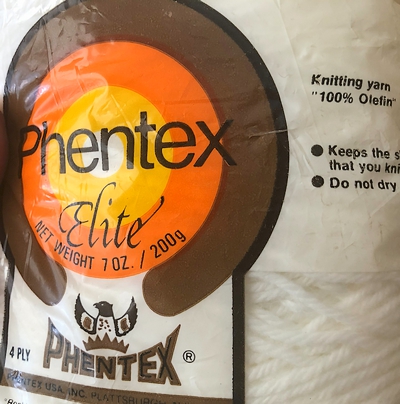
Phentex was the brand of Polypropylene yarn purchased in the late 70’s, and the Phentex company still makes the yarn in its many forms today. Phentex markets the yarn under a variety of styles and types, many of which are available on Amazon. The “Slipper and Craft” yarn is a loose Olefin weave and will likely work well for your tying.

Most fly tiers will have a lifetime supply of Polypropylene (Olefin) yarn with only a single skein of the white and one additional in gray, I have found uses for turquoise blue, damsel dries, and brown – for Calibaetis parachutes. At six dollars a skein, you’re getting several decades of materials for the price of two of the small fly shops cards.

Jump on it.

My war against the 25 pack continues

I held my nose while ordering a 25 pack of “balance leech pins”. I needed a sample of the genuine to confirm what these really were – and from which industry they came. Possession of a 25 pack of anything from a tackle store typically requires me to blush profusely and commit the obligatory toe scuff to distract onlookers.

I hate 25 packs of anything, unless it’s Twinkies.

In fly fishing, the twenty five pack is just enough material to fiddle with and then run out when you discover some unknown yet useful quality.It’s enough to give your fishing buddy a handful, then find you only have three for yourself.

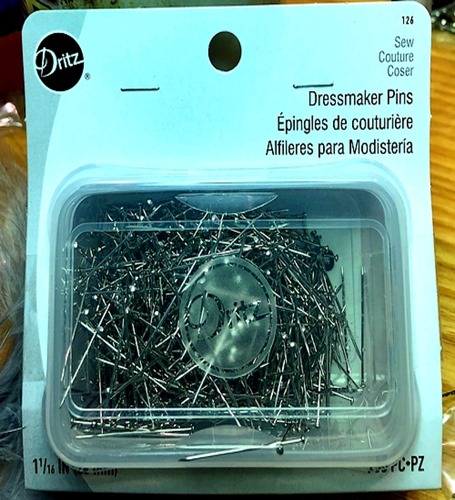
Today’s case it was enough to identify that “balanced leech pins” at $2.95 for 25, are simply dress maker’s pins – available at any fabric store for $6.95 for 750 of them. This wasn’t earth shattering as many fly tiers have guessed similarly, but as I noted the pattern recipe called for fly tying beads to balance the fly, and beads being another exorbitant 25 pack item, I thought I’d mention that standard metal beads will work better than the fly tying version – and are much cheaper.

Dressmaker pins are used as they have a flattened head which prevents our bead from slipping off the end of the pin.

DressMaker500

Solid copper, steel, or brass beads are available from Etsy, eBay, or Rings & Things and most hobby stores that cater to jewelry making. They work on barbless fly hooks with model perfect bends as they are not slotted to accommodate barb or sproat-style bends, but are sold for about $4 per hundred, versus $4.5 per 25 at the fly shop.

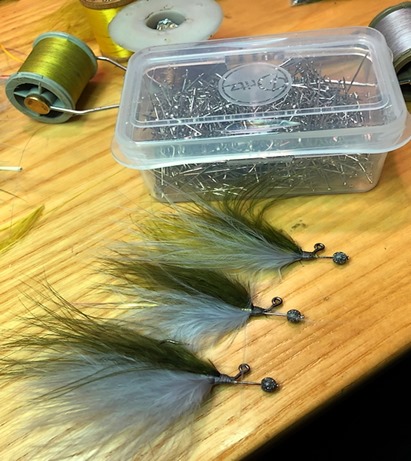
“Balance Leeching” is tying the fly on a 60 degree jig hook and including a bead on a dress maker’s pin to hold the fly level when suspended from a strike indicator. I had an idea this would work well on shallow weed flats for bass, and was intent on tying a couple dozen to try with minnow imitations as well as leechs.

balance_minnow600

Any chance I have to thwart the sale of a 25 pack of anything is worthy of the effort.I used some “diamond cut” 4mm iron beads to act as the balance element and tied others with dual beads so they would bang against one another (rattle) during the retrieve. Weeds are not yet available in the local lakes but they’ll show once the warm weather starts in earnest.

In Spring a Young Man’s thoughts turn to Cloudy Water

Spring is synonymous with the “Great Flush” wherein increased water levels caused by rain and snowmelt sends leaves, branches, empty water bottles, discarded Pandemic masks, and everything not nailed down – into whatever body of water is downstream.

I always seem to run into dirty water regardless of where I’m fishing and am always fiddling with flies attempting to find a solution to their visual appeal being obscured by debris and dirt.

The drought has complicated matters as well. As the water in lakes are drawn down it exposes loose dirt with little vegetation to hold it in place. Wave action caused by wind will stir that mix into a coffee colored slick that will extend it’s plume into the lake from the windward side of every point.

Wind and shallow water are common to both freshwater lakes and the California Delta. Vegetation tends to cleanse dirty water but a drought, coupled with the time of year, weeds are not available. Much of the underwater vegetation dies back during the Fall and Winter months, and the spring flush often empties into lakes whose weeds have not yet started their new cycle. The California Delta has less water level fluctuation and much more resident vegetation but is prone to wind which stirs the water in the shallows – disturbing bottom debris and sediment which quickly discolors water in the surrounding flats.

As fly fishing lacks many of the sensory elements of other types of fishing, like scent or sound, we are at a disadvantage when water conditions are less than ideal. Watching those Pro Bass shows often tempts me into using “Scent of a Thousand Nightcrawlers,” but I’ve resisted thus far only because the oily mess is likely to mat all materials and render flies lifeless and stiff.

Sound is a viable option on flies, but their method of attachment is a bit problematic. Many kinds of rattles exist for the bass jig market and might be adapted to flies with a bit of ingenuity.

The volume of rattle equipped baits on the lure and plug market suggests both lure manufacturers and anglers believe it attractive to predatory fish. As I’ve not read all the science (yet), I’ll assume the mob is onto something and all those rattle equipped lures are something more than a means to separate a fool and his money … and sound is an attribute to a fly in discolored water.

While not expert on sounds emitted by baitfish – it’s likely digestive noises and excess air are present in the innards of anything that isn’t a plant. Water transmits sound readily but I’m unsure whether “bad” noises exist and whether gastric noises or baitfish flatulence is attractive to predators. The act of swimming, either leisurely or frantically, is likely to add vibration (sound) into the water as well. The receptor on a predacious fish is likely its lateral line – as sound is likely transmitted through water as a vibration.

The bigger question is, which sounds and what pitch are triggers for large fish? Big sound, loud or soft, continuous sound or discrete notes?

I’d guess that the species and feeding behavior of the predator adds a unique mix of triggers, and Sailfish may respond to bigger sounds that would send a trout fleeing in terror. Schooling bait likely “sounds” different than a solitary minnow, so part of the mix will vary with the fish sought or imitated by the rattle equipped fly.

rattle700

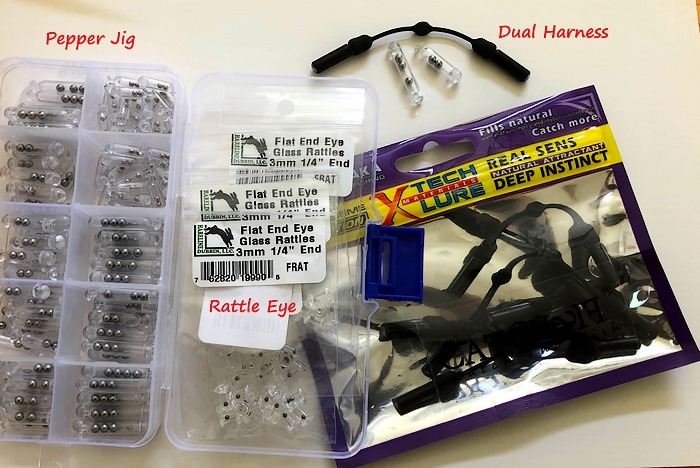
Rattles exist in a number of options, most are for jigs and bait casting gear. Three basic styles are the dual harness type (XTech), the “Pepper Jig” type – whose rattles fit into a rubber harness akin to a set of Mickey Mouse ears (rattles in the box), and the fly tying rattle (Eye Glass Rattle) – which are shaped like a traditional “barbell” eye, and attached in the same way.

All of these are “dogs with fleas” for the adventurous fly tier. Both the dual harness and the Pepper Jig rattles rely on a rubber element that can be lashed onto a hook with ease. Unfortunately, rubber will oxidize and you might lose the rattle after a season or two. The basic cylinder of the “Pepper” shaped rattle is problematic and bulbous, so securing it to the shank without using the harness is an issue, both in secure attachment and in its interference in tying the actual fly itself.

The “barbell” style rattle eyes have little or no sound as the beads are so tiny, so if it’s the noise you’re after, the fly tying version are essentially worthless. As I am unsure which sounds are most desirable to Striped Bass and Largemouth/Smallmouth, and sound is the solution to combat discolored water, I choose to use the larger beads and noisiest rattles ; the double barbell and/or Pepper Jig flavor.

The physics of rattles has to be considered as well. Rattles create sound as one or more “BB’s” hit either end of a air filled chamber. Air is buoyant  so the larger rattles (containing bigger beads and more trapped air) can alter the buoyancy of the completed fly. Using a double rattle will exacerbate the issue, so it’s prudent to drop your flies in a glass of water to determine whether you’ve affected the rake or pitch of the fly in the water.

I chose to use a single rattle from the dual harness. I trim the harness at the center bulb and tie the stem portion onto the hook shank in the tail position. this allows the bucktail or marabou to flow around the rattle body and hide it within the fly.

It’s worthy to note that both the dual harness and “Pepper Jig” variants can be threaded onto the fly by simply forcing the hole in the center harness over the fly head or onto the leader itself. This offers the ability to add and remove rattles to your existing flies but relies on the elasticity of the plastic to remain securely attached. It’s plain the maker would have chosen a plastic that resists oxidation, as jigs are subject to sunlight as well as flies, but the force of casting the fly coupled with stretching the rubber ring over the hook eye will likely cause it to fail sooner than its traditional use.

645rattleBluegill

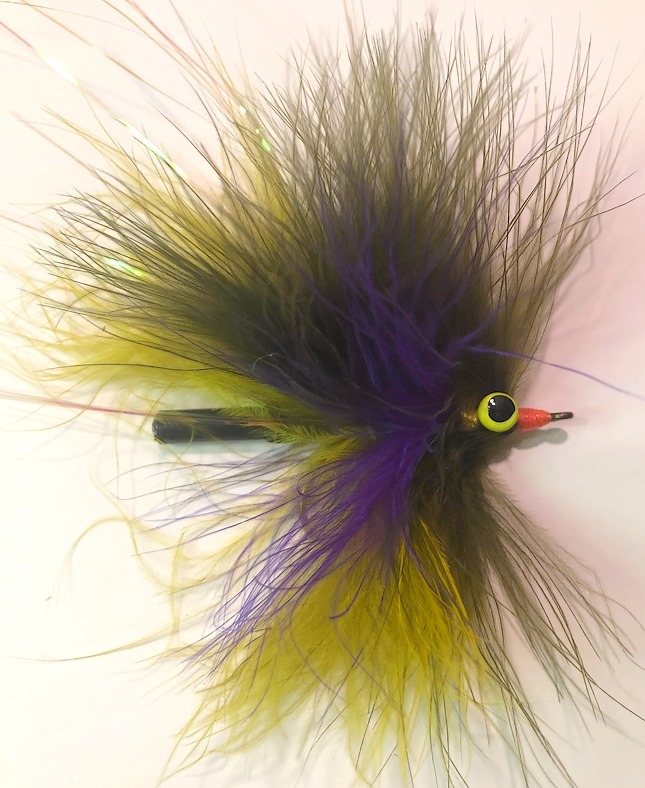
On the above “Little Bluegill” you can see the single barrel of the rattle tied in at the tail position. I have spread open the marabou to show the rattle, and when fished the rattle is not visible nor does it seem to affect the fly action. Any buoyancy issues will be overpowered by the lead eyes up front.

Mounting the rattle at the tail keeps it from obstructing the gape of the hook. Threading rattles onto the leader or eye means the barrels have the ability to dangle below the fly and may cause some issues with hook setting on smaller hooks. I trimmed the tether short to keep the barrel up tight to the shank of the hook rather than allowing it to sag to one side or the other.

Marabou striper flies fully loaded with water are already heavy things to hurl, so I didn’t notice issues with the increased weight. A fully loaded 2/0 is about as aerodynamic as a small school bus, so wear protective gear regardless.

8lbStriper700

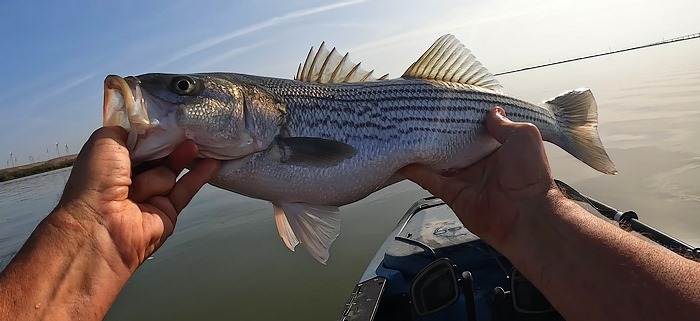
I fished Sherman Island just after two days of blustery wind last week and managed to score a single eight pound striper. The water was noticeably dirty from all the wind activity and while I cannot say it was the rattle that seduced the slimy SOB, I’d like to think I outwitted him on his own turf ..

More testing is required to prove anything however. I am scouring the Internet to see if there is any scientific work on the subject, that can translated from Latin into English, as I am interested on how pitch and tone might attract or repel – and whether I can manufacture something suitable to confirm any theories on this subject.

In the meantime, enjoy fiddling with these options most are available from any shops catering to lure and jig making.

I plan on using the same flies for Largemouth to see if they aid in catching fish on the muddy plumes of water that come off the points in the afternoon. Wind traditionally makes an appearance in early afternoon, and my wandering about on the bank has revealed that schools of Threadfin Shad use these plumes as cover from predators, foraging with relative impunity .. Dragging my fly out of such a plume might trigger something to dine, and I do so love to share my flies with things smaller than me…

Loon ERGO Serrated Scissor Review

The pandemic has accelerated my conversion from trout fisherman to bass fisherman  due to  the unknowns associated with food, lodging and travel. I’ve shelved all the gossamer and petite gear needed for trout fishing in favor of  Styrofoam, hair,  rubber legs, and hooks capable of severing your Carotid artery with an errant cast.

Loon Ergo Hair Scissor640

Tying flies for bass is the “Widow Maker” for most marriages, as the production of a dozen 2/0 poppers involves half a deer hide, acres of marabou and brightly dyed Grizzly hackle, most of which winds up clinging to your lap or blowing about your tying room at the whim of your air conditioning.

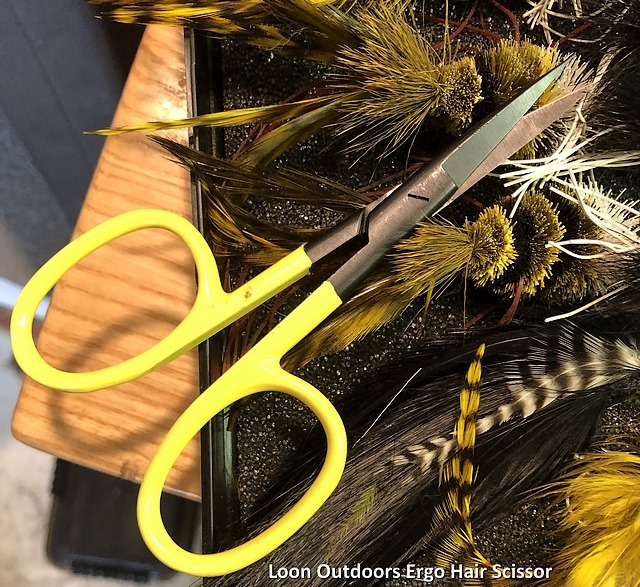
I keep reaching for my “trout” scissors to cut bead chain eyes and saw through Stinger hooks and realized they were better served staying in the drawer given their delicacy.  Unable to find my old serrated edge heavy scissors, I picked up a pair of the Loon Outdoor Ergo Hair scissors to replace them. At $15 per pair, these scissors are priced well considering the potential for destroying them while restocking your fly box.

Tying big deer hair poppers can shorten the life of traditional delicate scissors as there are additional pressures that go hand in hand with larger flies.

Volume: Large bass poppers require many times the materials of smaller trout flies. That translates into cutting larger volumes of material with each cut of your scissor. As leverage plays into the physics of scissor cuts – the longer the scissor the more force is applied to the fulcrum area, the small screw holding the scissors together. Stainless steel is a “soft” steel (compared to others), and the screw steel is typically “harder” than Stainless, which ensures this excess force  will eventually deform the screw hole and loosen the scissor over time.

Obscurity: Tying big lumpy hair poppers means you have an enormous wad of hair lashed to your hook prior to trimming the final shape. As the majority of the hook is hidden , it’s very easy to close the scissor on the shank, point, or eye – simply because you couldn’t see it while trimming. Whacking a hook point with your scissors is bad for the tips and for the screw area, as the steel of a hook is “harder” than the steel (often Stainless) used to make the scissor. Hook steel can easily take the points off of a Tungsten scissor, as Tungsten is among the hardest of all steels – but it is also among the most brittle.

Dirt: Carving large amounts of deer hair off of the hide is a dirty business. While animal hides are cleaned and washed prior to being parted up for packaging, there is still a lot of foreign material trapped in the hair. Dirt, debris, dried blood, seeds, and everything else trapped in the under fur will be in the path of your scissors each time you make a cut of hair, and that additional wear adds over time.

Bulk: Cutting through three-quarters of an inch of Elk hair takes considerably more effort than trimming a mallard feather, yet most tiers expect the results to be identical. Cutting large amounts of material with small scissors requires the scissor to be closed slower than when it cuts a small feather – or the screw area will suffer. This is the most common way to deform the screw hole, cutting too much too quickly, and either the handles bend as you close them or the screw hole widens to accommodate the excessive pressure. Scissors loosen as they age, but it’s actually deformity of the screw hole that causes all the extra play – rather than wear.  If you are tying a lot of large flies or the materials are quite tough it’s better to switch to a larger scissor with the backbone to sheer through the material with less strain on the fulcrum area.

Today, Bulk and habit were the root of my problems, as I kept reaching for the fine point trout scissor when I should have used a larger set with serrated blades. Serration is always useful when trimming hair as the fibers cannot slide out of the scissors ahead of the cut, the fibers tend to catch in the serration and ensures everything gets trimmed proper. Note that this is both good and bad, as the serrated scissor will grip and make absolute cuts – and you can remove too much material if you’re unused to them.

The Loon Ergo serrated scissors are a 4.5” (powder-coated stainless steel) scissor with superb tips and a light serration down one of the blades. The large finger holes, hence the “ergonomic” designator, are quite comfortable for extended tying sessions, and there is enough “beef” in the scissor frame to snap them closed without feeling the handles flex – which is a good tell that the scissor is over capacity on the cut.

At $15 the price is really cheap, prompting me to order a second set for use with conventional tackle, trimming braid and heavy monofilament where that serrated edge will prove extra useful..

As my tying room is currently bereft of carpet due to a “slab leak” and having to jack hammer the concrete pad beneath for the repair, I should mention that I managed to drop these scissors on their points and bent both tips in a dramatic fashion. Stainless steel is a soft steel, so I was able to restore the points to their original shape by dragging them across my vise barrel several times. This is not a failure of design or an inherent weakness in the quality of the product – rather this is what happens when good scissors and fine tips meet an immovable object.

Great scissor for a great price – and with the large finger holes even the hammy handed should find these comfortable.

Note: This is an unsolicited quick review of this product. The scissor was purchased at full retail from a shop.

A Colonoscopy is Better than Fly Fishing

ColonI was shocked by the violence of the outburst. How us “fly fishing guys were NUTS”, and how the speaker – a largemouth Bass devotee – would rather submit to a colonoscopy before EVER learning to fly fish.

I’m staring at an extended digit, which I assume to be the exclamation point for some hideous crime dealt by some pompous flyfisher …and the victims, the aforementioned gear-wielding bass fiends, being horribly traumatized as a result.

I could understand the vitriol if my fate was the company of fellows I didn’t care for – or the required fly fishing livery and mandatory smoking jacket were unsavory, but as I’m unsure what the source of the angst is – and whether the conversation will end in blows,  I’m  struggling  to envision what horrid crime would anger a fellow fisherman to the point of apoplexy.

I understand it better now.

As a reward for spending the weekend waist deep in cold water with not even a single bite, I was coaxed into a pilgrimage to “Mecca”, a.k.a. the Bass Pro Shop Outdoor World Boating and Tackle Megamall.

To suggest I was intimidated would be an understatement. No sooner had I broke the plane of the entry than I was hailed by a “Walmart Greeter” in store livery, and promptly herded past the acres of checkout aisles, test kitchen tidbits hawked by sweaty fat guys, and into the throng of people headed for the Big Aquarium of Tapped Glass – which was home to numerous large (and sonically deaf) fish whose fate it was to endure children banging on the glass – hoping to startle a resident into activity.

While I’m slowing to take it all in, I realize I’m that Old Lady blocking the soup aisle while poring over the sodium levels of Bean & Bacon versus the Chicken and Rice.  I am blocking the path to the Test Kitchen and the free samples of “Gut Shot Elk Butt” being foisted on the unwary. Those same folks that wrinkle their nose at laying a lip on fish from the Wild, now squealing in pleasure as Mother Nature dipped in sugar and deep fried makes the sumbitch tastes like a Twinkie ..

I managed to find refuge in an side aisle featuring a mixture of “my organ is bigger because I kill stuff” fluorescent tees, (which all the kids were in a tizzy over) mixed with the more staid earth tones of Sherpa gear that just came off the Matterhorn, whose drab sophistication Mom and Pop found enchanting.

I found a side eddy that took me past more glittering silver and gold spinner-baits than King Croesus’s treasury, and as I slow I begin to see price tags and comprehend where I am. I’m in “SevenDollarLand” where everything large or small, glittery or drab, wiggly or inflexible – cost seven dollars each.

Like Walmart, bins of merchandise dominated by sale banners and bold typefaces ensuring us old guys don’t have to squint before pantomiming our displeasure. Suddenly that tasteful bit of tackle we’re fondling is the “dipped toe” into many hundred’s of dollars in liability, and we find ourselves cornered by an angry spouse with no path to the hordes of squeezables in the Rubber Worm Garden.

I’m a fish out of water – uncomfortable in what should have been a religious experience. Organ music and choir warble gives way to announcements of lost children, debtor’s prison, and the screams of kids no longer interested in Dad’s pending decision between Deep Fuggin Craw and Yum Yum Yello Crankbait.

I’m cheek to jowl with many thousands of folks who have no interest in any of this other than the spectacle.

The fly fishing section was framed in dark wood and dim lighting, a welcome contrast to the bustle and garish colors of the Crankbait aisle.  Large price stickers announced the fly tying section as “Threedollarland”  – where spools of tying thread were $3.19, as were the tiny bits of duck’s arse, deer fetlock, and turkey down.

I hadn’t  thought the price tag mounted on the rear of a glassine envelope to be the fly fishing equivalent of “demure”, but I understand better now.

The shock of how much a new fly tier pays for materials  caused my eyes to water. Hackle has never recovered from the heady days of hair inserts, and the White River shop brand for Bass Pro was a small (and useless) handful of neck hackle reminiscent of India capes. At $13.00 per packet, a fellow could go broke tying a dozen dries.

I was more fortunate, given it was Shad season. I picked up a few fetching colors of pink and chartreuse tinsel, a packet of pink beads, a couple 10lb tippet spools (mono not flouro) and two spools of heavy white thread – and I was out the door at $31.00.

Nine flies later I wasn’t so impressed at my acumen …

Pricing a Royal Wulff was an eye opener. $14.00 for a packet of brown hackle, $5 for the calf tail, $4.79 for the Peacock, another $3.19 for red floss, and $3.19 for the thread, closely followed by $7 for a 25 pack of hooks, meant I was into the fly about $38 by the time I had everything.

Considering the hackle as the delimiter, maybe I could tie 9 good flies .. making the cost per fly about Four Dollars Each. As Bass Pro sells the damn flies for $12/dozen, we’re not likely to see the fly tying ranks swell much …

Ditto for the Thousand Dollar Fly Rod. As Momma and the kids stroll past the fly fishing section (with prices visible from the closest three aisles) we’re sending a powerful message to our recruit pool.

Tying flies as a means of defraying the cost of buying store-bought has always been one of the reasons for fly shop visitation and our continued support even during non fishing season. Like tippet, it’s one of the most common reasons for us to visit and toy with that new rod, or try on those new zipper front waders.

One megamall does not a trend make … but as our numbers are dwindling quite rapidly, and these “foreign” venues present our craft to thousands of potential recruits, far in excess of anything our small stores can muster, I was a bit surprised at my own reaction …

… and was an eloquent depiction of why my hardware mongering bass pals won’t even consider the long rod. A lesson punctuated by airborne spittle and much finger pointing.

139 Yards of shattered glass

It was one of those rare opportune moments where a simple resupply of “frog” yarn revealed something really useful at a compelling price … even better …ample tonnage remaining to satisfy any fly tier’s ambition to lay in a goodly supply.

Bernat Boa is a synthetic polyester ribbon yarn that’s strong enough to use as hackle, has enough structural integrity to use as streamer wings, can be wound closely to make 3D shaped minnows, and can be knotted and teased into any number of fish killing uses.

I use it consistently in Shad flies, bass flies, and anything requiring saddle hackles, because the edge binding the polyester fibers is thin enough to wind, and can be tied off securely without inducing weakness due to bulk.

As each skein has three or four colors, it becomes really cost effective due to the additional colors that can be harvested from its “camouflage” coloration.

Yarns that are in consistent demand typically introduce new colors (and retire older non performers), and as I refilled my dwindling supply of Shad “pink”, I noticed new colors that made the material doubly compelling.

Bernat_Holidays_Label

Apparently for Christmas 2014, Bernat introduced a series called, “Bernat Boa Holidays”, that added three additional festive solid colors;  Santa Suit (red), Holly Green, and Blizzard (white).

The white caught my eye immediately as I was tying some minnow patterns that needed a light colored body, and something about the original photograph suggested these filaments might be a form of Antron.

After I took delivery I was pleasantly surprised. This is a much softer and finer tri-lobal filament that has the “shattered glass” brilliance of Antron, but can be dubbed onto a dry fly.

Bernat_Holidays1

Where this material truly shines is when it is clipped from the yarn base and mixed into a natural fur blend to offer a sparkle akin to  baby seal. This “shattered glass” effect is great for a medium (trout) sized fur blend, and given polyester dyes readily, additional colors can be made from the white to suit more “earthy” sparkle effects.

Bernat_HolidayGrass

Holiday yarns tend to be limited release but I’ve not seen any mention of these being pulled post holiday season.

Do not buy these colors on eBay as they tend to range in the $6-$8 range per skein. Instead get them from YarnSupply.com or Knitting Warehouse – which has Blizzard on sale for $3.69 per skein.

These are often found in KMART stores as well, but holiday colors are typically swapped quickly to seasonal favorites shortly after the festivities are over.

139 yards per skein makes an awful lot of streamers or dubbing blends, I think you’ll find a multitude of uses quickly.