Author Archives: KBarton10

I just need regular rubber, the creek provides the Sticky

I was doing the math on the current set of hip boots and rather than pooch out the lower lip claiming I’d been used cruelly, I realized that my seasons are a bit different than most…

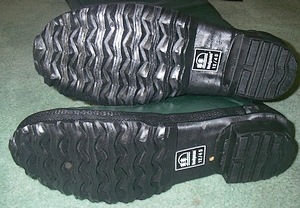
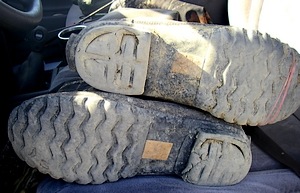
Hodgeman Wadewell II Hipboots after two seasons The left boot was taking on water from both heels and soles, I’d managed to wear through both, and the right boot was slurping water through both the uppers and heels, and all of this accomplished in two seasons.

Figure 100 days fishing per season – and the average trip walking distance of four miles, I’d managed to put nearly 1000 miles of streambed on these boots in an abnormally short time.

Federal statistics claim the average angler does about 9 trips per year – so that elevates me to the Truly Awesome Timewaster percentile.

These were the Hodgman Wadewell II hip boots which boasted an uncharacteristically good fit on my size 12 feet. All those miles were done in “street” socks – and nary a blister.

Hodgman Bantam Soles I liked them so much I bought two more pair; one identical to the original, and a second lighter set – the Hodgman Bantam weight Nylon, featuring an identical instep and sole as the Wadewell variant.

Two sets allow me to use one pair in the waters with confirmed invasives, and the second pair for water where they haven’t been confirmed (but are likely present). As mentioned in my “Where’s the Beef” post, most of the biologists are keeping watchful eyes on the blue ribbon watersheds, I won’t know what’s latched onto me for some time.

If you’re fishing more than 25 times a year you’re in the “high risk” angler category. You fish so often your gear may not dry thoroughly. Additional pairs lowers the risk somewhat – and as the Hodgman Bantam’s were only $35 (regularly $53), it’s cheap insurance considering the miles I’ll pack on those soles.

… and welded boot foot construction; no tongues, laces, and tomfoolery that can trap critters in those uppers. It’s no proof against invasives, but it lowers my “host” coefficient a bit compared to detachable wading shoes. I’m not lulled into thinking Vibram soles and conventional laces are an improvement.

The water I fish may be forlorn, odiferous, and forgotten – but I take mighty good care of it just the same.

Tags: Hodgeman Wadewell II, Hodgman Bantam weight Nylon, hip boots, waders, rubber soled wading boots, invasive species, brownlining, Vibram soles, fishing statistics

The Meek Shall Inherit once the Strong get eaten

The Good News is that Sacramento Pikeminnow can reach upwards of 31 pounds, the Bad News is that they don’t taste like Salmon.

Records released by the United States Fish and Wildlife Service reveal that the salmon counts taken at the Red Bluff Diversion Dam are down to one fourth their averages for this time of year. As of July 25th, 596 Chinook  salmon had crossed the dam, while the average for years past was 1,916.

However an alarming fact has also been revealed, the Sacramento Pike Minnow, the Chinook’s main predator, has crossed the dam in record numbers, 905 this year compared to an average of 713.

For us coarse fishers it appears the meek will inherit, once all the gleaming fancy fish have been pounded out of existence.  That’ll elevate what is left to gamefish status – and the guides will be plying the same holes for the wily “Golden Salmon.”

… and the Pikeminnow’s mortal foe, the Striped Bass is being litigated against by the southern California water districts; their assertion is the Striper is an invasive species and the root cause of Salmon decline.

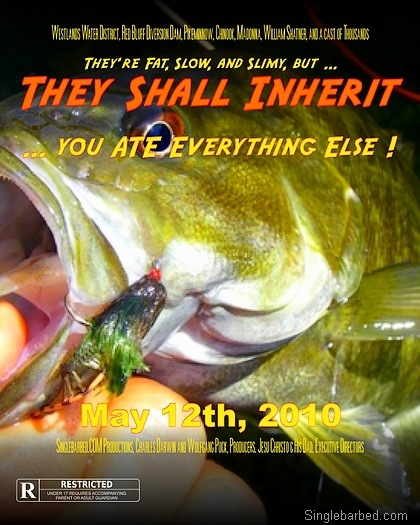
They Shall Inherit, The Movie

Once the lawsuit does away with the Stripers and the balance of the Delta is diverted to SoCal compliments of the Governator, we’ll have some odiferous foamy little trickle that San Rafael and Walnut Creek can fight over as to who gets to drink it.

It is singular that despite all the vitriol and law enforcement, despite the millions being spent on habitat restoration, bag limits, gear restrictions, catch and release rhetoric, despite all those countless hardworking folks devoted to the Salmon (including us) – that the Pikeminnow with nothing to protect it are thriving and on the increase …

… and if they tasted like a Twinkie, they too would be extinct.

Tags: Sacramento Pikeminnow, Chinook Salmon, Striped Bass, Governator, coarse fishing, Twinkie, Red Bluff Diversion Dam, water politics, meek shall inherit

Hisself admits frailty, acknowledges the ravages of Time and resolves to be meaner

rice2 I remember calling the announcer a “know-nothing boob” when he claimed Jerry Rice had “lost a step.” Those were fighting words, inferring the world’s greatest wide receiver from the world’s best-est NFL team was somehow mortal…

Forgive my obvious “homer-ism” – there are other NFL franchises, but with the home team employing both Joe Montana and Jerry Rice the late 80’s and early 90’s were mostly a coronation rather than a contest.

Fly anglers are athletes only most of us don’t see it that way. Our contracts cover “love and cherish” and a lifetime of lawn mowing, and when the “head coach” tells us to come off the couch – we do so with all haste and don’t twitter our distaste for her play calling …

I’ve been wrestling with this notion all season, coming to grips with the fact that I’ve lost a step. It’s painful to admit and I’ve blamed all manner of external entities, but the plain truth is age is starting to show itself.

Mortality is a rude awakening, some find it early via cataclysmic event – but the rest of us feel like we’re in high school for forty years and then suddenly we’re not.

At 46 my lifelong 20-20 vision started to deteriorate. A visit to the ophthalmologist yielded a gleeful diagnosis of “old guy” Presbyopia, and nothing to be done about it. It meant reading glasses for fly tying, as I had trouble resolving small flies and hackles, and it meant glasses for knot tying while fishing – as I could no longer thread monofilament through the eye.

It meant that if the glasses were lost or broken, my fishing was done. The last 45 minutes of dusk – the Holy Time – when fish get careless and bugs grew dense – was now 35 minutes of swearing while trying to tie on the right fly, then finding I could no longer see it when it landed.

… and Shad meant healing between trips. All those broken fingers suffered in youth, and both thumbs broken while salt water fishing, have reawakened like some dormant volcano – reminding me of every youthful lapse in judgment.

The heavy rods with Ultra-fine, Half wells, Cigar, or Reverse half Wells, now are passed over in favor of the Full Wells grip, which seems to give better purchase and requires less finger pressure to keep the rod from rotating.

Throwing a Type VI head is always arduous. One or more roll casts to get it onto the surface, one or more false casts to position the running knot outside the guides, and then flung with great vigor.

Pop calls it “economy of motion” – where you start to favor a body part and refine the casting stroke to minimize repetition. I can still go all day, but this season taught me to use one roll cast, one positioning cast, and toss. Distance is unaffected, this is the cast you should have been using all along, the cast the rod’s taper was designed to deliver and only youthful ardor and invulnerability prevented you from learning it.

In addition to the reading glasses, we’ve added water and sugar. I’ve always been in good walking shape and trips start at the parking lot, with multiple miles of upstream or downstream before thinking of returning.

A couple liters of water and a snack bar have replaced the beer and a sandwich. Most of my local watershed is blazing hot and the refractive heat from sandy stretches coupled with the humidity of the creek can take the starch out of your stride long before the car is visible.

The forced march through the burning sands has been tempered by wisdom. We can still do the full frontal assault, but a spot of shade and some water makes it much more comfortable.
A Park Bench in our future? We’ve added glasses, hydration, and a fart bar to the vest – three more items we can forget in the pre-dawn flurry of fly boxes, tippet and other essentials.

But it’s the melancholy that makes “losing a step” so difficult. You know that another decade and you may not be fishing alone anymore, the decade after, fishing may be limited to the parking area, and in the decade that follows fishing may be a sunny park bench at the casting club – where you rub aching stuff and tell fish stories with other fellows in similar circumstance.

… all the while keeping a fatherly eye on the youthful know-nothings unable to keep a defined loop aloft, knowing your impatience with their casting stems from your inability to wade steadily, or rock-hop some small creek to show the lad how it’s really done.

You shake your head when he applies additional force to the cast which makes the tailing loop worse, and unable to suffer further you straighten off the bench to walk out to the fellow – enduring his glare of resentment when you offer to assist.

I suppose I was the same way when those old guys approached me. I knew everything already, despite only being 12.

I can dump a few extra pounds to regain a short burst of squandered youth, but a couple years later even that won’t be enough and I’ll submit reluctantly to the ravages of Time.

The silver lining has to be passing on all that knowledge – learned painfully at the cost of self – to some scowling young prick that will only learn its value a couple decades later when he faces what I faced.

Those that tie flies will blink through thickening spectacles and continue their craft with renewed passion, as it preserves the connection to the sport despite age or frailty.

… and pressing six or seven flies into the hands of some youngster – whose eyes grow as big as silver dollars may be a suitable surrogate for using them yourself.

I’m toying with going out messy like Brett Favre. I’ll be the bane of the orthopedic surgeon insisting he replace stiffened tendons with sheep embryo injections or stem cells.

Some innocent fellow will be tromping through the woods and stumble across my prone form at water’s edge, and when he checks for a pulse I’ll startle him by croaking out a string of obscenities, “get your goddamn hands off’n me you lummox, and tell me whether that big Brown is still there despite your big assed feet …”

That’s the Gold Lining, being a mean old SOB for the last couple of fortnights …

Tags: Old guys, fly fishing, lost a step, mortality, Brett Favre, Jerry Rice, Joe Montana, mean SOB, casting club, impatient youth, economy of motion, retired athlete, sheep embryo, hydration pack,
I always seem to flirt with the terrorism label

The bullet holes attest to strict security I managed to eke one last trip out of the old waders – and with one set on backorder, I was just lucky I opted for the “chemical resistant” flavor on the second pair. No camouflage this time, just the ninja-esque black boots famous for cleaning overflowing toilets and oil spills.
Now I just need gloves to match.

Black will come in handy now that I know I’m standing on a 16” pipe bursting with Kerosene.

Peeking over the levee yielded the above warning, and I was sure some trigger happy airman in a Humvee was in my immediate future. It’s times like this you think about the Tungsten beads you ordered from mainland China, and the Jungle Cock you scored from Pakistan …

… and you wonder whether that cranked telephone attached to your testicles will hurt a lot – especially when you’re cuffed to a metal box spring and soaked with water.

Why didn’t I just buy them from Dan Bailey?

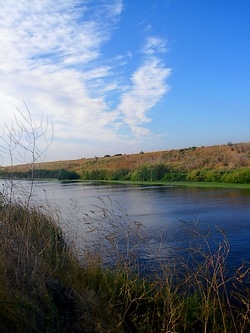
Brownline Shower facility I’m staying at the bottom of the trench frantically throwing “L” shaped casts as the wind is blowing much too hard for flies. I figure after a hundred yards I might get lucky and snake a few fish to the bank, which will give me a clue what calls this home.
Standing on a greasy mud spine throwing crayfish is much less fun when a squadron of fast-movers pull high-G above your head. I frantically try to find purchase knowing they’ll get “tone” on the second pass.

Bad enough that I can’t control the flight of the flies I’m using – much less dodge Sparrows while moonwalking around muskrat holes. Wisdom overcame fish lust and I sought terra firma.

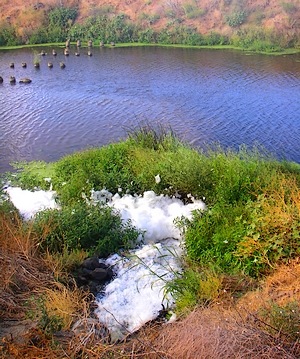
Gale force winds and fast movers interrupt fishing I was tempted briefly by the Brownline Shower facility above, no soap needed and undressing optional. It’s the drain from an unknown number of cornfields making it rich in precious nutrients, so precious they’re sprayed from planes rather than found in the soil.
The head would build to the size of a small car and the wind would tear it free and send it aloft. Once it crested the levee the wind would shatter it into a thousand pieces and the process began anew.

I christened it the Popcorn Geyser – something to torment fishing buddies with…

OK, there’s some really big fish on this stretch, I want you to stand right here and …”

Blanked again. Three trips, two called by wind and the third by low water. I suppose I should’ve taken my cue from the wind farm just down the road.

Tags: Solano County irrigation district, brownliners, fly fishing, crayfish, mudbugs, fast movers, waders, Tungsten beads, Jungle Cock

California water districts consider cage match between Quagga Mussel and Black Carp, winner to get citizenship

In an earlier post I’d made a joking reference to the next great gamefish being the common carp. Assuming plenty naturally; the continual destruction of the pristine water via human interaction, global warming, acid rain, and all other ills.

That theory may have more legs than first imagined.

Of greatest concern to states, water districts, and the populations they supply is the Quagga Mussel, whose prolific reproduction clogs pipes, pumps, and all that precious infrastructure that takes water from its source and out your tap.

These same entities are less concerned about environmental issues, fish populations, or what it does to your moored boat – they’ve got a full plate serving up an incompressible liquid to a burgeoning population.

With California in the grip of a 26 Billion dollar deficit (this year) and the potential for many more lean years ahead, everyone is frantically searching for something that will repel the little beasties and keep the water moving to the desert.

The state Department of Food and Agriculture has added quaggas to checklists at inspection stations. Since the first find in Lake Mead, 249,000 boats, canoes and kayaks have been stopped in California. Of those, 21,728 were drained and dried after evidence of mussels were detected. Nearly 400 have been quarantined.

Little wonder that the issue is growing with great ferocity, as nearly 10% of the recreational boats inspected are coming up “dirty.”

Of particular interest to us fishermen is the option of introducing a second invasive species to eat the first. Apparently the Black Carp is a voracious eater of the Quagga (as is the Red-Eared Sunfish), and a last ditch option may be to introduce Carp to the water supply.

I assume they’ll be sterilized triploids or something similar, but I’m not so sure:

Introducing carp to eat the sharp-shelled quaggas has not met with similar zeal. Still, Steve Robbins, general manager of the Coachella Valley Water District, sees value in allowing black carp to be used if the state’s power and water delivery system is overrun.

“I haven’t dropped the idea,” Robbins said. “We’re being successful right now. But if we weren’t successful” the district could seek a permit to use carp.

Nibling said some other species make meals of quaggas, such as the bottom-feeding redear sunfish.

“A number of fish eat quaggas,” he said. “The problem is they can’t eat enough.”

That’s great news for us fellows that aren’t timid about our admiration for Carp as a gamefish – but does bring some really interesting questions to the fore…

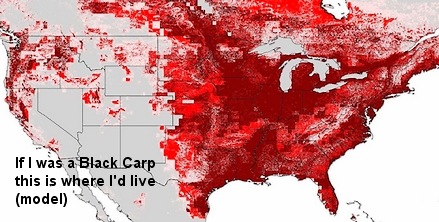
You’ve got a “Quagga Lawnmower” in the Black Carp, but you’ll probably need a sustainable (or growing) population of carp to diminish the growing population of mussels. Planting them as juveniles will cause all those monstrous White and Largemouth Bass to gorge themselves, which will piss off the water district manager (who really isn’t interested in the fisheries angle) – so in addition to suing the State of California for not delivering all the water they need to save Salmon, he’ll be suing the State again as those fat Southern California Largemouth are dining on regiments of his Quagga shock troops…

Theoretical Model of Black Carp Distribution

… and then the US Fish and Wildlife Service sues him for introducing an fertile invasive – with the potential for destroying most of the East Coast.

Water politics and “who ate whom” is liable to convert “fish bums” to the legal profession, as lawyers will spend more time on the water than the rest of us combined.

The good news (if any) is us apocalyptic brownliner’s will be plying our craft at every stop of the California Aqueduct, touting the merits of one Carp species over the other – until we’re recognized as a tangible threat, then we’ll join the long list of defendants summoned to the docket on a trumped up terrorism charge…

… as the Lockerbie Bomber only got eight years, we’ll be defiant as always.

The down side is that just as they clap the manacles on us – some fellow will boat the new World Record Largemouth Bass – weighing 63 pounds, and while incarcerated – and mindful of our posterior, we’ll miss out on the Great SoCal Largemouth Shootout. Southern California becoming the New West Yellowstone, drawing anglers and tournaments – lured by the prospect of lazy bloated fish barely able to tread water.

Cash prizes courtesy of the Water Districts, naturally …

Tags: Brownliner, Black Carp, Quagga Mussel, Lockerbie Bomber, West Yellowstone, California Aqueduct, largemouth bass, red eared sunfish, fish bums, Fish and Wildlife, bass tournament, Coachella Valley Water District, U.S. Bureau of Reclamation, lawyers, California water politics

High dollar tackle attracts the unwanted element

It’s an uncomfortable thought to be sure, having to repurchase your entire ensemble. It seems that every state has some premier fishery which has the unsavory crowd prowling the parking lots for unattended loot.

Fishing the urban interface is worse, with easy access to riverside parking areas whose cars are left unattended for great lengths of time, whose owners are waist deep in water – and powerless to prevent the snatch and grab…

As the value of the tackle increases and with the ready market provided by Craigslist and eBay, we can only look forward to more of the same – as contemporary tackle eclipses the value of CD players and tape decks.

I stopped using rod tubes for that reason – and if a friend brings one, I’ll remove the cap and hang the sock out of the top within view  to avoid the shattered window. Most precautions are obvious, don’t display extra tackle within easy reach – and make sure your tape deck is an eight track …


I wasn’t surprised when I read of the capture of the Missouri Tournament bandit – the debut of the “thousand dollar rod” foretold that someone would start pursuing anglers specifically. This fellow stalked the professional BASS circuit, rifling the boats moored after each days fishing.

When apprehended the police found nearly a thousand items in his garage, all pilfered from nearby lakes.

“They know people will be there with high dollar fishing equipment,” said Sgt. Callahan. “The general public doesn’t realize the dollar value…the rods and reels can be high dollar.”

The last time I calculated the costs of our entire ensemble; including leaders, flies, tippet spools, and assorted dangling vest accoutrements – even I was surprised at the totals – nearly $3300 per man (2007 prices). Figure resale on eBay would generate half of those costs – that’s a tidy sum.

Just keep alert. As the gear grows in value – so do the ranks of those that covet it.

Tags: tackle theft, BASS tournament, eight track tape, eBay resells stolen property, caveat emptor, empty rod tube, anti-theft, thousand dollar fly rod

Danville’s Monocord discontinued

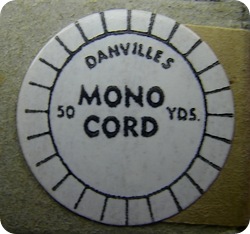
RIP Danville 3/0 A couple hundred thousand fellows will be gnashing teeth yet again – compliments of the Danville Chenille Company and their decision to discontinue their venerable 3/0 Monocord.

There are plenty of finer threads so it’s no catastrophe, but it’s a constant reminder that both natural and synthetics are prone to vanish without notice.

When Belding-Cortiscelli abandoned NYMO thread fly tiers were left with little other than sewing thread. Danville’s Monocord became the heir apparent as it shared some of the characteristics of the NYMO brand, namely tying flat.

NYMO has returned in recent years as a beading thread, but the smallest size available is “A”.

With the emphasis on the 6/0, 8/0, and 12/0 threads available today, the older and larger Monocord was collateral damage. I’m sure the salt water crowd will be in tears, as larger hooks and rough conditions lends itself to larger threads.

For those eager to lay in a goodly supply, grab what’s on the shelves – they’ve already ceased production.

(via Flyfishingnotes.com)

Tags: Monocord thread, Danville Chenille Company, 3/0 thread, Belding-Cortiscelli Thread Company, Nymo thread, nylon thread, fly tying thread

Reykjavik Whale Watching, the Old Spice sailor does slasher flick

Most of our angling rituals could be construed as a preamble for a good “slasher” film – starting with the pre-dawn rending of eggs and pig-flesh, and ending with the post-sunset rending of whatever-is-still-open.

PETA regards us as bestial vestiges of a bygone era and likely went “halfsies” on the big screen variant with Greenpeace – and it appears the fishermen image will be taking quite the hit in the forthcoming 13 sequels..

Gone is all the good press gained via countless “Old Spice” commercials, and you may want to list “hobbies” next to religion and politics on the forbidden topic list for the light n’ airy cocktail scene…

The skipper looks crusty enough, the babes are comely – but my money’s on the white whale … if there is one.

Reykjavik, no country for young emo’s.

Tags: Reykjavik Whale Watching, slasher films, PETA, emo, white whale, Old Spice, prequel, grody old guys, Greenpeace, whaling

Reader’s Digest feels the sting of a war on two fronts

paperboy The print media continues to struggle in the face of the combined onslaught of economy and Internet. We get mighty few clues on how the fishing press is faring as so few are publicly traded.
With Reader’s Digest filing Chapter 11, swapping debt for equity with its lenders, and numerous newspapers opting for digital only, it’s plain the effect is significant.

Even so, Reader’s Digest, the iconic monthly magazine founded in 1922 as a collection of condensed articles from other publications, has been searching for a new niche as the Internet upends the magazine industry’s traditional business models.

… and for each magazine shuttering its doors we have an electronic startup of the likes of This is Fly, Fish Can’t Read, or Catch – which by comparison enjoy miniscule costs and produce equal or better quality.

If I was a collector I’d be disappointed in the slow but steady transition from print to digital, but as each site archives their past issues for ready access I find it much easier to find the article I wanted to reread – or the pattern I wanted to tie – and they’re not cluttering my tying bench or causing domestic issues when I discover my dog eared trove tossed in the trash.

They won’t always be free – the coming revolt with the “per click” revenue model will be short and violent. Until then they’re best consumed hunkered in your cubicle with a soggy sandwich chaser.

Tags: Fish Can’t Read, This is Fly, Catch, Reader’s Digest, ezine, Chapter 11, debt for equity swap, Web 2.0, online angling magazines, per click revenue, redirected eyeballs