Author Archives: KBarton10

Saltwater Angler gets a Lemon

The latest viral video to sweep the Internet and it’s not angling’s finest hour…

I’ve always prided myself on not caring what bit my fly, and with all the goat carcasses and derelict automobiles I thread through – I’m no longer squeamish about what I step in …

A couple more of these and a new hobby is warranted

But a fellow has to draw the line somewheres, and after a half dozen of these on the end of my line, I’d give serious thought to Badminton.

Apparently a Lemon shark can reverse its gut when stressed, which is absolutely no comfort whatsoever…

Tags: Lemon Shark, YouTube, saltwater yuks, angling,

Book Review – Tying Catskill Style Dry Flies

I’ve always likened the traditional dry fly as the fly fishing equivalent of the Japanese Tea ceremony. You can tie a million of them and the number of times you’re pleased with the result you can count on one hand.

Double-divided quill wings spin our gossamer tippet into a snarl, Woodduck flank is expensive as hell, and we roar past the traditional Catskill dry enroute to something more contemporary and scientific.

The Catskill Cabal; George Labranche, Theodore Gordon, Preston Jennings, Walt & Winnie Dette, Rube Cross, Art Flick, Harry & Elsie Darbee, and Roy Steenrod, were instrumental in the migration of English dry fly theory and adapting chalkstream tactics to moving water. Despite the passage of nearly one hundred years, their influence on the sport continues unabated.

Red Quill, one of many Catskill standards

Mike Valla has written an engaging book on the entire Catskill experience – from his vantage as an “adoptee” of the Dette’s. It’s an interesting and fast read that introduces the rivers – their unique personalities and patrons, the fishermen, and the fly tying brain trust that gave us the traditional patterns we know today.

The book focuses on the development and variations of the traditional Catskill flies, how each was modified, the individual variants popularized by each tier, and how the modern Catskill patterns we tie today evolved from their inception.

“This was the Rube cross who told Walt Dette, in the late 1920’s, to get lost when Dette asked Cross to show him how to tie flies. Walt promised that he would tie only for himself, but Cross would have no part of it.”

“When (Rube) Cross turned down Walt Dette’s request to teach him his tying techniques, Dette purchased $50 worth of flies from Cross, and he, Winnie, and Harry Darbee dismantled them in a rented room above a Roscoe movie theater to learn the Cross technique ..”

“Legends” can be as ornery and cantankerous as the rest of us. Books and autobiographies usually omit personality and character – facets that add a great deal to any legend. In describing Rube Cross’s 1950 work, “The Complete Fly Tier” – where his fly tying style was photographed, its author may have tried to hide his technique from us as well:

“One late summer evening many years ago, while I was at Walt’s side at his vise, he explained what they discovered about the Cross technique: ‘That is not what the unwrapping revealed. When we untied Cross’s flies, he set those wings first, then the tails, then the body, the common sequence that is used today.’ Walt used to give Cross some benefit of the doubt, and stated that maybe Cross changed his technique, but it does seem odd. Winnie, on the other hand, thought the change described in the book deliberate, to hold secret his true technique.”

This “forty-thousand foot view” of the area and its personalities adds a great deal of information not encountered in specific literature, like the interactions of all this talent and their individual foibles.

Considering the materials and techniques of the day, no bobbins, 3/0 silk thread held with clothes pins, the lack of genetic hackle, the paucity of blue dun – a color that permeates Catskill flies, few synthetics, and no domestic supply of fly tying items – most ordered from England, their skill, especially the Dette’s and Rube Cross, is astounding.

The chapter on hackle brought back unwelcome memories from my own youth, as Dun necks were squirreled away in back rooms – reserved for that special customer. Each Catskill tyer eventually developed his own stable of chickens to ensure adequate dun hackle. “Live plucking” the hackle was the norm – the chickens being much too valuable to kill.

We’ve never had to run around in the dark trying to corral wise old roosters who’ve experienced a couple years of scalp pulling…

“Modern fly tiers have access to every possible shade of hackle required for any fly pattern, and the stiff hackle is superior to what we all had to live with years ago. Jack Atherton once traded one of his original paintings, worth thousands of dollars, for a hackle cape that the stiffness and color required for Neversink Skaters; tiers today don’t realize how coveted a good neck was in the early years. One can walk into any good shop and choose from a wide variety of dun shade and be assured that even the lowest grade necks are better than hackle available ten years ago.”

Indian and Chinese capes were the only thing available pre-1980’s. They were serviceable enough for flies #12 and above, but tying #16’s – with hackle less than an inch long, still brings me nightmares.

That attention to detail has propagated itself into the current hackle business, as Harry Darbee’s line of genetic chickens may have served as the initial brood stock for both amateur and commercial alike:

“The Darbee line, as it is called , has also found its way into the flock of numerous backyard breeders like Doc Alan Fried in Livingston Manor. Fried , in turn, continued Darbee’s generosity in sharing eggs, and it was through Doc Fried that Darbee DNA found its way into the Collins and Whiting hackle.” 

For the fly tyer interested in plates, dressings, and authentic patterns, you’ll not be disappointed. Step by step illustrations demonstrate the Dette-trained Valla’s Catskill mastery, and the many variants practiced by each of the above tiers. Many samples of original work are depicted from the author’s collection – and the Catskill Fly Fishing Center and Museum.

Despite the cross-continent geographic gulf, the dissimilarity in watersheds that I fish, and all the advances in synthetics and angling technology, “Catskill” style traditional dries still comprise a dominant role in the fly box. We no longer need to leave the gap behind the eye as the Turle knot has been replaced by the Clinch, but the design and simplicity of this style of dressing will likely survive another hundred years, despite the many who insist it’s outdated.

Great book, with content for both angler and fly tier alike.

(Full Disclosure: The reviewer paid full retail for the book, it’s available from Amazon.com for $32.95)

Tags: Mike Valla, Catskill Fly Fishing Center and Museum, Art Flick, Walt Dette, Rube Cross, Theodore Gordon, Harry Darbee, George LaBranche, Roy Steenrod, Preston Jennings, Tying Catskill Style Dry Flies, Turle knot, the Complete Fly Tier, Catskill angling lore

We’re grinding up more than we’re making

Ouch Powerful, controversial, and completely riveting. A sobering look at the state of the world’s oceans and the long term impacts to the planet.
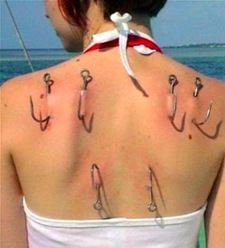
End of the Line – Episode 1

End of the Line – Episode 2 – European Union

End of the Line – Episode 3 – Heroes and Villains

End of the Line – Episode 4 – Rest in Peace

End of the Line – Episode 5 – The Power of Consumers

End of the Line – Episode 6 – The Future of Fish

It’s part Philip Glass, part Danny Elfman, and, at the sight of a mere dorsal fin, part John Williams. Music coats shots of everything from hundreds of fish flopping in nets to graphs denoting the steep decline in certain fish species. After 10 minutes, I got it: Things are bad.

“Docu-activism” at its finest – guaranteed to make you set down your Tuna sandwich and reach for something man-made .. like a Twinkie.

Tags: End of the Line, sustainable fisheries, salt water fish, Twinkie

Art or Advertisement

Art or Advertisement Would you date a gal with a chronic drooping backcast?
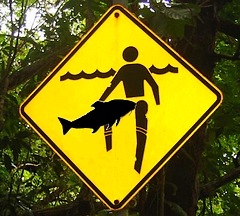
The Internet holds countless mysteries, and I’ve been scratching my chin on this flavor for some time. Is it art, self expression, Photoshop, or occupational advertisement?

I’d be scared to ask …

Those of you searching for the perfect outdoorswoman can rest assured that mosquitoes won’t be an issue.

… and if PETA climbs all over us for hooking “sea-kittens” – would the “human fly box” stifle their outrage?

Tags: Photoshop, drooping backcast, Mysteries of the Internet, PETA, human fly box

The immaculate inhalation

Beware of large ravenous fish While the UK is still mourning their lost brute Benson, Germany has countered with a new world record common carp. Landed last week, “Mary” flattened the scales at 86 pounds 6 ounces.
It’s plain that the “Superhero” carp crowd are as tweaked about the gear fetish as us fly fishermen, only they’ve got about twice the moving parts as we’re afflicted with:

Nermin took the giant fish on a snowman hookbait made from a 26mm Dynamite Baits Red Fish boilie, with a matching 15mm pop-up. He presented this on a 35lb Kryston Quicksilver Gold hooklink, a size 4 Korda Wide Gape X hook, and an 113g Fox inline lead.

It’s nice to know that despite all the ecological uncertainty, whether we blame Global Warming – or Little Green Men from Mars, we’ll still have plenty of gear to argue about.

I can’t help but wonder what spin us colonials will put on the fishery when we adopt the same practice. We scoff now, but we’ve always shown great reluctance to embrace anything unmodified – and a hundred years later we’re claiming we invented the sport.

We lack the patience to bait the water for two weeks in advance of the fishing trip – as this fellow did, and would prefer renting an air tanker for one monstrous pass of floor sweepings from a Wonderbread bakery.

My limit is about 60 pounds. Anything bigger is no longer sport, rather it’s just cursed hard work. Ensuring I still outweigh the now-angry beast by two or three times – and “nine in the clip, one in the pipe” will dissuade the animal from chasing me up the bank and back to the car.

It’s certain we would be giving them fearsome monikers destined to strike fear into small children and joggers, and outfitters would have eight or nine fingers and talk in whispers about teeth marks on cars, scales found near shattered doorjambs, and missing locals.

Given names would drive the animal activists into a frenzy.

Tags: Benson the Carp, Mary world record carp, common carp, wonderbread, boilie, named carp, world record

FTC requires Bloggers daylight vendor relationships and pay for post practices

In light of Federal Trade Commission ruling, I need to confess that Singlebarbed.com did in fact give me a set of the Precious (Sixth Finger scissors) and that I did willfully foist said device on the unsuspecting eyes of my readers.

Scissor_Payment To rectify this heinous breach of confidence, witness the left hand (of the author) paying the right hand (of the author) the full and complete purchase price of the aforementioned bloody awesome scissors.

Now that I’m a reformed whore – I get to throw big rocks at everyone else…

The Federal Trade Commission has ruled that as of December 31, 2009, bloggers will be required to list their relationships with any vendors, and whether the product they’ve reviewed was paid for – or provided free by the manufacturer.

Rather, in analyzing statements made via these new media, the
fundamental question is whether, viewed objectively, the relationship between the advertiser and the speaker is such that the speaker’s statement can be considered “sponsored” by the advertiser and therefore an “advertising message.” In other words, in disseminating positive statements about a product or service, is the speaker: (1) acting solely independently, in which case there is no endorsement, or (2) acting on behalf of the advertiser or its agent, such that the speaker’s statement is an “endorsement” that is part of an overall marketing campaign? The facts and circumstances that will determine the answer to this question are extremely varied and cannot be fully enumerated here, but would include: whether the speaker is compensated by the advertiser or its agent; whether the product or service in question was provided for free by the advertiser; the terms of any agreement; the length of the relationship; the previous receipt of products or services from the same or similar advertisers, or the likelihood of future receipt of such products or services; and the value of the items or services received.

This isn’t a really big deal as most blogs are personal and therefore exempt, but there’s plenty of grey area to stumble over. Many blogs are supported by the manufacturers (especially those that give favorable reviews) and a great deal of “loot” is dispensed through all the various angling mediums; magazines, blogs, forums, and the like.

In industries unrelated to fishing, manufacturers have commissioned “independent” blogs as a source of free word-of-mouth advertising and the FTC wants to shutter these “surrogate mouthpiece” sites.

Assume now that the consumer joins a network marketing program under which she periodically receives various products about which she can write reviews if she wants to do so. If she receives a free bag of the new dog food through this program, her positive review would be considered an endorsement under the Guides.

Individual authors lack the funds to buy multiple $700 rods each year – and may lack the desire even if the fundage was forthcoming. Manufacturers queue themselves willingly for the chance to reach your precious eyeballs, and the larger for-profit sites will now have to spill all the sordid details.

… and lest you think I’m pointing fingers, “for-profit” describes any site with Google’s AdSense advertisements – the irritating little ads to the right of this column that you never click on anyways.

I think this is a great idea and long overdue.

Popular blogs are besieged by unrelated vendors who will pay just for a link to their site. Something as innocuous as the word “shoes” can be worth money to a high traffic site. Vendors don’t care whose eyes they capture as long as there’s lots of them.

Product reviews have always been a sore spot – even amongst the magazine crowd. Fly fishing is such a personal issue that one fellow’s idea of a great rod may not be shared by others. Numerous articles on the topic have surfaced on this and other blogs about these “rock and a hard place” pressures.

If you play the game well, applying the lips to whichever hindquarters are presented – you get more free stuff, and advertisement revenue. If you don’t – well, you don’t get anything.

… and that’s fine too… only the FTC no longer sees it that way.

I’m not a legal mind, but if Sage is paying you a monthly stipend to host their banner and you review one of their rods, are you on their retainer?

Example 5: A skin care products advertiser participates in a blog advertising service. The service matches up advertisers with bloggers who will promote the advertiser’s products on their personal blogs. The advertiser requests that a blogger try a new body lotion and write a review of the product on her blog. Although the advertiser does not make any specific claims about the lotion’s ability to cure skin conditions and the blogger does not ask the advertiser whether there is substantiation for the claim, in her review the blogger writes that the lotion cures eczema and recommends the product to her blog readers who suffer from this condition. The advertiser is subject to liability for
misleading or unsubstantiated representations made through the blogger’s endorsement.

So how does it all work? The Redington RS4 review that TC and I did came with the requirement that we link back to the Redington site twice. The rod and reel we reviewed was donated by the vendor to our collective bosom with the understanding we’d both review the product.

The Trout Underground thought it a sturdy serviceable rod, and my opinion was that it was sturdy … too damn sturdy for my taste. That’s the gamble the vendor takes when putting his “best foot forward” – loose cannons like myself may not like the product and have the affront to say so.

The manufacturer is gambling on a favorable review and the topic (plus links) to bring your precious eyeballs back to their site for ritual exploitation.

Our combined (Underground/Singlebarbed) loot policy requires us to donate the rod and reel to the readers. I’m guessing this will happen after TC becomes more skilled in whip finishing his new daughter’s diapers …

The Modified Singlebarbed Loot Policy:

I own more tackle than a fully equipped fly shop. I’ve got more reels, rods, fly tying materials, books, hooks, waders, boots, and vest-based errata than I care to admit.

… the fact that my brother has borrowed or broken half of it is immaterial.

I will tell my girlfriend that any item she claims is new – was provided free by a vendor – and I’m counting on you not to spill the beans.

In the case of a product review I will outline the requirements the vendor has saddled me with – and whether I paid for the beast. As Singlebarbed does not kiss vendor buttocks, we’re considered “a loose cannon” by that community and I expect I will continue to pay for all products reviewed.

Tags: FTC endorsement rules change, FTC guides on endorsements and testimonials, Redington, trout underground, Google AdSense, bloggers, blogging ethics, schwag

If you can cast better than Brad Pitt, here’s your chance

If your tailing loop is more convoluted than most or a gob of pancake makeup will make you prettier than Brad Pitt, you might consider being immortalized on celluloid. Unfortunately you’ll have to live somewhere near Washington, Oregon, Northern California, Michigan, Ohio, Pennsylvania and New York State …

Kype Movie Opportunity

Kype magazine is looking for ardent salmon-steelhead anglers to feature in their magazine and forthcoming DVD.

Kype is currently searching for two anglers at each fishing location along their upcoming film tour to fish side by side with Publisher and film producer, George Douglas. “This is not your typical guide trip,” said Douglas. “This is an opportunity for anglers of all levels to showcase their fishing adventure and help kids at the same time.”

The camera crew will capture you and your adventure on film to be used for national distribution. In addition to highlighting this amazing sport and providing viewers with great fishing action, the underlying theme in this series is to capture the typical or not so typical day in an angler’s life that often includes the frustrations met on the river, to the evening celebration of the big catch. Similar to reality-TV filming, Kype’s film crew documents each aspect of these trips while bringing out unique personalities and the perseverance that drives anglers to their next hook-up.

… loosely translated it suggests they might not dub over your swear words and anything confessed while inebriated will be shared with the balance of the planet posthaste.

Kype apparently sponsors Thetugisthedrug.org angling community,  if you don’t embarrass yourself on celluloid – you’ve got a couple more chances in different mediums…

I can’t apply as they’ve used “the tug is the drug”, “tight lines” and “rip lips” on a single page. I’m allergic to all three, combined they’re Kryptonite to us dirty water anglers.

Tags: Kype magazine, thetugisthedrug.org, drug free fishing, new guys, trite angling phrases, fly fishing movie, Brad Pitt

Columbia River to go Barbless for Salmon and Steelhead

Pacific Salmon Beginning May 1st, 2010, Washington fisheries officials are proposing a single barbless hook restriction for the Columbia River.

Washington fisheries officials are about to deliver a bombshell on Columbia River anglers, proposing single barbless hooks be required for salmon and steelhead angling as far upstream as McNary Dam.

The proposed rules can be downloaded from the Washington Department of Fish and Wildlife website. The changes are scheduled for public comment October 8th, with a potential ratification in December.

#11. Hook Rules for Salmon in Marine Areas
Proposal: Require single-point barbless hooks when fishing for salmon from the Columbia River jetty and in Willapa Bay (MA 2-1) and the Westport Boat Basin from August 1 – January 31.

Explanation: This proposal would require single-point barbless hooks for all saltwater salmon fisheries, making saltwater salmon hook rules consistent and easy to follow, while allowing easier release of any salmon not retained

These types of changes are to be expected, in light of the dramatic decline in west coast salmon populations. This comes on the heels of a $7.50 increase in a Washington license (for salmon) – we can all expect to see stiff sanctions in play as the fish dwindle to extinction.

These are the Good Old days ..

Tags: Columbia River salmon, single barbless restriction, salmon, Washington fish and wildlife

What’s up, Dawg?

What's Up, Dawg! Us native Californian’s pride ourselves on being at the forefront of the next great trend – even marginal ones, just so we’re seen as holding up our end…

… and a pear shaped angler trudging through creek bottom just doesn’t offer the same opportunities as the hard-bodied ultra-consumer crowd – as they troll the beach admiring their reflection in the rear view…

Now I’ve got my own statement, hydration pack lipping full of lemon slices and Fortifido water.

I opted for the “natural Spearmint” assuming that if it can make a dog’s arse fresh – it’d tame the sour taste of cheap cheroots and alkali dust.

I may opt for the Peanut Butter if that doesn’t work, as Parsley sounds a mite off-putting.

We can emerge from some muddy rivulet knowing our skulking days are over, we’re “kissable sweet” – it’s only the rest of us that smells like hell.

Tags: Fortifido water, dog water, brownlining, trendy, wasteful, Peanut Butter, Parsley

Now if they could just do something with discarded water bottles

The Milk Crate Angler Angling art takes many forms and covers multiple mediums – yet only the Pristine seems worthy of immortalizing.

Us fellows that trod mud amidst the savagery of the rural-urban interface rarely see much celebration of our craft.

Recycled milk crates strike a special nerve – mostly because we’ve waded through their neatly ordered phalanxes below bridge abutments.

I consider it “gravity-based Moderne”. I like the concept, industrial art mixed with reservation of a favorite riffle … the Milk Crate Fisherman.

Tags: milk crate fisherman, rural-urban interface, angling art, gravity