Author Archives: KBarton10

A series of indignities that influence us even today

Bait fishing wasn’t so bad, especially after we discovered which of our dumb-assed buddies was really interested in fishing, and which were there just to break rods.

Lure fishing was better. We were suddenly agile – no longer rooted. Fishing became seduction versus sitting motionless hoping to be victimized. Fly fishing was better yet, we could tweak even more variables and influence the “eat, don’t eat” decision on levels beyond mere presentation and retrieve.

Yet fishing is a series of indignities, and as we mature both as individuals and fishermen we find elements better suited to our individual needs and unique rewards system. We don’t lose all of our past history, traces of each stage in our development linger and influence both our angling and personal tastes.

Some of my foibles can be traced back to my earliest angling efforts. Pautzke’s “Balls of Fire” and the discovery they were available in an ersatz cheddar-like flavor.

I was a purist even in those days, and carried my jug with its green and white lid in a battered tacklebox filled with snelled gold hooks and stained Kastmasters I’d pried off tree limbs during low water.

It could of been Skoal, Marlboro’s or any of the other brand conscious dalliances we discovered later, in my eyes it was purely a gelatinous killing machine, and my youthful naiveté hadn’t yet formed the Big Question; how salmon and trout would ever see each other in a landlocked impoundment.

That all changed with Watergate…

My predilection for fishing being well known, I was gifted a new green tacklebox containing much needed supplies. Perched in the lower section was the familiar Pautzke’s label, but the lid was white and the eggs were orange …

Trout?

Fishing was damn slow that day and I remember opening that jug gingerly … any fool knows that real salmon eggs are bright crimson, so bright that when you wipe your hands on blue jeans even Ma complains.

salmon? 

I mashed the first one expecting the same reaction as the crimson flavor, but the cheddar egg simply discolored a bit and turned into something you’d as soon not have clinging to extremities – much less step in …

It was the call of “angling science” that prompted the second one to get mashed between teeth, the fishing being slow, the lake being remote, and someone else forgetting their lunch and borrowing half of mine …

I’ve no stomach for caviar to this day, and frankly don’t give a damn what the Good Stuff costs, it’s goddamn bait.

Tags: Pautzke’s Balls of Fire, salmon eggs, caviar, sturgeon roe, trout roe, fish eggs, tastes like nasty,
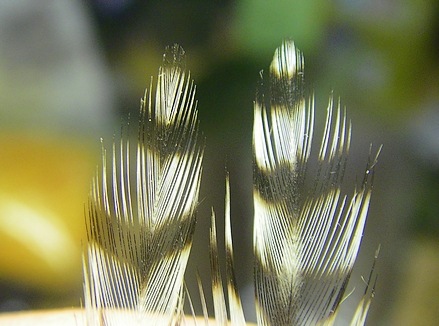
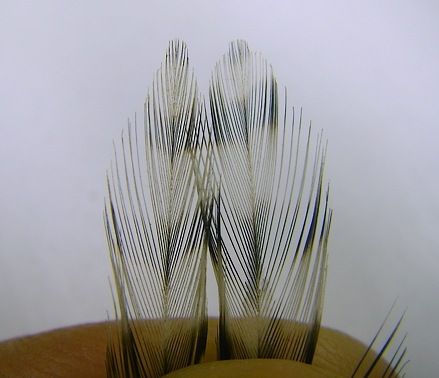
It’s like mascara, color can enhance and detract

My first commercial order was for two dozen Adams. I was 16 at the time, and quality control was letting the glue dry and giving it a couple of half hearted tugs – followed by a rigorous review of proportions.

By the time I’d completed 24 flies that passed muster I’d actually tied about 60 – and suffering through 60 flies of the same size and pattern was pure torture to a fellow that tied something different everytime he sat down.

It would be the better part of a decade before I could face the Adams without cringing, which is why the Mosquito figured so prominently in my angling development.

Hackle tip wings were my undoing. Grizzly specifically, and the lessons learned on that first order apply to the many flies since. Thousands of patterns pair materials for wings, cheeks, or body components – and attention has to be paid to the coloration of the pair chosen, as their mottling and coloration can make a perfect fly look less so.

Color can visually deceive the eye into thinking your proportions are wrong.

A bad pair for an Adams wing

The above picture shows us a “bad pairing.” The hackles themselves are fine – their coloration is good, but using the above pair will make the fly’s left wing appear shorter than the right.

It’s the tips of the feather that cause the issue. The left feather is tipped in black, the right feather is tipped in white; using the two together will make the left wing appear shorter. Add in the hackle in front of the wings – a mixture of brown and grizzly that will bust up the barring of the wing segments and exaggerate the color difference further.

Proper pairing

Here’s another pairing that will eliminate this simple problem. This “right” feather was next to the other “righty” above, yet has a black tip. Note how the bars are matched exactly with the left feather. This pairing will yield an Adams where the colors don’t upset the balance.

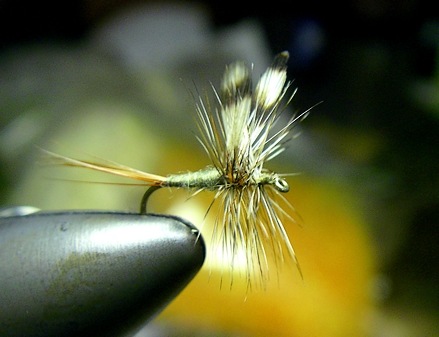
Side View of the finished Adams

From the quarter view above, nothing really looks amiss. Wings are cocked and extend above the hackle, both look equal length, and proportions look solid.

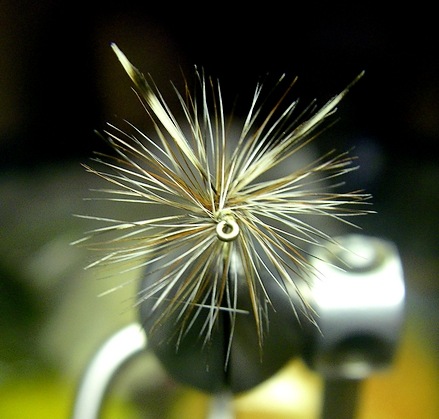
Front view of the poor feather pairing

Here is where the problem displays itself nicely. The black tipped wing (right) vanishes leaving only the last white segment visible. The white tipped wing (left) is strident and obvious, making the left look much too short.

Color. Normally it’s your friend but occasionally it can diminish or enhance a feature and throw your nicely tied fly into a tizzy. It’s the last thing to check before wrenching those precious hackles off the hide.

Tags: Adams, dry fly wing, grizzly hackle, fly tying tips, dry fly proportion, Mosquito,

The skies parted, the gods smiled, and you …

Finally, you meet a Supermodel

Now what are you quibbling about? You get her name and number – and that of her legal counsel, guaranteed.

… you thought it was going to happen differently. Some sultry pose, and a husky voiced welcome from a sunny and secluded spot on the bank.

Nope. She was jacked into her IPod and stood up to remove her top, when you … crashed and burned.

Tags: Fishing Supermodel Fantasy, Fishing fairytale, optimistic anglers, IPod,

The next Great Fingernail Removal System

My lampooning of dry fly fishermen is well documented, so I thought I’d take my comeuppance like a Man…

I’ve got a half dozen experimental colors of “Dubbing X” made, about an ounce of each, all hand made at the cost of most of my fingernails, lots of swearing, and the skin of both forefingers…

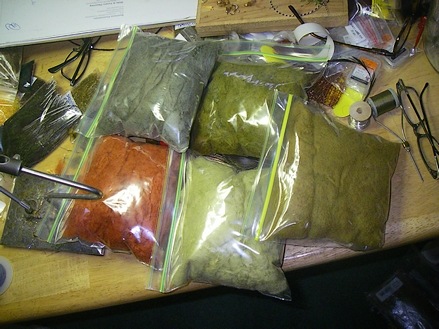
Dubbing "X"

A medium gray (Adam’s), a Blue Wing Olive, Pale Morning Dun, Upper Sacramento Pink, and an Ocher. The above are the California colors for those insects and may not be correct for your local watershed.

An “accidental color” is one that occurs while learning an unfamiliar dye process, where you’ve written the material off thinking nothing good could come of it – didn’t write down the formula, so you can’t reliably make it again … and it turned out pretty darn good – which was a complete shock.

… and then you destroy both fingernails and flesh in a series of ill advised attempts to render it to base fur before finding some process that partially works.

I could use a little feedback on the next Great Dry Fly Dubbing, drop me a note and I’ll toss some in the mail.

This is only for dry fly use. The material floats without assistance (specific gravity less than 1), and is a micro-filament – or “Nano-dubbing” as OldTrout58 calls it.

… while supplies last – I’ll need time to regrow some fingernails before the next batch.

Tags: Dubbing X, dry fly dubbing, Blue Wing Olive, gray, Pale Morning Dun, fly tying materials, Upper Sacramento pink,

I’m not sure I have to rattle anything

Truer words were never spoken Dear Older Bro,

You’ve been quiet of late which means you’ve found the joke gift that will enrage me – while you scuttle behind the Christmas tree and Ma’s protective skirts – making funny faces over her shoulder, knowing I can’t take a swing at you ‘cause Ma would be disappointed and knock us both senseless.

I’ve got a couple of brain cells left – perhaps more’n you – and have already guessed what deviltry you’re up to ….

In your glee at finding the gift that settles scores for the Simm’s floatation vest I gave you last year … the one whose bladder was filled with QuikDri concrete powder – that you managed to wriggle free from before your oxygen ran out … which I can’t believe you’re still holding against me, as any Captain worth his salt goes down with his ship …

… might I remind you that this gift is only effective if I see it – not wear it. Don’t buy the extra-large in Black for me to wear – rather the medium in Pink is more appropriate. In this manner Sweetpea will immediately claim “it’s the height of fashion pajamas” and will parade herself around with message displayed prominently until it’s nearly threadbare.

As Ma might read this, which is likely as the “hit counter” now stands at “two” – I’ll save all them sincere emotions for when Ma ain’t looking…

Your vengeful adoring Younger Brother.

Tags: QuikDri cement, demotivators.com, Simm’s floatation vest, Christmas

The Mayfly that moves mountains

FireDownBelow I’m the doubting kind and figure insects had nothing to do with it.
The truth is the EPA was so afraid that Steven Seagal would portray another of their employees – by filming a sequel to his “one line of speech then look angry “ 1997 action epic, that they’re about to deny access to 3 Billion dollars worth of Coal.

The mayfly, so irresistible to trout that anglers use it for bait and model lures after it, may become Appalachia’s spotted owl. Efforts to save old-growth forests in the Pacific Northwest, where the owls nest, led to federal protection in 1990 that restricted logging.

Mountaintop mining produces millions of tons of crushed shale and sandstone dumped in valleys and streams. Rainwater flowing though the debris carries dissolved metals into waters below, a lethal stew for mayflies, the EPA says.

Southern California thwarted by Delta Smelt, and the savior of Virginia trout a lowly mayfly?

Does size matter?

It appears so. Humans growing unsightly tumors or expiring prematurely doesn’t appear to concern our respective legislatures – we’re big enough to move if we don’t like it. Affect something small and defenseless – and get the full wrath of the Federal government on your head …

Perhaps our conservation organizations might want to rethink their game plan. Instead of defending trout, which are far too big and taste good, defend some tiny family of Caddisfly – one that’s hardly visible and largely unpronounceable…

… and then we can act surprised when the trout are the incidental beneficiary.

Tags: Virginia coal mines, mayfly, Steven seagal, EPA, Delta Smelt, old growth forests, spotted owl, trout protection, size matters

Steely resolve in the face of the Perfect Feather

Per request I’ll continue to post additional fly beautification tips in a weekly format. These will comprise hardscrabble lessons learned somewhere after beginner and before complete mastery.

Most tiers that tiptoe around the craft use their fishing instincts when no instructor or book is available. Most of us started as dry fly fishermen and it’s not surprising that most new fly tiers attempt the dry fly more often than nymphs.

… which is too bad. Tying nymphs is far more forgiving than the delicate and strictly proportioned Catskill dry. A novice tier can hold up some lumpy looking stonefly and if critiqued can respond with “ … well, all the stoneflies in _____ Creek are fat.”

… and if I had been the unfortunate to task the fellow – I’d blush like hell and backpedal in a hurry – never having fished over “fatty” Plecoptera …

The Catskill dry is completely unforgiving. It’s territory and techniques have been practiced for more than a hundred years – and artistic license must be defended, even for expert tiers.

One of those oft-mentioned-quickly-forgotten principles is made more difficult in the presence of the Perfect Feather …

Beware the Perfect Feather

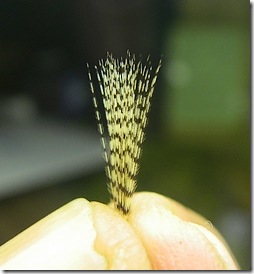
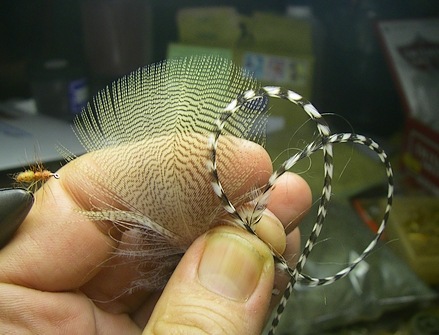
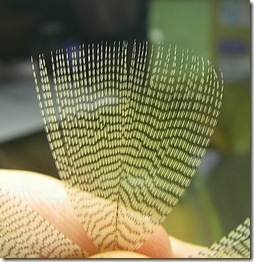
Above are two examples of the Perfect Feather; a foot long #16 grizzly saddle hackle, and a well marked (lefty) Wood duck flank feather with perfect tips. Both are treated with awe by the owning fly tier – and both can cause your fly to suffer cruelly if you’re not diligent…

Wooduck flank prepped

You’re a kid in a candy store, all those precious tips are in a straight line and unbroken. Giddy, you fail to clip the center stem because it’s perfect too.

You forgot that all feathers are either a left or a right, even foot long saddles and untouched Wood duck flank.

The wood duck will be your undoing twice. In the first case the stem will cock one wing to the left, and in the second, the stem center will retain 9 or 10 fibers attached and you’ll have to compensate by yanking fibers from the far wing to the near side to equalize that natural bulk.

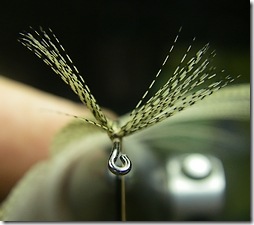
Stem does not appear to affect the wing, everything is straight

The picture at right shows the Perfect feather now clumped together with the center stem included. Note how all’s well – there’s no clue that anything is other than perfectly straight.

You’re thinking of dumping all your “lemon-dyed mallard” – as the sight of the wood duck with its pristine coloration, fine markings, and perfect tips – make it so much more pleasurable to work with – even justifying the hideous cost to lay in a goodly supply.

Unfortunately like Ulysses and the Sirens – their song is so beautiful, you’re ignoring the approaching rocks …

Now you're undone

Now you can see why you remove the center stem. The left side is thin and has a different angle than the right wing.

The cause is simple. You had to pull the loose fibers over to the right side to balance the two clumps – leaving the left, just the stem section. It’s thin because the fibers are attached to the center spine and have no “give” to move around.

We were lured onto those rocks consciously …

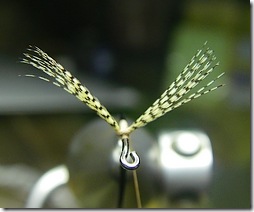
Same clump stem removed

The picture at right shows the same wing as before. I’ve removed the wing from the shank, clipped out the center stem and retied it back on.

Note the difference with the picture above. the left wing is  relaxed, the right wing is less dense and tighter – as you didn’t have to pull everything to that side to compensate for the stem on the left.

That foot-long Grizzly saddle is just as bad. You’re used to applying six or eight turns of hackle to your dry flies, but the lure of virtually unlimited hackle means you add four or five extra wraps and crowd the head. Crowding means fibers trapped in the knot that’ll wick the head cement right into the eye.

It’s the lure of the Perfect Feather. You won’t find it mentioned in any tome or DVD, and only your steely resolve to overcome it’s sweet song …

Tags: wood duck flank, grizzly saddle, upright and divided wing, center stem, lure of the Perfect Feather, steely resolve, fly tying

Perhaps we can covet an invasive enroute to exploiting it

rasberrycraz Screw the gnashing of teeth, mock concern, and “woe is me” populist reaction, we’re being assaulted by air, land, and sea – and it’s about time we exploited the little SOB’s …

… and it could be my new-found bravado comes from the quarter-pound of the perfectly colored dubbing dyed this weekend using leftover cranberry sauce and rust Tintex. I call it “Upper Sacramento Pink” – which I may rethink in light of this burgeoning commercial opportunity.

Think “Rasberry Pink” – the new hotness …

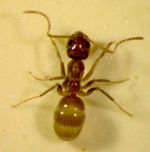
It’s the latest import into the South compliments of container ships in the Gulf of Mexico. The “Rasberry Ant” which goes through stinging Fire Ants akin to crap through a goose, eats bees, and anything else that it doesn’t like.

This is a species that we do not know much about. Presumably the ant came from the Caribbean through the Port of Houston,” Cook said. “We know the ant is in the Paratrechina genus and is capable of growing a population of billions and they need to eat. They especially like other bugs, like fire ants and honey bees.”

We’ve never shirked from the addition of more Latin in our cocktail conversations, and you can be sure we’ll be singing Mr. Rasberry’s praises once we land a couple dozen fish.

It’s about time we got a robust invasive that offered to improve the fishing rather than coat rocks with slime, mucous, or snail tracks.

The Port Houston McGinty

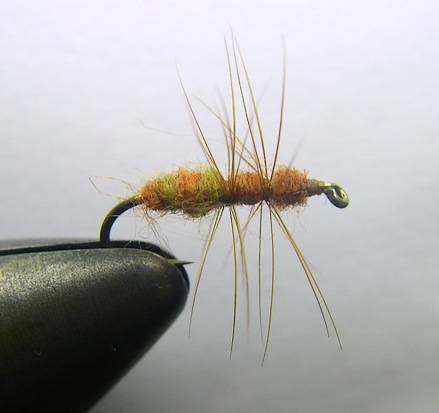
Meet the “Port Houston McGinty”

Washing waders may be the height of manliness for some, but I’d rather giggle while watching hordes of voracious trout food spill over the creek banks – sending the available fish into a bloody feeding frenzy…

Tags: Rasberry ant, invasive terrestrials, trout food, fire ants, ant pattern,

A Fly Tying Thanksgiving

The old days of lopping the head off a gobbler in your backyard are antiquity. Gentrification assured by CC & R’s that prevent live poultry on your acreage and expressly prohibits the stalking and slaying of same.

“Green” got the better of me, and I circumvented emasculating rules by getting most of a bumper and part of a steel belted radial on a goodly sized hen just down the road from my house.

Which makes me question whether there isn’t an innate conflict of interest for us Renaissance Men that’s triggered by the holiday and ensuing food debauch…

As “Chief Cook and Bottle-washer” I enjoy rarified standing among the drunken participants. The sumptuous sprawl of Turkey and fixings being my responsibility – while others tip-toe around my frantic boiling and chopping and fetch beer.

As “Resident fly tyer Extraordinaire” – I resent the imposition of a crowd of fat-arsed layabouts whose sole responsibility is to swill my liquor, contribute to global warming and get to watch football – something I’m denied by Role #1 above.

Cooking ritual is a complete mystery to the couch crowd – who are oblivious to culinary detail, and are making a comfortable dent in furniture yelling at some awesome play I missed while sweating over the hot stove.

“Dude, Bro … you look kind of hot in that apron.”

Like the millions of other cooks I’m short of pots early on – and forced to boil the neck and gizzards in pink fiber-reactive dye. With only four burners, a turkey, seven other side dishes, and a couple pounds of fur to color, expediency is the hallmark of the Great Chefs of Fly Tying.

… whose dual roles often conflict with one another, adding complexity to the proceedings.

The real trick is pairing natural foods and the colors that won’t leave incriminating evidence. “Fiber-Reactive” dye will only stain plant fiber and cannot be used with Brussel Sprouts, Yams, or Sweet ‘Tater – and “Acid” dyes stain protein so avoid Turkey, gravy, or stuffing.

…stuffing is best cooked conventionally as all the best recipes contain both meat and plant components.

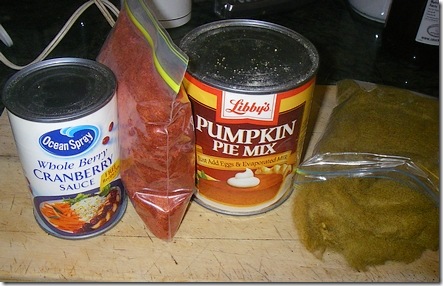
Pick complimentary colors if you're short on pots

Pots and burners are in short supply and it’s important to pick complimentary colors so you don’t let an oversight give artistry away. Olive Pumpkin pie is an eye-opener … but Ocher is merely “too much cinnamon.”

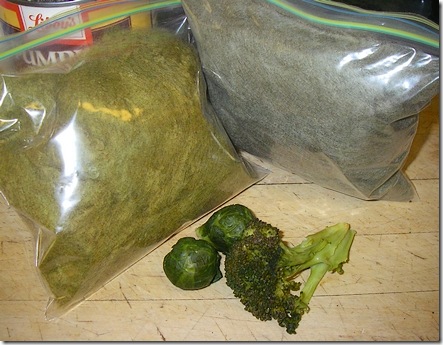
Brussel Sprouts paired with Blue Wing Olive

My family’s ancestral recipes include Broccoli ala Blue Wing Olive, and for that important “been in the refrigerator overnight” look – a good neutral gray is tough to beat.

Keep in mind that RIT uses huge amounts of salt as fixative. If you’re boiling or steaming either plant or meat protein, no additional seasoning is warranted.

By my quick count there are nearly 11,300 patterns that use turkey feathers in all or part of their dressing, it seems a shame that we don’t leave the feathers on the bird, drop it into a oak dye bath and give both feathers and skin that warm, fresh-roasted coloration.

… it’ll guarantee enough dark meat for everyone.

Tags: Thanksgiving, fly tying humor, dyeing materials, acid dye, fiber reactive dye, steel belted radial season, Walmart, Black Friday shoppers, fly fishing

In time for the holidays, Tough As Nails Barbie

While the rest of you are droning on about weights and tapers, modulus and action, I’ll be downstream ….

… just me and my Blue Water Barbie.

Via John Merwin and his Honest Angler blog, comes an eye opening video of a fellow catching a 100 pound blue shark on bright pink Barbie rod, complete with closed face spinning reel – and the precision drag system that makes some classic metal chunking sounds…

We’re always insisting that fly tackle offers the best “feel” of a fighting fish – but I’m not sure our rods can bend like Old Barbster.

I about died laughing, as did the assembled crew.


I’ve got one of these hanging proudly over the mantle, compliments of older brother and his misguided humor.

Now who has the last laugh?

Tags: Field & Stream, John Merwin, Barbie Rod, Blue Shark,