Author Archives: KBarton10

Thirty five Chickens or a couple boxes of stale Ho-Ho’s

Breakfast will be a bit of a liability, but I can just point out the cars in the parking lot with coolers.  While he’s separating the body and chassis by way of the ripped off door, I’ll be cleaning my fingernails and keeping an eye out for cops. “Big Fluffy” as a sidekick kind of opens the field a bit allowing me to ignore most human niceties, fishing regulations, trespassing issues, and neatly guarantees my solitude in your riffle.

Brutus the grizzly bear enjoys his 25,000-calorie breakfast — 35 pounds of treats such as raw chickens or carrot cake — but when his human best friend, naturalist Casey Anderson, presents him with a fresh, flopping fish, Brutus is confused and uninterested.  Raised by Casey from birth, Brutus is used to having his food delivered.  Now, Casey sets off on an adventure to the Alaska wilderness to observe Brutus’ grizzly cousins salmon fishing, hoping to gain new insight into their technique and teach it to his six-foot, 800-pound, furry friend.

http://channel.

I want this guy’s job …

Once “Pooh Bear” and me shoulder through the remnants of the fly shop’s door jamb, I’d mention, to no one at large, “Brutus needs to learn to fish, I’ll take that Scott, two of those Sage’s, the zipper-front Simms, and a handful of those Bogdans in the display case – all on the house, right?”

… and if some fellow feeling plucky so much as trembles a lower lip, I’ll point and tell my furry pal, “Look BooBoo, it’s a talking Twinkie!” They don’t have to know that “Fleabit” only kills for red licorice – and they can find that out in syndication…

Then we get helicoptered into some serious pristine, and as I gear up – I’ll glance at the competition and tell Brutus, “clear the riffle …” The salmon and steelhead will be running – as will all the guides, nature lovers, and sleepy-eyed fellows that got there at the crack of dawn.

Any handler worth his salt recognizes there’s no need for a magnum sidearm, all that’s required to immobilize a hungry, charging bear is a theater sized Ju-Ju-Bee’s.

Tags: National Geographic channel, teach a bear to fish, salmon, grizzly bear, Bogdan, Scott, sage, simm’s, Casey Anderson

Thirty Six miles of Maybe

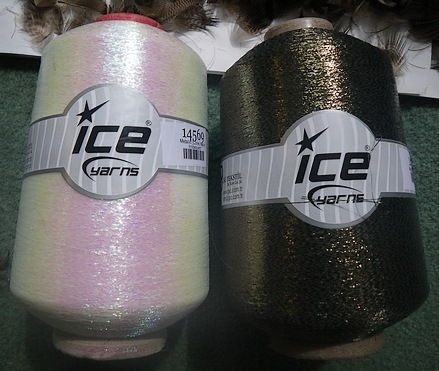
Sure I was moving a little fast for my own good, but I was convinced I’d discovered the Holy Grail of Cloisonné (klaus-un-nay), that multifilament braided mylar tinsel we’ve adopted for steelhead flies. It is great stuff, available in silver and gold, never tarnishes and was a fly tier’s dream compared to all the thread-cored mylar tinsels of recent manufacture.

My $39.95 covered a lifetime supply plus postage from Asia.

… Oh, it’s a lifetime supply sure enough, only I missed the yarn sizing and wound up with 45000 yards each of Dark Olive and Pearlescent superfine tinsel-thread

Imagination meets Desperation, the one pounder

… that’s eighteen miles of each color.

Now I’ve got to figure something that uses a ^%$# ton of it.

It runs contrary to my ethics to invent a couple dozen patented killers, then claim how much of a favor I’m doing you by selling you some teensy dust mote of the stuff … the fly shops have plowed that ground thoroughly.

But it does represent the last unspeakable variant of fly tying creativity, the collision of Imagination and Desperation. Us “scroungers” have been here many times and can only be thankful it’s not a full Bull Elk hide dripping in my driveway.

It’s too wide and breaks too easily to use as thread, but it would lend itself to being doubled over and used to replace all the other pearlescent components we’ve accumulated over the last couple of years. I could make a spun round tinsel, shellbacks for nymphs, wingcases, Easter basket dressing …

DkOlive_Tinsel

… or I could tie the entire blessed imitation out of the stuff and hope for the best.

It’s dry, doesn’t stink, and can be stashed away from prying feminine eyes eager to pounce on my mistakes (after the obligatory lecture or two).

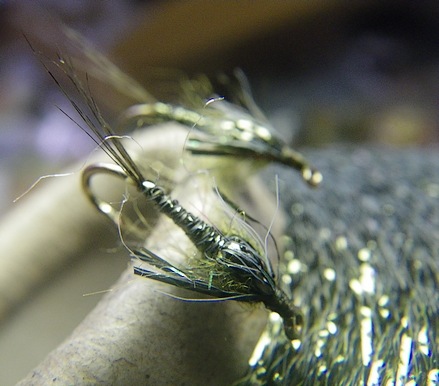
Trout flies come to mind and I managed to burn a foot building the little mayfly nymph above … 149,000 more and I’ll wish I’d bought two cones instead of the single …

I prefer the term unrepentant – society locks up those other fellows.

Tags: mylar thread, bulk fly tying materials, ice yarns, Turkey, mayfly nymph, Cloisonné, tinsel, fly tying

What sins are hidden away in your life list?

I'm apologizing to It! I ate everything I ever kept in saltwater, even when I found out that Rainbow Perch was most plentiful around the sewage outlets in San Francisco Bay.

They were plentiful and I was determined to exploit them, never thinking about the estrogen and grey water, and had I known it wouldn’t have mattered – Big City girls thought fish were born in Saran wrap and got the price sticker in adulthood, I was on the outs with the cheerleaders already.

I ate everything I ever kept in freshwater too – except for that Largemouth Bass from Lake Merced. I’d commissioned a couple of ne’er-do-wells to row me around the gray-green water while I flung a monstrous Purple spinnerbait. That snag turned out to be a six pound largemouth, and my youthful delight at confirming the Loch Ness monster of the lower lake tempted me to keep it.

Pop made tracings of the corpse and Ma dutifully cooked it, but nothing could make the jaw move after the first forkful entered. It was if you’d licked the glass of an aquarium …

… completely committed, like one of Ma’s chocolate icing spoons.

Now that the Winnemem Wintu tribal dancers are enroute to New Zealand to apologize to the salmon, in hopes of restoring them to California, a fellow has to look at the carnage and snelled hooks in his wake to see whether apologies are in order.

In a lifetime of fishing I’ve never toed my opponent into the brush, never tossed a stringer full of sunwarmed fish back into the depths, nor mutilated or mangled the vanquished for my amusement or for those with me. I’ve killed plenty, but made it as quick and painless as possible.

One moment of weakness on my sixteenth birthday, where I told Pop I could pass for fifteen for a couple years more, and his ethics made my path plain, “you’re the biggest fishkillingest SOB in the family, and you’ll buy a license like everyone else.”

There is one sodden red check mark near the blank pages yet to be written. I made sport of a Fillet O’ Fish, took it’s name in vain, and sprayed it across Ronald McDonald’s midsection enroute to the trash …

It’s not sport unless you can see your quarry’s eyes – and while I’m sure there are dozens of pairs within that ground, unnaturally pasty flesh, our meeting was chance – and not on the field of battle.

I’ll apologize to it them – when Ronald McDonald apologizes to me.

Tags: Ronald McDonald, Fillet O’ Fish, Winnemem Wintu, apologize to salmon, fishing humor, rainbow perch, San Francisco bay, big city girls, fishing, Saranwrap

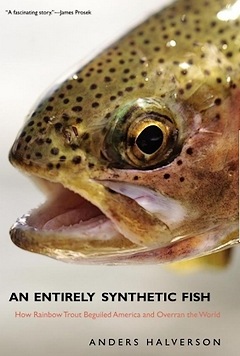
A Entirely Synthetic Fish, a book by Anders Halvorsen

An entirely synthetic fish The true game-fish, of which the trout and salmon are frequently the types, inhabit the fairest regions of nature’s beautiful domain. They drink only from the purest fountains, and subsist upon the choicest food their pellucid streams supply … [It] is self-evident that no fish which inhabit foul or sluggish waters can be ‘game-fish’.’ It is impossible from the very circumstances of their surroundings and associations. They may flash with tinsel and tawdry attire; they may strike with the brute force of a blacksmith, or exhibit the dexterity of a prize fighter, but their low breeding and vulgar manner of eating, betray their grossness.”

“An Entirely Synthetic Fish” is not a fishing book, rather it’s the chronology of the foibles, accidents, egos, and planned strategies that resulted in the Rainbow being the trout of choice for the Americas. It’s a surprisingly good yarn written deftly by Anders Halvorsen, (Yale, Ph.D Ecology), who has gathered together the milestones, personalities, and the ramifications of wadding an increasingly foreign species into every body of water conceivable.

One simple question sealed the fate of trout fishing the world over…

An eastern fellow steps off the stage in San Francisco, straightens his bowler and says, “where’s the salmon at?” – and via the miracle of a desolate stretch of the McCloud and assisted by the transcontinental railroad, the McCloud River Rainbow became the savior of the east coast and the known world.

… at the expense of everything that was living there already.

It was nip and tuck which would inherit, fish cultivation was in its infancy, with most of the eastern fish hatcheries owned by hobbyists or were for-profit, merely raising the Eastern Brook Trout for later sale at market.

The Good Old Days weren’t … and the East Coast was faced with increased pollution as a result of a burgeoning population. Many of the eastern watersheds died horribly, with the Atlantic Salmon the first to go. In an effort to restore their numbers an embassy was sent to the west coast to bring salmon back to raise and release in eastern rivers.

The McCloud river obliged them and the hatchery created there sent Pacific Salmon eggs packed in moss, whose fry were dutifully released – never to be heard from again. The salmon transplant may have been an abject failure, but the feisty nature of the McCloud River Rainbow was duly noticed.

The author warns us about our continued reliance on the planting of a single species, and how desirable characteristics of the Rainbow, its ability to thrive in warmer water, and willingness to eat artificials, set the stage for massive fisheries collapse when they’re exposed to an invasive or even domestic pest.

Like Whirling Disease – which the Eastern Brook and Brown trout can survive – but decimates the Rainbow trout as it’s especially vulnerable. The narrative of how Colorado infected 13 of its 15 watersheds by accidentally, then intentionally, planting Whirling Disease infected Rainbow trout being moot evidence.

“It was not until 2003, in the face of overwhelming evidence, and after spending well over $10 million to decontaminate only some of its facilities, that Colorado finally stopped stocking fish from hatcheries infected by the M. cerebalis parasite. By that time, though, it was too late. The disease had established itself in the wild, and the department’s policy of stocking diseased fish , Nehring later declared, was the primary cause.”

Whirling disease has been a hot topic of late, troublesome because of the thirty year lifespan of spores in stream sediment, and one of the Big Three invasives that conservation organizations have blamed on us anglers.

Trout planting and quality watershed are synonymous in hatchery circles, and the introduction of invasives as well as hatchery trout have had a profound effect in many states, not just Montana and Colorado. The story of hatchery induced plague is one of many ignored by the conservation literature, as was Colorado’s solution; adopting the “Hofer” strain Rainbow for production, a rainbow trout developed in Germany that is entirely proof against Whirling Disease.

In contrast, Montana fisheries were handled differently. The introduction of rainbows destroyed the indigenous populations of trout, and when Whirling disease followed on the Madison they ceased trout plants entirely, allowing the Brown trout to encroach on the much reduced and ailing population of rainbows, and waiting out the collapse with an eye towards Mother Nature. Which obliged them with a whirling disease resistant strain of Madison River rainbow trout that developed on its own.

… as it had in other states, and with as much mystery.

“But when I asked Vincent what Montana planned to do about the disease and specifically whether there were any plans to introduce resistant fish, as Colorado had done, he demurred. ‘I’m a little reluctant to just start whaling around out there, personally,’ he admitted. “’I’m somewhat leery  that it may backfire on us.’ “

It’s as much a tale of the men behind the fish as it is of the fish itself, which allows the book to be part narrative, part science, part history, and an engaging and fun read, especially the sections on WWII bomber pilots and the first attempts at aerial stocking.

But I’ll leave all the really tasty tidbits for you to learn, like how the Rainbow trout is intertwined with the Charge of the Light Brigade and how it was the popular choice to restore America’s flagging manhood.

“Put and Take” still weighs heavy in the mind of Fish and Game officials and most states manage their fisheries to suit the need of the casual angler:

“Take, for example , a sunny Sunday morning in May. Mr. Los Angeles looks out of his window and for no good reason at all discovers that there has been a cloudburst  on the desert the night before and there is water in the Los Angeles River. By 9:30 o’clock, 20,000 telephone calls have come to the Fish and Game Commission to come out and plant some fish because there is water in the Los Angeles River. Since we have one of the most efficient departments in the country, by 10 o’clock a truckload has started out. We carry a siren on the trucks, by which , at the end of planting, we let everybody know that the planting has been accomplished. By 11 o’clock the fish are caught out of the stream, and at noon the river has dried up again!”

It marks the current state of fisheries management whose early beginnings were about establishing viable colonies of fish, and have degenerated to emphasize “catchables.”

… and we love ‘em, or so the government thinks.

Every dollar spent growing and stocking Rainbow trout resulted in thirty-two dollars of economic activity through everything from worm sales to airplane fees.”

Success and failure in fisheries management is tied to many of the unique tenets we’ve always associated with fly fishing. While eager to claim our efforts as a causal agent, many of the unique regulations stem from failures in management, and how we capitalized on some inadvertent or timely trauma. A watershed whose fish collapse due to disease makes a reduced bag limit feasible, and sick fish are undesirable as table fare, and can be caught and released without the drama of declaring a river so by regulation.

I found the book alternately encouraging and fraught with despair. It’s plain we’ve learned nothing in a couple hundred years regarding tinkering with native species and the “put and take” notion of modern fisheries management – but it’s also encouraging that we’ve faced these same problems many times – and despite the state of our modern fisheries and their continued decline, a body of work remains that may assist us in pulling some back from the brink.

Full Disclosure: I purchased this book from Amazon.com for its suggested retail price ($17.16)

Tags: An Entirely Synthetic Fish, rainbow trout, McCloud river rainbow, whirling disease, brown trout, hofer rainbow, Atlantic salmon, McCloud river, pacific salmon, Anders Halvorsen
Based on the grin alone, it’s fly fishing

I got the message The myth has it patrolled ruthlessly by a grizzled fellow in overalls whose well oiled Blunderbuss is flanked by aimlessly scratching hounds – who are wary of his large plug of chaw – which is spat indiscriminately at dogs, feet, and anything else that ain’t nailed down.
Last week while surveying the fishless Little Stinking, Travelwriter let it drop that down the road from his vast holdings, existed a farm pond where huge fish porpoised lazily in pursuit of flies. As these were few and far between – amused themselves by eating ducks in between chewing on rubber tires and the shattered remnants of rowboats, the only trace of the fellows that tried it last year, all of whom are still missing.

I’d had to pause in our casting lesson and deliver a stern admonishment, “firstly, a farm pond is a sacred thing, it could be the greatest fishing ever experienced by mortal man, or it could well be lifeless. Secondly, you’ve mastered the Third Law of Fly fishing – the casual private property name droppage, followed by the offhand mention of a white whale, or reasonable facsimile.”

“But you’ve got to learn to cast more than seventeen feet, Grasshopper – try to use less toes on your next forward cast …”

I’ve never met a pond I didn’t like, especially when trying to teach some fellow the rudiments of fly casting. I was hoping it would be full of starving stunted fish that gave no quarter and asked for none.

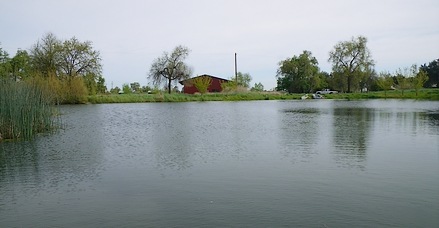
The fabled "Pond X"

Weed lined, perhaps a little over an acre in size, and 10 feet deep and the center … owning a flair for the dramatic she was dubbed, “Pond X.”

Travelwriter and I wandered around the edge tossing different colors of the Little Stinking Olive, which were received warmly – by small bass and bluegill.

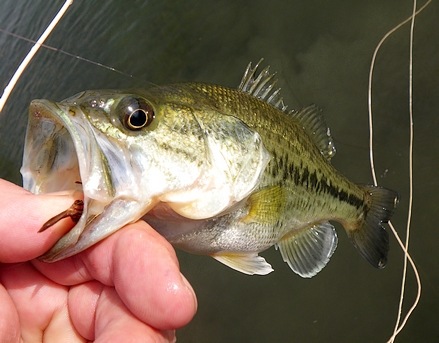
With the blackest lateral line I've seen

… which owned the blackest, most vivid lateral line I’ve seen. The fish were in wonderful shape and most were under a pound. The owner had mentioned much larger fish present – but it was a blustery day, and a bit early yet. The spawn will be starting soon, no redds were yet visible and I assumed most of the fish were hanging in the deeper water, still a bit lethargic.

“ I see a fish … I see a fish, he’s right out from me”, came the wail from the tules behind me. Travelwriter was dancing with excitement, unsure what to do while pointing his rod at the offending beast. I says, “good, now catch the damn thing.”

“I got a fish, I GOT a fish” was the response. Naturally I dropped everything to immortalize the moment, “ … he was right out from me so I dropped the fly in the water and jiggled it … he ATE it … is that fly fishing?”

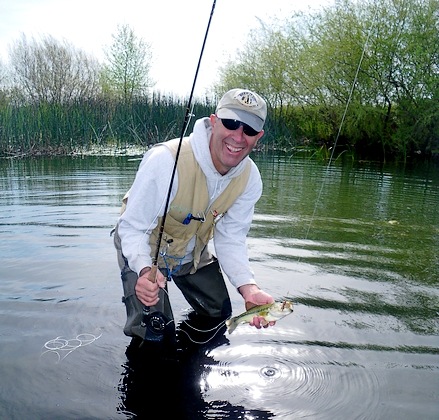
TravelWriter busts a cap on the Bass

I didn’t have the heart to tell him about all of the sins committed under the guise of fly fishing; how throwing the rod, rocks, or merely diving in with a loincloth and Buck knife could be loosely construed as same…

travel_victim2 “… now we’ve got to work on the pose, Grasshopper. That ain’t a Burrito, and your quarry is deserved of a little dignity, so hold it right side up, and give me a grimace … stretch them arms toward me to magnify …wipe that grin off your face … Oh, hell, we’ll work on the pinup later.”

“Grab that roach clip off’n your vest and see if you can’t remove that barbless hook without half the gills coming with it.”

Hell yes, based on the size of that grin, it’s fly fishing.

Tags: A Wannabe Travelwriter, farm pond, largemouth Black Bass, fly fishing, fly fishing humor, little stinking olive, bluegill,

North, East, and South, but the West side is dead

NOAA crest Just finished a deep scan of the 293 page California Draft Recovery Plan for Chinook salmon and Central Valley steelhead (9MB’s PDF), and I’ll admit to being a bit disappointed. Not so much the scope and cost as their reliance on dam modifications for the existing pristine – versus recovery of any ancestral haunts.
The Central Valley ends at Thomes Creek (near Anderson, CA) and doesn’t start until Sacramento and the American River – with everything on the west side written off as dead water.

It would have been great to see some of the local watersheds reborn. There’s still a salmon run in Putah Creek during wet years, and if they can survive it suggests that a steelhead or two may wander upriver as well.

In summary, it appears easier to build a peripheral canal and appeal to the benevolence of the Feds than it is to strike a balance with agribusiness and attempt consensus on the reallocation sacred cow.

Disappointment stems from the cost, 10 Billion – which will prove woefully inadequate in light of the required time, nearly 50 years. While recent economic upheaval has broached the trillion word and takes the fear out of mere billions, none of us will be around to enjoy any resurgence in gamefish or will be able to wade after the sparkling horde that may result.

Tags: California Draft Recovery Plan for Salmon, Thomes Creek, Putah Creek, California steelhead, peripheral canal, water reallocation

It could be the “Switch” rod what done it

Pink_Camo It could be a California angling phenomenon, but I see more guys wearing pink than girls.

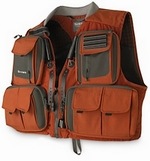
… and while fly line color continues to be debated with great ferocity in the forums, the  SIMM’s G3 Guide vest in rust orange debuted with hardly a murmur…

Now that embedded jungle cock and spray of gaily colored feathers adorn our rod blanks ( along with a pancake layer of thick epoxy to guarantee a dead spot ) and brightly colored Fisher-Price artwork emblazon our reels, have we given up the stalk and seduction of fish in favor of a clandestine fling with a brother angler of like mind?

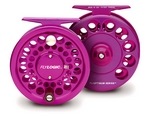
G3Guide Orange Flylogic Berry It could be the water, lord knows we’ve listed the offending hormones often enough, and what’s not been specifically mentioned can be inferred – but all this bawdy-house gear bespeaks of a fundamental shift in the angling psyche.
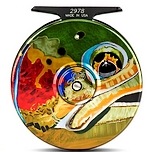
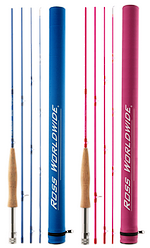
The old military gear, the olive drab’s and mustard Flecktarn, the muted earth tones designed to blend with bush or bank, the painstakingly crafted digital camouflage, all discarded in a race to announce your presence to the fish with authority.

De Young Series, Abel Automatics

It could be that the majority of the better streams have enough neon motel signs, fast food restaurants, and traffic lights on their banks that pine trees are outnumbered. The big fish lying doggo in Taco Bell’s riffle could associate bright with inanimate, and all the mobile green-stuff is markedly out of place and therefore hostile…

As the magazines and books probe fish vision further – alerting us to every nuance and twice for shortcomings, we change our flies to match ROSS Journey Fly Rod then storm through the quiet water like Liberace?

Be it fish, fowl, mammal, or human, the sacred tenet of Biology has always insisted the male displays bright colors to attract a mate. Which explains why money is green and credit cards are mostly in the vivid spectrum, red or blue, containing holograms or opalescence.

Fish are promiscuous – yet relationships rarely last past hook removal, so all this grandiose finery can’t be for their benefit, it’s apparently something deeper that is opaque to us  odiferous Brownline types – yet is all the rage elsewhere.

As a Native Son, I care not about coveted glances or gang sign, I just need to know whether I’m supposed to pick a rod that is compatible with my cheek blush, or whether it’s the hue of my Manscara I need to match.

… the last thing I need is to see a fellow struggling with a tailing loop and offer a bit of friendly advice, and be met with, “STFU NoOb!”

Tags: Ross Journey Youth fly rod, Abel De Young reel, Simm’s G3 Guide vest, Flylogic reel, Sage Pink Camo, camouflage, invisible to fish, digital camouflage, Flecktarn, Fisher-Price toys

That elusive final frontier

You’ve tied your own flies, you make your own leaders and wrapped your own fly rod, and with each minor triumph the crescendo of endorphins ebbs to leave you feeling hollow and incomplete …

It’s primeval biology that’s your nemesis, the inner Hunter-Gatherer is limited to stalking asparagus, armed with a coupon, and under the watchful gaze of the spouse. Completely unsatisfying, nothing screams, nothing bleeds, and outside of the occasional fishing trip – your emasculation is nearly complete.

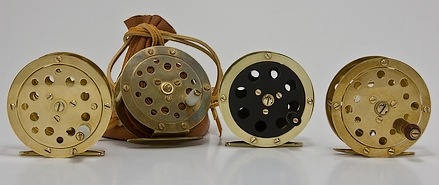
Eclectic_Anger_Reels

Photo Courtesy of the Eclectic Angler

But, perhaps not.

The Eclectic Angler has released his tome on handcrafting fly reels using little other than common hand tools and equipment you’ve got rusting in the garage. Even better, he’ll set you up with all the materials in kit form so you can work up the nerve to crack the book.

The Pfleuger Progress and its progeny was the height of fly fishing technology for decades, now you can craft an updated technological marvel that ensures your bragging rights for years to come.

Extension cord sold separately.

Tags: Michael L.J. Hackney, the Eclectic Angler, brass fly reel, Pfleuger Progress, roll your own, hunter-gatherer, fly fishing reel

A little imagination and a gubernatorial Prius to save the day

Wedged in the lock, problem solved Michigan is all over the news of late, largely because of the Supreme Court’s refusal to hear their case against Asian carp, Illinois and the Port of Chicago. Denied a second time yesterday (without explanation) the Court has one last hearing of the “Chicago Diversion” case in April – which many will say is too late.

“It makes sense for the Supreme Court to appoint a special master who’s an expert on this and have them take a look,” Schreck said. “Otherwise, they’re essentially telling six states to take a hike. I don’t think we’ve seen that very often.”

On other fronts, the first stonefly was discovered in the main branch of the Rouge River (also Michigan) – and Friends of the Rouge immediately claimed water quality improvements had borne fruit…

Both Non-Profits and Politicians are notoriously humorless and instead opted for a mixture of handwringing and elation …

I would have declared the Stonefly an invasive species, immediately requesting a tasty slice of the 78 million in “Obamabux” earmarked for the Great Lakes, dropped some cyclone fence into the water connected to car batteries, then blamed Illinois anglers for importing the sumbitch on felt soles …

The citizenry can rest easy knowing there’s no angler in office, as the result would be a couple of gunboats anchored in the harbor and a brigade of Michigan National Guard relieving the lock operators at sword’s point.

Subterfuge is required, which is why I’d suggest sending a couple of Toyota Prius’s screaming into the drink, neatly preventing the lock’s opening – and while the National Transportation and Safety engineers bickered with Toyota – the Great Lakes would be safe.

…for months.

Tags: Toyota Prius, Michigan National Guard, Asian Carp, Supreme Court, stonefly, Obamabux, Chicago Diversion