Author Archives: KBarton10

Dump the Hodgeman stock and short SIMM’s

Waterproof and breathable is so yesterday, along with all that Extreme you hoped to find. Simm’s will never recover and it seems water repelling rubber soles are the new aesthetic  – with both cleats and felt discarded out of hand.

Likewise for fly rods and Tenkara, as the real aficionados will be touting bare knuckle.

… and for the devout, you’ll have to rework the Jesus legend, as “Ulf” appears to enjoy similar powers …

Those long August afternoons offer ample cross training opportunities, and come the evening hatch you can run right out there with the rest of the throng and grab the fish by the lower lip just as it breaks the surface.

Mayfly? Denied!

Tags: Liquid Mountaineering, walking on water, something to do when fishing sucks,

Yet another pseudonym for our favorite invasive

Once the Madison Ave boys kick the campaign into high gear we’ll all be lining up for “Kentucky Tuna.” They’ll have to pull the White Lightning from school lunches, but what child doesn’t gaze adoringly at his Momma when offered a Tuna sand …

The pearly white flesh – complicated by a series of bones – is described as tasting like a cross between scallops and crabmeat by New Orleans chefs working on possible recipes. 

Granny says you can eat it

It’s our old pal the Asian Carp, canned to soften the bones, dipped in sour mash, relish, and mayo, and regurged onto innocent yet fortified Wonderbread.

“We’re trying to break that mindset, because a lot of people are prejudiced against the name ‘carp,’” said Sid Dasgupta, associate professor and principal investigator in the Division of Aquaculture and Environmental Sciences at KSU.

“This fish is not bad at all – it’s excellent.”

Us anglers are the root cause of all that slander, heaping scorn on anything with an inferior mouth or feelers. Innocent civilians are largely unawares of fish feeding habits and lifestyles until they join the throng heaving sandwich slices at the appreciative Golden Horde.

It’s for the same reason dog has fallen from fashion as restaurant fare, you know what it eats – and what it licks afterwards …

They experimented with the catch, smoking filets, canning the fish to soften the bones, and grinding it into fish cakes, croquets and salad.

True validation, and you know it’s coming, is when McDonald’s replaces the Fillet O’ Fish with our Asian interloper – until then all the blind taste tests and Cajun chefs are blowing hot air.

Yessir, no Dolphins were bycatch from our nets, but the sandwiches do jump around some when a Semi goes by …

Tags: Asian Carp, Fillet O’ Fish, Madison Ave spin, Cajun chef, the Wonderbread Hatch

Why your biggest Shad comes early in the season

It’s the fish you think of on slow days and rekindles flagging interest. It’s the fish that makes up for fussy trout and flies smaller than #20, it’s salve for a season of sunburn and mosquito bites, cures hangovers, and for a couple of too-short months allows us to focus on important fishing principles like spite and revenge.

It’s Alosa sapidissima, the American Shad – and while you may have fished for them hundreds of times, I guarantee you know less about their habits, food preferences, and history – than any of the other gamefish you chase regular.

Why? Simple, it’s a glutton for bright and shiny, shows little selectivity and is available in enormous numbers – so you’ve never had to wrinkle a brow or crack a book to be successful.

I’m the first to admit guilt, having asked the questions of those more experienced – and assumed they spoke gospel. Now with millions of the Silver Horde ascending my rivers, and with the next couple of months devoted to their complete and utter exploitation, I’ve no excuse not to learn more …

“Know thy enemy and know thy self and you will win a hundred battles.”

Much of the research on American Shad are from their native Eastern drainages, and it’s a story that doesn’t match well with what’s been relayed in idle banter on the river bank.

East Coast Shad are distributed as far south as North Carolina, yet multiple genetic strains are responsible. They are an anadromous fish, but in their southern range and warmer water – are like our Pacific salmon, spawning once before dying.

Colder water allows the fish to make the multiple migrations like the steelhead trout, with an average lifespan of about a decade. How long they can survive in the river is dependant on the sex and size of the fish when it enters fresh water, and measuring your local fish can assist in determining how long they’ll be present – and in a condition to eat your fly.

A rough calculation follows (length in mm):

Therefore, the average daily loss in somatic weight of
males was 1.63 g at 359 mm, 9.37 g at 493 mm,
and 5.75 g for mean-sized males of 428 mm. For
females the average daily loss in somatic weight
was 5.75 g at 421 mm, 18.87 g at 531 mm, and
12.47 g for mean-sized females of 477 mm.
Daily weight loss can be used to suggest how
long fish of different sizes can remain in freshwater
before death. The amount of weight loss which
results in death of shad is not known, but death
occurs in many animals when weight loss exceeds
40% (Curtis 1949).

If death occurs at 40% weight loss and it becomes morose and lethargic at about 30%, then a 359mm male (14”) that weighs about a pound, will not be interested in flies in about 82 days. Females lose weight even faster, so if you’re looking for the biggest fish you’ll need to fish almost as soon as they arrive.

… and you thought Science was for eggheads.

Shad feed in fresh water, but as plankton is less available they’ll opportunistically feed on aquatic insects, baitfish, shad eggs, and terrestrials.

Stomachs of fish collected upstream
from Port Jervis, N.Y. (295) in late May and June
frequently contained a few insects. I observed a
large mayfly hatch in late May 1964 near Hancock:
hundreds of adult shad were rising to the
surface, apparently to feed, and the stomachs of
many fish (about 50) captured by angling were
packed with mayflies. Similar surface feeding behavior
was observed on several other occasions,
although fish were not collected to confirm feeding.
Many adults captured during the Tri-State
Surveys contained recently eaten young shad and
shield darters, Percina peltata.

– from Weight loss, Mortality, Feeding, and Duration of Residence of Adult American Shad, Alosa Sapidissma, in Fresh Water – Mark E. Chittenden Jr.
Sacramento_Shad_stomach

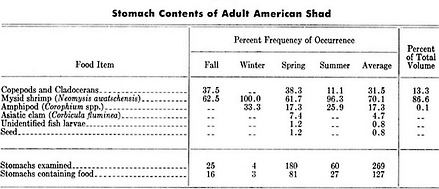
The California Fish & Game department has confirmed Shad feeding in the Sacramento delta, and the results of their trawls of the Sacramento River and Delta are shown above.
A Mycid Shrimp

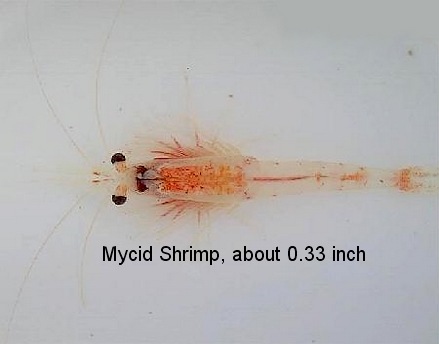
Which suggests there may be a couple of dozen other flies we haven’t considered – and the above lends a little credence to the red/white shad darts that have been effective for decades. Feeding habits are ruled by opportunistic prey and local conditions, and much science cites the link between small shad and terrestrial insects, and in many cases their stomach contents were disproportionately (greater than 20%) comprised of terrestrials.

Most migratory movement within a river system occurs between 9AM and 2PM, with numerous studies describing increased activity during daylight hours – and spawning commencing with dusk:

Females release their eggs close to the water surface to be fertilized by one or several males. Diel patterns of egg release depend upon water turbidity and light intensity. In clear open water, eggs are released and fertilized after sunset (Leim 1924; Whitney 1961), with peak spawning around midnight (Massmann 1952; Miller et al. 1971; 1975). In turbid waters (or on overcast days; Miller et al. 1982), eggs are released and fertilized during the day.

As my beloved American River is choked with spawning Striped Bass at nearly the same time, it’s important to note the tender regard for Shad held by the larger predatory bass:

A recent study strongly supports the hypothesis that striped bass predation on adult American shad in the Connecticut
River has resulted in a dramatic and unexpected decline in American shad abundance since 1992 (Savoy and Crecco 2004). Researchers further suggest that striped bass prey primarily on spawning adults because their predator avoidance capability may be compromised at that time, due to a strong drive to spawn during upstream migration.

– via American Shad, Chapter 2
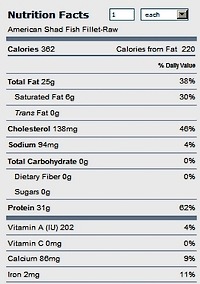
shad_Nutrition American Shad also hold an esteemed standing in American history, largely because of their role in feeding Washington’s army at Valley Forge. Alosa sapidissima is translated as “Very Delicious” and a starving patriot could ignore all those small bones as it chewed better than frozen boot sole …

The 2010 version has a few percentage points in Nitrosamines and PCB’s but the gastronomic benefits speak for themselves. Oily fat calories capable of sustaining a nation on the verge of independence.

Fast food has since become the 51st star on Old Glory, and it’s Pizza Hut that nourishes most of Afghanistan and Iraq.

For the rest of us gourmands it’s the Indian legend that holds more weight than precious Omega-3 fatty acids:

Shad are richly flavored thanks to a good bit of omega-3 laden fat, but they are among the boniest fish in the world. An old Indian saying has it that a porcupine fled into the water and was turned inside out to become the shad. It is not far off.

Tags: American Shad, Tsung Tzu, Alosa Sapidissima, shad feeding in freshwater, American River, Omega-3 fatty acid, Mycid shrimp, fly fishing for shad, fly fishing blog

Something old meets something new

234B With little help forthcoming from you chaps, I took a chance with another double sawbuck to land Coverite Microlite, another model fabric that doubles as our favorite nymph skin.

Coverite stretches nicely unlike the prior mylar variant I tested. Reinforcing the notion that I’ve found the industry, but the exact material remains at large. Coverite Microlite is close enough to the original Magic Shrimp foil that outside of the lack of colors available, my search is over.

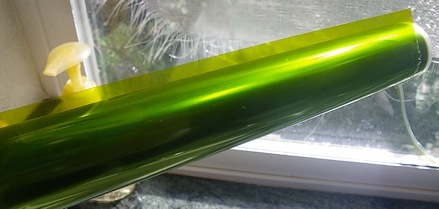
Microlite Transparent Green

I took one look at the Transparent Green and had to own it.

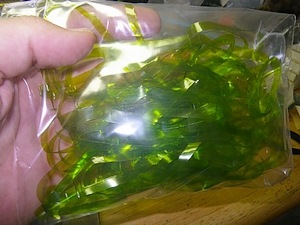
Yank the cardboard tube out of the center, grab a pair of scissors and simply cut the end of the roll in slices. Two minutes later you’ve got a bagful of 72” strands of 1/4″ or 3/8″ wide Czech nymph material. The roll is 6 ft long, 27 inches wide, and runs about $12 retail.

Microlite strips, a two minute task

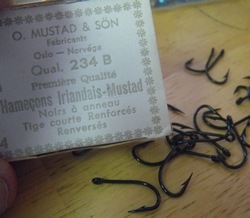
With that last haul of ancient Mustad hooks, I’ve replaced the expensive foreign scud hooks with a 2X strong Mustad 234B.

It’s a Ring eye, Japanned black,  reversed point, and the extra strength is capable of handling a little bending without falling apart like standard wire hooks.

Bottom-bouncing with heavy nymphs means standard wire will be straightened (weakened) on snags – and the unforged extra strong can resist snags much better,  and I can straighten the hook back to original shape without fear of weakening it measurably.

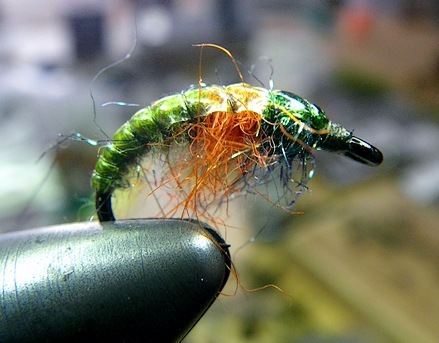
234B Czech Nymph

I bend the last quarter of the shank downward to give it the familiar Czech profile.

It brings back those fond memories from the Eighties; if the right shape wasn’t available we made that too. Thirty years later we’re in the same boat only we lack even the sturdy hooks to bend and twist to our will.

Tags: czech nymphs, mustad hooks, extra strong hooks, magic shrimp foil, vinyl covering, model airplanes, Mustad 234B, reversed point, japanned black, ring eye, short shank, fly tying materials, fly tying blog

Of Wooden ships and Iron Men

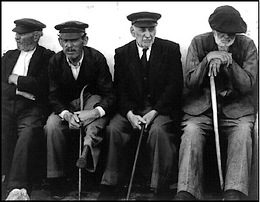
fouroldfishermen Sure it’s only a fragment of angling data, but it still imparts a horrifying aspect to how far we’ve sunk over the last hundred years.
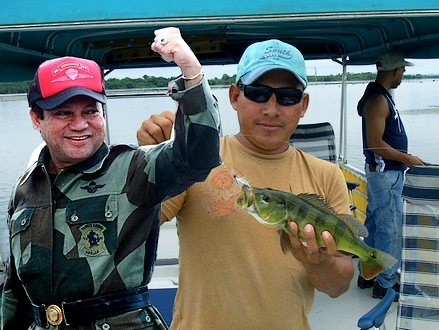
A recent examination of trawling records from the late 1800’s suggest that despite all the carbon fiber, nylon, sonar, radar, Twinkies, Playboy, the Internet, and on-ship HBO, the average commercial fisherman works 17 times harder to catch the same volume of fish, as his turn-of-the-century counterpart.

Seventeen, it’s a magic number …

Modern fly fishermen carry seventeen times the gear of them old guys, forcing most of us to give up the sport at 35 due to curvature of the spine. We carry potable water, toilet paper, energy bars, poly leaders, split shot, extra spool, extra lines, cell phone, pager, flotation vest, credit cards, bug spray, nippers, flask, stomach siphon, and reading glasses, and that’s only the first two pockets…

Anglers of yesteryear were lean and vigilant, bringing the water to mouth in cupped palm, carried a single rod and a can of Red Deer Fat to grease things to float, or left alone to sink.

We carry seventeen times more flies, in seventeen new phases of lifecycle. We spend our precious time wondering whether it was dun, spinner, emerger, cripple, or nymph – and them old guys only considered two kinds of bugs, those that were bothering them – and those that weren’t.

They had shiny, drab, and bright, and were correct 33% of the time. We’ve got floating, sinking, beadhead, lead free, barbless, and borrowed, then we have to determine insect stage – all as daylight ebbs.

They had horses that might trot 10 miles an hour, but only had 5 miles to the Pristine. We’ve got agile and sleek testimonials to modern engineering – capable of 200 mph in seven seconds, and while those speeds are useful, it takes four hours of bumper to bumper to get clear of our fellow man, then seven seconds to your next ticket.

They fished with rods that took seventeen times longer to make, constructed by rod companies whose lineage could be traced through 17 generations of loving craftsmen. Their rods were gossamer wands of indescribable beauty, with the temperament of women, and when put away damp or hastily – would warp and buckle in vengeance.

We’ve got rods that crap themselves out of a nozzle accompanied by the musical notes of carbon-based flatulence. They’re cold and plasticine, and cost seventeen times what they’re worth.

For that matter everything today costs seventeen times more, including fishing licenses and divorce.

… but the wardrobe is cheaper. Modern fishermen eschew bathing in lieu of an extra hour of fishing. The tweeds and ascot replaced with an extra application of anti-perspirant and a wet-knap chaser. Just enough homage to the niceties of civilization to get you through the drive thru and toll booth without incident.

The saving grace, the item enabling us to continue hemorrhaging both time and money in pursuit of diminishing returns, is we’ve abolished Debtor’s Prison … whose return appears imminent given the current Congress, delayed only by the inevitable Republican filibuster.

Tags: fishermen work harder, fly fishing, fly fishing cost, fly fishing humor

The Brown just got warmer and darker

delta The brown water looks bad enough already, now the federal government will be requiring California’s many thousands of aqueducts and levees to be shorn of all vegetation.

… meaning all those 100 year old oaks will be chipped and shredded, all the bankside willows and cottonwoods will be ripped up and vanished, and goats will be commonplace – given their incredible mowing ability.

For those out of state, the canal-aqueduct system of California is the next Big One. The potential for a natural disaster of epic proportions – due to water scarcity in the south state, and the relentless development that adds more toilets, mouths, green lawns, and swimming pools where they’ve no business existing…

Many are simple earthworks, built with now-primitive tools in the late 1800’s to reclaim fertile soil for farming. With our propensity for earthquakes, and the power of all that pent up water – a significant breach in the right spot would bleed the freshwater out and cause salt water from San Francisco Bay to rush inland, past the pumps to SoCal, and rendering everything south of Sacramento bone dry.

One temblor away from 25 million people thirsty. There’ll be plenty of soda pop and beer, but after the riots even that will be gone.

If the guidelines are enforced it’ll require the removal of a lot of vegetation and the shade it affords those waterways, and if there was anything naturally occurring – it’ll cease quickly.

… and for those anglers fishing the Delta, it may warm the water a bit, remove much of the bankside cover, and likely cause fish to abandon prior haunts in favor of those areas where vegetation remains plentiful.

Us fellows plying the long rod had better think of brain-addling daytime temperatures and pack plenty of water.

The Delta is a legendary Largemouth Bass and Striped Bass fishery, I imagine this type of change won’t be positive for the resident fish, but SoCal is owed, so it’s necessary.

Tags: California Delta, San Francisco Bay, levee repair, largemouth bass, striped bass, temblor, averting an eco-disaster, fly fishing for bass

One in the pocket is better than two in the bushes

It was the same story he used when in Italy, “… imagine my surprise when I rummaged in my pocket and found a single Little Stinking Olive!” I told him not to run it through the ponds at the Vatican, and doubly don’t dare hand twitch it through the green water at the Roman baths, but he ignored me both times …

LSO, Little Stinking Olive

… now, recently freed from the pillory of Saint Peter’s Basilica, I get another terse note from Panama…

“My employer dispatched me to Panama, and while I was pocketing Manuel Noriega’s collection of exotic Cubans, I found a single Little Stinking Olive …”

… naturally I’m a little concerned, as being caught hi-grading El Jefe’s stash has to be a firing squad and imprisonment, at the minimum …

Guided CIA Junket

Now I’m wondering who his employer is – and whether the company HQ isn’t in Langley, Virginia. Only “spooks” can take a dozen LSO’s and part them like the loaves and fishes – and by my count he lost nine of them by mid afternoon.

It’s a comfort to know he had permission, but I’m still unnerved by all them black sedans across the street.

Tags: Little Stinking Olive, Panama, Peacock Bass, Cuban cigars, pillory, St. Peter’s Basilica, fly fishing, Manuel Noriega

Anatomy of a spectral blend

Nothing like having your living room covered in gaily colored mounds of drying fiber. I’ve often wondered whether application of an industrial vacuum wouldn’t make the job easier, just suck everything up and start tying flies out of the contents of the dust trap.

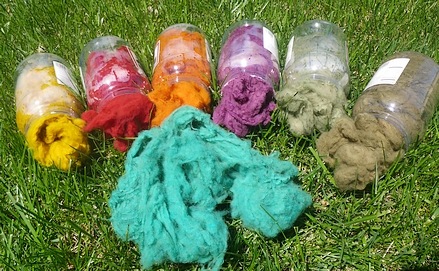
The artist's medium

Above are the raw elements of spectral dubbing, consisting of the primary colors of the color spectrum; red, cyan (Lt. blue), and yellow – and the secondary colors – orange, purple, and green. Only the cyan and yellow are acid dyed, the rest of the colors were built using RIT dye.

I’ve added a pound of Olive on the end as a tertiary color. I’ll add it to natural colored fur blends to make Olive tints to the original color.

It’s a raw mix of of natural fur that will replace the more expensive (and hard to find) Australian Opossum. A mainstay of my custom blends, Australian Opossum is imbued with tiny curls that retain air, adds loft and resists matting. Unfortunately, our American Opossum lacks those qualities and cannot be used as a substitute.

The spectral effect is the addition of all these colors to a base dubbing in small enough amount so as not to be seen until examined closely. At arm’s length, an Olive dubbing looks Olive – until you hold the fly close and can make out the individual colored fibers contained in the mixture.

It’s one of many building blocks of the Impressionist fly tyer, how to make a fly resemble nothing specific, yet look like everything – and all at the same time. Part of that magic is style and form, part is color.

Spectral dubbing blends should follow the 90/10 rule. 90% of the fur is the color you are attempting to imbue and 10% is the brightly colored fibers that will add a bit of deceit to the final product.

Building the Chaos color

Chaos Color Start The simplest way to build a good spectral effect is build the “Chaos” color and simply add it to your base fur in the desired quantity.
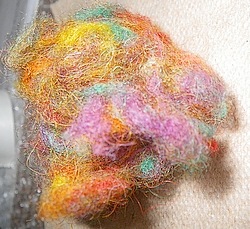
Add equal amounts of each of the six primary and secondary colors, and mix it into a single color. This is the Chaos color.

Now you can grab a pack of Hareline dubbing off the vendors wall, pinch in 10% – and blend your final product.

Add a bit of opalescent sparkle or other effects if desired.

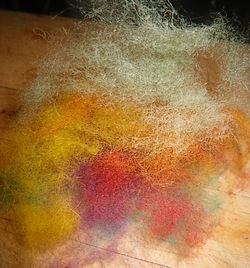
Above are equal pinches of the six colors. Because it’s a “sticky” fur due to the tiny curls, this will not blend well using an electric blender. It’ll knot itself into clumps of color rather than mix completely.

Straight out of the blender At right is the knotted mass that came out of the blender. It mixed the colors slightly, but the bulk of the mixture is still clumped color and undesirable.
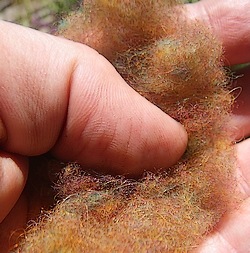
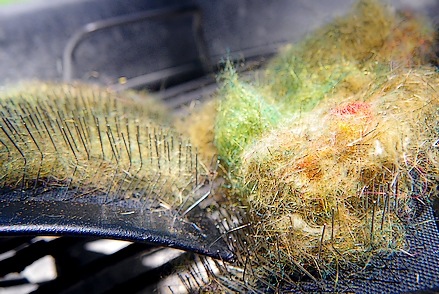
Non-sticky fibers, those that are straight and lack adhesion, like rabbit – will blend easily, but a good filler candidate is rarely straight, as it’s chosen exactly for this sticky quality.

If you’re building small amounts of fur, a pair of dog grooming wire brushes are needed. Just load both brushes with plenty of fur and pull them in opposite directions numerous times until you approve the result. Larger amounts are better served by mixing them with water, fill a gallon jug about half full and cram the fur inside, shake until it’s a cohesive colored mass.

The completed Chaos color

A well mixed Chaos color; equal parts red, yellow, cyan, green, purple, and orange, creates a red-brown or a “Russet Brown” shown at left.

Tuck that away in a separate bag and add to your base blends to color as needed.

Constructing the Final Blend

The amount shown at left is 10% of what I’ll build, to finish the task we’ll add that handful to 90% more of a standard olive blend.

Because I built both a spectral color and it’s a filler fiber, all I need is binder and wrapper in Olive to make my final mixture.

Dog brushes loaded with fur

I loaded the Chaos color on one brush and a mixture of medium olive beaver (binder) and natural Red Fox squirrel body (guard hairs, wrapper) on the other. Just put the teeth of the combs together and yank in opposite directions enough times to mix the two. Eventually all the hair will wind up on one brush, just pull it off and reload the combs as many times as needed.

The final color, a spectral Olive

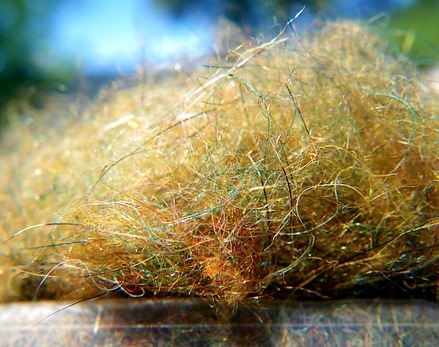
Above is a close-up of the final mix. It’s a medium olive imbued with the spectral Chaos color. The natural guard hairs are visible as are individual shafts of component color. At two feet, it’s just another olive, but up close almost any color combination is visible.Just another Olive until you peer closely

… which is the desired effect. A dominant base color and just enough of an accompaniment from the mixed primary and secondary colors to assist without overwhelming everything.

Tags: dubbing blends, bulk fly tying materials, spectral dubbing, Red Fox Squirrel, impressionism, primary and secondary color, artist’s color wheel, fly tying

Wanted: One remote control plane buff that rolls his own. Crashes frequently a plus

I’m still hot on the trail for the source of the Czech nymph overbody material. I go quiescent periodically when I lose the scent, but like an old dog I’ll keep on the trail so long as I’ve got a reasonable scent trail.

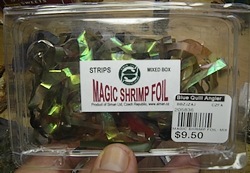
Magic Shrimp Foil I’ve found the material, now I need to find out which brand it is …
12 microns thick, available in a blizzard of colors, and 18 square feet for about $14 – depending on the vendor and his sale schedule.

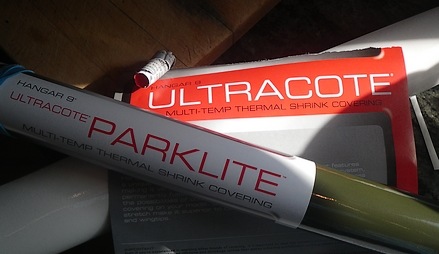
I knew I’d encountered this material before, but couldn’t remember where, until I remembered my brother repairing old Hobie balsa gliders – whose pilots were not yet proficient enough to hit the Twin Towers or the broad side of a barn – but were able to hit pavement at speeds never designed for balsa aircraft.

He had these bright orange sheets of heat shrink plastic that clad the balsa skeleton once the struts and wood had been pieced back together.

Ultracote - Mylar shrink film

It’s the exact thickness of Magic Shrimp Foil, has a dull side and a shiny side just as Shrimp Foil, but isn’t as stretchy. Hanger 9’s Ultracote is likely a mylar based product with little stretch – and the exact match is vinyl, which would complete the puzzle.

This material comes with a paper backing that clings via friction rather than adhesive. The backing allows you to use a paper cutter to cut nice thin strips without undue fuss, simply sneak into the mail room before everyone arrives at work and carve a lifetime supply.

It’s offered in metallic, transparent, and opaque colors – and appears to match many of the colors of Shrimp Foil, but lacks the opalescent tints.

I ordered a roll of Olive and a roll of transparent and they’re both useful for Czech shellbacks, but I’d rather not continue to shell out the cash in search of the specific brand – knowing that one of you may already be afflicted by this hobby or has a remote control plane shop in his neighborhood.

… or has a buddy heavy on the throttle and with hands of stone come the landing …

Tags: Czech nymph, fly tying materials, shellback, Hanger 9 Ultracote, RC aircraft covering, Magic Shrimp Foil, Hobie glider, balsa wood repair

Hedge Fund Managers and Wealthy Lodge Owners

Gold Mining The reason the Pebble Mine gets all the vitriol and press? Simple, all those wealthy lodge owners, salmon fishermen, and hedge fund managers have ties to the Powers that Be …

A compelling story in the Alaska Dispatch suggests the Donlin Mine is even bigger, a planned 2 mile wide, 1 mile long open pit mine that will uproot a couple hundred miles of the famed Iditarod trail, host toxic tailings near the banks of the longest undammed river in North America, and add a massive power plant as part of the construction – all of which is proceeding with little notice and much less resistance.

Donlin has attracted little attention, said Pam Miller, executive director of Alaska Community Action on Toxins, because “unlike Pebble, there aren’t the wealthy lodge owners. There’s just poor subsistence residents.”

Wealthy lodge owners might be the ultimate in NIMBY opposition to backyard development. They are extremely well connected, given their clients tend toward well-off businessmen and the idle rich. These are the kind of people with the connections that enable them to get major jewelry retailers to make public-relations claims they will never use Pebble gold in their products, even if it’s hard to trace any gold used for jewelry back to its original source.

Take this power block, couple it with downstream commercial fishermen who hold valuable Alaska limited entry fishing permits for Bristol Bay salmon and a millionaire neighbor running an investment fund worth billions, and you have a power bloc that can make life hell for any sort of development.

– via the Alaska Dispatch

By contrast the Donlin Mine is on native lands, in a historical mining district, and the locals are eager for the employment potential and power infrastructure that the mine provides.

Protests have been muzzled as it’s seen as anti-Native American.

Towing barges of fuel oil up the river sounds decidedly anti-salmon, but we’re the “bleeding hearts of the lower 48”, and we’re expected to say that.

I’m not privy to the full facts of the case, but the Dispatch article is a compelling read. It’s a contentious subject to be sure, but the “wealthy lodge owner” angle is new – and may partly explain why Pebble has enjoyed such extensive coverage and become a cause celebre’.

Tags: Donlin Project, Alaska Dispatch, Pebble Mine, wealthy lodge owners, evil fly fishermen, NovaGold