Author Archives: KBarton10

Peel Rubber, Kill a Salmon

peelrubberCars have been synonymous with pollution for several decades, but for fishermen “tire pollution” may be their worst legacy yet …

Scientists are attributing rubber dust from tire wear as being toxic to Salmon and Steelhead – and when transported into the watershed via rain and runoff, have attributed it to a series of fish kills in Puget Sound and possibly elsewhere.

Treating the runoff to neutralize the chemical would be prohibitively expensive due to the magnitude of paved roads near waterways, so the solution will require a change to tire composition, akin to the replacement of Freon for refrigeration systems.

The chemical is added to rubber to stabilize it from Ozone oxidation and goes by the trade name “6PPD.”

“It’s like a preservative for tires,” Tian said. “Similar to how food preservatives keep food from spoiling too quickly, 6PPD helps tires last by protecting them from ground-level ozone.”

Ozone, a gas created when pollutants emitted by cars and other chemical sources react in the sunlight, breaks the bonds holding the tire together. 6PPD helps by reacting with ozone before it can react with the tire rubber, sparing the tires.

But when 6PPD reacts with ozone, the researchers found that it was transformed into multiple chemicals, including 6PPD-quinone (pronounced “kwih-known”), the toxic chemical that is responsible for killing the salmon.

This chemical is not limited to the Puget Sound region. The team also tested roadway runoff from Los Angeles and urban creeks near San Francisco, and 6PPD-quinone was present there as well. This finding is unsurprising, the researchers said, because 6PPD appears to be used in all tires and tire wear particles are likely present in creeks near busy roads across the world.

YouTube has several videos on the subject from the University of Washington scientists that published the finding.

The question becomes how much 6PPD is found in “sticky rubber” and will the Purists insist we wade barefoot …

Hand Weights and Bicycles

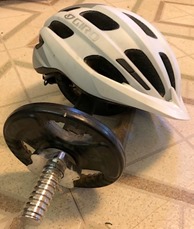
bikeWeightWith another drought plagued, fire prone, and unseasonably warm trout season headed our way, it’s time to jettison the fly tying gear and double down on weight lifting and increasing the morning bike ride.

The hand weights and sudden fitness kick aren’t to sculpt my sagging frame into something attractive to local cheerleaders, rather it’s to mitigate what I know is coming this season; low water and unseasonably dry conditions will force us to fish further from the parking lot.

With California’s snow pack was at 55%, and only a sliver of Winter remaining, it looks grim for the coming season and little increase can be expected from existing levels. Continuing drought ensures that our creeks and waterways will be scrawny – and pools that would have supported a couple of anglers for a couple of minutes, will fish a single angler for a handful of casts.

Moving frequently due to the “skinny” water will put additional strain on aging muscles and require us to be in better shape to handle a full day’s fishing.

Lakes and impoundments will act similar. Walking the banks will prove easier as low water offers few obstructions other than accumulations of driftwood and plastic water bottles, but what was shallow last year will be dirt this year, and we’ll be forced downslope to find the water’s edge. That means climbing upslope on the return and having to negotiate all that loose cobble enroute to the parking lot.

Those of us unfortunates that will be lugging a 105 pound kayak, will have to drag the Beast an additional 100 yards to get to the water, and on the return, will have to pull it upslope to get the boat back to the truck. Wheel assemblies make this easier, but the uphill slope and uncertain footing will make boat recovery much more arduous than negotiating a paved launch area.

… hence the emphasis on increasing the legwork and overall tone needed for our preseason workout.

Each of the last couple of years have proved devastating in terms of fire severity and impacts – and this year will be no different. The back country will likely be under additional restrictions (based on COVID and fire weather) so we should plan on issues associated with feeding, housing, and campfires.

I lost access to my local fisheries for most of the 2020’s summer due to fires and the debris field that followed. 2021 is likely to be a repeat as the ground is parched already and what didn’t burn last year is ripe for a dropped cigarette butt or lightning strike.

The Pandemic also resulted in a questionable boon to Fish & Game as an 11% additional folks bought or renewed their fishing license this year. Frequent lockdowns and being stuck at home means outdoor activities are the only approved flavor of social interaction. We may see a small uptick in traffic to the Piney Woods as a result.  Restaurant occupancy and motel / campground availability may also influence by demand, so it’s appropriate to factor into your trip  a few additional bodies attempting to get fed and housed.

These pesky COVID variants offer the remaining wild card in the outdoor mix. Should their increased virulence cause an uptick in the caseload, we may have existing restrictions persist throughout 2021 – despite the boon of vaccinations. Most of California is still bound by the Governor’s Tier Structure, with dining and lodging subject to local county issues, so plan on camping,  and washing down that Beef Jerky with a little branch water … should accommodations prove to be in short supply.

No Table Manners and the Appetite of a Glutton

I’ll go out on a limb and suggest our sport could use a few pedigreed opponents with both table manners and appetites of a Tyrannosaurus Rex. 

I’m thinking selfishly naturally, but think of all the knick-knacks we could remove from our vest, the words – like “gossamer” or “refined” we could purge from our vernacular, and the Jihad we could embrace as we rose to defend all the little kids and sunbathers frolicking at the beach …

I met one of those yesterday, and only managed to fight him to a draw.

Now I’m nursing the bruises and teeth marks, the line burns and the wounded pride that comes with knowing that had I hooked up with a real Striper I might have suffered the same fate as Jonah, swallowed whole by a great fish.

The tides were favorable the last couple of weeks so I tried Sherman Lake twice on Thanksgiving week. The Tuesday of that week was great weather and no fish, and the following day featured gale force winds that pushed the fly line (and sharp 2/0 hook) into the boat, while pushing me and my craft towards the rock jetty. Choosing between being skewered and a watery grave made the remaining option –  a hasty retreat back to the launch area, the only viable alternative.

Fish 1, Me Zip ..

This week promised a return to calm air and a continued spate of middling temperatures, so I returned to the waterway on Tuesday in pursuit of my first fly-caught Striper.
13inchStriper

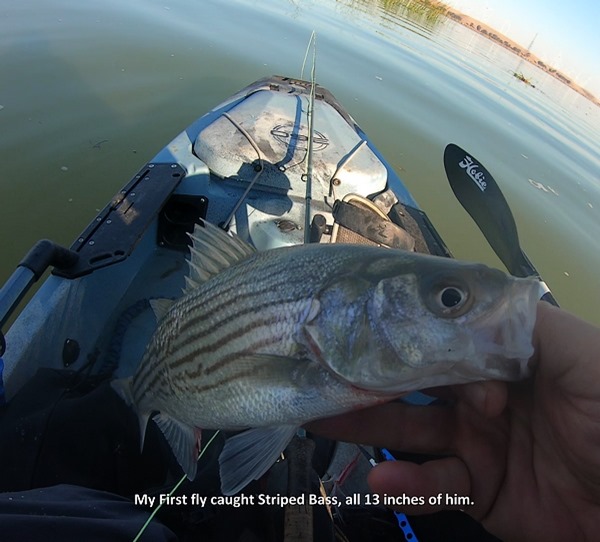
I don’t know which of us was more surprised, him … as he’d swallowed a fly that was half as big as he was – or me, who was expecting a Pikeminnow or small largemouth. The sure gluttony exhibited by my new pal gave me pause, as he had swallowed a 6” White Whistler… completely. (I had to remove the fly with pliers quickly – as I feared it would be digested before I could release the little Beast.)

This encounter got me thinking of the overall sport – how the evolution of the Genteel Angler; the woodsy Plaid shirts, and Pipe smoke of the Crosby era might have fared with silvery T-Rex’s inhabiting traditional Trout turf. Would we have been so eager to wade knowing the carnivorous little beasts could knife through your Seal-Dri’s and take your leg off at the knee?

Finally, this … was an adversary worth killing.

My thirteen inch nemesis whetted my appetite for additional carnage, and I continued flinging my six inch offering at anything that looked promising.  As the tide came in I had two more brief flurries of activity, a good sized largemouth ate the fly before losing the hook, and what I assumed to be another 13” glutton slammed the fly before also coming unbuttoned.

I returned the following day to fish this same general area; the northern edge and the three islands at the entrance to the Sacramento, as well as part of the northwest shoal of tules and floating water hyacinth.

As there were a half dozen boats in the center of Sherman Lake, I assumed some fish had been caught recently – half appeared to be bait fishing and the balance were casting lures and plugs of some sort. I had a lone fly fisherman roar up to my side and we both drifted with the incoming tide towards Antioch.

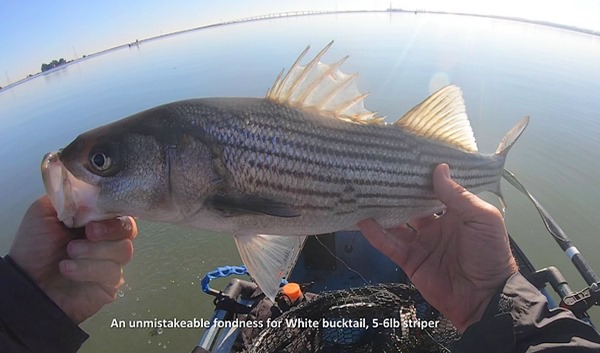
I was flinging my usual fare, 2/0 White Whistler, whose hook I had touched up to razor sharpness, when I was slammed by another Striper, this one a bit bigger. As I was out of sight of most of the boats I didn’t mind the noisy complaint from my old click-pawl reel – as I knew I was out of earshot of the flotilla jockeying in the center of the waterway.
6lbStriper600

After towing me around a bit I managed to boat the Glutton and retrieve the offending White Whistler from his maw. Apparently my comment to the smaller fish,  “…and return with your Big Brother!” had been followed to the letter – and while a 6 pounder is not a big fish, it was the prettiest thing I had seen in some time. I smuggled him off the deck and back into the water without commotion, hoping to remain unobserved.

Most of the small fleet of boats had left the center of the lake and moved either north (to the Sacramento) or south (to Big Break) and I was in sole possession of the area. I have a theory that the amount of horsepower present is indirectly proportional to attention span, and their owners tend to hop about making use of all those carbon credits – to the detriment of their fishing.

I managed to catch a largemouth and another 13 inch striper while pedaling in the area. The fact that every species will eat the same fly is a real treat.  Fly fishermen are quick to change fly if the fishing slows and it’s nice to simply face the mathematical odds of a fish being able to see your fly, and no activity means no fish, versus something more sinister like the wrong phase of insect or it’s abdominal color.

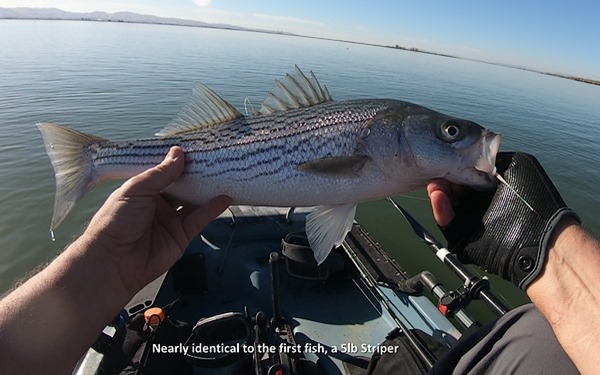
I swapped sides of the lake and fished down the rock jetty portion and landed a third Striper similar to the first.
2ndStriper600

To say I was ecstatic is an understatement. These fish are brutal fighters capable of towing my small craft in the ensuing tussle. I am rethinking a bit of my tackle in preparation for meeting the larger fish common to the area.  Currently I am tossing an 8 weight 10’ Echo on a WF floating line, but may need to increase capacity a bit to allow for additional brutish behavior should the fish be in excess of 10 pounds.

Towed into the center channel of the Sacramento would be thrilling until the first freighter appeared …
WhiteWhistlerr600

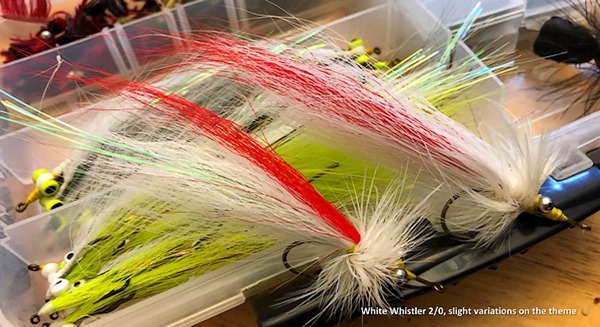
As I have an overabundance of Yellow NYMO thread, the Whistler’s tied above are tied with a few random changes. The classic is a white-red-white layering of the wing, but I also tie the fly with the red on top. I suppose some years I feel “extra bloody,” and some I adhere to the classic dressing.

In summary: The fish are starting to show but are not yet in great numbers. I have managed to land a Striper on a fly rod  – which was a Bucket List item, and while I’ve caught numerous Stripers on conventional tackle, am really impressed at their fighting ability on a light fly rod (and smallish fish).

Angling Conditions: Water temperature 58 degrees, ambient temperature 65 Degrees. One fish caught at low tide, one caught on incoming, one caught at full high tide.

Somewhere between a Float Tube and an Evinrude

Contrary to what you think of retirement, the reward is not being able to watch Saturday morning cartoons uninterrupted, rather it’s fishing  on weekdays while all the drunken Meatheads embody cartoons as they crowd the launch ramp on weekends.

After 30 years of toiling for CALFIRE, we parted on good terms and I took some  accumulated time on the books from pressing emergencies and late-night phone calls – and gifted myself a “Yak”, or fishing kayak,  and the ability to wield it in retirement whenever the mood suits me.

Fishing kayaks require a lot of thought and configuration to suit  fly fishermen, and I’m still learning what works and what doesn’t. How to optimize storage, how to NOT carry everything with me, how not to lose it all when I flip the boat, and more importantly – how not to leave anything on the deck without thinking about the coils of fly line underneath and how the kinetics play out when I release the cast …

Hint: Sploosh.

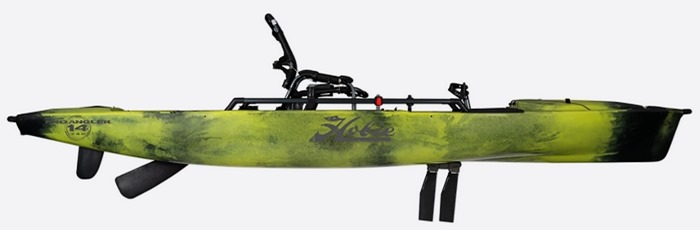
I’ll elaborate on my final configuration and more importantly – how to fish out of these shortly, once I’ve got enough hours to be a credible source. Fly fishermen have little experience fishing from boats that move  while casting –  and pedal powered kayaks allow both  versus having  to wield a paddle to move. Float tubes are stationary objects and prams bob contentedly in place but if your boat is moving while the cast is in the air a mess ensues as you have new things to snag with your line and new gods to invoke while swearing mightily at great puddles of fly line being run over by your boat.

HobieProangler360700

This week was the California Delta, and the pursuit of Striped Bass – which like every other gamefish I’ve targeted – gleefully thumb their nose at me despite my new “water-legs.”  While my pedal kayak and angling pastime has now been blessed as “heart healthy” by all lab coated professionals, the Striped Bass remained unimpressed and likely pirouetted around me while I pedaled around the confines of “Sherman Lake” and Sherman Island proper.

“Sherman Lake” is just a wide spot in the Delta at Sherman Island, and is a popular spot for duck hunters, striper and sturgeon fishermen (in the main channel), and hosts the occasional wind surfer or kayak angler. It is about 1.2 miles across and has five or six miles of bank ranging from rock jetties to dense Tule mats. With pedal power I can cross in about 15 minutes – but have to factor in drunken boaters, waves caused by wind or tides, and everything else that haunts a navigable body of water.

windfarm700

I did find seventeen new ways to penetrate my fat frame with really large and sharp fish hooks. All wounds were aided by bead chain eyes (Whistler), lead hourglass eyes (Clouser), and anything else capable of being lashed to a fish hook and able to turn a timid false cast into a lethal weapon.  Most involved  hastily applied tourniquets and a great deal of swearing, which may be why the bird watchers gave me a wide berth.

Kayak fishing in a heavily trafficked waterway is not for the faint of heart. Boat wakes and the boating curious can send enough water in your direction to give your small craft a fit if you’re not paying attention. Stability dictates your bisecting the oncoming wake with the bow of your craft, versus getting hit broadside by the wave, and the unwary angler can be sorting a tangle of running line, or netting a fish, unaware of the new threat and a little too much lean coupled with the arrival of the swell can lead to a rollover.

… which is why everything of value has to be tethered to your craft or should float unaided. Fishing vests are no longer an option as you need to wear a life jacket, so storage of all the little things; tippet dispensers, hook hones, and fly boxes has to be rethought as well.

Petite flies and the gossamer fly rods of stream fishing are replaced by those capable of hurling an entire chicken saddle or bucktail with ample lead. Casting skills are essential as you’ve got to impart lift to a rapidly descending Clouser Minnow, a fly which shares the aerodynamic profile of a paving stone, and with only a single double haul or you’re going to wear the fly instead of the fish.  Rods and flies are heavy, and casting them all day requires minimal “air” time; one roll cast to bring them to the surface, one false cast to get them aloft, one double haul to impart momentum – then fling the accumulated mass as far from you as possible to avoid injury.

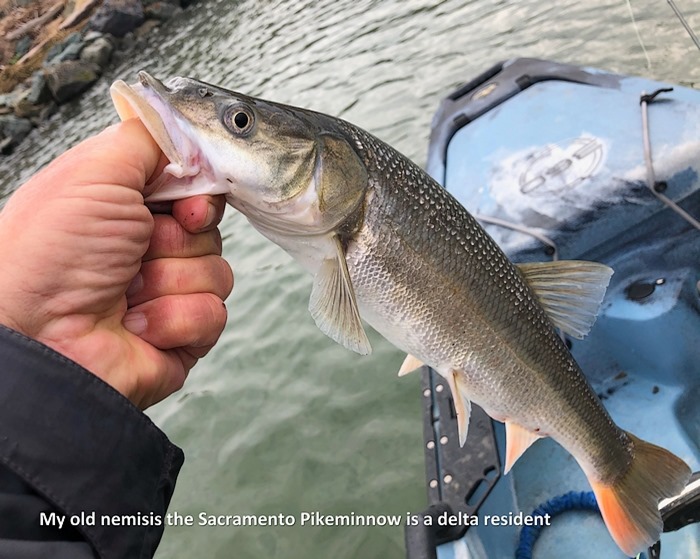
Despite all of the environmental and platform changes, all of the rod and fly differences, and despite the vagrancies of migratory fish and tides, it’s comforting to know that my ignoble pal, the Sacramento Pikeminnow, is a delta resident – and while not as showy as a Striped Bass, has also been sucked South due to all the lawn irrigation in SoCal.

deltapikeminnow700

They’re quite a bit bigger and silvery versus the yellow variant in my local creek. The Good News is they retain their aggressive nature and swallow a six inch Clouser with as much gusto as smaller flies. It was a welcome grab given how much water I covered and how little I had to show for all that effort.

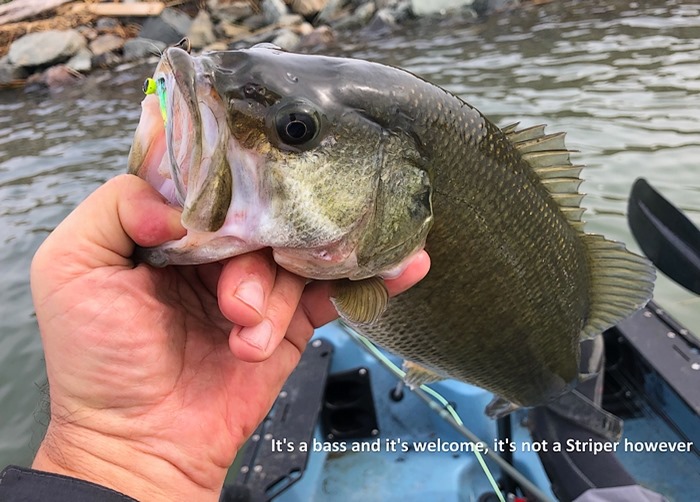
The first day I crossed to the West side and fished the Tule mats, with a lone Pikeminnow my only seduction. The second day I drifted the rock jetty on the East side and caught both Largemouth Bass and Pikeminnow but no Stripers. I saw a few fly fishermen in the main body but the frequency of their movement suggested their luck was identical to mine, fish scarce and Stripers scarcer.

DeltaBass700

I’ll continue to investigate the area as the tides permit. The fish are typically here most of the Winter, but tides determine the useful fishing hours and many occur too early or too late to fish.  Most folks familiar with the area insist on fishing the incoming tide but others like any tide movement, both incoming and outgoing. This is consistent with all the Striper fishing I did in San Francisco Bay – as the fish were active on any tide so long as it was moving.

Trip Log: External temperature 70 degrees. Fished the incoming high tide until slack tide. Water temperature 58 degrees. Flies used: assorted experimental ribbon yarn streamers, Flo Green Clouser, Shad Clouser, White Whistler.

Not Much Left Other than Fish

It’s been a month since the LNU Lightning Complex fire was contained around Lake Berryessa, and with no change in the status on the Bureau of Reclamation’s website, I took a run up there to eyeball what had burned and determine if the webmaster was simply lazy – or whether the infrastructure impacts were as bad as expected.

While I hoped for the former, it appears to be the latter ..

BerryessaLNU02020

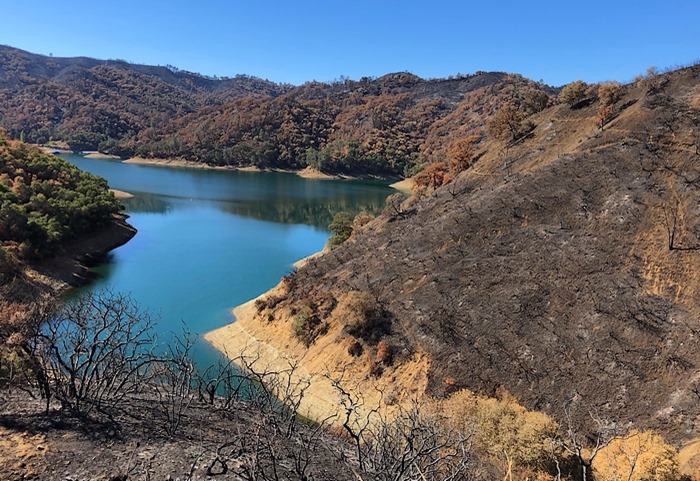
The above picture (taken between the dam and Markley Cove) shows how the fire burnt down to the water’s edge and apparently burned hot enough to wipe the area of most of the vegetation.

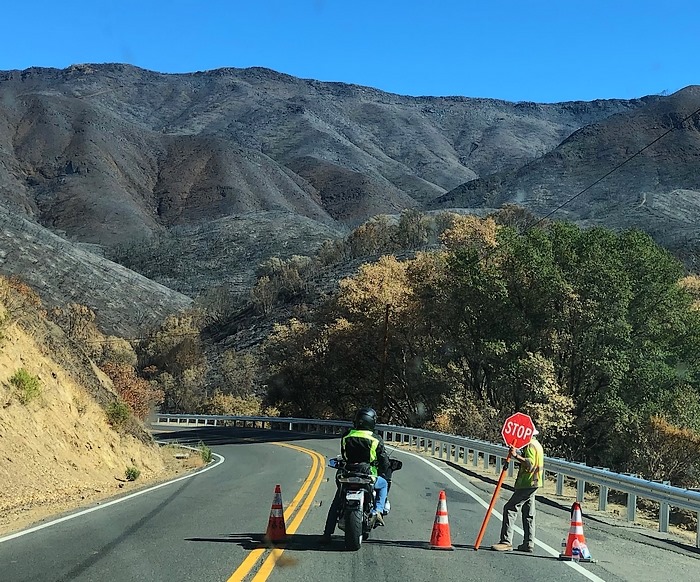
The upper slopes of the lake faired even worse, as the surrounding hillsides were much drier and burnt much more completely, leaving their slopes completely featureless. The below picture shows the mountains above the Markley / Pleasure Cove area.

BerryHillsideLNU2020700

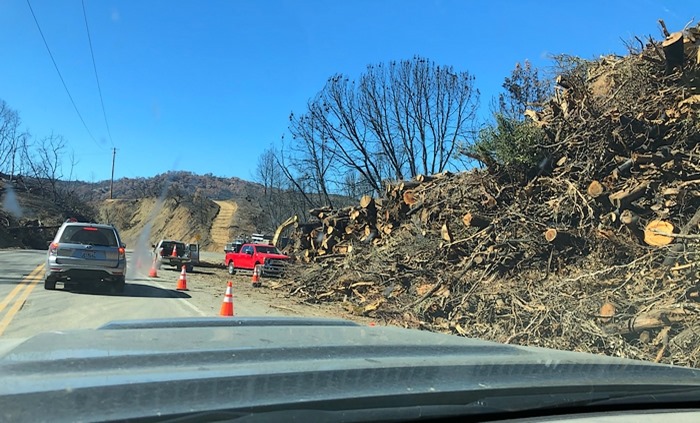
Roads in the area of the dam are choked with debris due to an aggressive hazard mitigation effort. Charred Oak trees and Digger Pine are perched precariously on the steep slopes above the highway and crews are removing the worst of the trees by skidding them  down the hillside into waiting trucks or stacking them into the available parking turnouts.

BerryLogging2020700

Because of the narrow roads and large equipment both flag men and delays are commonplace. Logging and the heavy equipment associated with handling the debris have reduced the road to a single lane of traffic metered by guide vehicles and punctuated by numerous stops.

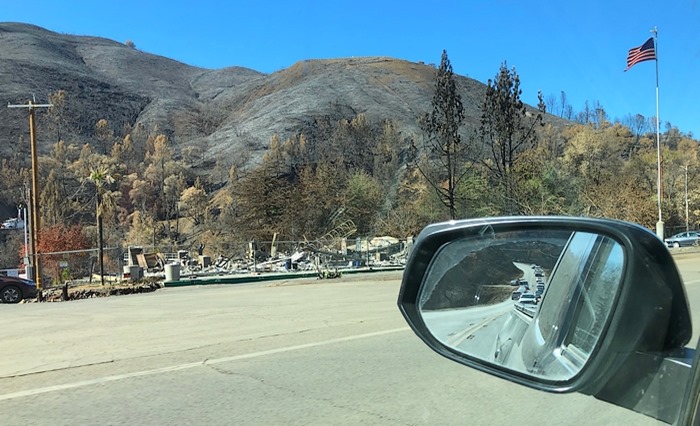
The Markley Cove store is no more. The marina and launch facilities appear intact, as do the numerous pleasure craft moored to the floating docks, but boat launches are forbidden and the area closed.

MarkleyStore2020700

Above is all that remains of the Markley Cove store. Access to the launch ramps are currently blocked by security (due to a combination of the bureau’s closure of the lake and the need to protect the remaining property from gawkers and looting).

What’s apparent is the appalling amount of lifeless dirt and rock that’s exposed to the elements and the potential for erosion once the rains start. As the entire lake was surrounded by the LNU Lightning Complex, and it burned to the water’s edge in so many places, there’s little chance that significant mitigation  can be completed in time for Winter.  Spring runoff will deliver a big slug of sediment into the lake and its tributaries, and it’s likely we’ll see numerous road closures due to unstable banks and periodic mud slides .

Putah Creek is liable to suffer a similar fate.

Putah Creek drains Berryessa, and being the closest bonafide trout stream to San Francisco, commands frequent visitors and much vehicle traffic. While the Putah Creek campground and resort facility were spared, much of the drainage below the campground was burned severely. The fire charred the banks of the wide portion of Putah (dubbed Lake Solano), and the area between it and the resort was burned worse than I’ve seen it in past fire seasons. I would expect sediment issues in the creek itself as the far bank and its vegetation was largely obliterated.

In short, stay away.

Until the roadways are restored driving anywhere near the lake is a steady dose of idling waiting for a pilot car, or threading your way between a chipper/shredder and a parked logging truck. I’d guess the stretches with trees will be cleared rather quickly, and the areas with destroyed structures will remain problematic as they attempt to dig out what remains and the truck traffic associated with the debris removal will remain high for the foreseeable future.

Loon ERGO Serrated Scissor Review

The pandemic has accelerated my conversion from trout fisherman to bass fisherman  due to  the unknowns associated with food, lodging and travel. I’ve shelved all the gossamer and petite gear needed for trout fishing in favor of  Styrofoam, hair,  rubber legs, and hooks capable of severing your Carotid artery with an errant cast.

Loon Ergo Hair Scissor640

Tying flies for bass is the “Widow Maker” for most marriages, as the production of a dozen 2/0 poppers involves half a deer hide, acres of marabou and brightly dyed Grizzly hackle, most of which winds up clinging to your lap or blowing about your tying room at the whim of your air conditioning.

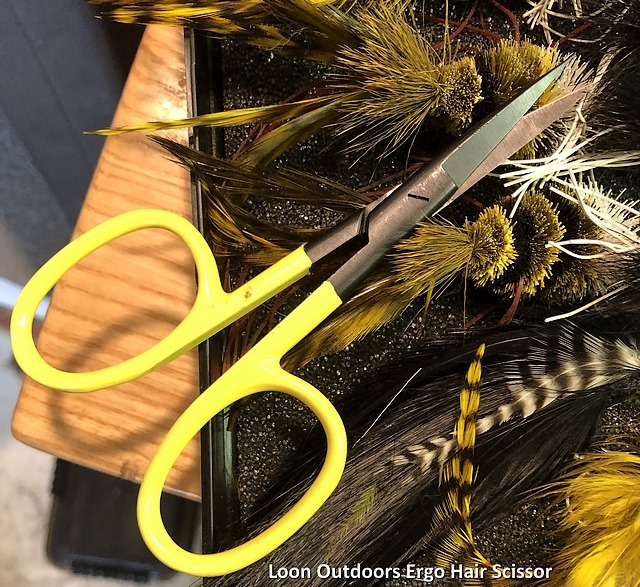
I keep reaching for my “trout” scissors to cut bead chain eyes and saw through Stinger hooks and realized they were better served staying in the drawer given their delicacy.  Unable to find my old serrated edge heavy scissors, I picked up a pair of the Loon Outdoor Ergo Hair scissors to replace them. At $15 per pair, these scissors are priced well considering the potential for destroying them while restocking your fly box.

Tying big deer hair poppers can shorten the life of traditional delicate scissors as there are additional pressures that go hand in hand with larger flies.

Volume: Large bass poppers require many times the materials of smaller trout flies. That translates into cutting larger volumes of material with each cut of your scissor. As leverage plays into the physics of scissor cuts – the longer the scissor the more force is applied to the fulcrum area, the small screw holding the scissors together. Stainless steel is a “soft” steel (compared to others), and the screw steel is typically “harder” than Stainless, which ensures this excess force  will eventually deform the screw hole and loosen the scissor over time.

Obscurity: Tying big lumpy hair poppers means you have an enormous wad of hair lashed to your hook prior to trimming the final shape. As the majority of the hook is hidden , it’s very easy to close the scissor on the shank, point, or eye – simply because you couldn’t see it while trimming. Whacking a hook point with your scissors is bad for the tips and for the screw area, as the steel of a hook is “harder” than the steel (often Stainless) used to make the scissor. Hook steel can easily take the points off of a Tungsten scissor, as Tungsten is among the hardest of all steels – but it is also among the most brittle.

Dirt: Carving large amounts of deer hair off of the hide is a dirty business. While animal hides are cleaned and washed prior to being parted up for packaging, there is still a lot of foreign material trapped in the hair. Dirt, debris, dried blood, seeds, and everything else trapped in the under fur will be in the path of your scissors each time you make a cut of hair, and that additional wear adds over time.

Bulk: Cutting through three-quarters of an inch of Elk hair takes considerably more effort than trimming a mallard feather, yet most tiers expect the results to be identical. Cutting large amounts of material with small scissors requires the scissor to be closed slower than when it cuts a small feather – or the screw area will suffer. This is the most common way to deform the screw hole, cutting too much too quickly, and either the handles bend as you close them or the screw hole widens to accommodate the excessive pressure. Scissors loosen as they age, but it’s actually deformity of the screw hole that causes all the extra play – rather than wear.  If you are tying a lot of large flies or the materials are quite tough it’s better to switch to a larger scissor with the backbone to sheer through the material with less strain on the fulcrum area.

Today, Bulk and habit were the root of my problems, as I kept reaching for the fine point trout scissor when I should have used a larger set with serrated blades. Serration is always useful when trimming hair as the fibers cannot slide out of the scissors ahead of the cut, the fibers tend to catch in the serration and ensures everything gets trimmed proper. Note that this is both good and bad, as the serrated scissor will grip and make absolute cuts – and you can remove too much material if you’re unused to them.

The Loon Ergo serrated scissors are a 4.5” (powder-coated stainless steel) scissor with superb tips and a light serration down one of the blades. The large finger holes, hence the “ergonomic” designator, are quite comfortable for extended tying sessions, and there is enough “beef” in the scissor frame to snap them closed without feeling the handles flex – which is a good tell that the scissor is over capacity on the cut.

At $15 the price is really cheap, prompting me to order a second set for use with conventional tackle, trimming braid and heavy monofilament where that serrated edge will prove extra useful..

As my tying room is currently bereft of carpet due to a “slab leak” and having to jack hammer the concrete pad beneath for the repair, I should mention that I managed to drop these scissors on their points and bent both tips in a dramatic fashion. Stainless steel is a soft steel, so I was able to restore the points to their original shape by dragging them across my vise barrel several times. This is not a failure of design or an inherent weakness in the quality of the product – rather this is what happens when good scissors and fine tips meet an immovable object.

Great scissor for a great price – and with the large finger holes even the hammy handed should find these comfortable.

Note: This is an unsolicited quick review of this product. The scissor was purchased at full retail from a shop.

And One to Rule them All

If you tie a lot of bass flies a pandemic is a welcome interlude given how enforced isolation and “work from home” is instrumental in creating the debris field from all those large hooks you stuffed with marabou, rubber legs, lead wire, and spun deer hair.

… and, even better, most of the folks sheltering in place with us have seen us lick our fingers after handling all those dead animal parts, and we’ve got no one pestering us to wash our hands, either.

My last trip afield showed my fly box had more plastic showing than flies, and knew I was overdue for an extended “self quarantine” period with a couple fistfuls of Marabou and a lot of Olive Grizzly hackle.

Fortunately, bass flies are not like trout flies and the typical angler need not carry every phase of insect life, in every color, and in both floating and sinking varieties. Instead bass fishing is limited to Big Things that Float, and Big Things that Sink, and only a handful of colorations are required:  Shad, Crayfish, Frog, and anything that resembles a small child or escaped Chihuahua.

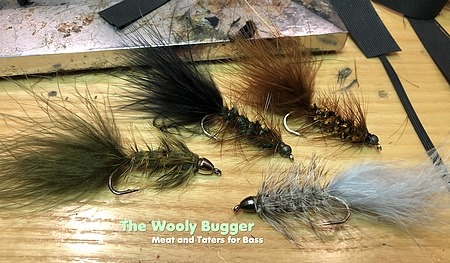
While many thousands of sinking bass flies exist for bass, few can match the  qualities of the Wooly Bugger. The simplicity of construction, low material cost, and seductive fishing action has made it a prominent option at your local fly shop – and likely earned a spot in your fly box already.

WoolyBuggerNew

Over the years I’ve had to slim down the volume of flies carried and shift focus to colors instead of patterns. Bass are usually associated with frog, minnow, and crayfish baits, and typically are pursued in lakes and ponds. where depth is always an issue given how fly tackle sinks so poorly. The long shank hooks typically employed with a Wooly Bugger allow us to pack lead, bead chain, beads, and allow us a platform for adding considerable weight – which is a boon in lake fishing.

The regular pulse of marabou has always been attractive to fish, and the palmered chenille front and marabou rear make a reasonable facsimile of a swimming  crayfish (which swim backwards), as well as resembling a minnow when yanked with a sustained retrieve, and in a pinch can approximate a frog – with its thin legs and bulky body, despite the fly not being on the surface – where frogs are found.

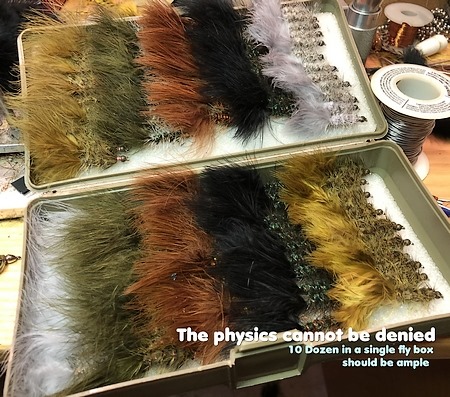
As a terrestrial angler wandering the bank I look for flies that can be used in more than one role – or simulate more than one prey, as space in my vest is always at a premium. Bass flies, especially the top water deer hair poppers, are  bulky and ill suited for traditional fly boxes forcing bass anglers to cut back on the diversity of flies they carry versus trout fishing.  The physics speak for themselves, as a dozen deer hair Dahlberg Divers  requires a couple of square feet of fly box space versus the tiny amount needed for a similar amount of #16 Griffith’s Gnat. The Wooly Bugger being one of the few styles that compress well in a fly box, allows bank anglers to carry a lot of them (or more colors) without having to carry a suitcase to accommodate their bulk.

10dozen

Many of the flies I carry loosely map to roles seen in traditional bait caster tournament lures, as crank baits, jerk-baits, poppers, worms, jigs, and spinner baits, possess actions that are timeless and have been fished successfully for decades. The Wooly Bugger falls into the “jig” category when weighted, due to it’s up-down dance when equipped with a bead head, and is more of a “jerk-bait” when unweighted – as the hackle and marabou provide no resistance to sinking allowing the angler to retrieve it with a variety of fetching motions that resemble numerous food groups.

Lake fishing requires a lot of weight to sink the fly quickly and the fly’s design lends itself to bead chain, cone heads, or large lead – none of which will affect the fly’s action. Streams or shallow ponds typically require less weight, but most of the Wooly Buggers that I fish are heavily weighted – simply due to the big water I’m fishing of late.

Lastly, the attribute that few consider is how the Wooly Bugger is often taught as one of the first flies learned in a beginner fly tying class. Cagey parents might be able to add a request for a few dozen as part of the allocation of weekly chores. Since the pandemic requires both parents and children to stay at home, what better way to ensure their online education complete – then researching the patterns and colors you’ll need for your next family adventure … after they take out the trash …

While it’s certain your stable of newly christened fly tiers will have a lot of defective product and won’t hold together long, it’s still a good bargain. That fly eating tree limb behind you coupled with the two wind knots in your leader will ensure your goodly supply is less so – in short order.

Marabou is cheap and a few minutes away from Tik Tok is downright patriotic …

Flavor being secondary to function

PBJLike all weighty discussions between anglers, the notion of what sandwich makes the best accompaniment to fishing is the source of both ire and amusement.
Anglers aren’t likely to pay  attention to expiration dates, certainly the talented ones don’t, and given our propensity to wad leftovers between two sodden slices of Wonder bread, we’re not known for our palate or presentation skills either.

Most admit that, “…does it go with beer?” serves as the only reasonable criteria, but there are the dissenting opinions  …

Mobile anglers will insist the resultant meal should transport well and shouldn’t leak – which effectively eliminates anything with tomato slices, BBQ sauce, or sauerkraut.  Fly fishermen dominate  this category given how the dimensions of the pocket dictates what fills it, and the condition of the foodstuff when deployed.

Boat anglers are most likely to compile the “Dagwood” variant, combining wondrous towers of cheese, veggies, and meat – knowing it will lie undisturbed in the cooler until needed. While known for their ability to transport delicacies into the thick of the fishing, boat anglers are paragons of lunchtime generosity, often sharing their architectural marvel with their quarry when the swells get rough.

Anglers unsure of their success afield will insist whatever it’s made from should have a significant layer of cheese, giving them the dairy-feather double threat.  If the fish ignore your feathered offering, perhaps Pautske’s “Balls O’ Sharp Cheddar” may be the reversal of fortune the trip requires.

Yet with all the careful planning and ritual, most anglers dine on disappointment come mealtime. Most miss the mark when they produce the shapeless lump from pack or vest pocket, whose condiments were buttressed via the fly floatant and DEET that osmosis drew from an adjoining pocket.

Recently I’ve pondered this self same issue, and after considering the various camps,  and the merits of Roast Beef and Sprouts versus Corned Beef with Swiss, I can tell most anglers are missing the Big Picture …

… the greatest angling meal of all time is the venerable Peanut Butter and Jelly sandwich, and for the obvious reason – it being the only sandwich found in your vest from last month that you can consume with guilty pleasure on this trip.

No need to scrape the Green Stuff, that’s pure Penicillin, which is right up there with “juice cleanse” on the Wellness scale .

Go Deep and Sulk, Whiner

I’ve lost all compassion for the fish. Sure, they have a bit of Lactic Acid buildup and a sore lip, but I’m waking up with ailments more painful and more debilitating, while the fish find some hidden refuge to nurse lip and their wounded pride, I have to hobble my way to the coffeepot despite aching back, sore neck, sunburn, barked knuckles, blisters, and strained muscles.

I spent yet another weekend laboring on behalf of the fish and their watery environment, and while humping rocks and timbers into ever increasing mounds and pillars, I thought of past weeks and the rising damage to mine own limbs, and had the temerity to ask myself, “… but is it worth it?”

“Worth it” being less a question than a known constant, but when you have to manually remove your aching fingers from around the coffee cup handle, the metaphysical rumination of the question comes unbidden.

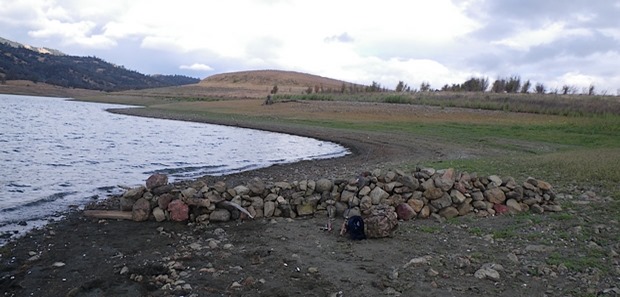
In retrospect, I started working on terraforming a piece of the lake a couple of months ago. As I am limited to about a day a week to work on the project, and while there is little shortage of woody debris and rocks littering the shoreline, it is still a two mile walk to get there, followed by hours of stoop labor carrying rocks, and another two miles back to parking area.

The 100 degree weather commensurate with a drought being merely a bonus.

That first weekend ended with sanded fingertips, what with all the grit and wet rocks slipping from my grasp. The following week it was work gloves to protect those precious fly tying fingers, but something I’d had for breakfast forced me to wobble back to the car dizzy and out of it.

With October came the winter parking area closure, which added an extra two miles to the hike round trip. That weekend ended with me dragging myself back to the car just prior to passing a kidney stone, so all the suffering endured during the ride home was a preamble to the welcome tinkle of stone colliding with porcelain.

Rockwall620

I did manage to complete three 30’ walls of rock, complete with timbers and ancillary connected debris – designed to give bait fish a hidey hole, and allow prowling bass to secret themselves in ambush. The timber and reclaimed Christmas trees I’ve imbedded in the rock work give me the opportunity to collect all manner of free fishing lures, which I consider payment from you fellows for all the sweat equity I put into the area.

Now that we’ve seen the temperatures start lower and have seen our first real rain, most of the lake is fishless. Bass slide deeper as the shallow water cools, and fishing is less of an option.

6pounder540

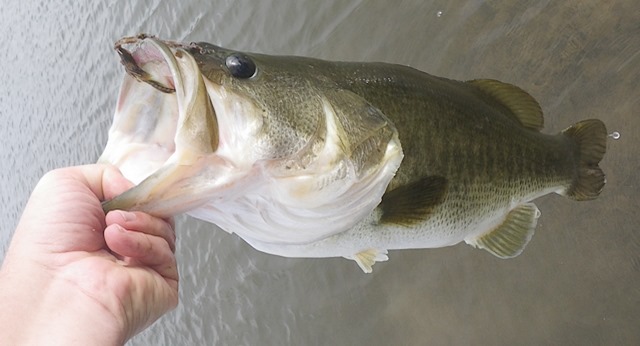
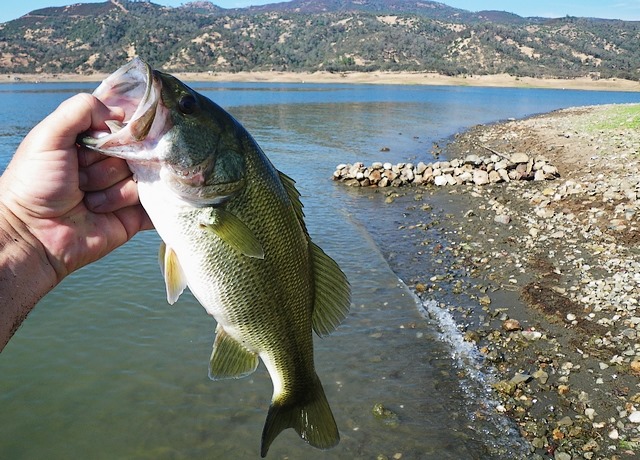
Then again, a  1/0 heavily weighted Olive Minnow, can occasionally yield something attempting to pack on the pounds prior to snoring all Winter. This is the biggest bass I’ve landed on a fly this year, somewhere between six and seven pounds.

… and tomorrow at work, when I get up out of my chair and feel every spot of soreness in my pudgy deskbound frame – I’ll know this SOB is sulking with his sore lip,  while I move gazelle-like to the water cooler to add another pound to the re-telling.

Is it worth it? Silly question …

Making Hell a Few Degrees Cooler

No parallel exists in fly fishing, and it’s another of the reasons I’m celebrating the differences between trout and bass and the lore and ritual of each.

Summer doldrums for trout fishing means a brief flurry of activity in the morning, and similar in the evening, with midday spent drinking or womanizing. With reservoir fishing for bass, it’s a bit of activity in the morning, lot’s of physical activity during midday, and a nap come evening.

Terraforming is part of my work for next year’s fishing. Building structure into an area that sees a lot of fish already, that will give them ambush points and cover to linger and become residents. Nothing beats knowing what you’re fishing over, and where the big fish sleep at night…

rockwall640

I put in two walls after the morning grab, about 25 feet of rocks and timbers about30 inches tall. As I visit this area each time, I’ll add to the walls and add a few additional walls further along the shoreline.

This makes a known fishy area able to retain more fish, gives the bait and the predators more places to hide, allows me to cancel my gym membership (next time bring gloves), and makes the midday hours productive instead of walking around blind casting.

… and it makes me feel a whole lot better than sending a check to an angling organization hoping they don’t spend most of it on the chairman’s salary. Improving fish habitat yourself means I get better fishing next year, and I’m making amends for a lifetime of torment I’ve inflicted on my finned pals.

The idea isn’t mine, there’s evidence of a lot of terraforming going on by bass anglers. Rings of Christmas trees roped together and anchored with concrete, rock and brush piles on the banks, it’s plain that the boating fraternity (and tournament crowd) don’t mind getting their hands dirty for their fishing.

Me, I’m simply hoping the ring of Hell I’m headed for is a few degrees cooler than it might’ve been, nothing noble about it.