Author Archives: KBarton10

Print my nymphs in Powerbait

I think most of the sporting fraternity would readily admit that they’re waiting on only two pieces of technology. Surely a lighter over and under would be a delight to own – as would a nine foot fly rod that could throw itself, but if you really want their research priorities it would boil down to the Star Trek broach – that you slap when you tell Scotty to beam you up, or the “Earl Grey, hot” matter-transmuter that Picard uses to summon hot tea and old Hardy reels …

We’ll have to wait a bit longer to be atomized and reassembled, but the burgeoning field of “3D Printing” should have the capability to crap solid objects out of the ether …

… so long as there’s plenty of “ink” in your printer, maybe even a fly rod or two …

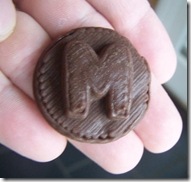
printed Chocolate cookie

As we’ve already got our expectations for junk food flavor set as low as possible, you can imagine how Madison Ave will insist on your 9 PM telly being dominated by flavorful and steaming, lush rich colors – and while your forebrain will warn you as you swipe the debit card through your computer, it’ll be too late.

… the flaccid, greasy, thing is already winging its way to you, burping itself into your outstretched hand …

It’ll be a bold new world when you press the “Dozen Adam’s” key … and I’ll be glad I’m able to skip the sodden result …

It’s one of the fifty qualities of deer hair you didn’t know was possible

I was in one of many petulant moods, lower lip pooched mightily resolved never to play parachute ever again. Every so often I’d produce a decent one, and then it was back to eleven anguished attempts to wrestle balky deer hair into a right-side up configuration just long enough for me to pin it in place with a couple turns of ginger hackle.

Each snapped thread, each spin of the wing, each busted hackle added to my rage, and while I couldn’t quite pin the issue on something obvious, it began to dawn on me that it wasn’t skill or lack of effort, it was some new wrinkle surfacing to thwart me.

It wasn’t rocket science either, I asked one of the fellows tying nearby to assist in diagnosing my obvious shortcomings, and while the both of us watched the hair resist my authoritative attempts at a post, it dawned on me that fly patterns might mention what animal is used, but it doesn’t mention whether it needs to be stiff, floppy, whether it should flair when tied in – or resist that too…

In my case I had a chunk of belly fur off a deer – whose fibers were long and poorly marked, as well as floppy and unable to support the thread base. Every time I attempted to lay a wrap around it for support it would slough the thread right off.

About then I trebled my estimate of the cost of fly tying, now that I was assured that an armload of deer hide was needed. Along with all them colors, I needed to add “well marked” and “stiff”  and “ass hair” to the growing list of stuff I was missing.

Deer Face, the best deal on deer hair ever

It’s one of those lessons that adds polish to your future work, and bridges the gap between flies you admire and your own work. Especially so when you can size the markings on the hair to the fly your tying.

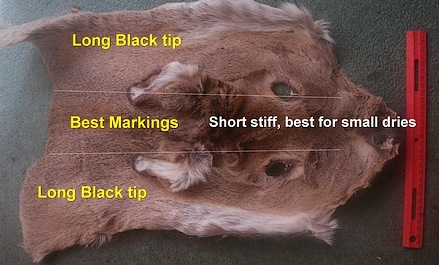
All animals have different markings and hair length corresponding to the different parts of the body. Belly hair is the longest and poorly marked (usually too light), and the strip that covers the spine is the darkest and best marked. Hair on the extremities is shorter and stiffer, as is the fine fur of the face and genital area.

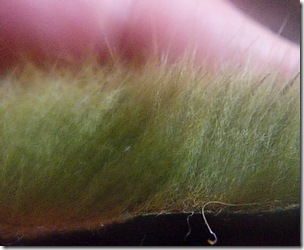
The photo above shows a typical deer mask, about two square feet costing around $10, and contains every size and marking coloration on the animal. It’s a great deal for the price, and gives much more hair than is needed allowing you to split the cost with pals, or attempting to learn dyeing with the extra …

Long Black Tip area hair

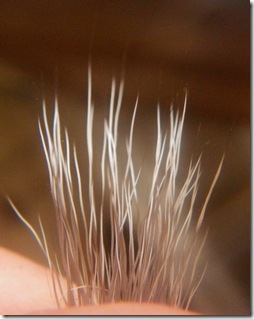
Here’s a blowup of the hair in the area marked “long black tip.” If you add only the black tip to the blond bar you already have a wing length equivalent to a size 14.

Worse, the hair is very long and floppy.

If you make a parachute wing of this type of hair it will be difficult to tie correctly (limp), and the long black tip will be hard to see – making the blond area of the wing look much too short. Ditto when fishing, you won’t be able to see those black tips at distance, and you’ll be straining to see the bump or blonde at twilight.

Deer's_Ear Contrast the above with the hair available in front of its ears, on its forehead and along its snout.

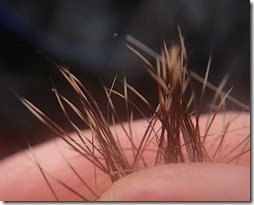
The black tip is a third the length as is the blond bar. A wing tied with this hair will show all three colors as opposed to the too-long limp hair above.

Because the hair is short it’s super stiff, and will support a parachute post without complaint.

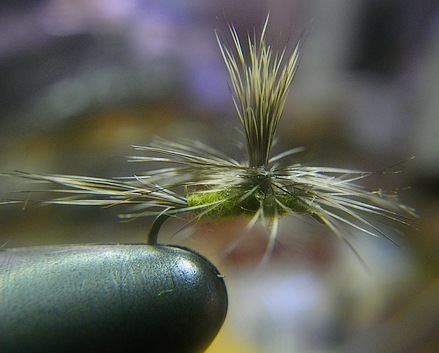
#15 Olive Parachute

Right-sizing a parachute wing mindful of the bands of color on deer hair makes the fly look complete and tidy. Grabbing fibers off the too-long side would make the above wing half-black and half-blonde, due to the length of their banding. All you could see on the water would be the little nubbin of blonde nearly flush with the waterline.

Unfortunately, so long as the jobbers hold sway on a fly shop’s materials you’ll never be exposed to all the qualities of hair from different parts of the body, largely because a 1 x 1” square of deer hair doesn’t have enough surface area to see the hair transition from neck to shoulder.

It’s these little hints that make you grip someone else’s flies and wonder how his look so much better than yours, and how you wish yours looked similar. 

You’ll be quick to understand once exposed to a big expanse of goody.

Note: Most taxidermists cut away the female genitalia, tossing the scrap into the waste basket. Should you be adventurous enough, deer “pooty” can be some of the stiffest and well marked hair on the entire animal.

It’s been washed and treated, just don’t flash it at some tying demo while you’re under the hot lights of the tying theater. Instead wait for your buddy to bare-hand his only sandwich, then you can tell him what he’s fishing.

Easily Distracted, how to tie flies the way a trout eats them

The problem with fly tying is that it’s so blasted untidy that it’s impossible to sit down with something in mind without being lured by something bright or shiny, and the result is a handful of something entirely different.

Most new tiers never see it coming, as the “Shoe-Box” phase, when everything they own can fit into a shoebox ends, and they’re so badly hooked they’ll drop all pretense at ethics or morals, and cover the kitchen table in a blink of an eye.

… nor are they mindful whose credit card is doing the covering.

It goes double for us hoarders. We’re slow hanging up all the Olive turkey wing we dyed last night, and the six or seven pounds we left dripping in the garage, none of which we dare move, have us leaving the vehicles to the streets tender mercies. Add the peroxide of beaver left on our ersatz clothesline rigged in the only shower – and colors, materials, and ideas, enter your subconscious unbidden.

You sit down with an idea of banging out a couple dozen flies for a pal and creativity takes the bit in its teeth and by the time someone starts yelling, you’ve got a couple dozen truly remarkable flies, only they aren’t what you were supposed to make.

I was content working on a new dry fly series I had dreamed up, and instead of groundbreaking and earth-shattering, I wound up with stuff that works – which is far more useful, only won’t boost the myth and legend of any memoirs I might later publish.

Fluttering_Caddis_Dry

Too many pieces of lightened beaver lined the garage drying, each possessed of seductive tan guard hairs suitable for the Fluttering Caddis dries of Leonard Wright’s, “Fishing the Dry Fly as a living Insect” fame.

I’m off on a tangent with original intent forgotten while I find the least-damp Olive turkey wing for biots, replacing the authors original pheasant tail fibers. I think the original Fly Fisherman magazine article suggested Mink guard hair, but beaver is free, closer, and willing …

One you can lick your fingers, the other you can’t

You hear the term often in fly tying, you just don’t see anyone actually doing the deed – outside of the occasional Peacock eye made hairless by swishing it around in caustic bleach, which is about all I’ve ever seen anyone do …

Which makes a lot of sense, as everytime I’ve touched the bottle it meant I had more than enough and didn’t mind destroying a couple square feet.

I’ve always accused dyeing as the Destroyer of Materials, but that’s just to scare them with weak constitutions. When the material dries you may not have a good color, but at least you’ve got something …

… watching something bleach will cure you of the temptation to do it again. Soaking a piece of fur in straight bleach is not what you’d expect; the bath starts to heat to the point where it may melt the plastic bowl, likely a reaction to chemicals the hide was steeped in during the tanning or hide preparation process, then hair and flesh start vanishing and the rest turns into a flesh colored slag that covers what’s left of the fur with a gooey bubblegum residue.

Eventually you kind of back away until the temperature lowers to the point you can toe what’s left into the trash.

Bleached hair patches and lightened colors on furs and feathers have typically been treated with Hydrogen Peroxide or similar lightening agent.

Hydrogen Peroxide is available in any supermarket or local drugstore, it’s an antiseptic and is sold as a 3% solution in the aisle with medical supplies and liniments. This concentration can lighten hair (human and animal) with numerous applications or one long soak.

"Bleached" Beaver - and some I've dyed yellow

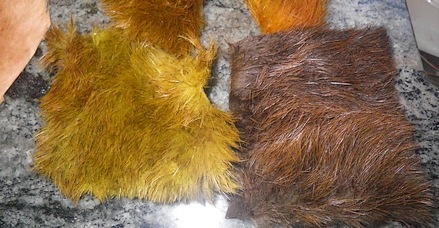
The center color above was “bleached” in a single bath of 3% peroxide. It took 92 hours to achieve this color from its natural gray. Four additional pieces I’ve dyed yellow ring the bleached color. As it is now, tossing a chunk into a drawer ensures a lifetime of Light Cahill’s.

Natural Beaver contrasted with dyed Yellow

Natural beaver is much too dark to be able to dye into light colors, at best it’ll turn muddy-dark. The above pieces were dyed in the identical pot for the same amount of time. Only the bleached hide can achieve the light olive I was attempting.

Light_olive_Beaver

So long as the fur is completely submerged the peroxide bath will ensure consistency of color. Note in the above photo how the Olive color is uniform from downy underfur to the tips. This is done by first pumping the back of the hide to force all the air bubbles out of the material, then dumping the result straight into the solution without wringing.

Beaver guard hairs will resist the dye mightily, and might only take on a tint of the desired color, this is true of most tough hair, especially those of the aquatic mammals.

Peroxide Orange Beaver

Hair stylists use a powdered lightener along with Hydrogen Peroxide to avoid “orangey” colored hair like the above. Internet forums mention that straight peroxide often yields an orange effect on human hair. Once the fibers are any shade close they should be pulled and dried anyways, as they’ll lighten into a tan-orange which is perfect for our later applications of dye.

Peroxide is available in food grade as well; solutions ranging between 8% and 35% and a cost commensurate. These will cut the time down significantly, 12% took the same beaver from gray to tan in just over 18 hours, but the solution costs around a dollar an ounce at that concentration. Most of the higher concentrations have to be mail ordered and signed for by someone over 18 as well.

Every animal is a bit different both in qualities and texture of their hair, and degree of lightening needed to reduce their natural color to something light enough for dye. It’s best to experiment with small chunks to determine how long the base 3% will take to render an appropriate shade for your use.

Just tuck a large bowl of the cheap stuff ($2.00) into the garage, carve the hides into 5×5 pieces and check the mix come the weekend, there’s little risk of it getting too light.

Does a slammed door mean landed or released?

Natural Beaver on Sunday April 24I think it necessary to occasionally give the gals credit for putting up with us. While I’ve changed the names to protect the innocent, rest assured this conversation is merely one scene among many …

(I call it “Kiki’s Guide to landing Keeper Wimmen, Fly Fishing Edition.”)

At my domicile, each time “Herself” arrives from travel she has to tiptoe around all manner of obscene things I’ve drug in from the out-of-doors. As she reacquaints herself with her surroundings, tiptoeing over the experiments in the bath tub, rotting flesh in the fridge, unknown lint and feather dander flitting about gaily, yet it’s taken in stride knowing someday all these fly rods charged to her credit card will be a one way rocket ship to wealth and infamy, and Oprah … not necessarily in that order.

Yes, I may have to kill and eat this one …

Fade In:

Natural Beaver Wed 27th 3% solution[Pointing at the sink] “Uh, what’s this? – can I throw it away?”

[Mock Terror as he rushes to defend] “No, that’s the experiment I’m running to see how many days it takes 3% Hydrogen Peroxide to remove the natural colors of a piece of beaver. I need that for a post next week.”


[Pointing at the Floor] “What about that (wrinkles nose)?”

Copper and Skins [Mock Terror as he rushes to defend] “No, that’s me attempting to make copper mordant so I can use that big bag of onion skins you asked about last week, how I was going to write a post on natural dyes and the number of different colors possible from pillaged onion husks.”

[Cross Arms on Chest] “Okay, surely I can throw out the smelly thing on the plate!”

[Mock Terror as he rushes to defend] “Only if you want to go hungry, that’s your dinner, Cupcake …”

Fly tying materials that grow on trees

I thought of it as answering one of many questions I’ve always had about watersheds and how soon they recovered from obvious trauma.

Travelwriter had spied some rising fish in a stretch of the river that was normally bone dry this time of year. Adding 170% more water to the stream means the farming community can’t suck it all down, and would as soon avoid doing so given the mattress springs, dead bodies, late model stolen-everything – all of which is tumbling in the current, surely to foul pumps and pipes alike.

Huff's Corner at 40-50 feet

BEFORE

That additional volume makes banks vanish, holes get created, and sandbars move miles overnight. Understanding who survived all that carnage would fill a big hole in my understanding of floods, fish, and who wins what …

Huff's Corner post flood

AFTER

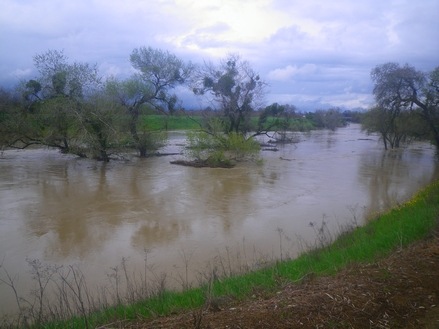
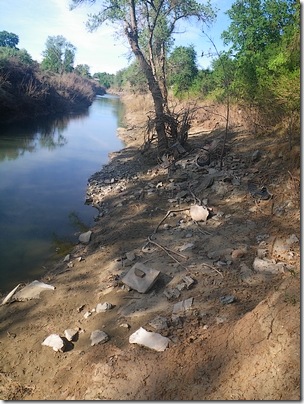
Note the shrubs, trees, and grasses are completely vanished off the right side of the creek, leaving only a single innocent looking tree that isn’t quite as innocent as it would seem … as I found out later …

The water was about 40-50 feet deep here a couple weeks ago, now it’s only a foot to 18 inches in most spots.

I went down the next evening to investigate, as I skeptical of “mystery rings” and whether anything could have survived given the above circumstances …

Pikeminnow survives Tsunami

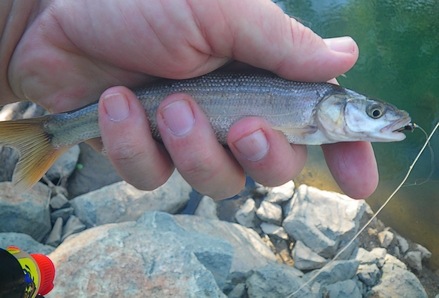
The stretch had become repopulated with about a dozen 4-6 inch Pikeminnow. Last season, the second since water was restored, the Pikeminnow fry had grown to three inches in length. The length of these suggests they’re second year fish.

Making these survivors of two massive earth moving floods (last year was wet too) I’d guess these fish survive by staying near the bank – despite the bank being a hundred yards from its historical norm.

I managed to land three or four fish – all similarly apportioned and nary a mark for their ordeal. 

Unfortunately they’ve survived only to die due to evaporation – which will start shortly. I may bring down a bucket and relocate what I can catch –  the creek is still starved of citizens and I don’t mind getting dirty. I’ll call it “Pee You” for Pikeminnow Unlimited – as I’m the only SOB willing to stick my neck out for a cockroach …

As I was there for a scienctific purposes, I hunkered down largely oblivious to my surroundings. I’m tossing cottonseed dander imitations and small nymphs into a small, deep hole in the wide part of the bend.

After pulling three or four fish out of  it’s depths I’m satisfied they’re all Pikeminnow, so I ease down the bank into the shallows below just to see if there’s any other activity .

The wind shifts abruptly and I get a faceful of meat decay. It’s close and I’m thinking big animal, yet dreading turning around and finding someone’s kid wedged in the crotch of a tree, victim of some upstream flooding accident.

I’m backpedaling while attempting to hold down the evening meal – all the while scanning the riverbank, underbrush, and everything else nearby, and nothing.

rotting_turkey

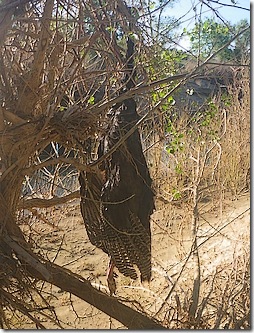
I ease around the tree and find Big Bird, the wiliest of all Mother Nature’s game birds, slammed into a fork of the tree at speed, and becoming more fragrant by the moment.

Naturally a moment of introspection was needed, especially as the little Angel on my shoulder was in heated debate with the little devil on the other …

The little angel claimed, “Dude, forget the bragging points, your girl is arriving tomorrow and the use of refrigerator or any other storage on your premises is completely out of the question!”

The little Devil snorted in contempt, “Dude, call yourself a Man? Don’t think of the rotting and swollen beached seal you cut too deeply, this time you’ll be able to get the stink out of your clothes easy, by tomorrow even!”

… just the thought of the rotting seal episode was enough, even if I was doing it for Science …

Wherein we profess a weakness for four letter fly rods .. and their makers

The entire idea of a much ballyhooed “lifestyle” brand is largely lost on me, my shortcoming entirely, nothing wrong with the rest of you. Guys love wearing other people’s advertising, and I don’t – insisting that Jim Beam pay me for the privilege.

( … and due to the vast expanse of my pasty and sodden flesh, it better be at billboard rates …)

But I get the idea in theory – whose intent suggests you like something enough to buy their other products, or recommend them across the board, or that you’re branding your arse cheeks with some companies logo because you are committed to their policies and neo-industrialist war mongering products …

Or there’s the nonchalant fly fishing variant, bastardized of any real nobility by changing it into a “support my feet up, beer swilling, fishing lifestyle by dumping large coin for my washed out tee shirt that we’ve emblazoned with a cool logo.”

Naturally all this is going through my head as I’m suddenly confronted with a rod company claiming it’ll sell me the graphite rod of my dreams for $233, featuring an extra tip, a case and sock, with the additional promise of weregonnadonate20%oftheproceedstothefish

Case, Sock, And Extra Tip

That’s rarified turf by any means, and I simply had to support them for no other reason than give Harvard Business School some heartburn …

So I ordered a 9’ #4 to replace my backup trout rod – which was starting to show the wear of real abuse, given its infancy rattling around the boat followed by rattling around the back of my truck.

The rod arrived in January and while both of us were largely idle, we managed to dance outside in between squalls and beat the lawn to smithereens. It felt responsive and supple, so we took it to the creek and tormented ourselves by roll casting over the late model Nissan’s breaking apart in the chocolate water …
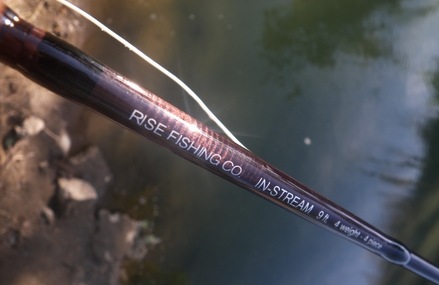
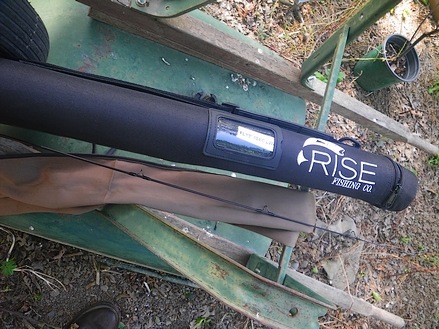
Rise Instream  9ft #4

It’s a nicely apportioned rod, with a crisp action that smacks of the RPL III days of Sage. The picture above gives you a glimpse of black wraps on brown blank, and the simple block-letter label.

It has a simple “Made in China” label on the reel end, which made me pause not at all.

This is a fishing rod, not a garish streetwalker, this is that “lifestyle” tool that suggests, “if the #4 was rock solid, I bet the #7 is tasty too.”

… and it’s about time for an inexpensive rod that you’d feel brokenhearted if you sat on it sudden-like, but wouldn’t break you to replace it . It’s the rod you give your kid on his fourteenth birthday hoping he’ll take it up permanently, knowing the rod won’t be an issue until he’s expert … and then only maybe …
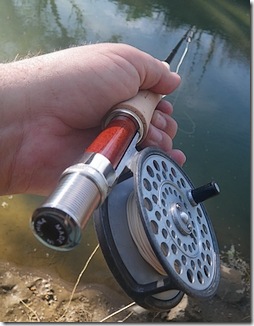
I equipped it with an LRH Lightweight which was a nice pairing

Sage-like action that I’d call  “crisp,” neither too slow or too fast to alter your casting stroke, and when you suddenly change direction because of a rising fish or low hanging limb, it responds quickly without feeling slow or overburdened.

With my known preferences on rod speed and recovery rates, it would be a #4.5 in your language. Enough power left in the spine to throw a #4 with authority, and it wouldn’t feel awkward with a line size heavier.

The fittings are sturdy and unremarkable, like the gleam of a new Craftsman hammer. Solid, business-like and competent.

Cork work was better than average – with few filled crevasses and no unsightly color mismatches.
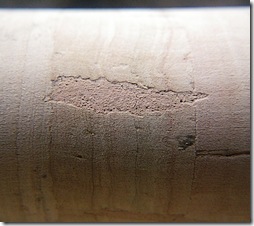
Rise Instream #4 cork gripTypically a rod maker fills any gaps in a cork handle with sanded cork mixed with adhesive. Poor cork quality yields overly large areas that need to be repaired, and can result in a color mismatch, which persists as handling oils and dirt will color them slightly different due to the adhesive being present.

The largest crevasse in the handle is shown at right, about half an inch, the balance of the handle was immaculate. This is indicative of quality cork and quality control.
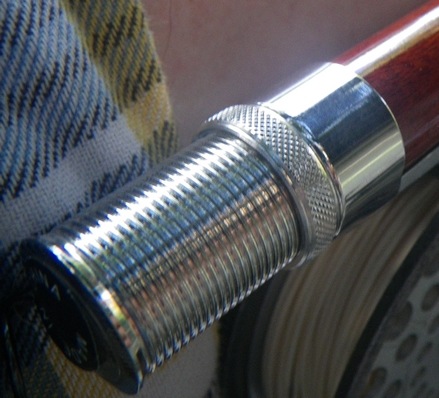
Rise Instream 4: Reel seat threading

If there’s any component on a fly rod worth cursing it’s the reel seat and its thread. You’re unwrapping a bad cast from the tip of the rod instead of the water, and while doing so – dragging your reel and reel seat in the sand on the bottom.
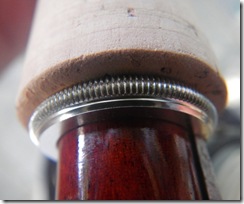
Rise Instream #4 Reel seat beautification trimNaturally we’ll find out it’s jammed once its black dark, the assembly rendered balky due to grit in the threads.

The Rise reel seat has a broad thread that made it difficult to tell whether it was sharp or dull (triangular or square thread), sure sign of some rounding. A single knurled sleeve fastens reel to reel seat – and while I’m more comfortable with the second locking sleeve, it’ll do on a light rod.

I may rethink that on the first 12 lb carp I hook – but for the moment I’m content …

The balance of the fixtures include a knurled hood imbedded under the cork to complete the remainder of the reel seat, shown above.
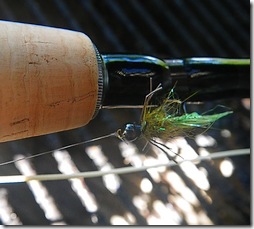
A Hook keeper, someone thought of me But the biggest surprise was finding that the low price included a hook keeper – which due to habit, I find to be an essential component of my scramble up banks, brazen dash through bramble thickets, and for quick and lazy disassembly of rods for that drive to the next hole.

Guides are two footed; two carbide, 7 snake, plus the tip.

Below is an example of the finish on one the largest carbide stripper. Laid on thickly as is customary, nothing out of the ordinary.
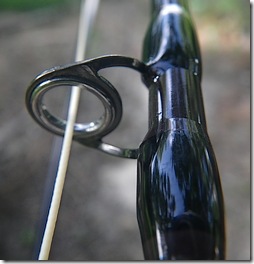
Rise Instream #4, Stripping Guide detail

Testing the four pieces of my rod shows the blank is not aligned on a single spline prior to the guides and grip being mounted. Two of four pieces  lined up, the remaining two placed the spline on the sides of the rod.

My preference is for all  component splines to line up, but as this is a hotly debated issue amongst rod makers, I’ll leave you to the opinions and mercy of your local rodmaking Sensei.

Buying a rod on another’s say so is a tremendous leap of faith, yet after four months of fiddling around trying to find something I don’t care for on the rod – the best I can do is the block lettering is unsuitable, fly fishing should have something light and airy – and in cursive …

All I’m suggesting is that the nice people at Rise have earned my admiration, mostly because I adore an action like those early Sage or Echo tapers.

… and while the rest of the crowd lusts after “hedge fund” rods from the perfumed darlings of yesteryear, I’ll stick to my Asian imports and continue to make payments on my house.

High priced painted strumpets we’ve got a plenty, and I’ll let their fanbois argue their respective merits, what’s been sorely needed is the “Craftsman” rod – a rod that costs commensurate with a hobby, a lifetime tool – one that won’t take a lifetime to pay off ..

Full Disclosure: I purchased the above Rise fly rod at full retail, which should have been $233, but I was volunteered to save New York state to the tune of eighteen dollars. It was later refunded.
Free Range Dubbing: Unless you’re looking at it in direct sunlight, you’re not seeing what I made for you

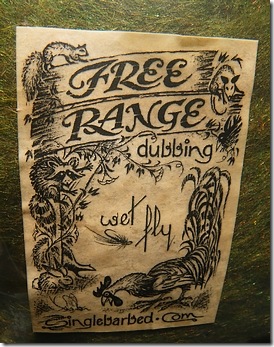
Free Range Label I figure my sudden foray into dubbing was like McDonald’s adding salads to an otherwise lard-based menu. How the lights abruptly dimmed and the sudden demand for lettuce left most of the country rediscovering Broccoli for their evening meal.
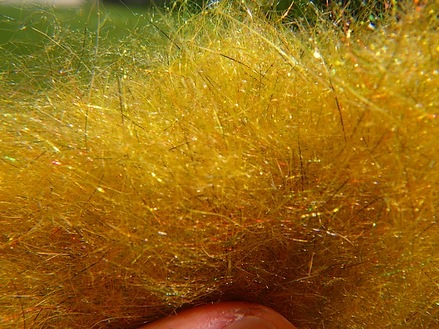
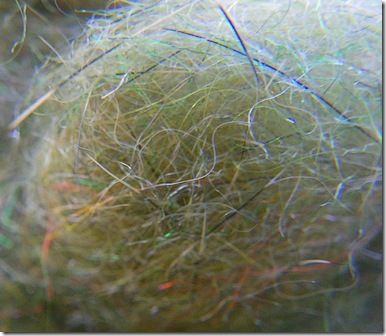
Like the gals and their hair extensions, I was unfazed that I emptied most warehouses of everything furry. I started with the wholesale furriers, worked my way through the local stuff and fur coats on eBay, and when I’d exhausted the obvious sources, I’d make the call to my contact at the SPCA to see what was chilling rapidly …

A couple of months worth of effort turned into the better part of a year’s worth of research, failed automation, test groups and test colors, research on color mixing, dyes … and worse, suddenly needing to find vast amounts of odd animals to include once refined to their final formula.

Failed automation meant having to do it all by hand in the kitchen. Meaning it’s been a lonely year – bread, water, and solitary confinement does that to a person …

All of this started off simply enough, a general indifference to the dubbing products available in today’s fly shop, most of which featured some sparkly synthetic as its only real quality. Absent from the shelves are the natural dubbings of the past; crafted to make it easy to apply on thread, or coarse so its stubbled profile resembles something comely, or all natural featuring aquatic mammals to make gossamer thin dry fly bodies.

Instead were pushed towards some glittering turd that is about as easy to dub as a Brillo pad, and sparkles like a perfumed tart.

So I brought the manicured styles back; finding in the process that few tiers are left with the skills to refine dubbing to specific tasks, fewer relay the ritual to print to teach others, and most new tiers are content with products the way they are as they’ve not been exposed to others. It’s as if the qualities of fur and the skills to turn them to our advantage are disappearing.

As mentioned in previous posts on dubbing, there are three distinct layers in a crafted dubbing, allowing you to insert distinct qualities as part of each layer’s construction. I’ve likened dubbing construction to a cigar, where the finished product contains binder, filler, and wrapper.

The Wrapper is the coarsest material, often made of animals with well marked guard hair, suitable for adding spike and shag to the finished blend.

The filler is often the coloring agent, made up of semi-coarse or semi-fine materials that comprise the bulk of the dubbing…

… and the binder is the softest component, which is often added in proportion to the filler and wrapper to hold all three layers together in a cohesive bundle.

Somewhere in all of this can be a fourth layer, not always present, that I call “special effects.” Shiny or sparkle, pearlescent or opalescent, some quality that natural materials lack which can be added to liven it with color or a metallic effect.

Free_Range_Dubbing2

The Free Range Difference

What I’ve constructed is a dubbing designed to assist both beginner and expert tiers by including specific desirable qualities that should belong in any quality nymph dubbing:

Ease of Use: The material isn’t unruly nor possessed of qualities of some Brillo-style gaudy synthetic. The soft binder layer entraps the spiky wrapper and makes dubbing the fur onto the thread easy.

Sized for 8 – 16 hooks: All the fibers present in each color have been sized to best fit your most common sizes of nymphs. That means you won’t be yanking too many overly long fibers out of your dubbing, or off the finished flies, as even the multiple guard hairs used have been chosen for length as well as coloration.

Minimal Shrinkage When Wet: The fibers of the filler layer, which comprise the largest part of the dubbing as well as most of the color, are chosen for their curl, so they will maintain their shape wet or dry, and what proportions leaves your vise will be retained when the fly is soaking wet.

Blended Color versus Monochrome: Each of the colors is the result of between 5 and 11 different materials, each with different shades and tints that add themselves to make the overall coloration. Like Mother Nature, whose insects are never a uniform color, each pinch yields a bit of unique in every fly tied.

Spectral Coloration: The special effects of each are often synthetic spectral color components, containing a range of colors that are sympathetic with the overall blend color.

Only Buggy Colors: We chose to concentrate our colors into traditional insect hues leaving the lightly used colors out of the collection. Most fly tiers have a drawer filled with colors that are rarely used, we’d prefer to focus on the “money” colors like olive and brown.

Rather than a single color of Olive, we’ll offer a half dozen olives – as they’re far more useful than coral pink or watermelon. We’ve done the same for brown and gray, and even added effects to make more than a single black.

Food-based Names: Everyone knows that colors named with food references are twice as tasty to fish. We got’em, they don’t – ’nuff said.

Twice as much: Earlier in the research phase of the project I discovered the average dubbing vendor now only gives you 0.91 of a gram with 2 grams of brightly painted cardboard. I’ll give you a couple grams of goodie, and a biodegradable slip of paper instead …

Free Range Dusky Olive

What it isn’t …

It’s not going to leap onto your thread unassisted, nor will it make your fingers less tacky and curb your propensity to grab too much. It’s not some painted harlot made gaudy by too much color. Special effects are nearly invisible to the eye, representing about 2% of the fiber, and until the fur is moved into direct sunlight, only then can you see the refractive elements that make the mix glow and sparkle.

Naturally once someone says, “ … and the trout see …” Everything past that is a leap of faith. Millions of nice fellows have roused from their cups to pound  table and insist trout love something or other. This entire collection is my sermon on colors and textures, imbued with everything I hold sacred.

Until I can get some automation in place this is more a labor of love than  profit. I managed to incur some fierce loyalties to the end result from many of the folks testing, and with a new season about to debut and them tying to make up for lost time, they’re looking for me to live up to my end of the bargain.

I have 20 colors completed and am planning about 10 additional colors to fill gaps. Most of the Olives and Browns and Grays are completed already, I just need to see what I reach for that isn’t there.

Yes, we’re a bit ahead of our supply lines still, but the season starts next weekend, and I can’t have you feeling naked and resentful. I figure after a couple trips into the season I’ll know exactly what’s missing.

If you would like a sample of the dubbing, drop me a note. I’ll put something in there you’ll like and you can send me a stamped envelope to cover my expenses …

Where they sleeps at night

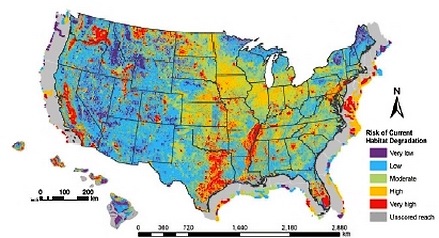
The National Fish Habitat Board just released a summary of the risks for watershed and habitat degradation for the entire US.

Overall, 27 percent of the miles of stream in the lower 48 states are at high or very high risk of current habitat degradation and 44 percent are at low or very low risk.  Twenty-nine percent of stream miles in the lower 48 states are at moderate risk of current habitat degradation.

fish_habitat_at_risk

It’s the usual suspects that are causal agents, most being activities of us humans, and the harsh chemicals that run off our land when it’s turned to industrial uses.

That harsh red band splitting California is where I live and fish, suggesting at least one stalwart crept to the edge of the bridge and tossed some vial into the murky brown below.

The report is very light on science and a suitable read for the average angler, if you’re interested in a map of your state and a brief mention of projects and issues, take a look at the 72 page PDF.

With cutting edge carbon technology

The process wherein you become your father is long, memorable, and completely horrifying. One day you’re dutifully changing your oil at 3000 miles, only to be reminded that no one does that anymore.

… or your painfully enduring some meeting that’s prolonged by the speaker feeling it necessary to answer his smart phone at every ring, holding the balance of the table a yawning captive.

The phone may be smart, but the SOB using it has the IQ of a cucumber.

What was once  the childish wide smile with face pressed against the fly shop glass has become the “Bah, Humbug face”  – worn only because you own everything good already, and the only thing missing is new, which may or may not be good.

Once we broke the fifty-bazillion modulus barrier, we listened patiently to the superlatives and dismissed ownership out of hand, we’d fallen for that lure back when we could achieve modulus at the mere sight of a sale, or just a fistful of red saddle hackle. Now that we’re in our dotage it isn’t cutting edge carbon technology we’re seeking, it’s just a quiet moment on the john.

And if it has a remote, heated seat, hidden bidet, has quadraphonic stereo, and has the suction power of a Death Star’s tractor beam, including all air in the bowl treated by carbon filtration, the price is goddamn academic …

After a lifetime of icy duck blinds, frozen limbs due to prolonged immersion in icy steelhead water, suffering all manners of discomfort and poor sanitation, handfuls of leaves that prove less so, I’d consider dumping six grand on a bonafide engineering marvel.

The touch screen controls may not have been such a good idea, at least not for us fisher-types.