Author Archives: KBarton10

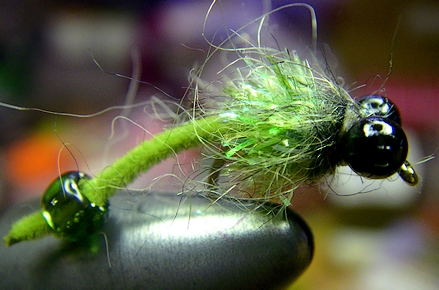
We left the beads at home, enjoying the spectacle of “weightless” fishing for a change

Nope, there’s no gaudy beads or feelers, no articulated body parts or rare materials to keep you from owning these killers immediately …

… although there is that trust thing …

Nor will I mention the hair extensions you’ll have to tear out by the roots, or the groans of the feminine members of the household as they watch fashion disappear into the firm grip of your hackle pliers …

Yes, the Boys of Summer – the top killing flies of my recent trip – were all dries.

Silver_Creek_Dry

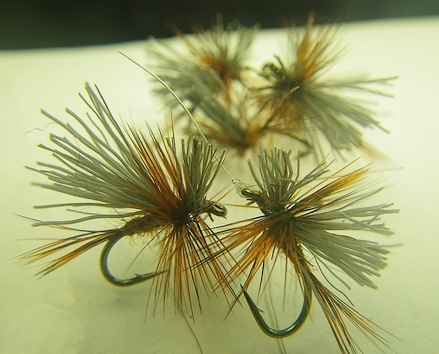
Most of the fish killing was the result of my earlier experimental the “Hovering Predator.” Little surprise given that it has the mayfly upwing when dry, the downwing of a caddis when wet, and as much deer or elk as a full dress Humpy or Elk Hair Caddis.

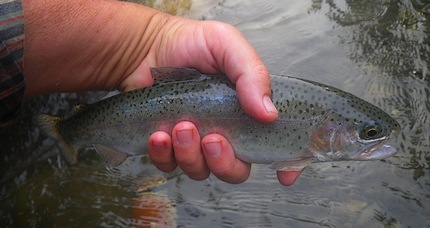
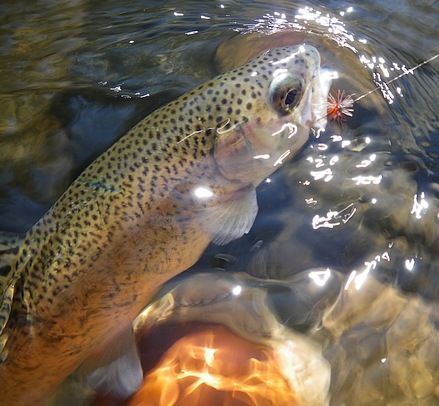
The fish above gave it about a microsecond before inhaling the beast deeply.

Fiery Hovering Predator #16

These are so much quicker to tie than a Humpy, and uses only about three turns of hackle per fly, relying instead on all those trimmed deer hair butts to give it a high floating three point stance. I doll it up with floatant to preserve the mayfly silhouette in slow water – and fling it without regard for dampness in the faster currents.

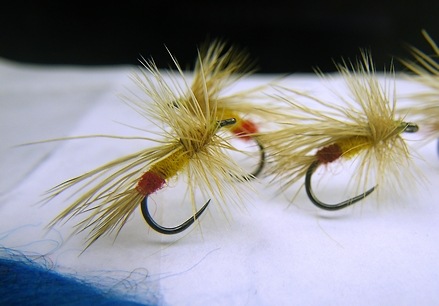
Hat Creek Yellow Sally

Second best was the time honored Yellow Sally I was introduced to at Hat Creek. Bright yellow body and scarlet egg sac, natural elk tips and ginger hackle complete the fly.

The Little Yellow Stone is a summer constant in the Sierra’s – and anything yellowish is sucked down with great glee by fish used to seeing it flutter by. In low light and with old eyes, it’s a welcome spot of white that can be seen immediately, and makes us geezers on equal footing with the younger crowd.

I tied all my dry flies on the fancy barbless tournament steel for the last two years. Not so much a preference as it is research in progress, a future article that may aid you in calculating their value to the casual angler.

Where we eschew Wild Trout in favor of the Wild

With all the attention on the West and East Forks, in light of a wild trout designation and the attendant hordes that frequent such places, it’s not surprising we opted to dabble in the group scene on the East Fork – and spent most of our time on a much smaller creek found by accident, whose virtue I felt was largely intact, despite the many pilgrims whizzing by in search of the wild or trophy fishery.

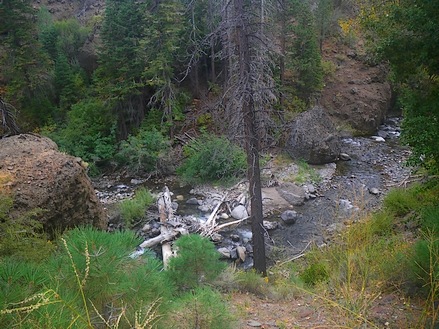
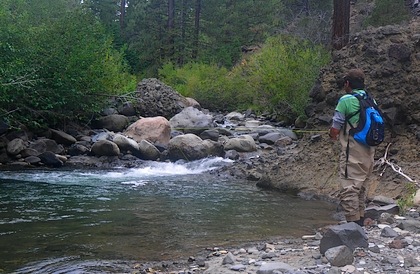
Silver Creek, Wolf Creek Bridge

Small streams offer an intimacy that large streams do not, and I’ve been too long away from their welcome tinkle; where the muddy footprints are yours, the scrape of a cleat on granite sounds jarring, each plunge pool a mystery, and each fallen log welcome shade from which some silver lightning bolt will materialize or vanish.

They’re always physically arduous, doubly so when wearing the restrictive rubber band of waders and the full fishing regalia that accompanies new water – where you’re not quite sure if you’ll need every fly ever made, and double that for tippet …

… where with a precarious foot on the uneven rocks of mid channel, you can wipe the sweat from your hat band, gazing backward at the steep grade you’ve already fished, and forward towards the unknown – and the steeper incline it hides. Where you can pause for a welcome blow that comes from knowing that those out of shape couldn’t last – and only D. Boone and his ilk are fit company.

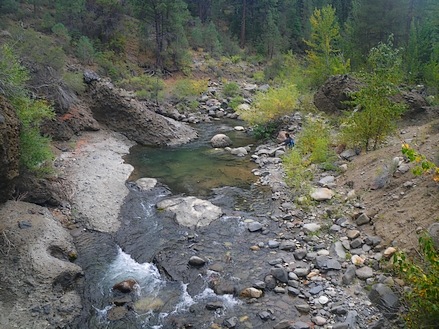
Silver Creek from Highway 4 above

Silver Creek drains Silver Lake (Ebbet’s Pass) and offers something pretty to look at while plunging down Hwy 4 to the East Fork of the Carson below.

Access is limited to the occasional gravel pullout and from the Wolf Creek and Silver Creek bridges – which bookends the long downhill run from Ebbet’s Pass to the East Fork.

All the fish are planted and seem to distribute themselves throughout the watershed, in contrast to the balance of milling, confused throng in the bridge pool.

Silver Creek Rainbow

A Silver Creek rainbow pulled from a deep plunge pool complements of an experimental dry fly.

It’s the kind of “shortened-leader, slam-it-down” dry fly fishing favored in these small stream, steep gradient creeks that drain both sides of the Sierras. The fish are not overly selective so much as opportunistic – given the insect will be lost in the bubbles in a fraction of a second, and their diet is equal parts aquatic insects mixed with odd bits of pine needle, leaf fragments, cigarette butts, or anything looking about the right shape and size.

Kelvin_Silver_Creek

It was completely delightful to simply exhaust yourself in the climb, lose yourself amid the intimacy and charm of the small stream experience, and then scrabble up the slope to the freeway, reminding all those air-conditioned faces pressed to the glass that the woods is an awesome fearful nightmare, populated by scratched and sweaty fat guys on the verge of a heat-induced coronary.

May all who fish here enjoy it as much as I did

I’ve got enough solid information after spending the last four days afield to keep you entertained for a couple of days at the least … But before we get into all those tales of daring-do, the overcoming of adversity, and the weakness of wild trout for Peach yogurt, we’ve got the odd tale of the Bridges of Alpine County …

… and how the local chamber of commerce, in an effort to woo those painfully scarce vacation dollars have decided to treat us fishermen especially good, by paying for a constant stream of brood stock to be pumped into the shaded pool at each local highway bridge.

There to be fought over in a hail of pre-dawn Kastmasters, Rooster-tails, and every BB equipped nymph known to Angling-kind.

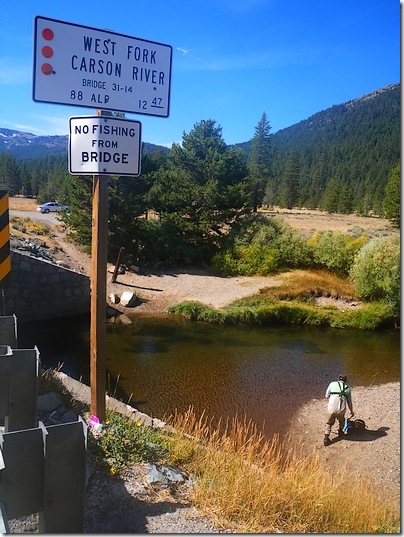
West_fork_bridge

Rather than accidentally enrage anyone at the concept, I’ll go on record as having no issue with carnage of any kind – fly or otherwise. Nor do I care whether a brother angler kills his fish or spares them. I’d suggest an only caution that at this late stage of the game, it might be prudent to only kill what you can eat, given most of the world’s fish supplies are dwindling and many are already farmed, and wild-caught anything is in ever-shortening supply.

As I’d not been to the Carson River before, and eager to begin assimilating data, I slowed to a halt at the first bridge and its gaggle of parked cars drawn onto the shoulders, to present my hindquarters to traffic while I peered over the rail and into the depths below …

… there to see six or eight anglers frantically lobbing death at an imaginary spot 14 feet under the bridge, wherein lay the precise phalanx of recently baptized hatchery fish finning silently amid the concussive thunder of thrown polished steel.

A stringer at the bank attests to fly fishing’s superiority, and the owning angler proudly displays a limit of five 4-pound fish, most belly up, but the occasional movement of a fin suggests while imminent, death is still at arm’s length.

I complement the angler on his catch, while ducking him and a pal lobbing two BB shot and a beadhead nymph back-hand under the bridge.

His advice was to be repeated by every grocery store, gas station, waitress, motel employee, or good natured local, who like stock market pundits – each had a favorite bridge and the knowing wink that accompanies, “ … and they just planted there last week.”

I’m just not used to it.

The bulk of my excursions in recent years have had some wild trout agenda or restriction, or I was simply far enough removed as not to have a lot of human interaction, angling or otherwise. While none of this makes me blanch overtly, the scene was repeated so many times over the course of the next four days, it makes me wonder whether the contented angler, as defined by Fish & Game’s “Put and Take” hatchery management – isn’t having the out-of-doors removed from his piney woods experience.

Certainly a concrete abutment isn’t a pine tree – nor is the constant hum of overhead traffic, which can never be confused with normal “woodsy” wildlife noises or the sigh of a light breeze in the tops of tall pines. Whether you’re parked on a sunny rock or Styrofoam cooler, the watchful gaze of those spectating – and those coveting your spot – must make the multi-hour drive no different than the checkout of the local grocery store, with the warden displaying momentary outrage when you’re discovered  bringing 9 items to an 8 item checkout.

The thoughts about bridges came unbidden, in part because of the reflex stab at the brakes when you encountered them undefended, and part because I wondered if there wasn’t a larger notion involved.

On one level, twenty pounds of hatchery fish dipped in five days worth of clean water, isn’t quite like dry-rub ribs, which can be smoked for eight hours then flamed to perfection. Rather, six months in a concrete trough eating dough-bait and floating excrement from the fish next to you, then baptized in a bit of clean water will make you pasty-flavored at best, given the temperatures of that trough aren’t cold enough to build firm and succulent flesh …

… which means my brother angler is about to show his spouse (and his entire neighborhood) 20 pounds of pasty white flesh that tastes only a bit better than licking the glass of an aquarium …

… and fourteen pounds of it will likely wind up lining his or his neighbor’s trashcan.

Which is the tiny bit of censure I’ll allow myself, given that wanton body count is a feature of my Dad’s sport (and his Dad’s sport) and we can no longer afford such waste.

But the other thoughts that came unbidden – was how the bridges serve as some unlikely metaphor of us as anglers; how we leap into the sport as young and impressionable, largely unaware of anything other than catching – and how with a bit of maturity and some experience do we realize much of what draws us back is between the bridges, and how as we acquire experience and preferences, spend most of our angling careers there.

Dry fly Purism, Wild trout, fly tying, conservation, and entomology, are a small fraction of the many wonders of that journey, as is the out-of-doors and the incredible environments wherein we find ourselves and our quarry.

… and later, when old age and infirmity permits only a short shamble from the car, how we return to those bridges – and how welcome they are given the certainty that one day, from some unfeeling hospital bed, even they will be lost to us.

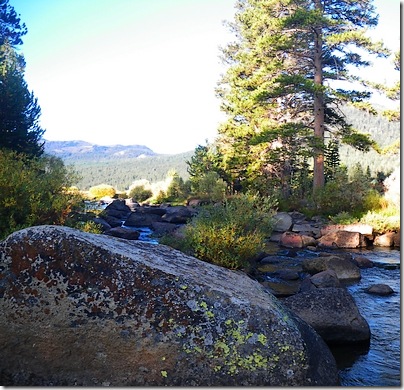
West Carson - Hope Valley

Like you – I am still mid-journey. I left the comfort of the bridge and its supply of wallowing fat fish and walked the entire valley following the West Fork of the Carson while it wound through grassland and willows. A bit down the trail was a park bench with an inlayed brass plaque inscribed, “May all who fish here enjoy it as much as I did” – with a brother-anglers name who died some eleven years ago.

While the water and watershed were intact, there wasn’t a fish to be seen in the entire three mile walk.

A stunning watershed with classic undercut grass banks and deep outside bends that would have held large wary fish – requiring hands and knees sneaking versus marching to the edge and flinging a downstream cast.

It was a rare glimpse of some fellow’s treasure, a relief that he was no longer part of any issue, nor could see his past glories diminished – and a bit of thought towards our unique form of stewardship given those Bridges of Alpine County.

It’s like your Momma, only she hands out Adams’s if you’re good

Back when I was young and virile they invited me because of all the dope I smoked I was in tune with the fish, I knew what they ate and where they slept at night …

Now that I’m simply another aged burden on society, I’m thinking that with this new slimmer physique, how I’m liable to scamper over those steep railroad embankments like a damn Gazelle, and how them as is with me will be sweaty, panting, and begging me to hold up.

Polenta_Italian_Dinner Then I heard them self-same pals at work mention, “Him? Yea, I’m, going with Fatty, mostly because the SOB cooks better than my wife – and is the only source of Grizzly hackle between here’n Nevada.”

I think the term is “crestfallen” … but it might be “dashed” instead …

Now that I know my real value I’ll be serving Livermush and Collard Greens to the next group of rowdies, and you can kiss my %&# for a replacement Yellow Humpy – or anything else for that matter.

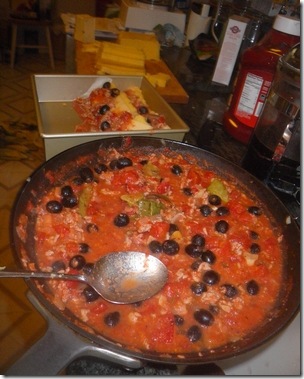
The real trick is simple and hearty food designed to warm a fellow from the sudden chill of elevation and the beginnings of Fall. Layers of Polenta and Pepper Jack, draped in a flavorful bath of spaghetti sauce infused with Basil and Bay leaves …

I’d describe the result as a “slashing rise” – there’s no timidity in the take.

East and West Forks of the Carson. Be there. Today.

How to solve some of the ills of synthetic dubbing, perhaps even speed your fly tying

It’s the only part of the fly that works entirely against you, whose real value is the spot of color it leaves when closing the gap between tail and wing. It absorbs water, resists drying, and if ever there was a case for “less is more” this is it.

Dry fly dubbing is comparatively humdrum when compared to the litany of clever things that can be incorporated into nymph dubbing. We don’t get to play with special effects, loft or spike, and the only texture that’s helpful is soft and cloying, aiding us in wrapping it around thread.

As the fly derives so little benefit from its presence, other than the hint of color, and as it’s more hindrance than asset, we should apply a bit more science to its selection than merely whether it makes a durable rug yarn.

As beginners we were introduced to fly tying with the natural furs available from Mother Nature. We tried everything from cheap rabbit to rarified mink, and while we could appreciate the qualities we were told to look for, none of the shops carried them in anything other than natural.

There might have been three or four colors of dyed Hare’s Mask, but everything else on the shelves were the miniscule packets of synthetic dander – not the aquatic mammals mentioned in every book about dry flies written in the last half century.

Shops don’t dye materials anymore, and jobbers don’t dye real fur – as synthetic fiber is sold for pennies to the pound – and it’s shiny, which appears to be the only requirement that matters much. Real fur is expensive, has to be cut, attracts moths, and doesn’t come in pink …

When closing that gap between tail and wing, “shiny” doesn’t make our radar much, floatation does, as will fineness of fiber, flue length, texture, and color. It’s the second most common reason for fly frustration, either grabbing too much, or reaching for something ill suited to make a delicate dry fly body.

Floatation being the most desirable given our fly is cast and fished on the surface. Fineness of fiber results in a soft texture that’s easy to apply to thread, and fiber length allows us to plan how big an area of a “loaded” thread we’ll make – sizing the fur to the hook shank, ensuring we’re not needlessly causing ourselves grief when tying smaller flies.

Given that a #16 seems to be the most common size of dry fly on my waters, as it was the most common size ordered during my commercial tying days, sizing dry fly dubbing for a #16 would make my tying much easier.

That extra bit of tearing or trimming could consume 20-30 seconds, especially if you’re looking for scissors, making it one of many shortcuts that could trim minutes off a fly, enhancing whatever miniscule profits are to be had from commercial tying.

“Sizing” the dry fly dubbing to the hook shank is done by testing different fiber lengths, and determining which length yields the minimum necessary to make a complete #16 body.
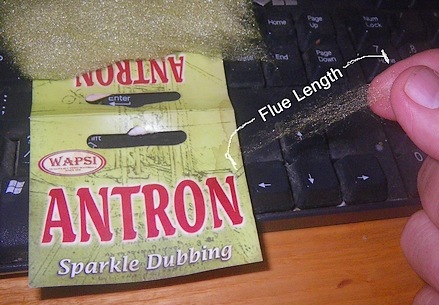
Wapsi Antron, flue length = 2.5"

Assume you have a typical synthetic dubbing like Wapsi’s “Antron”, which has a flue length of just over 2.5” . If you decant a tiny bit and all two and a half inches of the fiber were wrapped with concentric turns onto a thread, what size hook would it be the body for?

Hint: a lot bigger than you think

We can’t wrap the fibers on top of one another as it would make the dubbing too thick and would add to the moisture absorbed. We don’t want fibers too long – requiring us to snip or tear it off the thread, and it’ll burn time as we doctor the shorn area to lock it down. Extra turns of thread and time are also our enemy, making our experimentations with fiber length and the optimal thread load valuable.
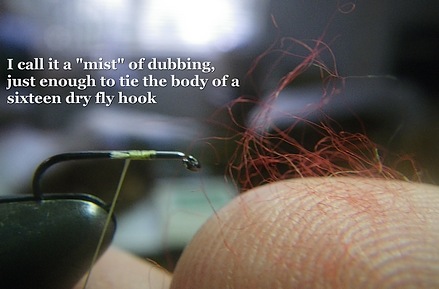
A mist of dubbing

If you think back to those same aquatic mammals that were our introduction to dry fly dubbing, only the beaver had fibers that might’ve been longer than an inch, the balance of those animals; mink, muskrat, and otter, are all short haired critters.
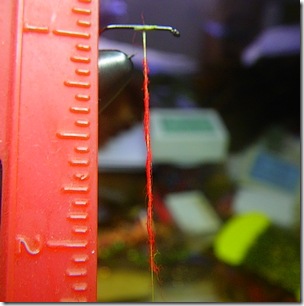
Same Mist on the thread

Transferring that knowledge to flue length, suggests somewhere between 1/2” and 1 1/2” should give us similar handling qualities of the aquatic mammals, assuming our materials share their tiny filament width and softness.

Above is that “too small” mist of 1” fibers rendered onto thread. Spun tightly, it renders nearly an inch of body material.

Swapping the 1” fibers for 1/2” only decreased the amount of material slightly, perhaps a 1/4” less at most.
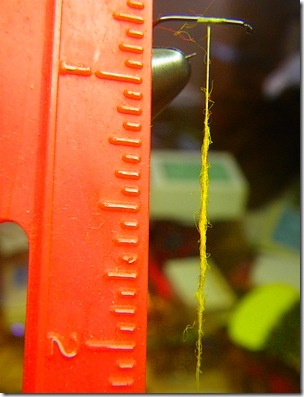
half inch fibers decreases the body only slightly

Predictably, our longer fibered Wapsi “Antron” dubbing with its 2.5” flue length covers much more thread, and despite the small diameter of its fibers, shows its unruly nature in the thickness of the noodle it makes.
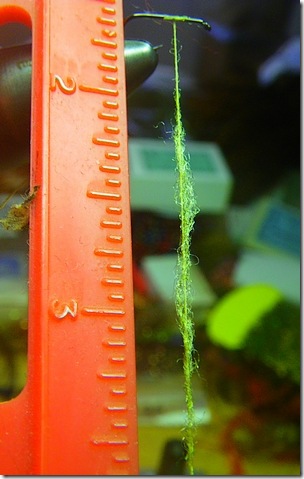
Wapsi Antron dubbed onto thread

After a half dozen turns, the remainder of the above will have to be pulled off the thread and removed. Given that implies more than half of what you grabbed, isn’t that a horrible waste?

From the above picture I’d make the claim that Wapsi doesn’t market this product as a dry fly dubbing (the label mentions only dubbing). The fly shop this was purchased at had a wall full of Antron colors, and outside of some Ice Dub and a few strips of natural fur, had standardized on this product for both nymphs and dries.

What actually may have happened is that they were tired of stocking 18 different flavors of stuff that didn’t sell all that well, and reduced the collection to a single flavor – because it’s all the same right?

Wrong, and I doubt your shop manager ties flies at all.
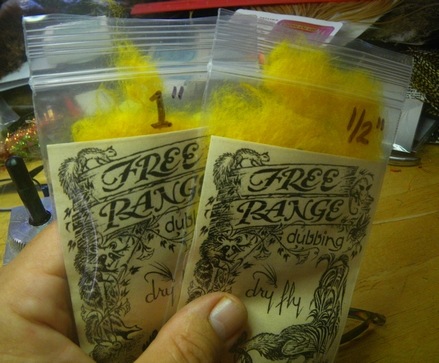
Still fiddling with colors and fiber sizes

I’m still fiddling with fibers, colors and blends, but am almost done on the flue length tests. I’ve got a natural fiber that’s as fine as an aquatic mammal – which plays hell with blenders, but I’ve got that solved. Now all that’s left is blending of colors and dyeing – and an entreaty to those that want to field test at my expense.

Until then – and using the above photos as a reference, you can eye your local shops offering to measure what fiber length their products provide. Now that you understand that flue length is directly proportional to the amount of thread covered, you can more easily understand why you’ve consistently have more fur than you need, and how you can take a pair of scissors to the package to shorten the fibers to a more useful size.

We’ve been in a synthetic rut for the most part of a decade. Vendors are often lazy and package their materials in whatever form is easiest, often the way they receive the product, not what form makes the best fly or tightest noodle on the thread.

Scissors or a hint of natural fur added to a synthetic can tame its rug yarn roots, making it much more useful than it exists when pulled from the rack.
What constitutes Single Barbless Artificial Only

1.08. Artificial Fly.

Any fly constructed by the method known as fly tying.

1.11. Artificial Lure.

An artificial lure is a man-made lure or fly designed to attract fish. This definition does not include scented or flavored artificial baits.

California’s Fish & Game regulations weren’t crafted for guys like me. I represent the ugly underbelly of fly tying – that 1% of fly tiers who read the fine print, that truculent, uncooperative fellow whom wardens gravitate towards – who reads the rules and has always wondered about, “artificial-fly only, single barbless hook” restrictions …

… the guy you see protesting loudest as he’s lead away in manacles.

“Fly tying” is thousands of small finger skills, mostly comprised of wrapping materials never envisioned for a small hook, in a vain attempt to tame them, or copy the imagination of some SOB in a magazine (who claims it’s easy).

The Gruyere Ghost

Take my Goat Cheese Bivisible above, it’s single, barbless, and constructed by the method known as fly tying. It helps measurably if you wait for it to achieve room temperature before dubbing it onto a floss core, then winding that for the body.

Ditto for that big-arsed Pteronarcys imitation I’ve dubbed the “Gruyere Ghost” – deadly in any color or size …

… and per the above legal in a number of states …

I love the smell of Napalm in the morning, it smells like … Science

Is it a vast conspiracy of vendors dictating to a few well meaning, yet chronically underfunded conservation agencies, and can this omission of information be the final straw we need to demonstrate our collective frustration in a molten pool of self-immolated 6X tippet?

For years we’ve been serenaded by all them pale, veggie-loving scientists about our thoughtless spread of Quagga and Zebra mussels. They’re busy bashing our boats in one sentence and damning our caustic footprints in the next …

invasives

… when all this time they knew that if both Quagga and Zebra Mussels were introduced into the same lake, that the Quagga would kick Zebra ass, and there would only be a Quagga mussel problem to clean up.

Listen all! This is the truth of it. Fighting leads to killing, and killing gets to warring. And that was damn near the death of us all. Look at us now! Busted up, and everyone talking about hard rain! But we’ve learned, by the dust of them all… Bartertown learned. Now, when men get to fighting, it happens here! And it finishes here! Two mollusks enter; one bivalve leaves.

– loosely adapted from Mad Max, Beyond Thunderdome

Apparently all them eggheads failed to mention how the Great Lakes is pockmarked with the scars of the two warring mollusks, and that the hordes of Quagga are spanking all comers including Asian anything and their capitol, the Edmond FitzGerald.

Horner Deer Hair with Black Thread, Humpy with Yellow, and Goofus Bug if it’s the red

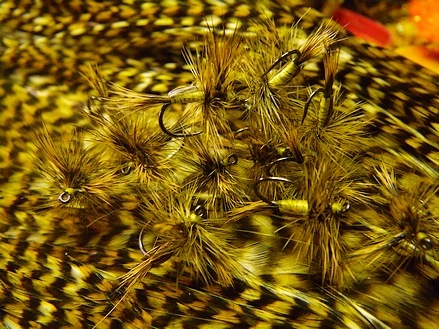
I’m reminded how much of the skill is in the hands of the tier, and how much of the finished look is in the materials he selects, and for many flies the mechanical attention to proportions simply cannot fix a bad choice of materials and their effect on the final look.

Which is why we spend so much time gazing fervently at road kill and the neighbors Maltese.

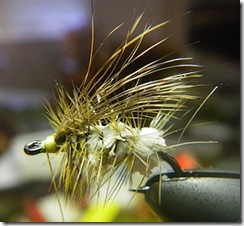
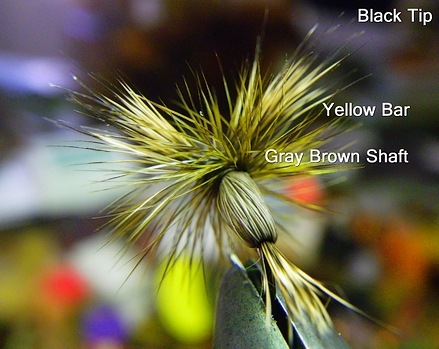
The veritable Horner Deer Hair, Humpy, Goofus Bug, or by whatever local name you know the fly, is a poster child for precise hair selection. Too long a tip and the wing disappears into the hackle, and you wind up using Moose for the tail – simply because the black tip and yellow bar are too long for the size you’re tying.

Horner Deer Hair Wing, showing deer hair colors

Unless all of the colors are small enough they won’t fit on a wing which  dry deer_facefly proportions dictate is merely twice gape, and the long black tips will bury the gold bar in the thickest part of the hackle where it can’t be seen.

Deer do possess hair that will tie a Humpy smaller than size 20. The down side is that it’s the muzzle of a deer – the area between eyes and black shiny nose.

You won’t find that at the fly shop, as most of their selection is prepackaged six or eight states distant, but you may be able to find a local taxidermist whose hunter didn’t pay the bill – or some garage sale mount that isn’t too badly moth eaten or brittle and can still be salvaged.

Yellow_Humpy, hiding in all them hair extensions