Author Archives: KBarton10

The list of donors being long and distinguished

While completely contemptuous of the current congress, I was surprised to learn that in addition to insider trading, ignoring any real responsibilities and the President, they have a sportsman’s fraternity – a caucus actually – where they can pontificate on all the reasons they love Mother Nature, so the carbon lobby feels obliged to add a couple zero’s to the legislators favorite charity … hisself.

pepper_Spray_congress

While the Democrats have consistently outshot the Republican team for the last three years running, it was amusing to see the group mentioned in a recent interview …

Mullins: What in the world does the Congressional Sportsmen’s Caucus do?

Harper: We hunt liberal, tree-hugging Democrats, although it does seem like a waste of good ammunition.

While I commend the above sentiment, I’m thinking they may want to dispense with the sporting clays and simply unload on the assembly from the spectators balcony.

… with an approval rating less than 10%, tree hugging Democrats are indistinguishable from washroom toe-tapping Republicans, and we’d be better off reshuffling the hand versus playing the cards dealt.

I figure those hoary old politicos who’ve held their seats for a couple generations will soak up most of the lead – leaving them young, fast-moving freshmen to hide behind all those splintered oaken seats.

Might increase their respect for the office – and give their debate on the ban on lead fishing tackle some small insights.

The 2011 Congressional Sportsmen’s Foundation Banquet and Auction was hosted by Amgen, Anheuser-Busch, ATK, Cabela’s, Cox Enterprises, Dallas Safari Club, Diageo, Ford Motor Company, Intermedia Outdoors, National Shooting Sports Foundation, Natural Resource Results, North American Deer Farmers Association, Outdoor Channel, Richard Childress Racing, Safari Club International, Shimano, Sportsman Channel, Wine & Spirits Wholesalers of America and Yamaha Motor Corporation USA.
Six Hundred things removed from Fly Fisherman because the zip code wasn’t exotic enough No. 443

Whether you’re following the teachings of some past master or merely becoming enamored of steelhead fishing, at some point you’ll enter a tangled web of materials poorly suited to fly tying – all of which will be proof against brute force or coaxing …

Most Atlantic Salmon tiers will admit to being frustrated by many aspects of the “olde flyes”, but endure their complexities to remain authentic, knowing so many tiers before them have given up in disgust.

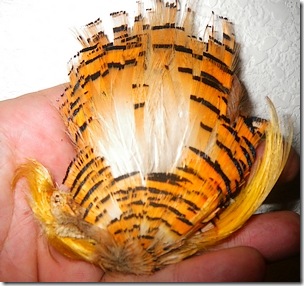
Whether it’s the tail on a steelhead fly or the topping on a salmon hairwing, pheasant crests have always driven tiers to drink, as they’re a three dimensional tie whose bend has to be matched to hook size.

Packaged Pheasant Crest After the bird is scalped these feathers hang forgotten for a couple decades until moth damage requires someone replaces their supply of Royal Coachmen tailing – by then the golden crest is warped into a number of odd directions which we hope will tie flat but know better. 
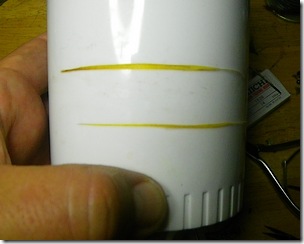
Subdue the unruly by licking the offending feathers onto a beer can and allow them to dry. They will retain both the shape and drape of the can diameter – as well as all point in the same direction.

 Drying Pheasant Crests

If a sharper bend is needed, simply wet the crests and use a smaller diameter bottle like a pill container. To ensure the crest is perfectly straight, pull the stem once it’s affixed to the beer bottle via spittle. The fibers will pull themselves perfectly straight as a result of your yanking on the stem.

Fly tiers are no strangers to licking beer bottles nor are they reluctant to nurse the leftovers once the cigarette butts are removed. It’s all part of the same downward spiral.

Us fly fishermen have never quibbled about certain labels

There’s nothing better than Science that fits a puzzle piece exactly into an odd shaped void of unexplained phenomenon, making our lives that much more meaningful …
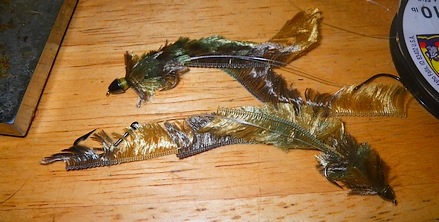
“This is the first study to establish a direct relationship between fish consumption, brain structure and Alzheimer’s risk," said Cyrus Raji, M.D., Ph.D., from the University of Pittsburgh Medical Center and the University of Pittsburgh School of Medicine. "The results showed that people who consumed baked or broiled fish at least one time per week had better preservation of gray matter volume on MRI in brain areas at risk for Alzheimer’s disease."

– via Medicalxpress.com

… giving both us and society one more reason not to limit our kill and farm our limit, and at the same instant neatly explaining why fishermen can’t abide the taste of their quarry, why we’re all destined to have our backsides wiped for us by some truculent male-nurse named “Bruno” …

While embracing Science with both feet, Fly Fishermen have never considered “smartness” of much value, preferring hands unsoiled by bait and pants legs clean of evidence – proof of their pedigree and breeding, never relying on mundane tests like ink blots and Mensa membership.

Guys that stand in cold water are “sturdy”, men that hike miles upstream for small wild fish are “antisocial”. In hindsight, “smart” is the guy that turned us down or had to mow lawn – and while we called him “limpdix” or “wimp” on the way up the hill, on the way back he had bested us morally and physically.

Before you rip into that double Mercury with Cheese, I should point out the asterisks that ensure all the fish death caused by science will be both wasted and pointless …

Eating fried fish, on the other hand, was not shown to increase brain volume or protect against cognitive decline.

Meaning anything made from fish that tastes really stunning or like McDonald’s cardboard will not help you at all, and depending on the source of your new found protein – the chances of you dying of Mercury poisoning or ingesting a tampon are almost certain.

A couple of snorts might make the price of a Sage One more palatable

That left boot full of icy water suggested that my, “It’s fixed!” was a bit premature – and my great idea on how to wake enormous and lethargic fish before Winter’s chill struck appeared to be just as porous …

snakelike_object

Coming from the far side of the siphon pool last week, I’d seen an enormous Pikeminnow and a few large smallmouth at the deep end. Knowing that the biggest Pikeminnow always respond to big bait, I figured to wiggle some ersatz wormlike object through that pool slowly – hoping the bass might inhale the bait as it went by …

… mostly because as the water grows colder most bass stop chasing food, preferring to husband the calories and let the bait come to them. Pikeminnow don’t seem to care about water temperature, which ensures their continued dominance of the food chain, and like them whichever proved hungry would be fine by me.

But I’d missed my chance, and releases from the dam combined with morning’s chill makes the water colder and put a cork in the bass fishing. Even Little Meat opted to wait on the bank instead of treading water nearby.

foodClub1

I caught quite a few smaller fish on a variety of small nymphs, but after sloshing around the creek for a couple hours, the sun’s warmth proved a bigger draw and I opted for the high ground …

“High” being entirely prophetic given the sudden resurgence of “huffing” and the constant reminder that kids and their brain cells are on divergent paths.

Love that Easy Off!

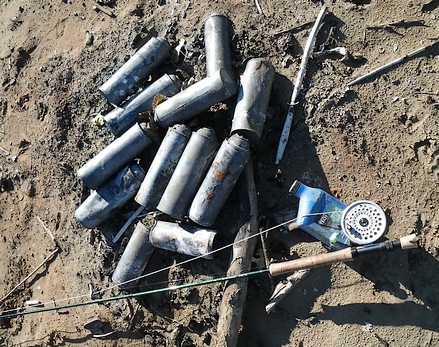
It was no different for our generations other than we had a bit more self respect, opting for aged model glue or teasing nitrous from the whipped cream cans instead of huffing a 12-pack of oven cleaner.

Most of the time it ended badly, with some dimwit flooding both sinuses with pressurized dairy products, but we had respect for the woods and policed our empties, versus leaving them scattered as evidence of our misdeeds.

If memory serves I dropped model making and the dairy industry for fly tying, suggesting it may have been drug use that made brightly colored bits of feather and standing in the rain so appealing …

What’s your excuse?

I am shocked that there is opposition to young fishermen …

I find it compelling drama but as it’s occurring in Europe there’s hardly a mention of the issue in our media. 
SANA, the largest angling organization in Scotland is rocked with scandal because its board accepting money donated by the fish farming industry, whose very existence threatens the last wild stocks of Scottish salmon.

SANA’s own website confirms its Migratory Fish Committee is committed to “campaigning against certain activities of the Scotland’s west coast marine salmon farming industry in the belief that these are endangering wild migratory stocks and the environment.”

However, this did not prevent trustees of the national governing body for game angling from agreeing a three-year sponsorship deal, understood to be worth a total of £12,000, with SSC for SANA’s International Youth Fly Fishing Team.

– via the Scotsman.com

It certainly represents a pickle for any well meaning angling organization. On the one hand money is so rare that anything is gladly accepted – and on the other, we’ve never had the luxury of donor organizations that may be working at cross purposes to our own, and are ill equipped to define who’s on our side and who’s not.

It’s plain that somewhere in the States we’re going to be dealing with the self-same issue – and we’ll be as stunned by the offer of money as we will be to the carnage that ensues should we accept.

With half of all seafood already pen raised – and with the world’s population continuing to grow, this issue is going to get more tangled and complex rather than less so. Terrestrial pens or blue water facilities may prove part of the solution – but it’ll be decades and many lawsuits before we work the kinks from the system.

Of particular interest to me in the article are the comments from the public – and the argument made by the industry shill about us wanting to preserve the wild fish only to kill them ourselves.

Like the presidential candidates, I’m unsure how we’ll appear in the court of public opinion. I’ve got no answer to refute that “you’re killing them too” issue. We know we kill fish, even when it’s catch and release, and mortality rates have been well documented …

I can’t help think of that nice, retired, dentist fellow, who didn’t really want to be club president this year – and how the crowd shouted down his protests and elected him anyway … and the limo from Gorton’s has just squealed to a stop at the curb and the well dressed suits fix him with a greasy smile …

Damn few called – and even fewer chosen

We’re never going to be confused with The Most Interesting Man In the World or the thousand dollar jam he’s pimping – but there is that special something that sets the Singlebarbed reader apart from mainstream fly fishing – or even your average serial ax murderer.

On stream or off, it’s that special flair that makes us human yet more so, in some indefinable way – larger than what surrounds us …

One of the Eberle clan

… the impossible lie for some, yet not to our readership – which sees the “possible” when others see naught but hardship or disaster.

Psychologists have a long winded term for it – and while I’ve forgotten most of the syllables other than “-complex” it’s sure to be flattering.

You always hated the taste anyways, now you can point and claim it’s a Ponzi scheme of Madoff proportions

The consumer be damned, what’s important is the IGFA will have proper protocol for certifying all them lab-induced trophies we can look forward to in the coming millennia …


As every watershed could wind up whelping mongrel fish; escapees from fish farms mating frantically with whatever genetic material is pumped into the overly warm trickle by Fish & Game, the real question is for us anglers – can we broaden our minds long enough to redefine our catch?

We’ve failed horribly in the past.

Recent sampling in Europe has found as much as 30% of fish at market mislabeled. While no one is pointing fingers at some broader conspiracy to replace fancy cuts with mongrel fillets, our collective palate wouldn’t know guppy from Fillet O’ Fish.

… we prove that daily at the drive thru …

“Fish passes through so many hands from the time it’s caught to the time it’s sold that it’s hard to tell where the mislabeling occurs or whether it’s intentional. That makes the process very difficult to police,”

In the US, Consumer Reports suggests 20-25% of the fish on store shelves isn’t the product advertised.

Genetic bar coding will allow many extra world records of the more mundane variety, like hybrid Rain-browns, or the fabled Kokanee-Walleye-Musky mixture, known fondly as the “Kowalski” – takes artificials voraciously, fights like hell, only you have to teach it to swim …

Outside of a chaste population of fingerlings in some chilly headwater, genetic bar coding will confirm that everything that bumps ass on algae has some form of interloper in its bloodline, and outside of the hoary ancient records where only a shock tippet and a couple of feet of leader was needed, nearly all non-digital IGFA records will likely join Roger Maris’s as some quaint but meaningful codicil is attached (*61).

There will only be two kinds of fish left; Mother Nature fish – found behind glass in aquariums – whose pedigree rivals that of royal and ancient, and *fish … “real” having been trademarked in an earlier court battle …

*Fish :  contains lips, beaks, heavy metals, nitrogenous fertilizers, soy meal, jowls, gills, scales, copepods, and organic matter. Organic Matter contains more lips, innards, test tube genetic material, red dye #4, and the occasional fingernail …

Salmon Anemia uber alles

Sushi2 While the hew and cry over genetic variants of Mother Nature’s finest will be played out in boardrooms and courtrooms, rest assured that our knack for bullying the environment, and then crapping on the survivors is largely intact.

It seems humans and their reared salmon have finally managed to bridge the wide gulf between wild stocks and their pen raised cousins, by introducing a hatchery caused disease into the wild ..

.. Salmon Anemia, no known cure, and a yen to trod upon whatever we don’t gill net …

The virus that causes the disease originated in the mid- 1980s in Atlantic salmon fish farms in Norway and spread to Scotland, Canada and the U.S. Farms in Chile also were infected, probably via imported eggs.

– via Bloomberg

This time it’s Mother Nature’s turn to gasp, as our disease affects both Pacific and Atlantic salmon, and therefore is the perfect, and final solution to the “salmon menace.”

Finally, some fish farms, particularly in British Columbia, should be relocated away from the migratory corridors of wild fish, so that any anemia outbreak that might occur there would be less likely to spread.

… and while they’re pointing fingers and debating across international borders, the lesson to be learned was already known to us fish chasers, “scrub your boots and don’t crap where you eat.”

Yellowstone Park, is it being loved to Death?

National Park Service The National Park Service’s report on the continuing issues of Yellowstone Park is full of grim news. Daily visitations continue to climb, leading to stress on the infrastructure, and all the invasives spread by car tires, clothing, and felt soles, continue to resist efforts at controlling them.

On Yellowstone Lake:

Nearly 550,000 lake trout have been removed from the lake
since 1994, including about 146,000 in 2010. The number
of lake trout caught per 100 meters of net has been rising
since 2002, suggesting that the lake trout population has
been increasing faster than the fish are being removed.

On the creepy crawly invasives:

First detected in the park in 1994, New Zealand mud snails
are now in all of the major watersheds
, where they form dense colonies and compete with native species.

… and on us:

After exceeding 3 million for the first time in 1992, annual visitation at Yellowstone fluctuated between 2.8 and 3.1 million until new records were set in 2009 (3.3 million) and 2010 (3.6 million). About 70% of the visitation occurs from June through August. Although there are no day use quotas, lodging and campgrounds in the park can accommodate only about 14,300 visitors during the summer, while daily visitation during July 2010 averaged 30,900. Fall visitation has increased since the 1980s and now comprises about 21% of annual use; winter visitation has never been more than 6% of the annual total.

With all those vehicles and their sticky rubber tires, over 20000 acres of invasive plants were treated, many with herbicides, a first for Yellowstone. Campgrounds and trails are consistent sources for most of the vegetative invasives, suggesting it’s us at the root cause.

With little change from the 2000 plan, and a harsh economic environment, it suggests “fighting them to a draw” might be a valued outcome, given a Congress with little sympathy and no mandate other than steep cuts in spending.