 I’ve seen a lot of “Inner Sanctums” – many complete with sepulchral organ music and a bell-ringer named Igor. All of them were tucked in cubby holes, garages, and dimly lit alcoves, away from visitors, heat, and the refrigerator.
Most earned it – mountains of partially decayed animal parts, the constant hum of NFL action coming from a laboring TV (the only source of heat), offset by the drone of hungry moths, and the obligatory Taco Bell wrapper with affinity for human feet.
I’ve seen TV tables, plywood buttressed by milk crates, formal dining tables, and all manner of work surfaces pressed into unlikely service. It doesn’t have to be this way, and tying flies where you can see your breath does little to improve the pattern.
Fly tiers have 3 phases of their craft, and the work area should reflect that.
Phase 1: The cardboard box and kitchen table
This is the initial start of most hobbies, you’re trying your hand at it not yet sure it’s for you. Materials are contained in a single cardboard box, or tackle caddy, and are brought to the kitchen – close to the beer. Your tenure is short and are evicted at mealtime, regardless of the number of flies completed.
Phase 2: You’re hiding the VISA bill from your spouse, and have been allocated a small corner of real estate to leave messy.
Phase two is the all important phase, as the mess and collateral damage will earn your exile to the garage. You’re possessed by creative genius and are ignoring the sprawl of dead animal parts and fish hooks underfoot. Phase two ends abruptly at the first moth infestation, or better yet, when Junior is found munching a green squirrel tail.
Phase 3: It’s no longer a sprint, it’s a marathon
This phase is marked by an uneasy truce on the domestic front. Any confrontation has been resolved and you’ve claimed whatever unwanted space is available, the garage, a cubby hole, or an outbuilding. The life long pursuit of materials is in full swing, and your spouse finds you fingering the fake fur on her jacket, oblivious to the fact she’s wearing it.
Tainting this tertiary phase is the leftovers from the first two. The cardboard box has been replaced by numerous cardboard boxes, and whatever table that was in the garage is now your tying surface.
Now the goal is to ingratiate yourself back inside where it’s warm, and address the long term issues of comfort and light.
Light is among the most important issues for tiers, we all have day jobs and the bulk of our tying is in the evening. Getting situated near a good light source is important, augmenting that with direct light at the vise will make it easier on your eyes, and increase the amount of tying before your eyes become fatigued.
Incandescent light is “hot” – both the bulb and housing can be hot enough to burn you, the carbide lamps are extremely hot, and will hurt. You need to position the light source far enough away from the vice to not strike it while tying, usually above is best, as the bright bulb is not within your visual range.
Fluorescent lamps are cool to the touch and can be positioned closer to the work area than incandescent, neither can get too close, otherwise your thumping them every time you wind thread.
Both kinds of light alter your perception of color, sunlight is actually bluish as it has to pass through the sky, colors we perceive in daylight are different if displayed under a white (fluorescent) or yellow (incandescent) light. If your attempting some exacting imitation, do your color matching in daylight, and your tying in the evening. You’ll find that florescent lights appear to bleach the color, so you’ll pick one to two shades too dark.
If you’re a nutcase, you can add a blue bulb to your lighting arrangement. Artist’s do that to compensate, it’s overkill for us tiers.
In my youth I was an apartment dweller, and the debris field generated by my tying was unacceptable to normal society. Loose fish hooks and dander followed each eviction from acceptable work surfaces, and I knew I needed something permanent, something all mine. Garage sales were commonplace and I started eyeballing women’s vanity tables, usually $25 or less. These small tables had 5 drawers, 2 on each side, 1 in the center. Pop had a wood shop and tore off the existing surface and replaced it with a white-stained plywood hutch. This gave me double the work surface of the original desk, and a light backdrop to aid in tying. While the desk itself was fine, the leg aperture was sized for a woman, so legs and knees always seemed to get banged on something.
It was cheap, utilitarian, and served me well for the next 20 years.
The downside wasn’t overly painful, but gradually they became more pronounced. Use of “C Clamp” vises prevented the center drawer from being accessible, and no way to subdivide the drawer storage, so you had to constantly dig through things to find the patch of moose hair. Insect activity was semi-frequent, and if a drawer was left open, or materials scattered about the surface, somehow they would always find the drawers below.
Phase X – The Unmentionable phase
Phase “X” is the “double secret” phase of a tier’s pilgrimage. Fly shop staff never mention it, tier’s lock the door before talking about it, and your spouse folds her arms and gets that stern look.
It’s “surrogate fishing” – tieing flies is the closest thing to really fishing, and despite your season closure, you find next year’s flies to be almost as rewarding as getting bit. You no longer wince at the thought of a chicken meat costing $4, and the cape $65, it’s just part of doing business.
Custom furniture is the next logical step, a fly tying area designed for you, fitted to your height, posture, and storage tailored to fly tying, not ladies’ cosmetics or sewing.
I bit the bullet about a decade ago, and so far the only regret has been “why did I wait so long?” Having tied commercially for nearly 20 years, I’d suffered numerous indignities that could’ve been solved easily by the right work surface and storage arrangement, not counting the dollars lost to bug infestations.
Custom furniture is expensive, about the same price as paying for a nice piece for the family dining area, or a solid wood media center, it’s not particle board crap like most furniture, but solid wood that will last multiple generations. You buy it once, built to your specification, and it lasts you the rest of your life. The price tag yields the same shock as when the spouse drags you into a nice furniture store, and the argument is simply, “OK, you get one, then I get one.”
Unfortunately, this debate is not over, when she sees it she’s going to want it, so you’ll have to be firm and hold your turf.
Customized Features:
We’re not building a writing desk, so you need to determine the shortcomings of your existing setup and design the solution in the finished furniture. Cabinet makers can do amazing things with wood, but you have to design these custom elements and explain to them what’s needed.
1. It must be an attractive yet simple piece if it is going into an apartment, it can’t clash with what you have already, and it must be worthy of the living room; the storage components and work surface cannot remain cluttered, as the kids will be doing their homework on it when you’re not using it.
2. It must have adjustable storage, rigid dividers that can be moved into areas to adjust the drawer contents for different uses. You never know what materials will be used a decade from now, adjustable storage allows you to reconfigure the drawer space to allow for new items not yet foreseen.
3. It must isolate the contents of one drawer from all the others, rigid cedar dividers between drawers so that moth eggs cannot fall from the top drawer into the drawers below it. This is a flytying desk, handle the insect issue now during the design phase, the money you save will pay for the entire piece over time.
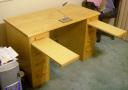 4. It must provide a drying area for large flies. Trout flies can usually dry without any special arrangement, but larger flies with bigger heads cannot be laid onto the work surface, they need to be stuck in something to allow the head cement or colored lacquer to set blemish free. I could use a Styrofoam cup, but we’re designing this beast, maybe the cabinet maker knows a thing or two that can help?
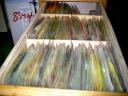 5. It must have drawers sized for common packaged items. Hooks, thread, packaged dubbing, and even chicken necks come in similar sized packages, having drawers designed to hold these items would make their storage easy.
6. As it is a large desk, it must come apart easily for moving. A good sized work surface is about the length of your arm deep, and four feet wide. Older homes tend to have narrower doorways, and if your an apartment dweller, you need to lug the beast up and down stairs without damaging it. The simplest method is to detach the work surface from the supporting table, allowing you to fit easily through any door, as well as your buddy’s pickup bed.
7. It should be equally versatile on rug as it is on hard flooring. All furniture is heavy (especially the cheap particle board stuff), install interior casters that won’t be visible, this will allow you to roll the desk around to clean around it, won’t scar floors, and will disappear if the desk is on rug, adding to its favorable appearance.
8. The table should be sized to your height, and the chair should be chosen to match. Ergonomics suggest that the arm of the chair should be at the same height as the work surface to avoid issues like Carpal Tunnel. Fly tiers don’t have the same repetitive motion that a typist endures, but you should adjust your chair to match the new furniture. Part of the cabinet makers interview should be measuring your knee height when at rest, as well as the height of your elbow from the floor. They will assist him in ensuring the work surface is at the proper height.
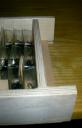 9. Drawers should be able to extend from the desk to make all contents accessible, they should do so without falling out of the desk.
As invaluable as the “kid in the candystore” design process, was the feedback received from the artisan making the furniture. His prowess with wood added elements I hadn’t considered, and as he teased my requirements out, he was able to refine them into practical things that didn’t add to the cost of the finished table. He was a fly fisherman and also tied flies, at the end of the project he had made one for me and one for his own use.
Then he retired. It was an unfortunate happenstance and I had nothing to do with it, I think..
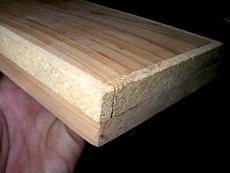 One of his best ideas you can make for yourself, taking a block of red cedar and lining one side with cork strips. It’s a portable drying stand for use on the work area, and when thrown into a drawer, it’s additional bug repellent, two birds one stone. If the cork gets trashed, replace it with new strips and contact cement, a simple idea that is worth it’s weight in gold.
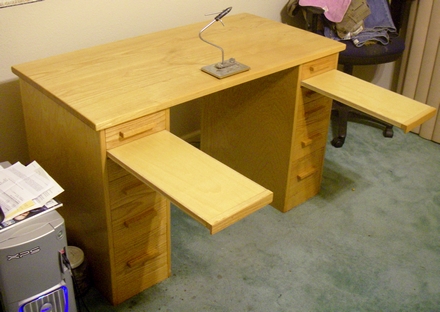
Six screws hold the surface to the two storage units, remove them and the top slips off neatly, allowing you to bundle the unit into another room without smacking door jambs and marring the furniture itself.
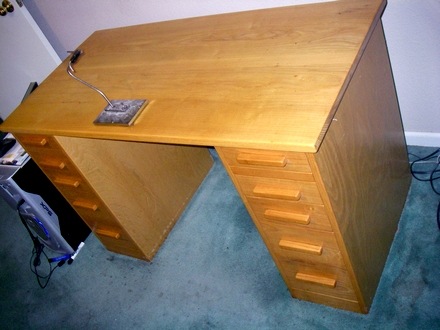
The unit has 10 drawers, 5 per side, none under the center so that C-clamp vises can be used. Two sliding trays pull out from under the top drawer, both are lined with cork strips (held with contact cement for easy replacement) on the top to dry larger flies.
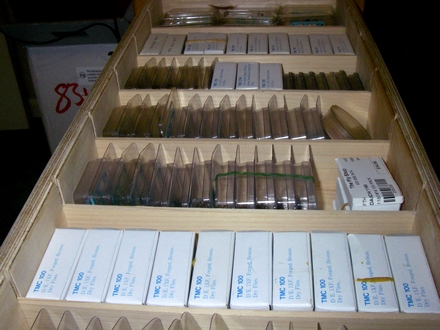
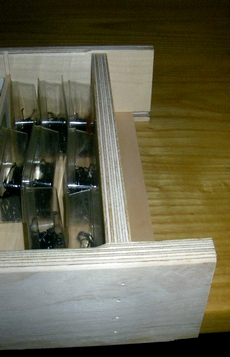
The top drawers are designed for hooks and tools, all the drawers are slotted to allow the inserts to be repositioned to resize each area. The drawers are made of maple plywood so that they won’t warp. Seasonal differences in humidity can cause warping of solid wood; it can swell and shrink, using the maple plywood prevents the drawers from binding on the runners, regardless of climate.
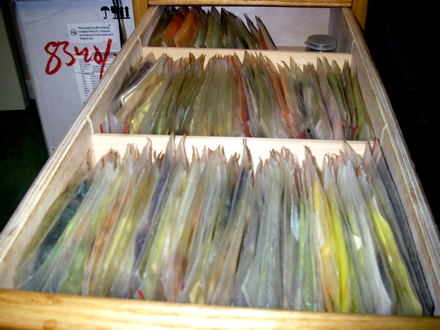
Four of the drawers are for larger items; one contains all threads, floss, and tinsel, another is for Partridge hook bags, the third is for necks and saddles in their original bags, and the last is general purpose. I use the general purpose drawer to contain whatever I was working on last – this allows me to sweep the work surface clean quickly, when guests arrive.
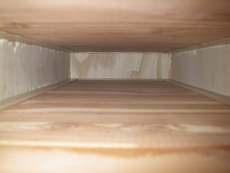
Bugs cannot survive in any drawer, and in 12 years of use I have had no infestations of materials contained in the desk. In large part this is due to the red cedar barrier above and below each of the storage areas. Even if bugs did get into one drawer the solid cedar barrier will not allow eggs to pass into any other area.
The bad news is that my girl wants this desk badly, and is always hinting that I should share. That’s a far cry from socially unacceptable, I figure we never accepted “no” on the third date, likely I’m dealing with the same phenomenon.
I remain firm and chaste, we’ll see how long my resolve lasts.
For the Phase X tiers that are contemplating the same issues, take note of the modifications to assist you in building your own list. Of the above, only the red cedar barriers added to the cost of the finished table.
Technorati Tags: fly tying desk, custom furniture, adequate work surface, fly tying storage, fly tying

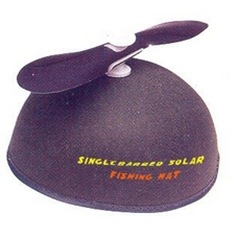 There’s great potential in thin film solar fabric for fly fishermen as we’re always the last idiot to head for shade. Rather than sell the extra juice back to the Grid, it makes sense to start thinking about what gadget you want to power, as it’s your cranium that’s baking, it should be your call.
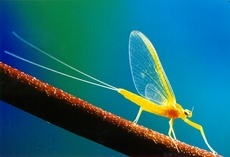 One of those oddball factoids you stumble across quite by accident, “..why does aquatic insect activity peak at dawn and dusk?” I’ve heard many explanations, assuming the lower air temperatures played the largest role in mating behavior.
 I’ve been watching the gauge all week waiting for the worst of the water to pass, cabin fever got the better of common sense, so I hit the river armed with tackle, instead of a cup of coffee.
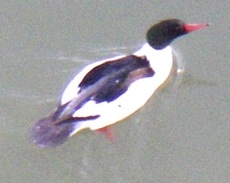 Nondescript was nowhere to be seen and the watermark on the bank suggested he’d had an additional 3 foot of water through his favorite lie in the last week, likely he was nursing some resentment at his living room suddenly transforming itself into an aquatic interstate, so he left my offerings untouched.
 I like the idea, but it smacks of a “gladly pay you Tuesday for a hamburger today” ecological balance. It’s nice that these issues are slowly being acknowledged, but passing the burden to someone else isn’t deprivation, it’s just making the minimum payment on a credit card.
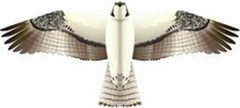 Teased unmercifully by an erstwhile pal? Sand kicked in your sandwich by an inebriated yet lucky in-law? Itching for a chance to get even? Just fade back out of eyesight and
 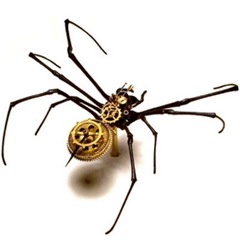 I can’t confirm whether he’s a fisherman or not, but the watch parts should make additional weight unnecessary.
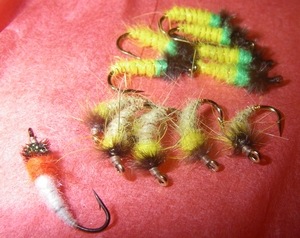 In researching the latest craze, “Czech Nymphing” – the thought occurred to me that the style of fishing isn’t new, Western anglers call it “High Sticking” – a traditional pocket water nymphing style used with great effect for many decades. It’s the flies that are new – thin profiles, heavily weighted, and … colorful?
 Singlebarbed has always led the charge on cutting edge technology, willing to suffer the slings and arrows of the path less traveled, allowing readers to giggle at my inevitable pratfall.