Monthly Archives: May 2011

It’s one of the fifty qualities of deer hair you didn’t know was possible

I was in one of many petulant moods, lower lip pooched mightily resolved never to play parachute ever again. Every so often I’d produce a decent one, and then it was back to eleven anguished attempts to wrestle balky deer hair into a right-side up configuration just long enough for me to pin it in place with a couple turns of ginger hackle.

Each snapped thread, each spin of the wing, each busted hackle added to my rage, and while I couldn’t quite pin the issue on something obvious, it began to dawn on me that it wasn’t skill or lack of effort, it was some new wrinkle surfacing to thwart me.

It wasn’t rocket science either, I asked one of the fellows tying nearby to assist in diagnosing my obvious shortcomings, and while the both of us watched the hair resist my authoritative attempts at a post, it dawned on me that fly patterns might mention what animal is used, but it doesn’t mention whether it needs to be stiff, floppy, whether it should flair when tied in – or resist that too…

In my case I had a chunk of belly fur off a deer – whose fibers were long and poorly marked, as well as floppy and unable to support the thread base. Every time I attempted to lay a wrap around it for support it would slough the thread right off.

About then I trebled my estimate of the cost of fly tying, now that I was assured that an armload of deer hide was needed. Along with all them colors, I needed to add “well marked” and “stiff”  and “ass hair” to the growing list of stuff I was missing.
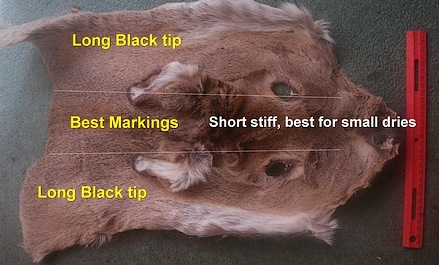
Deer Face, the best deal on deer hair ever

It’s one of those lessons that adds polish to your future work, and bridges the gap between flies you admire and your own work. Especially so when you can size the markings on the hair to the fly your tying.

All animals have different markings and hair length corresponding to the different parts of the body. Belly hair is the longest and poorly marked (usually too light), and the strip that covers the spine is the darkest and best marked. Hair on the extremities is shorter and stiffer, as is the fine fur of the face and genital area.

The photo above shows a typical deer mask, about two square feet costing around $10, and contains every size and marking coloration on the animal. It’s a great deal for the price, and gives much more hair than is needed allowing you to split the cost with pals, or attempting to learn dyeing with the extra …
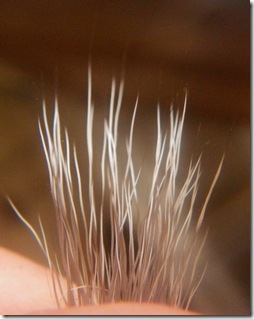
Long Black Tip area hair

Here’s a blowup of the hair in the area marked “long black tip.” If you add only the black tip to the blond bar you already have a wing length equivalent to a size 14.

Worse, the hair is very long and floppy.

If you make a parachute wing of this type of hair it will be difficult to tie correctly (limp), and the long black tip will be hard to see – making the blond area of the wing look much too short. Ditto when fishing, you won’t be able to see those black tips at distance, and you’ll be straining to see the bump or blonde at twilight.
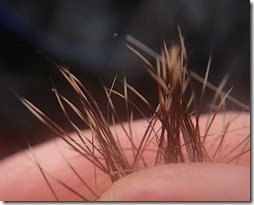
Deer's_Ear Contrast the above with the hair available in front of its ears, on its forehead and along its snout.

The black tip is a third the length as is the blond bar. A wing tied with this hair will show all three colors as opposed to the too-long limp hair above.

Because the hair is short it’s super stiff, and will support a parachute post without complaint.
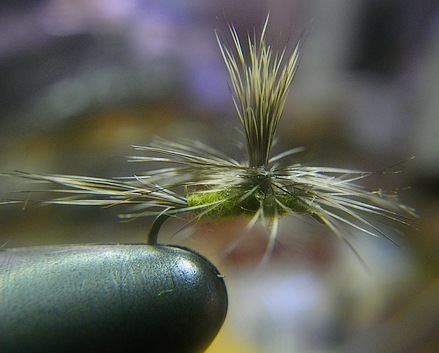
#15 Olive Parachute

Right-sizing a parachute wing mindful of the bands of color on deer hair makes the fly look complete and tidy. Grabbing fibers off the too-long side would make the above wing half-black and half-blonde, due to the length of their banding. All you could see on the water would be the little nubbin of blonde nearly flush with the waterline.

Unfortunately, so long as the jobbers hold sway on a fly shop’s materials you’ll never be exposed to all the qualities of hair from different parts of the body, largely because a 1 x 1” square of deer hair doesn’t have enough surface area to see the hair transition from neck to shoulder.

It’s these little hints that make you grip someone else’s flies and wonder how his look so much better than yours, and how you wish yours looked similar. 

You’ll be quick to understand once exposed to a big expanse of goody.

Note: Most taxidermists cut away the female genitalia, tossing the scrap into the waste basket. Should you be adventurous enough, deer “pooty” can be some of the stiffest and well marked hair on the entire animal.

It’s been washed and treated, just don’t flash it at some tying demo while you’re under the hot lights of the tying theater. Instead wait for your buddy to bare-hand his only sandwich, then you can tell him what he’s fishing.
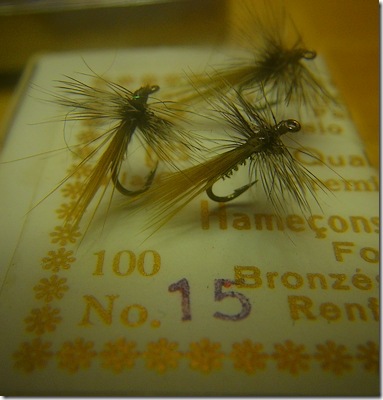
Easily Distracted, how to tie flies the way a trout eats them

The problem with fly tying is that it’s so blasted untidy that it’s impossible to sit down with something in mind without being lured by something bright or shiny, and the result is a handful of something entirely different.

Most new tiers never see it coming, as the “Shoe-Box” phase, when everything they own can fit into a shoebox ends, and they’re so badly hooked they’ll drop all pretense at ethics or morals, and cover the kitchen table in a blink of an eye.

… nor are they mindful whose credit card is doing the covering.

It goes double for us hoarders. We’re slow hanging up all the Olive turkey wing we dyed last night, and the six or seven pounds we left dripping in the garage, none of which we dare move, have us leaving the vehicles to the streets tender mercies. Add the peroxide of beaver left on our ersatz clothesline rigged in the only shower – and colors, materials, and ideas, enter your subconscious unbidden.

You sit down with an idea of banging out a couple dozen flies for a pal and creativity takes the bit in its teeth and by the time someone starts yelling, you’ve got a couple dozen truly remarkable flies, only they aren’t what you were supposed to make.

I was content working on a new dry fly series I had dreamed up, and instead of groundbreaking and earth-shattering, I wound up with stuff that works – which is far more useful, only won’t boost the myth and legend of any memoirs I might later publish.

Fluttering_Caddis_Dry

Too many pieces of lightened beaver lined the garage drying, each possessed of seductive tan guard hairs suitable for the Fluttering Caddis dries of Leonard Wright’s, “Fishing the Dry Fly as a living Insect” fame.

I’m off on a tangent with original intent forgotten while I find the least-damp Olive turkey wing for biots, replacing the authors original pheasant tail fibers. I think the original Fly Fisherman magazine article suggested Mink guard hair, but beaver is free, closer, and willing …

One you can lick your fingers, the other you can’t

You hear the term often in fly tying, you just don’t see anyone actually doing the deed – outside of the occasional Peacock eye made hairless by swishing it around in caustic bleach, which is about all I’ve ever seen anyone do …

Which makes a lot of sense, as everytime I’ve touched the bottle it meant I had more than enough and didn’t mind destroying a couple square feet.

I’ve always accused dyeing as the Destroyer of Materials, but that’s just to scare them with weak constitutions. When the material dries you may not have a good color, but at least you’ve got something …

… watching something bleach will cure you of the temptation to do it again. Soaking a piece of fur in straight bleach is not what you’d expect; the bath starts to heat to the point where it may melt the plastic bowl, likely a reaction to chemicals the hide was steeped in during the tanning or hide preparation process, then hair and flesh start vanishing and the rest turns into a flesh colored slag that covers what’s left of the fur with a gooey bubblegum residue.

Eventually you kind of back away until the temperature lowers to the point you can toe what’s left into the trash.

Bleached hair patches and lightened colors on furs and feathers have typically been treated with Hydrogen Peroxide or similar lightening agent.

Hydrogen Peroxide is available in any supermarket or local drugstore, it’s an antiseptic and is sold as a 3% solution in the aisle with medical supplies and liniments. This concentration can lighten hair (human and animal) with numerous applications or one long soak.

"Bleached" Beaver - and some I've dyed yellow

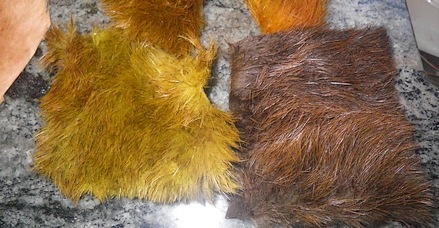
The center color above was “bleached” in a single bath of 3% peroxide. It took 92 hours to achieve this color from its natural gray. Four additional pieces I’ve dyed yellow ring the bleached color. As it is now, tossing a chunk into a drawer ensures a lifetime of Light Cahill’s.

Natural Beaver contrasted with dyed Yellow

Natural beaver is much too dark to be able to dye into light colors, at best it’ll turn muddy-dark. The above pieces were dyed in the identical pot for the same amount of time. Only the bleached hide can achieve the light olive I was attempting.

Light_olive_Beaver

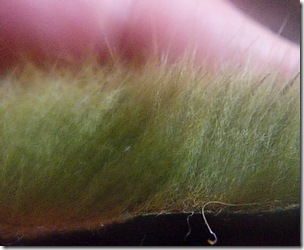
So long as the fur is completely submerged the peroxide bath will ensure consistency of color. Note in the above photo how the Olive color is uniform from downy underfur to the tips. This is done by first pumping the back of the hide to force all the air bubbles out of the material, then dumping the result straight into the solution without wringing.

Beaver guard hairs will resist the dye mightily, and might only take on a tint of the desired color, this is true of most tough hair, especially those of the aquatic mammals.

Peroxide Orange Beaver

Hair stylists use a powdered lightener along with Hydrogen Peroxide to avoid “orangey” colored hair like the above. Internet forums mention that straight peroxide often yields an orange effect on human hair. Once the fibers are any shade close they should be pulled and dried anyways, as they’ll lighten into a tan-orange which is perfect for our later applications of dye.

Peroxide is available in food grade as well; solutions ranging between 8% and 35% and a cost commensurate. These will cut the time down significantly, 12% took the same beaver from gray to tan in just over 18 hours, but the solution costs around a dollar an ounce at that concentration. Most of the higher concentrations have to be mail ordered and signed for by someone over 18 as well.

Every animal is a bit different both in qualities and texture of their hair, and degree of lightening needed to reduce their natural color to something light enough for dye. It’s best to experiment with small chunks to determine how long the base 3% will take to render an appropriate shade for your use.

Just tuck a large bowl of the cheap stuff ($2.00) into the garage, carve the hides into 5×5 pieces and check the mix come the weekend, there’s little risk of it getting too light.