There’s little doubt I prefer the technical references to the feel-good fly fishing memoir, both have their proper place, but when I reach for text I want a question answered, skills increased, or broader knowledge of an unfamiliar yet burgeoning subject.
Czech nymphing has fascinated me for a variety of reasons. It’s the “Cinderella” story mostly; small team emerges to dominate traditional fly fishing competition, remains virtually unbeatable in successive years, and the rest of the angling planet alternately “pooh-pooh’s” their meat oriented fishing style, while desperately begging for similar tackle from domestic makers.
Despite their monopoly of the long light rod, the resurgence of the multiple fly rig, coiled Stren indicators, and 24-30 foot leaders, scud hooks, and the preformed lead inlay – what sets the Czech nymph apart from most fly styles is their elegant blend of color and precise imitation.
Quite simply, they have incorporated the finer elements of attractors, yet have retained the shape and styles consistent with our modern realistic imitations.
… and as a reformed whore former commercial fly tier, tying many hundreds of drab dull flies can be onerous. A hint of sparkle or color is just enough to make that chair less hard ….
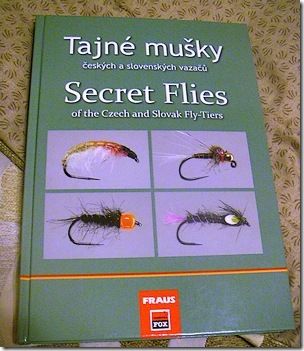
“Secret Flies of the Czech and Slovak Fly-Tiers” is a pattern encyclopedia featuring twenty one current or former Czech competitors and nearly 350 of their favorite flies. There is very little preamble and almost no text. Each tier gives a brief explanation of past accomplishments on the World stage, and presents a dozen or more of his favorite flies. Both the patterns and text are in Czech – which is translated into English as a footnote to each pattern.
It’s the largest single compendium of Czech patterns that I’ve seen to date, and provides a glimpse of enough Caddis nymphs, wet flies, and streamers, for you to realize those elements common to all the featured flies.
Like color. Neither Rhycophilia nor Brachycentrus feature a tricolor abdomen highlighted by orange seal, but you’d still welcome a couple dozen in your fly box.
Many countries have a long history of colorful attractor flies, gradually slipping from prominence due to gleaming newer flies and the synthetics they contain. Scientific angling still holds sway, and colors our perception of what’s fishy and what’s not.
… and while we fiddle with knotted legs and precision, some Eastern Bloc kindred spirit adds a dab of maroon seal to his Olive Caddis and eats our competitive lunch …
Czech patterns and fishing style is slowly entering our mainstream arsenal, almost like Spey rods – which we held at arm’s length for a couple hundred years, then claim we invented them …
But the typical Czech nymph tied by American fly tier’s is missing the delicate profile of the european original. As many of the featured flies in the book portray, the authentic flies feature a double-tapered body – lightly tapered body, thick middle, and tapered front. It’s a trifling detail for most, but lends itself to a couple fortnights of inspired tying – especially for those fellows willing to order the book from Europe to learn more …
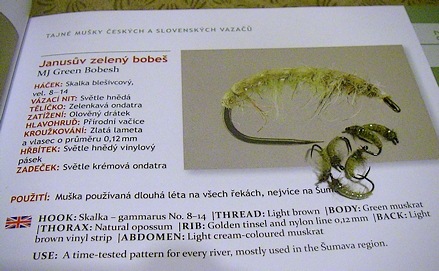
The above photo shows a representative fly pattern, its translation, and scant narrative.
While the photographs are detailed and quite excellent, this book is for an accomplished tier – one that can reproduce the pattern from a glimpse of a single photo …
… AND … knows enough of European materials (both hooks and synthetics) to make the appropriate substitution. Unfortunately, Wapsi and Umpqua are only known to the US, and many common synthetics like the vinyl/latex back may have a different vendor and therefore a different vended name for their product.
They’ll be cited in the translation but you may have to do a little leg work to verify your pet flavor of vinyl is appropriate.
Most of the hooks referenced are Skalka, Knapek, and Maruto. You can substitute similar hooks if you’re familiar with those makers and their models. US vendors like the Blue Quill Angler carry both the Skalka and Knapek competition hooks – and they’re not cheap.
All of these materials can be purchased at Czechnymph.com which was the source of the book, as I could not find it available anywhere in the United States.
In short, an advanced fly tying pattern encyclopedia – absent fishing techniques or step by step illustrations, requiring significant knowledge on the part of the reader – and containing about 350 patterns of Czech-Slovak origin.
As I’ve seen few Czech nymphing books contain this many patterns, I’d think it would be considered singular in that respect.
Full Disclosure: I paid 779.3 CZK for the book, with shipping it was about $42 retail. (changes in world currency are daily)
Tags: Czechnymph.com, Milo Janus, Skalka hooks, Knapek hooks, Maruto hooks, Blue Quill Angler, Secret Flies of the Czech and Slovak Fly-Tiers, fly tying pattern reference, Czech nymphing, Caddis
 It didn’t work back in the Sixties, when J. Edgar and his G-Men encouraged academics to rename the lowly “Egbert Carp” to “Grass Carp” as it’s known today.