Monthly Archives: January 2010

Print being Dead, and here is where they buried her

Print is far from dead It’s a daunting project that Project Gutenberg & Google has undertaken, scanning all the books in the world and making them available online. It’s not without incident considering they already incurred $124 million in infringed copyrights – but they’re forging ahead undaunted.

With Amazon’s Kindle creating quite the stir over Christmas, and competitors lining up to enter similar products into the mix – it appears we’ll have the opportunity to add to our fishing library virtually.

As my vision is on the wane – I can’t admit to comfort while straining over a dimly backlit screen, but it’s likely to intrude more each decade.

There’s quite a few famous angling tomes already available, and many out of print classics that are unavailable to anyone other than collectors.

George Kelson – The Salmon Fly, how to Dress it and how to Use it (1895)

G.E.M. Skues –  The Way of the Trout with the Fly (1921) and Modern Development of the Dry Fly (1910)

Mary Orvis Marbury – Favorite Trout Flies and their Histories

George M. LaBranche – The Dry Fly and Fast Water (1914)

Frederick M. Halford – Floating Flies and How to Dress Them (1886)

There are many hundreds of titles, some you may have never heard of – and the tags under each allow you to refine your search to specific areas of the online collection. Most of the books are old enough to no longer be copyrighted, and it makes sense that Google would want to avoid all the litigation until it’s determined how the author will receive compensation.

Kelson’s book on the Salmon Fly is still considered the Bible of the married wing, eyeless hook crowd. You can download it for free in PDF form versus paying $500 for an old copy.

I’ve read many of these and am continually fascinated over the convictions of their authors. Adding a certain perspective to read, “the Salmon, being the noblest of all fishes, eat Butterflies …” – then grab a copy of a current magazine and read, “they eat leeches because …”

… and in a hundred years will some fellow be giggling over our assumptions?

Our ignorance of history causes us to slander our own times.  – Gustav Flaubert

Anglers today shrink from the old tomes as being antiquated and out of date – and while the language may be archaic, the lessons are still current.

Download a fistful of PDF’s and fish the turn-of-the-century Catskills, or a Irish freshet for sea run trout – then tuck them away as reference materials or simply a good read.

Tags: Project Gutenberg, Google Internet Book Archive, copyright, George Kelson, G.E.M. Skues, Mary Orvis Marbury, George M. LaBranche, Frederick M. Halford, Amazon Kindle, out of print angling books

and The Pale Morning Dun is the tastiest of all

The Golden Stone, terror of the cobble Most of us anglers are oblivious to what goes on in all those streambed nooks and crannies. We’re content so long as it emerges at dusk and exists in enough numbers to keep fish fat and healthy.

Like the dinosaur – scientists assumed that the biggest were at the top of the food chain and everything smaller ran in fear … until they found a Tyrannosaurus Rex and figured a mid-sized predator with a mean streak may be worse than all those enormous herbivores.

So it is with invertebrates, the Giant Stoneflies of our fast water are benevolent – and the mid-size Golden Stone is the T-Rex of the substrate, driving mayflies to flee in terror as it snacks its way through the elderly and infirm …

… and the Pale Morning Dun is either slow as molasses – or tastier than the rest, as more of them were eaten than any other invertebrate.

Which is oddly consistent with my past haunts. All the rivers famous for PMD hatches like Fall River and Hat Creek were absent significant fast water – and where it existed we’d walk past in favor of a slower stretch downstream.

Naturally I’m using the most rudimentary sampling, the widely recognized “fast water = heavily oxygenated = stoneflies” theory of angling. Which gives us something to ponder. Do we mash stoneflies knowing were saving countless smaller bugs – or do we stay out of the fight?

I’d characterize myself as an indiscriminate masher, as once your wading shoes break the Size 12 or 13 barrier – even the Stoneflies flee screaming.

Interesting to note the document suggests that mayflies can distinguish between the Acroneuria (T-Rex) and Pteronarcys (benevolent Giant Fatty Stonefly), and flee from one yet not from the other.

… and the real question becomes, “ was it the current that caused your feet to slip, or was it a million Infrequens with ropes and pullies – getting you to mash invading stoneflies?”

… the little bastards could well be sentient …

Tags: Ephemerella Infrequens, Acroneuria, Pteronarcys, stonefly, mayfly, cobble warfare, tyrannosaurus rex, dinosaurs, fly fishing humor, Hat Creek, Fall River, wading shoes

50 Years of Science fiction ruined by a single biologist

blacklagoon Those giddy days of Halloween television,  Ma insisted you were too young to watch a pissed humanoid water breather slime its way through the streets preying on the unwary, dragging screaming female teens into the cold bosom of a nearby bay …

… there to perform unimaginable and completely horrific unknown rituals on their taut … flesh …

Pop wasn’t allowed to watch either – and if the pair of you were caught he’d point finger and rat you out.

50 years of perfectly good science fiction ruined because some biologist discovered different …

Apparently fish gills aren’t just for breathing. A dual purpose organ which assists in ion exchange with the surrounding water, allowing fish to regulate their internal chemistry.

“In freshwater fish, like rainbow trout, they tend to lose ions from their blood to the water, because the ion concentration in blood is greater than that of freshwater,” she said.

The team took measurements from the gills of young, developing rainbow trout to find out what functions they were performing.

“When the gills are still immature, a significant portion of ion uptake occurs at the skin. As the fish get older and the gills mature, [this] can gradually shift to… the gills,” said Ms Fu.

“We found that ion uptake shifted from the skin to the gills earlier than oxygen uptake. This led us to propose that the gills are needed for ion regulation earlier than they are needed for oxygen uptake.”

This recent study suggests you may be twice the oaf for jamming them hammy hands into the gill area, as you may be injuring a delicate mechanism designed to suck up sewage, DDT, and twice distilled female hormones.

The good news is that Hollywood can reshoot all them old movies, and feature a really pissed man-eating-mostly-head Rainbow trout with a preference for nubile teen fems …

… and you get to claim innocence (while pointing the finger at Junior) – as you thought it was a Rivers that Cost Most remake …

I say, do the math. A steady influx of chemicals into the watershed and gills as chemical exchange – begats really muscular gills as the toxic burden increases, requiring evolution and expansion of the skull area – resulting in (possibly) larger brains and huge gill assemblies.

That larger head should make big teeth an evolutionary no-brainer, and the result will be a sentient, really pissed, mostly head, rainbow trout – with the ability to harsh your mellow, babe.

… better learn how to cast from a shark cage.

Tags: fish gills, gill evolution, University of British Columbia, Clarice Fu, DDT, rainbow trout, ion exchange, sewage, DDT, science fiction, nubile teens, pissed water breather

The Sixth Finger Roadmap, a Powerpoint presentation filled with dancing frogs

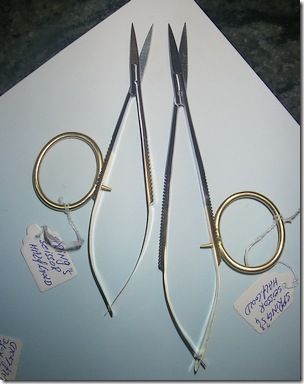
The prototypes for the next generation of Sixth Finger scissors arrived on my doorstep yesterday. I’d asked for them to add a zipper so I could change it each year and obsolete everything you already own …

I figured I could offer it as a fetching facsimile to the Royal Canadian Mounties and the cord that secured their sidearm. Three and a half feet of ballistic nylon – and should you ever lay them down, they’d be available to sit on once you returned to your desk.

It certainly would reinforce the notion to keep them in your hand – the downside would be you’re having to tie standing up for the next three months.

Madison Ave calls it “branding” – affixing the image of a product into your subconscious so you can’t help but think of me when you see it. I call it a life long scar, and you’ll never be able to look at a Band-Aid or tourniquet without cringing …

The vendor has added all of the enhancements I’ve asked for and produced something quite special.

The General Purpose flavor of Sixth Finger Issue: The current flavor of scissor is a light-duty specialty scissor, with small light blades and fine tips. It’s wonderful for trout flies and medium sized flies, yet has issues with thick or bulky. Those same light blades offer a small sharp tip – but can be deflected by a heavy woven four strand yarn, or bulky chenille.

Resolution: The debut of the General Purpose variant, designed to accomodate light,  coarse, and heavy materials. It is equipped with a larger, heavier blade that cannot be deflected. It’s simple physics that cause the issue, and adding mass to the blade prevents it bending out of the way, and lengthening the handle allows more force to be exerted to sever large materials cleanly.

The General Purpose will be longer by an inch, half of which is in the blade area, and the balance in the handle. The spring mechanism has been shortened yet retains a crisp positive action. Even better is the blades – about twice the mass – both thicker and longer, and we didn’t have to give up the fine tips.

As I eat what I sell, I’ve already started testing the materials that proved difficult on the smaller scissors, and have been chuckling with great glee …

But I didn’t do you no favor …

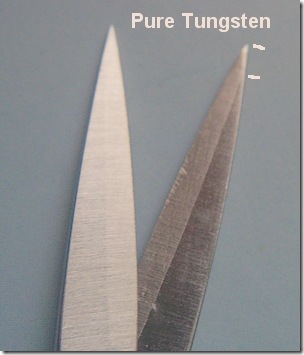
Pure Tungsten at the tip To assist both normal and this new “General Purpose” variant, I’ve also added tungsten inserts on both models, but I didn’t do you any favor by doing so …

Tungsten Carbide is one of the hardest metals known to Man, and in scissors it makes a superior cutting edge – one that will last much longer than conventional surgical stainless.

It’s also the most brittle. One bleary-eyed late night cut where you catch the hook shank up at the scissor tip, and you can take the points clean off.

This is true of $500 surgical scissors as well as inexpensive flavor. The only known solution is to make a blunt point which allows more tungsten into the area, giving the tip greater shear strength. As fine tips are essential on a good set of scissors, blunt is unacceptable.

Having tied with Tungsten inserts and expensive surgical scissors for the last 25 years, I can vouch for the fragility of the tip. Bill Hunter sold me my first pair and mentioned, “you’ll have to relearn your scissor work, or you’ll tear these up.”

I did. But at the cost of the first pair.

The second set lasted 20 years, so the transition is easy enough to make, but only after you’ve destroyed at least one set. In short, you learn to make all cuts away from the shank – never cutting towards the hook.

We’ve also opted for an adjustable screw to aid quick disassembly for sharpening.  Medical scissors attempt to braise or grind the screw to prevent seams that allow bacteria to collect on the scissor surface. This prevents the screw from turning – and tightening the screw is often not possible.

As all scissors eventually need adjustment (except in the medical profession where they’re often discarded) –  I’ve got a slightly different screw assembly on these prototypes to see if I can adjust it in the future.

Summary: For 2010 I’ll be offering three models of the Sixth Finger; a larger General Purpose scissor with Tungsten inserts, the current model of surgical stainless, and a variant of the original scissor also with Tungsten inserts.

Pricing and availability should be around the mid-March timeframe. I’m attempting to bring the price in around the $25 dollar mark for the Tungsten and larger General Purpose flavors.

… and my thanks for the many helpful comments and feedback on these “children” of mine. Many of you have been quite candid about changes you’d like – or features that suited you, and I’ve rolled all that into this second generation of product.

Based on what testing I’ve completed, they’ll go through your jeans and a couple inches of Gluteus before you have time to draw a breath …

Testers: Around March I’ll be sending out 10-12 sets of the new scissors to some of the existing owners as a test group. If you’d like to test one model over another I’ll inquire before I send them.

I’d like to upgrade everyone, but the economics say otherwise.

Full Disclosure: I came up with the bright idea, and use them daily, to the exclusion of all other scissors. But as I’m also the vendor – I am not to be believed.

Tags: Sixth Finger Scissor, Product Roadmap, fly tying scissors, Tungsten Carbide, adjustable screw hole, fine tips, Bill Hunter, RCMP, shameless commerce

Nothing like having a chalkstream in your backyard

We've got plenty of structure in the streambed, now add water The ringtone belonged to “Deep Walnut”, the Yolo county landowner I’d turned to the side of righteousness. The pleasantries were brief, and I was informed that the annual “crop report” outlining the sins of watery tomatoes had been secreted on the grounds of my residence.

Sure it’s a touch over the top, but in a smallish town when it’s raining – what else is there to do.

Actually “Deep Walnut” is a double agent – as the document merely outlines the crap I waded through last season, and how far over the state approved environmental standards the pollutants have climbed.

I figure his handlers are slapping each other heartily knowing no sane person would wade through known carcinogens and medical waste – but sanity has never been a strong suit, so I just hand the list to the physician while he readies an armada of large gauge needles with which to violate my posterior.

… and yes, this report was an eye opener. Outlining enough naturally occurring Boron that I’d consider wedging a mandrel in the substrate just to see if I’d have a functioning six weight after a sustained downpour.

… a steady rise in the salinity of the water, as well as a pH of 9.0 – both exceeding state guidelines. It’s a comfort that with all the decline in quality waters that I’ve got a chalkstream being deposited on my doorstep, which should recoup last year’s 50% decline in home value.

Unfortunately most of the wells near my house have been closed due to nitrate contamination. Both Woodland and Davis get much of their drinking water from groundwater, and at least four (those near my house) have already been closed.

… so I’m looking to close escrow with a fly fisherman. Civilians will not appreciate the view from my veranda, nor those contaminated sparkling waters anytime this century, and most of the next.

I’d petition to rename the street “Love Canal” but most of the water managers are too young to get the joke …

I suppose the biologists took one look at the local creek and skipped over the mayflies and stoneflies, choosing Cerodaphnia Dubia (water fleas) to measure toxicity.

Didn’t help, they died screaming …

But the good news has to be the toxic algae bloom and the increase in eColi found. Proof that the local creek is capable of hosting a diverse ecosystem containing predators and killer bio-toxins.

… and with all the microscopic nasty entering the food chain, and slurped gleefully by the young-of-the-year fry, the fish should be virile, aggressive and subdued with nothing less than a single-jack.

… and all it’ll take to realize this angling paradise, this lone speck of quality amidst the dust bowl of the Central Valley?  Just add water.

Tags: Brownlining, Little Stinking, Deep Walnut, Yolo County Farm Bureau, cerodaphnia dubia, ecoli, boron, selenium, fly fishing, Woodland, Davis, groundwater contamination

Dressed to Kill: Pro the new Tweed and ethics by mail order

The last decade was not our finest hour. Professional sports and ethics under scrutiny, press conferences featuring unrepentant athletes apologizing for dog fighting, bruised spouses, gunplay, infidelity, and their entourage – orchestrated carefully by agents and handlers hoping to mitigate the discomfort of sponsors.

Plenty bled into our sport, the dawn of the “sporting professional” whose intensity and divine calling permits them to leapfrog both “sportsmen” and antiquated ethics, and focus on watershed domination, while ignoring vacationers and us relaxed hobbyists alike.

Internet forums and interactive media were abuzz with tales of those used cruelly. Threads narrate the actions of insensitive fellows who’ve low holed someone’s riffle, wading where they should have been fishing, then sprayed half the cars in the parking lot with dirt and gravel in a rush to repeat the scene elsewhere.

Fueled by catalogs and questionable ethics, they’ve somehow skipped over Poppa’s quaint little “Quiet Sport” and the old notions, to clad themselves as guides and outfitters. Guides somehow earning the “Bad Boy professional” label for want of something truly sinister. The combination of battered truck, weathered brow, and not shaving synonymous with grit, pain, and performance enhancing drugs.

At times it seemed that Trout season was reduced to sixteen weekends plus a bye week, with smiling lawyers leading the way through the flashbulbs and throng of Paparazzi.

The signs of this evolution were everywhere, and not limited to fishing.

The weekend bike ride morphed into grim adults on multi-thousand dollar road bikes wearing European racing livery. Colorful spandex replacing street clothes and gadgets jingle from everywhere; digital devices that measure wind shear, heart rate, and caloric burn, ensuring we’re connected to the bustle of civilization, that which the bike was meant to flee.

Fishing was no different. Our periodicals fawned over unsmiling anglers with a yard of silvery phallus slung purposefully at their crotch. It’s the neo-traditional “look at my Junk” pose. Grim, unsmiling angler with the fish of a lifetime, resentful that he has to pause for the rest of us.

All fish giants, all waters exotic, but only if you’re a professional.

Vendors were falling all over themselves to accommodate this “driven warrior” mentality, how those few hours each weekend are validated by wearing the livery of professional angling. What started as youthful fun is pushed towards “Pro” sport, evidence of sacrifice and deprivation.

Catalogs boast of the new camouflage, Puce and Mauve, along with G3 Guide vests, Battenkill Pro Guide, and Pro Stocking foot waders. Shirts have become guide shirts, and ball caps rechristened as “Pro fishing hats.” We wear our labels on the outside, evidence of our loyalties on breast and hat brim, like NASCAR sponsorships; Sage, Simm’s, Scott, and Loomis, yet conspicuously absent the salty stain of real usage.

Tackle and outerwear prices climbed with every decal. Clothing became “tactical” rather than functional, and the uniform ensures we’re not lumped into the hobbyist cadre, and can crowd your riffle as we deem fit.

The stern professional, wearing racing livery, knowing he could have taken Lance Armstrong if only that silly pedestrian hadn’t spoiled his “line” through the red light.

Perhaps it’s the dawn of the new Hunter-Gatherer with roots in the workplace mating ritual. Our increasingly domesticated lifestyle doesn’t leave much to kill but time. Each weekend we embrace hardship and its retelling around the water cooler – drawing gasps from our coworkers, while we search the crowd for a suitably impressed mate.

” .. we hadn’t had a Starbucks in two entire days, but we didn’t flinch from the cold water. We laughed as it began to rain and the lesser woodsmen fled for shelter and home, then we seen the Bear …”

Real guides are left scratching their head wondering, “who in their right mind would want to be us?” Most are on sabbatical from similar jobs, the luxury of an outdoors career possible only until the snow flies, when they’ll return to grocery stores, local schools, and county jail.

They know there’s no professional class, as most are pressed into service by a combination of geography and availability. Talented locals that leap at the chance of big city wages in depressed areas without much industry.

Many warm their homes with real firewood, know one end of an axe from another, and are happy to supplement their income with the influx of “Pro Guides” and their starched, clean linen. Clients admire the simplicity of the outdoor experience, contrasted with their urban morass, and ignore the sweat and toil of boats, oars, torn flesh, packed lunches, and drooping backcasts.

Angling literature has always used great license portraying both guides and their sporting clientele. The guide as woodsy-character; gruff, often unforgiving, steeped in outdoors lore, hard drinking, occasionally foul mouthed, with a penchant for closing bars, eating raw meat, and winking at daughters, wives, or whatever’s closest …

… female, hopefully human this time.

Guides are enchanted by their larger than life literary depiction yet dismiss it with a chuckle, knowing it’s largely folklore.

“Sports” have endured the foppish Big City label for the last hundred years, and armed with the latest gear from giggling vendors appear hell-bent on continuing that tradition. Complaints about the room, complaints about the food, and petulant because the fish refuse to bite. Their sport neither quaint nor old, never practiced by their Father, extremist really – requiring personal sacrifice and a hefty annual income.

With all eyes focused on the personal celebration in the end zone, the tearful retirement ceremonies and new emphasis on self, we’ve forgotten that the Poor Sport and starched outdoor livery is nothing new, we’ve only added a certain selfishness to an already boorish element.

A combination of glitzy marketing aided by misguided sense of self worth, fostered by twits twittering GPS coordinates for every fish they imagined caught.

Leaving only the faded plaid wool shirt to distinguish “them as do” from “them as wished they did.”

We know better. Fishing has always been about respect. It’s the passing of skills and reverence for the out-of-doors to the next generation, so they won’t see the tall pines and unfettered river as something to drown out with an iPod … so they know not to pave the last pure trickle to please Wendy’s.

It’s always been patched waders and mosquitoes, hardship and inclement weather. It’s cold water down the pants leg, and requires a hardy breed of fellow already – there’s no need for additional pain or glamour, and no cause not to respect others in similar predicament.

… and vendors have always preyed on the weak-minded. The more tactical they can convince you to wear, the less strategic you’ll be about your budget.

While those starched creases may imbue the wearer with unnatural powers, making practice unnecessary and study optional, swathing yourself in Pro Guide isn’t like big city parks, where proximity and insensitive dog walkers guarantee you’ll get some on you.

Tags: Simm’s, Scott, Loomis, Sage, Battenkill Pro Guide, G3 Guide vest, tactical clothing, Bad Boys of Sport, the Quiet Sport, sporting ethics, guides

Part 2: The timid fellows guide to dyeing hair

In Part 1 we covered most of the dyeing process – and the difficulty associated with matching a known color.  The steps are the same for dyeing anything; first a cleanse and prep of the original material, followed by immersion in hot water so the shock of the dye bath doesn’t induce physical change.

Feathers are difficult because much of the time you’re dyeing loose materials, which can cause problems with their tendency to float – and your tendency to chase every last one, while the mass continues to darken even though its been removed from the dye itself.

By comparison chunks of hide are much easier. Furbearer’s may have some natural oils that prove resistant, but as you’re dealing with a single swatch you can pull it and rinse it as often as you like.

In essence, the hide chunk itself becomes the “test feather” – pulled routinely and rinsed until you have the desired color.

Big animals contain all manner of dirt, nettles, and dried guts or blood. If you’ve been gifted by a hunting buddy, you may have a lot more preparation work to get the hide suitable for coloration. This may include scraping all flesh and fat off the hide with a grapefruit spoon (serrated) before adding Borax or cornmeal and stretching the hide to dry.
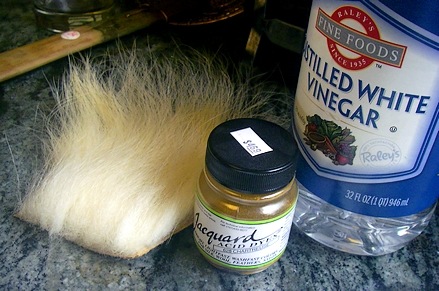
We'll start with Polar Bear, Acid dye, and White Vinegar as fixative 

Other concerns are the age of the hide and its integrity. A hot dye bath and a vigorous clean and dry can be enough to break apart an old hide – especially Polar Bear, whose last legal importation was in the 1970’s.

We’ll repeat the process used on the feathers for the Polar Bear shown above, and in doing so – I’ll get to test a new color of Jacquard acid dye to get some familiarity with the vendor and their idea of Chartreuse.

As mentioned in Part 1, each vendor has a different palette and the label is a reference color – not a guarantee of the outcome. Chartreuse being a yellow tinged with green, I’m going to test their dye on a small piece prior to dyeing a larger amount.
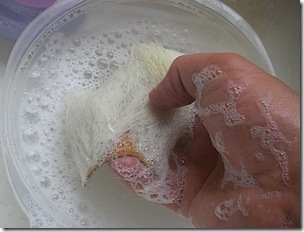
Dish Detergent and agitation

The cleaning process is identical to feathers. A little dish detergent into the soak bowl, followed by agitation to remove any dirt particles at the base of the hair.

Always handle the item by the hide. Most hair is dyed for the tips and not the underfur. Gripping the hide will allow you to feel it break up, if it’s an old hide, and will not bust up the tips which is the portion we’ll be using on completed flies.

Rinse the completed section two or three times to remove the soap. Refill the soaking bowl with clean water and return the section of hide to it.

The Fur Difference:
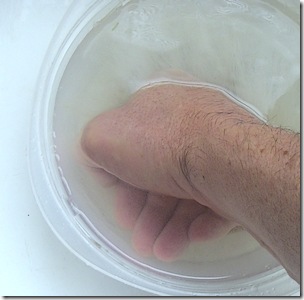
Rythmic pressing against the bowl to remove oxygen Where dyeing feathers and fur differ, is that hides trap lots of oxygen in the underfur and matted hair. All of which must be removed before we can insert the piece in the dye bath.

Arrange the section “fur side down” and press your knuckles against the back of the hide to force out the oxygen. Do not allow the piece to surface. Rhythmically press down firmly and release (leaving the piece completely submerged) until no more bubbles escape.

It’s no different than loading a sponge. By pumping the back of the hide we’re pulling in water to replace the released oxygen, super-saturating the entire piece.

We do this to ensure that when the hide is placed in the dye bath, the pigment can reach all of the fur simultaneously. If it can’t, some sections will be darker than others.
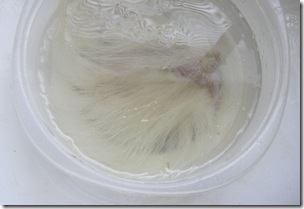
Super-Saturated, note how it no longer floats Similar to those strung saddle hackles or Marabou you buy in the store. The tops are nicely dyed Purple, or whatever color purchased, but the butts are mottled with undyed sections of white. This is a result of not supersaturating the material. The dye hit the top three-quarters of the hackle while the butts retained oxygen, preventing color from soaking into the feathery marabou at their base.

The piece above is now supersaturated, note how it remains on the bottom.

Like the feathers we’ll add the piece to the dye bath without draining it. That will allow the dye to replace the fresh water uniformly, and the piece will be the same tint in both underfur and guard hair.
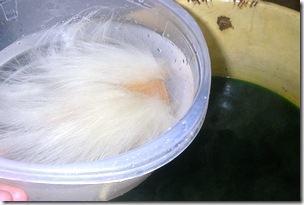
Adding to the dye without draining

At right, we’re adding the Polar bear into the dye undrained.

Chartreuse being a mixture of yellow and green, I will expect to see the material yellow immediately and the green to alter the shade over time.

Yellow is one of the rare colors that’s nearly impossible to screw up. It can be too dark or too light, but always “yellows” successfully. Because this is a new vendor and a dye I’ve not tried before, I’ll be alert to color change. If anything goes wrong the piece won’t be ruined, I can use green or yellow in flies, so there’s little risk.
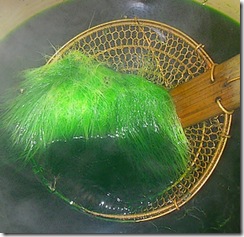
Polar_Allatonce

It’s been in the bath less than thirty seconds, yet I’ll it to measure absorption. The super-saturation is evident by all parts of the hide, underfur, and tips, are receiving color.

A bit scary to see so much green”? No.

Many complex colors are a mixture crafted to deliver pigment over time. Most would think a Chartreuse dye would be predominantly yellow, yet it’s the opposite – a Kelly Green color.

I’ve always assumed it was the absorption rate that dictated mixtures and bath color. Yellow absorbs instantly, green having to fight its way past the yellow to lay itself down. Hence the Kelly green is added to overpower yellow.

Unless it’s Rinsed it ain’t that color

Polar Bear is a unique fiber, essentially a hint of color surrounded by a transparent sheath. Like most guard hair it’s a really tough material, and will take color slower than underfur, which is similar to feathers in absorption.

Color can only be confirmed after a rinse. Like our pulling of sample feathers to check the coloration, hair must be removed and rinsed to confirm its hue – as the fibers themselves are much tougher and resistant to color absorption. 

Polar_Drained

I’ve held the piece above the bath allowing the dye to drain out. It looks like a good chartreuse (note the underfur is dyed completely down to the hide – no white “roots”).

Rinsing will determine whether I’m done.

Holding the hair so the water is going in the same direction as the grain of fur, rinse it under cold tap water while alternately squeezing until the water runs clear.
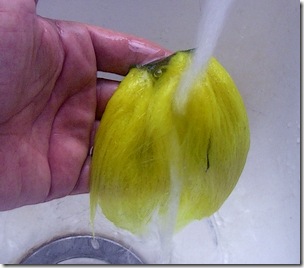
Rinse in cold water

Cold water will close the pores of the material and the steady stream of water will cease coloration.

I have a nicely dyed piece of Yellow Polar bear, the chartreuse is largely gone.

Note how all the green seen in the above slides has vanished. Also note the fur is dyed completely, all the way to the hide.

Did I screw up the dye bath? Should I add more dye, more heat, or more fixative?

The answer is found on the back of the hide. Remember, we’re dealing with a vendor unfamiliar to us, likewise with a color of his we’ve never attempted …
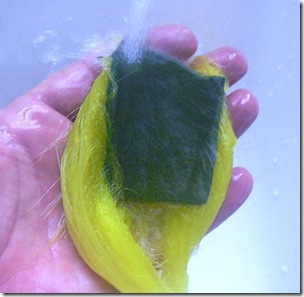
The back of the piece, and the clue

Shown at right is the back of the hide, which has the telltale clue.

The hide itself is green, not yellow. That tells us that all colors of the dye were activated properly, and the result is likely what the vendor has chosen as Chartreuse.

There is a tiny hint of green in the color (your monitor may show it differently), given the material is soaking wet I’ll dry it completely and assess the color tomorrow, when all the variables will have been eliminated.
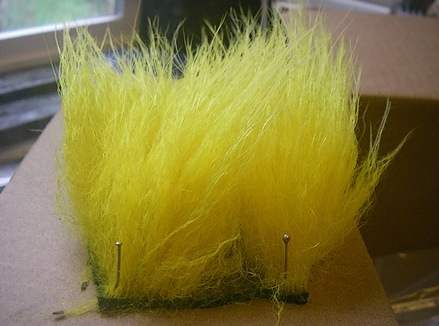
Polar bear, dyed and staked down on cardboard

Hides curl when dried – and it won’t matter whether the skin was naturally cured or tanned, it’ll roll up like a potato chip if you let it. Always tack the piece down on the corners using pins and cardboard so that it will dry evenly and remain flat.

Cardboard will wick water from the hide and assist the drying process better than wood. I’ll cut up a box and stake out all the pieces before taking them into the garage (or outside) to dry.

Note the uniformity of color in both guard hairs and underfur. No white splotches at the base, no slop.

… and the sign of success? Those nice pink fingers shown in all the illustrations above. Skin is protein, and will take the dye really well, expertise is judged by the color of your fingers – as that determines the color of your spouse’s kitchen and her precious linoleum.

Always wipe down the countertops and sink area. Dry dye powder can occasionally escape – and won’t become activated until something wet hits it. Better you to find it now than eating jaundiced Cheerios …

Tags: Chartreuse acid dye, dyeing polar bear, protein dye, dye bath, dyeing fly tying materials, marabou, strung saddle hackle, fly tying materials, fly tying

If it were a book it would be an outdoors romance

I’m browsing some learned archives of scientific phenomenon while trying to stifle a yawn, when I saw a familiar banner.

Little known LSU professor dedicates life to the sensory capabilities of fish, discovers “can’t miss” lure system that guarantees extinction of all life in fresh water and salt…”

(Proof that Scientific journals can be no better than the last few pages of Outdoor Life.)

“… scientific lure company gets wind of the amazing new discovery and purchases right to manufacture amazing fish-killing-lure-system…”

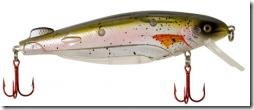
Rainbow Trout, only $33.96

That old story has been around for at least a hundred years, and the only real question is how much is it going to cost me, and must I purchase batteries separately?

Amazing scientific fish-killing systems somehow are never cheap, and I can only assume it’s the lifetime of being sequestered in lab garb that requires such a hit to the credit card.

“The take home message from this is simple: fish learn and associate particular scents as food, but taste is an actual reflex for them. The taste of particular natural chemicals triggers a feeding response.” In other words, if a fish is exposed to certain taste stimuli, it cannot control its urge to bite. Obviously, this has huge implications for the fishing industry, but the technology doesn’t stop there.

Mentioning all those modern devices like patents and intellectual property adds a certain legitimacy, which is markedly different than the many snake oil variants of the past.

… and if my lay translation is correct, a fish that eats certain things simply must eat more of them – until it lies on the bottom stuffed and immobile. Lay’s Potato chips made a similar claim with their, “you can’t just eat one” advertising, so the science appears sound …

LSU’s Office of Intellectual Property worked closely with Caprio in the early stages of his technology’s formation all the way through the licensing agreement with Mystic Tackleworks, a company dedicated to developing scientific fishing lure systems.

For a 5.5” strobe equipped minnow whose “taste” tank is filled by jamming a plasticine nozzle in its arse and squeezing, you’ll pay $33.96. As they’re sold as kits, you’ll receive:

The BioPulse™ Freshwater Medium Diver Kit includes the 5.5″ Rainbow Lure with split rings and size 2 Eagle Claw ‘Laser Sharp” hooks, one canister of Sci-X™ Freshwater Neurological Feeding Stimulant, and one bottle of BioFlush™ Anti-Microbial Cleaning Solution

In a sense I’m jealous. The only time we’ve had the luxury of science and raw marketing genius converge was for the “Frisky Fly” – the little V-shaped buzz bomb of the 1980’s. Jim Teeny made a stab at patenting the Teeny Nymph, and everyone merely hated him for it …

…probably because it wasn’t scientific.

I made an attempt to patent the “Singlebarbed Sonic Fly Fishing Fish Summoner” – but was rejected on the provisional patent as dog food and creamed corn was already under patent …

… and I had a great spiel on why you needed to punch holes in the sonic assembly with a can opener …  audio resonance being the fourth dimension and all …

Thirty-four dollars per lure is a stiff sentence. I’ll assume it’s the Freshwater Neurological Feeding Stimulant that’s the LSU Professor’s handiwork, and wait by the trash can while Mr. Inconsolable throws that away now that his $35 in part of a bridge piling …

Who knows, the anti-microbial cleaning solution might work on waders …

Full Disclosure: Never seen or fished one, no plans to fish one either.

Tags:Frisky fly, Jim Teeny, Teeny nymph, Mystic Tackleworks, Biopulse fishing system, neurological feeding stimulant, bass lures, LSU

Now you can do the honorable thing, forget it in your car

The Next Generation Something I missed from earlier this year. For 2010, the Department of Fish & Game no longer requires California anglers to have their fishing license in plain sight.
Initially it was a good idea, but the advent of licenses purchased over the Internet and printed by home computer eliminated the brightly colored paper – which allowed them to verify ownership from a distance.

Once again you can put your license in your wallet, leave that in the car, then do the “panic slap” of your pockets while the warden starts writing your ticket…

Tags: California license regulations, Department of Fish & Game, changes for 2010

The Trout of the future will prefer imitations to natural insects

I know I shouldn’t look, but I did.

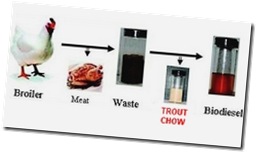
Trout_Chow There are thousands of highly trained scientists examining the diet and feeding habits of both salmon and trout. The Bad News is they’re doing so to determine whether they can be raised on Plutonium pellets, concrete, animal waste, or anything else we don’t want…

An admirable task that – but only once through the digestive tract shouldn’t be enough to diffuse weapons-grade anything.

As an interested bystander, browsing the findings of countless dietary studies on Salmonids, a couple of interesting points become clear immediately.

As the fish will be harvested at a given weight – rather than grown to full maturity, long term affects to the “crop” will be ignored.

Soybean meal has been has been used to partially replace fish meal in the diets of several fish but it is known to cause enteritis in Atlantic salmon, Salmo salar

Nice to know that in addition to being spray painted with orange dye , your fillet had the runs …

Don’t despair. There’s enough fly fishing scientists working clandestinely to improve all the trout fishing of the future. It’s the Perfect Crime, with the aquaculture industry an unwitting accomplice in building the first trout that likes artificial flies better than natural insects…

Woot. Got your attention now, did I?

The results from this study show that feather meal, poultry by-product meal, blood meal and meat and bone meal have good potential for use in rainbow trout diets at high levels of incorporation.

Fed feathers from infancy. No more pellets (which are hard to tie and float so poorly), instead our graceful trout of the future will have deeply rooted unnatural cravings for chicken feathers – and since aquaculturists are such tight wads, the secret color should be white.

I’m tying 2/0 White Millers by the bushel.

Tags: Feather Meal, blood meal, chicken feathers, farmed trout, Plutonium, pen raised, salmon, soy-induced enteritis, artificial flies, fly fishing humor