Monthly Archives: July 2009

How Yugoslavia put the adrenaline back in fly tying

I suppose some might consider it  “the fun’s back in fly tying” – but while I’m here sucking a forefinger, I don’t see it that way…

The Skalka and Knapek competition barbless hooks arrived yesterday, and with less than 24 hours before my march northward, I had to bang out as many flies as possible to have something to test.

I tested my coagulation rate thoroughly, that and my blood type…

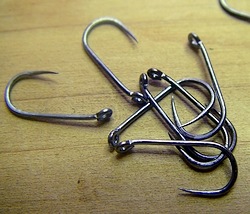
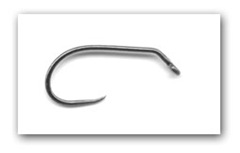
Knapek dry fly and streamer hooks are a “squarish” bend with a wicked kirbed, barbless needle for a point that seeks human flesh with neither guilt nor remorse. Lacking a barb to slow its progress through your palm or forefinger – it’s added a new dimension to fly tying…

… and that’s what I’d expect of a hook that costs nearly $0.30 each – whose attributes might separate you from kissing “Miss Colorado Flyfish” and a five digit payday.

Knapek Streamer Hook

For the first time I found myself commiserating with the prey – as I alternately nursed one fingertip after another. Materials that obscure the hook point yet need to be coaxed backwards on the shank – like hackle or chenille, invariably put those precious highly-trained, coaxing fingers into Harm’s Way. 

The pain starts to register after it’s a quarter inch in – giving you a hint you should stop applying pressure – but the follow-through is still enroute, so the second quarter inch is just a bonus. Once the point encounters the back of your fingernail it slows down some …

I’m thinking that a standard hook set would drive a #14 Humpy clean through the trout’s skull – and with a bend designed to keep the corpse attached – telling the warden, “I didn’t do it” will be a bit of a dance – what with the lifeless parr-marked corpse bobbing nearby.

Tying on these requires the vise to grip the bend of the shank and none of the point, or just the point and none of the bend. With a 10 degree offset, grabbing both point and bend will bend the wire, removing the kirbed portion and possibly weakening the wire.

knapek Dry #14 The points are fiendish, much longer and sharper than what I’m used to – and beaked, turned up to hold onto the flesh its just violated.

They adhere to traditional Redditch sizing – which I like much better than the Tiemco / Mustad standards. Both the Tiemco 100 series and the Mustad 94840 / 3906B are about 1X longer than they should be – and the Knapek are sized true like the older and shorter Partridge, “Captain Hamilton” style.

In short, I’m in love – not the sappy “chick flick” kind, more of the sinister sado-masochistic thing – and with piercing all the rage, I can wait till “Mr BB-Lip” finishes wowing the girls with his fourteen piercings, then I can recount the last thousand I endured …

I’m not so sure the Masai might not induct me as a full blood brother…

Ice Cream on tap and the Pizza Chopper hovering overhead

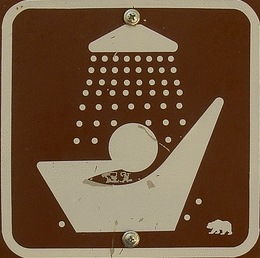
Coin activated showers Once again I’m the center of attention as co-workers dance about me in utter horror.

We’re leaving this morning for the Annual “Guys from work go fishing and talk smack about everyone else,” trip – and I’m being admonished to bring quarters for the shower…

“Shower? %$#@ That.”

While the other fellows roll their eyes skyward pantomiming the “Eww” face, I’m wondering how we got to this sordid gentrified state.

When I backpacked we’d use a handful of wild lavender for soap and go bare-arsed into the lake – and only then after being voted off the island. Grubby clothing and a weeks worth of stubble was nothing when you’re cutting your own firewood and survival was Rainbow Trout stuffed with the last handful of trail mix.

Add eight miles of dusty trail to a week without Twinkies, sprinkle in 5000 feet of elevation and we swore Rice-A-Roni was ladled by Wolfgang Puck hisself…

Older bro’s hushed whisper, “this lake has Brown Trout!” really meant, “maybe these are imbued with different natural spices” – as we’d run out of Lemon Pepper a week ago.

Now, with pavement leading up to a groomed fire pit and a trunkload of gleaming cutlery, thousand candlepower lanterns, and Gnocchi’s boiled over a gas stove – we’re back to white dinner jackets and fine china.

“Maybe some cold cuts and a little bread to make a sandwich, we’ll have been on the water for 15 hours, horse shit will look and taste good by then. Just keep the cleanup light – as once that food hits your belly – and after all that fishing, you’ll be asleep in minutes.”

They weren’t listening. They were lost in a land of pizza choppers hovering overhead delivering cases of cold beer and thick steaks.

It dawned on me that it’s the converse that’s true – and why I find so many empty discarded water bottles in the forest. It’s not how rough it is that characterizes the outdoor experience – it’s the degree you tamed the outdoors that now separates the hardcore from the casual.

Unless you’ve got ice cream on demand, you’re not an outdoorsman, unless you transform that 30X30 regulation campsite into your living room, complete with satellite TV and NFL Ticket, you’re a total outdoor wuss.

I’ve only got a couple of choices, yank the generator cord and watch them cry over all that wasted dairy, asking each other in disbelief whether it’s safe to eat pate and gruyere with mayonnaise that’s been room temperature for the last nine hours…

“Bob? *Sniff* Christ Jesus, the Grey Poupon’s been kilt!” 

… or I could just skip the shower all three days … which isn’t nearly as fatal, it only seems that way.

… um, still deciding ..

The saga of the Columbian Bounty Killers

Clint does Trash Fish I’ve always assumed it’s professional disdain – why the Fish and Game is reluctant to use anglers for eradication or thinning fish populations.

The only venture I know of; “Fistful of Pikeminnow”, and “For A Few Pikeminnow More”, suggest that the bounty program on Columbia River Pikeminnow netted 158,000 fish for 2008, with anglers pocketing nearly $1,000,000 during the fracas.

Nice lump of change for many – with nearly $500,000 dollars paid to the top 20 fishermen. That’s $25,000 each for countless days afield and a swell suntan.

It’s plain that the agencies are reluctant to go whole hog – as the jobs created by bounty-killer “infrastructure” projects would be neatly offset by the number of anglers abandoning work in favor of professional fishing – otherwise we’d see thousands of such programs nationwide.

Since 1990, more than three million northern pikeminnow have been removed through the sport reward program. As a result of these efforts, predation on juvenile salmonids is estimated to have been cut by 38 percent.

Whether you believe the numbers or not, that’s a healthy return on investment – considering the multi-million dollar fish ladders and bank restorations that achieve single digit returns.

During the same period we’ve increased our appetite for cooked salmon nearly 12% – suggesting that while we possess a certain altruistic lean, we are listening to the doctors lecture us on heart health.

The rise of the legendary angler and the skills commensurate

We always had some form of sporting literature lying around, old Field & Stream magazines or Outdoor Life that eventually would migrate enmasse to the John, where they joined “the sporting ladies” of National Geographic on their final tour before discard.

Whether it was upland game or bird hunting, there was always some story featuring a grizzled antisocial codger who had uncanny hounds, or Labrador retrievers that played outfield for a AAA club, whose noses ferreted out game via nonverbal link with master and whichever direction chaw was spat …

Duck hunters got the fellow that drank excessively, grabbed his nose, squatted, and bleated some high pitched noise via nasal resonance; “ee-bie, eenie, EE-nie” – causing birds to halt midair and dive for his blind like Stuka’s swarming Poland.

I always thought fishermen were shortchanged with all these colorful stories, we got the “snagged rubber boot” story, whose characters spoke precise English and observed semi-normal hygiene.

Some fellow living in a log cabin in West Yellowstone isn’t colorful enough, especially when he’s book-ended with wife, kids, and SUV. Relationships prove he’s mastered most of the social skills, and not the kind of hoary legend I’d pay to guide me through the woods..

Water-witching, old guys with uncanny skills, and outdoor exorcisms have been the exclusive purview of our gun-toting cousins, but all that’s changed – we’ve got our own brand of superhero …

The Worm Grunter.

Feast your eyes on Page One of Sports Afield, ladies

Little red flags mark the writhing hoards of monstrous worms ready to do their master’s bidding – thousand yard stare from three tours with the LRRP’s in ‘Nam, it’s page one material, ladies …

… and if your Yellowstone guide can’t summon clouds of mayflies, you got ripped, Pilgrim.

Unlike Bell Bottoms this kind of tacky is a good thing

It was a crash course in paraffin, beeswax, petroleum distillates, herbal additives, and tropical fruit – none of which I’d anticipated with such a mundane bit of research.

I’ve gone through three sports, two industries, and a half dozen hobbies – hoping to find something special, and found that the ignoble Beeswax remains right up there with the tackiest waxes known. I found better, but the toilet ring from the local hardware store is still among the top waxes available.

As described in an earlier post, wax usage is on the decline – limited to those geezers like myself that learned prior to the debut of specialty fly tying threads and pre-waxed nylon. In those days small thread was size “A” – and most of it came from the sewing trade.
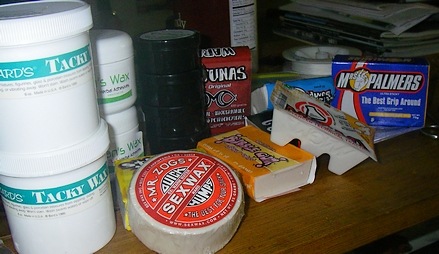
Part of the candidate pool

Desirable characteristics include being soft enough to use with materials other than thread, non-staining and colorless so it doesn’t change the material, non-oxidizing – so you can leave the cap off and the material doesn’t harden, and cheap as dirt – so you can indulge in obscene rituals without breaking the bank.

10 different surf board waxes and three different temperatures later, it’s safe to conclude that feet and flies don’t share any similarity. Surf wax is much harder and less tacky than Beeswax and is only a bit softer than candle wax. It has a light “tack” to the touch, is cheap – less than $2 per block, and is available with the best range of scents; Mango, Banana, Bubblegum – but no Nightcrawler or Salmon Egg, which would’ve tilted my research instantly.

While disappointing, it only whetted my appetite, knowing that somebody somewhere had a malleable wax with enough surface sticky to make fly tiers happy.

Casting and the mold making “lost wax” process uses a repair wax that’s soft and somewhat sticky, sold by the pound it fit only the malleable and cheap criteria.

40 Rivers mentioned bow wax, used to lubricate bow strings; it’s soft enough but it’s dual purpose – to adhere bow string filaments into a single strand and to lubricate the pulleys and gears used in modern compound bows. There’s many different kinds and was the sole industry distinguishing between sticky and tacky.

Bow strings (both crossbow and compound bows) are made from a diverse mix of fibers, including many synthetics like Dyneema. Some waxes use a mixture of wax and silicon, others use Beeswax blends designed for older bows. Silicon suggested even more possibilities, being the dominant component of liquid dry fly floatants and many common pastes. A fellow that ties mostly dry flies might want to yield some sticky in lieu of a wax with water resistance and minor floatation qualities.

Bow wax is worthy of additional study.

Magician’s use tacky wax for palming cards and other magic tricks. Like bows and surfboards, dozens of different varieties exist – each touted as stickier than most or stickiest. Small balls of this semi-transparent white wax are concealed in the magician’s palm, allowing him to press the hand against the deck and remove cards.

These waxes are perfect for traditional thread work, quite sticky to the touch and will enable a thread to load considerable fur without assistance. As the wax sticks to everything; human skin, paper, fur, beer cans, etc., and is colorless and odorless – it’s perfect for fly tying.

… I suspect it’s stolen from another industry however, and as additional candidates were delivered the Holy Grail became clearer…

Museum wax.
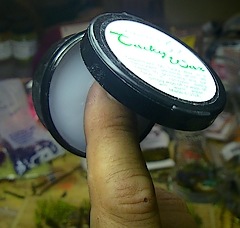
Department 56 Tacky wax, Museum quality Designed to attach precious artifacts to glass display cases without staining or adding residue. Also called “Miniature Wax” – used by those hobbyists that delight in recreating the battle of Waterloo with lead soldiers, spending months building battle scenes complete with miniature foliage and regiments of soldiers, all of which is secured to the base substrate with small balls of semi-transparent white wax.

A white wax that sticks to absolutely everything …

Department 56 “Tacky Wax” was one of two finalists. Department 56 is known for miniaturized Christmas villages and provides a complete line of miniature building materials for hobbyists. Retail is $2.50 for about 1-1.5 ounces – and can be found on eBay for less than half retail. Like all eBay items it’ll be available at many prices – some more than retail, so wait for your price to appear.
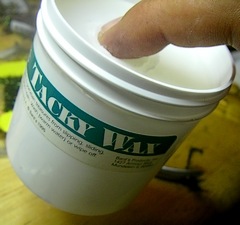
Bard's Tacky Wax, six ounces suspended by a finger Bard’s Tacky Wax is another museum grade display wax, looks identical to the Department 56 product and is extremely tacky. It’s comparable in price to the Dept 56 product, but is also available in 6 ounce tubs for about $9.50.

The picture at right shows the six ounce container suspended by the grip of the wax on my finger – plenty of tack to suit us fly tying fiends – something Beeswax was unable to reproduce …

Both are perfectly suited for fly tying. Soft and malleable allowing you to press a feather into the surface, works exceptionally well on thread (once removed from the container), and both are odorless and colorless – allowing use on white or light colored materials, and doesn’t oxidize or harden when left with the container open.

Neither are derivatives of Beeswax – as they lack the “greasy” feel at room temperature common to Overton’s and the venerable toilet ring, which are Beeswax based. Handling the wax will add “tacky” to your fingers without any apparent residue – also different than Beeswax – which adds “sticky” and visible residue.

I suspect many of the Magician’s Wax products are actually miniature wax decanted into different containers. Comforting to note that fly tying isn’t the only hobby scrounging elsewhere for materials.

I’ll decant wax from the containers and encase the ball of material in simple saran wrap, exposing half to the elements for brushing on thread, while handling the wrapped side. Simply close the wrapping around the ball when leaving on your bench so it doesn’t pick up trimmed material from the work surface.

Wax is one of those materials never made for fly tying – merely lifted from another industry and decanted into a more suitable container. Brown waxes are traditionally blends of Beeswax and other compounds, white waxes can be paraffin based or an entirely different synthetic compound.

Synthetics offer tackiness without the room temperature greasiness of Beeswax nor the slight discoloring inherent in a darker wax. If you’re dissatisfied with your current fly tying wax you might want to look into either of the above museum waxes as an alternative.
Where Elvis and the Buzzbait will reign supreme

Lake_Tahoe Steeped in controversy yet the theory is simple; if garlic and lemon makes it palatable then it escapes the invasive label. If it’s too small to barbeque it’s destined to be fought tooth and nail.
The exception being Rock Snot, which despite urging from the President’s Council on Physical Fitness, we avoid salad like the plague so there’s little mystery in why we’re determined to eradicate it.

The Jewel of the Sierra Nevada, Lake Tahoe, may soon dwarf anything on the B.A.S.S. circuit – what with it being the second deepest lake in the US, proximity to the glitz and glamour of Reno, and filled with defenseless fat Mackinaw, Rainbow, and Brown trout just waiting to serve as forage for the Largemouth Bass…

That new world record from Japan is on unsteady ground in light of this high elevation jewel and its gradually warming water – two degrees in the last seventy years, and projected to warm further in the next decade.

Likely introduced by anglers in the Tahoe Keys neighborhood of South Lake Tahoe in the early 1990s, bass and bluegill appear to be spreading throughout the lake slowly but steadily.

The fish have overrun the Keys and have been found in more than half of the marinas and lagoons sampled around the lake.

The current residents were all introduced by Man, with eradication of the native Lahontan Cutthroat following shortly thereafter, making the Largemouth and Bluegill introduction a “double negative” – halting efforts to restore the native fishery.

A cold water Largemouth is fine table fare – and other than the Elvis impersonator in the V-8 equipped “party barge” next to you, little will change other than the quarry.

A powerpoint presentation suggests that the shallow marinas offer warmer water – and further development near the lake shore assists the warming process, with portions of the lake warming as much as three more degrees, allowing for a longer growth season and approaching temperatures Largemouth find attractive.

If current warming trends persist – about 2070 we’ll be hosting some spectacular fishing.

The National Park designation isn’t going to save them

I’d like to think that the only options were Good, Bad, & Ugly – but past experience suggests there’s the occasional Divine, and a lot of Ridiculous.

I’m headed up North again next week – this time to assault some overly content Rainbow and Brown trout that assume the National Park designation means safety…

I’m facing the traditional lake fare, Calibaetis and Damselflies predominate with all the usual suspects thrown in to confuse the issue. A lot of nymphs cover the traditional mayfly activity, but I’ve got an opportunity to address damsels and test some “no hackle” dry flies – with lake fishing offering a great opportunity to see how they set and how long they’ll float.

Prototypes, scads of them – but I’ll toss out only a teaser just to whet your appetite; it’s Friday and a little mirth sets well with your exodus from work and pursuits that don’t involve ties or bagels.

Brass Gull side view

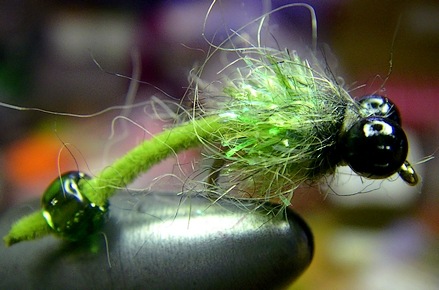
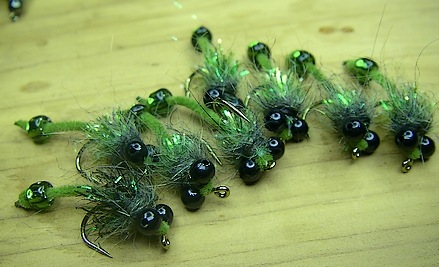
Lead free for National Park use – Brass balls ensure the fly flops over – while I ignore the hoots and giggles of the unbelievers – kirbed Scud hook to give extra hooking, topped with fur combed through Fritz to dampen the sparkle just enough …

A flock of Gulls

Tail bead is lined with silver to glow, and when I give a yank both head and tail flop – offering just enough movement to motivate that fat Federal hanging off the sunken log …

I used some of Roughfisher’s Peacock cactus chenille for the bottom variant – we’ll lump both under “ridiculous” until their field trial – the Really Good Stuff I can’t photograph – my hand shakes too much from laughing …

Raised in an artificial environment what did you expect?

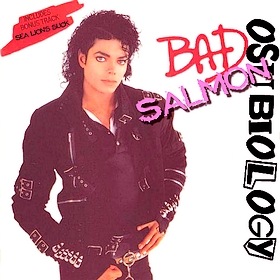
He died for your sins... Raised in a bubble with the press of humanity alert to your every move, tight security and handlers catering to your every need, with researchers and reporters combing through your trash -you’re certain to have reproductive problems.
Androgyny is the least of your worries, what with caretakers ensuring you’re fed and clothed, associations groomed to the privileged few of similar means, thrust together in some artificial world the rest of us only read about. Why wouldn’t the entire boy-girl thing gets skewed- where little boys look cute and girls are asexual … free drugs from a licensed physician, and never have to drive yourself anywhere …

I want to be a hatchery fish too …

Under those circumstances I’m surprised the scientists at Oregon State University were surprised that hatchery fish have trouble breeding  – and more importantly so do their offspring.

Fishery managers have suggested boosting the last vestiges of wild-spawning native salmon runs by crossbreeding them with relatively abundant hatchery fish.

Doing so may cause more harm than good, according to the OSU researchers.

As I’ve been keeping score their current management scenario is as follows: They’re shooting sea lion’s that eat the returning hatchery fish as there ain’t enough of them to feed us and the sea lions, but the fish they’re protecting are intermingling with the last few native fish, which undermines the reproduction of both, so:

“We have to go to greater lengths to (enhance) our ability to remove and harvest hatchery fish,” he said. “Those that aren’t harvested ought to be captured.”

… we’re going to kill all of the hatchery fish as they’re now the enemy.

It’s clear to me, kill %$#& everything, pave it, then blame our parents for the wanton despoiling of our precious fishery.

…. and that World War II thing, that was lame too …

A little scrimshaw will make that tie-dye less attractive

I had another chat with Kevin Compton the distributor for the Dohiku and Grip hook lines and was reminded to check up on our my favorite subject, competitive fly fishing.

My contention has always been that all real evolution in tackle is occurring due to the competitive angler – and us hobbyists are pretty content with the current state of rods, lines, flies, and fly fishing sundries.

Considering we’re enjoying rods and tackle whose roots are in the Space Race – competition merely showcases the trends and materials early. American manufacturers hindered by our reluctance to embrace the competition aspects probably scowl as did “Fatso” Goering, when he asked Adolf Galland what was needed to win the Battle of Britain..

“Finally, as his time ran short, he grew more amiable and asked what were the requirements for our squadrons. Moelders asked for a series of Me109’s with more powerful engines. The request was granted. ‘And you ?’ Goering turned to me. I did not hesitate long. ‘I should like an outfit of Spitfires for my group.’ “

… it must be tough on the Sage rep to walk off as the American team wave their Italian rods , but the B.A.S.S. circuit knows a sponsor when it sees one – and will be thrilled to wear the Sage decal.

Competition is by nature secretive and ever changing –  the only reason the Bassmaster’s winner divulges his secret bait is because he has to – and digging up information on contemporary competitive tackle is like pulling teeth – at best you get what worked last year.

Jiri Klima “googles” nicely –  the Czech fishing coach introduced a line of jig hooks and pre-weighted nymph forms unlike the “shrimp” style seen in past years. These are turned into Caddis jigs versus the more traditional nymph tie.

Naturally we’re clutching our chest in horror, “jigs” being the Devil’s handiwork and proof the competitive instinct is damning our sport to perdition.

I don’t see it that way.

The return of the semi-automatic, in your face

.. now that the French are using semi-automatic reels it’s time to crack out all those old Martin wind-ups, as what’s old is new again.

Makes those tie-dye Abel’s look mighty drab – but scrimshaw will do that to you. The above Vivarelli Grayling runs just a bit under $1200, with the more mundane models, made from carbon fiber, around $250.

Nope, there’s no US maker with anything similar.

Eleven foot three weights are exciting to many, but competition is having its greatest impact on hook development. The absorption of the Redditch-based Partridge by Mustad marked a low point in fly hooks, the remaining manufacturers offering little variety and nothing but established styles.

Something as simple as a nickel/chrome hook for Shad or Steelhead left only Eagle Claw’s 1197N as the sole silver hook available. Targus has added one more in the 3908T – a replacement for the traditional Mustad 3908C that was swept under the carpet with all the other “marginal” sellers.

Dohiku_Nymph_Special_HDN302 While the Clouser minnow allowed fly tiers to consider jig hooks for streamers, the Czech nymph crowd have introduced the Nymph Special, a bent shank nymph hook designed specifically for bead usage.
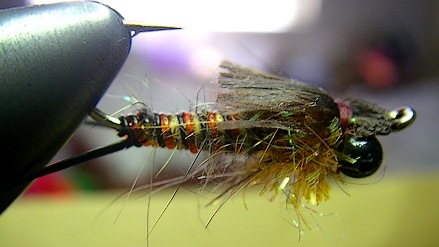
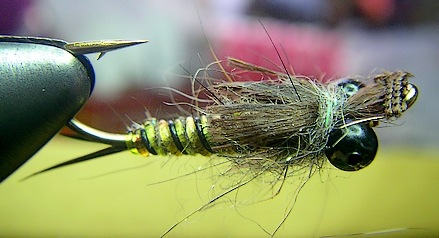
Debarbing a traditional Model Perfect bend-forged wire hook has always been problematic; forged wire is much more brittle than its round wire equivalent – and the Model Perfect bend is the poorest for purchase and retention in fish flesh.

Sproat and modified Sproat dry fly hooks in round wire replace those missing short shanked Mustad’s like the 7957B and 7948A – both considered nymph hooks yet set the standard for tying our heavy water (large fish) western dry flies like the Humpy and many others.

Seeing the reintroduction of small niche players means big dividends for the rest of us. They’ll struggle with production, temper, wire, and all the other ills of hook making – but they offer us some interesting diversity – sorely lacking on the shelves now.

The upturned beak point, kirbed points,  and elongated “spear” style looks like it’ll address many of the barbless issues we’ve had in the past. Especially those makers that yanked the barb off their standard hook with no thought to redesigning point and bend to compensate.

I’ll be testing some of the styles from Knapek, Skalka, and Dohiku, in an upcoming article – I just need to learn Yugoslav and Czech first … maybe some Japanese as well.

Oxidation suggests a little caution is warranted

It’s one of those odd-duck materials that fills a need – only the need is ill defined. It’s a warning klaxon to us life long accumulators – we’ve learned the hard way, define the need before reaching for the 6.5 lb bulk spool…

I’ve been struggling with a lucid description for days; it’s akin to the rubberized “snot” that attachs your credit card to it’s stiff paper backing when delivered in the mail. Wrenching the plastic off the paper you’re left with a long swipe of transparent rubbery slime on the back of the card which peels off as a single piece.

If that isn’t awe inspiring I’m not sure what is…

The most recognizable name is Stretch-Magic, available as a bead cord for elastic bracelets and necklaces. It’s the only reason I dared take a chance on a rubbery material – as I’m still smarting over the Latex Craze of the mid-80’s.

Stretch Magic & Stretchy - a knock off

If you remember everyone was tying latex flies; peeling the skin off of golf balls and pestering their dentist for Latex Dental Dam – thin sheets of rubbery goodness that made spectacular caddis worms…

… spectacular that season, the next year you opened your fly box to find oxidized fragments and bare hooks. Like everyone else I’d succumbed and had a drawer that looked like the bottom of the potato chip bag after someone sat on it.

I learned a hint of caution around rubbery…

Stretch Stone Amber

I dropped $2.50 to test a spool, then went to eBay to see what I should’ve paid – found a generic knockoff in Korea for $2.00 for 10 spools, in hot pink.  I banged out a dozen Shad flies which were quickly ate – and buoyed by success I scored 8 more colors from China for a total of 99¢.

Stretch Stone Yellow

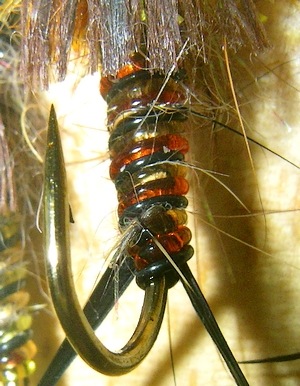
It’s available in 1mm, 0.8mm, 0.7mm, 0.6mm, and 0.5mm, and is a really tough gelatinous ribbing material. The fiber is round in shape and takes marking pen well, allowing smaller sizes to be used as rubberlegs on nymphs as well as traditional body material. (the flies shown above #8’s using 0.6mm and 0.5mm)

Close up of the body On most patterns I’ll stick a dubbing needle between coils and yank out the underbody. Slick and glassy looks great in a magazine – but I like scruffy and dirty, and have never had much luck on flies that seemed stiff and glossy.

No solid entomology to back my assertion just personal preference.

Whatever is underneath the material will influence the final result, factor the color of the underbody with the color of overlay chosen. On Shad flies I used silver tinsel to turn the body into a glowing pink, the above flies used gray dubbing as the underbody.

I’m working on solving a Damselfly dilemma for next week’s adventure, having a rubbery lifelike material appears to fit that paradigm as well – one of a number of damsel possibilities I’ve got to test.

Me fiddling with the material and it’s success on Shad does not a season make – so be cautious if you purchase some; start with small amounts of black or clear and try it on a few patterns. If it’s intact and remains supple after a year in storage, you may consider buying a few more colors.