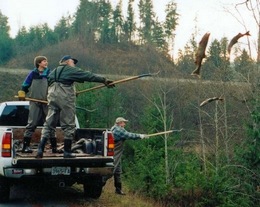
 I don’t think the government would be terribly appreciative but we may want to reintroduce the “Viking funeral” for hardcore anglers, what better way to display your devotion than, “I want to be nutrients for invertebrates.”
A lot of research has been focused at the effect of pacific salmon carcasses in West Coast fisheries, specifically the benefit performed by many thousands of tons of decaying fish distributed throughout the waterway and its banks.
Researchers have traced salmon nutrients to many
different types of organisms, from freshwater invertebrates
and fish to birds and bears and even to streamside
vegetation. These organisms take up the nutrients
by feeding directly on salmon eggs and spawnedout
carcasses, incorporated dissolved nutrients (e.g.,
algae and fungi), or feeding on other organisms that
have taken up salmon nutrients. Streams that are fertilized
by salmon nutrients are hypothesized to be more
productive than streams that receive relatively few or
no salmon.
Salmon apparently have great impact to the insect populations of their host streams, and not all of them are beneficial. Construction of spawning “redds” are destructive to to the host insects – and the density of the spawn can radically diminish insect populations in the prime gravel areas.
After two years of benthic sampling for insect production
and analysis, preliminary results show that the stream bed disturbance caused by salmon spawning activities severely impacts the insect community, reducing density and perhaps even diversity.
This affect is reversed by the decomposition of spawned salmon, and the benefits of carcasses and their debris lasts about 6 months. Researchers are able to see the effects of Carbon, Nitrogen, and Phosphorus, released by the decaying salmon, as their isotopes originated in salt water making them different than resident minerals. Streams vary in mineral richness, and some streams can get a mineral boost in excess of 30% of their historical totals.
Bilby et al. (1996) also monitored growth rates of juvenile
fish, finding that age-0-plus coho salmon exhibited a doubling in growth rate after adults spawned in the stream. In a nearby stream without spawning salmon, age-0-plus steelhead showed no change in growth rate during the winter. High growth rates can increase the overwinter survival rate, and larger smolt size has been related to increased marine survival (Bilton et al. 1982; Ward and Slaney 1988). Piorkowski (1995) qlso found that direct consumption of salmon biomass was the main avenue of nutrient uptake for salmon fry, grayling (Thymallus spp.), and rainbow trout (0. mykiss) in southcentral.Alaskan
streams.
The value of a carcass is obtained only if it isn’t flushed out of the ecosystem due to high water. Streamside debris plays a role in capturing and retaining carcasses long enough for them to be consumed by insects and terrestrial animals.
The bad news is the value to the watershed rises if more bodies are available to decay, as almost all of the Pacific salmon runs are a fraction of their historic size, this makes the host rivers less fertile than before. The implication may be that less returning fish means the rivers are able to support less insects and juveniles.
The same applies for salmon eggs and released milt. About 30% of the eggs released actually spawn, the other 70% become additional forage for anything able to ingest them.
What isn’t mentioned and might be inferred is the effect of dams on the fertility of a host river. Blocking any migration would remove the beneficial effect of carcasses and suggests the river is immediately less fertile and unable to support historic populations of insects and resident fish.
The short answer is there’s no such thing as a bad way to dispose of fish parts. Tossed onto the bank they’re forage for all manner of terrestrial wildlife and plants, and flung into the creek they’re chow for mayflies, caddis, and everything else, including next season’s fry.
Add it to your list of snappy comebacks should some bird watcher grief you over your “natural” disposal methods – as long as you don’t hit them with it – it’s all good.
 We’ve returned to the “fun” part of summer, temperatures breached 103 today, add the smoke burden and it’s about as enjoyable as you can imagine; profuse sweat, extra humidity, and air you can eat with a steak knife.
 Skipping the fishing to go straight to the catching part sounds potentially cheaper, but the virtual odds sound much too realistic to be a cost savings.
 I never thought about the perils of genetically manipulated beef, with my meager BBQ skills I usually eat briquette of “beef like substance”. Charcoal is a spice – get enough black on that haunch and the genetics are the least of your worries.
 If you’re one of the big homebuilders the ground has been coming away from underfoot for over a year – now the courts have determined all that “ground” went into the creek, and in addition to all the homes they have and can’t sell, they’re liable for the sins committed while building all that excess inventory.