Monthly Archives: April 2013

Snakes, why does it always have to be snakes …

King Solomon’s mines were no different, immense wealth hidden away by inclement terrain, protected by idol worshiping cannibals and unspeakable terrors, whose existence was part fact and part fable.

I’m thinking along these lines as I hear the Yolo County flood control officer tell me of the Central Valley’s “lost trout stream”, whose canyon a narrow scratch through waist-high tick-laden scrub, flanked by impenetrable sheets of rock whose reflective capabilities amplify the stifling heat, whose trail-less slopes offer unsteady footing for deer and the most practiced outdoorsman.

… that being the Good News …

… and while this self-same official confesses they don’t fish, they are adamant they took a family member there who caught trout just prior to being chased from the ravine by hordes of Rattlesnakes unleashed by enraged Buddhists.

Buddhists, why does it always have to be Buddhists

The thought of a splinter cell of camo-clad Buddhists gives me pause -what with Karma being the kissing cousin of an Angler’s Luck, something even the most rational, level-headed, and scientific angler will tell you is something never to trifle with

… and while I might scoff at private property, barbed wire, and enraged land owners packing weaponry, the notion of being luck-less with rod in hand suggests throwing streamers at a balky lawnmower might be as rewarding.
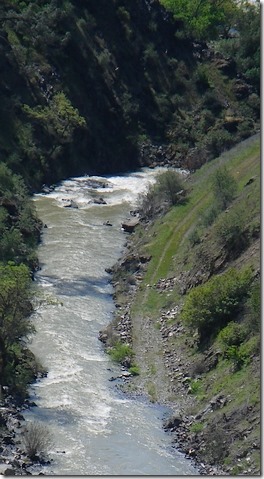
rattlesnake_creekThen there was that bothersome “infested” word she used, “… the canyon is infested with rattlesnakes …”

Which doubled my enthusiasm given that how many and how big the trout were is always proportional to the danger present, and as only headhunting cannibals can rival angry Buddhists, ticks, and snakes snapping at every exposed extremity,  means I’ve stumbled on the Lost Dutchman – the Flying Dutchman, and Noah’s Ark – all captured on the greasy folds of a hastily narrated paper map.

Given that John Muir gave no hint, Audubon was afraid to commit an image to paper, and Father Serra crossed himself and returned to the coast, the trout are likely both wild and lonesome,  especially so given their remote location and inclement surroundings. Quite possibly they’ve given up insects all together – relying on a diet of rock-scalded rabbit and white rice, perhaps even bits of human flesh, as no one that has seen the creek returned alive … except the Yolo County Flood Control employee, and since she don’t fish can’t be considered people

Committing all those directions to a hamburger wrapper and retracing that tortuous path in 4-wheel low, resulted in one long distance glimpse of my quarry from the ridgeline above. I was warned that it was too early to fish as it is still discolored by Spring runoff and three times its traditional flow.

I dubbed it Rattlesnake Creek, and while I can surely make it down without loss of life, getting back up is liable to be hellish – not to mention all those skinned extremities from rock hopping down the narrow canyon, or passing out from the heat while attempting to add waders, vests, and tackle to the mix.
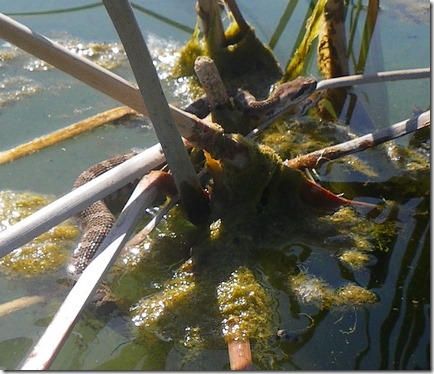
rattlesnake_swim_good… and if to make matters worse, as I stood in mid current framing a potential scenario where I might attempt the outing alone (as my fishing pals are unadventurous and complete pussies ), I had one of the rattlers that infest my Little Stinking swim up and attempt to share my waders. A reminder that they swim just fine – and even perched on a rock in midstream safety would still be an issue.

But only because Rattlesnake Creek is a trout stream, if it was full of Smallmouth, them snakes would fear the water more than my ponderous tread ..

… if it was full of Smallmouth, I’d be scared to go too …
Tying the Awkward hackle, adding artistry and function to the humdrum business of wet fly hackle

I was never at a loss as to what to call it, my only concern was whether I would call it the same thing twice or merely be content with whatever epithet I spat from clenched teeth.

A technique about as awkward as is frustrating, and while those that attempt it are not likely to mention genius in the same breath, it shows rare possibilities of extending traditional wet fly hackle into materials and styles not considered traditional.

As hackle typically covers the tie off of everything that came before it, all you need remember is the amount of “hackle” you prepare must change based on the number of turns you’ll apply, as well as the circumference of the thread you’re about to cover. As “less is more” in wet fly hackle, consider using no more than three turns total – more if using this technique to build a “Palmer” hackle or specialty hackle like a Spey fly requires.

I start with a slip of paper about 3/8” wide and three inches long, and smear a hint of tacky wax to the bottom two inches, giving me an inch to hold that is not sticky. Two inches of “awkward” hackle is about 3-4 turns of a #8 hook.

The beauty of this style is that any fiber is eligible to make a hackle flue, so you can select them based on color, texture, action, or stagger lengths so one color is short and close to the fly – and a second fiber is longer and drapes over the body.

It can also be used to “right size” feathers too big for the hook size you’re tying, as you can pull the fibers short now they’re no longer connected to a bothersome stem.

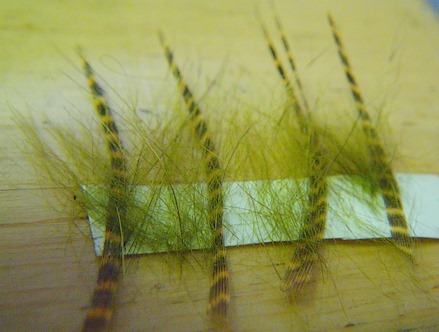
Clip a few fibers of material and press them into the tacky edge of the paper at regular intervals. Select a second, third, or fourth material and fill in the spaces with additional fibers to make your finished hackle.

In the below example, I’ve added Maple Sugar Teal flank fibers every 1/4 inch, and filled in the gaps with Olive dyed Hare’s Mask guard hair, using both feather and fur to make my hackle. The teal flank is set longer than the Hare’s Mask, which should project a few tips out past the halo of Olive fur, ensuring their color shows separate and distinct.

Teal_OliveHaresMask

Once the amount of fibers is appropriate for the hackle density, simply throw a loop of thread from the hook shank and slide the fiber side of the “hackle tape” through the loop, holding onto the top (or bottom) inch that does not have wax on it.

loop_tealOliveHares

Now grit your teeth and hold the loop closed with your left thumb and forefinger and run your scissors up between the gap of paper and thread and cut away the paper.

Now spin the mixture as quickly as you can to have the thread loop capture each fiber and lock it between the threads. If you’re not swearing yet, start – as really profane swearing can alter gravity and it’s attempt at dropping all your earlier work out of the loop and into your lap.

spun_loop

Transfer the loop to a set of hackle pliers and continue to spin the combined materials tightly. The more turns per inch on the resultant hackle the better the fibers will be anchored on the completed fly.

Awkward_Olive_Completed

Here is the completed “Awkward Olive” nymph showing the final hackle. The Maple teal was set longer than the Olive Hare’s Ear guard hair, and the regular rabbit duff found along with the guard hair was left in the final mix to offer softness and motion once wet.

Awkward_Olive_top

Here’s the same fly shown from above which allows you to see the two lengths of hackle added with a single application. The long teal fibers offer considerably more motion than usual as they are not connected to a stem, and the secondary fibers of Olive Hare’s mask pulse when wet, giving the result a compelling action unavailable in traditional hackle.

Use your imagination, add feather fibers and marabou strands, hair, deer hair fibers, any fibrous material can be used including yarn fragments and bits of tinsel. The only caution is the larger the fiber diameter the harder it is to lock tightly with thread.

Don’t be afraid to add a loop of Size “A” thread or even Kevlar thread for super coarse materials or extremely large flies including those tied Spey style. Wax the loop assist it holding the materials in place for the delicate cut that must be made.

While wax is not as popular as it once was, any tier worth his salt ignores what the crowd likes in favor of what works. It comes from too many icy winters filling fly boxes with bits of dead animal, the kind of behavior that depresses your Facebook “friend” count and neighbors looking to borrow sugar …

Dumpster diving, sloth, and the sweet song of glass

dumpster_diveIt was an involuntary wince when I felt the resistance to my pulling an armload of fishing tackle from the back of the rig. Instinctively I’d bowed like a tarpon angler whose seen his quarry come airborne on a taut line, yet the crack of rod tip impacting something in the bed as it released lacked the rattle of broken –  yet sounded violent enough to trigger a burst of self loathing and profanity.

Only a dental visit makes an angler more repentant … a dangling fly and momentary sloth meeting something damp, oversized and heavy, with a prized rod thrust into Harm’s way and an armload of supplies making its peril invisible.

I got lucky, the overly loud snap of tippet and accompanying violent reverb off the truck bed merely disrobed half a snake guide of thread, and altered the tip top from spherical into ellipse.

… which didn’t slow my swearing any, just made the muttered epithets blanket North America, rather than the World at large…

After a year reacquainting myself with fiberglass, and my renewed pleasure causing me to move numerous rods from the back of the pile to the front, I could scarce afford to start trimming their number with carelessness.

Especially since I’d made the mistake of cracking a catalog and asking myself, “what’s the latest generation of glass going for?”

A house payment, Natch … silly question.

… and whether it’s got a couple of vowels or simply a consonant preceding “glass, “ it’s alternatingly a sharp intake of breath or a headshaking giggle.

After viewing a couple of contemporary catalogs, I figured the “S” meant “Super” or “Superlative” – yet just as quickly changed to – “Stupid”, “Simple” or possibly its owner merely a “Spendthrift”.

“Sudden Chastity” being part of the Mean Old Guy mantra, as we knew a good rod lasts a lifetime and saved the old gear, only occasionally upgrading our tackle with more fashionable contemporary fodder. Naturally, once heeled we feel free to comment on others and how their manhood comes cheap …

Yet from my Ivory pedestal, as I attempted to straighten what was now a damning ellipse, I realized its source was just as damning, as this was proof of my Urban Urchin youth, the unloved pristine Fenwick Feralite, Model FF807, that I’d spied in a curbside dumpster along with a worn Mad Magazine (Issue #50).

The gay colors of the comic book cover had me teetering precariously on the lip of the dirty container, brushing aside rancid can goods, broken lathe and plaster, and with comic in one hand, spying the cork grip of someone’s failed attempt at Gentile …

I ignored the angry screams from the second floor, figuring the same spinster was likely the cause of the rod owner’s premature death, and he wouldn’t mind my repurposing his tackle – nor my thumbing nose at his spouse.

Now some thirty years distant (and suddenly blushing from snooty commentary), I find this rod proof that I was never “to the manor born” – rather I was an ardent gutter snipe angler intent on killing stuff smaller than me.

Boxers

… which is why I prefer sub-hundred dollar glass from eBay, and never turn up my nose at the creek’s bountiful offerings, including bullet riddled teapots and free shorts.

… and here I was thinking the Jigglicious video was the penultimate found thing …