Monthly Archives: September 2009

“Less is More” holds for both writing and hot weather wading

Now that the prototype has dried out I can claim that it runs in the family. Idiocy mostly, but occasionally us Singlebarbed menfolk come out of the kitchen clutching some napkin-based idea that’s been done seventeen times before yet lacks military epaulets or bondage belt buckles popularized by the late King of Pop.

My steady whining about “too damn hot” is only drowned out by Igneous Rock’s louder lament of the same issue. He has to transition from San Francisco’s steady 65° to my summertime 105° within a 45 minute drive. Despite my living here for the last decade, the combination of humidity near the water and the forced march through the Scorching Sands of Death – has the both of us looking for something better.

… cooler, actually.

I pried the “concept” vest out of his hands as soon as I laid eyes on it. I claimed “eminent domain” as the waters nearby were all mine, he countered with “blood-rite-of-Firstborn”, but I rattled a boxful of experimental flies he hadn’t seen and won temporary custody.

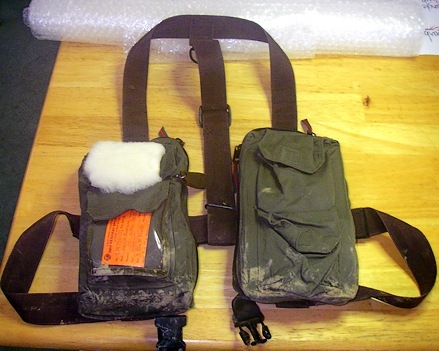
The Hot Weather vest

This is merely a concept to test construction and fabrics, but the lack of fabric sets it apart from traditional fare and diminishes the heat burden significantly. Especially the back – where the large rear pocket on a vest means a double layer of fabric – complimented by the hydration pack to make a third layer of stifling warmth.

A lot of our fishing is single-purpose. All that’s needed is a couple boxes of flies, a couple spools of tippet, and a set of nippers. Shad comes to mind – hot temperatures, wading up to your navel and only one box of flies needed. Ditto for Carp and most Bass fishing.

The complexity of fishing technology is not always in our best interest. Many products are spat out like computer software, where vendors try to find some whiz-bang gadget that sets the 2010 model apart from the 2009 version, hoping you buy both. I own one and am quite pleased with it, yet have no need for half the pockets and during shad season the bottom four inches are underwater.

All the super-secret components of the next prototype are absent so older brother doesn’t mind revealing what may become a hot-weather-shorty vest. I figure I can trade flies for a neck-level cell phone pocket – I’m always on a short tether during fire season and carry one on my local trips. It’ll double as an iPod harness for the younger crowd, many of whom prefer to drown out the tinkle of the brook with the sounds of molten metal.

… and no, the lower pocket “camouflage” pattern is entirely my doing – compliments of a tunneling muskrat and opaque water. It’ll cost me some flies when Older Bro sees his “Mona Lisa” defaced, but we’ve determined it drains quickly enough – under duress.

If I could turn it into a set of “Miami Vice” shoulder holsters it’d set the Florida flats afire …

Tinkering with these products are usually a fusion of what you do for a living with what you do for a hobby. It’s that “outside the box” thinking that births the revolutionary idea versus the evolutionary. If only a couple of the ideas planned for this harness work out  – the boys at SIMM’s are going to kick themselves …

Tags: shorty wading vest, Igneous Rock, iPod, hydration pack, hot weather vest, muskrat, SIMM’s

Lunch Hour fodder: The debut of the FishCantRead eZine

Fish Can't Read eZine I’m an unapologetic supporter of the eZine format. Hard copy is good, but eventually they are dog-eared, foodstained, crumpled, and left in the bathroom – where some non-fisherperson seizes them for a quick journey to the trash can.

I like them because the online marketplace features content and authors that don’t fit the traditional mold. With minimal startup costs editors of fly fishing eZines are less afraid to risk uncommon topics and engage unknown authors – giving us rabid angling types a chance to do something other than flip the pages.

“Fishing the [Insert Famous River Here] River” or “ Indicators for Monstrous [Insert Trophy Salmonid Name Here] have had a couple of decades – and I don’t mind seeing what the new guy is using or the water he calls home.

I’ll credit the younger crowd for the new attitude, the quickness to adopt the new medium and much of the “in your face” bravado. Occasionally it may rub us the wrong way but us older crowd need a good shaking to keep us invigorated

This is Fly and Catch come to mind – and while you may not care for every article, author, or posture – they’re bringing technology and a new viewpoint to some of our hoary old traditions – and that’s refreshing change.

Our mainstream media has inbred to the point of predictability – and with many newspapers and magazines struggling in the current economic climate, we’re quite close to realizing a largely paperless subscription model.

Today marks the debut issue of “Fish Can’t Read” the latest fly fishing eZine. and I’ll donate a lunch hour and sandwich to peruse the virgin issue despite it being not work related…

… and when the Web Gendarmes call me on the phone to rattle their manacles in my ear, I’ll respond in characteristic flavor, “… glad you boys pointed that out – stop by the cafeteria on your way up as I could use more Mustard.”

Let’s give the New Kid a warm welcome … because something about him is so very familiar …

Tags: Fishcantread.com, Fish Cant Read magazine, This is Fly, Catch, ezine, online fly fishing magazine

Singlebarbed debuts the “Sixth Finger” Scissor – Can fly tying be improved by a fellow with mud between his toes?

My childhood was interspersed with some family member saying, “Hmm” and disappearing into the basement to craft the “John Wayne Super-Sport Rubberband Gun” – allowing me to cut a swath through the opposition forces which were armed with antiquated single shot muzzleloaders.

… as Hisself was the local paperboy with access to millions of rounds of ammunition, life was good for a few short weeks until the partisans discovered rocks …

The lesson is the same, the better mousetrap exists in countless garages and only the occasional product is pursued from napkin illustration to vendor countertop. Those that make the journey can always be improved upon to accommodate new functionality the original design didn’t anticipate.

I had my “Ah-ha” moment last year while doing a little research on surgical scissors. I stumbled across a design that looked promising, bought a couple of sets to try, and liked the result but also recognized it had shortcomings.

Without a foundry and metallurgical skills, I managed to mock up a pair using wire – and that was close enough to be a proof of concept. I had something and the idea was good enough to pursue.

The Sixth Finger from Singlebarbed

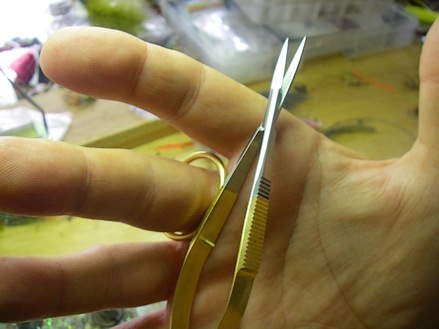
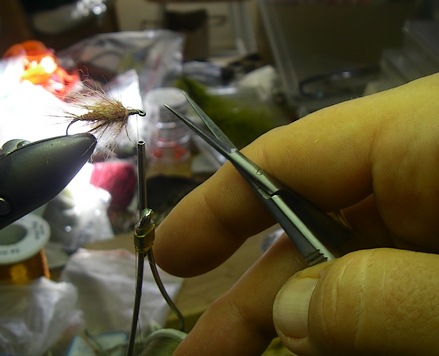
The Singlebarbed “Sixth Finger”, designed to remain in the hand for the duration of the tying session. One over-sized finger hole allows the scissor to be worn like a wedding ring – at the base of the finger and keeps the points away from your work and them precious eyeballs.

Wear them like a ring

If you watch fly tiers they fall into two groups; those that keep the scissors in their hand at all times, and those that set them down. Bulky finger holes make it more difficult to close your hand around the scissor – and can slightly restrict the use of the fingers during material preparation.

Points out of the way - and away from your eyes

Absent that extra wad of metal, the hand can close naturally around the scissor and give the fingers a full range of motion during material staging and placement.

Thumb makes the cut

Simply open your hand to make a cut, using the thumb to press on the spring-loaded handle.

These are light scissors with fine points and a finger hole designed for big hammy hands, not the smaller style common to other scissors and the embroidery trade. 4.5” inches long and made of surgical stainless steel with faux gold handles. These will work with either left or right hands.

Angling products are normally colored by Madison Avenue’s blessed action words; “revolutionary”, “extreme modulus”, “laser engraved”, “sublime action”, and “rocket-taper” … Singlebarbed would rather skip the heavy platitudes – rather we’ll let the testimony of our peers divulge just how tasty these scissors perform:

The plastic container said “tear at notch to vent” and I placed the spaghetti and meatballs in the in the microwave and pushed the start button. I was leaning against the sink and watching the table rumble around when I heard the “cla-clunk” of the mailbox lid. I opened the front door and reached into the box and found your package and returned to my lean on the sink while cutting away the clear tape. As I lifted the top of the box I was startled by a large pop and looked up to see that the top had blown off the ready-to-eat-meal and now my lunch was sticking to the ceiling of the microwave.

Luckily for me, I was holding a box full of “quilted packaging material” to assist in red sauce removal. I can’t thank you enough.
 
Oh, and the knuckle-scissors are neat too.

Even the packing material is multi-purpose – as we’ve spared no expense.

The scissors are available via Google Checkout on this site, simply click on the advertisment to initiate the purchase.
 How to Use the Sixth Finger

Most will find it completely intuitive as the scissor shape and gravity dictates most of the motion.

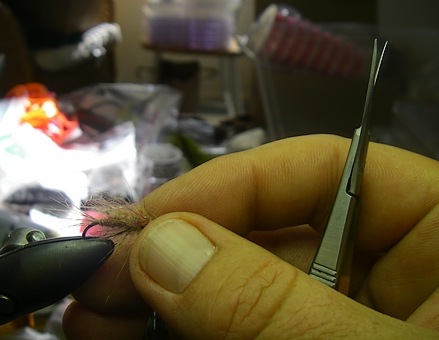
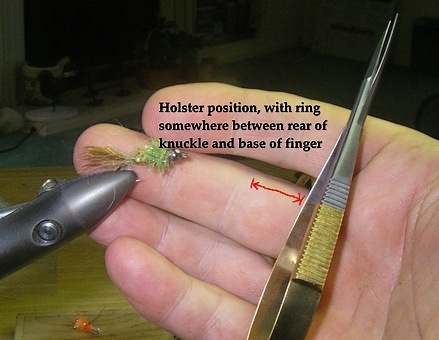
Three basic positions are used to “holster” or cut with the points. Depending on the size of your fingers most will find the holster position somewhere behind the knuckle and the base of the finger.

Scissor in holstered position

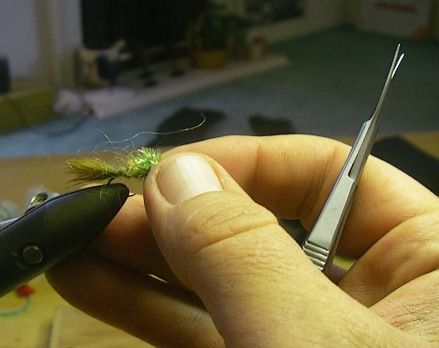
Absent that big metal second finger hole – your hand can flex naturally while positioning materials in preparation for them to be secured to the hook shank. So long as the hand is tilted upward the scissors remain out of the way.

Full range of motion for the fingers containing the scissor

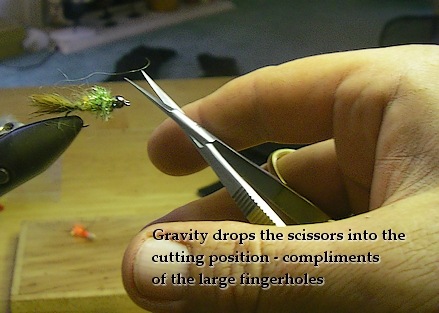
Once the materials are secured with thread just tilt the hand downward and the scissors will fall into the “cut” position. The overly large finger hole allows the scissor more motion on the finger than traditional tying tools – and accommodates larger hands – so chafing is at a minimum.

Gravity assists in reaching the cutting position

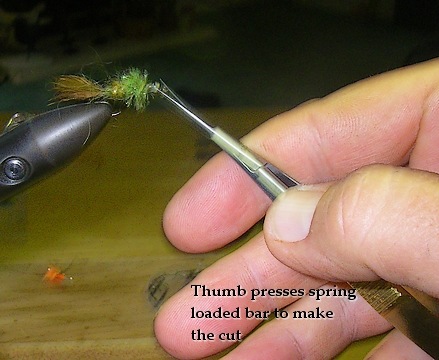
All that remains is to press your thumb against the spring loaded scissor and the cut is made. Tilt the hand and the “Sixth Finger” falls back into the holstered position.

Thumb presses spring loaded bar to make the cut

Having tied flies for thirty years and used a wide range of scissors – from four dollar specials to surgeon’s scissors, I’m personally quite thrilled at the result. Having the scissors at the ready cut an additional 30 seconds off of my tying time – compared to regular scissors – and if you’re not used to holding the scissors in your hand you should save at least a minute or two versus hunting for them in the debris at the vise base.

These are fine point – light duty; no cutting of bead chain or prying open tuna cans, heavy work is best left to larger shear-style scissors. These will cover the bulk of your cutting and should provide great service. They will not tire your hand or chafe the ring finger.

From innocent angler to state and local taxes, lawyers, patent discovery, and all the ills I’ve preached against. Not something a fellow does willingly. I suppose it’s moot testament to the rigors of paper napkins and the “better mousetrap.”

I’m counting on you seeing the difference at first use.

Dealer inquiries are welcome.

Tags: Singlebarbed scissor, sixth finger fly tying scissors, surgical stainless, fine point scissors, shameless commerce, fly tying tools, EBAY

Hoki, the other White Meat

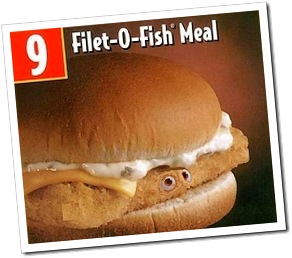
Filet of fish like substance Two years ago I introduced you to the Fillet O’ Fish sandwich – the Hoki, or Whipfish. The New York Times is reporting that this model sustainable fishery has suddenly become unsustainable compliments of McDonald’s, Long John Silver, and modern fast food.

This is one of those rare moments where anglers can take the Moral High ground – as everyone knows despite our lust to catch fish, most of us would rather have a hamburger.

My theory is you can bread and deep fry a car tire and it’ll make a suitable replacement given the volume of Tartar-saucelike-substance added. As the Hoki lives a half mile down with a lifespan of nearly 100 years – the next great whitemeat has to be Jellyfish..

… no worries, they’ll give it a catchy name.

Tags: McDonald’s Filet O’ Fish sandwich, Hoki, Whipfish, Moral High Ground, Long John Silver

Mel Krieger Dinner and Tribute

Mel Krieger Tribute Event

Thursday, September 24, 2009

MarketBar – One Ferry Building, San Francisco

6:00pm Reception, 7:30pm Dinner

Ticket Price: $150 per person or $2,000 for a table of (8)

Mel Krieger (1928-2008)

Mel Krieger is considered to be one of the top fly fishing and fly casting instructors of the twentieth century. Mel and Fanny Krieger moved to San Francisco in 1964 and soon became fixtures in the fly fishing community. Mel was a champion caster who turned to books, videos, workshops, and clinics to teach his simple techniques around the world. Mel taught thousands of pupils the art of casting, including casting champion Steve Rajeff. He was also played an important role with the Fly Fishing Federation when that organization’s Certified Casting Instructor Program was created in 1992.

Krieger has received many awards from the fly fishing community. In 1994 he was inducted into the Northern California Fly Fishing Federation Hall of Fly Fishing Fame, received the Federation’s The Order of the Lapis Lazuli award in 2006, and was presented with the American Museum of Fly Fishing’s Heritage Award in 2003.

MarketBar

The MarketBar is located at One Ferry Building in San Francisco. The MarketBar boasts a seasonal Mediterranean menu using fresh, local ingredients found in the surrounding marketplaces. For the evening’s event the MarketBar will be serving a brassiere-style dinner accompanied by wines donated by the E. & J. Gallo Winery of Healdsburg, California. Owners Doug Biederbeck and Joseph Graham are generously donating a portion of the dinner’s service to the American Museum of Fly Fishing.

For more information about the Museum and the tribute dinner honoring Mel Krieger, please contact Kim Murphy at 802-362-3300 or kmurphy@amff.com. Keep checking our website at www.amff.com for an auction preview and proxy bids.

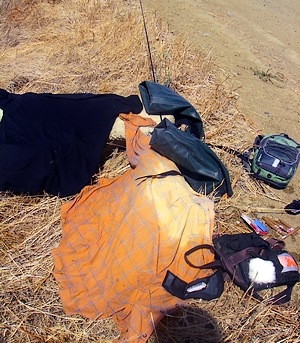
Laundry day on Sporting Creek

Seeing a muskrat sends shivers down my spine.  It’s “freshwater Taliban” whose yen for burrows and tunneling are the source of hyperextended knees, unstable footing, and cursing fishermen.

Laundry Day on Sporting Creek I’d seen a couple last week and made every effort to move slow near the waters edge – and even slower in the water, but the little bastards got me…

I’m easing into position all sneaky like – can’t see my feet due to an oil slick and brown water, and then the bottom fell out.

Ten inches of water turned into five feet of coffee colored, cigar destroying, lukewarm  goo – compliments of a Muskrat tunnel whose roof collapsed, sending me down the muddy slope into the deep end.

On the one hand it was a welcome dip on a mighty hot day – but on the other – calling it water was being generous.

The path less trodden means you skinny out of your clothing without fear. A suitable rock to park your laundry for ten minutes and let the 103° temperatures work their magic. The eye-scorching whiteness of all that exposed flab likely fried some muskrat retina – so we’re even.

I’d been thinking it was time to get out of the sun anyways – but as I was testing out a new rod and a “hot weather” vest-prototype, I had lingered a bit longer.

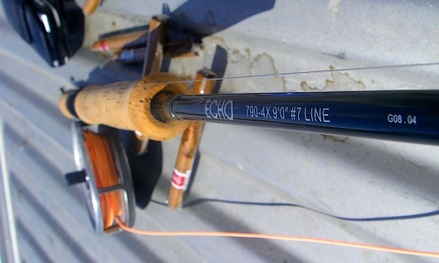
Echo Classic 9' #7, 4 piece

The above Echo Classic is what that Redington RS4 should have been. I’m becoming a huge fan of Tim Rajeff’s Echo rods – and it’s not surprising, both of us spent our youth learning from them mean old guys at the Golden Gate Angling and Casting Club.

… we share the same school of Kung fu ..

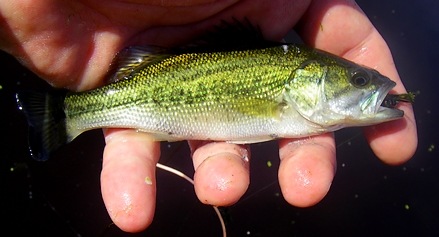
As I was “squelching” my way back to the car I located the Largemouth Bass nursery, and took out my remaining ire on stuff smaller’n me.

Sporting Creek Largemouth

These little guys were responsible for baitfish spraying out of the water like leaping frogs. I had hoped it was something bigger chasing them – my best was about five inches long.

Tags: Largemouth Bass, Muskrat, Echo Classic 790, Echo Rod Company, Redington RS4, Taliban

Some fellow is out there fishing for me

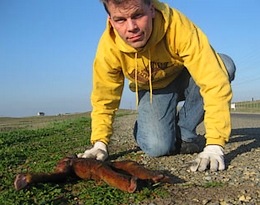
Fake roadkill prank It was a bad idea to mention road kill as “a virtually untapped source of quality fly tying materials”. It’s risky enough pulling a barely controllable broadslide in traffic – what with the risk to life and limb coupled with all the cell phone calls I interrupt …

Now some sick SOB is gunning for me. It wouldn’t be so bad if he had better taste in synthetics.

Monkey is enough to make me perk up as I whizz by – but a couple of brightly colored stiffy parrots would induce a panic stop.

Tags: Cockeyed.com, fake road kill, fly tying materials, panic stop


You owe huge

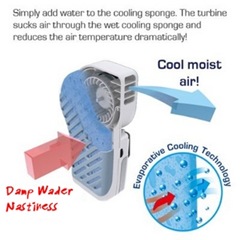
The Wader Cooler, only raises your voice by a couple octaves

Sure I’m blushing, I keep scratching chin trying to figure whether it’s an icy male “enhancement”  or whether I can mount it on the vest and pipe the exhaust down a leg.

It’s new life for the neoprene waders we’ve got stashed in the closet; what with their superior floatation, warmth in Winter, and doesn’t ship water inboard when you take a header. We were in better shape prior to “breathable” as we had to fight both current and Rubberband effect.

Half of us would toss the three-ply and return to Neoprene if we could cool the “swamp” a bit. I’d grip my personal swamp cooler between hammy cheeks and enunciate carefully so my voice didn’t crack into a falsetto…

Wader Cooler 4 AA batteries ensures five hours of continuous operation – exchanging fetid wader dampness for cool moist air.

Just clamp it firmly between your hams and try not to giggle.

Back at the campground and attached to a tent pole – it’ll restore a thin veneer of civilization to your outpost and may even make the family speak to you again.

At $44.95, that’s about 5% of the cost of the new whizbang wader – and with $5 of batteries per day, it should get you another decade on those old SIMM’s stashed in your closet.

Tags: battery operated swamp cooler, male enhancement, neoprene waders, wader cooler,

Susan’s Purse Making Caddis, ten toes on the fender

Us Anglers have always been linked with conservation issues. Often we’re the whistle blowers that link some abusive practice with its effects on riparian habitat.

Invasive species and our part in spreading them was a stiff jolt. We’ve had the luxury of being the “Good Guys” for so many years – finding out we are the cause of some malady is a bit uncomfortable.

Giving up felt soled waders may be martyrdom to some, but as the pristine environments shrink, what else are you willing to part with?

Oh yes, it’s coming to that.

Those that made the pilgrimage to Hat Creek when reopened after its makeover by CalTrout have fond memories of large fish, Green Drakes, and the Powerhouse #2 riffle lined with enormous October caddis cases.

They are all gone now and have been for many years.

We did that. All those thunderous feet chasing large fish managed to squash the October Caddis out of the areas accessible to wading anglers. Siltation from the upstream powerhouse and the occasional canal break were responsible for the demise of the Carbon Bridge Drake hatch – but all our feet in the riffle above certainly added to the silt burden downstream – we just never measured the effect.

… and like most “trophy” water – our passion for bigger fish and wild trout has always put a dent in populations – despite our intentions otherwise. Hook the same fish 34 times a year and eventually he gets his gut squeezed, hits a log when dropped, or no longer has enough integrity in his lower jaw to eat mayflies …

We mean well – we’re not bad people, it’s just a numbers game. Thousands of anglers fishing continuously over a small space alters the landscape just like grazing cattle.

… and cleated rubber soles – they will make it easier to destroy the banks – as the same entree and exit points are used by thousands of anglers season after season.

The next couple of decades are liable to make us give up a lot more than felt soles, we may even be banned from certain watersheds – or no longer permitted to wade at all.

Invasive species come to mind, but I’m thinking of the Endangered Species Act and shock of finding some of the best water denied to the Gore-Tex hordes.

This year two species of underwater insect made the Federal Endangered Species list; the meltwater lednian stonefly (Glacier Park), and Susan’s purse-making caddisfly (central Colorado: Trout Creek Spring and High Park Fen) and may result in federal protection for what small areas still contain them.

This has always been a hot issue among private land owners who are suddenly denied use of their property to protect a salamander or lily – and with our big feet stirring up sediment and squashing insects underfoot, we may have to ante-up as well.

It’s certainly an unwelcome thought, yet fascinating to contemplate.

… and while you glance down at them big feet knowing you’re innocent of all wrongdoing – how your gazelle-like dance through the fast water couldn’t possibly be doing harm. Think again. Many thousands of insect lovers you never knew existed will be gearing up to confront you in the parking lot…

… you’ll have one foot poised over the water when you feel the Taser darts bite through your vest.

Tags: meltwater lednian stonefly, susan’s purse making caddis, insect lovers, taser, hat creek, wild trout, big wading feet, CalTrout, Trophy trout, global warming, Endangered Species Act, cleated wading shoes

Wherein we apply the boots to her watery midsection

I’m on unfamiliar turf, unsure whether to be melancholy, maudlin, or go with chest thumping bravado. Guys are always conflicted that way as we aren’t allowed to “tear up” when Old Yeller gets lead out behind the barn, nor are we supposed to get melancholy when we see our home water laying there with bones exposed and buzzards her only companion.
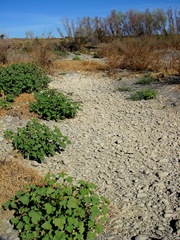
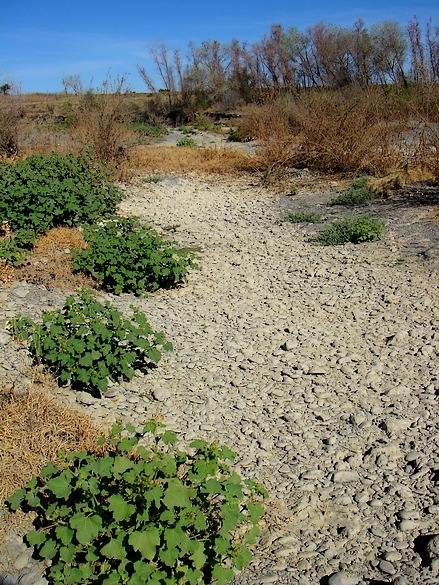
Dry as a bone

On May 9th my beloved Little Stinking had the stopper pulled and ran bone dry. A couple months ago I wandered the lower stretch and saw the only water remaining was four large beaver ponds. This morning I had the nerve to go up to the big fish stretch to see what remained – as the gauge read that water had been restored.

The creek was dead, completely dewatered and dry as a bone.

As it was early still and heat wasn’t an issue I elected to hold a wake. I’d wander down through the normal jaunt and see how deep each hole was and collect a few lost flies.

I must have made quite the spectacle as even the ATV crowd gave me a wide berth. I’m fully geared with hip boots, vest, and rod – and crunching through dry creek bed like I was expecting to fish sometime soon.

My already dubious reputation was lowered a couple of notches, I suppose I’m the “Wild Man of Crap Creek”, “tetched” in the head by too much sun. Mothers no longer wave back – they gather their kids close as I pass …
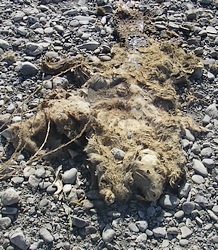
Wally, where's the Beaver? Dead and desiccated beaver were scattered near their burrows. While agile underwater they’re clumsy prey on dry land, easy pickings for coyotes or someone’s Rottweiler.

The pelts were too far gone for my road kill honed reflexes, and I left them for the buzzards.

Even the deep stretches were dry, at best with a bit of dampened mud at the bottom. No fish carcasses were evident but they would’ve been picked clean and skeletal.

It’s a complete wipe. Bugs dead, fish dead, and the wildlife in the area foraging for water as best they can. I found a couple muddy traces that had an inch of water remaining, and the volume of animal tracks nearby were moot testimony to the deer, coyotes, and birds having to make do.

It was science at this point. What happens when fish detect lowering water and the temperature rises to unacceptable? Do they slide downstream until blocked – there to die, or can they sense the calamity and migrate before the inter-pool riffles dry and block passage?

At the end of my downstream leg and after tromping nearly two miles I found the last pool of water remaining. A family of four mink (might have been otter) were swimming in four feet of of clear water in a pond I could nearly cast across.
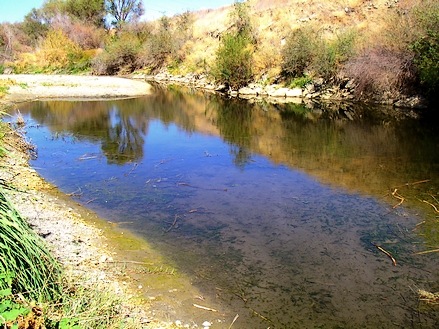
The last oasis

In the past this had been the home of all the really large smallmouth, with the far bank a deep slot nearly ten feet deep. Now it was a large swimming pool of half that depth.

I’d never seen mink on the creek – even in her final moments the Old Gal was still full of surprises. I sat on the gravel bar above and watched them swim around a bit. The water was full of fish, everything that could swim downstream had done so – now marooned by shrinking water and likely will be eaten by the four mink in residence.

Not much a fellow could do other than remember the big fish landed or lost on the same stretch.

… but Singlebarbed ethics require me to add my boot heels to the watery bitch’s midsection and I strung the rod for one last go. We’d make this an “Irish” wake and dispel melancholy with a few fingers of adrenaline.

The Little Stinking had one last surprise in store – surrendering my first Black Crappie. It was a bit bittersweet, but I’ve now landed every fish on the “Lethal Mercury – Do Not Eat” sign posted on every bridge crossing.

…most would consider it a dubious honor, but I was thrilled.
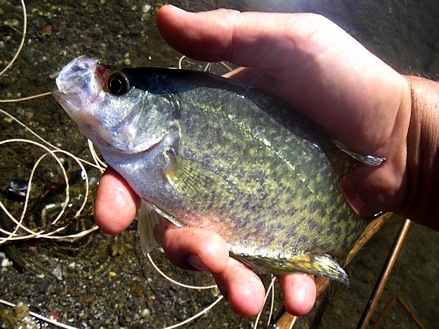
The Black Crappie

Say hello to my little friends, they’ve entertained both you and I these last couple of years …

The Sacramento Pikeminnow – the lateral line moves upward as it approaches the gill plate, about the only distinguishing feature separating it from the equally common, Sacramento Sucker.
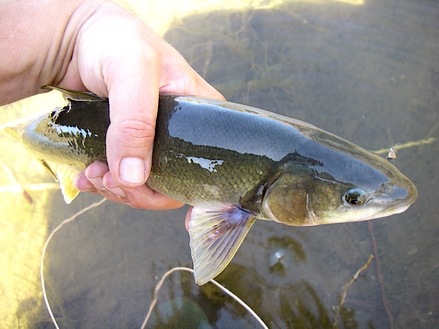
Sacramento Pikeminnow

The Hardhead – nearly indistinguishable from the Pikeminnow except in the larger sizes, where it’s entire belly becomes an orange-yellow. (whereas the pikeminnow remains white)
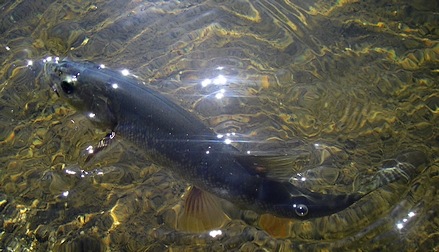
Sacramento Sucker

I landed fifty fish in about an hour; bluegill, sunfish, pikeminnow, suckers, smallmouth bass, and crappie. Each displayed its unique characteristics that I’ve memorized over time. Pikeminnow adore the large fly stripped fast (as do the suckers), and Bass love to inhale flies as they sink.

It was a great way to part company with an old friend – and while Winter’s rain will replenish the water it will take longer to refurbish the food sources and fish.

If the creek had invasives, they’ll be dead too.

I’d like to be really angry about the demise of this fishery, but it’s merely a symptom of a larger problem. Drought to be sure – as California has been suffering for the last three years, but the more painful thought is the realization that water is bought and sold for profit rather than metered for efficiency or environmental concerns.

Recently outfitted with a water meter, it’s plain that even the rural communities will be paying for water by the gallon, while the big agricultural interests resell their water back to cities for enormous profit.

Yesterday, the Hanford Sentinel broke the news that Sandridge Partners, a Westside “family farm”, was planning on selling 14,000 acre-feet of Sacramento San Joaquin Delta water a year to the Mojave Water Agency, San Bernardino County, for a mind boggling 5,500 dollars an acre-foot.
Who wants to be a millionaire? This deal will yield 77 million dollars to, wait for it, multimillionaires. Sandridge Partners is owned by the Vidovich family of Silicon Valley, who already amassed a considerable fortune turning Silicon Valley orchards into housing tracts. More recently, according to the Environmental Working Group, as detailed in an article in the San Francisco Chronicle, Sandridge Partners were the biggest 2008 recipients in the entire nation for federal subsidies for thirsty cotton, wheat, and peanuts for their farms in three San Joaquin Valley counties. Think of them as Kern County’s Welfare Kings.

(via The Trout Underground)

Equip your house with solar panels and you can resell energy back to the grid, so why aren’t you credited with money for the water you conserve?

Drinking water is fast becoming the world’s most precious commodity. While many have giggled at the crappy brown mess I fish in – they aren’t laughing when I name the communities that are drinking it – and my cigar butts.

When water reaches four bucks a gallon some type of reform will resurface the issue of salmon versus watery tomatoes – and which we want to eat for ten cents a pound more …

Until then be content that despite the iron grip of a third consecutive year of drought, California tomatoes shrugged it off with alacrity:

It’s shaping up to be a record year for California’s processing tomato contracted production with a forecast of 13.5 million tons, 13 percent above the previous record year of 1990.

Planted and harvest acres are forecast at 308,000 and 307,000, respectively, according to statistics from the U.S. Department of Agriculture. Acreage drifted from areas where there wasn’t adequate water supplies, with acreage up significantly in Kern and San Joaquin counties.

Fresno still leads the state with the most 2009 contracted production with 102,000 acres. San Joaquin County is second with 44,000 acres and Yolo County rounds out the top-3 with 34,000 acres.

… and then they sue the state because we cut back water to save a few hundred salmon.
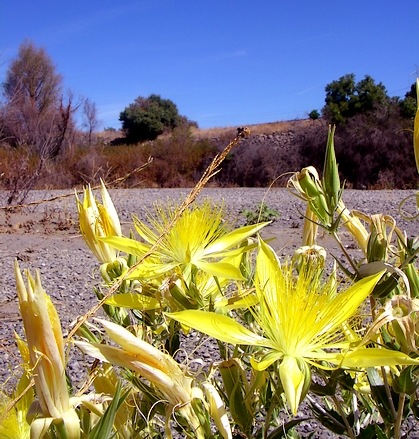
Dry creekbed and a few posies are all that's left

Something stinks, and it’s not the corpse of my creek. She smells of hot rock and a few posies … all that remains.

Tags: California tomatoes, little stinking, pikeminnow, sucker, crappie, bluegill, wake, smallmouth bass, California drought, water politics, potable water, drinking water